Coastal Features Created By Erosion
Along a coastline, there are often many features created by erosion.  The most common of these are  : Cliffs Headlands Bays  Caves Arches Stacks
Cliffs  : Cliffs are shaped through a combination of erosion & weathering. Soft rock  erodes easily  and creates  gently  sloping cliffs .  Hard rock is more resistant and  erodes slowly  and creates  steep cliffs .
 
Cliff Processes & Morphology The rate & cliff morphology depend on factors such as cliff erosion, commonly due to  marine erosion & sub-aerial erosion. Factors include:
1 .  Geological  structure &  lithology joint & fault rapid rate of  erosion
2 . Hard rock cliff basalt & granite erode slowly - produce steep high cliffs Hard rock, such as basalt, resists wave erosion creating a headland and sea stacks.
3 . Softer rock & glacial material weathered more quickly & mass  movement result in less steep slope glacial material
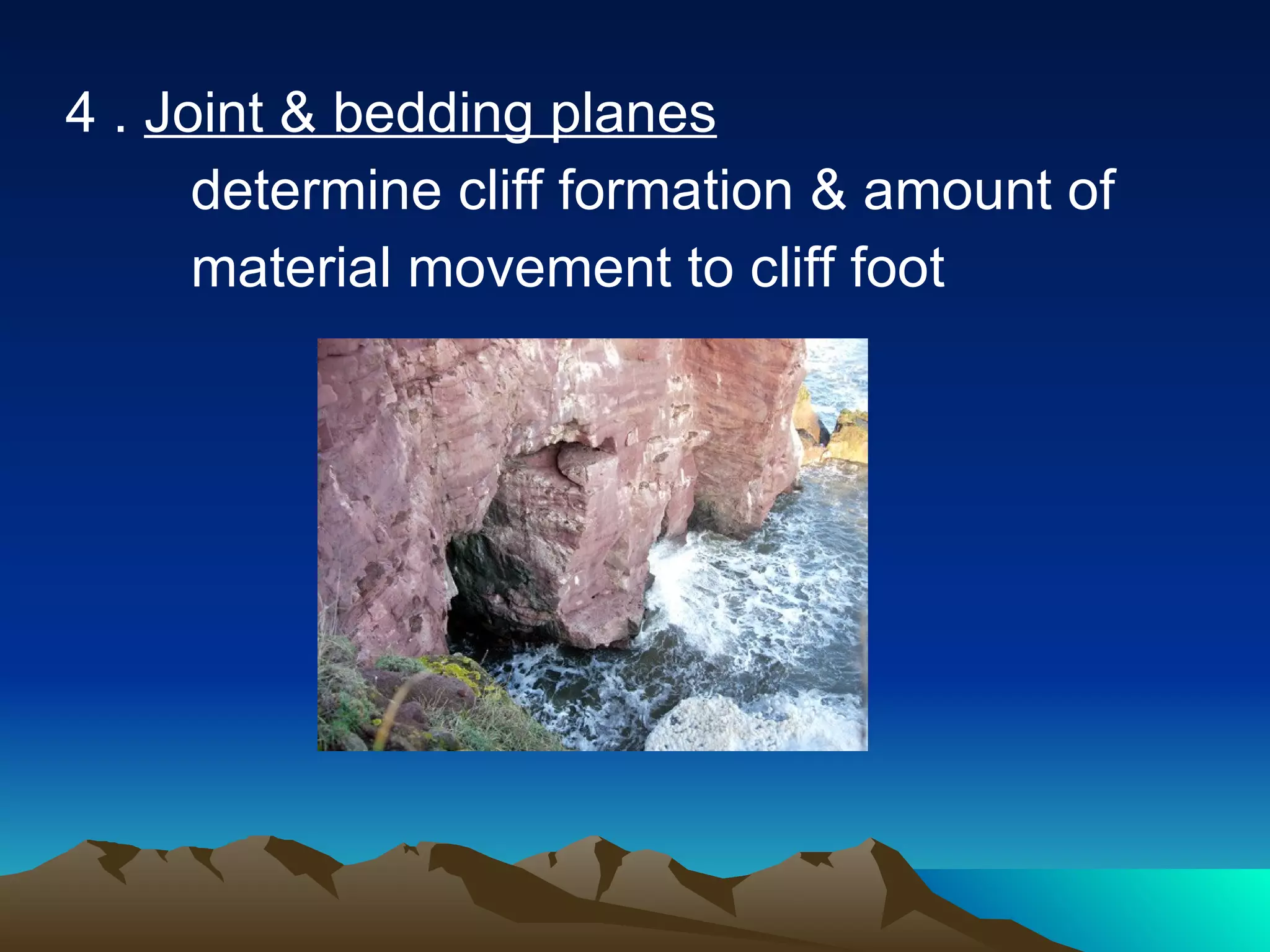
4 .  Joint & bedding planes determine cliff formation & amount of  material movement to cliff foot
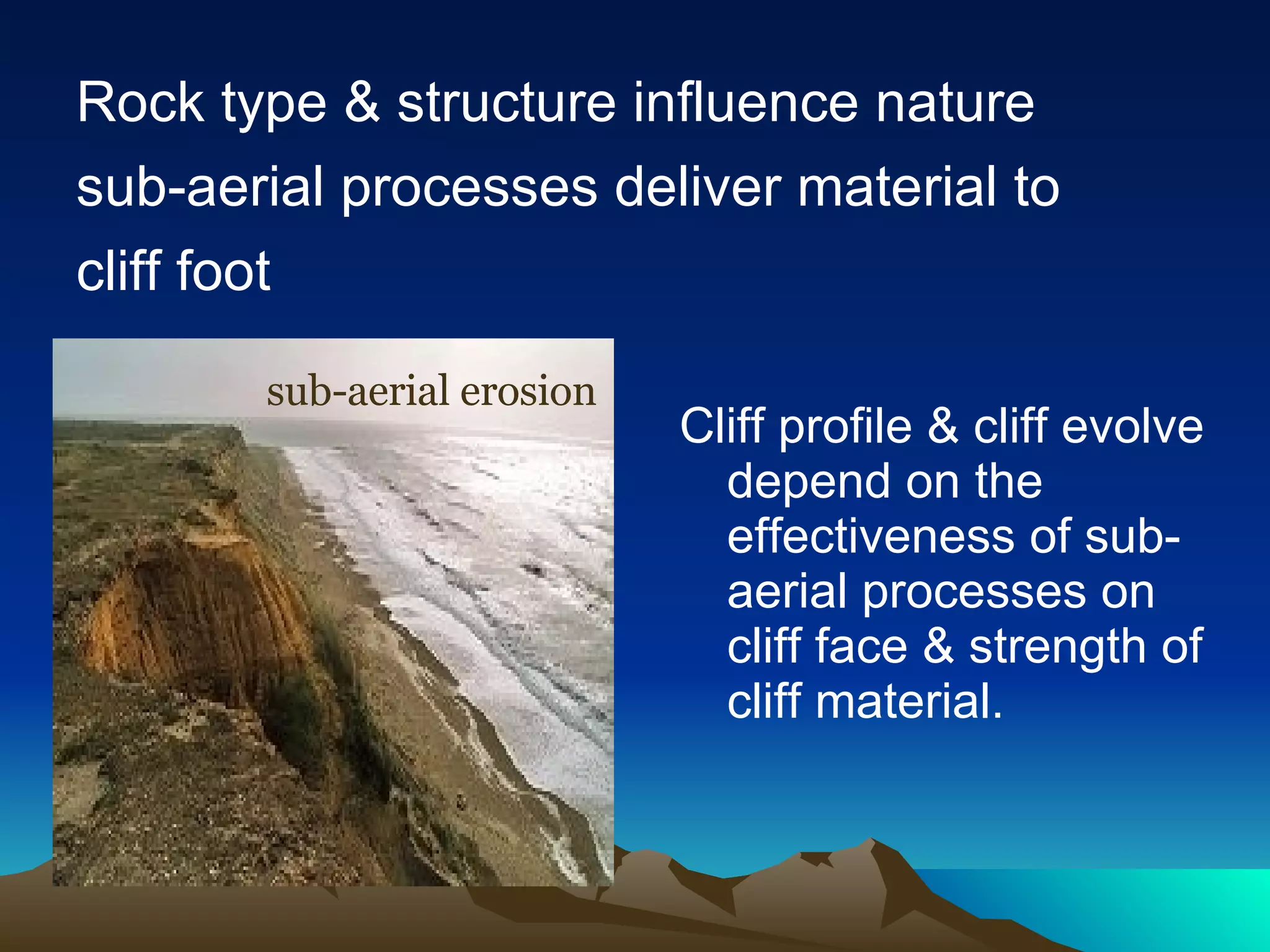
Rock type & structure influence nature  sub-aerial processes deliver material to  cliff foot sub-aerial erosion Cliff profile & cliff evolve depend on the effectiveness of sub-aerial processes on cliff face & strength of cliff material.
Hard rock & soft rock evolution are : Episodic & Cyclical: Material accumulates at the cliff foot, separated by longer periods of slower erosion, attrition and sediment transport as accumulated material  is made smaller by attrition, then removed by marine  action is itself episodic.  As the toe armour is removed the cliff base is exposed to wave action and the erosion Cycle is repeated.
Done by: Md. Sharinoriman Md.  Sharif Nancy Antas Nurazirah Hj Mohaiman Safriamizah Yayan

Coastal Features Created By Erosion Sherry

  • 1.
  • 2.
    Along a coastline,there are often many features created by erosion. The most common of these are : Cliffs Headlands Bays Caves Arches Stacks
  • 3.
    Cliffs :Cliffs are shaped through a combination of erosion & weathering. Soft rock erodes easily and creates gently sloping cliffs . Hard rock is more resistant and erodes slowly and creates steep cliffs .
  • 4.
  • 5.
    Cliff Processes &Morphology The rate & cliff morphology depend on factors such as cliff erosion, commonly due to marine erosion & sub-aerial erosion. Factors include:
  • 6.
    1 . Geological structure & lithology joint & fault rapid rate of erosion
  • 7.
    2 . Hardrock cliff basalt & granite erode slowly - produce steep high cliffs Hard rock, such as basalt, resists wave erosion creating a headland and sea stacks.
  • 8.
    3 . Softerrock & glacial material weathered more quickly & mass movement result in less steep slope glacial material
  • 9.
    4 . Joint & bedding planes determine cliff formation & amount of material movement to cliff foot
  • 10.
    Rock type &structure influence nature sub-aerial processes deliver material to cliff foot sub-aerial erosion Cliff profile & cliff evolve depend on the effectiveness of sub-aerial processes on cliff face & strength of cliff material.
  • 11.
    Hard rock &soft rock evolution are : Episodic & Cyclical: Material accumulates at the cliff foot, separated by longer periods of slower erosion, attrition and sediment transport as accumulated material is made smaller by attrition, then removed by marine action is itself episodic. As the toe armour is removed the cliff base is exposed to wave action and the erosion Cycle is repeated.
  • 12.
    Done by: Md.Sharinoriman Md. Sharif Nancy Antas Nurazirah Hj Mohaiman Safriamizah Yayan