








Sampling Techniques
Snowball Sampling & Purposive Sampling
Prepared by :
NAMA PENUH

NOMBOR MATRIK

MUHAMMAD FIQRI BIN MUSTAFFA
SARIAH BINTI MEGAT YACOB

D20111048884
D20111048844

CHRISTINA ANAK RINGGIT
SARIAH BINTI MEGAT ABDULLAH
SAIDATUL NADHRAH BINTIYACOB

D20111048850
D20111048844
D201111048855

DYGKU NURUL HAFIZAH BINTI AWG MUSTAPHA
CHRISTINA ANAK RINGGIT
MUHAMMAD FIQRI BIN MUSTAFFA

D20111048856
D20111048856
D20111048850
D20111048884

SAIDATUL NADHRAH BINTI ABDULLAH

D201111048855
Snowball Sampling
DEFINITION
Snowball sampling is a

NON-PROBABILITY sampling technique that is used by researchers to
IDENTIFY potential subjects in studies where SUBJECTS are HARD to
LOCATE.
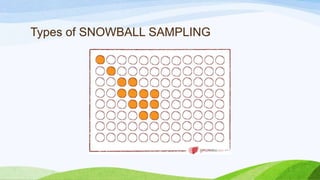
Types of SNOWBALL SAMPLING
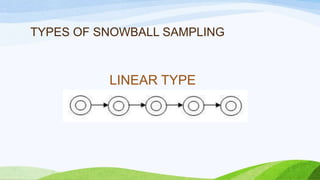
TYPES OF SNOWBALL SAMPLING

LINEAR TYPE
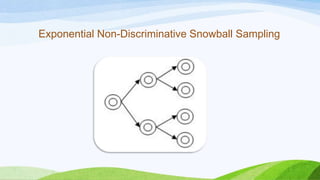
Exponential Non-Discriminative Snowball Sampling
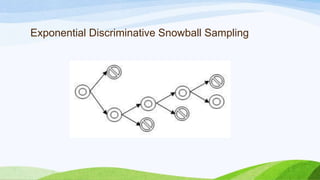
Exponential Discriminative Snowball Sampling
ADVANTAGES &
DISADVANTAGES
SNOWBALL SAMPLING
ADVANTAGES OF SNOWBALL SAMPLING
1. LOCATE HIDDEN POPULATIONS
It is possible for the surveyors to include people in the survey that they would not
have known.

2. LOCATING PEOPLE OF A SPECIFIC POPULATION
There is no lists or other obvious sources for locating members of the population
of specific interest.

3. CHEAP
The process is cheap, simple and cost-efficient. This sampling technique needs
little planning and fewer workforce compared to other sampling techniques.
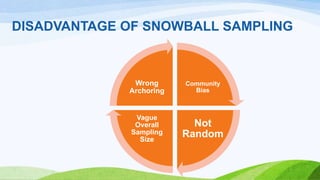
DISADVANTAGE OF SNOWBALL SAMPLING

Wrong
Archoring

Community
Bias

Vague
Overall
Sampling
Size

Not
Random
1. COMMUNITY BIAS
The first participants will have strong impact on the sample. Snowball
sampling is inexact, and can produce varied and inaccurate results. The
method is heavily reliant on the skill of the individual conducting the actual
sampling, and that individual’s ability to vertically network and find an
appropriate sample. To be successful requires previous contacts within the
target areas, and the ability to keep the information flow going throughout the
target group.

2. NOT RANDOM
Snowball sampling contradicts many of the assumptions supporting
conventional notions of random selection and representativeness. However,
Social systems are beyond researcher’s ability to recruit randomly. Snowball
sampling is inevitable in social systems.
3. VAGUE OVERALL SAMPLING SIZE
There is no way to know the total size of the overall population.

4. WRONG ARCHORING
Another disadvantage of snowball sampling is the lack of definite knowledge
as to whether or not the sample is an accurate reading of the target
population. By targeting only a few select people, it is not always indicative
of the actual trends within the result group. Identifying the appropriate person
to conduct the sampling, as well as locating the correct targets is a time
consuming process which renders the benefits only slightly outweighing the
costs.
Purposive Sampling
Definition
A type of non probability sampling where the researcher consciously selects
particular elements or subjects for addition in a study so as to make sure that the
elements will have certain characteristics pertinent to the study.

A purposive sample is a non-representative subset of some larger
population, and is constructed to serve a very specific need or purpose.

It normally targets a particular group of people.
Definition
Selection of individuals with specific characteristics.

One might:
1.Request certain individuals within a population
(e.g., ask for an adult male in the household in a
telephone survey)
Definition
Restrict the sampling to certain audiences
(e.g., select a sample from readers of Popular
Mechanics)
Specify a need for individuals with certain
characteristics (e.g., solicit with ads).
Definition
VIDEO PURPOSIVE SAMPLING
ADVANTAGES &
DISADVANTAGES
PURPOSIVE SAMPLING
• Less costly and less time consuming

• Ensures proper representation
• Prevents unnecessary and irrelevant items entering
into sample per chance

• Ensures intensive study of the selected items.
• Gives better results if the investigator is unbiased &
has the capacity of keen observation and sound
judgment.
• No equal chance for all the items of the universe being included in the
sample.
• No possibility of having any idea about the degree of accuracy
achieved in the investigation conducted
• Enough space for bias or prejudices of the investigate to play and
influence the selection.
• Not suitable for the large samples where
the size of both universe and the sample
considerably large.
• No possibility of calculating the sample
error the idea of which is based on the
mathematical concepts which are no
applicable to non random methods of
sampling.
Example of Snowball
Sampling & Purposive
Sampling
Example of Snowball Sampling
Use
Use when you do not have access to sufficient people with the
characteristics you are seeking.

Method
Find people to study.
Ask them to refer you other people who fit your study requirements,
then follow up with these new people.
Repeat this method of requesting referrals until you have studied
enough people.
Example of Snowball Sampling

Example
A researcher is studying environmental engineers but can only find five. She asks these
engineers if they know any more. They give her several further referrals, who in turn
provide additional contacts. In this way, she manages to contact sufficient engineers.
Example of Snowball Sampling

Discussion
The 'snowball' effect occurs as referrals multiply at each step. For example if you got
two referrals from each person, then starting from two people get four more, then
eight, sixteen and so on.
Snowball sampling uses a method beloved by sales people, where customer referrals
to new prospects have particular value as the relationship of trust and obligation
between the identified person and the referrer makes it more likely that the new person
will make a purchase.
The way that the sample is chosen by target people makes it liable to various forms of
bias. People tend to associate not only with people with the same study selection
characteristic but also with other characteristics. This increases the chance of
correlations being found in the study that do not apply to the generalized wider
population.
Example of Snowball Sampling

The need to get the person to give you a referral also means that the researcher has to
form a relationship with the person and be nice to them. This can change the study
results as affective biases in both the researcher and the target person change how
they think and behave.
With care in selection (you do not have to use every referral) and avoiding personal
bias, snowball sampling can still be a useful method, particularly if you have no other
way of reaching the target population.
Snowball sampling is also known as chain sampling, chain-referral sampling or referral
sampling.
Example of Purposive
Sampling
Use
Use when you want to access a particular subset of people.

Method
When taking the sample, reject people who do not fit a particular
profile.
Example of Purposive
Sampling
Example
A researcher wants to get opinions from non-working mothers. They go around an area
knocking on doors during the day when children are likely to be at school. They ask to
speak to the 'woman of the house. Their first questions are then about whether there
are children and whether the woman has a day job.
.
Example of Purposive
Sampling

Discussion
Purposive sampling starts with a purpose in mind and the sample is thus selected to
include people of interest and exclude those who do not suit the purpose.
This method is popular with newspapers and magazines which want to make a
particular point. This is also true for marketing researchers who are seeking support for
their product. They typically start with people in the street, first approaching only 'likely
suspects' and then starting with questions that reject people who do not suit.
Purposive sampling is non-probability and hence can be subject to bias and error.
Thank you 

Slide sampling presentation-latest

  • 1.
    Sampling Techniques Snowball Sampling& Purposive Sampling Prepared by : NAMA PENUH NOMBOR MATRIK MUHAMMAD FIQRI BIN MUSTAFFA SARIAH BINTI MEGAT YACOB D20111048884 D20111048844 CHRISTINA ANAK RINGGIT SARIAH BINTI MEGAT ABDULLAH SAIDATUL NADHRAH BINTIYACOB D20111048850 D20111048844 D201111048855 DYGKU NURUL HAFIZAH BINTI AWG MUSTAPHA DYGKU NURUL HAFIZAH BINTI AWG MUSTAPHA CHRISTINA ANAK RINGGIT MUHAMMAD FIQRI BIN MUSTAFFA D20111048856 D20111048856 D20111048850 D20111048884 SAIDATUL NADHRAH BINTI ABDULLAH D201111048855
  • 2.
  • 3.
    DEFINITION Snowball sampling isa NON-PROBABILITY sampling technique that is used by researchers to IDENTIFY potential subjects in studies where SUBJECTS are HARD to LOCATE.
  • 4.
  • 5.
    TYPES OF SNOWBALLSAMPLING LINEAR TYPE
  • 6.
  • 7.
  • 8.
  • 9.
    ADVANTAGES OF SNOWBALLSAMPLING 1. LOCATE HIDDEN POPULATIONS It is possible for the surveyors to include people in the survey that they would not have known. 2. LOCATING PEOPLE OF A SPECIFIC POPULATION There is no lists or other obvious sources for locating members of the population of specific interest. 3. CHEAP The process is cheap, simple and cost-efficient. This sampling technique needs little planning and fewer workforce compared to other sampling techniques.
  • 10.
    DISADVANTAGE OF SNOWBALLSAMPLING Wrong Archoring Community Bias Vague Overall Sampling Size Not Random
  • 11.
    1. COMMUNITY BIAS Thefirst participants will have strong impact on the sample. Snowball sampling is inexact, and can produce varied and inaccurate results. The method is heavily reliant on the skill of the individual conducting the actual sampling, and that individual’s ability to vertically network and find an appropriate sample. To be successful requires previous contacts within the target areas, and the ability to keep the information flow going throughout the target group. 2. NOT RANDOM Snowball sampling contradicts many of the assumptions supporting conventional notions of random selection and representativeness. However, Social systems are beyond researcher’s ability to recruit randomly. Snowball sampling is inevitable in social systems.
  • 12.
    3. VAGUE OVERALLSAMPLING SIZE There is no way to know the total size of the overall population. 4. WRONG ARCHORING Another disadvantage of snowball sampling is the lack of definite knowledge as to whether or not the sample is an accurate reading of the target population. By targeting only a few select people, it is not always indicative of the actual trends within the result group. Identifying the appropriate person to conduct the sampling, as well as locating the correct targets is a time consuming process which renders the benefits only slightly outweighing the costs.
  • 13.
  • 14.
    Definition A type ofnon probability sampling where the researcher consciously selects particular elements or subjects for addition in a study so as to make sure that the elements will have certain characteristics pertinent to the study. A purposive sample is a non-representative subset of some larger population, and is constructed to serve a very specific need or purpose. It normally targets a particular group of people.
  • 15.
    Definition Selection of individualswith specific characteristics. One might: 1.Request certain individuals within a population (e.g., ask for an adult male in the household in a telephone survey)
  • 16.
    Definition Restrict the samplingto certain audiences (e.g., select a sample from readers of Popular Mechanics) Specify a need for individuals with certain characteristics (e.g., solicit with ads).
  • 17.
  • 18.
  • 19.
    • Less costlyand less time consuming • Ensures proper representation • Prevents unnecessary and irrelevant items entering into sample per chance • Ensures intensive study of the selected items. • Gives better results if the investigator is unbiased & has the capacity of keen observation and sound judgment.
  • 20.
    • No equalchance for all the items of the universe being included in the sample. • No possibility of having any idea about the degree of accuracy achieved in the investigation conducted • Enough space for bias or prejudices of the investigate to play and influence the selection.
  • 21.
    • Not suitablefor the large samples where the size of both universe and the sample considerably large. • No possibility of calculating the sample error the idea of which is based on the mathematical concepts which are no applicable to non random methods of sampling.
  • 22.
    Example of Snowball Sampling& Purposive Sampling
  • 23.
    Example of SnowballSampling Use Use when you do not have access to sufficient people with the characteristics you are seeking. Method Find people to study. Ask them to refer you other people who fit your study requirements, then follow up with these new people. Repeat this method of requesting referrals until you have studied enough people.
  • 24.
    Example of SnowballSampling Example A researcher is studying environmental engineers but can only find five. She asks these engineers if they know any more. They give her several further referrals, who in turn provide additional contacts. In this way, she manages to contact sufficient engineers.
  • 25.
    Example of SnowballSampling Discussion The 'snowball' effect occurs as referrals multiply at each step. For example if you got two referrals from each person, then starting from two people get four more, then eight, sixteen and so on. Snowball sampling uses a method beloved by sales people, where customer referrals to new prospects have particular value as the relationship of trust and obligation between the identified person and the referrer makes it more likely that the new person will make a purchase. The way that the sample is chosen by target people makes it liable to various forms of bias. People tend to associate not only with people with the same study selection characteristic but also with other characteristics. This increases the chance of correlations being found in the study that do not apply to the generalized wider population.
  • 26.
    Example of SnowballSampling The need to get the person to give you a referral also means that the researcher has to form a relationship with the person and be nice to them. This can change the study results as affective biases in both the researcher and the target person change how they think and behave. With care in selection (you do not have to use every referral) and avoiding personal bias, snowball sampling can still be a useful method, particularly if you have no other way of reaching the target population. Snowball sampling is also known as chain sampling, chain-referral sampling or referral sampling.
  • 27.
    Example of Purposive Sampling Use Usewhen you want to access a particular subset of people. Method When taking the sample, reject people who do not fit a particular profile.
  • 28.
    Example of Purposive Sampling Example Aresearcher wants to get opinions from non-working mothers. They go around an area knocking on doors during the day when children are likely to be at school. They ask to speak to the 'woman of the house. Their first questions are then about whether there are children and whether the woman has a day job. .
  • 29.
    Example of Purposive Sampling Discussion Purposivesampling starts with a purpose in mind and the sample is thus selected to include people of interest and exclude those who do not suit the purpose. This method is popular with newspapers and magazines which want to make a particular point. This is also true for marketing researchers who are seeking support for their product. They typically start with people in the street, first approaching only 'likely suspects' and then starting with questions that reject people who do not suit. Purposive sampling is non-probability and hence can be subject to bias and error.
  • 30.