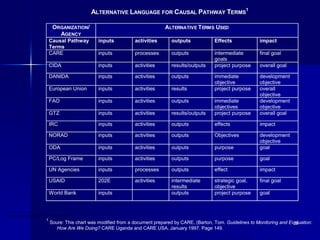
The document provides an overview of program design, monitoring and evaluation. It discusses conducting needs assessments to understand community needs and priorities. It also covers developing a causal pathway framework to link program activities, outputs, and outcomes. Monitoring and evaluation are presented as important parts of the process to determine what is working and how programs can be improved.
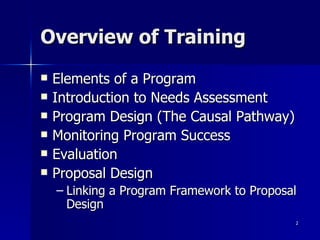
Overview of TrainingElements of a Program Introduction to Needs Assessment Program Design (The Causal Pathway) Monitoring Program Success Evaluation Proposal Design Linking a Program Framework to Proposal Design
3.
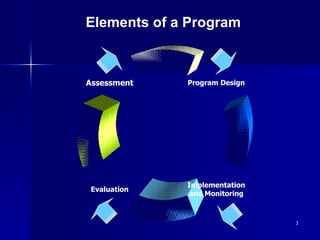
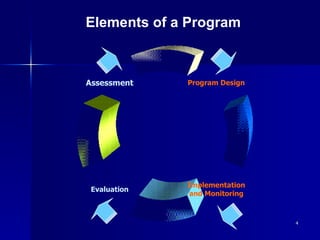
Elements of aProgram Implementation and Monitoring Assessment Program Design Evaluation
4.
Elements of aProgram Implementation and Monitoring Assessment Program Design Evaluation
5.
Needs Assessment BasicsWhy conduct a needs assessment? To learn what a group or community sees as the most important needs To understand the environment in which you will be working To prioritize what you may be able to do with your group or community
6.
Needs Assessment BasicsWhat is a needs assessment survey? Some general characteristics: Have pre-set list of questions to be answered Have pre-determined sample size for the number and types of people to be surveyed Should be PARTICPATORY
7.
Phases of NeedsAssessment Phase 1: Brainstorm Why am I doing this? What are my goals in conducting the survey? Am I ready to do this? Brainstorm
8.
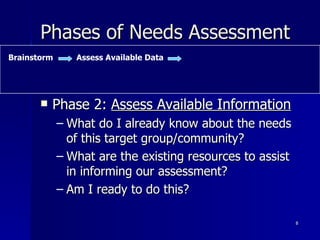
Phases of NeedsAssessment Phase 2: Assess Available Information What do I already know about the needs of this target group/community? What are the existing resources to assist in informing our assessment? Am I ready to do this? Brainstorm Assess Available Data
9.
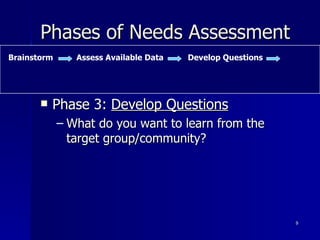
Phases of NeedsAssessment Phase 3: Develop Questions What do you want to learn from the target group/community? Brainstorm Assess Available Data Develop Questions
10.
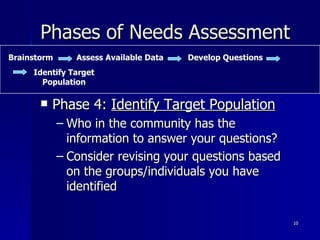
Phases of NeedsAssessment Phase 4: Identify Target Population Who in the community has the information to answer your questions? Consider revising your questions based on the groups/individuals you have identified Brainstorm Assess Available Data Develop Questions Identify Target Population
11.
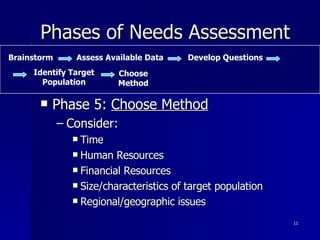
Phases of NeedsAssessment Phase 5: Choose Method Consider: Time Human Resources Financial Resources Size/characteristics of target population Regional/geographic issues Brainstorm Assess Available Data Develop Questions Identify Target Population Choose Method
12.
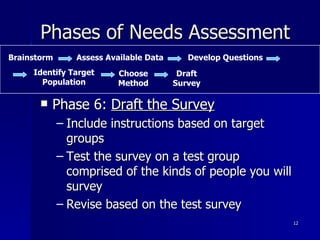
Phases of NeedsAssessment Phase 6: Draft the Survey Include instructions based on target groups Test the survey on a test group comprised of the kinds of people you will survey Revise based on the test survey Brainstorm Assess Available Data Develop Questions Identify Target Population Choose Method Draft Survey
13.
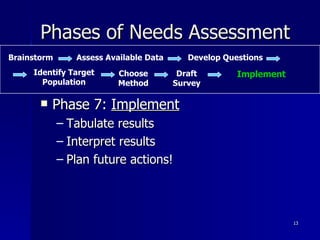
Phases of NeedsAssessment Phase 7: Implement Tabulate results Interpret results Plan future actions! Brainstorm Assess Available Data Develop Questions Identify Target Population Choose Method Draft Survey Implement
14.
Needs Assessment ToolsThere are many ways to Engage a community in assessing its needs… Focus Groups Community Forums Individual Interviews Surveys Community Resource Inventories
15.
Needs Assessment ToolsFocus Groups Guided group discussion of 6 to 12 individuals from similar backgrounds with a skilled moderator and, if possible, a recorder. Moderator guides the group into increasing levels of focus on key issues. Time: 1.5 – 2 hours each Expertise: Moderate Cost: Low
16.
Needs Assessment ToolsCommunity Forums A series of public meetings to involve the community in defining and discussing needs. They are less formal than focus groups and open to the public. Time: 2 – 4 hours each Expertise: Low Cost: Low
17.
Needs Assessment ToolsIndividual Interviews One-on-one interviews with individuals who represent the target population or have extensive knowledge or experience. A skilled interviewer asks specific and open-ended questions to obtain information about needs. Respondents can express their understanding openly and freely. Time: Not more than 1 hour per meeting Expertise: Moderate Cost: Low
18.
Needs Assessment ToolsSurveys Generally three kinds: face-to-face, telephone and mailed (emailed). Time: Not more than 45 minutes to 1 hour to complete Expertise: High Cost: High
19.
Needs Assessment ToolsCommunity Resource Inventories A means of data collection that usually results from a survey of service providers, which yields a listing or summary of information about activities and services provided by organizations and agencies in a defined geographic area. Time: Not more than 1 hour to complete Expertise: Moderate Cost: Moderate
Program Design Somequick Definitions: Cause : Pathway : The Causal Pathway : A framework for designing a program with clearly defined inputs, activities and outcomes.
22.
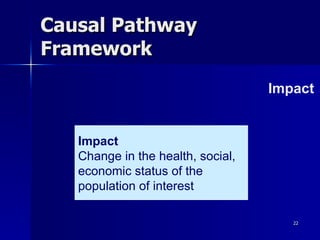
Causal Pathway FrameworkImpact Impact Change in the health, social, economic status of the population of interest
23.
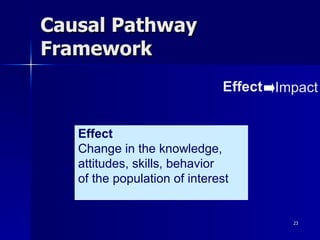
Causal Pathway FrameworkImpact Effect Effect Change in the knowledge, attitudes, skills, behavior of the population of interest
24.
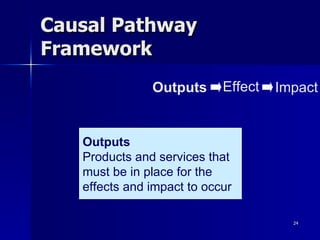
Causal Pathway FrameworkImpact Effect Outputs Outputs Products and services that must be in place for the effects and impact to occur
25.
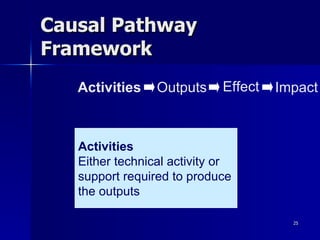
Causal Pathway FrameworkImpact Effect Outputs Activities Activities Either technical activity or support required to produce the outputs
26.
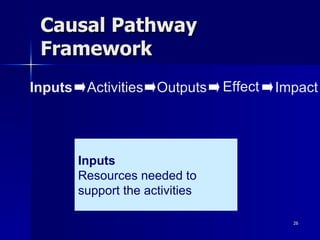
Causal Pathway FrameworkImpact Effect Outputs Activities Inputs Inputs Resources needed to support the activities
27.
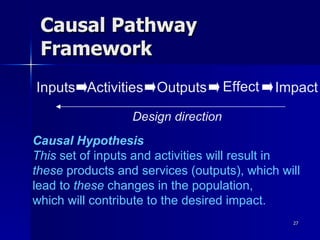
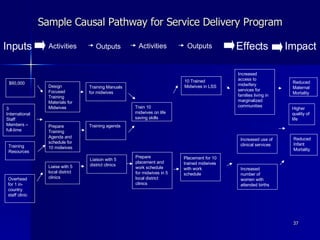
Causal Pathway FrameworkImpact Effect Outputs Activities Inputs Design direction Causal Hypothesis This set of inputs and activities will result in these products and services (outputs), which will lead to these changes in the population, which will contribute to the desired impact.
28.
29.
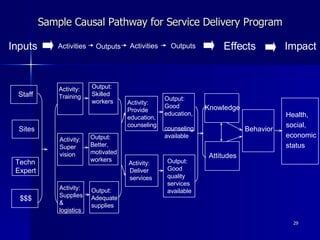
Sample Causal Pathwayfor Service Delivery Program Impact Effects Activities Inputs Outputs Activities Outputs Health, social, economic status Knowledge Attitudes Behavior Activity: Deliver services Output: Good quality services available Activity: Provide education, counseling Output: Good education, counseling available Activity: Supplies & logistics Output: Adequate supplies Activity: Training Output: Skilled workers Activity: Super vision Output: Better, motivated workers Staff Sites $$$ Techn Expert
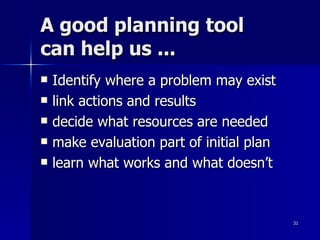
A good planningtool can help us ... Identify where a problem may exist link actions and results decide what resources are needed make evaluation part of initial plan learn what works and what doesn’t
32.
Program Design: Key Issues USAID/Vietnam Informal Training January, 2004
33.
Before you considerMonitoring and Evaluating… Some basic pre-implementation steps: Q: Are the outputs, effects and impact easily measurable ? Q: Are the key beneficiaries and cooperating partners clearly identified ? Q: Are there sufficient funds and political support and/or commitment from relevant parties for this program?
34.
Before you considerImplementing… Crucial Questions: Q: How will the program build capacity among its beneficiaries? Q: What are the program’s sustainability and exit strategies ? Q: What are the risks and what steps will be taken to monitor and minimize risks?
35.
Before you considerImplementing… Additional Factors: Policy Support Measures Participation of Local Stakeholders Gender Issues Management Capacity Environmental Issues Economic and Financial Issues
Sample Causal Pathwayfor Service Delivery Program Impact Effects Activities Inputs Outputs Activities Outputs $60,000 3 International Staff Members – full-time Training Resources Overhead for 1 in-country staff clinic Design Focused Training Materials for Midwives Prepare Training Agenda and schedule for 10 midwives Training Manuals for midwives Training agenda Train 10 midwives on life saving skills Prepare placement and work schedule for midwives in 5 local district clinics 10 Trained Midwives in LSS Liaise with 5 local district clinics Increased access to midwifery services for families living in marginalized communities Increased use of clinical services Increased number of women with attended births Liaison with 5 district clinics Placement for 10 trained midwives with work schedule Reduced Maternal Mortality Reduced Infant Mortality Higher quality of life
38.
The Causal Pathway: Monitoring and Evaluation USAID/Vietnam Informal Training January, 2004
39.
Monitoring and EvaluationWhat is it? Monitoring and evaluation is the process through which we gain information about the activities and achievements of programs, in order to make decisions to improve them.
40.
Monitoring and Evaluation:Why Do It? Did we do what we said we were going to do? Did we achieve what we said we would achieve? Also ... Was the project design sound? How can it be improved? Did our project cause the observed change?
41.
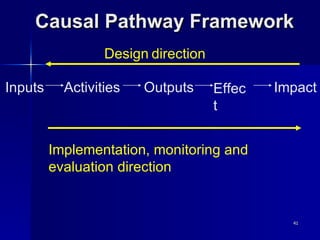
Causal Pathway FrameworkImpact Effect Outputs Activities Inputs Design direction Implementation, monitoring and evaluation direction
42.
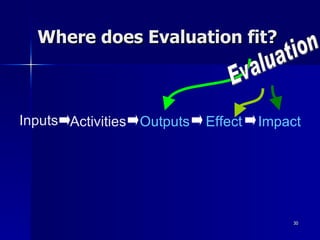
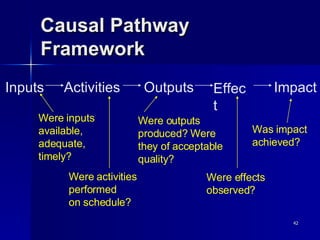
Causal Pathway FrameworkImpact Effect Outputs Activities Inputs Were inputs available, adequate, timely? Were activities performed on schedule? Were outputs produced? Were they of acceptable quality? Were effects observed? Was impact achieved?
43.
Measurement How dowe know if these steps occurred? We measure them, using … Indicators
44.
Where measurement fallsshort…. Programs often measure processes, rather than impact, effects, or even outputs! Example: # of trainings conducted Why is this insufficient in telling us how well a program has succeeded?
45.
Measuring Outputs OutputIndicators measure products and services provided by the program, and the quality of these products and services
46.
Formulation of anIndicator Output indicator: [# of] or [ % of planned] [specific activities / products / services] that [have been carried out / achieved] [to acceptable / expected standard of quality]
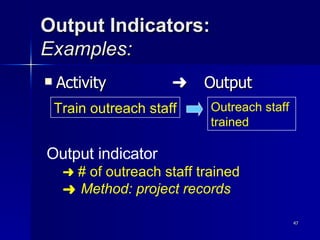
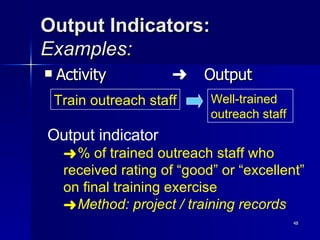
Output Indicators: Examples: Activity Output Output indicator % of trained outreach staff who received rating of “good” or “excellent” on final training exercise Method: project / training records Train outreach staff Well-trained outreach staff
49.
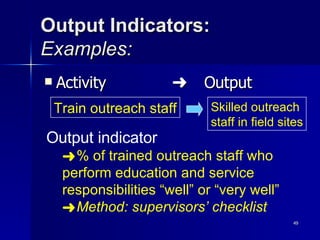
Output Indicators: Examples: Activity Output Output indicator % of trained outreach staff who perform education and service responsibilities “well” or “very well” Method: supervisors’ checklist Train outreach staff Skilled outreach staff in field sites
50.
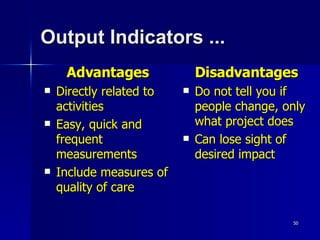
Output Indicators ...Advantages Directly related to activities Easy, quick and frequent measurements Include measures of quality of care Disadvantages Do not tell you if people change, only what project does Can lose sight of desired impact
51.
Measuring Effects EffectIndicators measure the level of knowledge, attitudes, skills, intentions and behaviors of the population of interest
52.
Formulation of anIndicator Effect indicator: [% or #] of [group members] who [know / believe / can / do] [specific knowledge/attitude/skill/behavior]
53.
Formulation of anIndicator Effect indicator: Example % of adolescents with disabilities aged 12-18 with adequate skills for employment in a chosen vocation Method: Observation of skills, with scoring guide
54.
Effect Indicators … Advantages Show changes in people Often an adequate endpoint if causal pathway is strong Disadvantages Do not tell you if status has changed Do not tell you what caused the change (problem of attribution) Data can be difficult and expensive to obtain (if population-based)
Formulation of anIndicator Impact indicator: usually a rate or ratio disability employment rate fertility rate rate of children born with disabilities HIV Prevalence Empowerment rate ??? Method: population-based
57.
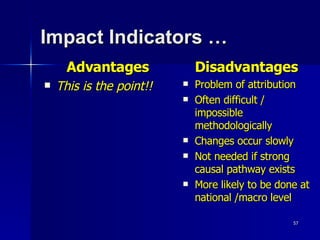
Impact Indicators … Advantages This is the point!! Disadvantages Problem of attribution Often difficult / impossible methodologically Changes occur slowly Not needed if strong causal pathway exists More likely to be done at national /macro level
58.
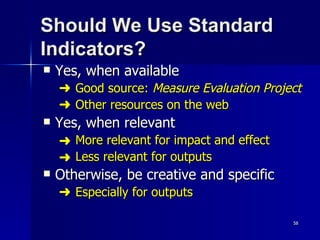
Should We UseStandard Indicators? Yes, when available Good source: Measure Evaluation Project Other resources on the web Yes, when relevant More relevant for impact and effect Less relevant for outputs Otherwise, be creative and specific Especially for outputs
59.
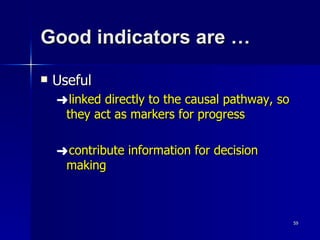
Good indicators are… Useful linked directly to the causal pathway, so they act as markers for progress contribute information for decision making
60.
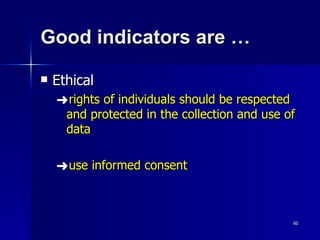
Good indicators are… Ethical rights of individuals should be respected and protected in the collection and use of data use informed consent
61.
Good indicators are… Scientifically robust valid reliable sensitive specific
62.
Good indicators are… Accessible must be able to measure easily choose appropriate data collection method
63.
Data Collection MethodsUsually quantitative: Project records, service statistics Observation (with standardized checklist) Mini-surveys / exit interviews Community-based KAP surveys Census Special studies: biological data, chart or record review Others
64.
Choose Indicators foryour Project Causal Pathway that ... are well-formulated include measures of output quality link directly to the pathway measure important causal links throughout the pathway rely on a variety of data collection methods KISS (Keep It Short and Simple)
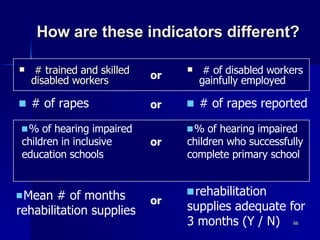
How are theseindicators different? # trained and skilled disabled workers # of rapes % of hearing impaired children in inclusive education schools Mean # of months rehabilitation supplies # of disabled workers gainfully employed or or # of rapes reported % of hearing impaired children who successfully complete primary school or rehabilitation supplies adequate for 3 months (Y / N) or
67.
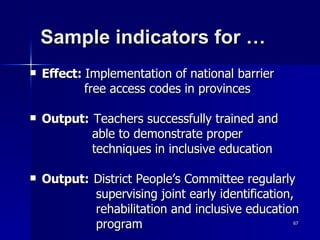
Sample indicators for… Effect: Implementation of national barrier free access codes in provinces Output: Teachers successfully trained and able to demonstrate proper techniques in inclusive education Output: District People’s Committee regularly supervising joint early identification, rehabilitation and inclusive education program
68.
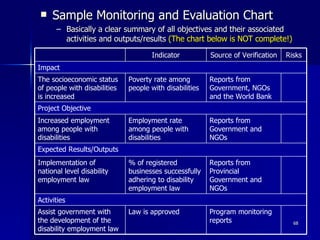
Sample Monitoring andEvaluation Chart Basically a clear summary of all objectives and their associated activities and outputs/results (The chart below is NOT complete!) Activities Reports from Provincial Government and NGOs % of registered businesses successfully adhering to disability employment law Implementation of national level disability employment law Reports from Government and NGOs Employment rate among people with disabilities Increased employment among people with disabilities Reports from Government, NGOs and the World Bank Poverty rate among people with disabilities The socioeconomic status of people with disabilities is increased Program monitoring reports Law is approved Assist government with the development of the disability employment law Expected Results/Outputs Project Objective Impact Risks Source of Verification Indicator
69.
Other Resources UnderstandingImpact Evaluation http://www.worldbank.org/poverty/impact/index.htm Online Evaluation Resource Library http://oerl.sri.com/
70.
Program Design: Exercise 2: Designing Indicators for your Causal Pathway
Program Evaluation Thisintroduction to Evaluation is designed for staff who assist in program design. Following are some general principles and issues that are important to consider in the program design phase.
73.
Program Evaluation Whatis an Evaluation? Evaluation should be an integral part of the development of a program. It should: Identify, during the life of a program, strengths, weaknesses and relevance to the overall objectives Assess the program impact on the lives of local community members Apply the lessons learned to additional program planning.
74.
Evaluation planning shouldbegin during the design phase of a program Programs that have vague or unclear goals tend to produce unclear and unfocused evaluations Program Evaluation
75.
Program Evaluation A“Good Evaluation” will: Raise new questions and fresh ideas Suggest different ways of looking at outcomes
76.
Some Key FocalAreas for a Program Evaluation include…. Capacity Building Sustainability Cost-effectiveness Relevance to needs of target population Coverage Replicability Gender
77.
Remember… Evaluation shouldalways be undertaken in the spirit of “valuing” a program. Evaluation aims to improve , not to criticize .
78.
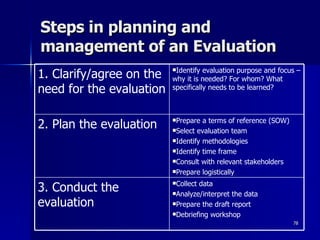
Steps in planningand management of an Evaluation Collect data Analyze/interpret the data Prepare the draft report Debriefing workshop 3. Conduct the evaluation Prepare a terms of reference (SOW) Select evaluation team Identify methodologies Identify time frame Consult with relevant stakeholders Prepare logistically 2. Plan the evaluation Identify evaluation purpose and focus – why it is needed? For whom? What specifically needs to be learned? 1. Clarify/agree on the need for the evaluation
79.
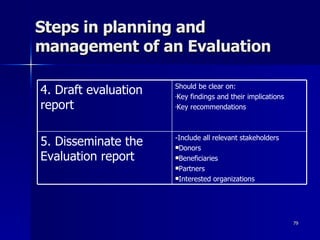
Steps in planningand management of an Evaluation -Include all relevant stakeholders Donors Beneficiaries Partners Interested organizations 5. Disseminate the Evaluation report Should be clear on: Key findings and their implications Key recommendations 4. Draft evaluation report
80.
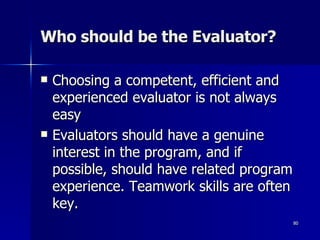
Who should bethe Evaluator? Choosing a competent, efficient and experienced evaluator is not always easy Evaluators should have a genuine interest in the program, and if possible, should have related program experience. Teamwork skills are often key.
81.
Internal vs. ExternalEvaluations Internal and external evaluations are not always mutually exclusive Your organization may wish to conduct both over the course of your program implementation
82.
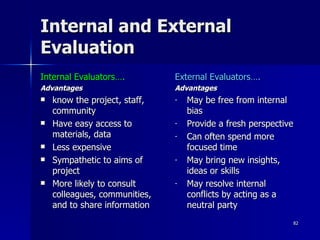
Internal and ExternalEvaluation Internal Evaluators…. Advantages know the project, staff, community Have easy access to materials, data Less expensive Sympathetic to aims of project More likely to consult colleagues, communities, and to share information External Evaluators…. Advantages May be free from internal bias Provide a fresh perspective Can often spend more focused time May bring new insights, ideas or skills May resolve internal conflicts by acting as a neutral party
83.
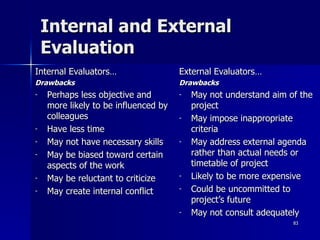
Internal and ExternalEvaluation Internal Evaluators… Drawbacks Perhaps less objective and more likely to be influenced by colleagues Have less time May not have necessary skills May be biased toward certain aspects of the work May be reluctant to criticize May create internal conflict External Evaluators… Drawbacks May not understand aim of the project May impose inappropriate criteria May address external agenda rather than actual needs or timetable of project Likely to be more expensive Could be uncommitted to project’s future May not consult adequately
84.
Program Design: Transforming a Program Framework into a Proposal USAID/Vietnam Informal Training January, 2004
85.
From Causal Pathwayto Proposal… The Causal Pathway is the skeletal framework for a proposal, with the addition of a few extra ingredients….
86.
Elements of aProfessional Proposal Cover Letter Executive Summary (If Proposal is longer than 10 Pages) Introduction/Background information Program Description Program Timeline Monitoring and Evaluation Chart Organizational Chart Detailed Budget Detailed Budget Notes Annexes or Appendices (If necessary)
87.
Elements of aProfessional Proposal Cover Letter Addresses the recipient of the proposal (the potential donor) Clearly describes in a paragraph the major objective(s) of the proposal Adds any additional, important information which may not be clear from the proposal Should be positive and hopeful!
88.
Elements of aProfessional Proposal Executive Summary Only necessary if the proposal is longer than 10 pages Clearly summarizes the program description, including major objectives, outputs, and activities, in addition to major beneficiaries, cooperating partners, and timeframe
89.
Elements of aProfessional Proposal Introduction/Background Information Should set the stage for the program Who is your organization and what are your particular skills/existing programs? What is the nature of the area in which you will be working? Politics? History? People? (As necessary) Describe briefly the nature and results of the needs assessment that was conducted leading to the design of your program. Introduce Beneficiaries and Cooperating Partners
90.
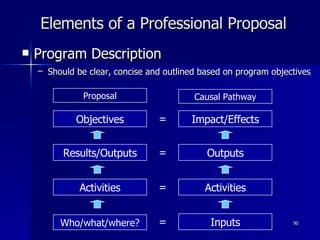
Elements of aProfessional Proposal Program Description Should be clear, concise and outlined based on program objectives Objectives = Impact/Effects Results/Outputs = Outputs Proposal Causal Pathway Activities = Activities Who/what/where? = Inputs
91.
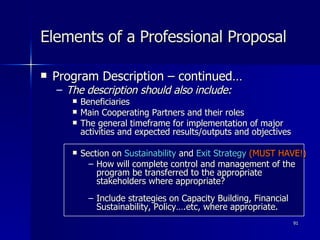
Elements of aProfessional Proposal Program Description – continued… The description should also include: Beneficiaries Main Cooperating Partners and their roles The general timeframe for implementation of major activities and expected results/outputs and objectives Section on Sustainability and Exit Strategy (MUST HAVE!) How will complete control and management of the program be transferred to the appropriate stakeholders where appropriate? Include strategies on Capacity Building, Financial Sustainability, Policy….etc, where appropriate.
92.
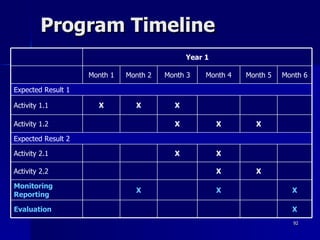
Program Timeline XX Activity 2.1 X X Activity 2.2 X Evaluation X X X Monitoring Reporting Expected Result 2 X X X Activity 1.2 X X X Activity 1.1 Expected Result 1 Month 6 Month 5 Month 4 Month 3 Month 2 Month 1 Year 1
93.
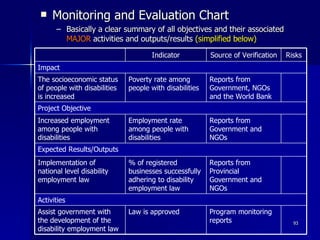
Monitoring and EvaluationChart Basically a clear summary of all objectives and their associated MAJOR activities and outputs/results (simplified below) Activities Reports from Provincial Government and NGOs % of registered businesses successfully adhering to disability employment law Implementation of national level disability employment law Reports from Government and NGOs Employment rate among people with disabilities Increased employment among people with disabilities Reports from Government, NGOs and the World Bank Poverty rate among people with disabilities The socioeconomic status of people with disabilities is increased Program monitoring reports Law is approved Assist government with the development of the disability employment law Expected Results/Outputs Project Objective Impact Risks Source of Verification Indicator
94.
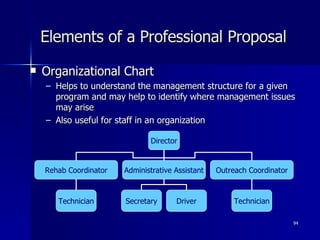
Elements of aProfessional Proposal Organizational Chart Helps to understand the management structure for a given program and may help to identify where management issues may arise Also useful for staff in an organization Director Rehab Coordinator Administrative Assistant Outreach Coordinator Technician Secretary Driver Technician
95.
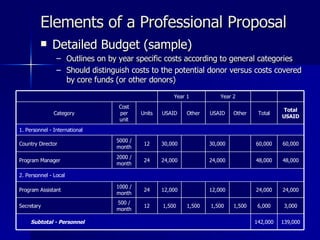
Elements of aProfessional Proposal Detailed Budget (sample) Outlines on by year specific costs according to general categories Should distinguish costs to the potential donor versus costs covered by core funds (or other donors) 3,000 6,000 1,500 1,500 1,500 1,500 12 500 / month Secretary 142,000 24,000 48,000 60,000 Total 60,000 30,000 30,000 12 5000 / month Country Director 48,000 24,000 24,000 24 2000 / month Program Manager 139,000 Subtotal - Personnel 24,000 12,000 12,000 24 1000 / month Program Assistant 2. Personnel - Local 1. Personnel - International Total USAID Other USAID Other USAID Units Cost per unit Category Year 2 Year 1
96.
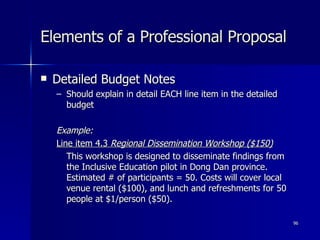
Elements of aProfessional Proposal Detailed Budget Notes Should explain in detail EACH line item in the detailed budget Example: Line item 4.3 Regional Dissemination Workshop ($150) This workshop is designed to disseminate findings from the Inclusive Education pilot in Dong Dan province. Estimated # of participants = 50. Costs will cover local venue rental ($100), and lunch and refreshments for 50 people at $1/person ($50).