Methodology:
  Sampling
  methods.
 LO: To understand the different
 types of sampling methods and
the strengths and weaknesses of
         these methods.
Key Words
 Activity
1. Closed questions
2. Questionnaires
3. Variables
4.Representative
5. Sampling
6. Sampling Frame
Starter: Write down as
  many of the key words
  that you can remember
from the presentation (6).
Match each key word with the
          definition.
• Can be answered with a limited choice of answers
  from a pre-set list
• A method for collecting information and drawing
  inferences about a larger population or universe
• Consisting of a series of questions and other
  prompts for the purpose of gathering information
  from respondents
• a list that includes every member of the
  population from which a sample is to be taken
• a typical example or specimen of a group,
  quality, or kind
• Any factor that can change or vary
• Closed questions- Can be answered with a
  limited choice of answers from a pre-set list
• Sampling- A method for collecting
  information and drawing inferences about a
  larger population or universe
• Questionnaire- Consisting of a series of
  questions and other prompts for the
  purpose of gathering information from
  respondents
• Sampling Frame- a list that includes every
  member of the population from which a
  sample is to be taken
• Representative- a typical example or
  specimen of a group, quality, or kind
• Variable- Any factor that can change or
  vary
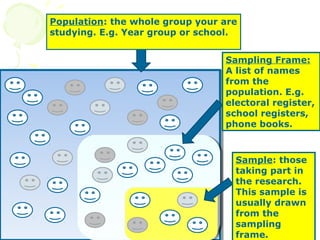
Population: the whole group your are
studying. E.g. Year group or school.


                                 Sampling Frame:
                                 A list of names
                                 from the
                                 population. E.g.
                                 electoral register,
                                 school registers,
                                 phone books.


                                   Sample: those
                                   taking part in
                                   the research.
                                   This sample is
                                   usually drawn
                                   from the
                                   sampling
                                   frame.
How do you choose people
      to research?

• Sampling is how you choose
  individuals to research.
• There are 6 different types of
  sampling.
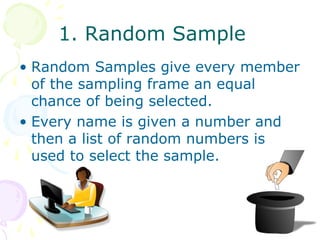
1. Random Sample
• Random Samples give every member
  of the sampling frame an equal
  chance of being selected.
• Every name is given a number and
  then a list of random numbers is
  used to select the sample.
What could be the strengths and
  weaknesses of this method?
Strengths              Weaknesses
•Avoids bias/          •Not a representative
subjective             sampling type,
judgements of who to   people with certain
include.               variables could get
•Everyone has equal    left out, i.e.
chances of being       accidentally you could
selected.              choose all men-
                       Implications for your
                       findings?
2. Systematic sample
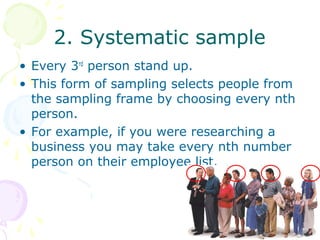
• Every 3rd person stand up.
• This form of sampling selects people from
  the sampling frame by choosing every nth
  person.
• For example, if you were researching a
  business you may take every nth number
  person on their employee list.
What could be the strengths and
  weaknesses of this method?
• Similar to random sampling.
3. Quota Sampling
• Is used commonly by market researchers
  in town centres.
• The researcher has quotas to fill, i.e. you
  might need 25 women under 35. So the
  researcher will ask the first 25 women who
  meet these requirements to include in the
  research. This will continue until all the
  quotas are filled.

• What are the strengths and weaknesses of
  this method of sampling?
Strengths and weaknesses
     of quota sampling
Strengths                    Weaknesses
1. Simple, quick and         1. Bias, the people are
   easy.                        selected on appearance,
                                so people may be
2. You can get people           excluded.
   with the desired        2. The sample will differ
   characteristics e.g.       depending on the time of
   gender, ethnicity, age.    day and place in which it
                               is conducted, e.g. if
                               conducted mid day in
                               town many of the sample
                               may be unemployed.
                             3. Consequently, not
                                representative.
4. Stratified Sampling
• This sampling method involves the
  research population being divided into
  different strata in terms of the populations
  variables, i.e. gender, age, ethnicity.
• A sample is then drawn which include
  people with these characteristics.
• Each strata needs to be representative of
  the general population
4. Stratified Sampling

• So, your target is Year 10 Psychology
  Students……
• In the year, there are 50 male
  psychology students, and 150
  female….
• You need 20 participants, how many
  males and females should you use?
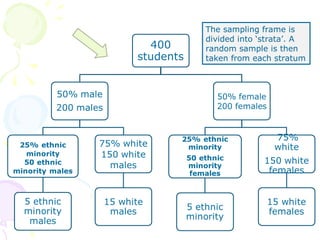
The sampling frame is
divided into ‘strata’. A
random sample is then
taken from each stratum
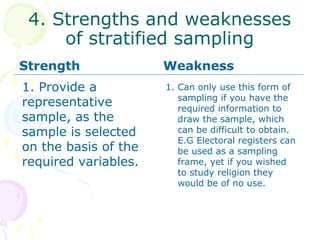
4. Strengths and weaknesses
     of stratified sampling
Strength              Weakness
1. Provide a          1. Can only use this form of
                         sampling if you have the
representative           required information to
sample, as the           draw the sample, which
sample is selected       can be difficult to obtain.
                         E.G Electoral registers can
on the basis of the      be used as a sampling
required variables.      frame, yet if you wished
                         to study religion they
                         would be of no use.
5. Snowball sampling
• This sampling method involves using a
  network of like minded or like situated
  individuals.
• By accessing one person suitable for your
  study, you can then, via them find other
  people for your study.
• Very good for sensitive subjects, such as
  people who have been subject to domestic
  violence and go to a support group or hard
  to access groups such as gypsies or
  sensitive communities.
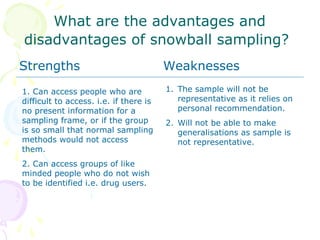
What are the advantages and
disadvantages of snowball sampling?
Strengths                               Weaknesses
1. Can access people who are            1. The sample will not be
difficult to access. i.e. if there is      representative as it relies on
no present information for a               personal recommendation.
sampling frame, or if the group         2. Will not be able to make
is so small that normal sampling           generalisations as sample is
methods would not access                   not representative.
them.
2. Can access groups of like
minded people who do not wish
to be identified i.e. drug users.
6. Volunteer Sampling
• Another sampling method to use when it is
  difficult to find a sampling frame.
• Advertisements will announce the research
  and request volunteers for the sample.
• Same advantages and disadvantages of
  snowball sampling.
• Further disadvantage: Subjects are self
  selected.
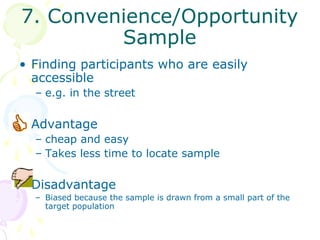
7. Convenience/Opportunity
         Sample
• Finding participants who are easily
  accessible
  – e.g. in the street

• Advantage
  – cheap and easy
  – Takes less time to locate sample

• Disadvantage
  – Biased because the sample is drawn from a small part of the
    target population

L4 sampling main.

  • 1.
    Methodology: Sampling methods. LO: To understand the different types of sampling methods and the strengths and weaknesses of these methods.
  • 2.
  • 3.
  • 4.
  • 5.
  • 6.
  • 7.
  • 8.
  • 9.
    Starter: Write downas many of the key words that you can remember from the presentation (6).
  • 10.
    Match each keyword with the definition. • Can be answered with a limited choice of answers from a pre-set list • A method for collecting information and drawing inferences about a larger population or universe • Consisting of a series of questions and other prompts for the purpose of gathering information from respondents • a list that includes every member of the population from which a sample is to be taken • a typical example or specimen of a group, quality, or kind • Any factor that can change or vary
  • 11.
    • Closed questions-Can be answered with a limited choice of answers from a pre-set list • Sampling- A method for collecting information and drawing inferences about a larger population or universe • Questionnaire- Consisting of a series of questions and other prompts for the purpose of gathering information from respondents • Sampling Frame- a list that includes every member of the population from which a sample is to be taken • Representative- a typical example or specimen of a group, quality, or kind • Variable- Any factor that can change or vary
  • 12.
    Population: the wholegroup your are studying. E.g. Year group or school. Sampling Frame: A list of names from the population. E.g. electoral register, school registers, phone books. Sample: those taking part in the research. This sample is usually drawn from the sampling frame.
  • 13.
    How do youchoose people to research? • Sampling is how you choose individuals to research. • There are 6 different types of sampling.
  • 14.
    1. Random Sample •Random Samples give every member of the sampling frame an equal chance of being selected. • Every name is given a number and then a list of random numbers is used to select the sample.
  • 15.
    What could bethe strengths and weaknesses of this method? Strengths Weaknesses •Avoids bias/ •Not a representative subjective sampling type, judgements of who to people with certain include. variables could get •Everyone has equal left out, i.e. chances of being accidentally you could selected. choose all men- Implications for your findings?
  • 16.
    2. Systematic sample •Every 3rd person stand up. • This form of sampling selects people from the sampling frame by choosing every nth person. • For example, if you were researching a business you may take every nth number person on their employee list.
  • 17.
    What could bethe strengths and weaknesses of this method? • Similar to random sampling.
  • 18.
    3. Quota Sampling •Is used commonly by market researchers in town centres. • The researcher has quotas to fill, i.e. you might need 25 women under 35. So the researcher will ask the first 25 women who meet these requirements to include in the research. This will continue until all the quotas are filled. • What are the strengths and weaknesses of this method of sampling?
  • 19.
    Strengths and weaknesses of quota sampling Strengths Weaknesses 1. Simple, quick and 1. Bias, the people are easy. selected on appearance, so people may be 2. You can get people excluded. with the desired 2. The sample will differ characteristics e.g. depending on the time of gender, ethnicity, age. day and place in which it is conducted, e.g. if conducted mid day in town many of the sample may be unemployed. 3. Consequently, not representative.
  • 20.
    4. Stratified Sampling •This sampling method involves the research population being divided into different strata in terms of the populations variables, i.e. gender, age, ethnicity. • A sample is then drawn which include people with these characteristics. • Each strata needs to be representative of the general population
  • 21.
    4. Stratified Sampling •So, your target is Year 10 Psychology Students…… • In the year, there are 50 male psychology students, and 150 female…. • You need 20 participants, how many males and females should you use?
  • 22.
    The sampling frameis divided into ‘strata’. A random sample is then taken from each stratum
  • 23.
    4. Strengths andweaknesses of stratified sampling Strength Weakness 1. Provide a 1. Can only use this form of sampling if you have the representative required information to sample, as the draw the sample, which sample is selected can be difficult to obtain. E.G Electoral registers can on the basis of the be used as a sampling required variables. frame, yet if you wished to study religion they would be of no use.
  • 24.
    5. Snowball sampling •This sampling method involves using a network of like minded or like situated individuals. • By accessing one person suitable for your study, you can then, via them find other people for your study. • Very good for sensitive subjects, such as people who have been subject to domestic violence and go to a support group or hard to access groups such as gypsies or sensitive communities.
  • 25.
    What are theadvantages and disadvantages of snowball sampling? Strengths Weaknesses 1. Can access people who are 1. The sample will not be difficult to access. i.e. if there is representative as it relies on no present information for a personal recommendation. sampling frame, or if the group 2. Will not be able to make is so small that normal sampling generalisations as sample is methods would not access not representative. them. 2. Can access groups of like minded people who do not wish to be identified i.e. drug users.
  • 26.
    6. Volunteer Sampling •Another sampling method to use when it is difficult to find a sampling frame. • Advertisements will announce the research and request volunteers for the sample. • Same advantages and disadvantages of snowball sampling. • Further disadvantage: Subjects are self selected.
  • 27.
    7. Convenience/Opportunity Sample • Finding participants who are easily accessible – e.g. in the street • Advantage – cheap and easy – Takes less time to locate sample • Disadvantage – Biased because the sample is drawn from a small part of the target population

Editor's Notes

  • #11 Sampling frame- a list that includes every member of the population from which a sample is to be taken e.g. school register Sampling- A method for collecting information and drawing inferences about a larger population or universe
  • #15 Consider the following subjects of possible questionnaire-based surveys. Which of them do you feel would have simple random sampling as an appropriate sampling method? Are there any limitations? In which would random sampling be totally inappropriate? A survey of shoppers in a clothes shop on a Saturday morning A study of employees in an organisation A survey of consumer attitudes to British Gas Survey of a theatre audience following a play School-children's attitudes to branded clothing Feedback from hotel clients on perceptions of their last visit to that hotel In each of the above examples, identify the sampling frame you would use if you were to undertake a simple random sample
  • #22 For every 1 boy there are 3 girls: 1:3 ratio 5 boys 15 girls a) Can you think of some different "strata" (other than gender ) that could be used if you were undertaking a stratified sample of the adult population of Galashiels?   b) A company employs 200 part-time staff and 800 full-time staff, and you want to undertake depth interviews with 20 of these. If you were to take a random sample, you might find that all of the names you selected were part-time staff. For this reason you have decided to undertake a stratified sample. Work out how many part-time and how many full-time employees you should interview so as to accurately reflect the proportions of the two groups in the whole workforce. Answer = ________ Part-time and ________ Full-time
  • #28 If you were to undertake a convenience sample of people who were walking past you in the main street in Corstorphine or Galashiels on a Wednesday morning, which groups of the population would be over-represented and which groups would be under-represented ? Over-representedUnder-represented   If you were undertaking a questionnaire on student attitudes to banking services at the college, and decided to deliver it through a convenience sample in the bar of the Students' Union, which groups of students would be over-represented and which under-represented ? Over-representedUnder-represented