Non- Probability
Random Sampling
Non- Probability Random Sampling
Types
Quota Sampling
Purposive / Judgemental Sampling
Snonwball Sampling
Convenience Sampling
Panel Sampling
Welcome to class!
Today's Agenda
Afia Mehmood FA20-BSM-001
Sana Akhtar Nagra FA20-BSM-024
Khadeeja Abid FA20-BSM-031
Adeeba Naeem FA20-BSM-039
Samiya Yasmeen FA20-BSM-042
Aroosha Tanveer FA20-BSM-050
My Team Members
Convenience Sampling
Convenience sampling is a type of non-probability
sampling.
it is type of sampling in which data is collected from the
" conveniently available respondents".
Convenience sampling also called graph sampling,
availability sampling,
accidental sampling, chunk sampling, haphazard
sampling etc.
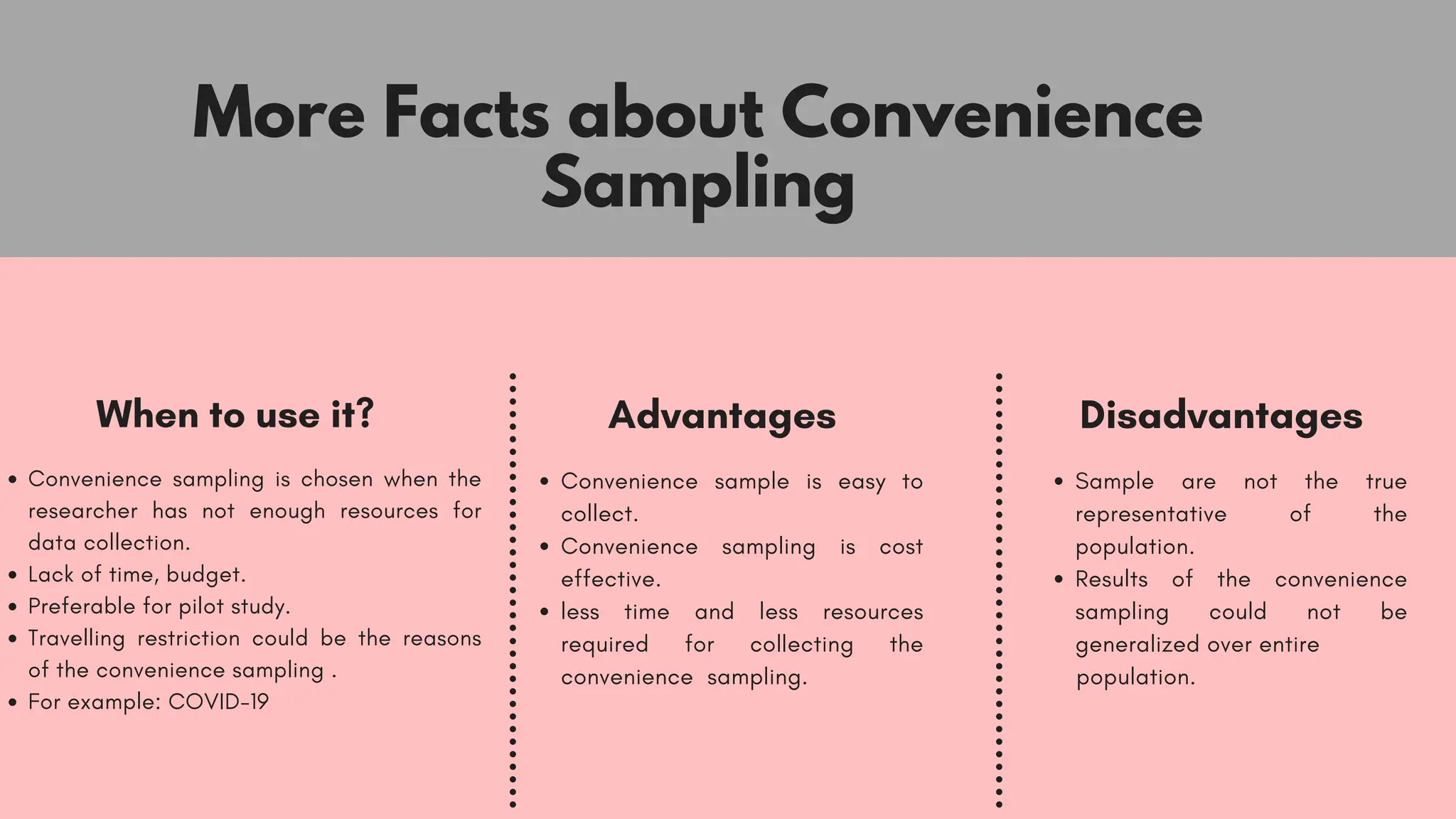
More Facts about Convenience
Sampling
When to use it?
Convenience sampling is chosen when the
researcher has not enough resources for
data collection.
Lack of time, budget.
Preferable for pilot study.
Travelling restriction could be the reasons
of the convenience sampling .
For example: COVID-19
Advantages
Convenience sample is easy to
collect.
Convenience sampling is cost
effective.
less time and less resources
required for collecting the
convenience sampling.
Disadvantages
Sample are not the true
representative of the
population.
Results of the convenience
sampling could not be
generalized over entire
population.
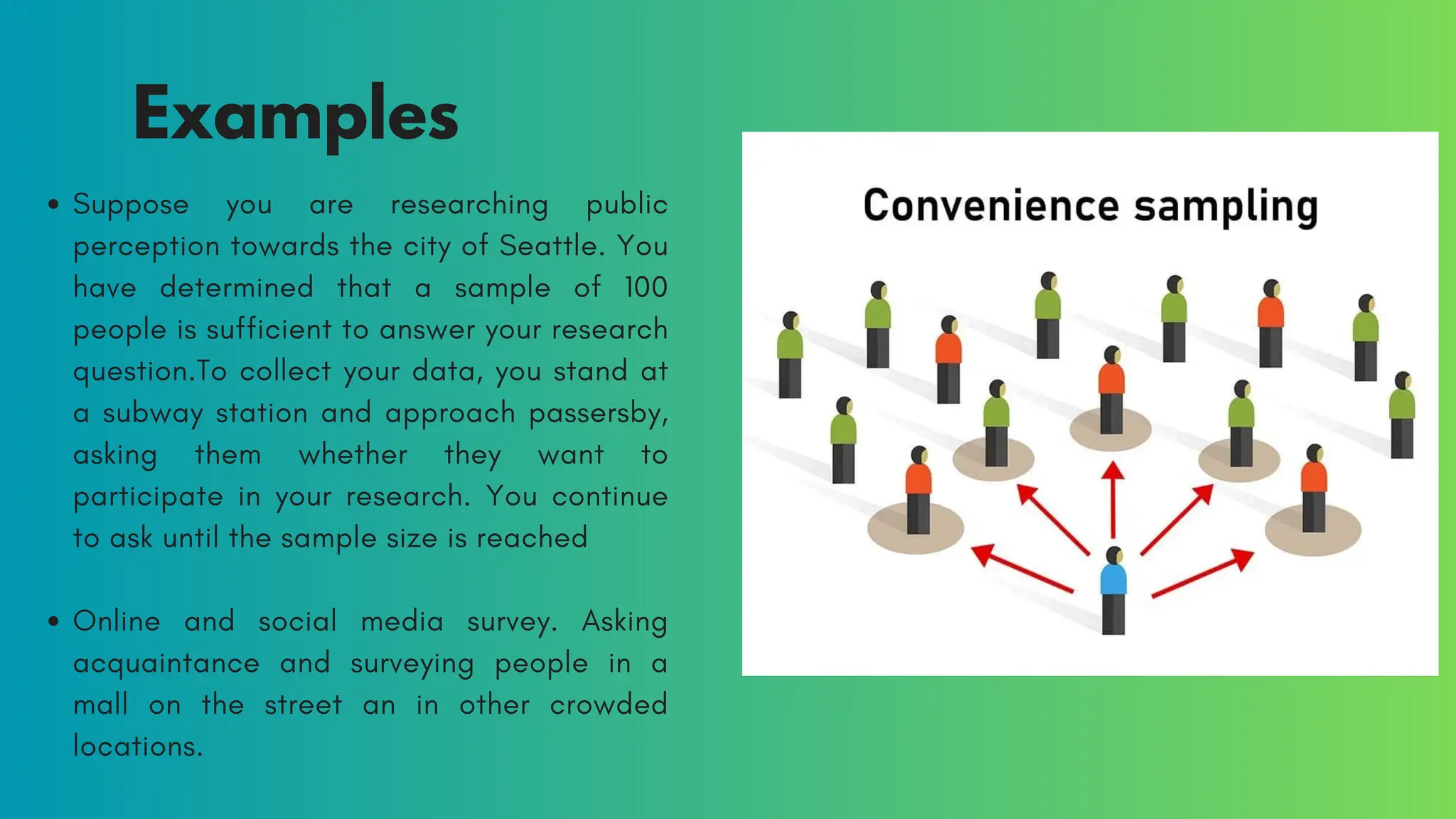
Suppose you are researching public
perception towards the city of Seattle. You
have determined that a sample of 100
people is sufficient to answer your research
question.To collect your data, you stand at
a subway station and approach passersby,
asking them whether they want to
participate in your research. You continue
to ask until the sample size is reached
Online and social media survey. Asking
acquaintance and surveying people in a
mall on the street an in other crowded
locations.
Examples
It is a sampling techniques in which researcher select the sample based
on
Selection of a sample exclusively depend on the judgment of the
researcher.
Judgment of researcher depend on the criteria he has defined for
research,
It is vulnerable to sampling bias as it is entirely depends on researcher's
It is also called autorotative sampling, deliberate sampling selective
sampling, subjective sampling etc.
his knowledge and judgment.
the respondents which fulfills the criteria are selected for sample rest of
them are rejected.
judgment .
Judgemental Sampling
More Facts about Judgemental
Sampling
When to use it?
Usually use when a limited number of
individuals passes the trait of interest .
It is the only useable sampling techniques in
obtaining information from a very specific
group of people .
Advantages
It is simple and easy, no
complicated procedure is
involved to draw the sample.
Researcher select the sample
which is the true representative of
the population.
Data is collected only from the
relevant respondent .
Unnecessary respondents are
rejected.
Disadvantages
Personal judgment may leads
to sampling bias..
Judgment error may occur as
the researcher being.
Difficult to defined the
selection of participants.
Example
Popular journals conduct surveys in selected metropolitan cities to
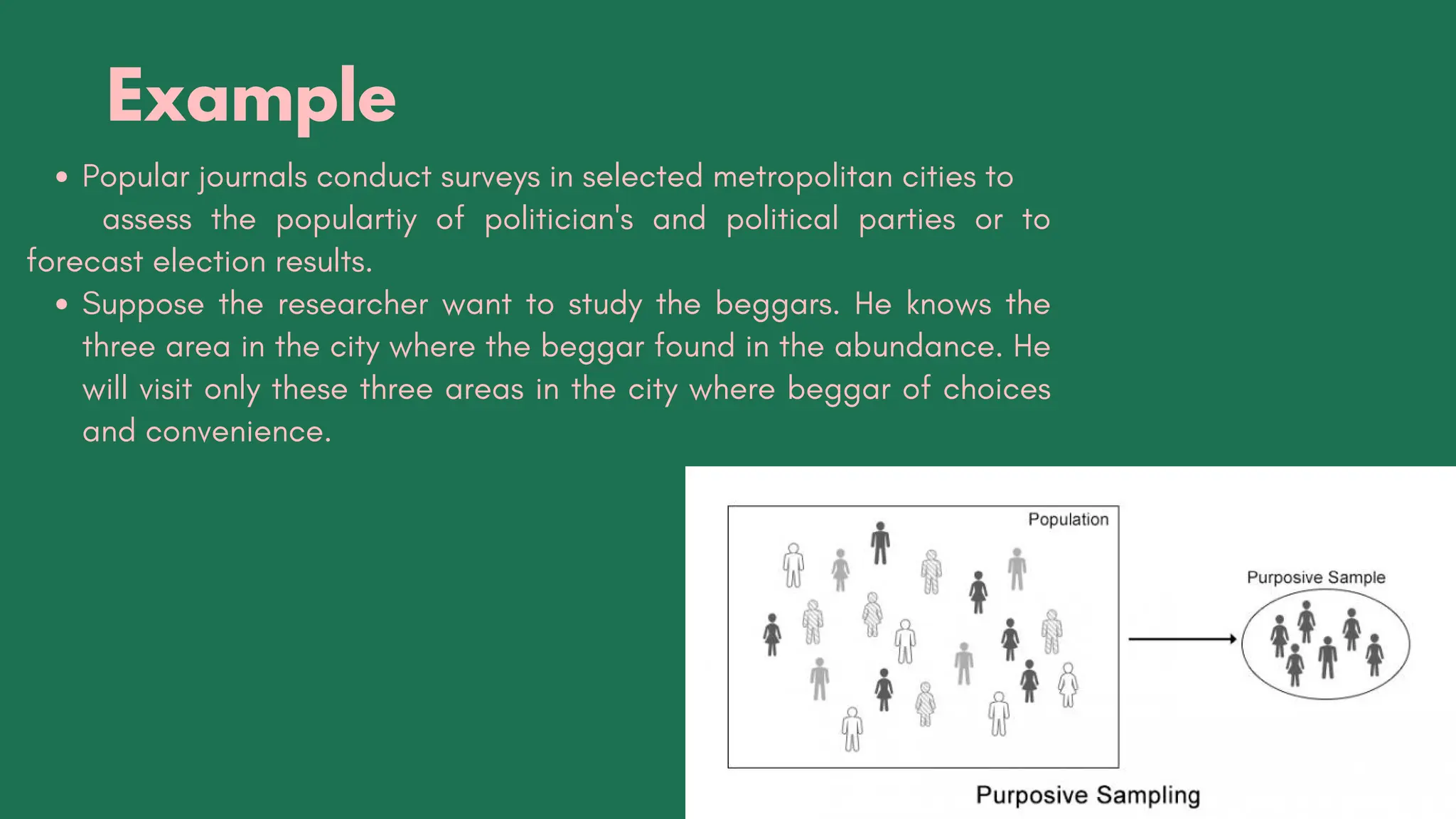
Suppose the researcher want to study the beggars. He knows the
three area in the city where the beggar found in the abundance. He
will visit only these three areas in the city where beggar of choices
and convenience.
assess the populartiy of politician's and political parties or to
forecast election results.
Quota sampling is type of non-probability.
In this sampling techniques, entire population is subdivided
into homogenous group and then a quota " no of
items/respondents to be selected from sample" is fixed for
each group.
Once the quota is assigned to each group then sample is
selected using convenience or judgmental sampling.
Quota Sampling
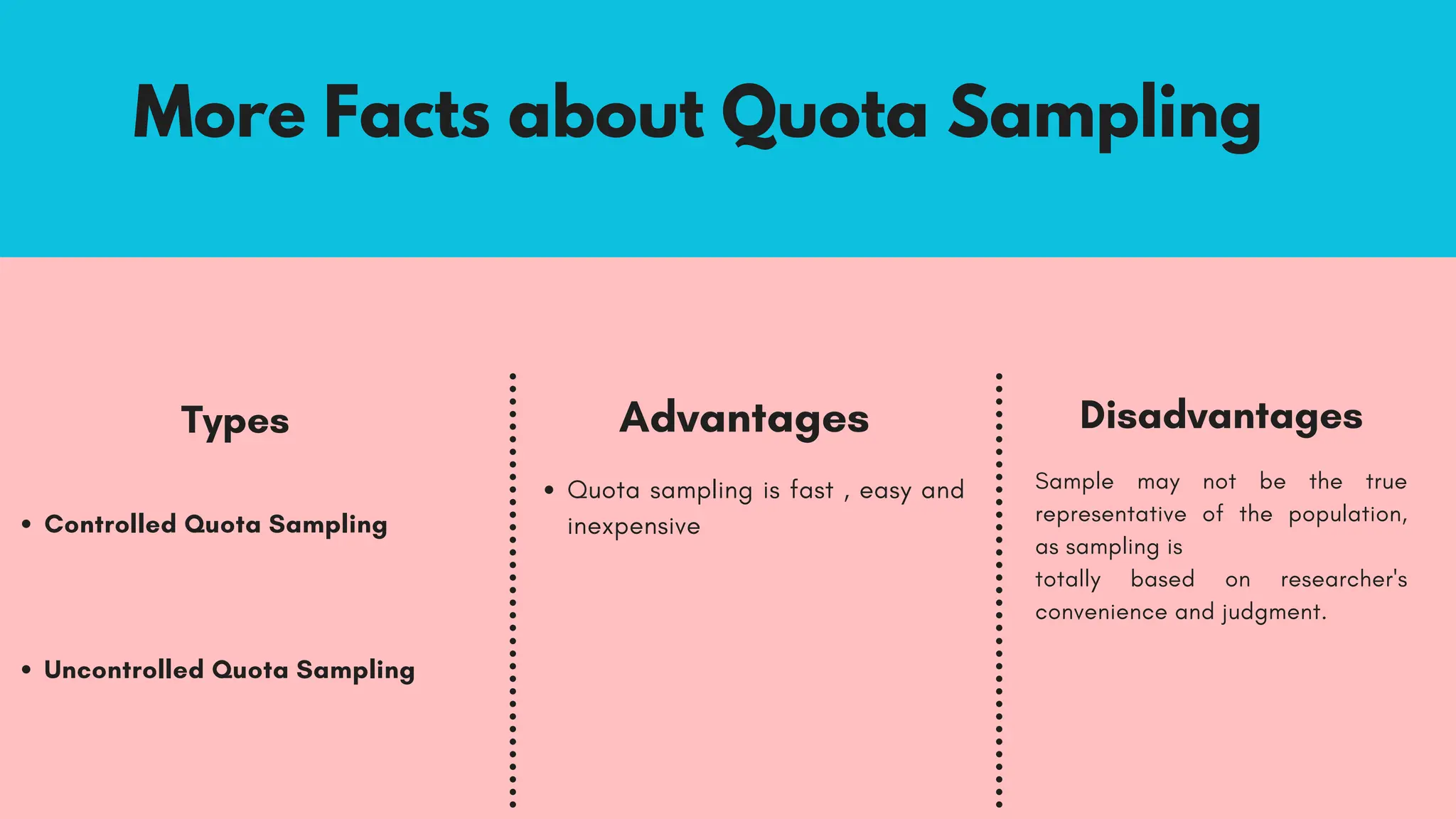
More Facts about Quota Sampling
Types
Controlled Quota Sampling
Uncontrolled Quota Sampling
Advantages
Quota sampling is fast , easy and
inexpensive
Disadvantages
Sample may not be the true
representative of the population,
as sampling is
totally based on researcher's
convenience and judgment.
Examples
A researcher want to study the preference of mobile phone brand in females in a city: (
Suppose population is 1000 and sample size is 100).
A cigarette company wants to find out what age group prefers what brand of cigarettes
in a particular city. They apply survey quota on the age groups of 21-30, 31-40, 41-50,
and 51+. From this information, the researcher gauges the smoking trend among the
population of the city.
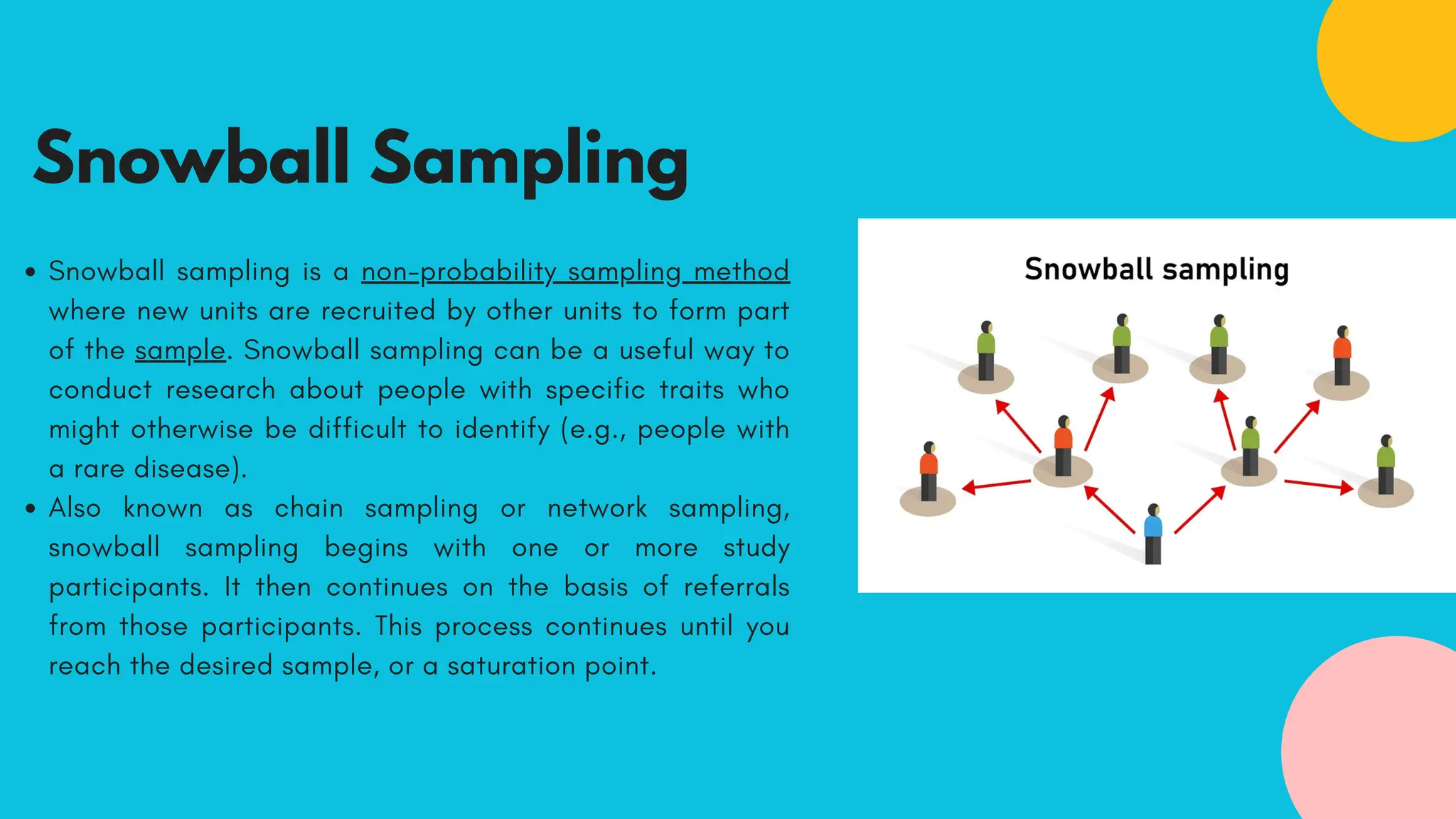
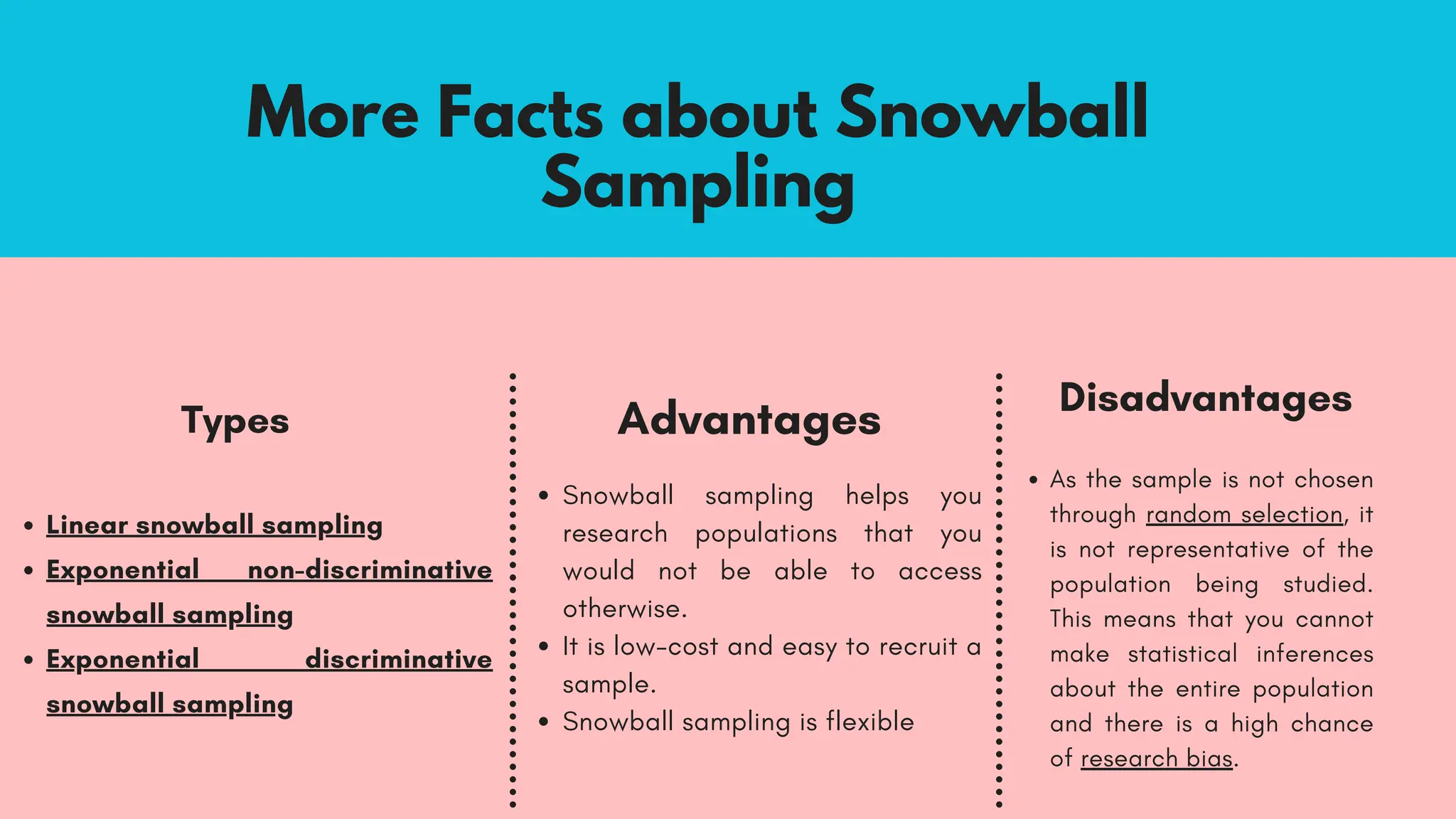
Snowball Sampling
Snowball sampling is a non-probability sampling method
where new units are recruited by other units to form part
of the sample. Snowball sampling can be a useful way to
conduct research about people with specific traits who
might otherwise be difficult to identify (e.g., people with
a rare disease).
Also known as chain sampling or network sampling,
snowball sampling begins with one or more study
participants. It then continues on the basis of referrals
from those participants. This process continues until you
reach the desired sample, or a saturation point.
More Facts about Snowball
Sampling
Types
Linear snowball sampling
Exponential non-discriminative
snowball sampling
Exponential discriminative
snowball sampling
Advantages
Snowball sampling helps you
research populations that you
would not be able to access
otherwise.
It is low-cost and easy to recruit a
sample.
Snowball sampling is flexible
Disadvantages
As the sample is not chosen
through random selection, it
is not representative of the
population being studied.
This means that you cannot
make statistical inferences
about the entire population
and there is a high chance
of research bias.
In researching the motivations of tiny house owners, you decide you only want to focus on
those who bought one in the past three years.As you inquire with your acquaintances, you find
someone who bought a tiny house a year ago. At the end of the interview, you ask them if they
know of other owners. You do not specify that the purchase has to be in the past three
years.As it happens, they do know of two more people who bought tiny houses in the same
area as they did. You contact both, and find out that one bought the house four years ago and
the other eight months ago. Since the one who bought the house four years ago does not meet
your criteria, you only interview the other.You repeat the same process, asking for referrals and
screening them until you have enough participants.
Example
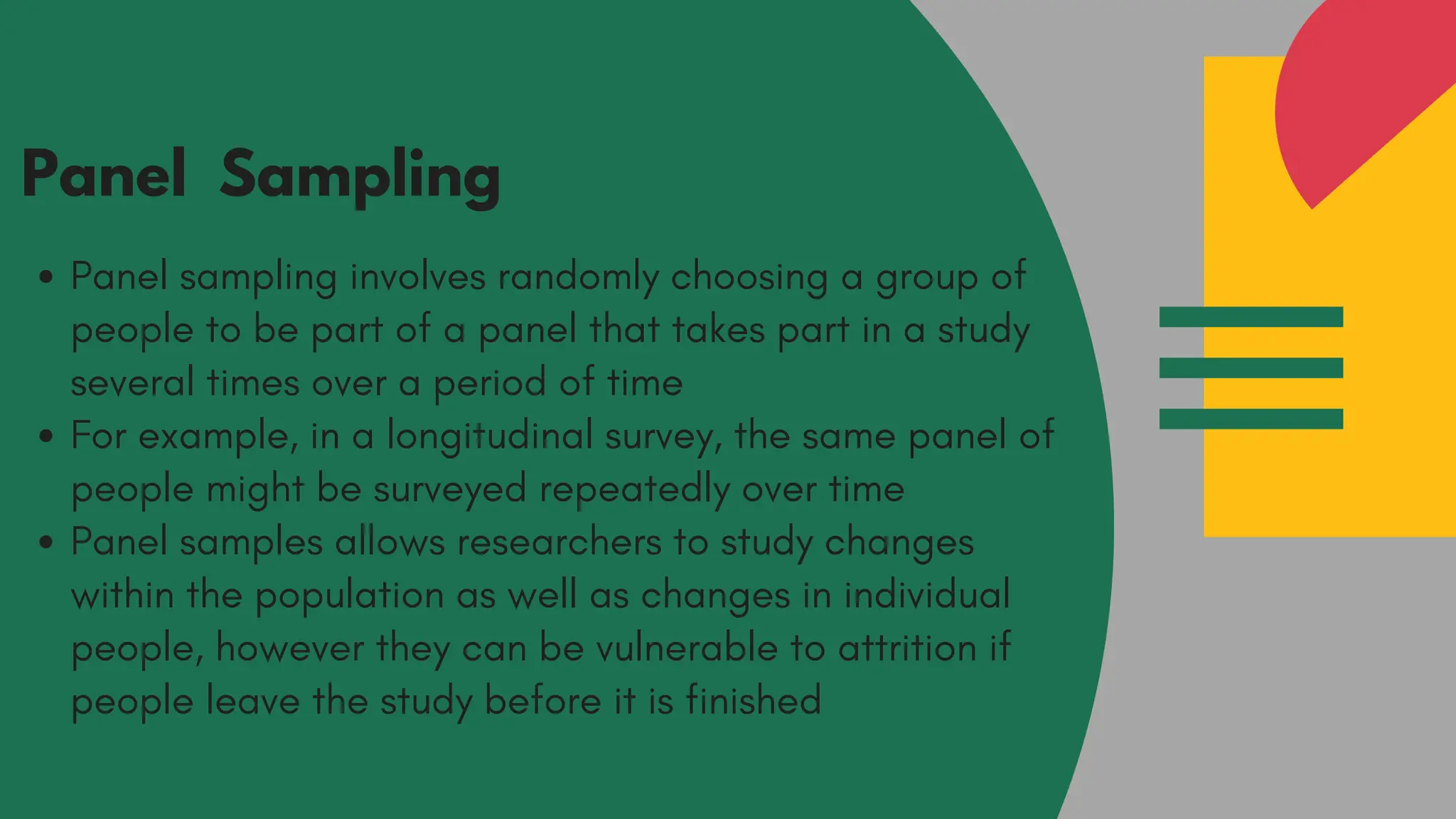
Panel Sampling
Panel sampling involves randomly choosing a group of
people to be part of a panel that takes part in a study
several times over a period of time
For example, in a longitudinal survey, the same panel of
people might be surveyed repeatedly over time
Panel samples allows researchers to study changes
within the population as well as changes in individual
people, however they can be vulnerable to attrition if
people leave the study before it is finished
And we're done!
Any Query?
Thank You !

Non- Probability Random Sampling.pdf

  • 1.
  • 2.
    Non- Probability RandomSampling Types Quota Sampling Purposive / Judgemental Sampling Snonwball Sampling Convenience Sampling Panel Sampling Welcome to class! Today's Agenda
  • 3.
    Afia Mehmood FA20-BSM-001 SanaAkhtar Nagra FA20-BSM-024 Khadeeja Abid FA20-BSM-031 Adeeba Naeem FA20-BSM-039 Samiya Yasmeen FA20-BSM-042 Aroosha Tanveer FA20-BSM-050 My Team Members
  • 4.
    Convenience Sampling Convenience samplingis a type of non-probability sampling. it is type of sampling in which data is collected from the " conveniently available respondents". Convenience sampling also called graph sampling, availability sampling, accidental sampling, chunk sampling, haphazard sampling etc.
  • 5.
    More Facts aboutConvenience Sampling When to use it? Convenience sampling is chosen when the researcher has not enough resources for data collection. Lack of time, budget. Preferable for pilot study. Travelling restriction could be the reasons of the convenience sampling . For example: COVID-19 Advantages Convenience sample is easy to collect. Convenience sampling is cost effective. less time and less resources required for collecting the convenience sampling. Disadvantages Sample are not the true representative of the population. Results of the convenience sampling could not be generalized over entire population.
  • 6.
    Suppose you areresearching public perception towards the city of Seattle. You have determined that a sample of 100 people is sufficient to answer your research question.To collect your data, you stand at a subway station and approach passersby, asking them whether they want to participate in your research. You continue to ask until the sample size is reached Online and social media survey. Asking acquaintance and surveying people in a mall on the street an in other crowded locations. Examples
  • 7.
    It is asampling techniques in which researcher select the sample based on Selection of a sample exclusively depend on the judgment of the researcher. Judgment of researcher depend on the criteria he has defined for research, It is vulnerable to sampling bias as it is entirely depends on researcher's It is also called autorotative sampling, deliberate sampling selective sampling, subjective sampling etc. his knowledge and judgment. the respondents which fulfills the criteria are selected for sample rest of them are rejected. judgment . Judgemental Sampling
  • 8.
    More Facts aboutJudgemental Sampling When to use it? Usually use when a limited number of individuals passes the trait of interest . It is the only useable sampling techniques in obtaining information from a very specific group of people . Advantages It is simple and easy, no complicated procedure is involved to draw the sample. Researcher select the sample which is the true representative of the population. Data is collected only from the relevant respondent . Unnecessary respondents are rejected. Disadvantages Personal judgment may leads to sampling bias.. Judgment error may occur as the researcher being. Difficult to defined the selection of participants.
  • 9.
    Example Popular journals conductsurveys in selected metropolitan cities to Suppose the researcher want to study the beggars. He knows the three area in the city where the beggar found in the abundance. He will visit only these three areas in the city where beggar of choices and convenience. assess the populartiy of politician's and political parties or to forecast election results.
  • 10.
    Quota sampling istype of non-probability. In this sampling techniques, entire population is subdivided into homogenous group and then a quota " no of items/respondents to be selected from sample" is fixed for each group. Once the quota is assigned to each group then sample is selected using convenience or judgmental sampling. Quota Sampling
  • 11.
    More Facts aboutQuota Sampling Types Controlled Quota Sampling Uncontrolled Quota Sampling Advantages Quota sampling is fast , easy and inexpensive Disadvantages Sample may not be the true representative of the population, as sampling is totally based on researcher's convenience and judgment.
  • 12.
    Examples A researcher wantto study the preference of mobile phone brand in females in a city: ( Suppose population is 1000 and sample size is 100). A cigarette company wants to find out what age group prefers what brand of cigarettes in a particular city. They apply survey quota on the age groups of 21-30, 31-40, 41-50, and 51+. From this information, the researcher gauges the smoking trend among the population of the city.
  • 13.
    Snowball Sampling Snowball samplingis a non-probability sampling method where new units are recruited by other units to form part of the sample. Snowball sampling can be a useful way to conduct research about people with specific traits who might otherwise be difficult to identify (e.g., people with a rare disease). Also known as chain sampling or network sampling, snowball sampling begins with one or more study participants. It then continues on the basis of referrals from those participants. This process continues until you reach the desired sample, or a saturation point.
  • 14.
    More Facts aboutSnowball Sampling Types Linear snowball sampling Exponential non-discriminative snowball sampling Exponential discriminative snowball sampling Advantages Snowball sampling helps you research populations that you would not be able to access otherwise. It is low-cost and easy to recruit a sample. Snowball sampling is flexible Disadvantages As the sample is not chosen through random selection, it is not representative of the population being studied. This means that you cannot make statistical inferences about the entire population and there is a high chance of research bias.
  • 15.
    In researching themotivations of tiny house owners, you decide you only want to focus on those who bought one in the past three years.As you inquire with your acquaintances, you find someone who bought a tiny house a year ago. At the end of the interview, you ask them if they know of other owners. You do not specify that the purchase has to be in the past three years.As it happens, they do know of two more people who bought tiny houses in the same area as they did. You contact both, and find out that one bought the house four years ago and the other eight months ago. Since the one who bought the house four years ago does not meet your criteria, you only interview the other.You repeat the same process, asking for referrals and screening them until you have enough participants. Example
  • 16.
    Panel Sampling Panel samplinginvolves randomly choosing a group of people to be part of a panel that takes part in a study several times over a period of time For example, in a longitudinal survey, the same panel of people might be surveyed repeatedly over time Panel samples allows researchers to study changes within the population as well as changes in individual people, however they can be vulnerable to attrition if people leave the study before it is finished
  • 17.
  • 18.