Sampling
Business Research
Sampling
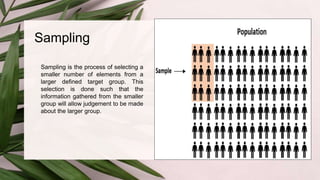
Sampling is the process of selecting a
smaller number of elements from a
larger defined target group. This
selection is done such that the
information gathered from the smaller
group will allow judgement to be made
about the larger group.
Important Terms
•Population: - A population is a group of related objects or occurrences relevant to a particular topic or
experiment.
•Sample:- It is the particular group from whom you will get data. The sample size is always smaller than
the population as a whole.
•Sample unit:- It is the object or person being observed.
•Sampling frame:-The list of all the sampling units with a proper identification (which represents the
population to be covered is called the sampling frame). The frame may consist of either a list of units or
a map of the area (in case a sample of the area is being taken).
20XX Contoso business plan 4
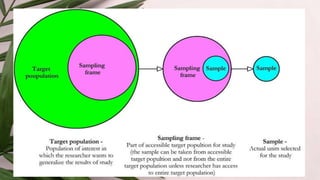
Population
Whole consumer base
Sampling Frame
Group of consumer you
have the ability to
contact for your Survey
Sample
Consumer you actually
contact for the survey
Sample Unit
The individuals whose
characteristics are to be
measured in the
analysis
Example
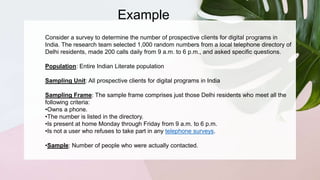
Consider a survey to determine the number of prospective clients for digital programs in
India. The research team selected 1,000 random numbers from a local telephone directory of
Delhi residents, made 200 calls daily from 9 a.m. to 6 p.m., and asked specific questions.
Population: Entire Indian Literate population
Sampling Unit: All prospective clients for digital programs in India
Sampling Frame: The sample frame comprises just those Delhi residents who meet all the
following criteria:
•Owns a phone.
•The number is listed in the directory.
•Is present at home Monday through Friday from 9 a.m. to 6 p.m.
•Is not a user who refuses to take part in any telephone surveys.
•Sample: Number of people who were actually contacted.
Sampling Techniques
The sampling method or sampling technique is the process of studying the population by gathering information and analyzing that data.
Researchers are often interested in answering questions about populations like:
•What is the average height of a certain species of plant?
•What is the average weight of a certain species of bird?
•What percentage of citizens in a certain city support a certain law?
One way to answer these questions is to go around and collect data on every single individual in the population of
interest.
However, this is typically too costly and time-consuming, so researchers instead take a sample of the population
and use the data from the sample to draw conclusions about the population as a whole.
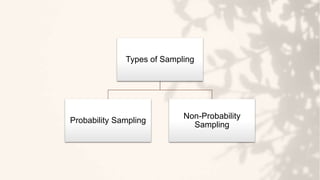
Types of Sampling
Probability Sampling
Non-Probability
Sampling
Probability Sampling
The probability sampling method utilizes some form of random selection. In this method, all the eligible
individuals have an equal chance of getting selected as the sample from the whole sample space.
For example, if we have a population of 100 people, each one of the persons has a chance of 1 out of
100 being chosen for the sample.
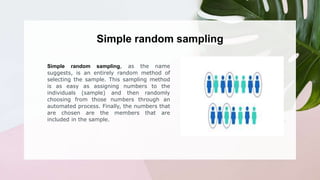
Simple random sampling, as the name
suggests, is an entirely random method of
selecting the sample. This sampling method
is as easy as assigning numbers to the
individuals (sample) and then randomly
choosing from those numbers through an
automated process. Finally, the numbers that
are chosen are the members that are
included in the sample.
Simple random sampling
Stratified random sampling
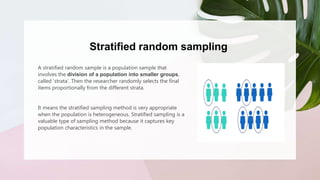
A stratified random sample is a population sample that
involves the division of a population into smaller groups,
called ‘strata’. Then the researcher randomly selects the final
items proportionally from the different strata.
It means the stratified sampling method is very appropriate
when the population is heterogeneous. Stratified sampling is a
valuable type of sampling method because it captures key
population characteristics in the sample.
Systematic Sampling
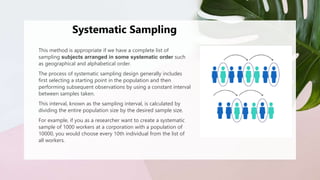
This method is appropriate if we have a complete list of
sampling subjects arranged in some systematic order such
as geographical and alphabetical order.
The process of systematic sampling design generally includes
first selecting a starting point in the population and then
performing subsequent observations by using a constant interval
between samples taken.
This interval, known as the sampling interval, is calculated by
dividing the entire population size by the desired sample size.
For example, if you as a researcher want to create a systematic
sample of 1000 workers at a corporation with a population of
10000, you would choose every 10th individual from the list of
all workers.
Cluster Random Sampling
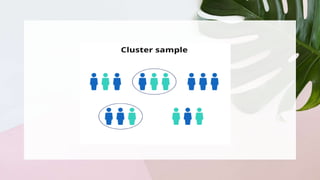
In the clustered sampling method, the cluster or group of people are formed from the population set. The group has similar
significatory characteristics. Also, they have an equal chance of being a part of the sample. This method uses simple random
sampling for the cluster of the population.
Example:
An educational institution has ten branches across the country with almost the number of students. If we want to collect
some data regarding facilities and other things, we can’t travel to every unit to collect the required data. Hence, we can use
random sampling to select three or four branches as clusters.
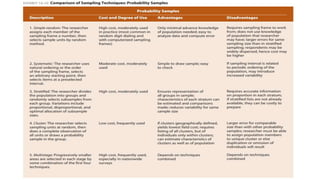
All these four methods can be understood in a better manner with the help of the figure given below. The figure contains
various examples of how samples will be taken from the population using different techniques
Non-probability
Sampling
Non-probability sampling
Non-probability sampling is defined as a sampling technique in which the researcher
selects samples based on the subjective judgment of the researcher rather than
random selection. It is a less stringent method. This sampling method depends
heavily on the expertise of the researchers.
Non-probability sampling is a method in which not all population members have an
equal chance of participating in the study, unlike probability sampling.
Researchers use this method in studies where it is impossible to draw random
probability sampling due to time or cost considerations.
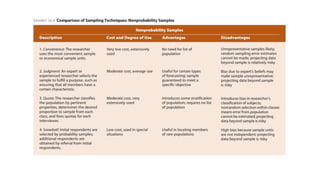
Convenience sampling
Convenience sampling is a non-probability sampling technique where samples are selected
from the population only because they are conveniently available to the researcher.
Researchers choose these samples just because they are easy to recruit, and the researcher did
not consider selecting a sample that represents the entire population.
Ideally, in research, it is good to test a sample that represents the population. But, in some
research, the population is too large to examine and consider the entire population. It is one
of the reasons why researchers rely on convenience sampling, which is the most common
non-probability sampling method, because of its speed, cost-effectiveness, and ease of
availability of the sample.
Judgmental or Purposive sampling
In the judgmental sampling method, researchers select the samples based purely on the
researcher’s knowledge and credibility. In other words, researchers choose only those
people who they deem fit to participate in the research study.
Judgmental or purposive sampling is not a scientific method of sampling, and the
downside to this sampling technique is that the preconceived notions of a researcher can
influence the results. Thus, this research technique involves a high amount of ambiguity.
Quota Sampling
Nonprobability sampling procedure that ensures that various subgroups of a
population will be represented on pertinent characteristics to the exact extent that
the investigator desires.
The sample obtained from a quota sampling method contains similar proportions of
observations as the whole population with some known traits or characteristics. In
quota sampling, the researcher selects from his/her judgement or some fixed
quota. In other words, the sample observations will be chosen based on pre-
specified virtues. Then the total sample contains the same distribution of
characteristics that were assumed to be found in the population of concern.
Snowball Sampling
A sampling procedure in which initial respondents are selected by probability methods and
additional respondents are obtained from information provided by the initial respondents.
Snowball sampling or chain-referral sampling is defined as a non-probability
sampling technique in which the samples have rare traits. This is a sampling technique, in
which existing subjects provide referrals to recruit samples required for a research study
Thank you
20XX 23

Sampling.pptx

  • 1.
  • 2.
    Sampling Sampling is theprocess of selecting a smaller number of elements from a larger defined target group. This selection is done such that the information gathered from the smaller group will allow judgement to be made about the larger group.
  • 3.
    Important Terms •Population: -A population is a group of related objects or occurrences relevant to a particular topic or experiment. •Sample:- It is the particular group from whom you will get data. The sample size is always smaller than the population as a whole. •Sample unit:- It is the object or person being observed. •Sampling frame:-The list of all the sampling units with a proper identification (which represents the population to be covered is called the sampling frame). The frame may consist of either a list of units or a map of the area (in case a sample of the area is being taken).
  • 4.
  • 5.
    Population Whole consumer base SamplingFrame Group of consumer you have the ability to contact for your Survey Sample Consumer you actually contact for the survey Sample Unit The individuals whose characteristics are to be measured in the analysis
  • 6.
    Example Consider a surveyto determine the number of prospective clients for digital programs in India. The research team selected 1,000 random numbers from a local telephone directory of Delhi residents, made 200 calls daily from 9 a.m. to 6 p.m., and asked specific questions. Population: Entire Indian Literate population Sampling Unit: All prospective clients for digital programs in India Sampling Frame: The sample frame comprises just those Delhi residents who meet all the following criteria: •Owns a phone. •The number is listed in the directory. •Is present at home Monday through Friday from 9 a.m. to 6 p.m. •Is not a user who refuses to take part in any telephone surveys. •Sample: Number of people who were actually contacted.
  • 7.
    Sampling Techniques The samplingmethod or sampling technique is the process of studying the population by gathering information and analyzing that data. Researchers are often interested in answering questions about populations like: •What is the average height of a certain species of plant? •What is the average weight of a certain species of bird? •What percentage of citizens in a certain city support a certain law? One way to answer these questions is to go around and collect data on every single individual in the population of interest. However, this is typically too costly and time-consuming, so researchers instead take a sample of the population and use the data from the sample to draw conclusions about the population as a whole.
  • 8.
    Types of Sampling ProbabilitySampling Non-Probability Sampling
  • 9.
    Probability Sampling The probabilitysampling method utilizes some form of random selection. In this method, all the eligible individuals have an equal chance of getting selected as the sample from the whole sample space. For example, if we have a population of 100 people, each one of the persons has a chance of 1 out of 100 being chosen for the sample.
  • 10.
    Simple random sampling,as the name suggests, is an entirely random method of selecting the sample. This sampling method is as easy as assigning numbers to the individuals (sample) and then randomly choosing from those numbers through an automated process. Finally, the numbers that are chosen are the members that are included in the sample. Simple random sampling
  • 11.
    Stratified random sampling Astratified random sample is a population sample that involves the division of a population into smaller groups, called ‘strata’. Then the researcher randomly selects the final items proportionally from the different strata. It means the stratified sampling method is very appropriate when the population is heterogeneous. Stratified sampling is a valuable type of sampling method because it captures key population characteristics in the sample.
  • 12.
    Systematic Sampling This methodis appropriate if we have a complete list of sampling subjects arranged in some systematic order such as geographical and alphabetical order. The process of systematic sampling design generally includes first selecting a starting point in the population and then performing subsequent observations by using a constant interval between samples taken. This interval, known as the sampling interval, is calculated by dividing the entire population size by the desired sample size. For example, if you as a researcher want to create a systematic sample of 1000 workers at a corporation with a population of 10000, you would choose every 10th individual from the list of all workers.
  • 13.
    Cluster Random Sampling Inthe clustered sampling method, the cluster or group of people are formed from the population set. The group has similar significatory characteristics. Also, they have an equal chance of being a part of the sample. This method uses simple random sampling for the cluster of the population. Example: An educational institution has ten branches across the country with almost the number of students. If we want to collect some data regarding facilities and other things, we can’t travel to every unit to collect the required data. Hence, we can use random sampling to select three or four branches as clusters. All these four methods can be understood in a better manner with the help of the figure given below. The figure contains various examples of how samples will be taken from the population using different techniques
  • 15.
  • 16.
    Non-probability sampling Non-probability samplingis defined as a sampling technique in which the researcher selects samples based on the subjective judgment of the researcher rather than random selection. It is a less stringent method. This sampling method depends heavily on the expertise of the researchers. Non-probability sampling is a method in which not all population members have an equal chance of participating in the study, unlike probability sampling. Researchers use this method in studies where it is impossible to draw random probability sampling due to time or cost considerations.
  • 17.
    Convenience sampling Convenience samplingis a non-probability sampling technique where samples are selected from the population only because they are conveniently available to the researcher. Researchers choose these samples just because they are easy to recruit, and the researcher did not consider selecting a sample that represents the entire population. Ideally, in research, it is good to test a sample that represents the population. But, in some research, the population is too large to examine and consider the entire population. It is one of the reasons why researchers rely on convenience sampling, which is the most common non-probability sampling method, because of its speed, cost-effectiveness, and ease of availability of the sample.
  • 18.
    Judgmental or Purposivesampling In the judgmental sampling method, researchers select the samples based purely on the researcher’s knowledge and credibility. In other words, researchers choose only those people who they deem fit to participate in the research study. Judgmental or purposive sampling is not a scientific method of sampling, and the downside to this sampling technique is that the preconceived notions of a researcher can influence the results. Thus, this research technique involves a high amount of ambiguity.
  • 19.
    Quota Sampling Nonprobability samplingprocedure that ensures that various subgroups of a population will be represented on pertinent characteristics to the exact extent that the investigator desires. The sample obtained from a quota sampling method contains similar proportions of observations as the whole population with some known traits or characteristics. In quota sampling, the researcher selects from his/her judgement or some fixed quota. In other words, the sample observations will be chosen based on pre- specified virtues. Then the total sample contains the same distribution of characteristics that were assumed to be found in the population of concern.
  • 20.
    Snowball Sampling A samplingprocedure in which initial respondents are selected by probability methods and additional respondents are obtained from information provided by the initial respondents. Snowball sampling or chain-referral sampling is defined as a non-probability sampling technique in which the samples have rare traits. This is a sampling technique, in which existing subjects provide referrals to recruit samples required for a research study
  • 23.