
Sampling Techniques
& Samples Types
Submitted By: Nitish
Sadotra
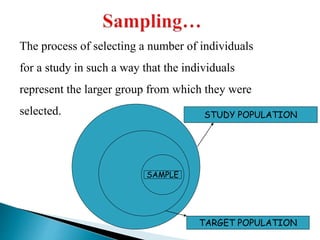
The process of selecting a number of individuals
for a study in such a way that the individuals
represent the larger group from which they were
selected.
TARGET POPULATION
STUDY POPULATION
SAMPLE
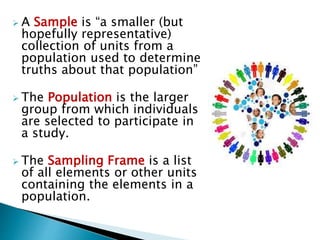
 A Sample is “a smaller (but
hopefully representative)
collection of units from a
population used to determine
truths about that population”
 The Population is the larger
group from which individuals
are selected to participate in
a study.
 The Sampling Frame is a list
of all elements or other units
containing the elements in a
population.
 To gather data about the population in order
to make an inference that can be generalized
to the population.
There are two Techniques for sampling;
i. Quantitative Research Technique.
ii. Qualitative Research Technique.
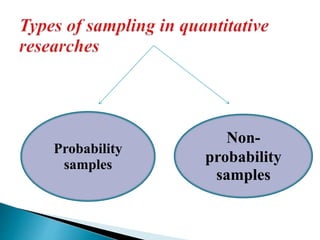
Probability
samples
Non-
probability
samples
 Broadly known as probability sampling.
 Best method to achieve a representative
sample.
 Four techniques;
1. Random sampling.
2. Stratified random.
3. Cluster.
4. Systematic.
1. Random sampling
Selecting subjects so that all members of a
population have an equal and independent chance of
being selected.
2. Stratified random sampling
The population is divided into two or more groups
called strata, according to some criteria, such as
geographic location, grade level, age, or income, and
subsamples are randomly selected from each strata.
3. Cluster sampling
 The process of randomly selecting intact groups, not
individuals, within the defined population sharing similar
characteristics.
 Clusters are locations within which an intact group of
members of the population can be found
 Examples
 Neighborhood
 Schools
 Classrooms
4. Systematic sampling
◦ Selecting every Kth subject from a list of the
members of the population
◦ Advantage
 Very easily done
◦ Disadvantages
 subgroups
 Some members of the population don’t have an equal
chance of being included
2. Purposive sampling
3. Quota sampling
1. Convenience sampling
Non-probability samples
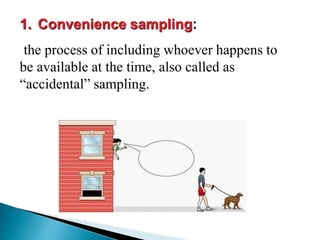
1. Convenience sampling:
the process of including whoever happens to
be available at the time, also called as
“accidental” sampling.
2. Purposive sampling:
the process whereby the researcher selects a
sample based on experience or knowledge of
the group to be sampled, also called as
“judgment” sampling.
3. Quota sampling
the process whereby a researcher
gathers data from individuals possessing
identified characteristics and quotas.
1) Maximal Variation Sampling
2) Typical Sampling
3) Theory or Concept Sampling
4) Homogeneous Sampling
5) Critical Sampling
6) Opportunistic Sampling
7) Snowball Sampling
It is when you select individuals that differ on a certain characteristic.
In this strategy you should first identify the characteristic and then find
individuals which display that characteristic.
2- Typical Sampling
It is when you study a person or a site that is “typical” to those
unfamiliar with the situation. You can select a typical sample by
collecting demographic data or survey data about all cases.
It is when you select individuals or sites because they can help you to
generate a theory or specific concepts within the theory. In this strategy
you need a full understanding of the concept or the theory expected to
discover during the study.
4- Homogeneous Sampling
It is when you select certain sites or people because they possess similar
characteristics. In this strategy, you need to identify the characteristics and
find individuals or sites that possess it.
It is when you study an exceptional case represents the central
phenomenon in dramatic terms.
6- Opportunistic Sampling
It is used after data collection begins, when you may find that you
need to collect new information to answer your research questions.
7- Snowball Sampling
It is when you don't know the best people to study because of the
unfamiliarity of the topic or the complexity of events. So you ask
participants during interviews to suggest other individuals to be
sampled.
Sampling techniques and types

Sampling techniques and types

  • 1.
    Sampling Techniques & SamplesTypes Submitted By: Nitish Sadotra
  • 2.
    The process ofselecting a number of individuals for a study in such a way that the individuals represent the larger group from which they were selected. TARGET POPULATION STUDY POPULATION SAMPLE
  • 3.
     A Sampleis “a smaller (but hopefully representative) collection of units from a population used to determine truths about that population”  The Population is the larger group from which individuals are selected to participate in a study.  The Sampling Frame is a list of all elements or other units containing the elements in a population.
  • 4.
     To gatherdata about the population in order to make an inference that can be generalized to the population. There are two Techniques for sampling; i. Quantitative Research Technique. ii. Qualitative Research Technique.
  • 5.
  • 6.
     Broadly knownas probability sampling.  Best method to achieve a representative sample.  Four techniques; 1. Random sampling. 2. Stratified random. 3. Cluster. 4. Systematic.
  • 7.
    1. Random sampling Selectingsubjects so that all members of a population have an equal and independent chance of being selected. 2. Stratified random sampling The population is divided into two or more groups called strata, according to some criteria, such as geographic location, grade level, age, or income, and subsamples are randomly selected from each strata.
  • 8.
    3. Cluster sampling The process of randomly selecting intact groups, not individuals, within the defined population sharing similar characteristics.  Clusters are locations within which an intact group of members of the population can be found  Examples  Neighborhood  Schools  Classrooms
  • 9.
    4. Systematic sampling ◦Selecting every Kth subject from a list of the members of the population ◦ Advantage  Very easily done ◦ Disadvantages  subgroups  Some members of the population don’t have an equal chance of being included
  • 10.
    2. Purposive sampling 3.Quota sampling 1. Convenience sampling Non-probability samples
  • 11.
    1. Convenience sampling: theprocess of including whoever happens to be available at the time, also called as “accidental” sampling.
  • 12.
    2. Purposive sampling: theprocess whereby the researcher selects a sample based on experience or knowledge of the group to be sampled, also called as “judgment” sampling.
  • 13.
    3. Quota sampling theprocess whereby a researcher gathers data from individuals possessing identified characteristics and quotas.
  • 14.
    1) Maximal VariationSampling 2) Typical Sampling 3) Theory or Concept Sampling 4) Homogeneous Sampling 5) Critical Sampling 6) Opportunistic Sampling 7) Snowball Sampling
  • 15.
    It is whenyou select individuals that differ on a certain characteristic. In this strategy you should first identify the characteristic and then find individuals which display that characteristic. 2- Typical Sampling It is when you study a person or a site that is “typical” to those unfamiliar with the situation. You can select a typical sample by collecting demographic data or survey data about all cases.
  • 16.
    It is whenyou select individuals or sites because they can help you to generate a theory or specific concepts within the theory. In this strategy you need a full understanding of the concept or the theory expected to discover during the study. 4- Homogeneous Sampling It is when you select certain sites or people because they possess similar characteristics. In this strategy, you need to identify the characteristics and find individuals or sites that possess it.
  • 17.
    It is whenyou study an exceptional case represents the central phenomenon in dramatic terms. 6- Opportunistic Sampling It is used after data collection begins, when you may find that you need to collect new information to answer your research questions. 7- Snowball Sampling It is when you don't know the best people to study because of the unfamiliarity of the topic or the complexity of events. So you ask participants during interviews to suggest other individuals to be sampled.