SOC2002: Sociological Analysis and Research Methods LECTURE 2: Social Research Design (2) Lecturer: Bonnie Green [email_address]
Social Research Design (2):  Overview What is social research and why do we bother? Characteristics of social research Social research as a process The steps in that process: Overview Today: object  -> topic -> question(s)
Why do we do research? Required by our course Personal interest in a particular object or question Personal interest in specific social theory or problem Might be getting paid to do it A puzzle in your disciplinary literature
What is social research? Social research is concerned with exploration and discovery in the social world Not an end in itself, but a means of finding something out about something means of gathering more knowledge means of developing and testing concepts and theories
What is social research? A process “ Research is a careful search, capable of withstanding close examination, for information which can be used to produce or enhance knowledge” (Pole and Lampard, 2002: 2)
Characteristics of research Systematic inquiry with the objective of making claims about the world Claims that go beyond a hunch, conjecture, intuition, anecdote or common sense Claims are warranted and/or based on empirical evidence
Characteristics of research Subject to criteria of public accountability Display evidence based conclusions open to critical scrutiny by academics by policy makers by employers robust methodology is  key  to this
Characteristics of research Lots of different types of research e.g. based on primary or secondary data  Common distinction is between quantitative and qualitative research Quantitative Data are “numerical and based on counting or enumerating” (Pole and Lampard, 2002: 4) Often statistical involving measurements and scores N  is usually large
Characteristics of research Qualitative Data intended “to convey the essence or quality of the experience” (Pole and Lampard, 2002: 4) Often discursive involving whole texts, images, sound recordings, videos N  is often small Can you mix methods? When should you use qualitative and when should you use quantitative?
Recognising social research The Primary Review (12 th  Oct 2007): http://www.primaryreview.org.uk/index.html http://news.bbc.co.uk/1/hi/education/7039966.stm http://www.bbc.co.uk/radio4/today/ Is this an example of social research? Watch this space…
Research as a ‘process’ Qualitative and quantitative techniques are used in different situations to produce different kinds of knowledge Highlights that social research is an  integrated process Number of relatively distinct steps but there is an  important relationship between the way research is carried out and the knowledge it produces
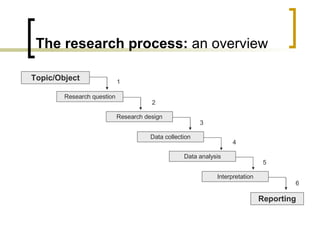
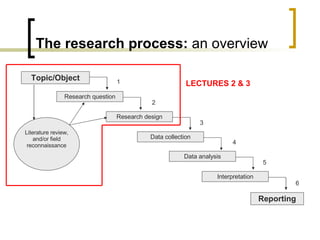
The research process:  an overview Reporting Topic/Object 1 2 3 4 5 6 Research question Research design Data collection Data analysis Interpretation
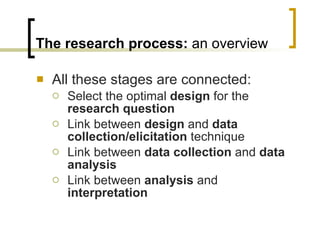
The research process:  an overview All these stages are connected: Select the optimal  design  for the  research question Link between  design  and  data collection/elicitation  technique Link between  data collection  and  data analysis Link between  analysis  and  interpretation
The research process:  an overview Reporting Literature review, and/or field reconnaissance Topic/Object 1 2 3 4 5 6 LECTURES 2 & 3 Research question Research design Data collection Data analysis Interpretation
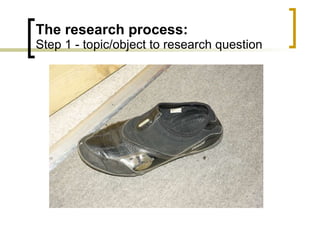
The research process: Step 1 - topic/object to research question What are suitable concepts and/or objects for social research?
The research process: Step 1 - topic/object to research question
The research process: Step 1 - topic/object to research question What are suitable objects for social research? What are suitable topics? Globalisation The State Intimacy Identity Risk Network society
The research process: Step 1 - topic/object to research question Globalisation: The impact of globalisation on state autonomy Has globalisation constrained the decision-making powers of democratic states? Is there a relationship between degree of trade openness and the quality of state transfers in OCED countries between 1990-2000? What is the sign of the slope coefficient in the regression of state transfers as a % of GDP and $ value of (exports+imports)/GDP?
The research process: Step 1 - topic/object to research question Broad topic area  -> specific questions -> indicators “ progressive focussing” (Pole and Lampard, 2002) How do you get from 1 to 4? Literature review and/or field reconnaissance
The research process: The Literature review What is it? A focussed survey or  systematic review  of what is already known about your topic/object Why is it important? Substantively important Methodologically important Allows identification of relevant conceptual frameworks
The research process: The Literature review How do you do it? Use your existing knowledge Databases on the library catalogue  http://www.library.ex.ac.uk/electronic/databases.html ‘snowballing’ Consider underlying social issues Don’t be constrained by disciplinary boundaries
The research process: The Literature review How do you keep track of it? Keep records! Notification features Rank your sources Essential Important Relevant Supporting Irrelevant/ inappropriate
The research process: Step 2 - research question to research design Continuing the processes of “progressive focussing” Exercise in your seminar groups…
Social Research Design (2):  Summary Moving from topic/concept to research question: Think of lots of “large contextual questions” Review them and decide on relative importance Consider how they might be addressed, what type of knowledge they might produce and whether this produces a  feasible  research design

SOC2002 Lecture 2

  • 1.
    SOC2002: Sociological Analysisand Research Methods LECTURE 2: Social Research Design (2) Lecturer: Bonnie Green [email_address]
  • 2.
    Social Research Design(2): Overview What is social research and why do we bother? Characteristics of social research Social research as a process The steps in that process: Overview Today: object -> topic -> question(s)
  • 3.
    Why do wedo research? Required by our course Personal interest in a particular object or question Personal interest in specific social theory or problem Might be getting paid to do it A puzzle in your disciplinary literature
  • 4.
    What is socialresearch? Social research is concerned with exploration and discovery in the social world Not an end in itself, but a means of finding something out about something means of gathering more knowledge means of developing and testing concepts and theories
  • 5.
    What is socialresearch? A process “ Research is a careful search, capable of withstanding close examination, for information which can be used to produce or enhance knowledge” (Pole and Lampard, 2002: 2)
  • 6.
    Characteristics of researchSystematic inquiry with the objective of making claims about the world Claims that go beyond a hunch, conjecture, intuition, anecdote or common sense Claims are warranted and/or based on empirical evidence
  • 7.
    Characteristics of researchSubject to criteria of public accountability Display evidence based conclusions open to critical scrutiny by academics by policy makers by employers robust methodology is key to this
  • 8.
    Characteristics of researchLots of different types of research e.g. based on primary or secondary data Common distinction is between quantitative and qualitative research Quantitative Data are “numerical and based on counting or enumerating” (Pole and Lampard, 2002: 4) Often statistical involving measurements and scores N is usually large
  • 9.
    Characteristics of researchQualitative Data intended “to convey the essence or quality of the experience” (Pole and Lampard, 2002: 4) Often discursive involving whole texts, images, sound recordings, videos N is often small Can you mix methods? When should you use qualitative and when should you use quantitative?
  • 10.
    Recognising social researchThe Primary Review (12 th Oct 2007): http://www.primaryreview.org.uk/index.html http://news.bbc.co.uk/1/hi/education/7039966.stm http://www.bbc.co.uk/radio4/today/ Is this an example of social research? Watch this space…
  • 11.
    Research as a‘process’ Qualitative and quantitative techniques are used in different situations to produce different kinds of knowledge Highlights that social research is an integrated process Number of relatively distinct steps but there is an important relationship between the way research is carried out and the knowledge it produces
  • 12.
    The research process: an overview Reporting Topic/Object 1 2 3 4 5 6 Research question Research design Data collection Data analysis Interpretation
  • 13.
    The research process: an overview All these stages are connected: Select the optimal design for the research question Link between design and data collection/elicitation technique Link between data collection and data analysis Link between analysis and interpretation
  • 14.
    The research process: an overview Reporting Literature review, and/or field reconnaissance Topic/Object 1 2 3 4 5 6 LECTURES 2 & 3 Research question Research design Data collection Data analysis Interpretation
  • 15.
    The research process:Step 1 - topic/object to research question What are suitable concepts and/or objects for social research?
  • 16.
    The research process:Step 1 - topic/object to research question
  • 17.
    The research process:Step 1 - topic/object to research question What are suitable objects for social research? What are suitable topics? Globalisation The State Intimacy Identity Risk Network society
  • 18.
    The research process:Step 1 - topic/object to research question Globalisation: The impact of globalisation on state autonomy Has globalisation constrained the decision-making powers of democratic states? Is there a relationship between degree of trade openness and the quality of state transfers in OCED countries between 1990-2000? What is the sign of the slope coefficient in the regression of state transfers as a % of GDP and $ value of (exports+imports)/GDP?
  • 19.
    The research process:Step 1 - topic/object to research question Broad topic area -> specific questions -> indicators “ progressive focussing” (Pole and Lampard, 2002) How do you get from 1 to 4? Literature review and/or field reconnaissance
  • 20.
    The research process:The Literature review What is it? A focussed survey or systematic review of what is already known about your topic/object Why is it important? Substantively important Methodologically important Allows identification of relevant conceptual frameworks
  • 21.
    The research process:The Literature review How do you do it? Use your existing knowledge Databases on the library catalogue http://www.library.ex.ac.uk/electronic/databases.html ‘snowballing’ Consider underlying social issues Don’t be constrained by disciplinary boundaries
  • 22.
    The research process:The Literature review How do you keep track of it? Keep records! Notification features Rank your sources Essential Important Relevant Supporting Irrelevant/ inappropriate
  • 23.
    The research process:Step 2 - research question to research design Continuing the processes of “progressive focussing” Exercise in your seminar groups…
  • 24.
    Social Research Design(2): Summary Moving from topic/concept to research question: Think of lots of “large contextual questions” Review them and decide on relative importance Consider how they might be addressed, what type of knowledge they might produce and whether this produces a feasible research design