Sample &Sampling
    Design
     DR.G.SINGARAVELU
      Associate Professor
          UGC-ASC
   BHARATHIAR UNIVERSITY
        COIMBATORE
DEFINITIONS
 Population-totality of the objects or
 individuals regarding inferences are
      made in a sampling study.

Sample-smaller representation of a
          large whole.

Sampling- is a process of selecting a
 subset of randomised number of the
 members of the population of a study
Sampling frame /Source list -complete list of all the
  members/ units of the population from which each
  sampling unit
Sample design / sample plan-is a definite plan for obtaining
  a sample from a given population.

Sampling unit-is a geographical one (state,district)

Sample size-number of items selected for the study

Sampling Error-is the difference between population value
  and sample value.

Sampling distribution-is the relative frequency distribution of
  samples.
CENSUS/SAMPLING
 Census-collection of data from
       whole population.

Sampling is taking any portion of
  a population or universe as
      representative of that
           population.

Sampling method has been using
 in social science research since
      1754 by A.L.BOWLEY
Indispensable of sampling in
            Research
Saves lot of time
Provides accuracy
Controls unlimited data
Studies individual
Reduces cost
Gives greater speed /helps to complete in
stipulated time
Assists to collect intensive and exhaustive data
Organises conveniences
Steps in Sampling Process /
           Procedures
Define the population (element,units,extent and
time)
Specify sampling frame(Telephone directory)
Specify sampling unit (retailers, our
product,students,unemployed)
Specify sampling method/technique
Determine sampling size
Specify sampling size-(optimum sample)
Specify sampling plan
Select the sample
PRINCIPLES OF SAMPLING
Two important principles
Principles of Statistical Regularity-random
  (sufficient representative of the sample),
Principles of Large Numbers-(steadiness ,
  stability and consistency)
Principles are referred to as the laws of
  sampling
Good sampling
The sample should be true representative of
universe.
No bias in selecting sample
Quality of the sample should be same
Regulating conditions should be same for all
individual
Sampling needs to be adequate
Estimate the sampling error
Sample study should be applicable to all items
Preparing a sampling design
Type of universe (set of objects)
Finite/Non-finite
Sampling unit (district,school,products)
Sampling frame
Sampling size
Sampling technique
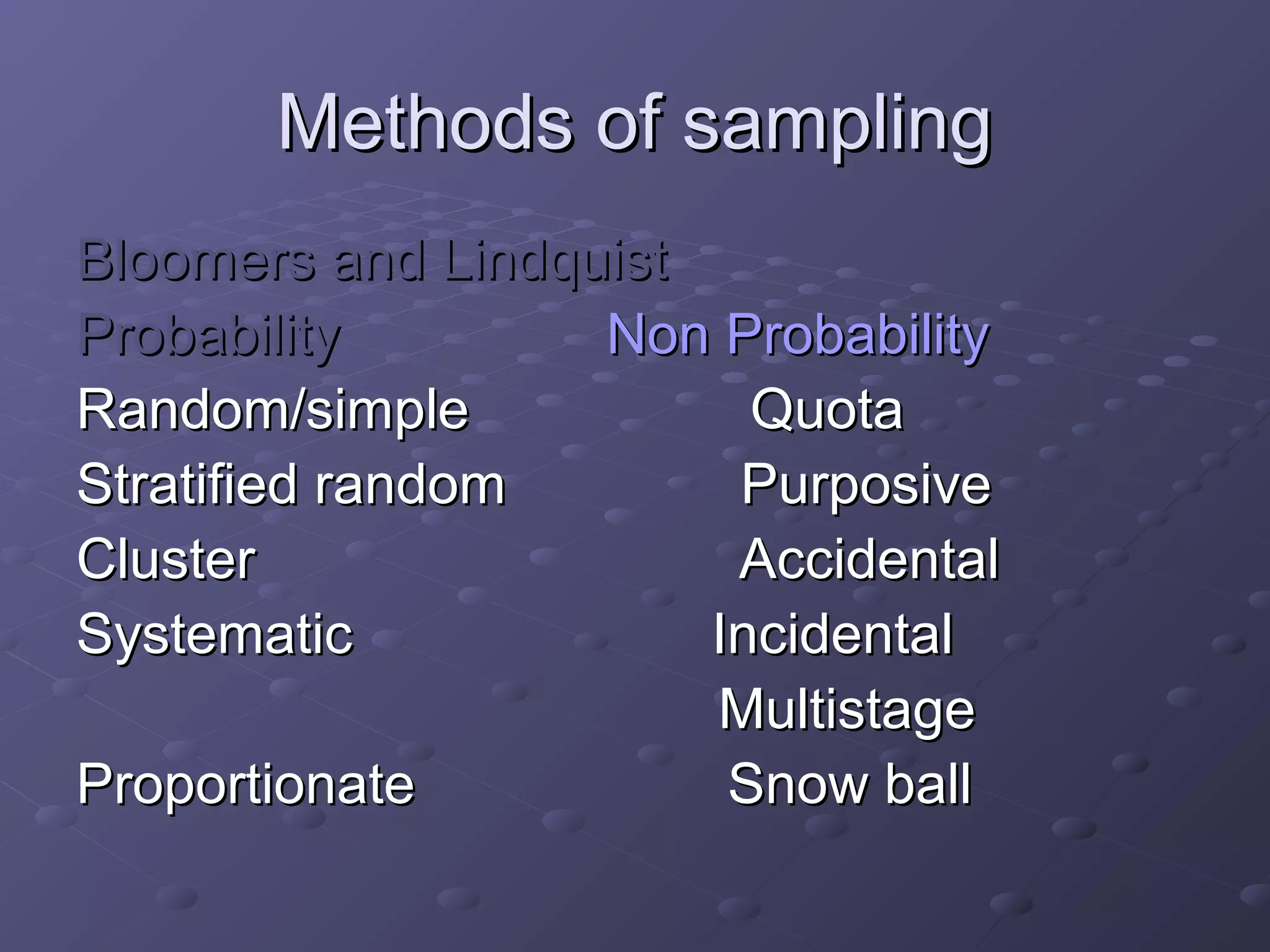
Methods of sampling
Bloomers and Lindquist
Probability        Non Probability
Random/simple            Quota
Stratified random       Purposive
Cluster                 Accidental
Systematic             Incidental
                       Multistage
Proportionate           Snow ball
Probability
  Probability sampling technique is one
in which every unit in the population has a
chance of being selected in the sample
  This probability can be accurately
determined.
Nonprobability sampling
    Nonprobability sampling is any sampling
    method where some elements of the population
    have no chance of selection (these are
    sometimes referred to as 'out of
    coverage'/'undercovered'), or where the
    probability of selection can't be accurately
    determined.
     It involves the selection of elements based on
    assumptions regarding the population of interest,
    which forms the criteria for selection.
    The selection of elements is non random
.
Simple random sampling
In a simple random sample ('SRS') of a given size, all
such subsets of the frame are given an equal probability.
Method of chance selection. Lottery method,Tippet’s
table, Kendall and Babington smith, Fisher and Yate’s
numbers.
Simple random sampling with replacement:- equal
probability selection of each unit=1/N (Monte-Carlo
simulation)
Simple random without replacement -varying probability
selection of each. First unit=1/N , Second unit=1/N-1,
Probality of selection of the nth unit=1/N-(n-1)(Monte-
Carlo simulation
Systematic
Systematic sampling involves a random
start and then proceeds with the selection
of every kth element from then onwards.
In this case, k=(population size/sample
size).
 It is important that the starting point is not
automatically the first in the list, but is
instead randomly chosen from within the
first to the kth element in the list
Sampling interval width=I=N/n=800/40=20
Stratified or Mixed sampling
Where the population embraces a number of
distinct categories, the frame can be organized
by these categories into separate "strata." Each
stratum is then sampled as an independent sub-
population, out of which individual elements can
be randomly selected .(homogenous group)

Two types-Proportionate (equal number of unit
from each stratum proportion to size of the
strata) and Disproportionate (not equal number
of unit from each stratum proportion to size of
the strata)
Cluster sampling
Cluster sampling is an example of 'two-
stage sampling' or 'multistage sampling/
Multi phase sampling'
in the first stage a sample of areas is
chosen
in the second stage a sample of
respondents within those areas is
selected.(several stages)- State level,Dist
level,Village level,Hosehold level.
Cluster Sampling

This stepwise process is useful for those who
know little about the population they’re studying.
 First, the researcher would divide the population
into clusters (usually geographic boundaries).
Then, the researcher randomly samples the
clusters.
Finally, the researcher must measure all units
within the sampled clusters.
 Researchers use this method when economy of
administration is important.
Sequential sampling
Single sampling

Double sampling

Multiple sampling
Non probability
Non probability sampling does not
involve random selection and
probability sampling does .
Multistage sampling
Multistage sampling is a complex form of cluster
sampling in which two or more levels of units are
embedded one in the other.
The first stage consists of constructing the clusters that
will be used to sample frame.
In the second stage, a sample of primary units is
randomly selected from each cluster (rather than using
all units contained in all selected clusters).
In following stages, in each of those selected clusters,
additional samples of units are selected and so on.
All ultimate units (individuals, for instance) selected at
the last step of this procedure are surveyed.
Purposive/Judgment Sampling

In purposive sampling, selecting sample
with a purpose in mind
Purposive sampling can be very useful for
situations where we need to reach a
targeted sample quickly and where
sampling for proportionality is not the
primary concern.
It is for pilot study
Questions / questionnaires may be tested.
Quota sampling

Quota sampling, the population is first
segmented into mutually exclusive sub-groups,
just as in stratified sampling.
Then judgment is used to select the subjects or
units from each segment based on a specified
proportion. For example, an interviewer may be
told to sample 200 females and 300 males
between the age of 45 and 60.
Proportional quota sampling
Nonproportional quota sampling
It is very popular for market survey and opinion
poll.
Snowball Sampling

 Identifying someone who meets the
criteria for inclusion in the study.
Snowball sampling is especially useful
when we are trying to reach populations
that are inaccessible or hard to find
This method would hardly lead to
representative samples
Intially certain members and add few
members latter
Convenience sampling
Convenience sampling (sometimes
known as grab or opportunity sampling)
is a type of nonprobability sampling which
involves the sample being drawn from that
part of the population which is close to
hand
Accidental Sampling
The researcher can select any sample in
any place, can collect the data from
pedestrian also.
It can be used for exploratory studies
It has sample error.
It has less accuracy
Combination of Probability sampling
  and Non Probability sampling
If sampling is carried out in series of
stages, it is possible to combine
probability and non-probability sampling in
one design
Users of particular product in one street
for the particular group of people.
Utility of the particular product in the town.
Sampling Errors
The errors which arise due to the use of
sampling surveys are known as the sampling
errors.
Two types of sampling errors-Biased Errors,
Unbiased Errors
Biased Errors-Which arise due to selection of
sampling techniques.-size of the sample
Unbiased Errors / Random sampling errors-arise
due to chance differences between the members
of the population included in the sample and not
included.
Methods of reducing Sampling
             Errors
Specific problem selection
Systematic documentation of related
research
Effective enumeration
Effective pre testing
Controlling methodological bias
Selection of appropriate sampling
techniques.
Non-sampling Errors
Non-sampling errors refers to biases and mistakes in
  selection of sample.
CAUSES FOR NON-SAMPLING ERRORS
  Sampling operations
  Inadequate of response
  Misunderstanding the concept
  Lack of knowledge
  Concealment of the truth.
  Loaded questions
  Processing errors
  Sample size
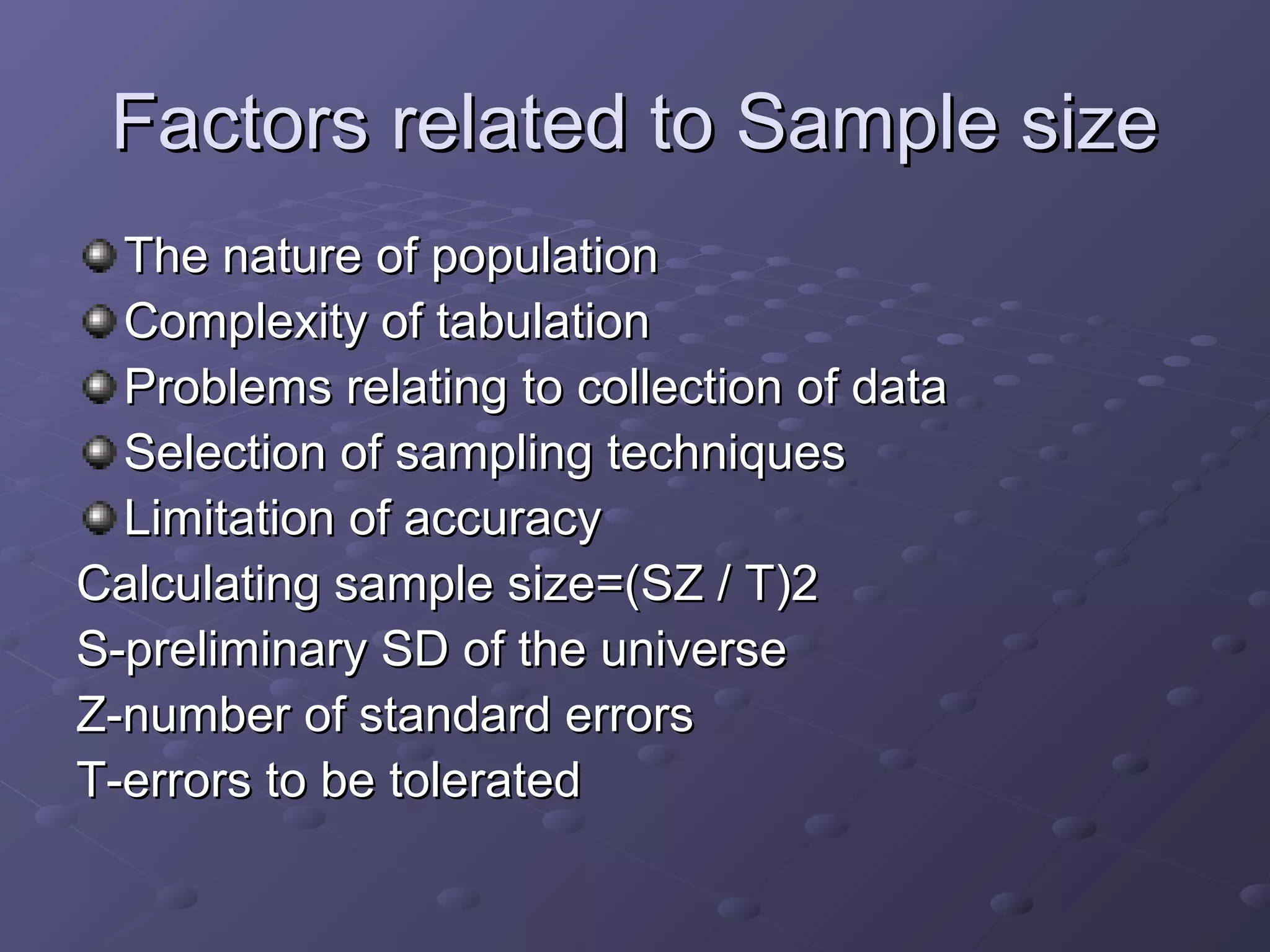
Factors related to Sample size
  The nature of population
  Complexity of tabulation
  Problems relating to collection of data
  Selection of sampling techniques
  Limitation of accuracy
Calculating sample size=(SZ / T)2
S-preliminary SD of the universe
Z-number of standard errors
T-errors to be tolerated
Sampling design

Sampling design

  • 1.
    Sample &Sampling Design DR.G.SINGARAVELU Associate Professor UGC-ASC BHARATHIAR UNIVERSITY COIMBATORE
  • 2.
    DEFINITIONS Population-totality ofthe objects or individuals regarding inferences are made in a sampling study. Sample-smaller representation of a large whole. Sampling- is a process of selecting a subset of randomised number of the members of the population of a study
  • 3.
    Sampling frame /Sourcelist -complete list of all the members/ units of the population from which each sampling unit Sample design / sample plan-is a definite plan for obtaining a sample from a given population. Sampling unit-is a geographical one (state,district) Sample size-number of items selected for the study Sampling Error-is the difference between population value and sample value. Sampling distribution-is the relative frequency distribution of samples.
  • 4.
    CENSUS/SAMPLING Census-collection ofdata from whole population. Sampling is taking any portion of a population or universe as representative of that population. Sampling method has been using in social science research since 1754 by A.L.BOWLEY
  • 5.
    Indispensable of samplingin Research Saves lot of time Provides accuracy Controls unlimited data Studies individual Reduces cost Gives greater speed /helps to complete in stipulated time Assists to collect intensive and exhaustive data Organises conveniences
  • 6.
    Steps in SamplingProcess / Procedures Define the population (element,units,extent and time) Specify sampling frame(Telephone directory) Specify sampling unit (retailers, our product,students,unemployed) Specify sampling method/technique Determine sampling size Specify sampling size-(optimum sample) Specify sampling plan Select the sample
  • 7.
    PRINCIPLES OF SAMPLING Twoimportant principles Principles of Statistical Regularity-random (sufficient representative of the sample), Principles of Large Numbers-(steadiness , stability and consistency) Principles are referred to as the laws of sampling
  • 8.
    Good sampling The sampleshould be true representative of universe. No bias in selecting sample Quality of the sample should be same Regulating conditions should be same for all individual Sampling needs to be adequate Estimate the sampling error Sample study should be applicable to all items
  • 9.
    Preparing a samplingdesign Type of universe (set of objects) Finite/Non-finite Sampling unit (district,school,products) Sampling frame Sampling size Sampling technique
  • 10.
    Methods of sampling Bloomersand Lindquist Probability Non Probability Random/simple Quota Stratified random Purposive Cluster Accidental Systematic Incidental Multistage Proportionate Snow ball
  • 11.
    Probability Probabilitysampling technique is one in which every unit in the population has a chance of being selected in the sample This probability can be accurately determined.
  • 12.
    Nonprobability sampling Nonprobability sampling is any sampling method where some elements of the population have no chance of selection (these are sometimes referred to as 'out of coverage'/'undercovered'), or where the probability of selection can't be accurately determined. It involves the selection of elements based on assumptions regarding the population of interest, which forms the criteria for selection. The selection of elements is non random .
  • 13.
    Simple random sampling Ina simple random sample ('SRS') of a given size, all such subsets of the frame are given an equal probability. Method of chance selection. Lottery method,Tippet’s table, Kendall and Babington smith, Fisher and Yate’s numbers. Simple random sampling with replacement:- equal probability selection of each unit=1/N (Monte-Carlo simulation) Simple random without replacement -varying probability selection of each. First unit=1/N , Second unit=1/N-1, Probality of selection of the nth unit=1/N-(n-1)(Monte- Carlo simulation
  • 14.
    Systematic Systematic sampling involvesa random start and then proceeds with the selection of every kth element from then onwards. In this case, k=(population size/sample size). It is important that the starting point is not automatically the first in the list, but is instead randomly chosen from within the first to the kth element in the list Sampling interval width=I=N/n=800/40=20
  • 15.
    Stratified or Mixedsampling Where the population embraces a number of distinct categories, the frame can be organized by these categories into separate "strata." Each stratum is then sampled as an independent sub- population, out of which individual elements can be randomly selected .(homogenous group) Two types-Proportionate (equal number of unit from each stratum proportion to size of the strata) and Disproportionate (not equal number of unit from each stratum proportion to size of the strata)
  • 16.
    Cluster sampling Cluster samplingis an example of 'two- stage sampling' or 'multistage sampling/ Multi phase sampling' in the first stage a sample of areas is chosen in the second stage a sample of respondents within those areas is selected.(several stages)- State level,Dist level,Village level,Hosehold level.
  • 17.
    Cluster Sampling This stepwiseprocess is useful for those who know little about the population they’re studying. First, the researcher would divide the population into clusters (usually geographic boundaries). Then, the researcher randomly samples the clusters. Finally, the researcher must measure all units within the sampled clusters. Researchers use this method when economy of administration is important.
  • 18.
  • 19.
    Non probability Non probabilitysampling does not involve random selection and probability sampling does .
  • 20.
    Multistage sampling Multistage samplingis a complex form of cluster sampling in which two or more levels of units are embedded one in the other. The first stage consists of constructing the clusters that will be used to sample frame. In the second stage, a sample of primary units is randomly selected from each cluster (rather than using all units contained in all selected clusters). In following stages, in each of those selected clusters, additional samples of units are selected and so on. All ultimate units (individuals, for instance) selected at the last step of this procedure are surveyed.
  • 21.
    Purposive/Judgment Sampling In purposivesampling, selecting sample with a purpose in mind Purposive sampling can be very useful for situations where we need to reach a targeted sample quickly and where sampling for proportionality is not the primary concern. It is for pilot study Questions / questionnaires may be tested.
  • 22.
    Quota sampling Quota sampling,the population is first segmented into mutually exclusive sub-groups, just as in stratified sampling. Then judgment is used to select the subjects or units from each segment based on a specified proportion. For example, an interviewer may be told to sample 200 females and 300 males between the age of 45 and 60. Proportional quota sampling Nonproportional quota sampling It is very popular for market survey and opinion poll.
  • 23.
    Snowball Sampling Identifyingsomeone who meets the criteria for inclusion in the study. Snowball sampling is especially useful when we are trying to reach populations that are inaccessible or hard to find This method would hardly lead to representative samples Intially certain members and add few members latter
  • 24.
    Convenience sampling Convenience sampling(sometimes known as grab or opportunity sampling) is a type of nonprobability sampling which involves the sample being drawn from that part of the population which is close to hand
  • 25.
    Accidental Sampling The researchercan select any sample in any place, can collect the data from pedestrian also. It can be used for exploratory studies It has sample error. It has less accuracy
  • 26.
    Combination of Probabilitysampling and Non Probability sampling If sampling is carried out in series of stages, it is possible to combine probability and non-probability sampling in one design Users of particular product in one street for the particular group of people. Utility of the particular product in the town.
  • 27.
    Sampling Errors The errorswhich arise due to the use of sampling surveys are known as the sampling errors. Two types of sampling errors-Biased Errors, Unbiased Errors Biased Errors-Which arise due to selection of sampling techniques.-size of the sample Unbiased Errors / Random sampling errors-arise due to chance differences between the members of the population included in the sample and not included.
  • 28.
    Methods of reducingSampling Errors Specific problem selection Systematic documentation of related research Effective enumeration Effective pre testing Controlling methodological bias Selection of appropriate sampling techniques.
  • 29.
    Non-sampling Errors Non-sampling errorsrefers to biases and mistakes in selection of sample. CAUSES FOR NON-SAMPLING ERRORS Sampling operations Inadequate of response Misunderstanding the concept Lack of knowledge Concealment of the truth. Loaded questions Processing errors Sample size
  • 30.
    Factors related toSample size The nature of population Complexity of tabulation Problems relating to collection of data Selection of sampling techniques Limitation of accuracy Calculating sample size=(SZ / T)2 S-preliminary SD of the universe Z-number of standard errors T-errors to be tolerated