Quota Sampling
Types of quota sampling
Controlled quota sampling
– involves
introduction of
certain restrictions
in order to limit
researcher’s choice
of samples.
Uncontrolled quota
sampling
– resembles convenience
sampling method in a
way that researcher is
free to choose sample
group members
according to his/her
will.
How to use quota sampling?
1. Divide the sample population into
subgroups
2. Figure out the weightages of subgroups
3. Select an appropriate sample size
4. Survey while adhering to the subgroup
population proportions
When to use quota sampling?
– To investigate a trait or characteristic of
a certain subgroup
– To observe relationships between
subgroups
Advantages
– Time constraint (comparing to stratified)
– Cost-effective
– Absence of sampling frame
Disadvantages
– Unable to calculate sampling error
– Sampling bias
– Quality of the work may suffer
– Does not represent the entire population
– Cannot make statistical inferences
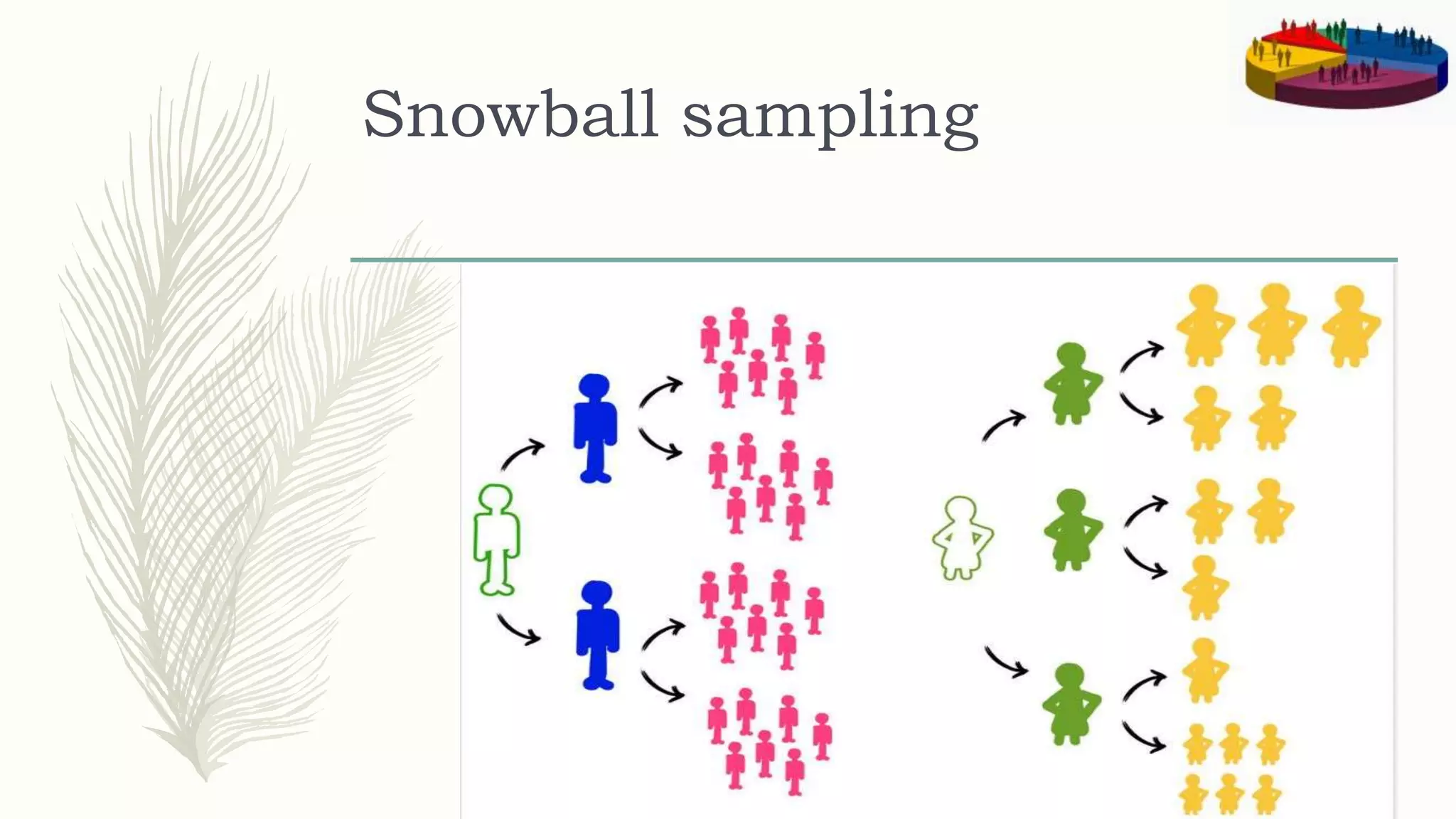
Snowball sampling
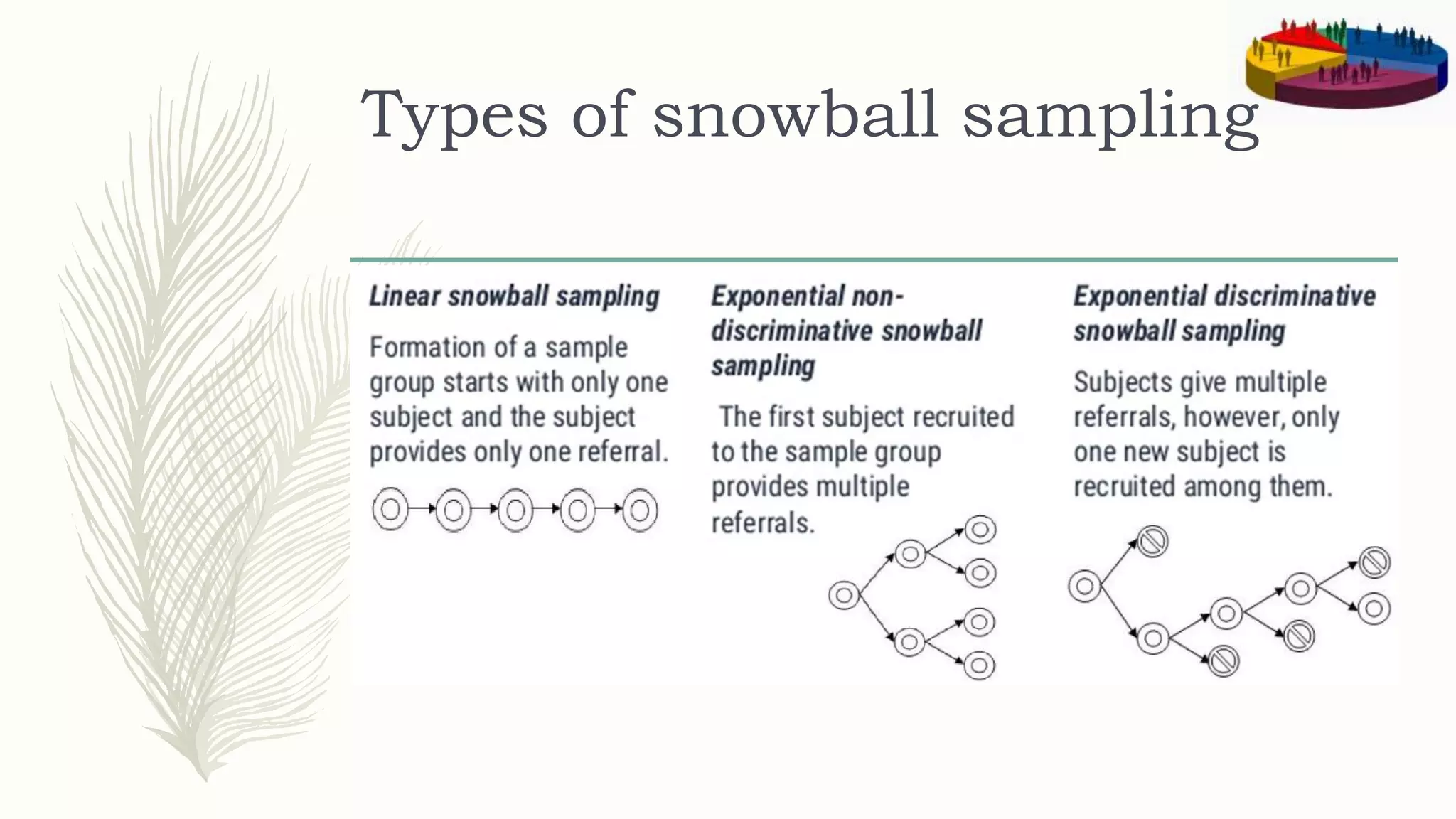
Types of snowball sampling
Advantages
– Facilitates to access hidden populations
– Can produce in-depth results and relatively
quickly
– Cost-effective
– Simple process
– Less planning
– Fewer workforce
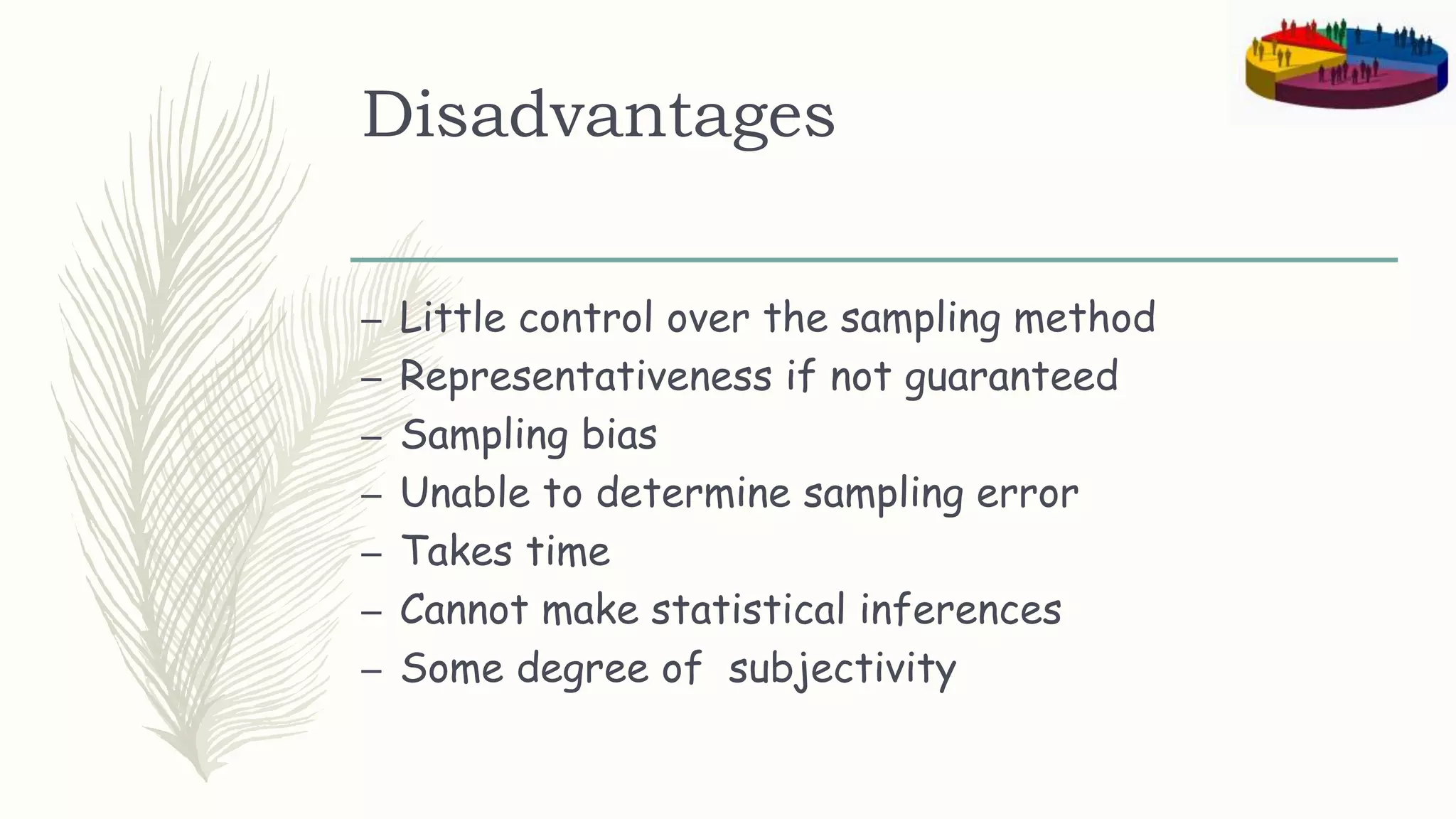
Disadvantages
– Little control over the sampling method
– Representativeness if not guaranteed
– Sampling bias
– Unable to determine sampling error
– Takes time
– Cannot make statistical inferences
– Some degree of subjectivity
Quota sampling vs Snowball
sampling
Quota sampling Snowball sampling
Characteristics Common (Eg: gender, age) Very rare
Relies on Researchers judgment or
convenience
First respondent
Time Low Varies depending on trust

Quota and snowball

  • 1.
  • 2.
    Types of quotasampling Controlled quota sampling – involves introduction of certain restrictions in order to limit researcher’s choice of samples. Uncontrolled quota sampling – resembles convenience sampling method in a way that researcher is free to choose sample group members according to his/her will.
  • 3.
    How to usequota sampling? 1. Divide the sample population into subgroups 2. Figure out the weightages of subgroups 3. Select an appropriate sample size 4. Survey while adhering to the subgroup population proportions
  • 4.
    When to usequota sampling? – To investigate a trait or characteristic of a certain subgroup – To observe relationships between subgroups
  • 5.
    Advantages – Time constraint(comparing to stratified) – Cost-effective – Absence of sampling frame
  • 6.
    Disadvantages – Unable tocalculate sampling error – Sampling bias – Quality of the work may suffer – Does not represent the entire population – Cannot make statistical inferences
  • 7.
  • 8.
  • 9.
    Advantages – Facilitates toaccess hidden populations – Can produce in-depth results and relatively quickly – Cost-effective – Simple process – Less planning – Fewer workforce
  • 10.
    Disadvantages – Little controlover the sampling method – Representativeness if not guaranteed – Sampling bias – Unable to determine sampling error – Takes time – Cannot make statistical inferences – Some degree of subjectivity
  • 11.
    Quota sampling vsSnowball sampling Quota sampling Snowball sampling Characteristics Common (Eg: gender, age) Very rare Relies on Researchers judgment or convenience First respondent Time Low Varies depending on trust

Editor's Notes

  • #2 Definition and examples Application of quota sampling ensures that sample group represents certain characteristics of the population chosen by the researcher.
  • #5 Researchers choose quota samples as it allows the researchers to sample a subgroup that is of great interest to the study. If a study aims to investigate a trait or a characteristic of a certain subgroup, thus type of sampling is the ideal technique. It allows researchers to observe relationships between subgroups. In some studies, traits of a certain subgroup interact with other traits of another subgroup. In such cases, it is also necessary for the researcher to use this type of sampling technique.
  • #6 When time is limited and short
  • #7 Quality of the work may suffer due to researcher incompetency and/or lack of experience Sampling bias – resulting due to the selection of units to be included in the sample based on ease of access and cost considerations
  • #8 Also known as chain referral sampling Definition and examples When to use snowball sampling? When studying about hidden, vulnerable and more impenetrable social groups.
  • #10 Ability to recruit hidden populations
  • #11 There is no guarantee about the representativeness of samples. It is not possible to determine the actual pattern of distribution of population. Can miss isolates who are not connected to any network. Oversampling a particular network of peers can lead to bias Takes time to study and get prior knowledge and to build trust and get first respondents - initial hostility Referals will largely epend on the subjective perceptions of initial respondents about the involvement of others in the activity. Thus the most popular long-term residents or those with wider social networks are more likely to be identified than others.