Sleep pattern and its
disturbance
Evaluator: Dr Mahalingham V Presenter: Shruti Shirke
[Asst. professor, CON AIIMS BBSR] M.Sc Neuroscience Nursing
Introduction
• Nearly one third of our life is spent in sleep.
• Sleep is a cyclic physiological process that alternate with longer
period of wakefulness by decreased ability to react to stimuli.
• The sleep wake cycle influences and regulates the physiological
and behavioural response, restores immunity, vital processes,
mood etc
Definition: ‘Sleep’
• According to baillier’s nurses dictionary
• “A period of rest for the body and mind, during which bodily
functions are partially suspended”.
• Sleep can be defines as the state of consciousness characterized by
decreased awareness and responsiveness to stimuli”.
‘Circadian Rhythm’
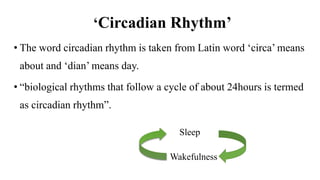
• The word circadian rhythm is taken from Latin word ‘circa’ means
about and ‘dian’ means day.
• “biological rhythms that follow a cycle of about 24hours is termed
as circadian rhythm”.
Sleep
Wakefulness
Circadian Rhythm
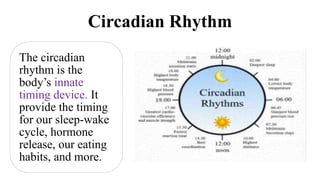
The circadian
rhythm is the
body’s innate
timing device. It
provide the timing
for our sleep-wake
cycle, hormone
release, our eating
habits, and more.
Physiology of Sleep
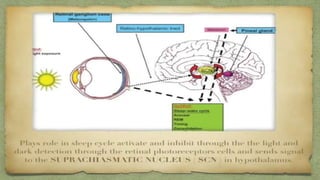
Retinal ganglion cells:
Supra chiasmatic nucleus:
Melatonin:
Stages of Sleep
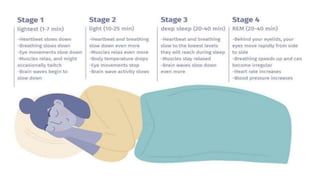
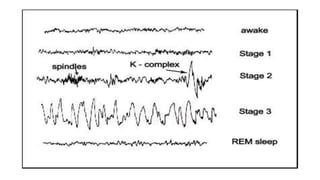
• Polysomnographic profiles and electrophysiologic changes in brain waves,
eye moment and muscle tone shows 5 sleep stages and 2 types of sleep.
•S- Sleep (NREM)
•D- Sleep (REM)
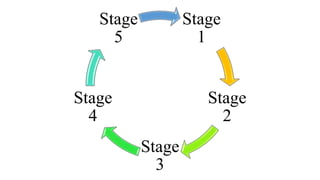
Stage
1
Stage
2
Stage
3
Stage
4
Stage
5
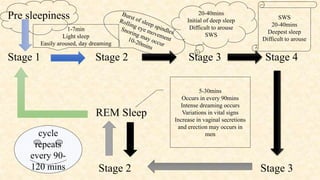
Pre sleepiness
Stage 1 Stage 2 Stage 3 Stage 4
REM Sleep
Stage 2 Stage 3
1-7min
Light sleep
Easily aroused, day dreaming
20-40mins
Initial of deep sleep
Difficult to arouse
SWS
SWS
20-40mins
Deepest sleep
Difficult to arouse
5-30mins
Occurs in every 90mins
Intense dreaming occurs
Variations in vital signs
Increase in vaginal secretions
and erection may occurs in
men
cycle
repeats
every 90-
120 mins
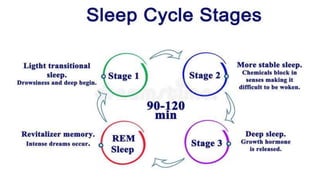
Stages of sleep
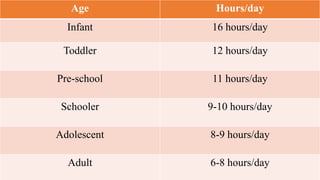
Normal sleep requirement
Age Hours/day
Infant 16 hours/day
Toddler 12 hours/day
Pre-school 11 hours/day
Schooler 9-10 hours/day
Adolescent 8-9 hours/day
Adult 6-8 hours/day
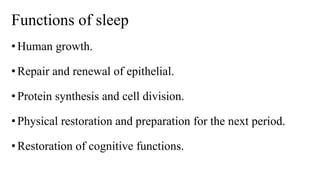
Functions of sleep
•Human growth.
•Repair and renewal of epithelial.
•Protein synthesis and cell division.
•Physical restoration and preparation for the next period.
•Restoration of cognitive functions.
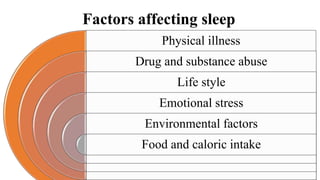
Factors affecting sleep
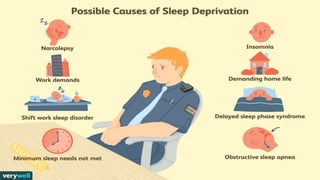
Physical illness
Drug and substance abuse
Life style
Emotional stress
Environmental factors
Food and caloric intake
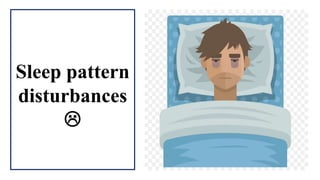
Sleep pattern
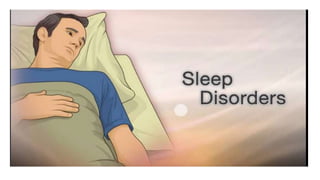
disturbances

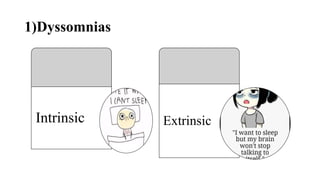
1)Dyssomnias
Intrinsic Extrinsic
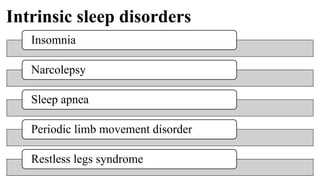
Intrinsic sleep disorders
Insomnia
Narcolepsy
Sleep apnea
Periodic limb movement disorder
Restless legs syndrome
Insomnia
• According to national sleep foundation - 30-40% of Americans have
insomnia
Insomnia is perception of inadequate sleep, characterized by difficulty
in initiating sleep and frequent awakening from sleep
Idiopathic insomnia:
Psycho-physiological insomnia:
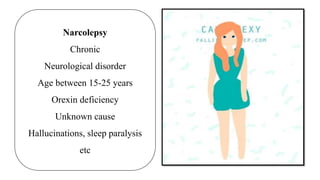
Narcolepsy
Chronic
Neurological disorder
Age between 15-25 years
Orexin deficiency
Unknown cause
Hallucinations, sleep paralysis
etc
Narcolepsy cont..
• Daytime sleepiness
• Cataplexy: strong transient muscle weakness(triggered by
emotions)
• Hypogogic (fall asleep)/ Hypnopompic (wakeup) hallucination
• Sleep paralysis
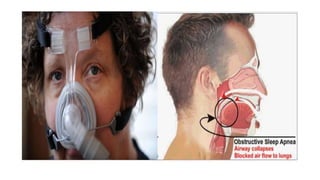
Sleep apnoea
Obstructive sleep apnea Central sleep apnea
It is a period of no breathing between snoring intervals. The person may not
breath for 10-20 seconds or more, leads to drop in O2 saturation, irregular pulse
and sometimes increase BP causes brief period of awakening throughout night.
Periodic limb movement(PLMD)
• Nocturnal myoclonus consist of
stereotyped sleep related movements
of the lower limbs and occasionally
of upper limbs, ranging from simple
to the dorsiflexion of the big toe and
entire leg.
Restless leg syndrome(WED)
• It is a condition that causes an
uncontrollable urge to move legs
usually because of unpleasant
sensation, moving eases unpleasant
sensation.
• Typically happens while sleep,
evening, lying down and sitting.
Extrinsic sleep disorders:
a) Adjustment sleep disorder.
b) Limit setting sleep disorder.
c) Alcohol dependent sleep disorder.
d) Altitude insomnia.
e) Environmental sleep disorder.
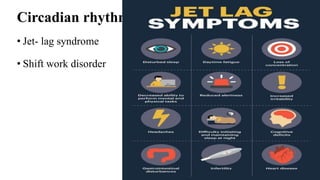
Circadian rhythm sleep disorders
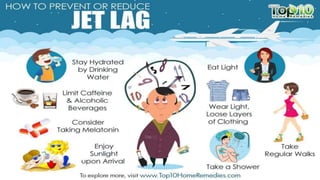
• Jet- lag syndrome
• Shift work disorder
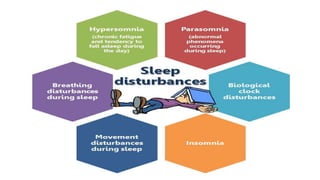
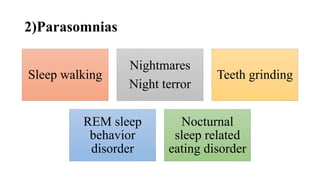
2)Parasomnias
Sleep walking
Nightmares
Night terror
Teeth grinding
REM sleep
behavior
disorder
Nocturnal
sleep related
eating disorder
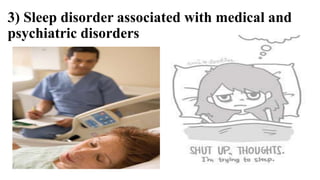
3) Sleep disorder associated with medical and
psychiatric disorders
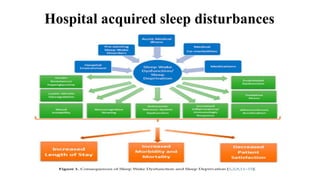
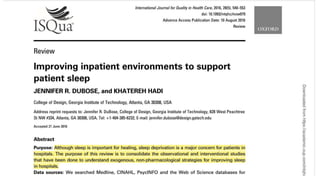
Hospital acquired sleep disturbances
•
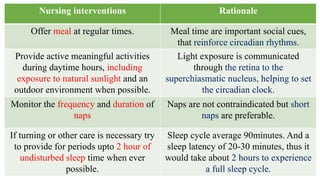
Nursing interventions Rationale
Offer meal at regular times. Meal time are important social cues,
that reinforce circadian rhythms.
Provide active meaningful activities
during daytime hours, including
exposure to natural sunlight and an
outdoor environment when possible.
Light exposure is communicated
through the retina to the
superchiasmatic nucleus, helping to set
the circadian clock.
Monitor the frequency and duration of
naps
Naps are not contraindicated but short
naps are preferable.
If turning or other care is necessary try
to provide for periods upto 2 hour of
undisturbed sleep time when ever
possible.
Sleep cycle average 90minutes. And a
sleep latency of 20-30 minutes, thus it
would take about 2 hours to experience
a full sleep cycle.
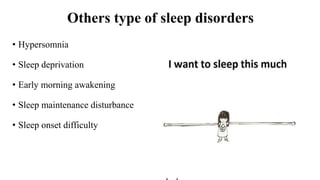
Others type of sleep disorders
• Hypersomnia
• Sleep deprivation
• Early morning awakening
• Sleep maintenance disturbance
• Sleep onset difficulty
Hypersomnia (EDS)
• It is a condition in
which person feel
excessive sleepiness
during day time.
• It can be primary and
secondary
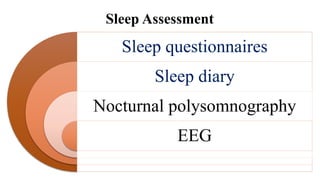
Sleep Assessment
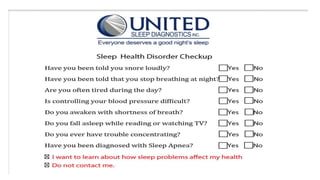
Sleep questionnaires
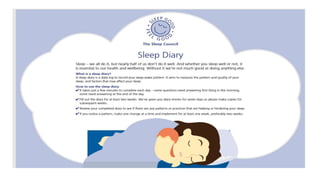
Sleep diary
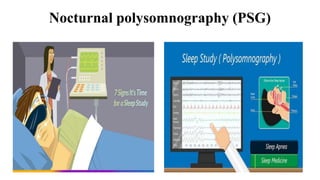
Nocturnal polysomnography
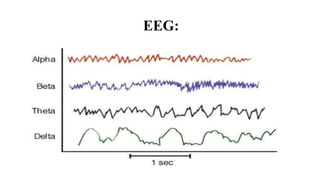
EEG
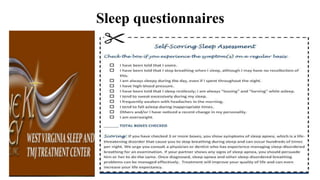
Sleep questionnaires
Sleep diary
Nocturnal polysomnography (PSG)
EEG:
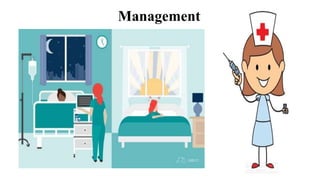
Management
Nursing Management
Prepare restful environment.
Promoting bedside rituals.
Offering appropriate bedtime snacks and beverages.
Promoting relaxation.
Promoting comfort.
Schedule nursing care to avoid unnecessary
disturbance
Tips for better sleep
• Maintain regular time
• Regular exercise
• Maintain comfortable environment at the time of sleep
• Use bed for relaxing or sleeping only
• Don’t nap during the day or evening
• Don’t dwell into intense thoughts or feelings before sleep
• Don’t rely on sleeping pills
Management
• Antidepressants: Trazodone
• Benzodiazepines: lorazepam
• Doxepin: (Trouble staying in sleep)(blocks histamine receptor) Silenar
• Ramelteon: (Trouble falling asleep) Rozerem
• CNS stimulants: Modafinil (Used in Narcolepsy)
• SSRI: (It supress REM sleep)
Research evidence
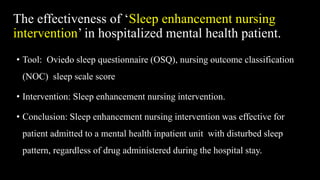
The effectiveness of ‘Sleep enhancement nursing
intervention’ in hospitalized mental health patient.
• Tool: Oviedo sleep questionnaire (OSQ), nursing outcome classification
(NOC) sleep scale score
• Intervention: Sleep enhancement nursing intervention.
• Conclusion: Sleep enhancement nursing intervention was effective for
patient admitted to a mental health inpatient unit with disturbed sleep
pattern, regardless of drug administered during the hospital stay.
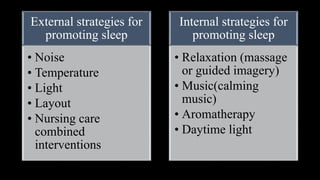
External strategies for
promoting sleep
• Noise
• Temperature
• Light
• Layout
• Nursing care
combined
interventions
Internal strategies for
promoting sleep
• Relaxation (massage
or guided imagery)
• Music(calming
music)
• Aromatherapy
• Daytime light
Summary:
• Definition of sleep
• Sleep cycle
• Factors affecting sleep
• Sleep disorders
• Dysomnia
• Parasomnia
• Other sleep disorders
• Sleep Assessment
• Management
• Research evidence
Conclusion:
Reference:
• www.sleepcouncil.org.uk
• Black JM, Hawks JH. Medical surgical nursing clinical management for
positive outcomes. Vol 1. 7th edition. Saunders, India 2005 pp 461-500
• Brunner and suddarths. ‘textbook of medical surgical nursing’, volume-
2, 13th edition,wolter kluwer(India),pvt,ltd.pg:189
• Basavanthappa BT. ‘medical surgical nursing’ 2ndedition, jaypee brother
medical publisher, New Delhi. pvt ltd. pg:931
Reference: cont..
• Surekha Anbazhagan, Naveen Ramesh, Catherine Nisha, Bobby Joseph Indian
Environ Med. 2016 Jan-Apr; 20(1): 35–38. doi: 10.4103/0019-5278.183842
PMCID: PMC4922274
• https://www.sccm.org/ICULiberation/Resources/PADIS-Guidelines-
Teaching-Slides-Sleep
• Pisani MA, Friese RS, Gehlbach BK, et al. Sleep in the intensive care
unit. Am J Respir Crit Care Med. 2015;191:731–738. [PMC free
article] [PubMed] [Google Scholar]
•Thankyou

Sleep pattern disturbances

  • 2.
    Sleep pattern andits disturbance Evaluator: Dr Mahalingham V Presenter: Shruti Shirke [Asst. professor, CON AIIMS BBSR] M.Sc Neuroscience Nursing
  • 3.
    Introduction • Nearly onethird of our life is spent in sleep. • Sleep is a cyclic physiological process that alternate with longer period of wakefulness by decreased ability to react to stimuli. • The sleep wake cycle influences and regulates the physiological and behavioural response, restores immunity, vital processes, mood etc
  • 4.
    Definition: ‘Sleep’ • Accordingto baillier’s nurses dictionary • “A period of rest for the body and mind, during which bodily functions are partially suspended”. • Sleep can be defines as the state of consciousness characterized by decreased awareness and responsiveness to stimuli”.
  • 5.
    ‘Circadian Rhythm’ • Theword circadian rhythm is taken from Latin word ‘circa’ means about and ‘dian’ means day. • “biological rhythms that follow a cycle of about 24hours is termed as circadian rhythm”. Sleep Wakefulness
  • 6.
    Circadian Rhythm The circadian rhythmis the body’s innate timing device. It provide the timing for our sleep-wake cycle, hormone release, our eating habits, and more.
  • 7.
    Physiology of Sleep Retinalganglion cells: Supra chiasmatic nucleus: Melatonin:
  • 10.
    Stages of Sleep •Polysomnographic profiles and electrophysiologic changes in brain waves, eye moment and muscle tone shows 5 sleep stages and 2 types of sleep. •S- Sleep (NREM) •D- Sleep (REM)
  • 11.
  • 12.
    Pre sleepiness Stage 1Stage 2 Stage 3 Stage 4 REM Sleep Stage 2 Stage 3 1-7min Light sleep Easily aroused, day dreaming 20-40mins Initial of deep sleep Difficult to arouse SWS SWS 20-40mins Deepest sleep Difficult to arouse 5-30mins Occurs in every 90mins Intense dreaming occurs Variations in vital signs Increase in vaginal secretions and erection may occurs in men cycle repeats every 90- 120 mins
  • 13.
  • 15.
    Normal sleep requirement AgeHours/day Infant 16 hours/day Toddler 12 hours/day Pre-school 11 hours/day Schooler 9-10 hours/day Adolescent 8-9 hours/day Adult 6-8 hours/day
  • 16.
    Functions of sleep •Humangrowth. •Repair and renewal of epithelial. •Protein synthesis and cell division. •Physical restoration and preparation for the next period. •Restoration of cognitive functions.
  • 17.
    Factors affecting sleep Physicalillness Drug and substance abuse Life style Emotional stress Environmental factors Food and caloric intake
  • 18.
  • 20.
  • 21.
    Intrinsic sleep disorders Insomnia Narcolepsy Sleepapnea Periodic limb movement disorder Restless legs syndrome
  • 22.
    Insomnia • According tonational sleep foundation - 30-40% of Americans have insomnia Insomnia is perception of inadequate sleep, characterized by difficulty in initiating sleep and frequent awakening from sleep Idiopathic insomnia: Psycho-physiological insomnia:
  • 23.
    Narcolepsy Chronic Neurological disorder Age between15-25 years Orexin deficiency Unknown cause Hallucinations, sleep paralysis etc
  • 24.
    Narcolepsy cont.. • Daytimesleepiness • Cataplexy: strong transient muscle weakness(triggered by emotions) • Hypogogic (fall asleep)/ Hypnopompic (wakeup) hallucination • Sleep paralysis
  • 25.
    Sleep apnoea Obstructive sleepapnea Central sleep apnea It is a period of no breathing between snoring intervals. The person may not breath for 10-20 seconds or more, leads to drop in O2 saturation, irregular pulse and sometimes increase BP causes brief period of awakening throughout night.
  • 27.
    Periodic limb movement(PLMD) •Nocturnal myoclonus consist of stereotyped sleep related movements of the lower limbs and occasionally of upper limbs, ranging from simple to the dorsiflexion of the big toe and entire leg. Restless leg syndrome(WED) • It is a condition that causes an uncontrollable urge to move legs usually because of unpleasant sensation, moving eases unpleasant sensation. • Typically happens while sleep, evening, lying down and sitting.
  • 30.
    Extrinsic sleep disorders: a)Adjustment sleep disorder. b) Limit setting sleep disorder. c) Alcohol dependent sleep disorder. d) Altitude insomnia. e) Environmental sleep disorder.
  • 32.
    Circadian rhythm sleepdisorders • Jet- lag syndrome • Shift work disorder
  • 34.
    2)Parasomnias Sleep walking Nightmares Night terror Teethgrinding REM sleep behavior disorder Nocturnal sleep related eating disorder
  • 35.
    3) Sleep disorderassociated with medical and psychiatric disorders
  • 37.
    Hospital acquired sleepdisturbances •
  • 38.
    Nursing interventions Rationale Offermeal at regular times. Meal time are important social cues, that reinforce circadian rhythms. Provide active meaningful activities during daytime hours, including exposure to natural sunlight and an outdoor environment when possible. Light exposure is communicated through the retina to the superchiasmatic nucleus, helping to set the circadian clock. Monitor the frequency and duration of naps Naps are not contraindicated but short naps are preferable. If turning or other care is necessary try to provide for periods upto 2 hour of undisturbed sleep time when ever possible. Sleep cycle average 90minutes. And a sleep latency of 20-30 minutes, thus it would take about 2 hours to experience a full sleep cycle.
  • 39.
    Others type ofsleep disorders • Hypersomnia • Sleep deprivation • Early morning awakening • Sleep maintenance disturbance • Sleep onset difficulty
  • 40.
    Hypersomnia (EDS) • Itis a condition in which person feel excessive sleepiness during day time. • It can be primary and secondary
  • 42.
    Sleep Assessment Sleep questionnaires Sleepdiary Nocturnal polysomnography EEG
  • 43.
  • 45.
  • 47.
  • 48.
  • 52.
  • 53.
    Nursing Management Prepare restfulenvironment. Promoting bedside rituals. Offering appropriate bedtime snacks and beverages. Promoting relaxation. Promoting comfort. Schedule nursing care to avoid unnecessary disturbance
  • 54.
    Tips for bettersleep • Maintain regular time • Regular exercise • Maintain comfortable environment at the time of sleep • Use bed for relaxing or sleeping only • Don’t nap during the day or evening • Don’t dwell into intense thoughts or feelings before sleep • Don’t rely on sleeping pills
  • 55.
    Management • Antidepressants: Trazodone •Benzodiazepines: lorazepam • Doxepin: (Trouble staying in sleep)(blocks histamine receptor) Silenar • Ramelteon: (Trouble falling asleep) Rozerem • CNS stimulants: Modafinil (Used in Narcolepsy) • SSRI: (It supress REM sleep)
  • 56.
  • 58.
    The effectiveness of‘Sleep enhancement nursing intervention’ in hospitalized mental health patient. • Tool: Oviedo sleep questionnaire (OSQ), nursing outcome classification (NOC) sleep scale score • Intervention: Sleep enhancement nursing intervention. • Conclusion: Sleep enhancement nursing intervention was effective for patient admitted to a mental health inpatient unit with disturbed sleep pattern, regardless of drug administered during the hospital stay.
  • 60.
    External strategies for promotingsleep • Noise • Temperature • Light • Layout • Nursing care combined interventions Internal strategies for promoting sleep • Relaxation (massage or guided imagery) • Music(calming music) • Aromatherapy • Daytime light
  • 61.
    Summary: • Definition ofsleep • Sleep cycle • Factors affecting sleep • Sleep disorders • Dysomnia • Parasomnia • Other sleep disorders • Sleep Assessment • Management • Research evidence
  • 62.
  • 63.
    Reference: • www.sleepcouncil.org.uk • BlackJM, Hawks JH. Medical surgical nursing clinical management for positive outcomes. Vol 1. 7th edition. Saunders, India 2005 pp 461-500 • Brunner and suddarths. ‘textbook of medical surgical nursing’, volume- 2, 13th edition,wolter kluwer(India),pvt,ltd.pg:189 • Basavanthappa BT. ‘medical surgical nursing’ 2ndedition, jaypee brother medical publisher, New Delhi. pvt ltd. pg:931
  • 64.
    Reference: cont.. • SurekhaAnbazhagan, Naveen Ramesh, Catherine Nisha, Bobby Joseph Indian Environ Med. 2016 Jan-Apr; 20(1): 35–38. doi: 10.4103/0019-5278.183842 PMCID: PMC4922274 • https://www.sccm.org/ICULiberation/Resources/PADIS-Guidelines- Teaching-Slides-Sleep • Pisani MA, Friese RS, Gehlbach BK, et al. Sleep in the intensive care unit. Am J Respir Crit Care Med. 2015;191:731–738. [PMC free article] [PubMed] [Google Scholar]
  • 65.