The human skeleton
Axial Skeleton
Includes:
1. Skull
2. Vertebral column
3. Ribs
4. Sternum
Appendicular
skeleton
Includes:
1. Girdles – Pectoral and Pelvic
2. Limb Bones – Fore limb and
Hind limb
https://askabiologist.asu.edu/sites/default/files/SkeletonViewer/SkeletonViewer.swf
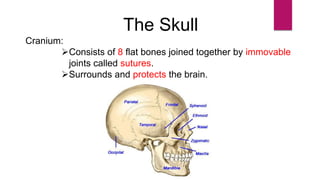
The Skull
Cranium:
Consists of 8 flat bones joined together by immovable
joints called sutures.
Surrounds and protects the brain.
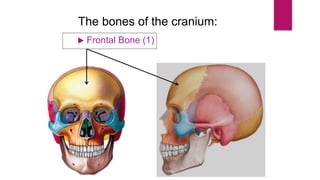
The bones of the cranium:
 Frontal Bone (1)
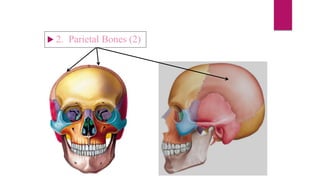
 2. Parietal Bones (2)
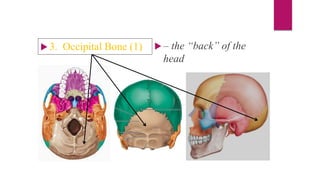
 – the “back” of the
head
 3. Occipital Bone (1)
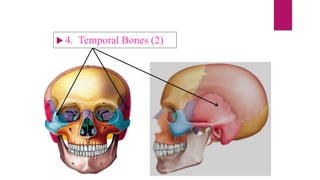
 4. Temporal Bones (2)
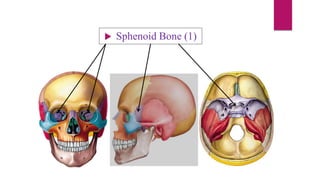
 Sphenoid Bone (1)
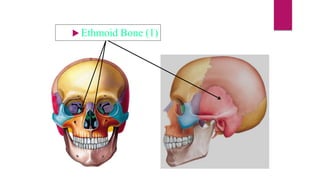
 Ethmoid Bone (1)
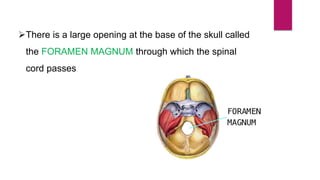
There is a large opening at the base of the skull called
the FORAMEN MAGNUM through which the spinal
cord passes
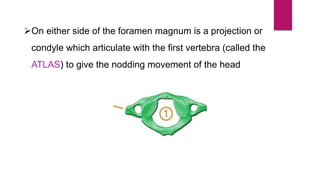
On either side of the foramen magnum is a projection or
condyle which articulate with the first vertebra (called the
ATLAS) to give the nodding movement of the head
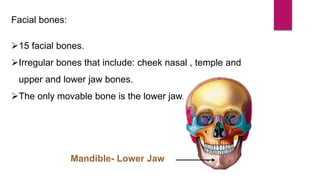
Facial bones:
15 facial bones.
Irregular bones that include: cheek nasal , temple and
upper and lower jaw bones.
The only movable bone is the lower jaw.
Mandible- Lower Jaw
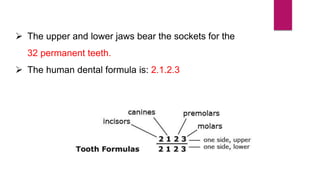
 The upper and lower jaws bear the sockets for the
32 permanent teeth.
 The human dental formula is: 2.1.2.3
The vertebrate column
The vertebral columns is divided into 5 regions:
 Cervical (neck) region
Thoracic region (chest)
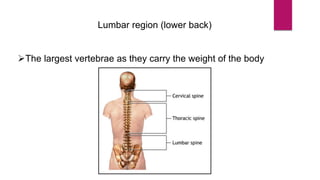
 Lumbar region (lower back)
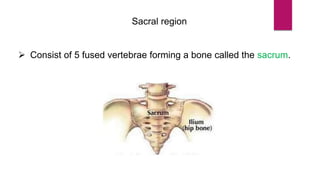
Sacral region
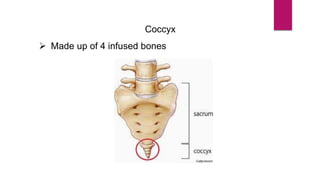
 Coccyx
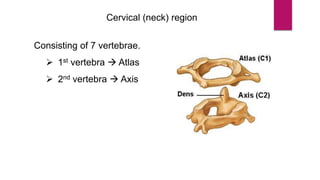
Cervical (neck) region
Consisting of 7 vertebrae.
 1st vertebra  Atlas
 2nd vertebra  Axis
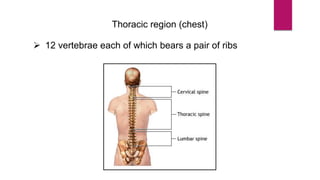
Thoracic region (chest)
 12 vertebrae each of which bears a pair of ribs
Lumbar region (lower back)
The largest vertebrae as they carry the weight of the body
Sacral region
 Consist of 5 fused vertebrae forming a bone called the sacrum.
Coccyx
 Made up of 4 infused bones
Curves of a spine
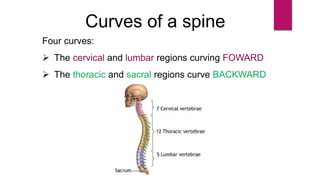
Four curves:
 The cervical and lumbar regions curving FOWARD
 The thoracic and sacral regions curve BACKWARD
FUNCTIONS OF VERTEBRAL COLUMN
Supports the skull
Surrounds and protects the spinal cord.
Provides attachment for ribs, girdles, and back muscles
Separate vertebrae and S-shaped curvature provide flexibility
allowing humans to bend backwards, forwards and sideways.
Cartilage discs act as shock absorbers
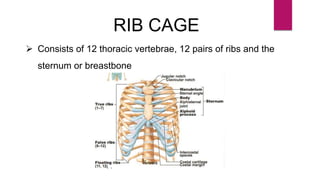
RIB CAGE
 Consists of 12 thoracic vertebrae, 12 pairs of ribs and the
sternum or breastbone
Functions of rib cage:
 Protection of the heart and lungs
 With the help of the diaphragm and the intercostal
muscles they increase. And decrease the volume of the
thoracic cavity thereby allowing inhalation and exhalation
to take place.

The human skeleton

  • 1.
  • 2.
    Axial Skeleton Includes: 1. Skull 2.Vertebral column 3. Ribs 4. Sternum Appendicular skeleton Includes: 1. Girdles – Pectoral and Pelvic 2. Limb Bones – Fore limb and Hind limb https://askabiologist.asu.edu/sites/default/files/SkeletonViewer/SkeletonViewer.swf
  • 3.
    The Skull Cranium: Consists of8 flat bones joined together by immovable joints called sutures. Surrounds and protects the brain.
  • 4.
    The bones ofthe cranium:  Frontal Bone (1)
  • 5.
     2. ParietalBones (2)
  • 6.
     – the“back” of the head  3. Occipital Bone (1)
  • 7.
     4. TemporalBones (2)
  • 8.
  • 9.
  • 10.
    There is alarge opening at the base of the skull called the FORAMEN MAGNUM through which the spinal cord passes
  • 11.
    On either sideof the foramen magnum is a projection or condyle which articulate with the first vertebra (called the ATLAS) to give the nodding movement of the head
  • 12.
    Facial bones: 15 facialbones. Irregular bones that include: cheek nasal , temple and upper and lower jaw bones. The only movable bone is the lower jaw. Mandible- Lower Jaw
  • 13.
     The upperand lower jaws bear the sockets for the 32 permanent teeth.  The human dental formula is: 2.1.2.3
  • 14.
    The vertebrate column Thevertebral columns is divided into 5 regions:  Cervical (neck) region Thoracic region (chest)  Lumbar region (lower back) Sacral region  Coccyx
  • 15.
    Cervical (neck) region Consistingof 7 vertebrae.  1st vertebra  Atlas  2nd vertebra  Axis
  • 16.
    Thoracic region (chest) 12 vertebrae each of which bears a pair of ribs
  • 17.
    Lumbar region (lowerback) The largest vertebrae as they carry the weight of the body
  • 18.
    Sacral region  Consistof 5 fused vertebrae forming a bone called the sacrum.
  • 19.
    Coccyx  Made upof 4 infused bones
  • 20.
    Curves of aspine Four curves:  The cervical and lumbar regions curving FOWARD  The thoracic and sacral regions curve BACKWARD
  • 21.
    FUNCTIONS OF VERTEBRALCOLUMN Supports the skull Surrounds and protects the spinal cord. Provides attachment for ribs, girdles, and back muscles Separate vertebrae and S-shaped curvature provide flexibility allowing humans to bend backwards, forwards and sideways. Cartilage discs act as shock absorbers
  • 22.
    RIB CAGE  Consistsof 12 thoracic vertebrae, 12 pairs of ribs and the sternum or breastbone
  • 23.
    Functions of ribcage:  Protection of the heart and lungs  With the help of the diaphragm and the intercostal muscles they increase. And decrease the volume of the thoracic cavity thereby allowing inhalation and exhalation to take place.

Editor's Notes

  • #2 Have you ever seen a house being built? Yes/No What part of the house do they build first? Frame What does the frame of the house do? Shape and support What is the frame of the human body? Our skeleton
  • #3 Follow link and explore and discuss the skeleton in pairs!
  • #16 Atlas supports the skull and the joint with the skull allows for the nodding movement of the head. Axis side movement
  • #19 sacrum that forms part of the pelvic girdle which provides for the attachment of muscles and the legs.
  • #21 In a newborn baby the entire vertebral column curves backwards probably because of the connes of the uterus. Initially a baby cannot support the weight of its head.. When after about 3 months it is able to support its head, the cervical forward curve is complete . The lumbar forward curve is complete when the baby is able to stand on its own and ready to learn to walk. These curves of the vertebral column provide some of the resilience and spring so essential in balance and movement.
  • #23 All 12 pair of ribs are attached to the thoracic vertebrae The first 7 pairs are attached to the sternum by cartilage. These are the true ribs The next 3 pairs are each attached .to the rib above by means of cartilage. These are the false ribs. The last 2 pairs are not attached at all to in the front and are called floating ribs. Between each pair of ribs are external and internal intercostal muscles The sternum is a at dagger shaped bone at the front of the rib cage.