NUCLEAR MAGNETIC RESONANCE
SPECTROSCOPY
DEPARTMENT OF PHARMACEUTICAL CHEMISTRY
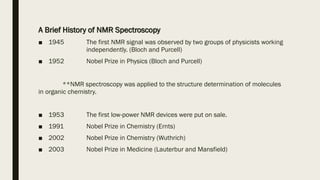
A Brief History of NMR Spectroscopy
■ 1945 The first NMR signal was observed by two groups of physicists working
independently. (Bloch and Purcell)
■ 1952 Nobel Prize in Physics (Bloch and Purcell)
**NMR spectroscopy was applied to the structure determination of molecules
in organic chemistry.
■ 1953 The first low-power NMR devices were put on sale.
■ 1991 Nobel Prize in Chemistry (Ernts)
■ 2002 Nobel Prize in Chemistry (Wuthrich)
■ 2003 Nobel Prize in Medicine (Lauterbur and Mansfield)
■ Nuclear magnetic resonance spectroscopy, most commonly known as NMR
spectroscopy or magnetic resonance spectroscopy (MRS), is a spectroscopic
technique to observe local magnetic fields around atomic nuclei.
■ The sample is placed in a magnetic field and the NMR signal is produced by
excitation of the nuclei sample with radio waves into nuclear magnetic resonance,
which is detected with sensitive radio receivers.
■ The intramolecular magnetic field around an atom in a molecule changes the
resonance frequency, thus giving access to details of the electronic structure of a
molecule and its individual functional groups.
■ As the fields are unique or highly characteristic to individual compounds, in modern
organic chemistry practice, NMR spectroscopy is the definitive method to identify
monomolecular organic compounds.
■ Many nuclei may be studied by NMR techniques, but hydrogen and carbon are most
commonly available.
■ Whereas infrared (IR) spectroscopy reveals the types of functional groups present in
a molecule, NMR gives information about the number of magnetically distinct atoms
of the type being studied.
■ When hydrogen nuclei (protons) are studied, for instance, one can determine the
number of each of the distinct types of hydrogen nuclei as well as obtain information
regarding the nature of the immediate environment of each type.
■ Similar information can be determined for the carbon nuclei. The combination of IR
and NMR data is often sufficient to determine completely the structure of an
unknown molecule.
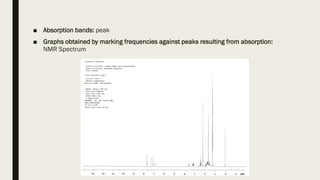
■ Absorption bands: peak
■ Graphs obtained by marking frequencies against peaks resulting from absorption:
NMR Spectrum
UV and IR Spectrometers functional groups of organic molecules
Elemental analysis C, H, O, N, S%
NMR Spectrometry Depending on the magnetic character of the atomic
nucleus, it gives information about the skeleton of the molecule.
■ Other spectroscopic methods are related to electrons, NMR Spectroscopy is related
to nuclei.
■ For NMR, it requires very long wavelength radiation such as radio waves and a
strong magnetic field of the electromagnetic spectrum.
■ As there is no need for breaking up the molecule, the assay samples can be reused
in NMR. A disadvantage is that a relatively large amount, 2–50 mg of a purified
substance is required.
■ Preferably, the sample should be dissolved in a solvent, because NMR analysis of
solids requires a dedicated magic angle spinning machine and may not give equally
well-resolved spectra.
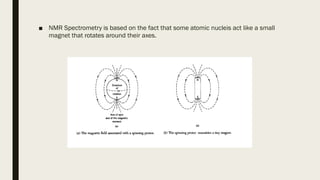
■ NMR Spectrometry is based on the fact that some atomic nucleis act like a small
magnet that rotates around their axes.
MAGNETIC PROPERTIES OF NUCLEI
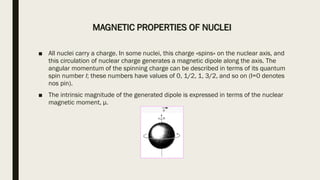
■ All nuclei carry a charge. In some nuclei, this charge «spins» on the nuclear axis, and
this circulation of nuclear charge generates a magnetic dipole along the axis. The
angular momentum of the spinning charge can be described in terms of its quantum
spin number I; these numbers have values of 0, 1/2, 1, 3/2, and so on (I=0 denotes
nos pin).
■ The intrinsic magnitude of the generated dipole is expressed in terms of the nuclear
magnetic moment, Îź.
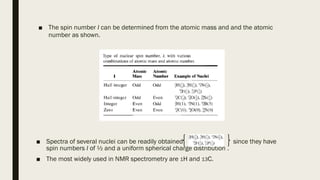
■ The spin number I can be determined from the atomic mass and and the atomic
number as shown.
■ Spectra of several nuclei can be readily obtained since they have
spin numbers I of ½ and a uniform spherical charge distribution .
■ The most widely used in NMR spectrometry are 1H and 13C.
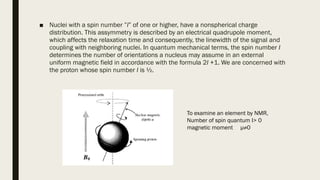
■ Nuclei with a spin number ”I” of one or higher, have a nonspherical charge
distribution. This assymmetry is described by an electrical quadrupole moment,
which affects the relaxation time and consequently, the linewidth of the signal and
coupling with neighboring nuclei. In quantum mechanical terms, the spin number I
determines the number of orientations a nucleus may assume in an external
uniform magnetic field in accordance with the formula 2I +1. We are concerned with
the proton whose spin number I is ½.
To examine an element by NMR,
Number of spin quantum I> 0
magnetic moment µ≠0
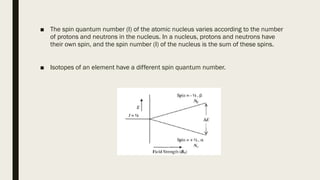
■ The spin quantum number (I) of the atomic nucleus varies according to the number
of protons and neutrons in the nucleus. In a nucleus, protons and neutrons have
their own spin, and the spin number (I) of the nucleus is the sum of these spins.
■ Isotopes of an element have a different spin quantum number.
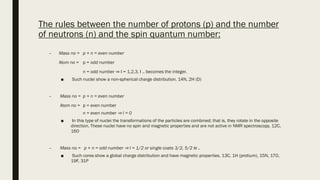
The rules between the number of protons (p) and the number
of neutrons (n) and the spin quantum number:
– Mass no = p + n = even number
Atom no = p = odd number
n = odd number ⇒ I = 1,2,3, I .. becomes the integer.
■ Such nuclei show a non-spherical charge distribution. 14N, 2H (D)
– Mass no = p + n = even number
Atom no = p = even number
n = even number ⇒ I = 0
■ In this type of nuclei the transformations of the particles are combined; that is, they rotate in the opposite
direction. These nuclei have no spin and magnetic properties and are not active in NMR spectroscopy. 12C,
16O
– Mass no = p + n = odd number ⇒ I = 1/2 or single coats 3/2, 5/2 le ..
■ Such cores show a global charge distribution and have magnetic properties. 13C, 1H (protium), 15N, 17O,
19F, 31P
■ Since I = 1/2, NMR measurements of most 1H and 13C atoms are performed.
■ Proton Magnetic Resonance (1H-NMR) spectroscopy will be examined by taking into
consideration the fact that they are the main building blocks in organic molecules.
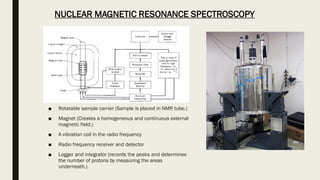
■ Rotatable sample carrier (Sample is placed in NMR tube.)
■ Magnet (Creates a homogeneous and continuous external
magnetic field.)
■ A vibration coil in the radio frequency
■ Radio frequency receiver and detector
■ Logger and integrator (records the peaks and determines
the number of protons by measuring the areas
underneath.)
NUCLEAR MAGNETIC RESONANCE SPECTROSCOPY
Magnet;
■ Natural magnet with low magnetic field strength (1-2 Tesla)
Used in electromagnet devices. Expensive…
■ The superconducting electromagnet 20 Tesla rom is continuously cooled through
liquid helium and externally liquid nitrogen in a Dewar container. In order to maintain
the superconductivity, the magnet must be continuously kept at the liquid helium
temperature (4ÂşK = -269ÂşC). If the temperature rises above this value, resistance
occurs on the wires forming the coil, the wires become hot, helium evaporates
rapidly and the magnetic field disappears değer
■ Liquid helium is charged to the device every 6 months. To maintain the liquid helium
for a long time, it is necessary to load liquid nitrogen (-196ÂşC) into the device every
week.
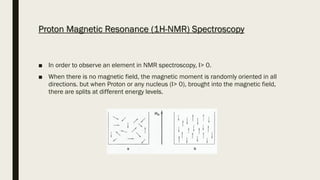
Proton Magnetic Resonance (1H-NMR) Spectroscopy
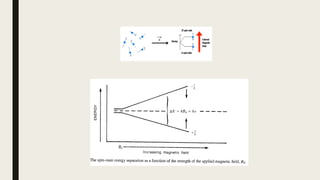
■ In order to observe an element in NMR spectroscopy, I> 0.
■ When there is no magnetic field, the magnetic moment is randomly oriented in all
directions. but when Proton or any nucleus (I> 0), brought into the magnetic field,
there are splits at different energy levels.
NUCLEAR MAGNETIC RESONANCE SPECTROSCOPY
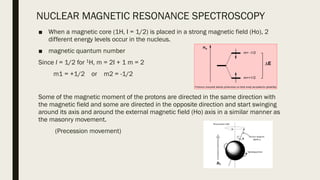
■ When a magnetic core (1H, I = 1/2) is placed in a strong magnetic field (Ho), 2
different energy levels occur in the nucleus.
■ magnetic quantum number
Since I = 1/2 for 1H, m = 2I + 1 m = 2
m1 = +1/2 or m2 = -1/2
Some of the magnetic moment of the protons are directed in the same direction with
the magnetic field and some are directed in the opposite direction and start swinging
around its axis and around the external magnetic field (Ho) axis in a similar manner as
the masonry movement.
(Precession movement)
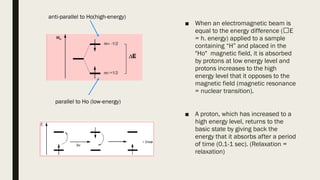
■ When an electromagnetic beam is
equal to the energy difference ( E
= h. energy) applied to a sample
containing “H” and placed in the
"Ho" magnetic field, it is absorbed
by protons at low energy level and
protons increases to the high
energy level that it opposes to the
magnetic field (magnetic resonance
= nuclear transition).
■ A proton, which has increased to a
high energy level, returns to the
basic state by giving back the
energy that it absorbs after a period
of time (0.1-1 sec). (Relaxation =
relaxation)
anti-parallel to Ho(high-energy)
parallel to Ho (low-energy)
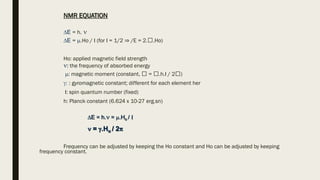
NMR EQUATION
E = h. 
E = .Ho / I (for I = 1/2 ⇒ /E = 2. .Ho)
Ho: applied magnetic field strength
: the frequency of absorbed energy
: magnetic moment (constant, = .h.I / 2 )
: : gyromagnetic constant; different for each element her
I: spin quantum number (fixed)
h: Planck constant (6.624 x 10⁻²⁷ erg.sn)
E = h. = .Ho / I
 = .Ho / 2
Frequency can be adjusted by keeping the Ho constant and Ho can be adjusted by keeping
frequency constant.
THE CHEMICAL SHIFT AND SHIELDING
■ NMR has great utility because not all protons in a molecule have resonance at the
same frequency. This variability is due to the fact that the protons in a molecule are
surrounded by electrons and exists in slightly different electronic environments from
one another. The valence-shell electron densities vary from one proton to another.
The protons are shielded by the electrons that surround them.
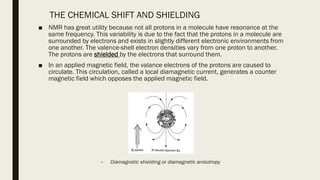
■ In an applied magnetic field, the valance electrons of the protons are caused to
circulate. This circulation, called a local diamagnetic current, generates a counter
magnetic field which opposes the applied magnetic field.
– Diamagnetic shielding or diamagnetic anisotropy
■ In an atom, the local diamagnetic current generates a secondary,
induced magnetic field which has a direction opposite that of the
applied magnetic field.
■ As a result of diamagnetic anisotropy, each proton in a molecule is
shielded from the applied magnetic field to an extent that depends on
the electron density surrounding it. The greater the electron density
around a nucleus diminishes the net applied magnetic field that the
nucleus experiences.
■ As a result, the nucleus precesses at a lower frequency. Each proton
in a molecule is in a slightly different chemical environment and
consequently has a slightly different amount of electronic shielding,
which results in a slightly different resonance frequency.
■ These differences in resonance frequency are very small. It is very difficult to
measure exact frequencies to that precision; hence no attempt is made to measure
the exact resonance frequency of any proton.
■ Instead, a reference compound is placed in the solution of the substance to be
measured, and the resonance frequency of each proton in the sample is measured
relative to the resonance frequency of the protons of the reference substance .
■ In other words, the frequency difference is measured directly. The standard
reference substance that is used universally is tetramethylsilane (CH3)4Si, also
called TMS.
■ This compound was chosen initially because the protons of its methyl groups are
more shielded than those of most other known compounds. At that time, no
compounds which had better-shielded hydrogens than TMS were known, and it was
assumed that TMS would be a good reference substance since it would mark one
end of the range. Thus, when another compound is measured, the resonance of its
protons are reported in terms of how far (in Hertz) they are shifted from those of
TMS.
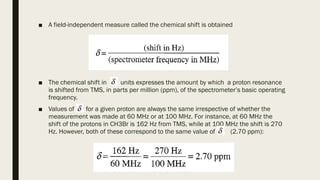
■ A field-independent measure called the chemical shift is obtained
■ The chemical shift in units expresses the amount by which a proton resonance
is shifted from TMS, in parts per million (ppm), of the spectrometer’s basic operating
frequency.
■ Values of for a given proton are always the same irrespective of whether the
measurement was made at 60 MHz or at 100 MHz. For instance, at 60 MHz the
shift of the protons in CH3Br is 162 Hz from TMS, while at 100 MHz the shift is 270
Hz. However, both of these correspond to the same value of (2.70 ppm):
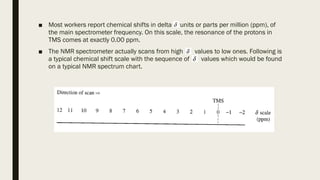
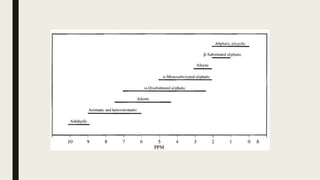
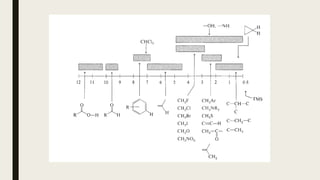
■ Most workers report chemical shifts in delta units or parts per million (ppm), of
the main spectrometer frequency. On this scale, the resonance of the protons in
TMS comes at exactly 0.00 ppm.
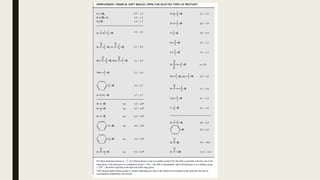
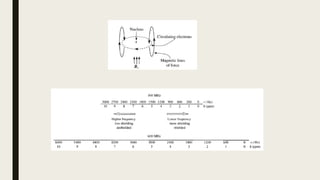
■ The NMR spectrometer actually scans from high values to low ones. Following is
a typical chemical shift scale with the sequence of values which would be found
on a typical NMR spectrum chart.
Chemical shift values of heteroatom protons (NH, OH, SH) in an NMR spectrum
may vary with factors such as ;
■ H bonds with other atoms,
■ used solvent,
■ concentration of the assay sample,
■ the temperature of the spectrum.
When D2O is added to the sample solution, they are replaced with deuterium
and do not give a peak in the spectrum.
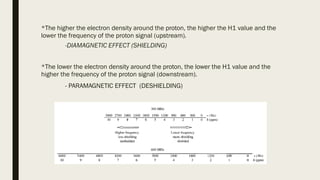
*The higher the electron density around the proton, the higher the H1 value and the
lower the frequency of the proton signal (upstream).
-DIAMAGNETIC EFFECT (SHIELDING)
*The lower the electron density around the proton, the lower the H1 value and the
higher the frequency of the proton signal (downstream).
- PARAMAGNETIC EFFECT (DESHIELDING)
■ Each proton gives peaks depending on the chemical environment. The more
shielding of a proton has with the induction current from its periphery, the greater
the magnetic field required for the proton to resonate.
■ The higher the shading effect, the more the protons absorb in the higher area and
give the peak.
Factors Affecting Chemical Shift
■ Local diamagnetic effects generated by electrons around the protons
■ Effect of magnetic fields generated by neighboring atomic and atomic groups
■ Magnetic anisotropy
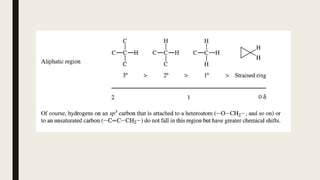
■ Carbon hybridization [sp3 (-CH3) <sp2 (-CH2) <sp2 (Ar-H)]
■ Electronegativity of substituents
■ O (3.5)> N (3.0)> S (2.5)
■ F (4.0)> Cl (3.0)> Br (2.8)> I (2.5)
■ The sum of electronic effects
■ (Paramagnetic shift increases in proportion to the number of H substituted with
halogens having higher electronegativity.)
MAGNETIC ANISOTROPY
■ There are some types of protons whose chemical shifts are not easily explained by
simple considerations of the electronegativity of the attached groups.
■ For example; the protons of benzene and other aromatic systems have a chemical
shift as large as that of the proton of chloroform.
■ Alkenes, alkynes and aldehydes also have protons whose resınance values are not
in line with the expected magnitudes of any electron-withdrawing or hybridization
effects. In each of these cases, the anomalous shifft is due to the presence of an
unsaturated system (one with pi electrons) in the vicinity of the proton in question.
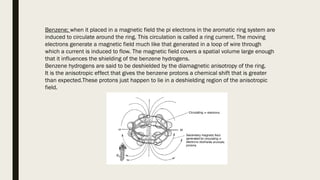
Benzene; when it placed in a magnetic field the pi electrons in the aromatic ring system are
induced to circulate around the ring. This circulation is called a ring current. The moving
electrons generate a magnetic field much like that generated in a loop of wire through
which a current is induced to flow. The magnetic field covers a spatial volume large enough
that it influences the shielding of the benzene hydrogens.
Benzene hydrogens are said to be deshielded by the diamagnetic anisotropy of the ring.
It is the anisotropic effect that gives the benzene protons a chemical shift that is greater
than expected.These protons just happen to lie in a deshielding region of the anisotropic
field.
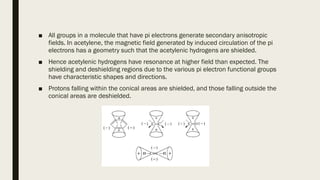
■ All groups in a molecule that have pi electrons generate secondary anisotropic
fields. In acetylene, the magnetic field generated by induced circulation of the pi
electrons has a geometry such that the acetylenic hydrogens are shielded.
■ Hence acetylenic hydrogens have resonance at higher field than expected. The
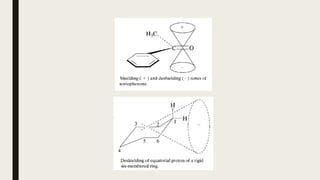
shielding and deshielding regions due to the various pi electron functional groups
have characteristic shapes and directions.
■ Protons falling within the conical areas are shielded, and those falling outside the
conical areas are deshielded.
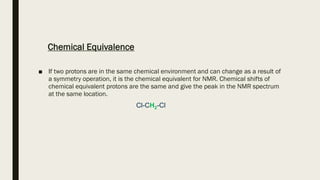
Chemical Equivalence
■ If two protons are in the same chemical environment and can change as a result of
a symmetry operation, it is the chemical equivalent for NMR. Chemical shifts of
chemical equivalent protons are the same and give the peak in the NMR spectrum
at the same location.
Cl-CH2-Cl
Magnetic Equivalence
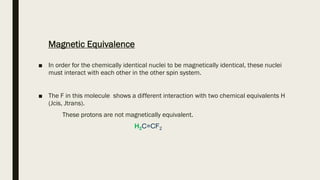
■ In order for the chemically identical nuclei to be magnetically identical, these nuclei
must interact with each other in the other spin system.
■ The F in this molecule shows a different interaction with two chemical equivalents H
(Jcis, Jtrans).
These protons are not magnetically equivalent.
H2C=CF2
SPIN-SPIN SPLITTING (n+1) RULE
■ The chemical shift and the integral (peak area) can give information about the
number and types of hydrogens contained in a molecule.
■ The other type of information to be found in the NMR spectrum is that derived from
the spin-spin splitting phenomenon.
■ Even in simple molecules, each type of proton rarely gives a single resonance peak.
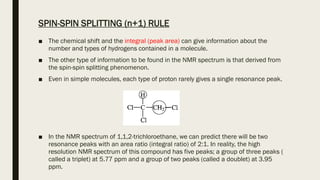
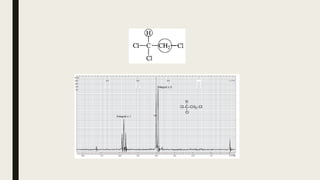
■ In the NMR spectrum of 1,1,2-trichloroethane, we can predict there will be two
resonance peaks with an area ratio (integral ratio) of 2:1. In reality, the high
resolution NMR spectrum of this compound has five peaks; a group of three peaks (
called a triplet) at 5.77 ppm and a group of two peaks (called a doublet) at 3.95
ppm.
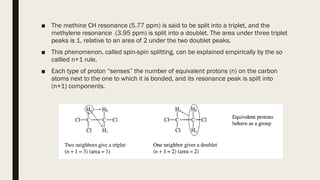
■ The methine CH resonance (5.77 ppm) is said to be split into a triplet, and the
methylene resonance (3.95 ppm) is split into a doublet. The area under three triplet
peaks is 1, relative to an area of 2 under the two doublet peaks.
■ This phenomenon, called spin-spin splitting, can be explained empirically by the so
callled n+1 rule.
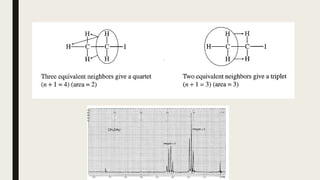
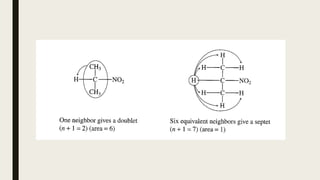
■ Each type of proton “senses” the number of equivalent protons (n) on the carbon
atoms next to the one to which it is bonded, and its resonance peak is spilt into
(n+1) components.
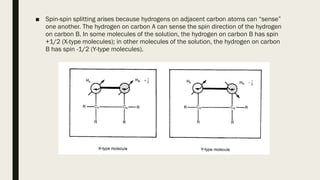
■ Spin-spin splitting arises because hydrogens on adjacent carbon atoms can “sense”
one another. The hydrogen on carbon A can sense the spin direction of the hydrogen
on carbon B. In some molecules of the solution, the hydrogen on carbon B has spin
+1/2 (X-type molecules); in other molecules of the solution, the hydrogen on carbon
B has spin -1/2 (Y-type molecules).
■ The chemical shifts of proton A is influenced by the direction of the spin in proton B.
Proton A is said to be coupled to proton B. Its magnetic environment is affected by
whether proton B has a + ½ or a -1/2 spin state. Thus, proton A absorbs at aslightly
different chemical shift value in type X molecules than in type Y molecules. In fact,
in X-type molecules, proton A is slightly deshielded because the field of proton B is
aligned with the applied field and its magnetic moment adds to the applied filed. In
Y-type molecules, proton A is slightly shielded with respect to what its chemical shift
would be in the absence of coupling. In this latter case, the field of proton B
diminishes the eefect of the applied field on proton A.
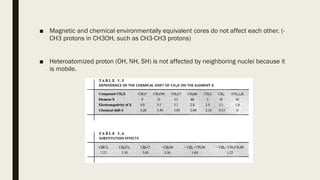
■ Magnetic and chemical environmentally equivalent cores do not affect each other. (-
CH3 protons in CH3OH, such as CH3-CH3 protons)
■ Heteroatomized proton (OH, NH, SH) is not affected by neighboring nuclei because it
is mobile.
PASCALS TRIANGLE
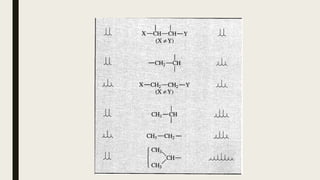
■ We can easily verify that the intensity ratios of multiplets derived from the n+1.
Rulefollow the entries in the mathematical theory Pascal’s triangle.
■ Each entry in the triangle is the sum of the two entries above it and to its immediate
left and right. Notice that the intensities of the outer peaks of a multiplet such as a
septet are so small compared to the inner peaks that they are often obscured in the
baseline of the spectrum.
■ The intensity of the resulting peaks relative to each other is related to the H number
(n) on the adjacent carbon and is calculated by the Pascal triangle or (a + b) n.
When the peaks are analyzed according to the number (n), the coefficients show
relative intensities.
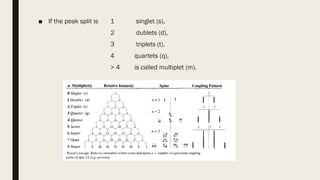
■ If the peak split is 1 singlet (s),
2 dublets (d),
3 triplets (t),
4 quartets (q),
> 4 is called multiplet (m).
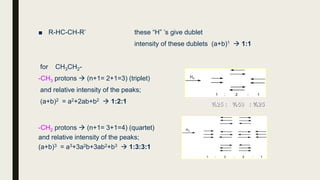
■ R-HC-CH-R’ these “H” ’s give dublet
intensity of these dublets (a+b)1  1:1
for CH3CH2-
-CH3 protons  (n+1= 2+1=3) (triplet)
and relative intensity of the peaks;
(a+b)2 = a2+2ab+b2  1:2:1
-CH2 protons  (n+1= 3+1=4) (quartet)
and relative intensity of the peaks;
(a+b)3 = a3+3a2b+3ab2+b3  1:3:3:1
%25 : %50 : %25
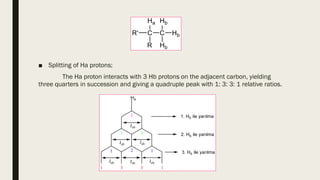
■ Splitting of Ha protons;
The Ha proton interacts with 3 Hb protons on the adjacent carbon, yielding
three quarters in succession and giving a quadruple peak with 1: 3: 3: 1 relative ratios.
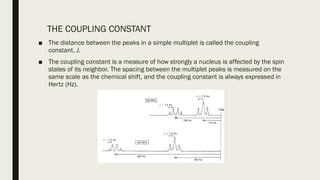
THE COUPLING CONSTANT
■ The distance between the peaks in a simple multiplet is called the coupling
constant, J.
■ The coupling constant is a measure of how strongly a nucleus is affected by the spin
states of its neighbor. The spacing between the multiplet peaks is measured on the
same scale as the chemical shift, and the coupling constant is always expressed in
Hertz (Hz).
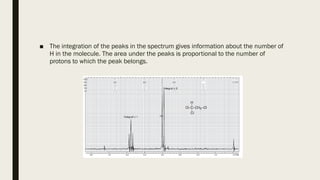
■ The integration of the peaks in the spectrum gives information about the number of
H in the molecule. The area under the peaks is proportional to the number of
protons to which the peak belongs.
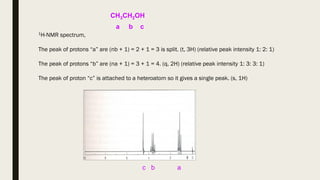
CH3CH2OH
a b c
1H-NMR spectrum,
The peak of protons “a” are (nb + 1) = 2 + 1 = 3 is split. (t, 3H) (relative peak intensity 1: 2: 1)
The peak of protons “b” are (na + 1) = 3 + 1 = 4. (q, 2H) (relative peak intensity 1: 3: 3: 1)
The peak of proton “c” is attached to a heteroatom so it gives a single peak. (s, 1H)
c b a
Solvents used in NMR spectroscopy
■ In order to obtain the NMR spectrum of a substance, the solution must be prepared
by dissolving in a suitable solvent. Used solvents;
■ It should not react with the substance to be analyzed and it should be inert.
■ It should have a low boiling point.
■ Must be nonpolar.
■ It should not contain any protons. (If the solvent contains protons, it will give peak
with the protons of the substance)
Signals of most commonly used solvents in 1H-NMR Spectroscopy:
■ CHCl3 in CDCl3 7.27  ppm + 1.65  ppm (water peak)
■ CD3SOCD2H in DMSO-d6 2.50  ppm + 3.34  ppm (water peak)
■ acetone-d6 in CD3COCD2H 2.05  ppm + 2.78  ppm (water peak)
■ CD3OH in CD3OD 3.31  ppm
■ HOD in D2O 4.5-5.5  ppm
Chemical Shift Reagents
For the separation of very close or overlapping peaks in the NMR Spectrum;
■ Field strength can be increased.
■ Chemical reagents can be used to change the location of the signal.
The rare earth elements (Lanthanides) are used in the complexes formed by (-
diketones such as Europium (Eu), Itterbium (Yb) and Praseodymium (Pr). These
reagents are reversibly bound to the free electrons of the heteroatoms in the analyzed
sample. Thus, the peaks of the other groups in the molecule, depending on the distance
from the complex center, sliding into the low area with Eu and Yb complexes,and into
the high area with the Pr complex and the peaks are separated.
■ THANK YOU FOR YOUR ATTENTION..

7pr-NMR spectroscopy.pdf

  • 1.
  • 2.
    A Brief Historyof NMR Spectroscopy ■ 1945 The first NMR signal was observed by two groups of physicists working independently. (Bloch and Purcell) ■ 1952 Nobel Prize in Physics (Bloch and Purcell) **NMR spectroscopy was applied to the structure determination of molecules in organic chemistry. ■ 1953 The first low-power NMR devices were put on sale. ■ 1991 Nobel Prize in Chemistry (Ernts) ■ 2002 Nobel Prize in Chemistry (Wuthrich) ■ 2003 Nobel Prize in Medicine (Lauterbur and Mansfield)
  • 3.
    ■ Nuclear magneticresonance spectroscopy, most commonly known as NMR spectroscopy or magnetic resonance spectroscopy (MRS), is a spectroscopic technique to observe local magnetic fields around atomic nuclei. ■ The sample is placed in a magnetic field and the NMR signal is produced by excitation of the nuclei sample with radio waves into nuclear magnetic resonance, which is detected with sensitive radio receivers. ■ The intramolecular magnetic field around an atom in a molecule changes the resonance frequency, thus giving access to details of the electronic structure of a molecule and its individual functional groups. ■ As the fields are unique or highly characteristic to individual compounds, in modern organic chemistry practice, NMR spectroscopy is the definitive method to identify monomolecular organic compounds.
  • 4.
    ■ Many nucleimay be studied by NMR techniques, but hydrogen and carbon are most commonly available. ■ Whereas infrared (IR) spectroscopy reveals the types of functional groups present in a molecule, NMR gives information about the number of magnetically distinct atoms of the type being studied. ■ When hydrogen nuclei (protons) are studied, for instance, one can determine the number of each of the distinct types of hydrogen nuclei as well as obtain information regarding the nature of the immediate environment of each type. ■ Similar information can be determined for the carbon nuclei. The combination of IR and NMR data is often sufficient to determine completely the structure of an unknown molecule.
  • 5.
    ■ Absorption bands:peak ■ Graphs obtained by marking frequencies against peaks resulting from absorption: NMR Spectrum
  • 6.
    UV and IRSpectrometers functional groups of organic molecules Elemental analysis C, H, O, N, S% NMR Spectrometry Depending on the magnetic character of the atomic nucleus, it gives information about the skeleton of the molecule. ■ Other spectroscopic methods are related to electrons, NMR Spectroscopy is related to nuclei. ■ For NMR, it requires very long wavelength radiation such as radio waves and a strong magnetic field of the electromagnetic spectrum. ■ As there is no need for breaking up the molecule, the assay samples can be reused in NMR. A disadvantage is that a relatively large amount, 2–50 mg of a purified substance is required. ■ Preferably, the sample should be dissolved in a solvent, because NMR analysis of solids requires a dedicated magic angle spinning machine and may not give equally well-resolved spectra.
  • 7.
    ■ NMR Spectrometryis based on the fact that some atomic nucleis act like a small magnet that rotates around their axes.
  • 8.
    MAGNETIC PROPERTIES OFNUCLEI ■ All nuclei carry a charge. In some nuclei, this charge «spins» on the nuclear axis, and this circulation of nuclear charge generates a magnetic dipole along the axis. The angular momentum of the spinning charge can be described in terms of its quantum spin number I; these numbers have values of 0, 1/2, 1, 3/2, and so on (I=0 denotes nos pin). ■ The intrinsic magnitude of the generated dipole is expressed in terms of the nuclear magnetic moment, μ.
  • 9.
    ■ The spinnumber I can be determined from the atomic mass and and the atomic number as shown. ■ Spectra of several nuclei can be readily obtained since they have spin numbers I of ½ and a uniform spherical charge distribution . ■ The most widely used in NMR spectrometry are 1H and 13C.
  • 10.
    ■ Nuclei witha spin number ”I” of one or higher, have a nonspherical charge distribution. This assymmetry is described by an electrical quadrupole moment, which affects the relaxation time and consequently, the linewidth of the signal and coupling with neighboring nuclei. In quantum mechanical terms, the spin number I determines the number of orientations a nucleus may assume in an external uniform magnetic field in accordance with the formula 2I +1. We are concerned with the proton whose spin number I is ½. To examine an element by NMR, Number of spin quantum I> 0 magnetic moment µ≠0
  • 11.
    ■ The spinquantum number (I) of the atomic nucleus varies according to the number of protons and neutrons in the nucleus. In a nucleus, protons and neutrons have their own spin, and the spin number (I) of the nucleus is the sum of these spins. ■ Isotopes of an element have a different spin quantum number.
  • 12.
    The rules betweenthe number of protons (p) and the number of neutrons (n) and the spin quantum number: – Mass no = p + n = even number Atom no = p = odd number n = odd number ⇒ I = 1,2,3, I .. becomes the integer. ■ Such nuclei show a non-spherical charge distribution. 14N, 2H (D) – Mass no = p + n = even number Atom no = p = even number n = even number ⇒ I = 0 ■ In this type of nuclei the transformations of the particles are combined; that is, they rotate in the opposite direction. These nuclei have no spin and magnetic properties and are not active in NMR spectroscopy. 12C, 16O – Mass no = p + n = odd number ⇒ I = 1/2 or single coats 3/2, 5/2 le .. ■ Such cores show a global charge distribution and have magnetic properties. 13C, 1H (protium), 15N, 17O, 19F, 31P
  • 13.
    ■ Since I= 1/2, NMR measurements of most 1H and 13C atoms are performed. ■ Proton Magnetic Resonance (1H-NMR) spectroscopy will be examined by taking into consideration the fact that they are the main building blocks in organic molecules.
  • 14.
    ■ Rotatable samplecarrier (Sample is placed in NMR tube.) ■ Magnet (Creates a homogeneous and continuous external magnetic field.) ■ A vibration coil in the radio frequency ■ Radio frequency receiver and detector ■ Logger and integrator (records the peaks and determines the number of protons by measuring the areas underneath.) NUCLEAR MAGNETIC RESONANCE SPECTROSCOPY
  • 15.
    Magnet; ■ Natural magnetwith low magnetic field strength (1-2 Tesla) Used in electromagnet devices. Expensive… ■ The superconducting electromagnet 20 Tesla rom is continuously cooled through liquid helium and externally liquid nitrogen in a Dewar container. In order to maintain the superconductivity, the magnet must be continuously kept at the liquid helium temperature (4ºK = -269ºC). If the temperature rises above this value, resistance occurs on the wires forming the coil, the wires become hot, helium evaporates rapidly and the magnetic field disappears değer ■ Liquid helium is charged to the device every 6 months. To maintain the liquid helium for a long time, it is necessary to load liquid nitrogen (-196ºC) into the device every week.
  • 16.
    Proton Magnetic Resonance(1H-NMR) Spectroscopy ■ In order to observe an element in NMR spectroscopy, I> 0. ■ When there is no magnetic field, the magnetic moment is randomly oriented in all directions. but when Proton or any nucleus (I> 0), brought into the magnetic field, there are splits at different energy levels.
  • 17.
    NUCLEAR MAGNETIC RESONANCESPECTROSCOPY ■ When a magnetic core (1H, I = 1/2) is placed in a strong magnetic field (Ho), 2 different energy levels occur in the nucleus. ■ magnetic quantum number Since I = 1/2 for 1H, m = 2I + 1 m = 2 m1 = +1/2 or m2 = -1/2 Some of the magnetic moment of the protons are directed in the same direction with the magnetic field and some are directed in the opposite direction and start swinging around its axis and around the external magnetic field (Ho) axis in a similar manner as the masonry movement. (Precession movement)
  • 19.
    ■ When anelectromagnetic beam is equal to the energy difference ( E = h. energy) applied to a sample containing “H” and placed in the "Ho" magnetic field, it is absorbed by protons at low energy level and protons increases to the high energy level that it opposes to the magnetic field (magnetic resonance = nuclear transition). ■ A proton, which has increased to a high energy level, returns to the basic state by giving back the energy that it absorbs after a period of time (0.1-1 sec). (Relaxation = relaxation) anti-parallel to Ho(high-energy) parallel to Ho (low-energy)
  • 20.
    NMR EQUATION E =h.  E = .Ho / I (for I = 1/2 ⇒ /E = 2. .Ho) Ho: applied magnetic field strength : the frequency of absorbed energy : magnetic moment (constant, = .h.I / 2 ) : : gyromagnetic constant; different for each element her I: spin quantum number (fixed) h: Planck constant (6.624 x 10⁻²⁷ erg.sn) E = h. = .Ho / I  = .Ho / 2 Frequency can be adjusted by keeping the Ho constant and Ho can be adjusted by keeping frequency constant.
  • 21.
    THE CHEMICAL SHIFTAND SHIELDING ■ NMR has great utility because not all protons in a molecule have resonance at the same frequency. This variability is due to the fact that the protons in a molecule are surrounded by electrons and exists in slightly different electronic environments from one another. The valence-shell electron densities vary from one proton to another. The protons are shielded by the electrons that surround them. ■ In an applied magnetic field, the valance electrons of the protons are caused to circulate. This circulation, called a local diamagnetic current, generates a counter magnetic field which opposes the applied magnetic field. – Diamagnetic shielding or diamagnetic anisotropy
  • 22.
    ■ In anatom, the local diamagnetic current generates a secondary, induced magnetic field which has a direction opposite that of the applied magnetic field. ■ As a result of diamagnetic anisotropy, each proton in a molecule is shielded from the applied magnetic field to an extent that depends on the electron density surrounding it. The greater the electron density around a nucleus diminishes the net applied magnetic field that the nucleus experiences. ■ As a result, the nucleus precesses at a lower frequency. Each proton in a molecule is in a slightly different chemical environment and consequently has a slightly different amount of electronic shielding, which results in a slightly different resonance frequency.
  • 23.
    ■ These differencesin resonance frequency are very small. It is very difficult to measure exact frequencies to that precision; hence no attempt is made to measure the exact resonance frequency of any proton. ■ Instead, a reference compound is placed in the solution of the substance to be measured, and the resonance frequency of each proton in the sample is measured relative to the resonance frequency of the protons of the reference substance . ■ In other words, the frequency difference is measured directly. The standard reference substance that is used universally is tetramethylsilane (CH3)4Si, also called TMS. ■ This compound was chosen initially because the protons of its methyl groups are more shielded than those of most other known compounds. At that time, no compounds which had better-shielded hydrogens than TMS were known, and it was assumed that TMS would be a good reference substance since it would mark one end of the range. Thus, when another compound is measured, the resonance of its protons are reported in terms of how far (in Hertz) they are shifted from those of TMS.
  • 24.
    ■ A field-independentmeasure called the chemical shift is obtained ■ The chemical shift in units expresses the amount by which a proton resonance is shifted from TMS, in parts per million (ppm), of the spectrometer’s basic operating frequency. ■ Values of for a given proton are always the same irrespective of whether the measurement was made at 60 MHz or at 100 MHz. For instance, at 60 MHz the shift of the protons in CH3Br is 162 Hz from TMS, while at 100 MHz the shift is 270 Hz. However, both of these correspond to the same value of (2.70 ppm):
  • 25.
    ■ Most workersreport chemical shifts in delta units or parts per million (ppm), of the main spectrometer frequency. On this scale, the resonance of the protons in TMS comes at exactly 0.00 ppm. ■ The NMR spectrometer actually scans from high values to low ones. Following is a typical chemical shift scale with the sequence of values which would be found on a typical NMR spectrum chart.
  • 28.
    Chemical shift valuesof heteroatom protons (NH, OH, SH) in an NMR spectrum may vary with factors such as ; ■ H bonds with other atoms, ■ used solvent, ■ concentration of the assay sample, ■ the temperature of the spectrum. When D2O is added to the sample solution, they are replaced with deuterium and do not give a peak in the spectrum.
  • 30.
    *The higher theelectron density around the proton, the higher the H1 value and the lower the frequency of the proton signal (upstream). -DIAMAGNETIC EFFECT (SHIELDING) *The lower the electron density around the proton, the lower the H1 value and the higher the frequency of the proton signal (downstream). - PARAMAGNETIC EFFECT (DESHIELDING)
  • 31.
    ■ Each protongives peaks depending on the chemical environment. The more shielding of a proton has with the induction current from its periphery, the greater the magnetic field required for the proton to resonate. ■ The higher the shading effect, the more the protons absorb in the higher area and give the peak.
  • 33.
    Factors Affecting ChemicalShift ■ Local diamagnetic effects generated by electrons around the protons ■ Effect of magnetic fields generated by neighboring atomic and atomic groups ■ Magnetic anisotropy ■ Carbon hybridization [sp3 (-CH3) <sp2 (-CH2) <sp2 (Ar-H)] ■ Electronegativity of substituents ■ O (3.5)> N (3.0)> S (2.5) ■ F (4.0)> Cl (3.0)> Br (2.8)> I (2.5) ■ The sum of electronic effects ■ (Paramagnetic shift increases in proportion to the number of H substituted with halogens having higher electronegativity.)
  • 34.
    MAGNETIC ANISOTROPY ■ Thereare some types of protons whose chemical shifts are not easily explained by simple considerations of the electronegativity of the attached groups. ■ For example; the protons of benzene and other aromatic systems have a chemical shift as large as that of the proton of chloroform. ■ Alkenes, alkynes and aldehydes also have protons whose resınance values are not in line with the expected magnitudes of any electron-withdrawing or hybridization effects. In each of these cases, the anomalous shifft is due to the presence of an unsaturated system (one with pi electrons) in the vicinity of the proton in question.
  • 36.
    Benzene; when itplaced in a magnetic field the pi electrons in the aromatic ring system are induced to circulate around the ring. This circulation is called a ring current. The moving electrons generate a magnetic field much like that generated in a loop of wire through which a current is induced to flow. The magnetic field covers a spatial volume large enough that it influences the shielding of the benzene hydrogens. Benzene hydrogens are said to be deshielded by the diamagnetic anisotropy of the ring. It is the anisotropic effect that gives the benzene protons a chemical shift that is greater than expected.These protons just happen to lie in a deshielding region of the anisotropic field.
  • 37.
    ■ All groupsin a molecule that have pi electrons generate secondary anisotropic fields. In acetylene, the magnetic field generated by induced circulation of the pi electrons has a geometry such that the acetylenic hydrogens are shielded. ■ Hence acetylenic hydrogens have resonance at higher field than expected. The shielding and deshielding regions due to the various pi electron functional groups have characteristic shapes and directions. ■ Protons falling within the conical areas are shielded, and those falling outside the conical areas are deshielded.
  • 39.
    Chemical Equivalence ■ Iftwo protons are in the same chemical environment and can change as a result of a symmetry operation, it is the chemical equivalent for NMR. Chemical shifts of chemical equivalent protons are the same and give the peak in the NMR spectrum at the same location. Cl-CH2-Cl
  • 40.
    Magnetic Equivalence ■ Inorder for the chemically identical nuclei to be magnetically identical, these nuclei must interact with each other in the other spin system. ■ The F in this molecule shows a different interaction with two chemical equivalents H (Jcis, Jtrans). These protons are not magnetically equivalent. H2C=CF2
  • 41.
    SPIN-SPIN SPLITTING (n+1)RULE ■ The chemical shift and the integral (peak area) can give information about the number and types of hydrogens contained in a molecule. ■ The other type of information to be found in the NMR spectrum is that derived from the spin-spin splitting phenomenon. ■ Even in simple molecules, each type of proton rarely gives a single resonance peak. ■ In the NMR spectrum of 1,1,2-trichloroethane, we can predict there will be two resonance peaks with an area ratio (integral ratio) of 2:1. In reality, the high resolution NMR spectrum of this compound has five peaks; a group of three peaks ( called a triplet) at 5.77 ppm and a group of two peaks (called a doublet) at 3.95 ppm.
  • 43.
    ■ The methineCH resonance (5.77 ppm) is said to be split into a triplet, and the methylene resonance (3.95 ppm) is split into a doublet. The area under three triplet peaks is 1, relative to an area of 2 under the two doublet peaks. ■ This phenomenon, called spin-spin splitting, can be explained empirically by the so callled n+1 rule. ■ Each type of proton “senses” the number of equivalent protons (n) on the carbon atoms next to the one to which it is bonded, and its resonance peak is spilt into (n+1) components.
  • 47.
    ■ Spin-spin splittingarises because hydrogens on adjacent carbon atoms can “sense” one another. The hydrogen on carbon A can sense the spin direction of the hydrogen on carbon B. In some molecules of the solution, the hydrogen on carbon B has spin +1/2 (X-type molecules); in other molecules of the solution, the hydrogen on carbon B has spin -1/2 (Y-type molecules).
  • 48.
    ■ The chemicalshifts of proton A is influenced by the direction of the spin in proton B. Proton A is said to be coupled to proton B. Its magnetic environment is affected by whether proton B has a + ½ or a -1/2 spin state. Thus, proton A absorbs at aslightly different chemical shift value in type X molecules than in type Y molecules. In fact, in X-type molecules, proton A is slightly deshielded because the field of proton B is aligned with the applied field and its magnetic moment adds to the applied filed. In Y-type molecules, proton A is slightly shielded with respect to what its chemical shift would be in the absence of coupling. In this latter case, the field of proton B diminishes the eefect of the applied field on proton A.
  • 49.
    ■ Magnetic andchemical environmentally equivalent cores do not affect each other. (- CH3 protons in CH3OH, such as CH3-CH3 protons) ■ Heteroatomized proton (OH, NH, SH) is not affected by neighboring nuclei because it is mobile.
  • 50.
    PASCALS TRIANGLE ■ Wecan easily verify that the intensity ratios of multiplets derived from the n+1. Rulefollow the entries in the mathematical theory Pascal’s triangle. ■ Each entry in the triangle is the sum of the two entries above it and to its immediate left and right. Notice that the intensities of the outer peaks of a multiplet such as a septet are so small compared to the inner peaks that they are often obscured in the baseline of the spectrum. ■ The intensity of the resulting peaks relative to each other is related to the H number (n) on the adjacent carbon and is calculated by the Pascal triangle or (a + b) n. When the peaks are analyzed according to the number (n), the coefficients show relative intensities.
  • 51.
    ■ If thepeak split is 1 singlet (s), 2 dublets (d), 3 triplets (t), 4 quartets (q), > 4 is called multiplet (m).
  • 52.
    ■ R-HC-CH-R’ these“H” ’s give dublet intensity of these dublets (a+b)1  1:1 for CH3CH2- -CH3 protons  (n+1= 2+1=3) (triplet) and relative intensity of the peaks; (a+b)2 = a2+2ab+b2  1:2:1 -CH2 protons  (n+1= 3+1=4) (quartet) and relative intensity of the peaks; (a+b)3 = a3+3a2b+3ab2+b3  1:3:3:1 %25 : %50 : %25
  • 53.
    ■ Splitting ofHa protons; The Ha proton interacts with 3 Hb protons on the adjacent carbon, yielding three quarters in succession and giving a quadruple peak with 1: 3: 3: 1 relative ratios.
  • 54.
    THE COUPLING CONSTANT ■The distance between the peaks in a simple multiplet is called the coupling constant, J. ■ The coupling constant is a measure of how strongly a nucleus is affected by the spin states of its neighbor. The spacing between the multiplet peaks is measured on the same scale as the chemical shift, and the coupling constant is always expressed in Hertz (Hz).
  • 55.
    ■ The integrationof the peaks in the spectrum gives information about the number of H in the molecule. The area under the peaks is proportional to the number of protons to which the peak belongs.
  • 56.
    CH3CH2OH a b c 1H-NMRspectrum, The peak of protons “a” are (nb + 1) = 2 + 1 = 3 is split. (t, 3H) (relative peak intensity 1: 2: 1) The peak of protons “b” are (na + 1) = 3 + 1 = 4. (q, 2H) (relative peak intensity 1: 3: 3: 1) The peak of proton “c” is attached to a heteroatom so it gives a single peak. (s, 1H) c b a
  • 57.
    Solvents used inNMR spectroscopy ■ In order to obtain the NMR spectrum of a substance, the solution must be prepared by dissolving in a suitable solvent. Used solvents; ■ It should not react with the substance to be analyzed and it should be inert. ■ It should have a low boiling point. ■ Must be nonpolar. ■ It should not contain any protons. (If the solvent contains protons, it will give peak with the protons of the substance)
  • 58.
    Signals of mostcommonly used solvents in 1H-NMR Spectroscopy: ■ CHCl3 in CDCl3 7.27  ppm + 1.65  ppm (water peak) ■ CD3SOCD2H in DMSO-d6 2.50  ppm + 3.34  ppm (water peak) ■ acetone-d6 in CD3COCD2H 2.05  ppm + 2.78  ppm (water peak) ■ CD3OH in CD3OD 3.31  ppm ■ HOD in D2O 4.5-5.5  ppm
  • 59.
    Chemical Shift Reagents Forthe separation of very close or overlapping peaks in the NMR Spectrum; ■ Field strength can be increased. ■ Chemical reagents can be used to change the location of the signal. The rare earth elements (Lanthanides) are used in the complexes formed by (- diketones such as Europium (Eu), Itterbium (Yb) and Praseodymium (Pr). These reagents are reversibly bound to the free electrons of the heteroatoms in the analyzed sample. Thus, the peaks of the other groups in the molecule, depending on the distance from the complex center, sliding into the low area with Eu and Yb complexes,and into the high area with the Pr complex and the peaks are separated.
  • 60.
    ■ THANK YOUFOR YOUR ATTENTION..