
Nuclear Magnetic Resonance
(NMR) Spectroscopy
12/15/2019 1
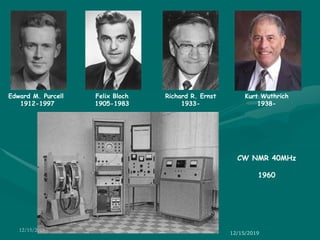
Felix Bloch
1905-1983
Edward M. Purcell
1912-1997
Kurt Wuthrich
1938-
Richard R. Ernst
1933-
CW NMR 40MHz
1960
12/15/2019
12/15/2019
12/15/2019 3
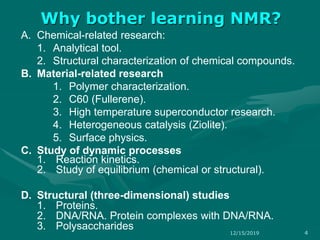
A. Chemical-related research:
1. Analytical tool.
2. Structural characterization of chemical compounds.
B. Material-related research
1. Polymer characterization.
2. C60 (Fullerene).
3. High temperature superconductor research.
4. Heterogeneous catalysis (Ziolite).
5. Surface physics.
C. Study of dynamic processes
1. Reaction kinetics.
2. Study of equilibrium (chemical or structural).
D. Structural (three-dimensional) studies
1. Proteins.
2. DNA/RNA. Protein complexes with DNA/RNA.
3. Polysaccharides
Why bother learning NMR?
12/15/2019 4
E. Drug design
1. Structure Activity Relationships (SAR) by NMR
F. Biomedical applications:
1. Metabolic studies of biological systems.
2. Magnetic Resonance Imaging (MRI), diagnostic
imaging, flow imaging, chemical shift imaging, functional
imaging.
3. Macromolecular structure determination in solution.
Finally, it’s the biggest, meanest, most expensive piece of
equipment you’ll see in your career, and this is a great time to
get your hands on it...
Why bother learning NMR?
12/15/2019 5
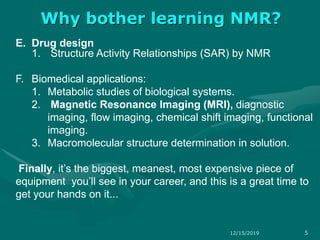
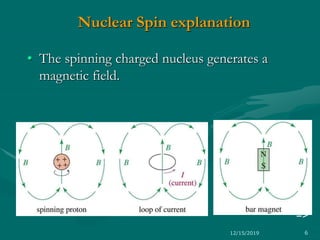
Nuclear Spin explanation
• The spinning charged nucleus generates a
magnetic field.
=>
12/15/2019 6
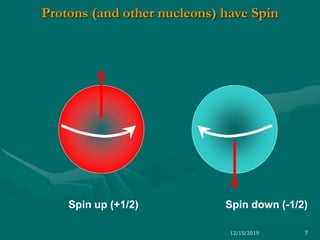
Protons (and other nucleons) have Spin
Spin up (+1/2) Spin down (-1/2)
12/15/2019 7
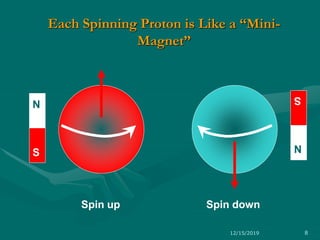
Each Spinning Proton is Like a “Mini-
Magnet”
Spin up Spin down
N
S
N
S
12/15/2019 8
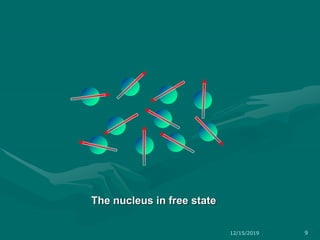
The nucleus in free state
12/15/2019 9
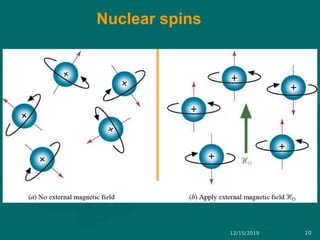
Nuclear spins
12/15/2019 10
Principles of NMR
 The nucleus spin on its own axis and magnetic moment is created,
resulting in the precessional orbit with a frequency called as
processional frequency.
 The nucleus of hydrogen atom behaves as spin bar magnet because
it possess both electric and magnetic field.
 NMR involves the interaction between an oscillating magnetic field
of EMR and the magnetic energy of the hydrogen nucleus or some
other nuclei, when they are placed in external magnetic field.
12/15/2019 11
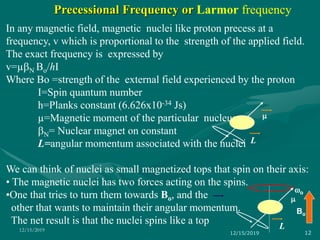
In any magnetic field, magnetic nuclei like proton precess at a
frequency, v which is proportional to the strength of the applied field.
The exact frequency is expressed by
v=µN Bo/hI
Where Bo =strength of the external field experienced by the proton
I=Spin quantum number
h=Planks constant (6.626x10⁻³⁴ Js)
µ=Magnetic moment of the particular nucleus
N= Nuclear magnet on constant
L=angular momentum associated with the nuclei
We can think of nuclei as small magnetized tops that spin on their axis:
• The magnetic nuclei has two forces acting on the spins.
•One that tries to turn them towards Bo, and the
other that wants to maintain their angular momentum.
The net result is that the nuclei spins like a top
Bo
wo
m
L
m
L
12/15/2019 12
12/15/2019
Precessional Frequency or Larmor frequency
Precession (continued)
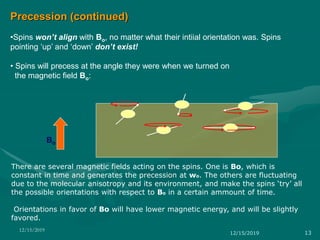
•Spins won’t align with Bo, no matter what their intiial orientation was. Spins
pointing ‘up’ and ‘down’ don’t exist!
• Spins will precess at the angle they were when we turned on
the magnetic field Bo:
Bo
There are several magnetic fields acting on the spins. One is Bo, which is
constant in time and generates the precession at wo. The others are fluctuating
due to the molecular anisotropy and its environment, and make the spins ‘try’ all
the possible orientations with respect to Bo in a certain ammount of time.
Orientations in favor of Bo will have lower magnetic energy, and will be slightly
favored.
12/15/2019 13
12/15/2019
Principles of NMR
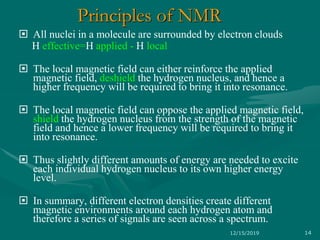
 All nuclei in a molecule are surrounded by electron clouds
H effective=H applied - H local
 The local magnetic field can either reinforce the applied
magnetic field, deshield the hydrogen nucleus, and hence a
higher frequency will be required to bring it into resonance.
 The local magnetic field can oppose the applied magnetic field,
shield the hydrogen nucleus from the strength of the magnetic
field and hence a lower frequency will be required to bring it
into resonance.
 Thus slightly different amounts of energy are needed to excite
each individual hydrogen nucleus to its own higher energy
level.
 In summary, different electron densities create different
magnetic environments around each hydrogen atom and
therefore a series of signals are seen across a spectrum.
12/15/2019 14
 A nucleus with an odd atomic number or an odd mass number has
a nuclear spin.
 The angular momentum of the charge is described as spin number.
They have 0, ½,1, 3/2…etc (I =0 denotes no spin)
 Each proton and neutron has its own spin. If sum of the proton
and neutron is even, spin number (I)= 0,1,2,3, etc
 If sum of the proton and neutron is odd I is half integral=1/2, 3/2,
5/2…etc
Principles of NMR
12/15/2019 15
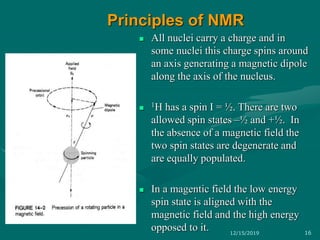
 All nuclei carry a charge and in
some nuclei this charge spins around
an axis generating a magnetic dipole
along the axis of the nucleus.
 1H has a spin I = ½. There are two
allowed spin states –½ and +½. In
the absence of a magnetic field the
two spin states are degenerate and
are equally populated.
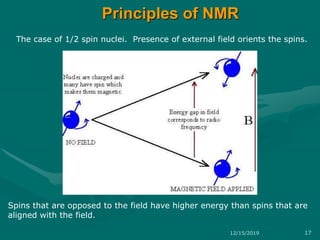
 In a magentic field the low energy
spin state is aligned with the
magnetic field and the high energy
opposed to it.
Principles of NMR
12/15/2019 16
The case of 1/2 spin nuclei. Presence of external field orients the spins.
Spins that are opposed to the field have higher energy than spins that are
aligned with the field.
Principles of NMR
12/15/2019 17
NMR equation
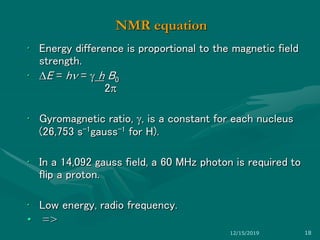
• Energy difference is proportional to the magnetic field
strength.
• E = h =  h B0
2
• Gyromagnetic ratio, , is a constant for each nucleus
(26,753 s-1gauss-1 for H).
• In a 14,092 gauss field, a 60 MHz photon is required to
flip a proton.
• Low energy, radio frequency.
• =>
12/15/2019 18
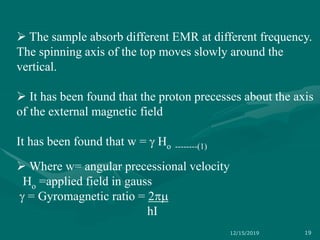
 The sample absorb different EMR at different frequency.
The spinning axis of the top moves slowly around the
vertical.
 It has been found that the proton precesses about the axis
of the external magnetic field
It has been found that w =  Ho --------(1)
 Where w= angular precessional velocity
Ho =applied field in gauss
 = Gyromagnetic ratio = 2m
hI
12/15/2019 19
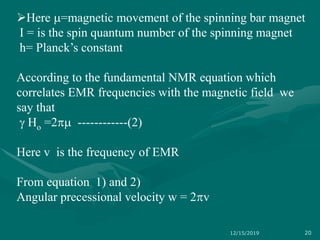
Here m=magnetic movement of the spinning bar magnet
I = is the spin quantum number of the spinning magnet
h= Planck’s constant
According to the fundamental NMR equation which
correlates EMR frequencies with the magnetic field we
say that
 Ho =2m ------------(2)
Here v is the frequency of EMR
From equation 1) and 2)
Angular precessional velocity w = 2v
12/15/2019 20
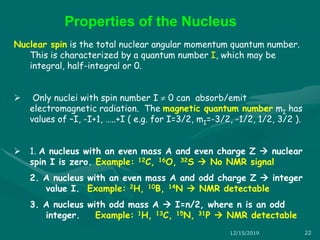
 Precessional frequency is defined as the number of
revolution per second made by the magnetic movement
vector of the nucleus around the external field Ho
 Alternatively the precessional frequency of the spinning
bar magnet (nucleus) may be defined as equal to the
frequency of EMR in megacycles per second necessary to
induce transition from one spin state to another.
 All nuclei carry a charge , so they will possess spin
angular- momentum. The nuclei which have a finite value of
spin quantum number (I >0) will precess along the axis of
rotation.
12/15/2019 21
Nuclear spin is the total nuclear angular momentum quantum number.
This is characterized by a quantum number I, which may be
integral, half-integral or 0.
 Only nuclei with spin number I  0 can absorb/emit
electromagnetic radiation. The magnetic quantum number mI has
values of –I, -I+1, …..+I ( e.g. for I=3/2, mI=-3/2, -1/2, 1/2, 3/2 ).
 1. A nucleus with an even mass A and even charge Z  nuclear
spin I is zero. Example: 12C, 16O, 32S  No NMR signal
2. A nucleus with an even mass A and odd charge Z  integer
value I. Example: 2H, 10B, 14N  NMR detectable
3. A nucleus with odd mass A  I=n/2, where n is an odd
integer. Example: 1H, 13C, 15N, 31P  NMR detectable
Properties of the Nucleus
12/15/2019 22
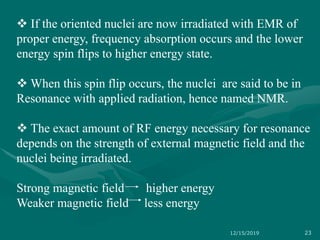
 If the oriented nuclei are now irradiated with EMR of
proper energy, frequency absorption occurs and the lower
energy spin flips to higher energy state.
 When this spin flip occurs, the nuclei are said to be in
Resonance with applied radiation, hence named NMR.
 The exact amount of RF energy necessary for resonance
depends on the strength of external magnetic field and the
nuclei being irradiated.
Strong magnetic field higher energy
Weaker magnetic field less energy
12/15/2019 23
12/15/2019 24
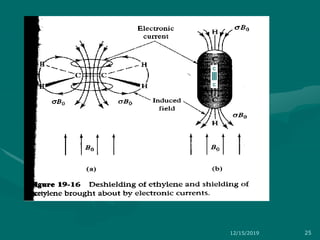
12/15/2019 25
C
C
Magnetic Shielding
• If all protons absorbed the same amount of energy in
a given magnetic field, not much information could be
obtained.
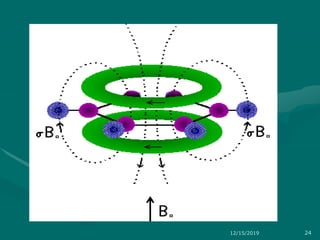
• But protons are surrounded by electrons that shield
them from the external field.
• Circulating electrons create an induced magnetic field
that opposes the external magnetic field.
=>
12/15/2019 26
Shielded Protons
Magnetic field strength must be increased for a
shielded proton to flip at the same frequency.
12/15/2019 27
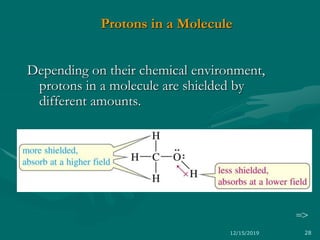
Protons in a Molecule
Depending on their chemical environment,
protons in a molecule are shielded by
different amounts.
=>
12/15/2019 28
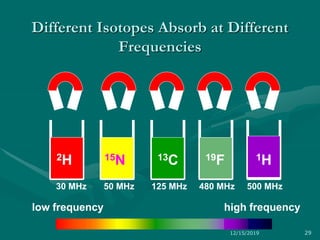
Different Isotopes Absorb at Different
Frequencies
low frequency high frequency
2H 15N 13C 19F 1H
30 MHz 50 MHz 125 MHz 480 MHz 500 MHz
12/15/2019 29
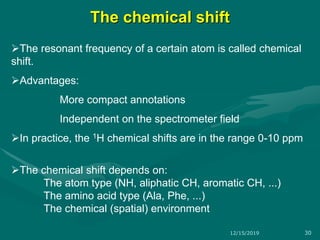
The chemical shift
The resonant frequency of a certain atom is called chemical
shift.
Advantages:
More compact annotations
Independent on the spectrometer field
In practice, the 1H chemical shifts are in the range 0-10 ppm
The chemical shift depends on:
The atom type (NH, aliphatic CH, aromatic CH, ...)
The amino acid type (Ala, Phe, ...)
The chemical (spatial) environment
12/15/2019 30
NMR Signals
1. The number of signals shows how many different kinds
of protons are present.
2. The location of the signals shows how shielded or
deshielded the proton is.
3. The intensity of the signal shows the number of
protons of that type.
4. Signal splitting shows the number of protons on
adjacent atoms.
5. To define the position of absorption the NMR chart is
calibrated by using TMS highly shielded molecule. The
exact place on the chart at which a nucleus absorb is
called “chemical shift”
12/15/2019 31
Chemical shift of TMS is arbitrarily set the zero point
1= 1ppm of the spectrometer operating frequency
1H NMR, 60MHz operating instrument 60,000,000
1= 1ppm (or) 60Hz
100MHZ operating instrument 1= 100Hz
 (ppm)= observed chemical shift (no.of Hz away from TMS)
Spectrometer frequency in MHz
If the induced field, opposes the applied field the electrons
are diamagnetic& the effect is diamagnetic shielding.
12/15/2019 32
The Chemical Shift of Different Protons
a) NMR is of no use if all protons absorbed at same frequency.
b) What makes it useful is that different protons usually appear at different
chemical shifts.
c) So, we can distinguish one kind of proton from another.
d) Why do different protons appear at different place?
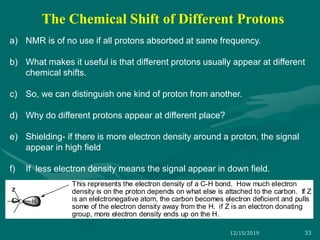
e) Shielding- if there is more electron density around a proton, the signal
appear in high field
f) If less electron density means the signal appear in down field.
C H
Z
This represents the electron density of a C-H bond. How much electron
density is on the proton depends on what else is attached to the carbon. If Z
is an elelctronegative atom, the carbon becomes electron deficient and pulls
some of the electron density away from the H. if Z is an electron donating
group, more electron density ends up on the H.
12/15/2019 33
The Chemical Shift of Different Protons
How do the electrons shield the magnetic field?
By moving. A moving charge creates a magnetic field, and the
field created by the moving electrons opposes the magnetic
field of our NMR machine.
It’s not a huge effect, but it’s enough to enable us to distinguish
between different protons in our sample.
12/15/2019 34
Types of NMR
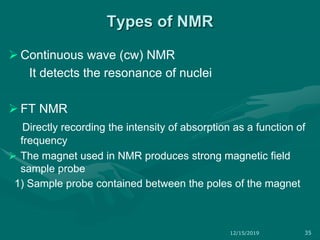
 Continuous wave (cw) NMR
It detects the resonance of nuclei
 FT NMR
Directly recording the intensity of absorption as a function of
frequency
 The magnet used in NMR produces strong magnetic field
sample probe
1) Sample probe contained between the poles of the magnet
12/15/2019 35
1. The probe has another coil wrapped at right angles to the
transmitter coil
2. Thus the optimum angle for detecting resonance
3. Various temp probe helps to keep the sample at different
temp (-100 to 200°C)
4. So NMR can be used for kinetic study, thermodynamics
12/15/2019 36
12/15/2019
The chemical shift (δ) is defined as the difference between
the resonance position of a nucleus and that of a standard
reference compound.
Chemical shift (δ) =[Δν (Hz)/Applied resonance
frequency × 106 Hz)] × 106 ppm
where, Δν = Difference in frequency (Hz) between
the observed signal and that of the standard.
Convention for δ : TMS assigned (δ = 0), values
for other protons are measured positively downfield.
In other words, increasing δ corresponds to
increasing de-shielding of the nucleus.
12/15/2019
Spin-spin Interactions
High resolution NMR spectra very often exhibit
signals as multiplets, invariably showing a more or
less symmetrical appearance.
Multiplicity is brought about due to the splitting of
the signal of one set of equivalent nuclei by the
magnetic fields of adjacent sets of nuclei i.e.,
spin-spin interactions.
12/15/2019
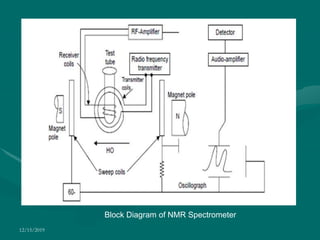
Block Diagram of NMR Spectrometer
Radiofrequency Oscillator
• It generated by electronic multiplication and natural
frequency of quartz crystal contained in a thermostated
block/different crystal/trasmitters are used
• RFO installed perpendicular to the magnetic field &
transmits RW of fixed frequency 60,100, 200 or 300 MHZ
12/15/2019 40
RF receiver/detector:
a) The sample in the NMR probe gives data which can be
detected as a signal
b) Detectors used in NMR should be sensitive as the
signal levels are small(<1milli volt)
c) So that multiplication of signal is essential
d) Rf receiver also to be perpendicular to the magnet like
oscillator
12/15/2019 41
Recorder
 The signal is sent to the recorder or oscilloscope
 It helps fast scanning of spectrum or electronic filtering of
signal
 The recorder plots resonance signal on y-axis and strength
of magnetic field on x-axis
 The strength of resonance signal  number of nuclei
resonating at that field strength
 Most spectrometer equipped with automatic integrator to
measure the area under the observed signal
12/15/2019 42
Solvents
CDCl3
• Advantages for non-polar to polar compounds
• CDCl3 peak appear in 7.27δ for sparingly soluble
compounds add drop wise (DMSO-d6)
• It will shift residual CHCl3 peak to 8.38δ
CCl4 for non polar compounds any water molecule causes
turbidity
DMSO-d6
• More viscous/restricted rotation, causes line broadening
non-volatile (difficult to remove from the sample)
12/15/2019 43
Additional Factors Affecting
Chemical Shift
 It is very difficult to predict the chemical shift of protons
attached to heteroatoms (O-H, N-H, S-H).
 It is due to hydrogen bonding which has the effect
deshielding the proton and it causes broadening of
signal.
 Replaces the exchangeable protons with deuteriums
which cannot be detected in the proton NMR.
 Hence its chemical shift can be identified without any
problem (It is a useful technique for -OH, NH2 and
COOH
12/15/2019 44
Solvent effect
 Changing the solvent has a dramatic, yet
unpredictable effect on the chemical shift of
signals.
 This is useful if important peaks overlap in a CDCl3
spectrum then another solvent, D6 benzene, D3
acetonitrile etc can be used
12/15/2019 45
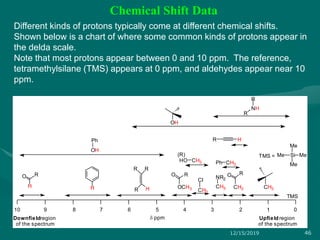
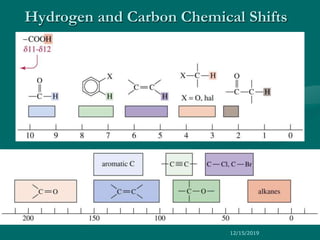
Chemical Shift Data
Different kinds of protons typically come at different chemical shifts.
Shown below is a chart of where some common kinds of protons appear in
the delda scale.
Note that most protons appear between 0 and 10 ppm. The reference,
tetramethylsilane (TMS) appears at 0 ppm, and aldehydes appear near 10
ppm.
ppm
TMS
CH3CH3
RONR2
CH3OCH3
RO
HR
R R
HH
RO
Ph CH3
HR
Cl
CH3
Ph
OH
OH
R
NH
R
Upfieldregion
of the spectrum
Downfieldregion
of the spectrum
TMS = Me Si
Me
Me
Me
012345678910
CH3HO
(R)
12/15/2019 46
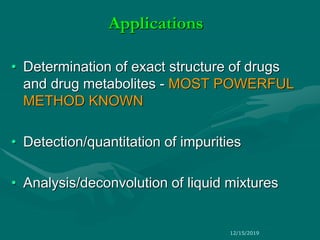
Applications
• Determination of exact structure of drugs
and drug metabolites - MOST POWERFUL
METHOD KNOWN
• Detection/quantitation of impurities
• Analysis/deconvolution of liquid mixtures
12/15/2019
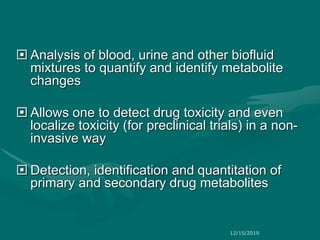
 Analysis of blood, urine and other biofluid
mixtures to quantify and identify metabolite
changes
 Allows one to detect drug toxicity and even
localize toxicity (for preclinical trials) in a non-
invasive way
 Detection, identification and quantitation of
primary and secondary drug metabolites
12/15/2019
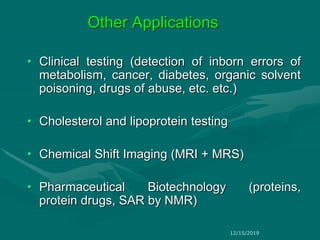
Other Applications
• Clinical testing (detection of inborn errors of
metabolism, cancer, diabetes, organic solvent
poisoning, drugs of abuse, etc. etc.)
• Cholesterol and lipoprotein testing
• Chemical Shift Imaging (MRI + MRS)
• Pharmaceutical Biotechnology (proteins,
protein drugs, SAR by NMR)
12/15/2019
Hydrogen and Carbon Chemical Shifts
=>
12/15/2019
Acknowledgement
•http://www.pharmacy.ualberta.ca/pharm325
12/15/2019

NMR SPECTROSCOPY 17.03.17

  • 1.
    Nuclear Magnetic Resonance (NMR)Spectroscopy 12/15/2019 1
  • 2.
    Felix Bloch 1905-1983 Edward M.Purcell 1912-1997 Kurt Wuthrich 1938- Richard R. Ernst 1933- CW NMR 40MHz 1960 12/15/2019 12/15/2019
  • 3.
  • 4.
    A. Chemical-related research: 1.Analytical tool. 2. Structural characterization of chemical compounds. B. Material-related research 1. Polymer characterization. 2. C60 (Fullerene). 3. High temperature superconductor research. 4. Heterogeneous catalysis (Ziolite). 5. Surface physics. C. Study of dynamic processes 1. Reaction kinetics. 2. Study of equilibrium (chemical or structural). D. Structural (three-dimensional) studies 1. Proteins. 2. DNA/RNA. Protein complexes with DNA/RNA. 3. Polysaccharides Why bother learning NMR? 12/15/2019 4
  • 5.
    E. Drug design 1.Structure Activity Relationships (SAR) by NMR F. Biomedical applications: 1. Metabolic studies of biological systems. 2. Magnetic Resonance Imaging (MRI), diagnostic imaging, flow imaging, chemical shift imaging, functional imaging. 3. Macromolecular structure determination in solution. Finally, it’s the biggest, meanest, most expensive piece of equipment you’ll see in your career, and this is a great time to get your hands on it... Why bother learning NMR? 12/15/2019 5
  • 6.
    Nuclear Spin explanation •The spinning charged nucleus generates a magnetic field. => 12/15/2019 6
  • 7.
    Protons (and othernucleons) have Spin Spin up (+1/2) Spin down (-1/2) 12/15/2019 7
  • 8.
    Each Spinning Protonis Like a “Mini- Magnet” Spin up Spin down N S N S 12/15/2019 8
  • 9.
    The nucleus infree state 12/15/2019 9
  • 10.
  • 11.
    Principles of NMR The nucleus spin on its own axis and magnetic moment is created, resulting in the precessional orbit with a frequency called as processional frequency.  The nucleus of hydrogen atom behaves as spin bar magnet because it possess both electric and magnetic field.  NMR involves the interaction between an oscillating magnetic field of EMR and the magnetic energy of the hydrogen nucleus or some other nuclei, when they are placed in external magnetic field. 12/15/2019 11
  • 12.
    In any magneticfield, magnetic nuclei like proton precess at a frequency, v which is proportional to the strength of the applied field. The exact frequency is expressed by v=µN Bo/hI Where Bo =strength of the external field experienced by the proton I=Spin quantum number h=Planks constant (6.626x10⁻³⁴ Js) µ=Magnetic moment of the particular nucleus N= Nuclear magnet on constant L=angular momentum associated with the nuclei We can think of nuclei as small magnetized tops that spin on their axis: • The magnetic nuclei has two forces acting on the spins. •One that tries to turn them towards Bo, and the other that wants to maintain their angular momentum. The net result is that the nuclei spins like a top Bo wo m L m L 12/15/2019 12 12/15/2019 Precessional Frequency or Larmor frequency
  • 13.
    Precession (continued) •Spins won’talign with Bo, no matter what their intiial orientation was. Spins pointing ‘up’ and ‘down’ don’t exist! • Spins will precess at the angle they were when we turned on the magnetic field Bo: Bo There are several magnetic fields acting on the spins. One is Bo, which is constant in time and generates the precession at wo. The others are fluctuating due to the molecular anisotropy and its environment, and make the spins ‘try’ all the possible orientations with respect to Bo in a certain ammount of time. Orientations in favor of Bo will have lower magnetic energy, and will be slightly favored. 12/15/2019 13 12/15/2019
  • 14.
    Principles of NMR All nuclei in a molecule are surrounded by electron clouds H effective=H applied - H local  The local magnetic field can either reinforce the applied magnetic field, deshield the hydrogen nucleus, and hence a higher frequency will be required to bring it into resonance.  The local magnetic field can oppose the applied magnetic field, shield the hydrogen nucleus from the strength of the magnetic field and hence a lower frequency will be required to bring it into resonance.  Thus slightly different amounts of energy are needed to excite each individual hydrogen nucleus to its own higher energy level.  In summary, different electron densities create different magnetic environments around each hydrogen atom and therefore a series of signals are seen across a spectrum. 12/15/2019 14
  • 15.
     A nucleuswith an odd atomic number or an odd mass number has a nuclear spin.  The angular momentum of the charge is described as spin number. They have 0, ½,1, 3/2…etc (I =0 denotes no spin)  Each proton and neutron has its own spin. If sum of the proton and neutron is even, spin number (I)= 0,1,2,3, etc  If sum of the proton and neutron is odd I is half integral=1/2, 3/2, 5/2…etc Principles of NMR 12/15/2019 15
  • 16.
     All nucleicarry a charge and in some nuclei this charge spins around an axis generating a magnetic dipole along the axis of the nucleus.  1H has a spin I = ½. There are two allowed spin states –½ and +½. In the absence of a magnetic field the two spin states are degenerate and are equally populated.  In a magentic field the low energy spin state is aligned with the magnetic field and the high energy opposed to it. Principles of NMR 12/15/2019 16
  • 17.
    The case of1/2 spin nuclei. Presence of external field orients the spins. Spins that are opposed to the field have higher energy than spins that are aligned with the field. Principles of NMR 12/15/2019 17
  • 18.
    NMR equation • Energydifference is proportional to the magnetic field strength. • E = h =  h B0 2 • Gyromagnetic ratio, , is a constant for each nucleus (26,753 s-1gauss-1 for H). • In a 14,092 gauss field, a 60 MHz photon is required to flip a proton. • Low energy, radio frequency. • => 12/15/2019 18
  • 19.
     The sampleabsorb different EMR at different frequency. The spinning axis of the top moves slowly around the vertical.  It has been found that the proton precesses about the axis of the external magnetic field It has been found that w =  Ho --------(1)  Where w= angular precessional velocity Ho =applied field in gauss  = Gyromagnetic ratio = 2m hI 12/15/2019 19
  • 20.
    Here m=magnetic movementof the spinning bar magnet I = is the spin quantum number of the spinning magnet h= Planck’s constant According to the fundamental NMR equation which correlates EMR frequencies with the magnetic field we say that  Ho =2m ------------(2) Here v is the frequency of EMR From equation 1) and 2) Angular precessional velocity w = 2v 12/15/2019 20
  • 21.
     Precessional frequencyis defined as the number of revolution per second made by the magnetic movement vector of the nucleus around the external field Ho  Alternatively the precessional frequency of the spinning bar magnet (nucleus) may be defined as equal to the frequency of EMR in megacycles per second necessary to induce transition from one spin state to another.  All nuclei carry a charge , so they will possess spin angular- momentum. The nuclei which have a finite value of spin quantum number (I >0) will precess along the axis of rotation. 12/15/2019 21
  • 22.
    Nuclear spin isthe total nuclear angular momentum quantum number. This is characterized by a quantum number I, which may be integral, half-integral or 0.  Only nuclei with spin number I  0 can absorb/emit electromagnetic radiation. The magnetic quantum number mI has values of –I, -I+1, …..+I ( e.g. for I=3/2, mI=-3/2, -1/2, 1/2, 3/2 ).  1. A nucleus with an even mass A and even charge Z  nuclear spin I is zero. Example: 12C, 16O, 32S  No NMR signal 2. A nucleus with an even mass A and odd charge Z  integer value I. Example: 2H, 10B, 14N  NMR detectable 3. A nucleus with odd mass A  I=n/2, where n is an odd integer. Example: 1H, 13C, 15N, 31P  NMR detectable Properties of the Nucleus 12/15/2019 22
  • 23.
     If theoriented nuclei are now irradiated with EMR of proper energy, frequency absorption occurs and the lower energy spin flips to higher energy state.  When this spin flip occurs, the nuclei are said to be in Resonance with applied radiation, hence named NMR.  The exact amount of RF energy necessary for resonance depends on the strength of external magnetic field and the nuclei being irradiated. Strong magnetic field higher energy Weaker magnetic field less energy 12/15/2019 23
  • 24.
  • 25.
  • 26.
    Magnetic Shielding • Ifall protons absorbed the same amount of energy in a given magnetic field, not much information could be obtained. • But protons are surrounded by electrons that shield them from the external field. • Circulating electrons create an induced magnetic field that opposes the external magnetic field. => 12/15/2019 26
  • 27.
    Shielded Protons Magnetic fieldstrength must be increased for a shielded proton to flip at the same frequency. 12/15/2019 27
  • 28.
    Protons in aMolecule Depending on their chemical environment, protons in a molecule are shielded by different amounts. => 12/15/2019 28
  • 29.
    Different Isotopes Absorbat Different Frequencies low frequency high frequency 2H 15N 13C 19F 1H 30 MHz 50 MHz 125 MHz 480 MHz 500 MHz 12/15/2019 29
  • 30.
    The chemical shift Theresonant frequency of a certain atom is called chemical shift. Advantages: More compact annotations Independent on the spectrometer field In practice, the 1H chemical shifts are in the range 0-10 ppm The chemical shift depends on: The atom type (NH, aliphatic CH, aromatic CH, ...) The amino acid type (Ala, Phe, ...) The chemical (spatial) environment 12/15/2019 30
  • 31.
    NMR Signals 1. Thenumber of signals shows how many different kinds of protons are present. 2. The location of the signals shows how shielded or deshielded the proton is. 3. The intensity of the signal shows the number of protons of that type. 4. Signal splitting shows the number of protons on adjacent atoms. 5. To define the position of absorption the NMR chart is calibrated by using TMS highly shielded molecule. The exact place on the chart at which a nucleus absorb is called “chemical shift” 12/15/2019 31
  • 32.
    Chemical shift ofTMS is arbitrarily set the zero point 1= 1ppm of the spectrometer operating frequency 1H NMR, 60MHz operating instrument 60,000,000 1= 1ppm (or) 60Hz 100MHZ operating instrument 1= 100Hz  (ppm)= observed chemical shift (no.of Hz away from TMS) Spectrometer frequency in MHz If the induced field, opposes the applied field the electrons are diamagnetic& the effect is diamagnetic shielding. 12/15/2019 32
  • 33.
    The Chemical Shiftof Different Protons a) NMR is of no use if all protons absorbed at same frequency. b) What makes it useful is that different protons usually appear at different chemical shifts. c) So, we can distinguish one kind of proton from another. d) Why do different protons appear at different place? e) Shielding- if there is more electron density around a proton, the signal appear in high field f) If less electron density means the signal appear in down field. C H Z This represents the electron density of a C-H bond. How much electron density is on the proton depends on what else is attached to the carbon. If Z is an elelctronegative atom, the carbon becomes electron deficient and pulls some of the electron density away from the H. if Z is an electron donating group, more electron density ends up on the H. 12/15/2019 33
  • 34.
    The Chemical Shiftof Different Protons How do the electrons shield the magnetic field? By moving. A moving charge creates a magnetic field, and the field created by the moving electrons opposes the magnetic field of our NMR machine. It’s not a huge effect, but it’s enough to enable us to distinguish between different protons in our sample. 12/15/2019 34
  • 35.
    Types of NMR Continuous wave (cw) NMR It detects the resonance of nuclei  FT NMR Directly recording the intensity of absorption as a function of frequency  The magnet used in NMR produces strong magnetic field sample probe 1) Sample probe contained between the poles of the magnet 12/15/2019 35
  • 36.
    1. The probehas another coil wrapped at right angles to the transmitter coil 2. Thus the optimum angle for detecting resonance 3. Various temp probe helps to keep the sample at different temp (-100 to 200°C) 4. So NMR can be used for kinetic study, thermodynamics 12/15/2019 36
  • 37.
    12/15/2019 The chemical shift(δ) is defined as the difference between the resonance position of a nucleus and that of a standard reference compound. Chemical shift (δ) =[Δν (Hz)/Applied resonance frequency × 106 Hz)] × 106 ppm where, Δν = Difference in frequency (Hz) between the observed signal and that of the standard. Convention for δ : TMS assigned (δ = 0), values for other protons are measured positively downfield. In other words, increasing δ corresponds to increasing de-shielding of the nucleus.
  • 38.
    12/15/2019 Spin-spin Interactions High resolutionNMR spectra very often exhibit signals as multiplets, invariably showing a more or less symmetrical appearance. Multiplicity is brought about due to the splitting of the signal of one set of equivalent nuclei by the magnetic fields of adjacent sets of nuclei i.e., spin-spin interactions.
  • 39.
  • 40.
    Radiofrequency Oscillator • Itgenerated by electronic multiplication and natural frequency of quartz crystal contained in a thermostated block/different crystal/trasmitters are used • RFO installed perpendicular to the magnetic field & transmits RW of fixed frequency 60,100, 200 or 300 MHZ 12/15/2019 40
  • 41.
    RF receiver/detector: a) Thesample in the NMR probe gives data which can be detected as a signal b) Detectors used in NMR should be sensitive as the signal levels are small(<1milli volt) c) So that multiplication of signal is essential d) Rf receiver also to be perpendicular to the magnet like oscillator 12/15/2019 41
  • 42.
    Recorder  The signalis sent to the recorder or oscilloscope  It helps fast scanning of spectrum or electronic filtering of signal  The recorder plots resonance signal on y-axis and strength of magnetic field on x-axis  The strength of resonance signal  number of nuclei resonating at that field strength  Most spectrometer equipped with automatic integrator to measure the area under the observed signal 12/15/2019 42
  • 43.
    Solvents CDCl3 • Advantages fornon-polar to polar compounds • CDCl3 peak appear in 7.27δ for sparingly soluble compounds add drop wise (DMSO-d6) • It will shift residual CHCl3 peak to 8.38δ CCl4 for non polar compounds any water molecule causes turbidity DMSO-d6 • More viscous/restricted rotation, causes line broadening non-volatile (difficult to remove from the sample) 12/15/2019 43
  • 44.
    Additional Factors Affecting ChemicalShift  It is very difficult to predict the chemical shift of protons attached to heteroatoms (O-H, N-H, S-H).  It is due to hydrogen bonding which has the effect deshielding the proton and it causes broadening of signal.  Replaces the exchangeable protons with deuteriums which cannot be detected in the proton NMR.  Hence its chemical shift can be identified without any problem (It is a useful technique for -OH, NH2 and COOH 12/15/2019 44
  • 45.
    Solvent effect  Changingthe solvent has a dramatic, yet unpredictable effect on the chemical shift of signals.  This is useful if important peaks overlap in a CDCl3 spectrum then another solvent, D6 benzene, D3 acetonitrile etc can be used 12/15/2019 45
  • 46.
    Chemical Shift Data Differentkinds of protons typically come at different chemical shifts. Shown below is a chart of where some common kinds of protons appear in the delda scale. Note that most protons appear between 0 and 10 ppm. The reference, tetramethylsilane (TMS) appears at 0 ppm, and aldehydes appear near 10 ppm. ppm TMS CH3CH3 RONR2 CH3OCH3 RO HR R R HH RO Ph CH3 HR Cl CH3 Ph OH OH R NH R Upfieldregion of the spectrum Downfieldregion of the spectrum TMS = Me Si Me Me Me 012345678910 CH3HO (R) 12/15/2019 46
  • 47.
    Applications • Determination ofexact structure of drugs and drug metabolites - MOST POWERFUL METHOD KNOWN • Detection/quantitation of impurities • Analysis/deconvolution of liquid mixtures 12/15/2019
  • 48.
     Analysis ofblood, urine and other biofluid mixtures to quantify and identify metabolite changes  Allows one to detect drug toxicity and even localize toxicity (for preclinical trials) in a non- invasive way  Detection, identification and quantitation of primary and secondary drug metabolites 12/15/2019
  • 49.
    Other Applications • Clinicaltesting (detection of inborn errors of metabolism, cancer, diabetes, organic solvent poisoning, drugs of abuse, etc. etc.) • Cholesterol and lipoprotein testing • Chemical Shift Imaging (MRI + MRS) • Pharmaceutical Biotechnology (proteins, protein drugs, SAR by NMR) 12/15/2019
  • 50.
    Hydrogen and CarbonChemical Shifts => 12/15/2019
  • 51.