3
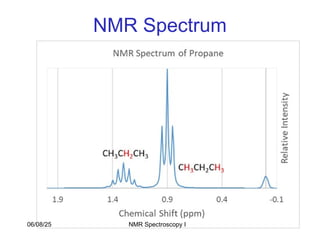
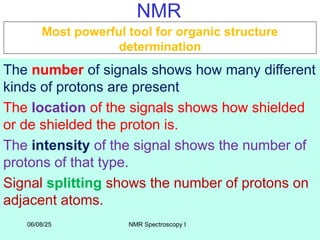
NMR
The number ofsignals shows how many different
kinds of protons are present
The location of the signals shows how shielded
or de shielded the proton is.
The intensity of the signal shows the number of
protons of that type.
Signal splitting shows the number of protons on
adjacent atoms.
Most powerful tool for organic structure
determination
06/08/25 NMR Spectroscopy I
4.
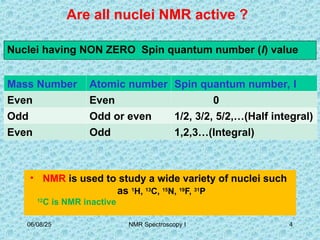
Are all nucleiNMR active ?
• NMR is used to study a wide variety of nuclei such
as 1
H, 13
C, 15
N, 19
F, 31
P
12
C is NMR inactive
Nuclei having NON ZERO Spin quantum number (I) value
Mass Number Atomic number Spin quantum number, I
Even Even 0
Odd Odd or even 1/2, 3/2, 5/2,…(Half integral)
Even Odd 1,2,3…(Integral)
06/08/25 4
NMR Spectroscopy I
5.
Nuclear Spin
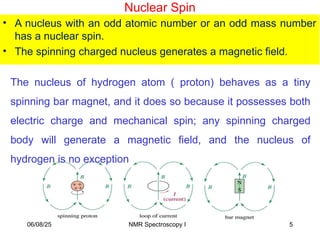
• Anucleus with an odd atomic number or an odd mass number
has a nuclear spin.
• The spinning charged nucleus generates a magnetic field.
The nucleus of hydrogen atom ( proton) behaves as a tiny
spinning bar magnet, and it does so because it possesses both
electric charge and mechanical spin; any spinning charged
body will generate a magnetic field, and the nucleus of
hydrogen is no exception
06/08/25 5
NMR Spectroscopy I
6.
Nuclear Spin
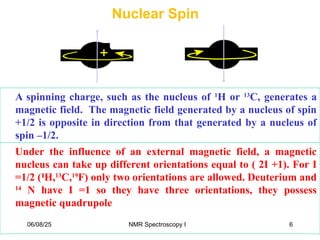
A spinningcharge, such as the nucleus of 1
H or 13
C, generates a
magnetic field. The magnetic field generated by a nucleus of spin
+1/2 is opposite in direction from that generated by a nucleus of
spin –1/2.
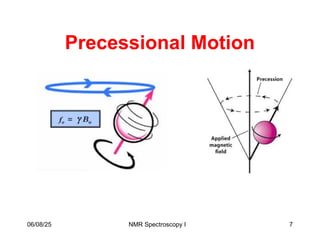
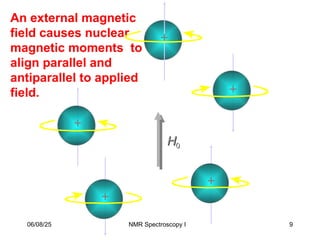
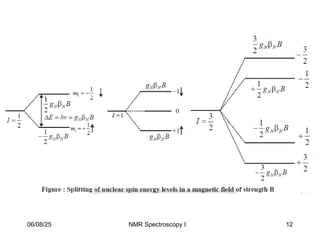
Under the influence of an external magnetic field, a magnetic
nucleus can take up different orientations equal to ( 2I +1). For I
=1/2 (1
1
H,13
C,19
F) only two orientations are allowed. Deuterium and
14
N have I =1 so they have three orientations, they possess
magnetic quadrupole
06/08/25 6
NMR Spectroscopy I
+
+
+
+
+
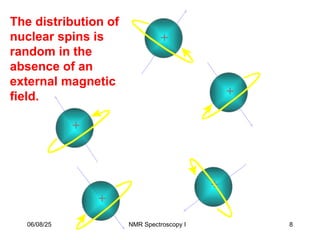
An external magnetic
fieldcauses nuclear
magnetic moments to
align parallel and
antiparallel to applied
field.
H
H0
0
06/08/25 9
NMR Spectroscopy I
10.
+
+
+
+
+
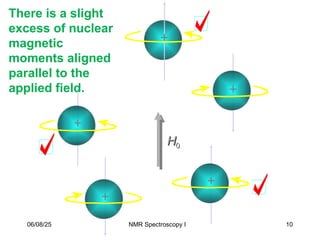
There is aslight
excess of nuclear
magnetic
moments aligned
parallel to the
applied field.
H
H0
0
06/08/25 10
NMR Spectroscopy I
11.
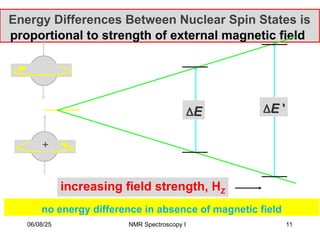
no energy differencein absence of magnetic field
Energy Differences Between Nuclear Spin States is
proportional to strength of external magnetic field
E
E
E
E '
'
increasing field strength, HZ
06/08/25 11
NMR Spectroscopy I
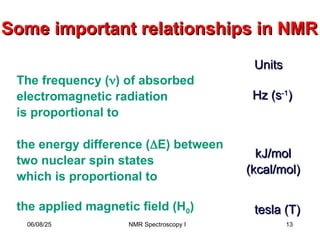
Some important relationshipsin NMR
Some important relationships in NMR
The frequency () of absorbed
electromagnetic radiation
is proportional to
the energy difference (E) between
two nuclear spin states
which is proportional to
the applied magnetic field (H0)
Units
Units
Hz (s
Hz (s-1
-1
)
)
kJ/mol
kJ/mol
(kcal/mol)
(kcal/mol)
tesla (T)
tesla (T)
06/08/25 13
NMR Spectroscopy I
14.
14
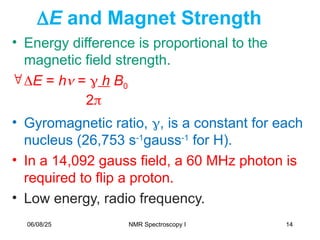
E and MagnetStrength
• Energy difference is proportional to the
magnetic field strength.
E = h = h B0
2
• Gyromagnetic ratio, , is a constant for each
nucleus (26,753 s-1
gauss-1
for H).
• In a 14,092 gauss field, a 60 MHz photon is
required to flip a proton.
• Low energy, radio frequency.
06/08/25 NMR Spectroscopy I
15.
Some important relationshipsin NMR
Some important relationships in NMR
The frequency of absorbed electromagnetic
radiation for a particular nucleus (such as 1
H or
13
C) depends on the molecular environment of
the nucleus (the electronic environment).
This is why NMR is such a useful tool
for structure determination. The signals of
different protons and carbon atoms in a molecule
show different signals, just like different functional
groups show different signals in the IR.
06/08/25 15
NMR Spectroscopy I
16.
16
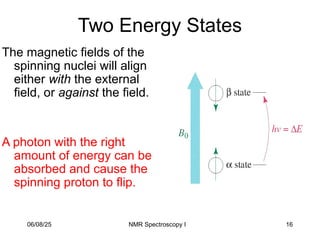
Two Energy States
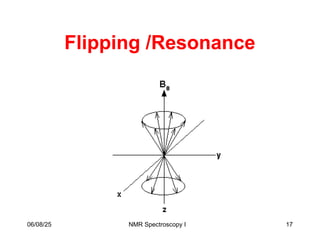
Themagnetic fields of the
spinning nuclei will align
either with the external
field, or against the field.
A photon with the right
amount of energy can be
absorbed and cause the
spinning proton to flip.
06/08/25 NMR Spectroscopy I
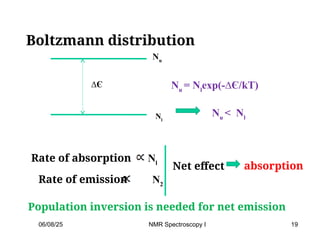
Protons absorb 60MHZ
Lower energy Nuclei move up to higher level
Equality reaches :Signals fade out……..SATURATION
Emission of energy known as RELAXATION PROCESS
1.Spin-Lattice relaxation: High energy nucleus transfers
energy to electromagnetic vectors in the surroundings such
as solvents etc. ( lattice indicates the entire framework or
aggregate of neighbours), Mean half life =T1
2.Spin-spin Relaxation: Transfers energy to nearby nucleus
having same ΔE. No net energy change, Mean half life =T2
If T1 & T2 small: Lifetime is short …Broadening of peaks
ΔE x Δt = h/2Π or Δh x Δγ x Δt = h/2Π or Δγ x Δt= Constant
So uncertainty in measuring frequency is low if Δt is
high.
Types of NMROperating system
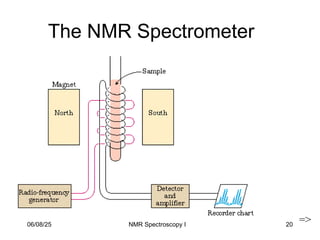
1. Magnetic field kept fixed and radiofrequency source is changed
( Frequency sweep)
2. Frequency kept fixed ( say at 60 MHz) and magnetic field is increased or
decreased until all the nuclei in turn presses at 60 MHz and come to
resonance (Field sweep)
3. Pulse NMR: All the nuclei are irradiated at a fixed field with a strong
pulse of radiofrequency energy containing all the frequencies over the
proton range
06/08/25 21
NMR Spectroscopy I
22.
22
Magnetic Shielding
If allprotons absorbed the same amount of
energy in a given magnetic field, not much
information could be obtained.
But protons are surrounded by electrons that
shield them from the external field.
Circulating electrons create an induced magnetic
field that opposes the external magnetic field.
06/08/25 NMR Spectroscopy I
23.
23
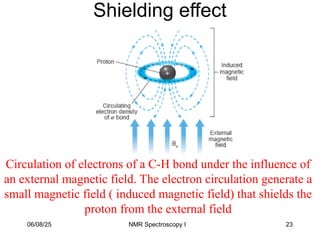
Shielding effect
Circulation ofelectrons of a C-H bond under the influence of
an external magnetic field. The electron circulation generate a
small magnetic field ( induced magnetic field) that shields the
proton from the external field
06/08/25 NMR Spectroscopy I
24.
24
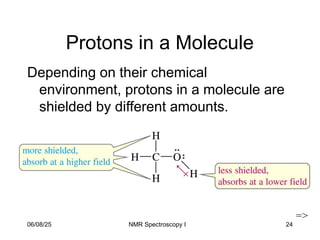
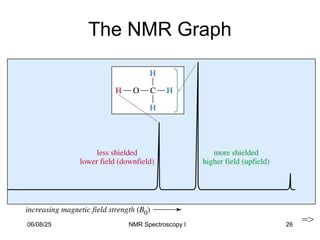
Protons in aMolecule
Depending on their chemical
environment, protons in a molecule are
shielded by different amounts.
=>
06/08/25 NMR Spectroscopy I
25.
25
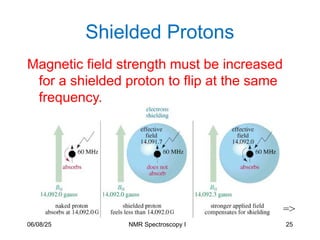
Shielded Protons
Magnetic fieldstrength must be increased
for a shielded proton to flip at the same
frequency.
=>
06/08/25 NMR Spectroscopy I
27
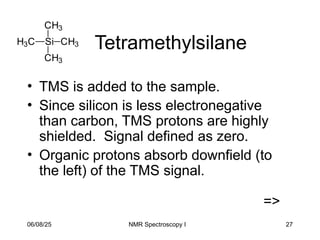
Tetramethylsilane
• TMS isadded to the sample.
• Since silicon is less electronegative
than carbon, TMS protons are highly
shielded. Signal defined as zero.
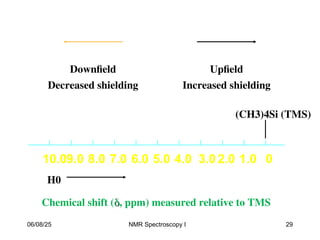
• Organic protons absorb downfield (to
the left) of the TMS signal.
=>
Si
CH3
CH3
CH3
H3C
06/08/25 NMR Spectroscopy I
28.
28
Chemical Shift
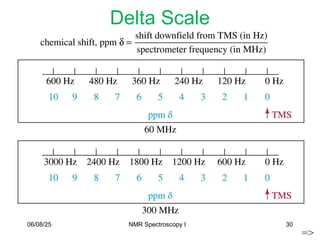
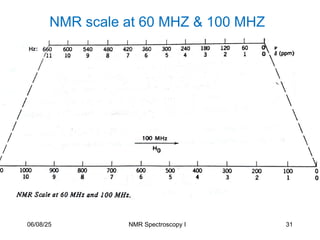
• Measuredin parts per million.
• Ratio of shift downfield from TMS (Hz)
to total spectrometer frequency (Hz).
• Same value for 60, 100, or 300 MHz
machine.
• Called the delta scale.
=>
06/08/25 NMR Spectroscopy I
32
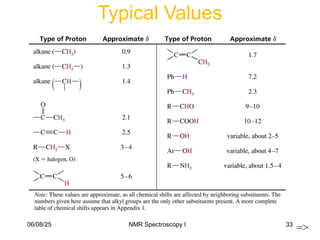
Location of Signals
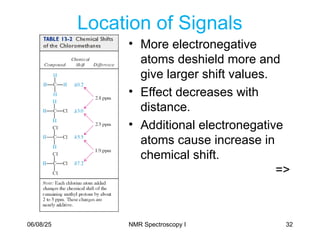
•More electronegative
atoms deshield more and
give larger shift values.
• Effect decreases with
distance.
• Additional electronegative
atoms cause increase in
chemical shift.
=>
06/08/25 NMR Spectroscopy I



![谷歌留痕技术 [ 𝙩𝙤𝙥 𝟮𝟯𝟯. 𝙘 𝙤𝙢 ]](https://cdn.slidesharecdn.com/ss_thumbnails/top233-260130174328-3833018c-thumbnail.jpg?width=640&height=640&fit=bounds)


