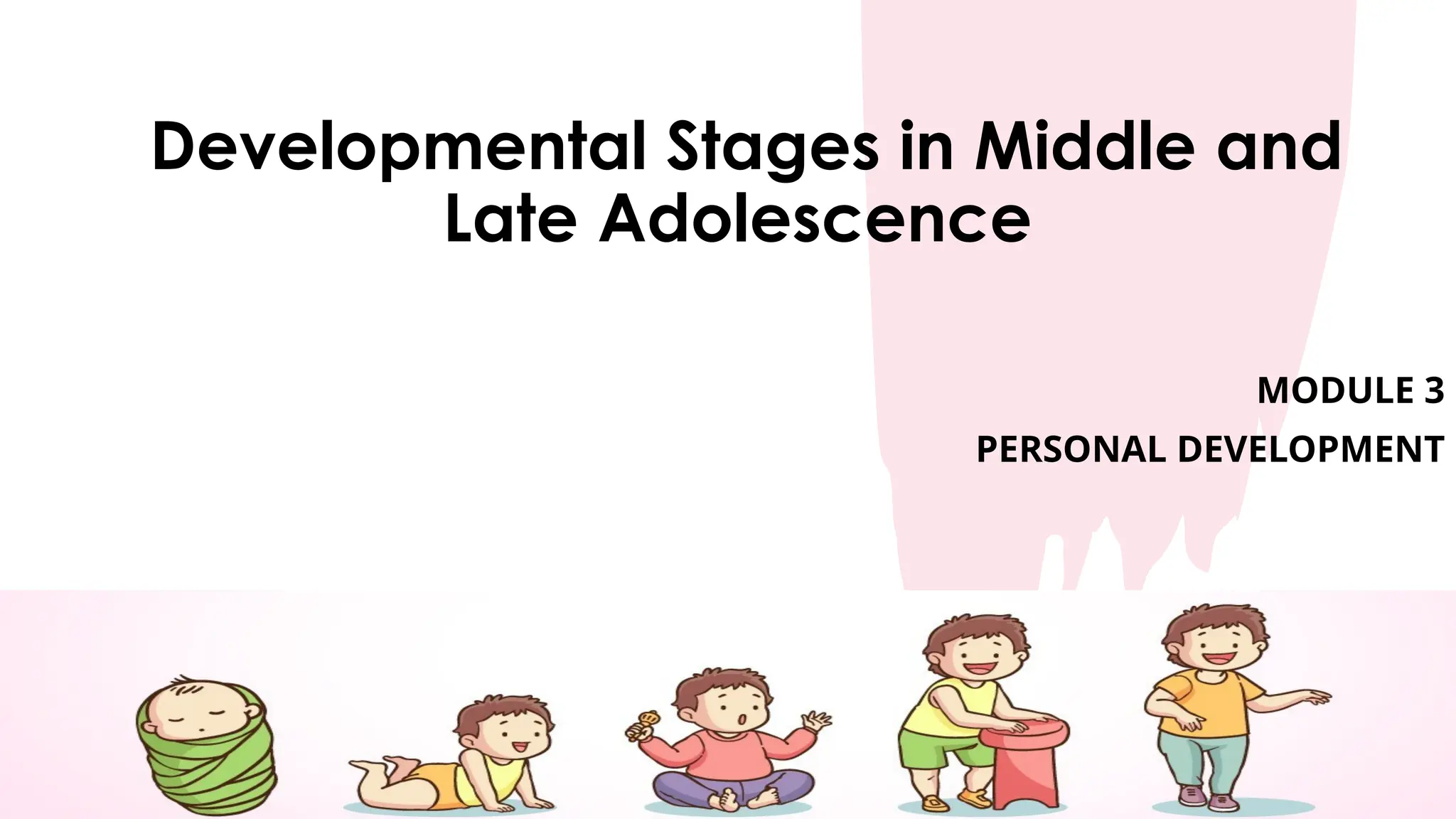
Developmental Stages in Middle and
Late Adolescence
MODULE 3
PERSONAL DEVELOPMENT
Let’s Play
- Move On
-Look Back
-Forever Alone
Objectives :
1. Classify various developmental tasks
according to developmental stage,
2. Evaluate your development in
comparison with persons of the same
age group, and
3. List ways to become a responsible
adolescent prepared for adult life.
MY PERSONAL TIMELINE
A personal timeline portrays the influential
events and happiness of a person’s life so
that he can understand where he has
gone wrong and right in the past. It helps
to plan the future in a better constructive
way.
DEVELOPMENTAL STAGES
Human development focuses on human growth and changes across
the lifespan, including physical, cognitive, social, intellectual,
perceptual, personality and emotion growth.
The study of human developmental stages is essential to
understanding how human learn, mature, and adapt. Throughout
their lives, humans go through various stages of development.
The human being is either in a stage of growth or decline, but either
condition imparts change. Some aspects of our life change very little
over time, are consistent. Other aspects change dramatically. By
understanding these changes, we can better respond and plan
ahead effectively.
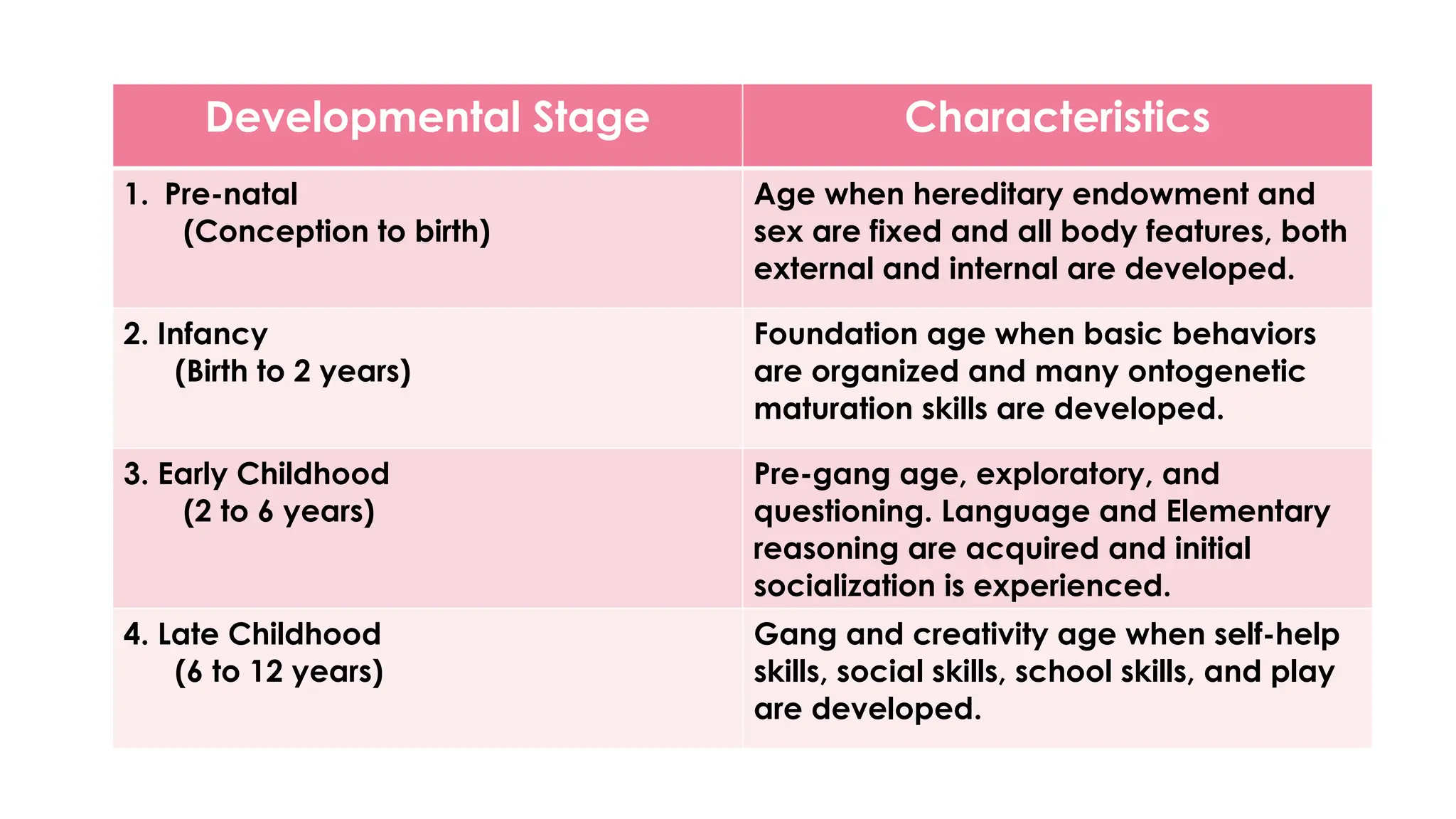
Developmental Stage Characteristics
1. Pre-natal
(Conception to birth)
Age when hereditary endowment and
sex are fixed and all body features, both
external and internal are developed.
2. Infancy
(Birth to 2 years)
Foundation age when basic behaviors
are organized and many ontogenetic
maturation skills are developed.
3. Early Childhood
(2 to 6 years)
Pre-gang age, exploratory, and
questioning. Language and Elementary
reasoning are acquired and initial
socialization is experienced.
4. Late Childhood
(6 to 12 years)
Gang and creativity age when self-help
skills, social skills, school skills, and play
are developed.
Developmental Stage Characteristics
5. Adolescence
(puberty to 18 years)
Transition age from childhood to
adulthood when sex maturation and
rapid physical development occur
resulting to changes in ways of feeling,
thinking and acting.
6. Early Adulthood
(18 to 40 years)
Age of adjustment to new patterns of life
and roles such as spouse, parent and
bread winner.
7. Middle Age
(40 years to retirement)
Transition age when adjustments to initial
physical and mental decline are
experienced.
8. Old Age
(retirement to death)
Retirement age when increasingly rapid
physical and mental decline are
experienced.
GROUP ACTIVITY
ROLEPLAY
Assignment
Using a bond paper (short size), write the major
events in your life and the significant people in your
life. You may add your age, specific dates and places.
You may draw the timeline horizontally, vertically,
diagonally or even using ups and down depending
on your imagination. Be creative in your
presentations. You may also use symbols, figures
and drawings. Think a title for your personal
timeline.
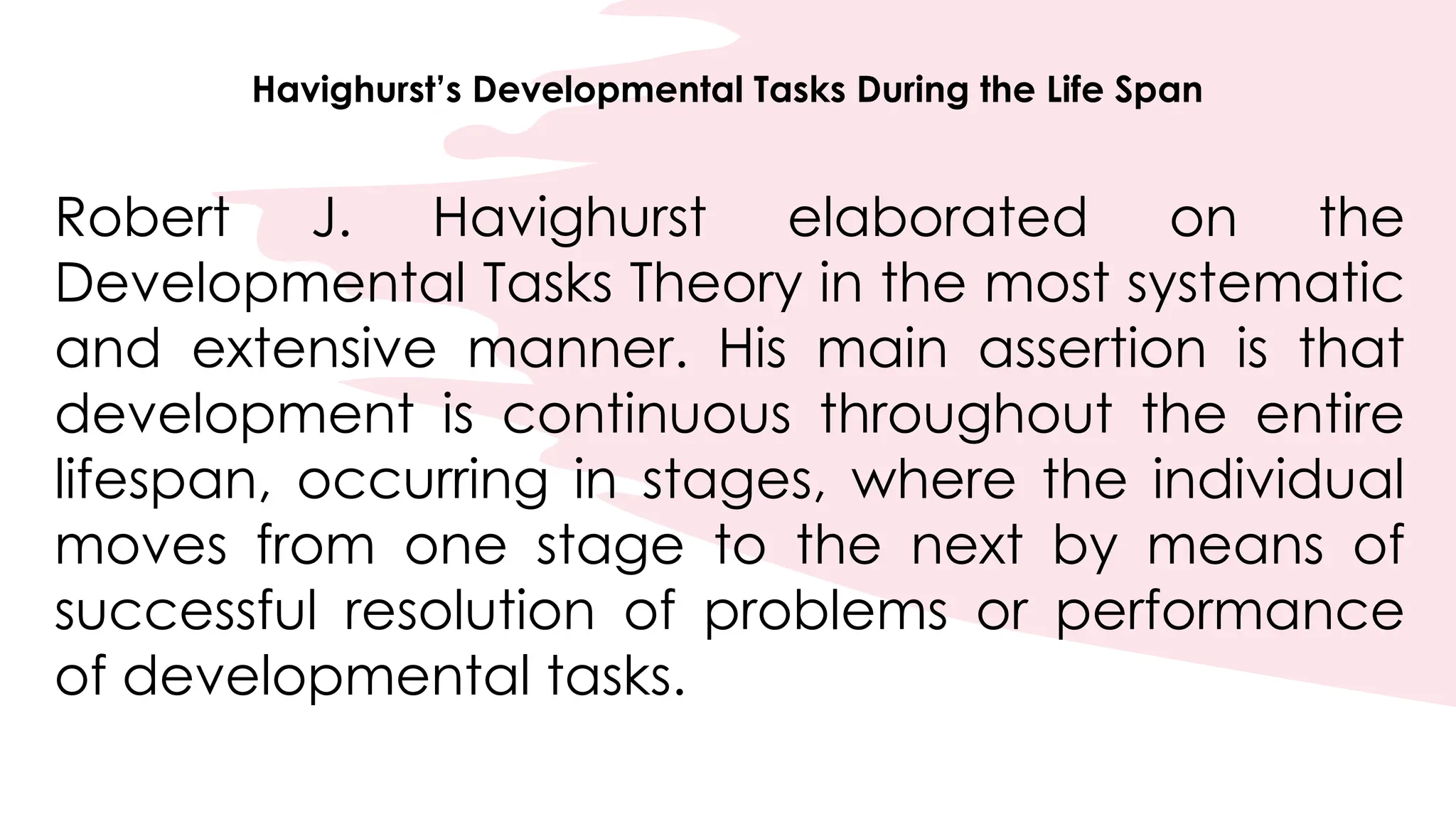
Havighurst’s Developmental Tasks During the Life Span
Robert J. Havighurst elaborated on the
Developmental Tasks Theory in the most systematic
and extensive manner. His main assertion is that
development is continuous throughout the entire
lifespan, occurring in stages, where the individual
moves from one stage to the next by means of
successful resolution of problems or performance
of developmental tasks.
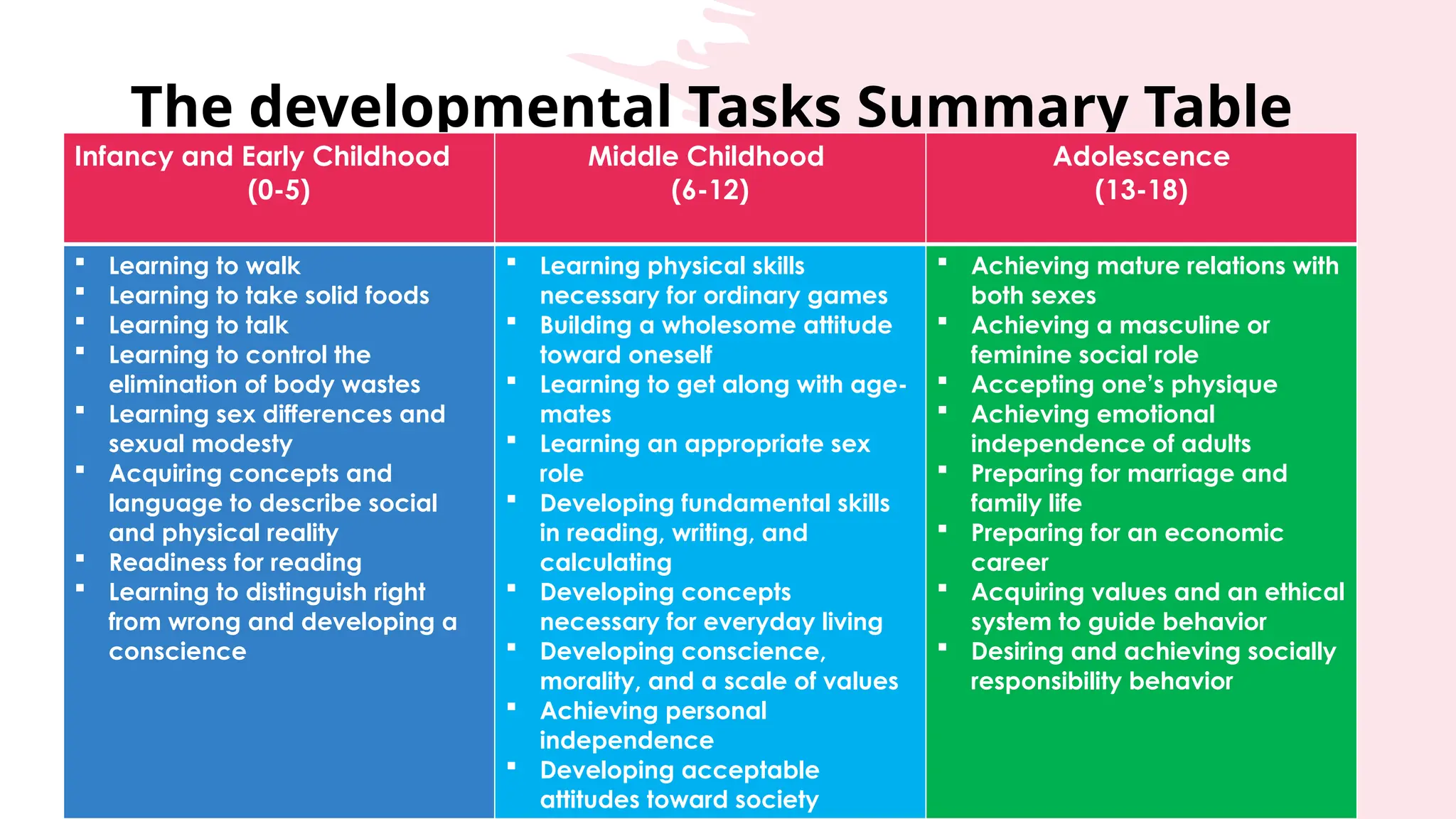
The developmental Tasks Summary Table
Infancy and Early Childhood
(0-5)
Middle Childhood
(6-12)
Adolescence
(13-18)
 Learning to walk
 Learning to take solid foods
 Learning to talk
 Learning to control the
elimination of body wastes
 Learning sex differences and
sexual modesty
 Acquiring concepts and
language to describe social
and physical reality
 Readiness for reading
 Learning to distinguish right
from wrong and developing a
conscience
 Learning physical skills
necessary for ordinary games
 Building a wholesome attitude
toward oneself
 Learning to get along with age-
mates
 Learning an appropriate sex
role
 Developing fundamental skills
in reading, writing, and
calculating
 Developing concepts
necessary for everyday living
 Developing conscience,
morality, and a scale of values
 Achieving personal
independence
 Developing acceptable
attitudes toward society
 Achieving mature relations with
both sexes
 Achieving a masculine or
feminine social role
 Accepting one’s physique
 Achieving emotional
independence of adults
 Preparing for marriage and
family life
 Preparing for an economic
career
 Acquiring values and an ethical
system to guide behavior
 Desiring and achieving socially
responsibility behavior
The developmental Tasks Summary Table
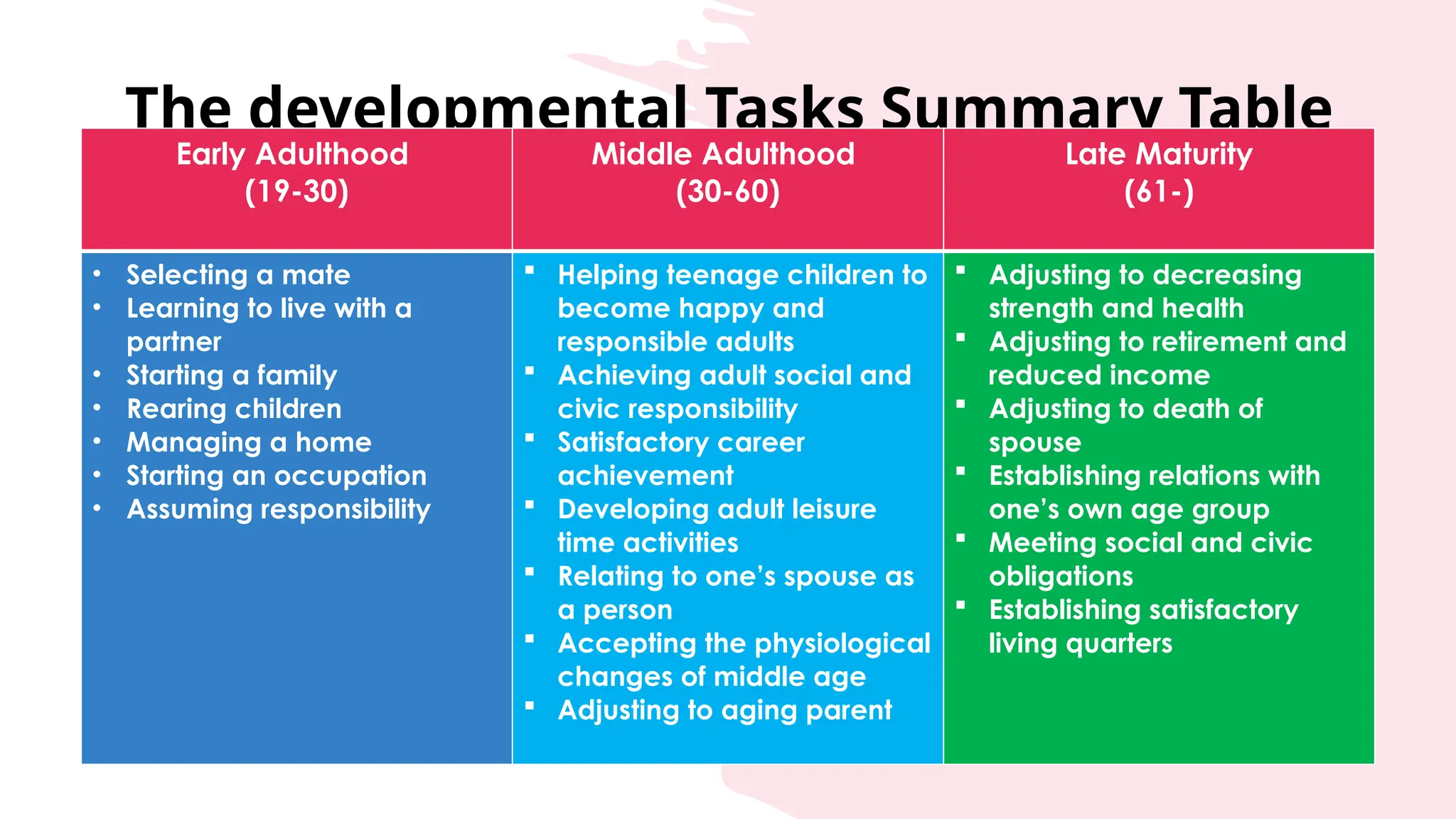
Early Adulthood
(19-30)
Middle Adulthood
(30-60)
Late Maturity
(61-)
• Selecting a mate
• Learning to live with a
partner
• Starting a family
• Rearing children
• Managing a home
• Starting an occupation
• Assuming responsibility
 Helping teenage children to
become happy and
responsible adults
 Achieving adult social and
civic responsibility
 Satisfactory career
achievement
 Developing adult leisure
time activities
 Relating to one’s spouse as
a person
 Accepting the physiological
changes of middle age
 Adjusting to aging parent
 Adjusting to decreasing
strength and health
 Adjusting to retirement and
reduced income
 Adjusting to death of
spouse
 Establishing relations with
one’s own age group
 Meeting social and civic
obligations
 Establishing satisfactory
living quarters
The challenges of Middle
and late Adolescence
Module 4
Personal Development
Objectives:
1. Discuss how facing the challenges during adolescence, you
may able to clarify and manage the demands of teen years,
2. Express your feelings on the expectations of the significant
people around you, such as your parents, siblings, friends,
teachers, community leaders, and
3. Make affirmations that help you become more lovable and
capable as an adolescent.
Successful people are always looking for opportunities to help others.
Unsuccessful people are always asking: “What’s in it for me?” – Brian Tracy
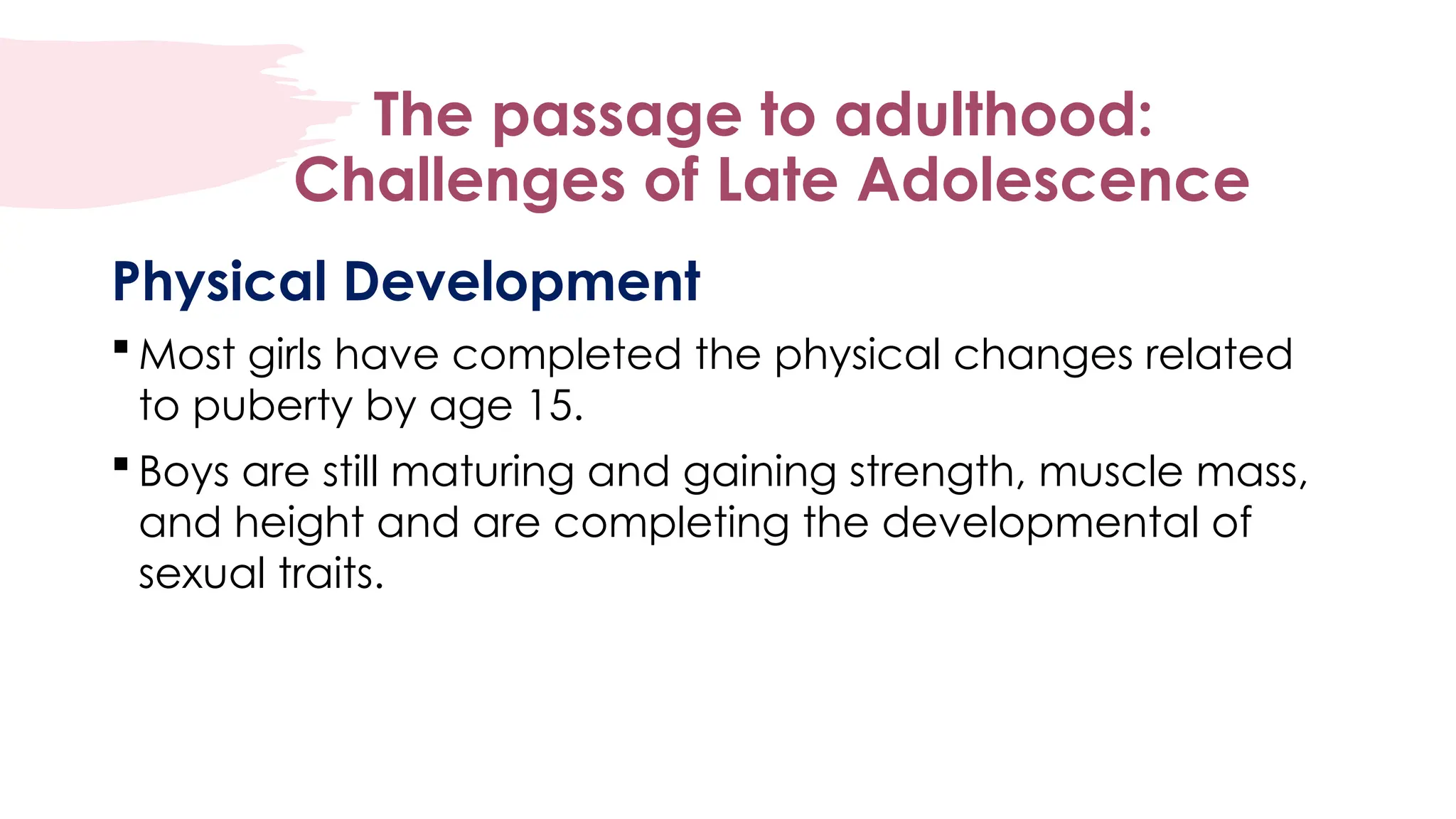
The passage to adulthood:
Challenges of Late Adolescence
Physical Development
 Most girls have completed the physical changes related
to puberty by age 15.
 Boys are still maturing and gaining strength, muscle mass,
and height and are completing the developmental of
sexual traits.
Emotional Development
• May stress over school and test scores.
• Is self-involved (may have high expectations and low self-
concept).
• Seeks privacy and time alone.
• Is concerned about physical and sexual attractiveness.
• May complain that parents prevent him or her from doing
things independently.
• Starts to want both physical and emotional intimacy in
relationships.
• The experience of intimate partnerships.
Social Development
• shifts in relationship with parents from dependency and
subordination to one that reflects the adolescent’s increasing
maturity and responsibilities in the family and the community.
• Is more and more aware of social behaviors of friends.
• Seek friends that share the same beliefs, values, and interests.
• Friends become more important.
• Starts to have more intellectual interests.
• Explores romantic and sexual behaviors with others.
• Maybe influenced by peers to try risky behaviors (alcohol, smoke,
sex).
Mental Development
• Becomes better able to set goals and think in terms of the future.
• Has a better understanding of complex problems and issues.
• Starts develop moral ideals and select role models.
Being happy (read)
Activity
1. Read the essay on “being happy”.
2. Choose a phrase , sentence, or paragraph that’s trikes you.
3. Make a slogan or personal declaration on how you can be
committed to self development.
4. Explain your thoughts and feelings about it.

PERDEV MODULE 3 - the developmental stages

  • 1.
    Developmental Stages inMiddle and Late Adolescence MODULE 3 PERSONAL DEVELOPMENT
  • 2.
    Let’s Play - MoveOn -Look Back -Forever Alone
  • 3.
    Objectives : 1. Classifyvarious developmental tasks according to developmental stage, 2. Evaluate your development in comparison with persons of the same age group, and 3. List ways to become a responsible adolescent prepared for adult life.
  • 4.
    MY PERSONAL TIMELINE Apersonal timeline portrays the influential events and happiness of a person’s life so that he can understand where he has gone wrong and right in the past. It helps to plan the future in a better constructive way.
  • 5.
    DEVELOPMENTAL STAGES Human developmentfocuses on human growth and changes across the lifespan, including physical, cognitive, social, intellectual, perceptual, personality and emotion growth. The study of human developmental stages is essential to understanding how human learn, mature, and adapt. Throughout their lives, humans go through various stages of development. The human being is either in a stage of growth or decline, but either condition imparts change. Some aspects of our life change very little over time, are consistent. Other aspects change dramatically. By understanding these changes, we can better respond and plan ahead effectively.
  • 6.
    Developmental Stage Characteristics 1.Pre-natal (Conception to birth) Age when hereditary endowment and sex are fixed and all body features, both external and internal are developed. 2. Infancy (Birth to 2 years) Foundation age when basic behaviors are organized and many ontogenetic maturation skills are developed. 3. Early Childhood (2 to 6 years) Pre-gang age, exploratory, and questioning. Language and Elementary reasoning are acquired and initial socialization is experienced. 4. Late Childhood (6 to 12 years) Gang and creativity age when self-help skills, social skills, school skills, and play are developed.
  • 7.
    Developmental Stage Characteristics 5.Adolescence (puberty to 18 years) Transition age from childhood to adulthood when sex maturation and rapid physical development occur resulting to changes in ways of feeling, thinking and acting. 6. Early Adulthood (18 to 40 years) Age of adjustment to new patterns of life and roles such as spouse, parent and bread winner. 7. Middle Age (40 years to retirement) Transition age when adjustments to initial physical and mental decline are experienced. 8. Old Age (retirement to death) Retirement age when increasingly rapid physical and mental decline are experienced.
  • 8.
  • 9.
    Assignment Using a bondpaper (short size), write the major events in your life and the significant people in your life. You may add your age, specific dates and places. You may draw the timeline horizontally, vertically, diagonally or even using ups and down depending on your imagination. Be creative in your presentations. You may also use symbols, figures and drawings. Think a title for your personal timeline.
  • 10.
    Havighurst’s Developmental TasksDuring the Life Span Robert J. Havighurst elaborated on the Developmental Tasks Theory in the most systematic and extensive manner. His main assertion is that development is continuous throughout the entire lifespan, occurring in stages, where the individual moves from one stage to the next by means of successful resolution of problems or performance of developmental tasks.
  • 11.
    The developmental TasksSummary Table Infancy and Early Childhood (0-5) Middle Childhood (6-12) Adolescence (13-18)  Learning to walk  Learning to take solid foods  Learning to talk  Learning to control the elimination of body wastes  Learning sex differences and sexual modesty  Acquiring concepts and language to describe social and physical reality  Readiness for reading  Learning to distinguish right from wrong and developing a conscience  Learning physical skills necessary for ordinary games  Building a wholesome attitude toward oneself  Learning to get along with age- mates  Learning an appropriate sex role  Developing fundamental skills in reading, writing, and calculating  Developing concepts necessary for everyday living  Developing conscience, morality, and a scale of values  Achieving personal independence  Developing acceptable attitudes toward society  Achieving mature relations with both sexes  Achieving a masculine or feminine social role  Accepting one’s physique  Achieving emotional independence of adults  Preparing for marriage and family life  Preparing for an economic career  Acquiring values and an ethical system to guide behavior  Desiring and achieving socially responsibility behavior
  • 12.
    The developmental TasksSummary Table Early Adulthood (19-30) Middle Adulthood (30-60) Late Maturity (61-) • Selecting a mate • Learning to live with a partner • Starting a family • Rearing children • Managing a home • Starting an occupation • Assuming responsibility  Helping teenage children to become happy and responsible adults  Achieving adult social and civic responsibility  Satisfactory career achievement  Developing adult leisure time activities  Relating to one’s spouse as a person  Accepting the physiological changes of middle age  Adjusting to aging parent  Adjusting to decreasing strength and health  Adjusting to retirement and reduced income  Adjusting to death of spouse  Establishing relations with one’s own age group  Meeting social and civic obligations  Establishing satisfactory living quarters
  • 13.
    The challenges ofMiddle and late Adolescence Module 4 Personal Development
  • 14.
    Objectives: 1. Discuss howfacing the challenges during adolescence, you may able to clarify and manage the demands of teen years, 2. Express your feelings on the expectations of the significant people around you, such as your parents, siblings, friends, teachers, community leaders, and 3. Make affirmations that help you become more lovable and capable as an adolescent. Successful people are always looking for opportunities to help others. Unsuccessful people are always asking: “What’s in it for me?” – Brian Tracy
  • 15.
    The passage toadulthood: Challenges of Late Adolescence Physical Development  Most girls have completed the physical changes related to puberty by age 15.  Boys are still maturing and gaining strength, muscle mass, and height and are completing the developmental of sexual traits.
  • 16.
    Emotional Development • Maystress over school and test scores. • Is self-involved (may have high expectations and low self- concept). • Seeks privacy and time alone. • Is concerned about physical and sexual attractiveness. • May complain that parents prevent him or her from doing things independently. • Starts to want both physical and emotional intimacy in relationships. • The experience of intimate partnerships.
  • 17.
    Social Development • shiftsin relationship with parents from dependency and subordination to one that reflects the adolescent’s increasing maturity and responsibilities in the family and the community. • Is more and more aware of social behaviors of friends. • Seek friends that share the same beliefs, values, and interests. • Friends become more important. • Starts to have more intellectual interests. • Explores romantic and sexual behaviors with others. • Maybe influenced by peers to try risky behaviors (alcohol, smoke, sex).
  • 18.
    Mental Development • Becomesbetter able to set goals and think in terms of the future. • Has a better understanding of complex problems and issues. • Starts develop moral ideals and select role models.
  • 19.
    Being happy (read) Activity 1.Read the essay on “being happy”. 2. Choose a phrase , sentence, or paragraph that’s trikes you. 3. Make a slogan or personal declaration on how you can be committed to self development. 4. Explain your thoughts and feelings about it.