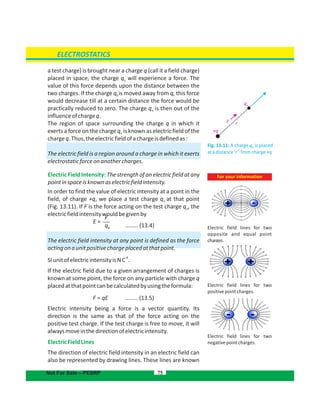
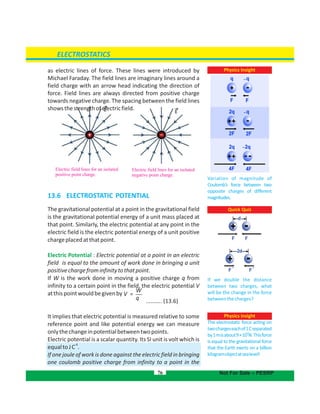
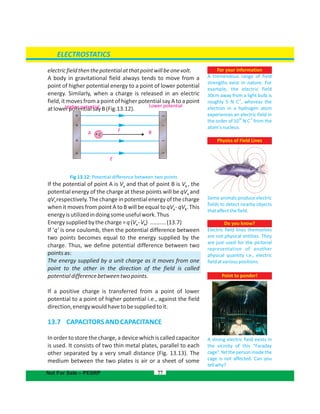
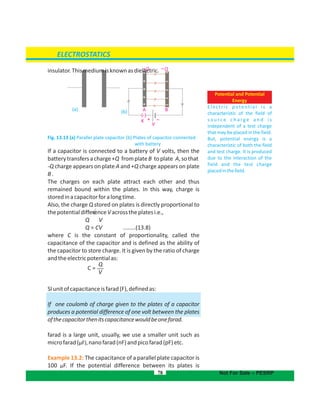
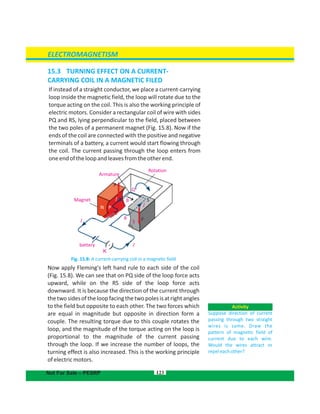
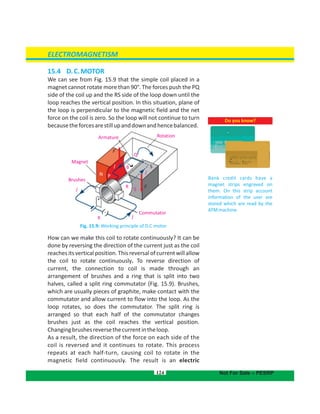
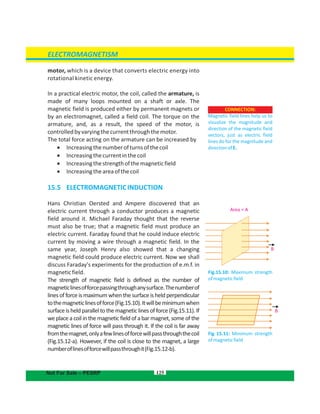
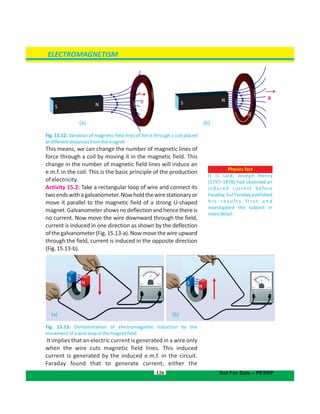
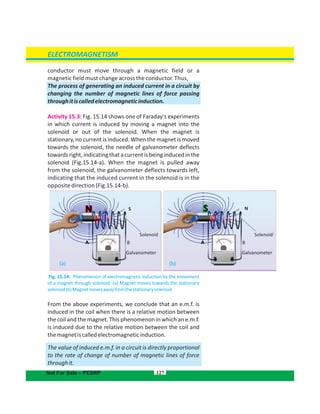
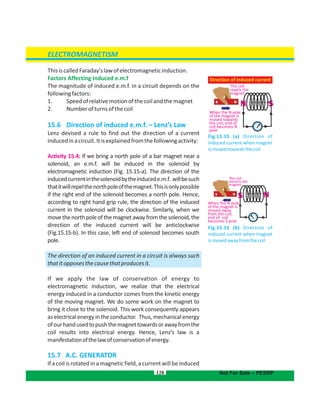
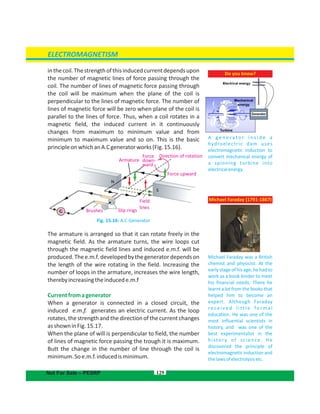
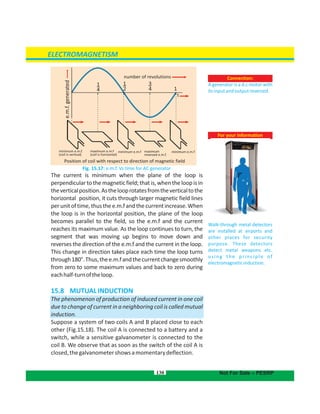
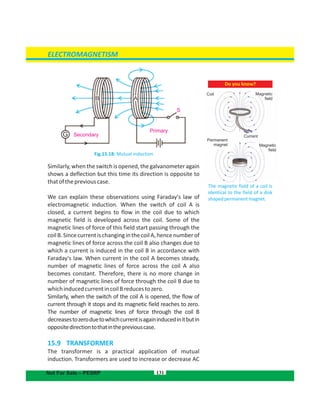
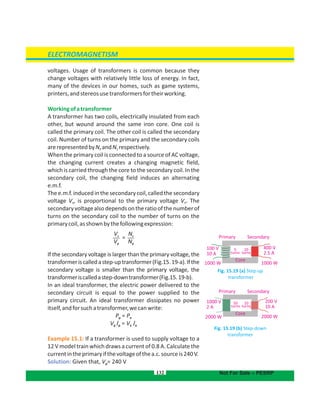
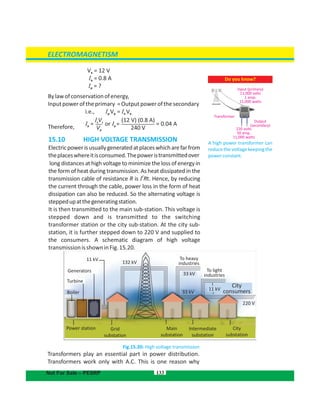
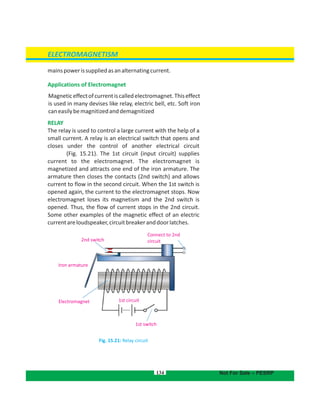
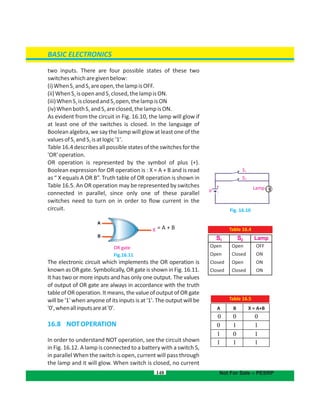
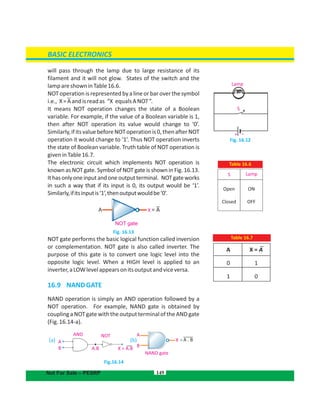
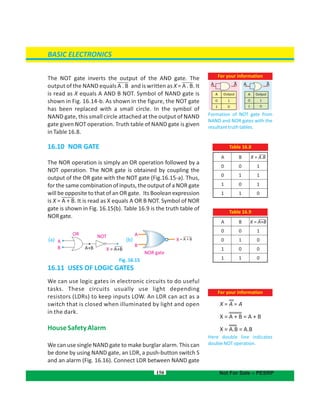
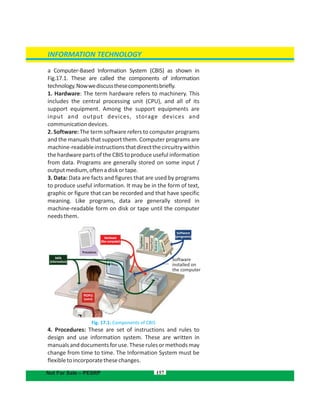
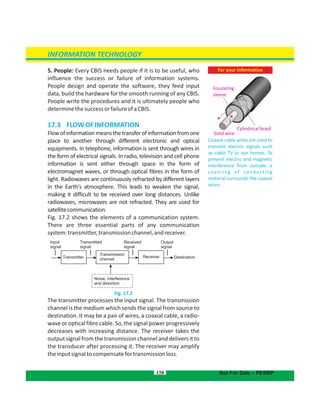
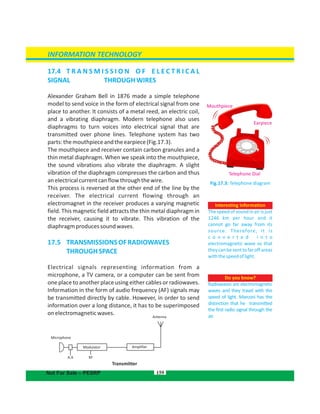
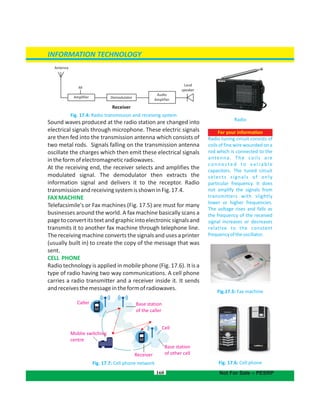
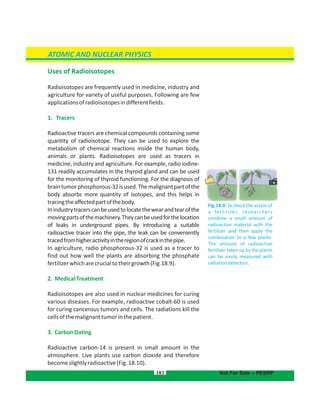
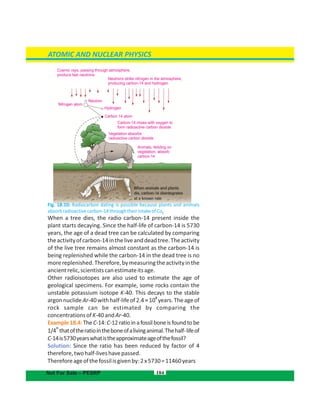
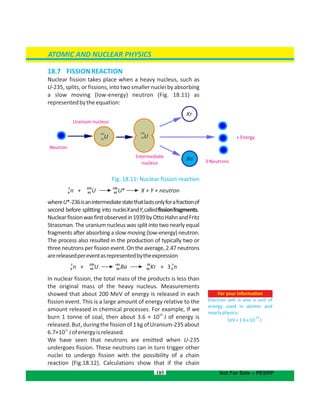
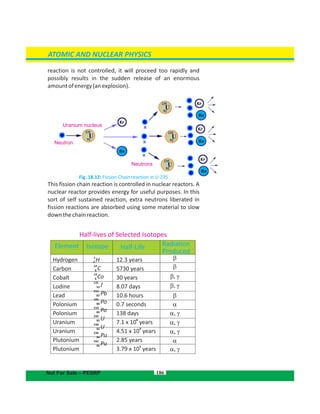
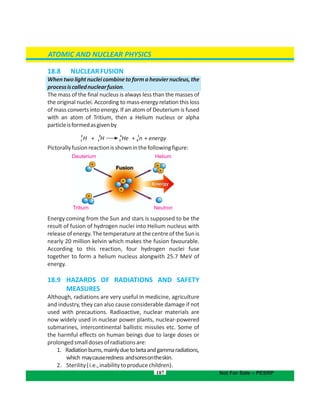
Unit 10Unit 10Unit 10
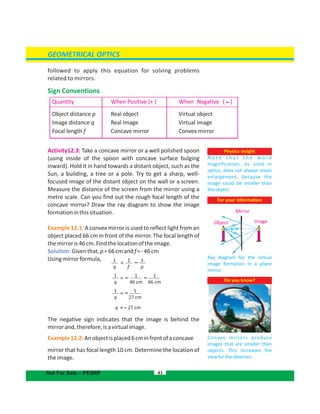
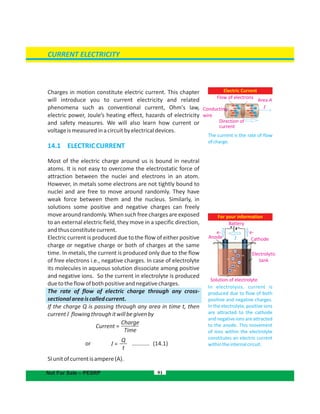
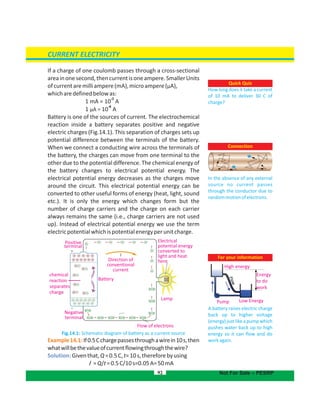
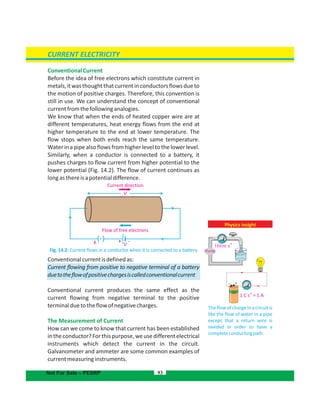
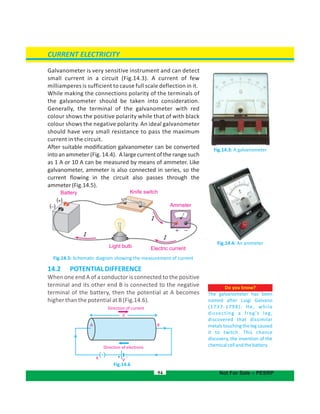
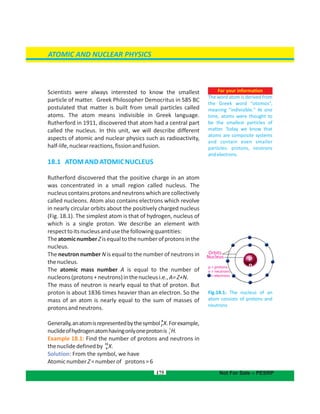
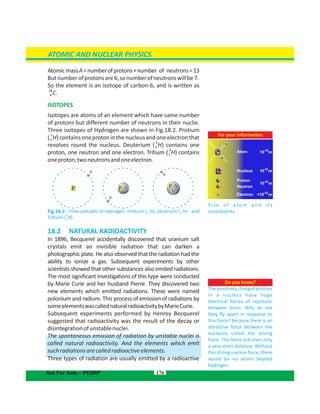
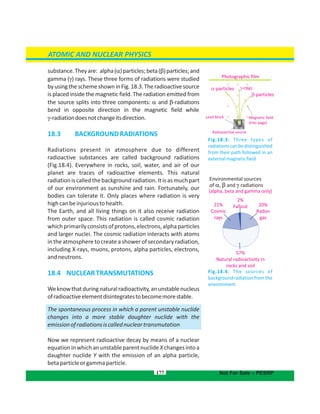
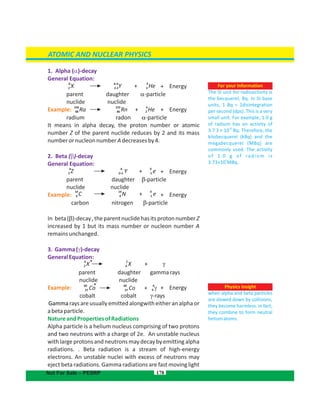
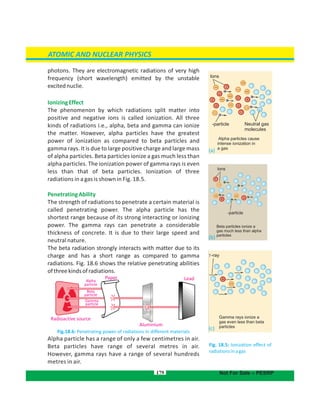
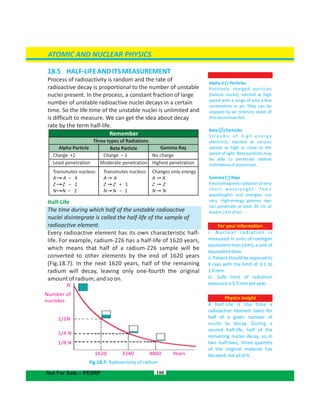
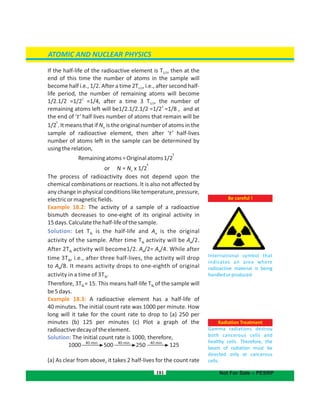
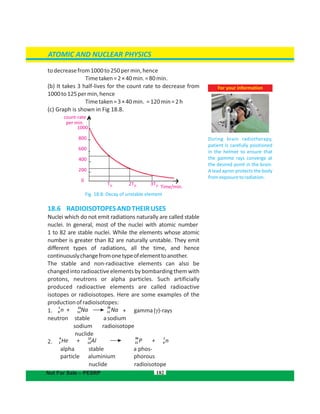
SIMPLE HARMONICSIMPLE HARMONIC
MOTION AND WAVESMOTION AND WAVES
SIMPLE HARMONIC
MOTION AND WAVES
• explain the diffraction of radiowaves but not of T.V waves (transmission can be heard in
such areas where the waves cannot reach directly).
Science, Technology and Society Connections
The students will be able to:
After studying this unit, students will be able to:
• state the conditions necessary for an object to oscillate with SHM.
• explain SHM with simple pendulum, ball and bowl examples.
• draw forces acting on a displaced pendulum.
• solve problems by using the formula T = 2π ll /g for simple pendulum.
• understand that damping progressively reduces the amplitude of oscillation.
• describe wave motion as illustrated by vibrations in rope, slinky spring and by
experiments with water waves.
• describe that waves are means of energy transfer without transfer of matter.
• distinguish between mechanical and electromagnetic waves.
• identify transverse and longitudinal waves in mechanical media, slinky and springs.
• define the terms speed (v), frequency( f ),wavelength (λ), time period (T), amplitude,
crest, trough, cycle, wavefront, compression and rarefaction.
• derive equation v = f λ.
• solve problems by applying the relation f = 1/T and v = fλ.
• describe properties of waves such as reflection, refraction and diffraction with the
help of ripple tank.
l g
A body is said to be vibrating if it moves back and forth or to
and fro about a point. Another term for vibration is
oscillation. A special kind of vibratory or oscillatory motion is
called the simple harmonic motion (SHM), which is the main
focus of this chapter. We will discuss important
characteristics of SHM and systems executing SHM. We will
also introduce different types of waves and will demonstrate
theirpropertieswiththehelpofrippletank.
10.1  SIMPLEHARMONICMOTION(SHM)
In the following sections we will discuss simple harmonic
motion of different systems. The motion of mass attached to
a spring on a horizontal frictionless surface, the motion of a
ball placed in a bowl and the motion of a bob attached to a
stringareexamplesofSHM.
MOTION OF MASS ATTACHED TO A SPRING
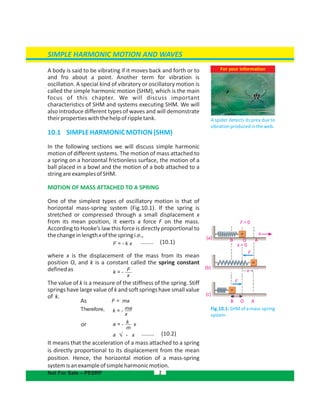
One of the simplest types of oscillatory motion is that of
horizontal mass-spring system (Fig.10.1). If the spring is
stretched or compressed through a small displacement x
from its mean position, it exerts a force F on the mass.
According to Hooke’s law this force is directly proportional to
thechangeinlengthxofthespringi.e.,
........ (10.1)
where x is the displacement of the mass from its mean
position O, and k is a constant called the spring constant
definedas
The value of k is a measure of the stiffness of the spring. Stiff
springs have large value of k and soft springs have small value
of k.
It means that the acceleration of a mass attached to a spring
is directly proportional to its displacement from the mean
position. Hence, the horizontal motion of a mass-spring
systemisanexampleofsimpleharmonicmotion.
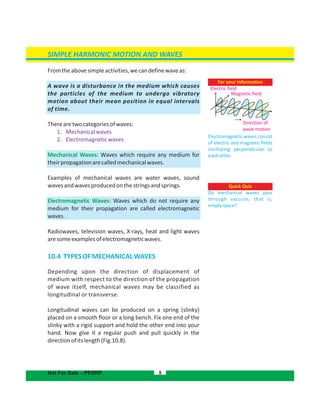
For your information
A spider detects its prey due to
vibrationproducedintheweb.
2
SIMPLE HARMONIC MOTION AND WAVES
Not For Sale – PESRP
As
or
Fig.10.1: SHM of a mass-spring
system
a - x ........ (10.2)
F = 0
B
B
O
O
A
A
F
F
(a)
(b)
x
(c)
x = 0
x
F = - k x
k = - F
x
k = - ma
x
a = - xk
m
F = ma
x
Therefore,
SIMPLE HARMONIC MOTION AND WAVES
3
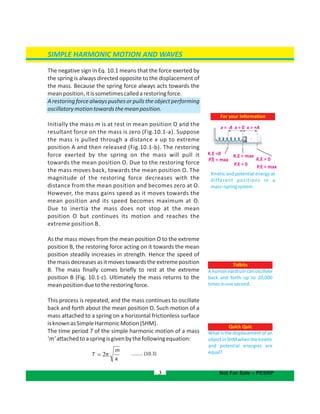
For your information
Kinetic and potential energy at
different positions in a
mass–springsystem.
x = -A x = 0 x = +A
K.E =0
P.E = max
P.E = 0
K.E = max
P.E = max
K.E = 0
The negative sign in Eq. 10.1 means that the force exerted by
the spring is always directed opposite to the displacement of
the mass. Because the spring force always acts towards the
meanposition,itissometimescalledarestoringforce.
Arestoringforcealwayspushesorpullstheobjectperforming
oscillatorymotiontowardsthemeanposition.
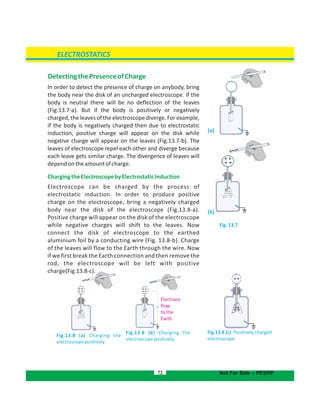
Initially the mass m is at rest in position O and themean
resultant force on the mass is zero (Fig.10.1-a). Suppose
the mass is pulled through a distance x up to extreme
position A and then released (Fig.10.1-b). The restoring
force exerted by the spring on the mass will pull it
towards the position O. Due to the restoring forcemean
the mass moves back, towards the mean position O. The
magnitude of the restoring force decreases with the
distance from the mean position and becomes zero at O.
However, the mass gains speed as it moves towards the
mean position and its speed becomes maximum at O.
Due to inertia the mass does not stop at the mean
position O but continues its motion and reaches the
extreme position B.
As the mass moves from the position O to the extrememean
position B, the restoring force acting on it towards the mean
position steadily increases in strength. Hence the speed of
themassdecreasesasitmovestowardstheextremeposition
B. The mass finally comes briefly to rest at the extreme
position B (Fig. 10.1-c). Ultimately the mass returns to the
meanpositionduetotherestoringforce.
This process is repeated, and the mass continues to oscillate
back and forth about the mean position O. Such motion of a
mass attached to a spring on a horizontal frictionless surface
isknownasSimpleHarmonicMotion(SHM).
The time period T of the simple harmonic motion of a mass
‘m’attachedtoaspringisgivenbythefollowingequation:
Not For Sale – PESRP
´
m
T 2 ......... (10.3)
Tidbits
A human eardrum can oscillate
back and forth up to 20,000
timesinonesecond.
Quick Quiz
What is the displacement of an
objectinSHMwhenthekinetic
and potential energies are
equal?m
k
T
SIMPLE HARMONIC MOTION AND WAVES
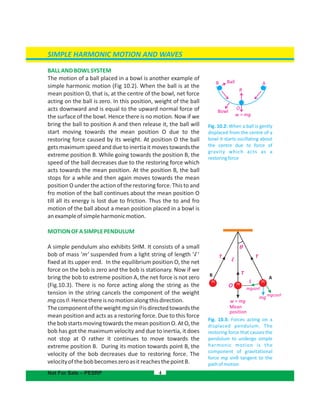
BALLANDBOWLSYSTEM
The motion of a ball placed in a bowl is another example of
simple harmonic motion . When the ball is at the(Fig 10.2)
mean position O, that is, at the centre of the bowl, net force
acting on the ball is zero. In this position, weight of the ball
acts downward and is equal to the upward normal force of
the surface of the bowl. Hence there is no motion. Now if we
bring the ball to position A and then release it, the ball will
start moving towards the mean position O due to the
restoring force caused by its weight. At position O the ball
gets maximum speed and due to inertia it moves towards the
extreme position B. While going towards the position B, the
speed of the ball decreases due to the restoring force which
acts towards the mean position. At the position B, the ball
stops for a while and then again moves towards the mean
position O under the action of the restoring force. This to and
fro motion of the ball continues about the mean position O
till all its energy is lost due to friction. Thus the to and fro
motion of the ball about a mean position placed in a bowl is
anexampleofsimpleharmonicmotion.
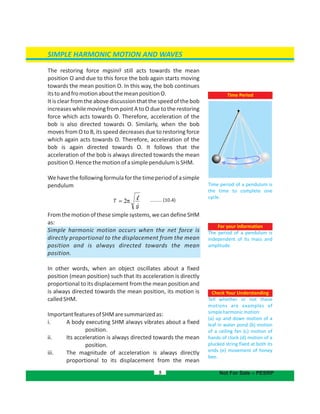
MOTIONOFASIMPLEPENDULUM
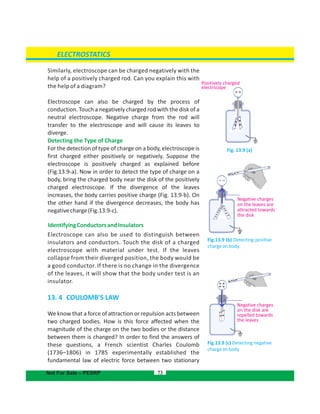
A simple pendulum also exhibits SHM. It consists of a small
bob of mass ‘m’ suspended from a light string of length ‘ ’
fixed at its upper end. In the equilibrium position O, the net
force on the bob is zero and the bob is stationary. Now if we
bring the bob to extreme position A, the net force is not zero
(Fig.10.3). There is no force acting along the string as the
tension in the string cancels the component of the weight
mgcosθ.Hencethereisnomotionalongthisdirection.
Thecomponentoftheweightmgsin isdirectedtowardstheθ
mean position and acts as a restoring force. Due to this force
the bob starts moving towards the mean position O. At O, the
bob has got the maximum velocity and due to inertia, it does
not stop at O rather it continues to move towards the
extreme position B. During its motion towards point B, the
velocity of the bob decreases due to restoring force. The
velocityofthebobbecomeszeroasitreachesthepointB.
4
Fig. 10.3: Forces acting on a
displaced pendulum. The
restoring force that causes the
pendulum to undergo simple
harmonic motion is the
component of gravitational
force mg sinθ tangent to the
pathofmotion
Not For Sale – PESRP
o mgsinθ
mg mgcosθ
A
TT
B
θ
T
S
w = mg
Mean
position
m m
m
l
l
Fig. 10.2: When a ball is gently
displaced from the centre of a
bowl it starts oscillating about
the centre due to force of
gravity which acts as a
restoringforce
B Ball
R
A
w = mg
O
Bowl
5
The restoring force mgsin still acts towards the meanθ
position O and due to this force the bob again starts moving
towards the mean position O. In this way, the bob continues
itstoandfromotionaboutthemeanpositionO.
It is clear from the above discussion that the speed of the bob
increaseswhilemovingfrompointAtoOduetotherestoring
force which acts towards O. Therefore, acceleration of the
bob is also directed towards O. Similarly, when the bob
moves from O to B, its speed decreases due to restoring force
which again acts towards O. Therefore, acceleration of the
bob is again directed towards O. It follows that the
acceleration of the bob is always directed towards the mean
positionO.HencethemotionofasimplependulumisSHM.
Wehavethefollowingformulaforthetimeperiodofasimple
pendulum
......... (10.4)
Fromthemotionofthesesimplesystems,wecandefineSHM
as:
Simple harmonic motion occurs when the net force is
directly proportional to the displacement from the mean
position and is always directed towards the mean
position.
In other words, when an object oscillates about a fixed
position (mean position) such that its acceleration is directly
proportional to its displacement from the mean position and
is always directed towards the mean position, its motion is
calledSHM.
ImportantfeaturesofSHMaresummarizedas:
i. A body executing SHM always vibrates about a fixed
position.
ii. Its acceleration is always directed towards the mean
position.
iii. The magnitude of acceleration is always directly
proportional to its displacement from the mean
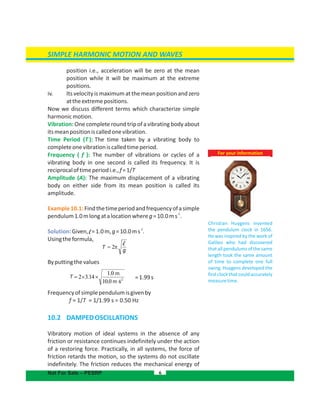
Time Period
Time period of a pendulum is
the time to complete one
cycle.
Check Your Understanding
Tell whether or not these
motions are examples of
simpleharmonicmotion:
(a) up and down motion of a
leaf in water pond (b) motion
of a ceiling fan (c) motion of
hands of clock (d) motion of a
plucked string fixed at both its
ends (e) movement of honey
bee.
SIMPLE HARMONIC MOTION AND WAVES
ß
l
T 2
Not For Sale – PESRP
l
g
For your information
The period of a pendulum is
independent of its mass and
amplitude.
T
SIMPLE HARMONIC MOTION AND WAVES
position i.e., acceleration will be zero at the mean
position while it will be maximum at the extreme
positions.
iv. Its velocity is maximum at the mean position and zero
attheextremepositions.
Now we discuss different terms which characterize simple
harmonicmotion.
Vibration: One complete round trip of a vibrating body about
itsmeanpositioniscalledonevibration.
Time Period (T ): The time taken by a vibrating body to
completeonevibrationiscalledtimeperiod.
Frequency ( f ): The number of vibrations or cycles of a
vibrating body in one second is called its frequency. It is
reciprocaloftimeperiodi.e.,f=1/T
Amplitude (A): The maximum displacement of a vibrating
body on either side from its mean position is called its
amplitude.
Example10.1:Findthetimeperiodandfrequencyofasimple
-2
pendulum1.0mlongatalocationwhereg=10.0ms .
Solution:
-2
Given, =1.0m,g=10.0ms .
Usingtheformula,
Byputtingthevalues
=1.99s
Frequencyofsimplependulumisgivenby
f = 1/T = 1/1.99 s = 0.50 Hz
10.2 DAMPEDOSCILLATIONS
Vibratory motion of ideal systems in the absence of any
friction or resistance continues indefinitely under the action
of a restoring force. Practically, in all systems, the force of
friction retards the motion, so the systems do not oscillate
indefinitely. The friction reduces the mechanical energy of
6
For your information
Christian Huygens invented
the pendulum clock in 1656.
He was inspired by the work of
Galileo who had discovered
that all pendulums of the same
length took the same amount
of time to complete one full
swing. Huygens developed the
first clock that could accurately
measuretime.
ß
l
T 2
g
Not For Sale – PESRP
2
sm0.10
m0.1
14.32 
T
g
l
l
T
T
m
m s
SIMPLE HARMONIC MOTION AND WAVES
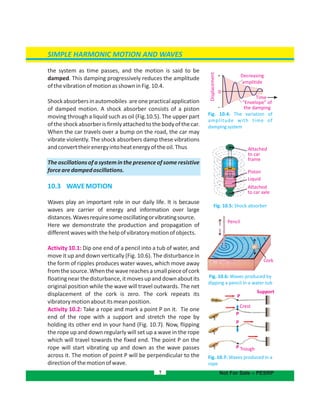
the system as time passes, and the motion is said to be
damped. This damping progressively reduces the amplitude
ofthevibrationofmotionasshowninFig.10.4.
Shockabsorbersinautomobiles areonepracticalapplication
of damped motion. A shock absorber consists of a piston
moving through a liquid such as oil . The upper part(Fig.10.5)
oftheshockabsorberisfirmlyattachedtothebodyofthecar.
When the car travels over a bump on the road, the car may
vibrate violently. The shock absorbers damp these vibrations
andconverttheirenergyintoheatenergyoftheoil.Thus
The oscillations of a system in the presence of some resistive
forcearedampedoscillations.
10.3 WAVEMOTION
Waves play an important role in our daily life. It is because
waves are carrier of energy and information over large
distances.Wavesrequiresomeoscillatingorvibratingsource.
Here we demonstrate the production and propagation of
differentwaveswiththehelpofvibratorymotionofobjects.
Activity 10.1: Dip one end of a pencil into a tub of water, and
move it up and down vertically (Fig. 10.6). The disturbance in
the form of ripples produces water waves, which move away
fromthesource.Whenthewavereachesasmallpieceofcork
floatingnearthedisturbance,itmovesupanddownaboutits
original position while the wave will travel outwards. The net
displacement of the cork is zero. The cork repeats its
vibratorymotionaboutitsmeanposition.
Activity 10.2: Take a rope and mark a point P on it. Tie one
end of the rope with a support and stretch the rope by
holding its other end in your hand (Fig. 10.7). Now, flipping
the rope up and down regularly will set up a wave in the rope
which will travel towards the fixed end. The point P on the
rope will start vibrating up and down as the wave passes
across it. The motion of point P will be perpendicular to the
directionofthemotionofwave.
7
Fig. 10.5: Shock absorber
Attached
to car
frame
Piston
Pencil
Liquid
Attached
to car axle
Fig. 10.4: The variation of
amplitude with time of
dampingsystem
Displacement
o
+
-
Decreasing
amplitide
“Envelope” of
the damping
Time
Fig. 10.6: Waves produced by
dipping a pencil in a water tub
Fig. 10.7: Waves produced in a
rope
Crest
Trough
P
Support
P
P
P
Not For Sale – PESRP
Cork
SIMPLE HARMONIC MOTION AND WAVES
Fromtheabovesimpleactivities,wecandefinewaveas:
A wave is a disturbance in the medium which causes
the particles of the medium to undergo vibratory
motion about their mean position in equal intervals
of time.
Therearetwocategoriesofwaves:
1. Mechanicalwaves
2. Electromagneticwaves
Mechanical Waves: Waves which require any medium for
theirpropagationarecalledmechanicalwaves.
Examples of mechanical waves are water waves, sound
wavesandwavesproducedonthestringsandsprings.
Electromagnetic Waves: Waves which do not require any
medium for their propagation are called electromagnetic
waves.
Radiowaves, television waves, X-rays, heat and light waves
aresomeexamplesofelectromagneticwaves.
10.4 TYPESOFMECHANICALWAVES
Depending upon the direction of displacement of
medium with respect to the direction of the propagation
of wave itself, mechanical waves may be classified as
longitudinal or transverse.
Longitudinal waves can be produced on a spring (slinky)
placed on a smooth floor or a long bench. Fix one end of the
slinky with a rigid support and hold the other end into your
hand. Now give it a regular push and pull quickly in the
directionofitslength(Fig.10.8).
8
For your information
Electromagnetic waves consist
of electric and magnetic fields
oscillating perpendicular to
eachother.
Direction of
wave motion
Electric field
Magnetic field
Quick Quiz
Do mechanical waves pass
through vacuum, that is,
emptyspace?
Not For Sale – PESRP
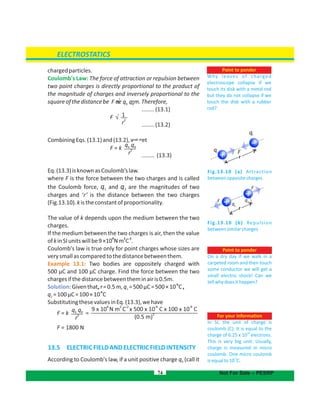
SIMPLE HARMONIC MOTION AND WAVES
Fig. 10.8: Longitudinal wave on a slinky
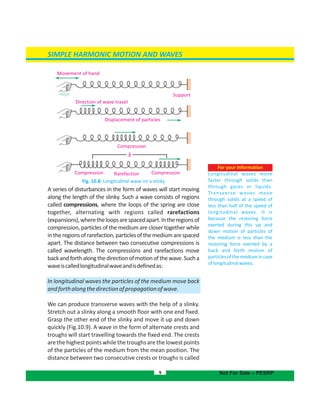
A series of disturbances in the form of waves will start moving
along the length of the slinky. Such a wave consists of regions
called compressions, where the loops of the spring are close
together, alternating with regions called rarefactions
(expansions),wheretheloopsarespacedapart.Intheregionsof
compression, particles of the medium are closer together while
intheregionsofrarefaction,particlesofthemediumarespaced
apart. The distance between two consecutive compressions is
called wavelength. The compressions and rarefactions move
backandforthalongthedirectionofmotionofthewave.Sucha
waveiscalledlongitudinalwaveandisdefinedas:
In longitudinal waves the particles of the medium move back
andforthalongthedirectionofpropagationofwave.
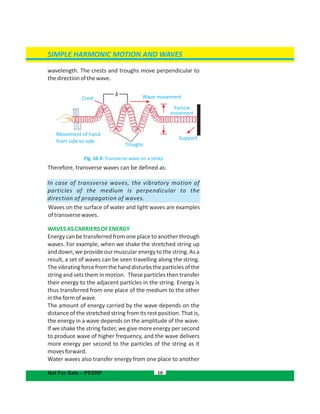
We can produce transverse waves with the help of a slinky.
Stretch out a slinky along a smooth floor with one end fixed.
Grasp the other end of the slinky and move it up and down
quickly (Fig.10.9). A wave in the form of alternate crests and
troughs will start travelling towards the fixed end. The crests
are the highest points whilethe troughs are the lowest points
of the particles of the medium from the mean position. The
distance between two consecutive crests or troughs is called
9
For your Information
Longitudinal waves move
faster through solids than
through gases or liquids.
Transverse waves move
through solids at a speed of
less than half of the speed of
longitudinal waves. It is
because the restoring force
exerted during this up and
down motion of particles of
the medium is less than the
restoring force exerted by a
back and forth motion of
particlesofthemediumincase
oflongitudinalwaves.
Movement of hand
Direction of wave travel
Displacement of particles
Compression
Rarefaction
Support
Compression Compression
Not For Sale – PESRP
λ
Fig. 10.8: Longitudinal wave on a slinky
SIMPLE HARMONIC MOTION AND WAVES
wavelength. The crests and troughs move perpendicular to
thedirectionofthewave.
Fig. 10.9: Transverse wave on a slinky
Therefore, transverse waves can be defined as:
In case of transverse waves, the vibratory motion of
particles of the medium is perpendicular to the
direction of propagation of waves.
Waves on the surface of water and light waves are examples
oftransversewaves.
WAVESASCARRIERSOFENERGY
Energy can be transferred from one place to another through
waves. For example, when we shake the stretched string up
and down, we provide our muscular energy to the string. As a
result, a set of waves can be seen travelling along the string.
Thevibratingforcefromthehanddisturbstheparticlesofthe
string and sets them in motion. These particles then transfer
their energy to the adjacent particles in the string. Energy is
thus transferred from one place of the medium to the other
intheformofwave.
The amount of energy carried by the wave depends on the
distance of the stretched string from its rest position. That is,
the energy in a wave depends on the amplitude of the wave.
If we shake the string faster, we give more energy per second
to produce wave of higher frequency, and the wave delivers
more energy per second to the particles of the string as it
movesforward.
Water waves also transfer energy from one place to another
10Not For Sale – PESRP
Crest
Movement of hand
from side to side
Troughs
Support
Wave movement
Particle
movement
λ
SIMPLE HARMONIC MOTION AND WAVES
asexplainedbelow:
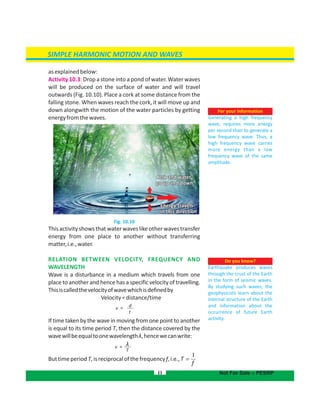
Activity 10.3: Drop a stone into a pond of water. Water waves
will be produced on the surface of water and will travel
outwards (Fig. 10.10). Place a cork at some distance from the
falling stone. When waves reach the cork, it will move up and
down alongwith the motion of the water particles by getting
energyfromthewaves.
Fig. 10.10
Thisactivityshowsthatwaterwaveslikeotherwavestransfer
energy from one place to another without transferring
matter,i.e.,water.
RELATION BETWEEN VELOCITY, FREQUENCY AND
WAVELENGTH
Wave is a disturbance in a medium which travels from one
place to another and hence has a specific velocity of travelling.
Thisiscalledthevelocityofwavewhichisdefinedby
Velocity=distance/time
If time taken by the wave in moving from one point to another
is equal to its time period T, then the distance covered by the
wavewillbeequaltoonewavelength ,hencewecanwrite:λ
ButtimeperiodT,isreciprocalofthefrequencyf,i.e.,
11
For your information
Generating a high frequency
wave, requires more energy
per second than to generate a
low frequency wave. Thus, a
high frequency wave carries
more energy than a low
frequency wave of the same
amplitude.
Do you know?
Earthquake produces waves
through the crust of the Earth
in the form of seismic waves.
By studying such waves, the
geophysicists learn about the
internal structure of the Earth
and information about the
occurrence of future Earth
activity.
Cork and waterCork and water
go up and downgo up and down
Cork and water
go up and down
Energy travelsEnergy travels
in this directionin this direction
Energy travels
in this direction
Not For Sale – PESRP
f
T
1

f
v =
v =
d
t
T
λ
T
f
SIMPLE HARMONIC MOTION AND WAVES
Therefore, ......... (10.5)
Eq.(10.5)istrueboth longitudinaland transversewaves.for
Example 10.2: A wave moves on a slinky with frequency of
4 Hzandwavelengthof0.4m.Whatisthespeedofthewave?
Solution: Giventhat, f =4Hz,λ=0.4m
Wave speed
=(4Hz)(0.4m)
-1
v=1.6ms
10.5 RIPPLETANK
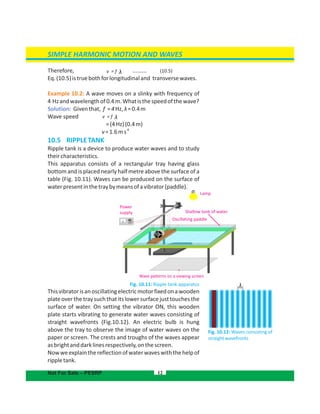
Ripple tank is a device to produce water waves and to study
theircharacteristics.
This apparatus consists of a rectangular tray having glass
bottom and is placed nearly half metre above the surface of a
table (Fig. 10.11). Waves can be produced on the surface of
waterpresentinthetraybymeansofavibrator(paddle).
Fig. 10.11: Ripple tank apparatus
Thisvibratorisanoscillatingelectricmotorfixedonawooden
plateoverthetraysuchthatitslowersurfacejusttouchesthe
surface of water. On setting the vibrator ON, this wooden
plate starts vibrating to generate water waves consisting of
straight wavefronts (Fig.10.12). An electric bulb is hung
above the tray to observe the image of water waves on the
paper or screen. The crests and troughs of the waves appear
asbrightanddarklinesrespectively,onthescreen.
Nowweexplainthereflectionofwaterwaveswiththehelpof
rippletank.
12
Lamp
Shallow tank of water
Oscillating paddle
Power
supply
Wave patterns on a viewing screen
Fig. 10.12: Waves consisting of
straightwavefronts
Not For Sale – PESRP
v = f
v = f
λ
λ
λ
λ
v
v
λ
2
2
1
1
SIMPLE HARMONIC MOTION AND WAVES
13
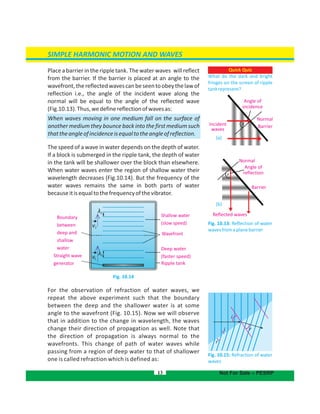
Place a barrier in the ripple tank. The water waves will reflect
from the . If the is placed at an angle to thebarrier barrier
wavefront,thereflectedwavescanbeseentoobeythelawof
reflection i.e., the angle of the incident wave along the
normal will be equal to the angle of the reflected wave
(Fig.10.13).Thus,wedefinereflectionofwavesas:
When waves moving in one medium fall on the surface of
another medium they bounce back into the first medium such
thattheangleofincidenceisequaltotheangleofreflection.
The speed of a wave in water depends on the depth of water.
If a block is submerged in the ripple tank, the depth of water
in the tank will be shallower over the block than elsewhere.
When water waves enter the region of shallow water their
wavelength decreases ( . But the frequency of theFig.10.14)
water waves remains the same in both parts of water
becauseitisequaltothefrequencyofthevibrator.
Fig. 10.14
For the observation of refraction of water waves, we
repeat the above experiment such that the boundary
between the deep and the shallower water is at some
angle to the wavefront (Fig. 10.15). Now we will observe
that in addition to the change in wavelength, the waves
change their direction of propagation as well. Note that
the direction of propagation is always normal to the
wavefronts. This change of path of water waves while
passing from a region of deep water to that of shallower
one is called refraction which is defined as:
Fig. 10.15: Refraction of water
waves
Boundary
between
deep and
shallow
water
Straight wave
generator
Shallow water
(slow speed)
Wavefront
Deep water
(faster speed)
Ripple tank
Fig. 10.13: Reflection of water
wavesfromaplanebarrier
Quick Quiz
What do the dark and bright
fringes on the screen of ripple
tankrepresent?
Not For Sale – PESRP
Incident
waves
Angle of
incidence
Normal
(a)
Barrier
(b)
Normal
Angle of
reflection
Barrier
Reflected waves
i
r
i
i r
r
SIMPLE HARMONIC MOTION AND WAVES
When a wave from one medium enters into the second
mediumatsomeangle,itsdirectionoftravelchanges.
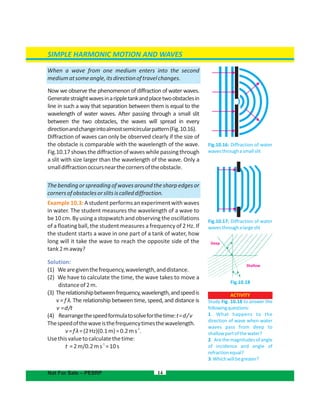
Now we observe the phenomenon of diffraction of water waves.
Generatestraightwavesinarippletankandplacetwoobstaclesin
line in such a way that separation between them is equal to the
wavelength of water waves. After passing through a small slit
between the two obstacles, the waves will spread in every
directionandchangeintoalmostsemicircularpattern(Fig.10.16).
Diffraction of waves can only be observed clearly if the size of
the obstacle is comparable with the wavelength of the wave.
Fig.10.17showsthediffractionofwaveswhilepassingthrough
a slit with size larger than the wavelength of the wave. Only a
smalldiffractionoccursnearthecornersoftheobstacle.
Thebendingorspreadingofwavesaroundthesharpedgesor
cornersofobstaclesorslitsiscalleddiffraction.
Example 10.3: A student performs an experiment with waves
in water. The student measures the wavelength of a wave to
be 10 cm. By using a stopwatch and observing the oscillations
of a floating ball, the student measures a frequency of 2 Hz. If
the student starts a wave in one part of a tank of water, how
long will it take the wave to reach the opposite side of the
tank2maway?
Solution:
(1) Wearegiventhefrequency,wavelength,anddistance.
(2) We have to calculate the time, the wave takes to move a
distanceof2m.
(3) Therelationshipbetweenfrequency,wavelength,andspeedis
v = f λ. The relationship between time, speed, and distance is
v =d/t
(4) Rearrangethespeedformulatosolveforthetime:t=d/v
Thespeedofthewaveisthefrequencytimesthewavelength.
-1
v=fλ=(2Hz)(0.1m)=0.2ms .
Usethisvaluetocalculatethetime:
-1
t =2m/0.2ms =10s
14
Fig.10.17: Diffraction of water
wavesthroughalargeslit
Deep
Shallow
ACTIVITY
Study Fig. 10.18 to answer the
followingquestions:
1. What happens to the
direction of wave when water
waves pass from deep to
shallowpartofthewater?
2. Arethemagnitudesofangle
of incidence and angle of
refractionequal?
3.Whichwillbegreater?
Not For Sale – PESRP
Fig.10.18
Fig.10.16: Diffraction of water
wavesthroughasmallslit
SIMPLE HARMONIC MOTION AND WAVES
15
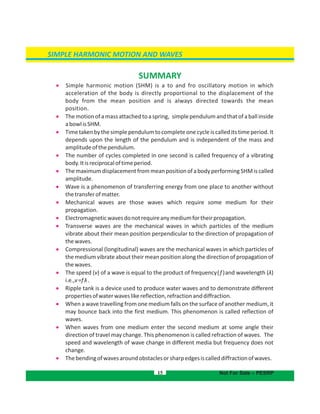
SUMMARY
 Simple harmonic motion (SHM) is a to and fro oscillatory motion in which
acceleration of the body is directly proportional to the displacement of the
body from the mean position and is always directed towards the mean
position.
 Themotionofamassattachedtoaspring, simplependulumandthatofaballinside
abowlisSHM.
 Timetakenbythesimplependulumtocompleteonecycleiscalleditstimeperiod.It
depends upon the length of the pendulum and is independent of the mass and
amplitudeofthependulum.
 The number of cycles completed in one second is called frequency of a vibrating
body.Itisreciprocaloftimeperiod.
 ThemaximumdisplacementfrommeanpositionofabodyperformingSHMiscalled
amplitude.
 Wave is a phenomenon of transferring energy from one place to another without
thetransferofmatter.
 Mechanical waves are those waves which require some medium for their
propagation.
 Electromagneticwavesdonotrequireanymediumfortheirpropagation.
 Transverse waves are the mechanical waves in which particles of the medium
vibrate about their mean position perpendicular to the direction of propagation of
thewaves.
 Compressional (longitudinal) waves are the mechanical waves in which particles of
the medium vibrate about their mean position along the direction of propagation of
thewaves.
 The speed (v) of a wave is equal to the product of frequency(f)and wavelength (λ)
i.e.,v=fλ.
 Ripple tank is a device used to produce water waves and to demonstrate different
propertiesofwaterwaveslikereflection,refractionanddiffraction.
 When a wave travelling from one medium falls on the surface of another medium, it
may bounce back into the first medium. This phenomenon is called reflection of
waves.
 When waves from one medium enter the second medium at some angle their
direction of travel may change. This phenomenon is called refraction of waves. The
speed and wavelength of wave change in different media but frequency does not
change.
 Thebendingofwavesaroundobstaclesorsharpedgesiscalleddiffractionofwaves.
Not For Sale – PESRP
SIMPLE HARMONIC MOTION AND WAVES
16
MULTIPLE CHOICE QUESTIONS
Choose the correct answer from the following choices:
i. Which of the following is an example of simple harmonic motion?
(a) the motion of simple pendulum
(b) the motion of ceiling fan
(c) the spinning of the Earth on its axis
(d) a bouncing ball on a floor
ii. If the mass of the bob of a pendulum is increased by a factor of 3, the period of the
pendulum'smotionwill
(a) be increased by a factor of 2
(b) remain the same
(c) be decreased by a factor of 2
(d) be decreased by a factor of 4
iii. Which of the following devices can be used to produce both transverse and
longitudinalwaves?
(a)astring (b)arippletank
(c) a helical spring (slinky) (d) a tuning fork
iv. Waves transfer
(a) energy (b) frequency
(c) wavelength (d) velocity
v. Which of the following is a method of energy transfer?
(a) conduction (b) radiation
(c) wave motion (d) all of these
vi. In a vacuum, all electromagnetic waves have the same
(a) speed (b) frequency
(c) amplitude (d) wavelength
vii. Alargerippletankwithavibratorworkingatafrequencyof30Hzproduces 25
completewavesinadistanceof50cm.Thevelocityofthewaveis
-1
(a) 53 cm s (b)
-1
60 cm s
-1 -1
(c) 750 cm s (d) 1500 cm s
viii.Whichofthefollowingcharacteristicsofawaveisindependentoftheothers?
(a) speed (b) frequency
(c) amplitude (d) wavelength
ix. The relation between v, f and λ of a wave is
(a) v f = λ (b) f λ = v
(c) v λ = f (d) v = λ / f
Not For Sale – PESRP
SIMPLE HARMONIC MOTION AND WAVES
17
REVIEW QUESTIONS
10.1. What is simple harmonic motion? What are the necessary conditions for a body to
executesimpleharmonicmotion?
10.2. Think of several examples of motion in everyday life that are simple harmonic.
10.3. What are damped oscillations. How damping progressively reduces the amplitude
ofoscillation?
10.4. How can you define the term wave? Elaborate the difference between mechanical
andelectromagneticwaves.Giveexamplesofeach.
10.5. Distinguishbetweenlongitudinalandtransversewaveswithsuitableexamples.
10.6. Draw a transverse wave with an amplitude of 2 cm and a wavelength of 4 cm. Label a
crestandtroughonthewave.
10.7. Derivearelationshipbetweenvelocity,frequencyandwavelengthofawave.Writea
formularelating ofawavetoitstimeperiodandwavelength.velocity
10.8. Waves are the means of energy transfer without transfer of matter. Justify this
statementwiththehelpofasimpleexperiment.
10.9. Explain the following properties of waves with reference to ripple tank
experiment:
a. Reflection b. Refraction c. Diffraction
10.10. Does increasing the frequency of a wave also increase its wavelength? If not, how
arethesequantitiesrelated?
CONCEPTUAL QUESTIONS
10.1. Ifthelengthofasimplependulumisdoubled,whatwillbethechangeinitstimeperiod?
10.2. A ball is dropped from a certain height onto the floor and keeps bouncing. Is the
motionoftheballsimpleharmonic?Explain.
10.3. A student performed two experiments with a simple pendulum. He/She used two
bobs of different masses by keeping other parameters constant. To his/her
astonishment the time period of the pendulum did not change!
Why?
10.4. Whattypesofwavesdonotrequireanymaterialmediumfortheirpropagation?
10.5. Plane waves in the ripple tank undergo refraction when they move from deep to
shallowwater.Whatchangeoccursinthespeedofthewaves?
NUMERICAL PROBLEMS
10.1. The time period of a simple pendulum is 2 s. What will be its length on the Earth?
-2
WhatwillbeitslengthontheMoonifg =g /6?whereg =10ms .em e
Ans.(1.02 m, 0.17 m)
10.2. Apendulumoflength0.99mistakentotheMoonbyanastronaut.Theperiodofthe
pendulumis4.9s.WhatisthevalueofgonthesurfaceoftheMoon?
Not For Sale – PESRP
SIMPLE HARMONIC MOTION AND WAVES
18
Ans.
-2
(1.63 m s )
10.3. Find the time periods of a simple pendulum of 1 metre length, placed on Earth and
th
on Moon. The value of g on the surface of Moon is 1/6 of its value on Earth,
-2
where g is10ms .e
Ans.(2 s, 4.9 s)
10.4. A simple pendulum completes one vibration in two seconds. Calculate its length,
-2
wheng=10.0ms . Ans.(1.02m)
10.5. If 100 waves pass through a point of a medium in 20 seconds, what is the frequency
and the time period of the wave? If its wavelength is 6 cm, calculate the
wavespeed.
-1
5 Hz, 0.2 s, 0.3 m s )Ans. (
10.6. A wooden bar vibrating into the water surface in a ripple tank has a frequency of
12 Hz. The resulting wave has a wavelength of 3 cm. What is the speed of the wave?
Ans.
-1
(0.36 m s )
10.7. A transverse wave produced on a spring has a frequency of 190 Hz and travels along
thelengthofthespringof90m,in0.5s.
(a) Whatistheperiodofthewave?
(b) Whatisthespeedofthewave?
(c) Whatisthewavelengthofthewave?
-1
Ans. (0.01 s, 180 m s , 0.95 m)
10.8. Water waves in a shallowdish are 6.0 cm long. At one point, the water moves up and
downatarateof4.8oscillationspersecond.
(a) Whatisthespeedofthewaterwaves?
(b) Whatistheperiodofthewaterwaves?
Ans.
-1
(0.29 m s , 0.21 s)
10.9. At one end of a ripple tank 80 cm across, a 5 Hz vibrator produces waves whose
wavelengthis40mm.Findthetimethewavesneedtocrossthetank.
Ans. (4 s)
10.10. What is the wavelength of the radiowaves transmitted by an FM station at 90 MHz?
6 8 -1
where1M=10 ,andspeedofradiowaveis3x10 ms . Ans.(3.33
m)
Not For Sale – PESRP
Unit 11Unit 11Unit 11 SOUNDSOUNDSOUND
The students will be able to:
•
•
•
•
describe that some sounds are injurious to health.
describe how knowledge of the properties of sound waves is applied in the design of
building with respect to acoustics.
Science, Technology and Society Connections
describe how ultrasound techniques are used in medical and industry.
explain the use of soft materials to reduce echo sounding in classroom studies, and
other public gathering buildings.
• explain how sound is produced by vibrating sources and that sound waves require
a material medium for their propagation.
• describe the longitudinal nature of sound waves (as a series of compressions and
rarefactions).
• define the terms pitch, loudness and quality of sound.
• describe the effect of change in amplitude on loudness and the effect of change in
frequency on pitch of sound.
• define intensity and state its SI unit.
• describe what is meant by intensity level and give its unit.
• explain that noise is a nuisance.
• describe how reflection of sound may produce echo.
• describe audible frequency range.
• describe the importance of acoustic protection.
• solve problems based on mathematical relations learnt in this unit.
After this students will be able to:studying unit,
SOUND
We know that vibrations of objects in any medium produce
waves. For example, vibrator of ripple tank produces water
waves. The medium in this case is liquid, but it can also be a
gas or a solid. Now we will discuss another type of waves that
wecanheari.e.,soundwaves.
11.1 SOUNDWAVES
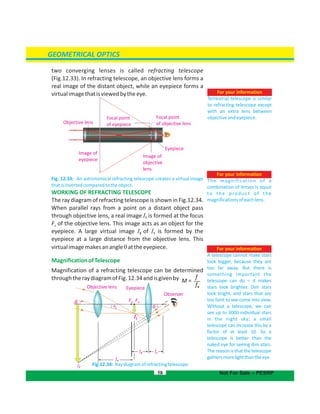
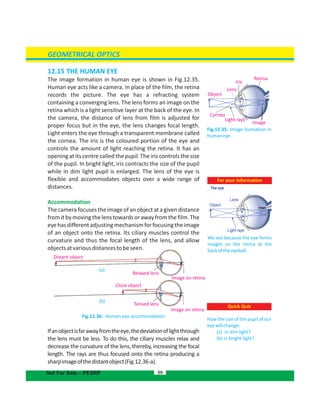
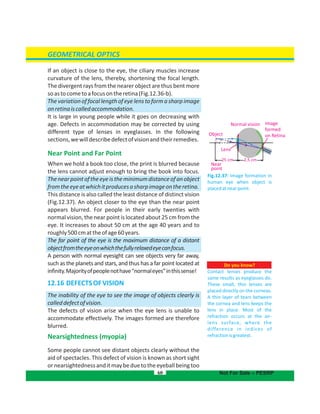
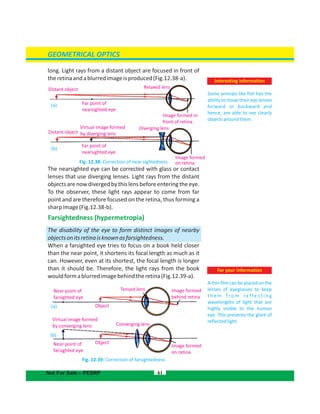
Like other waves, sound is also produced by vibrating bodies.
Due to vibrations of bodies the air around them also vibrates
and the air vibrations produce sensation of sound in our ear.
For example, in a guitar, sound is produced due to the
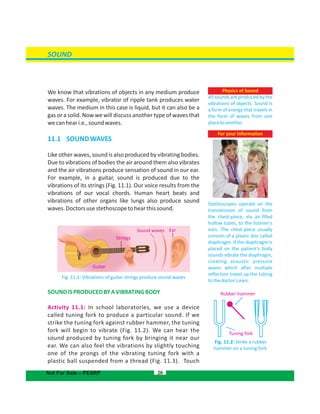
vibrations of its strings (Fig. 11.1). Our voice results from the
vibrations of our vocal chords. Human heart beats and
vibrations of other organs like lungs also produce sound
waves.Doctorsusestethoscopetohearthissound.
Fig. 11.1: Vibrations of guitar strings produce sound waves
SOUNDISPRODUCEDBYAVIBRATINGBODY
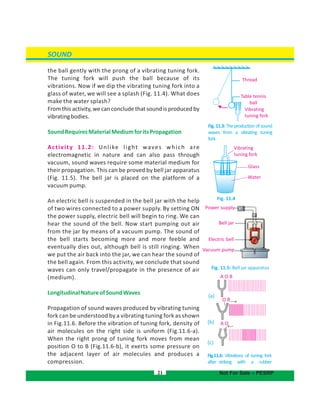
Activity 11.1: In school laboratories, we use a device
called tuning fork to produce a particular sound. If we
strike the tuning fork against rubber hammer, the tuning
fork will begin to vibrate (Fig. 11.2). We can hear the
sound produced by tuning fork by bringing it near our
ear. We can also feel the vibrations by slightly touching
one of the prongs of the vibrating tuning fork with a
plastic ball suspended from a thread (Fig. 11.3). Touch
For your information
Stethoscopes operate on the
transmission of sound from
the chest-piece, via air-filled
hollow tubes, to the listener's
ears. The chest-piece usually
consists of a plastic disc called
diaphragm. If the diaphragm is
placed on the patient’s body
sounds vibrate the diaphragm,
creating acoustic pressure
waves which after multiple
reflection travel up the tubing
tothedoctor'sears.
20
Sound waves
Strings
Ear
Guitar
Physics of Sound
All sounds are produced by the
vibrations of objects. Sound is
a form of energy that travels in
the form of waves from one
placetoanother.
Fig. 11.2: Strike a rubber
hammer on a tuning fork
Rubber hammer
Tuning fork
Not For Sale – PESRP
SOUND
the ball gently with the prong of a vibrating tuning fork.
The tuning fork will push the ball because of its
vibrations. Now if we dip the vibrating tuning fork into a
glass of water, we will see a splash (Fig. 11.4). What does
make the water splash?
From this activity, we can conclude that sound is produced by
vibratingbodies.
SoundRequiresMaterialMediumforitsPropagation
Activity 11.2: Unlike light waves which are
electromagnetic in nature and can also pass through
vacuum, sound waves require some material medium for
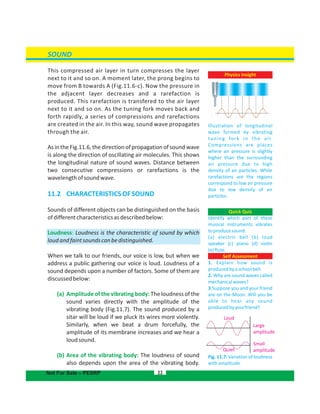
their propagation. This can be proved by bell jar apparatus
(Fig. 11.5). The bell jar is placed on the platform of a
vacuum pump.
An electric bell is suspended in the bell jar with the help
of two wires connected to a power supply. By setting ON
the power supply, electric bell will begin to ring. We can
hear the sound of the bell. Now start pumping out air
from the jar by means of a vacuum pump. The sound of
the bell starts becoming more and more feeble and
eventually dies out, although bell is still ringing. When
we put the air back into the jar, we can hear the sound of
the bell again. From this activity, we conclude that sound
waves can only travel/propagate in the presence of air
(medium).
LongitudinalNatureofSoundWaves
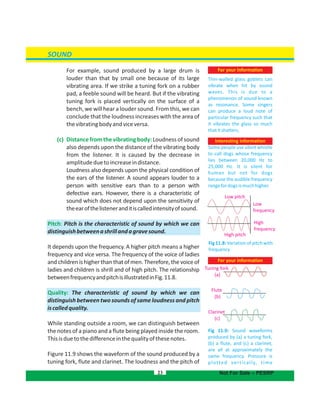
Propagation of sound waves produced by vibrating tuning
fork can be understood by a vibrating tuning fork as shown
in Fig.11.6. Before the vibration of tuning fork, density of
air molecules on the right side is uniform (Fig.11.6-a).
When the right prong of tuning fork moves from mean
position O to B (Fig.11.6-b), it exerts some pressure on
the adjacent layer of air molecules and produces a
compression.
Fig. 11.4
Fig. 11.3: The production of sound
waves from a vibrating tuning
fork
Fig. 11.5: Bell jar apparatus
21
Power supply
Bell jar
Electric bell
Vacuum pump
(a)
(b)
(c)
Fig.11.6: Vibrations of tuning fork
after striking with a rubber
Thread
Vibrating
tuning fork
Table tennis
ball
Vibrating
tuning fork
Glass
Water
A O B
O B
A O
Not For Sale – PESRP
SOUND
This compressed air layer in turn compresses the layer
next to it and so on. A moment later, the prong begins to
move from B towards A (Fig.11.6-c). Now the pressure in
the adjacent layer decreases and a rarefaction is
produced. This rarefaction is transfered to the air layer
next to it and so on. As the tuning fork moves back and
forth rapidly, a series of compressions and rarefactions
are created in the air. In this way, sound wave propagates
through the air.
Asinthe thedirectionof propagation of sound waveFig.11.6,
is along the direction of oscillating air molecules. This shows
the longitudinal nature of sound waves. Distance between
two consecutive compressions or rarefactions is the
wavelengthofsoundwave.
11.2  CHARACTERISTICSOFSOUND
Sounds of different objects can be distinguished on the basis
ofdifferentcharacteristicsasdescribedbelow:
Loudness: Loudness is the characteristic of sound by which
loudandfaintsoundscanbedistinguished.
When we talk to our friends, our voice is low, but when we
address a public gathering our voice is loud. Loudness of a
sound depends upon a number of factors. Some of them are
discussedbelow:
(a) Amplitude of the vibrating body: The loudness of the
sound varies directly with the amplitude of the
vibrating body (Fig.11.7). The sound produced by a
sitar will be loud if we pluck its wires more violently.
Similarly, when we beat a drum forcefully, the
amplitude of its membrane increases and we hear a
loudsound.
(b) Area of the vibrating body: The loudness of sound
also depends upon the area of the vibrating body.
22
Fig. 11.7: Variation of loudness
withamplitude
Quick Quiz
Identify which part of these
musical instruments vibrates
toproducesound:
(a) electric bell (b) loud
speaker (c) piano (d) violin
(e)flute.
Self Assessment
1. Explain how sound is
producedbyaschoolbell.
2. Why are sound waves called
mechanicalwaves?
3.Suppose you and your friend
are on the Moon. Will you be
able to hear any sound
producedbyyourfriend?
Large
amplitude
Loud
Quiet
Small
amplitude
Not For Sale – PESRP
Physics Insight
Illustration of longitudinal
wave formed by vibrating
tuning fork in the air.
Compressions are places
where air pressure is slightly
higher than the surrounding
air pressure due to high
density of air particles. While
rarefactions are the regions
correspond to low air pressure
due to low density of air
particles.
SOUND
For your information
Thin-walled glass goblets can
vibrate when hit by sound
waves. This is due to a
phenomenon of sound known
as resonance. Some singers
can produce a loud note of
particular frequency such that
it vibrates the glass so much
thatitshatters.
Interesting information
Some people use silent whistle
to call dogs whose frequency
lies between 20,000 Hz to
25,000 Hz. It is silent for
human but not for dogs
because the audible frequency
rangefordogsismuchhigher.
23
For example, sound produced by a large drum is
louder than that by small one because of its large
vibrating area. If we strike a tuning fork on a rubber
pad, a feeble sound will be heard. But if the vibrating
tuning fork is placed vertically on the surface of a
bench, we will hear a louder sound. From this, we can
conclude that the loudness increases with the area of
thevibratingbodyandviceversa.
(c) Distance from the vibrating body: Loudness of sound
also depends upon the distance of the vibrating body
from the listener. It is caused by the decrease in
amplitudeduetoincreaseindistance.
Loudness also depends upon the physical condition of
the ears of the listener. A sound appears louder to a
person with sensitive ears than to a person with
defective ears. However, there is a characteristic of
sound which does not depend upon the sensitivity of
theearofthelisteneranditiscalledintensityofsound.
Pitch: Pitch is the characteristic of sound by which we can
distinguishbetweenashrillandagravesound.
It depends upon the frequency. A higher pitch means a higher
frequency and vice versa. The frequency of the voice of ladies
and children ishigherthan thatofmen.Therefore,thevoiceof
ladies and children is shrill and of high pitch. The relationship
betweenfrequencyandpitchisillustratedinFig.11.8.
Quality: The characteristic of sound by which we can
distinguish between two sounds of same loudness and pitch
iscalledquality.
While standing outside a room, we can distinguish between
the notes of a piano and a flute being played inside the room.
Thisisduetothedifferenceinthequalityofthesenotes.
Figure 11.9 shows the waveform of the sound produced by a
tuning fork, flute and clarinet. The loudness and the pitch of
Fig11.8:Variationofpitchwith
frequency
Low
frequency
Low pitch
High pitch
High
frequency
For your information
Fig 11.9: Sound waveforms
produced by (a) a tuning fork,
(b) a flute, and (c) a clarinet,
are all at approximately the
same frequency. Pressure is
plotted vertically, time
(a)
(b)
(c)
Tuning fork
Flute
Clarinet
Not For Sale – PESRP
SOUND
these three sounds are the same but their waveforms are
different. So their quality is different and they can be
distinguishedfromeachother.
Intensity
The sound waves transfer energy from the sounding body to
thelistener.Theintensityofsounddependsontheamplitude
ofsoundwaveandisdefinedas:
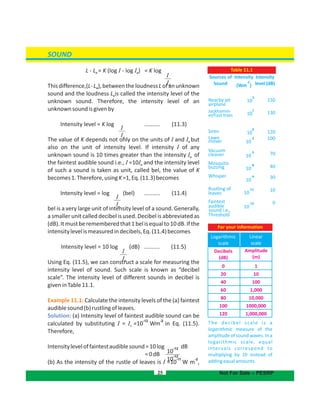
Sound energy passing per second through a unit area held
perpendicular to the direction of propagation of sound
wavesiscalledintensityofsound.
Intensity is a physical quantity and can be measured
accurately. The unit of intensity of sound is watt per square
metre(W ).
-2
m
SoundIntensityLevel
The human ear responds to the intensities ranging from
-12 -2
10 W m to more than 1 W m (which is loud enough to be
-2
painful). Because the range is so wide, intensities are scaled
by factors of ten. The barely audible and the faintest intensity
-12
of sound i.e., 10 W m is taken as reference intensity, called
-2
zerobel(aunitnamedafterAlexanderGrahamBell).
The loudness of a sound depends not only on the intensity of
sound but also on the physical conditions of the ear. The
human ear is more sensitive to some frequencies rather than
the others.
The loudness (L) of a sound is directly proportional to the
logarithmofintensityi.e.,
L logI
L=Klog .......... (11.1)I
whereKisaconstantofproportionality.
Let L be the loudness of the faintest audible sound of intensityo
I Iand L be the loudness of an unknown sound of intensity ,o
thenbyEq.(11.1),wecanwrite
L = K log (11.2)I ..........o o
SubtractingEq.(11.2)fromEq.(11.1),weget
24
Do you know?
Frequency of tuning fork
depends on the mass of its
prongs. The greater the mass,
the lower the frequency of
vibration which means the
lowerthepitch.
Quick Quiz
1. Why the voice of women is
more shrill than that of men?
2. Which property of sound
wavedeterminesits:
(a)loudness (b)pitch?
3. What would happen to the
loudness of sound with
increase in its frequency?
Not For Sale – PESRP
For your information
Asoundwavewithafrequency
of 3500 Hz and an intensity of
80 dB sounds about twice as
loud to us as a sound of 125 Hz
and 80 dB. It is because our
ears are more sensitive to the
3500 Hz sound than to the
125 Hz. Therefore intensity by
itself does not mean loudness.
Loudness is how our ears
detect and our brain perceives
theintensityofsoundwaves.
SOUND
L - L = K (log - log ) = K logI Io o
Thisdifference,(L-L ),betweentheloudnessLofanunknowno
sound and the loudness L is called the intensity level of theo
unknown sound. Therefore, the intensity level of an
unknownsoundisgivenby
Intensity level = K log .......... (11.3)
The value of K depends not only on the units of and butI Io
also on the unit of intensity level. If intensity of anyI
unknown sound is 10 times greater than the intensity ofIo
the faintest audible sound i.e., =10 and the intensity levelI Io
of such a sound is taken as unit, called bel, the value of K
becomes1.Therefore,usingK=1,Eq.(11.3)becomes
Intensity .......... (11.4)level = log (bel)
bel is a very large unit of intensity level of a sound. Generally,
a smaller unit called decibel is used. Decibel is abbreviated as
(dB).Itmustberememberedthat1belisequalto10dB.Ifthe
intensitylevelismeasuredindecibels,Eq.(11.4)becomes
Intensity .......... (11.5)level = 10 log (dB)
Using Eq. (11.5), we can construct a scale for measuring the
intensity level of sound. Such scale is known as “decibel
scale”. The intensity level of different sounds in decibel is
giveninTable11.1.
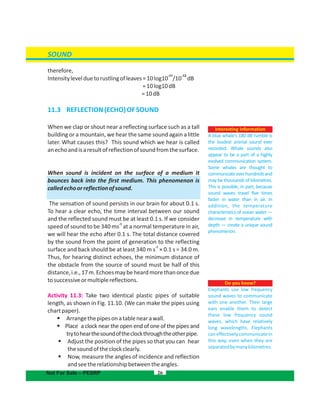
Example 11.1: Calculate the intensity levels of the (a) faintest
audiblesound(b)rustlingofleaves.
Solution: (a) Intensity level of faintest audible sound can be
-12 -2
calculated by substituting = 10 Wm in Eq. (11.5).oI I =
Therefore,
Intensityleveloffaintest sound=10log dBaudible
=0dB
-11 -2
(b) As the intensity of the rustle of leaves is =10 W m ,I
25
Sources of
Sound
Nearby jet
airplane
Jackhamm-
er/Fast train
Siren
Lawn
mover
Vacuum
cleaner
Mosquito
buzzing
Whisper
Rustling of
leaves
Faintest
audible
sound i.e.,
Threshold
Intensity
(Wm )
-2
3
10
1
10
0
10
-2
10
-5
10
-8
10
-9
10
-11
10
-12
10
Intensity
level (dB)
150
130
120
100
70
40
30
10
0
Table 11.1
Not For Sale – PESRP
For your information
The decibel scale is a
logarithmic measure of the
amplitude of sound waves. In a
logarithmic scale, equal
intervals correspond to
multiplying by 10 instead of
addingequalamounts.
Decibels
(dB)
Amplitude
(m)
0
20
40
60
80
100
120
1
10
100
1,000
10,000
1000,000
1,000,000
Logarithmic
scale
Linear
scale
I
Io
10
-12
10
-12
I
Io
I
Io
I
Io
SOUND
therefore,
-11 -12
Intensitylevelduetorustlingofleaves=10log10 /10 dB
=10log10dB
=10dB
11.3 REFLECTION(ECHO)OFSOUND
When we clap or shout near a reflecting surface such as a tall
building or a mountain, we hear the same sound again a little
later. What causes this? This sound which we hear is called
anechoandisaresultofreflectionofsoundfromthesurface.
When sound is incident on the surface of a medium it
bounces back into the first medium. This phenomenon is
calledechoorreflectionofsound.
The sensation of sound persists in our brain for about 0.1 s.
To hear a clear echo, the time interval between our sound
and the reflected sound must be at least 0.1 s. If we consider
-1
speed of sound to be 340 ms at a normal temperature in air,
we will hear the echo after 0.1 s. The total distance covered
by the sound from the point of generation to the reflecting
-1
surface and back should be at least 340 m s × 0.1 s = 34.0 m.
Thus, for hearing distinct echoes, the minimum distance of
the obstacle from the source of sound must be half of this
distance,i.e.,17m.Echoesmaybeheardmorethanoncedue
tosuccessiveormultiplereflections.
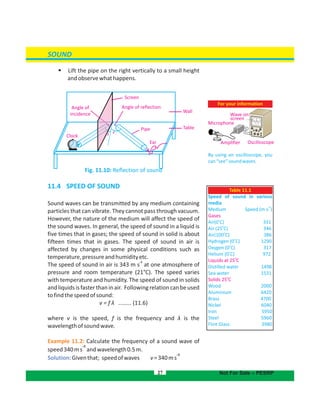
Activity 11.3: Take two identical plastic pipes of suitable
length, as shown in Fig. 11.10. (We can make the pipes using
chartpaper).
 Arrangethepipesonatablenearawall.
 Place a clock near the open end of one of the pipes and
trytohearthesoundoftheclockthroughtheotherpipe.
 Adjust the position of the pipes so that you can hear
thesoundoftheclockclearly.
 Now, measure the angles of incidence and reflection
andseetherelationshipbetweentheangles.
26
Do you know?
Elephants use low frequency
sound waves to communicate
with one another. Their large
ears enable them to detect
these low frequency sound
waves, which have relatively
long wavelengths. Elephants
caneffectivelycommunicatein
this way, even when they are
separatedbymanykilometres.
Interesting information
A blue whale's 180 dB rumble is
the loudest animal sound ever
recorded. Whale sounds also
appear to be a part of a highly
evolved communication system.
Some whales are thought to
communicateoverhundredsand
may be thousands of kilometres.
This is possible, in part, because
sound waves travel five times
faster in water than in air. In
addition, the temperature
characteristics of ocean water —
decrease in temperature with
depth — create a unique sound
phenomenon.
Not For Sale – PESRP
SOUND
 Lift the pipe on the right vertically to a small height
andobservewhathappens.
Fig. 11.10: Reflection of sound
11.4 SPEED OF SOUND
Sound waves can be transmitted by any medium containing
particles that can vibrate. They cannot pass through vacuum.
However, the nature of the medium will affect the speed of
the sound waves. In general, the speed of sound in a liquid is
five times that in gases; the speed of sound in solid is about
fifteen times that in gases. The speed of sound in air is
affected by changes in some physical conditions such as
temperature,pressureandhumidityetc.
-1
The speed of sound in air is 343 m s at one atmosphere of
pressure and room temperature (21°C). The speed varies
with temperature and humidity. The speed of sound in solids
andliquidsisfasterthaninair. Followingrelationcanbeused
tofindthespeedofsound:
v = f λ ........ (11.6)
where v is the speed, f is the frequency and is theλ
wavelengthofsoundwave.
Example 11.2: Calculate the frequency of a sound wave of
-1
speed340ms andwavelength0.5m.
Solution:Giventhat;
-1
speedofwaves v=340ms
27
For your information
By using an oscilloscope, you
can“see”soundwaves.
Wave on
screen
Microphone
OscilloscopeAmplifier
Not For Sale – PESRP
Angle of reflection
Pipe
Screen
Wall
Table
Ear
r
Clock
Angle of
incidence
i
Table 11.1
Speed of sound in various
media
Medium Speed (m s )
-1
Gases
o
Air(0 C) 331
0
Air (25 C) 346
o
Air(100 C) 386
o
Hydrogen (0 C) 1290
o
Oxygen (0 C) 317
o
Helium (0 C) 972
0
Liquids at 25 C
Distilled water 1498
Sea water 1531
0
Solids 25 C
Wood 2000
Aluminium 6420
Brass 4700
Nickel 6040
Iron 5950
Steel 5960
Flint Glass 3980
SOUND
Wavelength λ=0.5m
Usingtheformula v= λf
Puttingthevalues
=340 /0.5m=680Hz
-1
f ms
MeasuringSpeedofSoundbyEchoMethod
Apparatus: Measuring tape, stopwatch, flat wall that can
produceagoodecho.
Procedure:
1. Use the tape to measure a distance of 50 metres from
thewall.
2. Now clap your hands in front of the wall at a distance
of 50 metres and check if you can clearly hear
anecho from the wall. Make sure the echo is not
comingfrom any other wall in the area. The time taken by
the sound to travel 100 metres is the time
difference betweentheclapandtheecho.
3. Now restart the clapping and start the stopwatch at
the first clap. Count the number of claps, and
stopthe clapping and the stopwatch when you hear
theecho ofthe10thclap(say).
4. Now find the average time for 10 claps. After
calculating the time interval t between claps
and using the formula S = vt, we can calculate the
speedof thesound.
Example 11.3: Flash of lightning is seen 1.5 seconds earlier
than the thunder. Howfar away is the cloud in which the flash
-1
hasoccurred?(speedofsound=332ms ).
Solution:
-1
Given that, time t = 1.5 s, speed of sound v = 332 m s .
-1
Therefore,distanceofthecloud S = vt =1.5s×332ms =498 m.
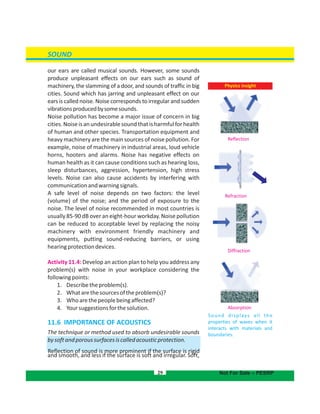
11.5  NOISE POLLUTION
We enjoy the programmes on radio or television by hearing
sounds of different qualities. In musical programmes, we hear
sound produced by musical instruments such as flute,
harmonium, violin, drum etc. Sound of these instruments has
pleasant effect on our ears. Such sounds which are pleasant to
28Not For Sale – PESRP
A
B
Do you know?
The speed of sound in air was
first accurately measured in
1738bymembersoftheFrench
Academy. Two cannons were
s e t u p o n t w o h i l l s
approximately 29 km apart. By
measuring the time interval
between the flash of a cannon
and the “boom”, the speed of
sound was calculated. Two
c a n n o n s w e r e f i r e d
alternatively to minimize errors
due to the wind and to delayed
reactions in the observers.
From their observations, they
deduced that sound travels at
0
about336ms at0 C.
-1
SOUND
our ears are called musical sounds. However, some sounds
produce unpleasant effects on our ears such as sound of
machinery, the slamming of a door, and sounds of traffic in big
cities. Sound which has jarring and unpleasant effect on our
ears is called noise. Noise corresponds to irregular and sudden
vibrationsproducedbysomesounds.
Noise pollution has become a major issue of concern in big
cities.Noiseisanundesirablesoundthatisharmfulforhealth
of human and other species. Transportation equipment and
heavy machinery are the main sources of noise pollution. For
example, noise of machinery in industrial areas, loud vehicle
horns, hooters and alarms. Noise has negative effects on
human health as it can cause conditions such as hearing loss,
sleep disturbances, aggression, hypertension, high stress
levels. Noise can also cause accidents by interfering with
communicationandwarningsignals.
A safe level of noise depends on two factors: the level
(volume) of the noise; and the period of exposure to the
noise. The level of noise recommended in most countries is
usually 85-90 dB over an eight-hour workday. Noise pollution
can be reduced to acceptable level by replacing the noisy
machinery with environment friendly machinery and
equipments, putting sound-reducing barriers, or using
hearingprotectiondevices.
Activity 11.4: Develop an action plan to help you address any
problem(s) with noise in your workplace considering the
followingpoints:
1. Describetheproblem(s).
2. Whatarethesourcesoftheproblem(s)?
3. Whoarethepeoplebeingaffected?
4. Yoursuggestionsforthesolution.
11.6 IMPORTANCE OF ACOUSTICS
The technique or method used to absorb undesirable sounds
bysoftandporoussurfacesiscalledacousticprotection.
Reflection of sound is more prominent if the surface is rigid
and smooth, and less if the surface is soft and irregular. Soft,
29 Not For Sale – PESRP
Physics insight
Sound displays all the
properties of waves when it
interacts with materials and
boundaries.
Reflection
Refraction
Diffraction
Absorption
SOUND
For your information
The phrase “blind as a bat” is a
false statement. Bats have some
vision using light, but when
placed in pitch-black rooms
crisscrossedwithfinewires,they
can easily fly around and
unerringly locate tiny flying
insects for food. We usually
assume that vision requires light
but both bats and dolphins have
the ability to “see” using sound
waves. Research in science and
technology has developed
“eyes” that enable humans also
toseeusingsoundwaves.
porous materials, such as draperies and rugs absorb large
amountofsoundenergyandthusquietechoesandsoftening
noises. Thus by using such material in noisy places we can
reduce the level of noise pollution. However, if the surface of
classrooms or public halls are too absorbent, the sound level
may be low for the audience. Sometimes, when sound
reflects from the walls, ceiling, and floor of a room, the
reflecting surfaces are too reflective and the sound becomes
garbled. This is due to multiple reflections called
reverberations. In the design of lecture halls, auditorium, or
theater halls, a balance must be achieved between
reverberation and absorption. It is often advantageous to
place reflective surfaces behind the stage to direct sound to
theaudience.
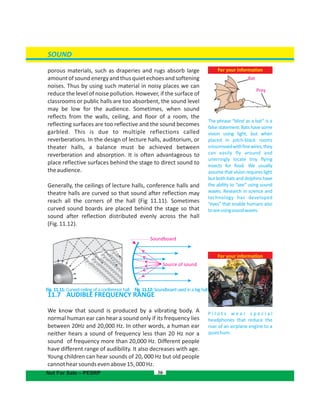
Generally, the ceilings of lecture halls, conference halls and
theatre halls are curved so that sound after reflection may
reach all the corners of the hall (Fig 11.11). Sometimes
curved sound boards are placed behind the stage so that
sound after reflection distributed evenly across the hall
(Fig.11.12).
11.7  AUDIBLE FREQUENCY RANGE
We know that sound is produced by a vibrating body. A
normal human ear can hear a sound only if its frequency lies
between 20Hz and 20,000 Hz. In other words, a human ear
neither hears a sound of frequency less than 20 Hz nor a
sound of frequency more than 20,000 Hz. Different people
have different range of audibility. It also decreases with age.
Young children can hear sounds of 20, 000 Hz but old people
cannothearsoundsevenabove15,000Hz.
30
Soundboard
Bat
Prey
Source of sound
Not For Sale – PESRP
For your information
P i l o t s w e a r s p e c i a l
headphones that reduce the
roar of an airplane engine to a
quiethum.
Fig. 11.11: Curved ceiling of a conference hall Fig. 11.12: Soundboard used in a big hall
SOUND
The range of the frequencies which a human ear can hear is
calledtheaudiblefrequencyrange.
11.8 ULTRASOUND 
Sounds of frequency higher than 20, 000 Hz which are
inaudible to normal human ear are called ultrasound or
ultrasonics.
Uses of Ultrasound
  Ultrasonic waves carry more energy and higher
frequency than audible sound waves. Therefore,
accordingtothewaveequationv=f λ,thewavelength
of ultrasonic waves is very small and is very useful for
detectingverysmallobjects.
  Ultrasonicsareutilizedinmedicalandtechnicalfields.
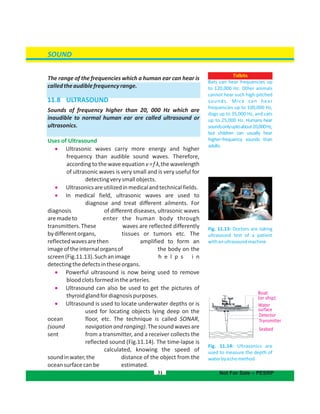
  In medical field, ultrasonic waves are used to
diagnose and treat different ailments. For
diagnosis of different diseases, ultrasonic waves
aremadeto enter the human body through
transmitters.These waves are reflected differently
bydifferentorgans, tissues or tumors etc. The
reflectedwavesarethen amplified to form an
imageoftheinternalorgansof the body on the
screen(Fig.11.13).Suchanimage h e l p s i n
detectingthedefectsintheseorgans.
  Powerful ultrasound is now being used to remove
bloodclotsformedinthearteries.
  Ultrasound can also be used to get the pictures of
thyroidglandfordiagnosispurposes.
  Ultrasound is used to locate underwater depths or is
used for locating objects lying deep on the
ocean floor, etc. The technique is called SONAR,
(sound navigationandranging).Thesoundwavesare
sent from a transmitter, and a receiver collects the
reflected sound (Fig.11.14). The time-lapse is
calculated, knowing the speed of
soundinwater,the distance of the object from the
oceansurfacecanbe estimated.
31
Fig. 11.13: Doctors are taking
ultrasound test of a patient
withanultrasoundmachine
Fig. 11.14: Ultrasonics are
used to measure the depth of
waterbyechomethod
Boat
(or ship)
Water
surface
Detector
Transmitter
Seabed
Not For Sale – PESRP
Tidbits
Bats can hear frequencies up
to 120,000 Hz. Other animals
cannot hear such high-pitched
sounds. Mice can hear
frequencies up to 100,000 Hz,
dogs up to 35,000 Hz, and cats
up to 25,000 Hz. Humans hear
soundsonlyuptoabout20,000Hz,
but children can usually hear
higher-frequency sounds than
adults.
SOUND
  SONAR ranging is also used to see the shape and the
sizeoftheobject.
Cracks appear in the interior of moving parts of high
speed heavy machines such as turbines,
enginesof ships and airplanes due to excessive
use.Thesecracks are not visible from outside but they
canbevery dangerous. Such cracks can be detected
byultrasonics.A powerful beam of ultrasound is made
topassthrough these defective parts. While passing,
thesewavesare reflected by the surfaceof thesecracks
andflaws.The comparison of the ultrasonic waves
reflectedfromcracks andfromthesurfacesofthesepartscangive
aclueofthe existenceofthecracks.
  Germs and bacteria in liquids can also be destroyed
byusinghighintensityultrasonicwaves.
32
SUMMARY
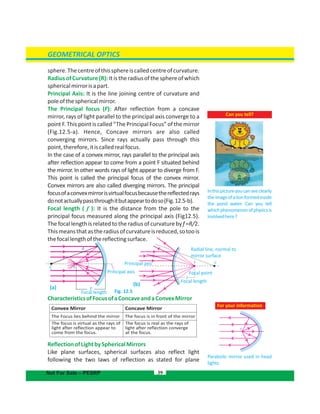
Sound is produced by a vibrating body. It travels in the medium from one place to
anotherintheformofcompressionalwaves.
Loudnessisafeatureofsoundbywhichaloudandafaintsoundcanbedistinguished.
Itdependsupontheamplitude,surfaceareaanddistancefromthevibratingbody.
  Sound energy flowing per second through unit area held perpendicular to the
direction of sound waves is called the intensity of sound. bel is unit of the intensity
levelofsound,where1bel=10decibels
 Pitch of the sound is the characteristics of sound by which a shrill sound can be
distinguishedfromagraveone.Itdependsuponthefrequency.
The characteristics of sound by which two sound waves of same loudness and pitch
aredistinguishedfromeachotheriscalledthequalityofsound.
 The sounds with jarring effect on our ears are called noise and the sounds having
pleasanteffectonourearsarecalledmusicalsounds.
Noise pollution has become a major issue of concern in some big cities. Any form of
sound which disturbs the normal functioning of any natural ecosystem or some
humancommunityisthecauseofnoisepollution.
 Noise pollution can be reduced to acceptable level by replacing the rusty noisy
machinery with environment friendly machinery and equipments, putting sound-
reducingbarriers,orusinghearingprotectiondevices.
 The technique or method used to absorb undesirable sound energy by soft and
porous surfaces is called acoustic protection. This can be done by using soft, rough
andporousmaterials.
Not For Sale – PESRP
SOUND
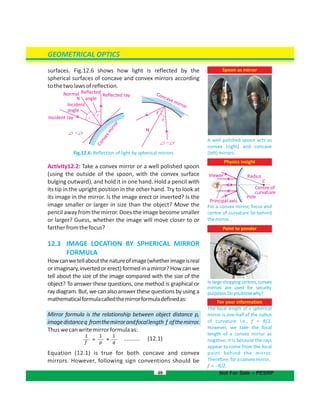
 Humanaudiblefrequencyrangeliesbetween20Hzto20,000Hz.
 Sound waves of frequency higher than 20, 000 Hz are called ultrasound while sound
wavesoffrequencylowerthan20Hzarecalledinfrasound.
 Ultrasound is used in many fields of science and technology such as medical,
engineering, agriculture. In medical field ultrasound is used to diagnose and treat
different ailments. Ultrasound is also used to locate underwater depths or for
locating objects lying deep on the ocean floor. The technique is called SONAR, an
acronymforsoundnavigationandranging.
MULTIPLE CHOICE QUESTIONS
Choose the correct answer from the following choices:
i. Which is an example of a longitudinal wave?
(a) sound wave (b) light wave
(c) radiowave (d) water wave
ii. How does sound travel from its source to your ear?
(a) by changes in air pressure (b) by vibrations in wires or strings
(c) by electromagnetic wave (d) by infrared waves
iii. Which form of energy is sound?
(a) electrical (b) mechanical
(c) thermal (d) chemical
iv. Astronautsinspaceneedtocommunicatewitheachotherbyradiolinksbecause
(a) sound waves travel very slowly in space
(b) sound waves travel very fast in space
(c) sound waves cannot travel in space
(d) sound waves have low frequency in space
v. The loudness of a sound is most closely related to its
(a) frequency (b) period
(c) wavelength (d) amplitude
vi. Foranormalperson,audiblefrequencyrangeforsoundwaveliesbetween
(a) 10 Hz and 10 kHz (b) 20 Hz and 20 kHz
(c) 25 Hz and 25 kHz (d) 30 Hz and 30 kHz
vii. When the frequency of a sound wave is increased, which of the following will
decrease?
i. wavelength ii. period iii. amplitude
(a) i only (b) iii only
(c) i and ii only (d) i and iii only
REVIEW QUESTIONS
11.1. What is the necessary condition for the production of sound?
33 Not For Sale – PESRP
SOUND
11.2. What is the effect of the medium on the speed of sound? In which medium sound
travelsmorefaster:air,solidorliquid?Justifyyouranswer.
11.3. Howcanyouprovethemechanicalnatureofsoundbyasimpleexperiment?
11.4. What do you understand by the longitudinal wave? Describe the longitudinal
natureofsoundwaves.
11.5. Soundisaformofwave.Listatleastthreereasonstosupporttheideathatsoundisawave.
11.6. We know that waves manifest phenomenon of reflection, refraction and
diffraction.Doessoundalsomanifestthesecharacteristics?
11.7. What is the difference between the loudness and intensity of sound? Derive the
relationshipbetweenthetwo.
11.8. On what factors does the loudness of sound depend?
11.9. What do you mean by the term intensity level of the sound? Name and define the
unitofintensitylevelofsound.
11.10. What are the units of loudness? Why do we use logarithmic scale to describe the
rangeofthesoundintensitieswehear?
11.11. What is difference between frequency and pitch? Describe their relationship
graphically.
11.12. Describe the effect of change in amplitude on loudness and the effect of change in
frequencyonpitchofsound.
11.13. If the pitch of sound is increased, what are the changes in the following?
a. the frequency b. the wavelength
c. the wave velocity d. the amplitude of the wave
11.14. If we clap or speak in front of a building while standing at a particular distance, we
rehearoursoundaftersometime.Canyouexplainhowdoesthishappen?
11.15. What is the audible frequency range for human ear? Does this range vary with the
ageofpeople?Explain.
11.16. Explainthatnoiseisanuisance.
11.17. Describetheimportanceofacousticprotection.
11.18. Whataretheusesofultrasoundinmedicine?
CONCEPTUAL QUESTIONS
11.1. Why two tin cans with a string stretched between them could be better way to
communicatethanmerelyshoutingthroughtheair?
11.2. We can recognize persons speaking with the same loudness from their voice. How
isthispossible?
11.3. You can listen to your friend round a corner, but you cannot watch him/her.
Why?
11.4. Why must the volume of a stereo in a room with wall-to-wall carpet be tuned
higherthaninaroomwithawoodenfloor?
34Not For Sale – PESRP
SOUND
11.5. A student says that the two terms speed and frequency of the wave refer to the
samething.Whatisyourresponse?
11.6. Two people are listening to the same music at the same distance. They disagree on
itsloudness.Explainhowthiscouldhappen.
11.7. Isthereanydifferencebetweenechoandreflectionofsound?Explain.
11.8. Willtwoseparate50dBsoundstogetherconstitutea100dBsound?Explain.
11.9. Whyultrasoundisusefulinmedicalfield?
NUMERICAL PROBLEMS
11.1.
-6 -2
A normal conversation involves sound intensities of about 3.0 × 10 W m . What is
the decibel level for this intensity? What is the intensity of the sound for 100
dB?
Ans. (64.8 dB, 0.01 W m )
-2
11.2. IfatAnarkaliBazarLahore,intensitylevelofsoundis80dB,whatwillbetheintensity
ofsoundthere?
-4 -2
Ans. (10 W m )
11.3.
-1
At a particular temperature, the speed of sound in air is 330 m s . If the wavelength
of a note is 5 cm, calculate the frequency of the sound wave. Is this frequency in the
audiblerangeofthehumanear?
3
Ans. (6.6 x 10
Hz,Yes)
11.4. A doctor counts 72 heartbeats in 1 min. Calculate the frequency and period of the
heartbeats.
Ans. (1.2 Hz, 0.83 s)
11.5. A marine survey ship sends a sound wave straight to the seabed. It receives an
-1
echo 1.5 s later. The speed of sound in seawater is 1500 m s . Find the depth of the
seaatthisposition. Ans.
(1125m)
11.6. A student clapped his hands near a cliff and heard the echo after 5 s. What is the
–1
distanceoftheclifffromthestudentifthespeedofthesoundistakenas346ms ?
Ans. (865 m)
11.7. A ship sends out ultrasound that returns from the seabed and is detected after
-1
3.42s.Ifthespeedofultrasound throughseawateris1531ms ,whatisthedistance
oftheseabedfromtheship?
Ans. (2618 m)
11.8. The highest frequency sound humans can hear is about 20,000 Hz. What is the
o
wavelength of sound in air at this frequency at a temperature of 20 C? What is the
wavelength of the lowest sounds we can hear of about 20 Hz? Assume the
-1O
speedof soundinairat20 Cis343ms .
35 Not For Sale – PESRP
Unit 12Unit 12Unit 12
• describe the terms used in reflection including normal, angle of incidence, angle of
reflection and state laws of reflection.
• solve problems of image location by spherical mirrors by using mirror formula.
• define the terminology for the angle of incidence i and angle of refraction r and
describe the passage of light through parallel-sided transparent material.
• solve problems by using the equation sin i /sin r = n (refractive index).
• state the conditions for total internal reflection.
• describe the passage of light through a glass prism.
• describe how total internal reflection is used in light propagation through optical fibres.
• describe how light is refracted through lenses.
• define power of a lens and its unit.
• solve problems of image location by lenses using lens formula.
• define the terms resolving power and magnifying power.
• draw ray diagram of simple microscope and mention its magnifying power.
• draw ray diagram of compound microscope and mention its magnifying power.
• draw ray diagram of a telescope and mention its magnifying power.
• draw ray diagrams to show the formation of images in the normal eye, a short-sighted
eye and a long-sighted eye.
• describe the correction of short-sight and long-sight.
After this students will be able to:studying unit.
GEOMETRICAL OPTICSGEOMETRICAL OPTICSGEOMETRICAL OPTICS
The students will be able to:
•
•
•
describe the use of spherical mirrors for safe driving, blind turns on hilly roads,
dentist mirror.
Science, Technology and Society Connections
describe the use of optical fibres in telecommunications and medical field and state
the advantages of their use.
describe the use of a single lens as a magnifying glass and in a camera, projector
and photographic enlarger and draw ray diagrams to show how each forms an image.
•
•
describe the use of lenses/contact lenses for rectifying vision defects of the human eye.
describe the exploration of the world of micro-organisms by using microscopes and of
distant celestial bodies by telescopes.
GEOMETRICAL OPTICS
Physics of Light
We see a page of a book
because light reflects from
each part of the page in all
directions, so that some of the
light rays from each part of the
page enter our eye. Because
almost no light is reflected by
the printed words, we “see”
themasblackareas.
Light is the main focus of this unit. We shall describe different
phenomena of light such as reflection, refraction and total
internal reflection. We will learn how images are formed by
mirrors and lenses and will discuss working principle of
compoundmicroscopeandtelescope.
12.1 REFLECTIONOFLIGHT
Reflection of light is illustrated in Fig. 12.1. When a ray of light
from air along the path AO falls on a plane mirror M, it is
reflected along the path OB. The ray AO is called incident ray
while the ray OB is called reflected ray. The angle between
incident ray AO and normal N, i.e., AON is called the angle<
of incidence represented by i. The angle between the normal
and the reflected ray OB, i.e., NOB is called angle of<
reflectionrepresentedbyr.
Fig. 12.1: Reflection of light
Nowwecandefinethephenomenonofreflectionas:
When light travelling in a certain medium falls on the
surface of another medium, a part of it turns back in the
samemedium.
LawsofReflection
(i) The incidentray, the normal, and the reflected ray atthe
pointofincidenceall lieinthesameplane.
(ii) The angle of incidence is equal to the angle of reflection
i.e.,i=r.
37
For your information
In the early 1700s, there were
two ideas about the nature of
light: particle nature and wave
nature. Newton put forward
the idea of corpuscular nature
of light. According to him, light
consists of tiny, fast-moving
particles. Maxwell formulated
the wave theory of light. In
1802, Thomas Young proved
the wave nature of light
experimentally. In 1900,
Planck suggested that light
consists of small packets of
energy called photon. Later on
idea of photon was confirmed
by experiments. Now we know
that light has dual nature; light
aswellasparticlenature.
Not For Sale – PESRP
Incident ray
Normal
Angle of
incidence
Angle of
reflection
Reflected ray
B
M90
ri
Plane mirror
Point of incidence
A
o


O
N
Aperture or opening Radius of
curvature
Principal axis Principal axis
Aperture
Pole
Pole
Centre of
curvature R
CC
R
GEOMETRICAL OPTICS
TypesofReflection
Nature of reflection depends on smoothness of the surface.
For example, a smooth surface of silver reflects rays of light in
one direction only. The reflection by these smooth surfaces is
called regular reflection (Fig.12.2). Most of the objects in
everyday world are not smooth on the microscopic level. The
rough surfaces of these objects reflect the rays of light in
many directions. Such type of reflection is called irregular
reflection(Fig.12.3).
12.2 SPHERICALMIRRORS
A mirror whose polished, reflecting surface is a part of a
hollow sphere of glass or plastic is called a spherical mirror. In
a spherical mirror, one of the two curved surfaces is coated
with a thin layer of silver followed by a coating of red lead
oxide paint. Thus, one side of the spherical mirror is opaque
and the other side is a highly polished reflecting surface.
Depending upon the nature of reflecting surface, there are
twotypesofsphericalmirrorsasshowninFig.12.4.
(a) Concave mirror (b) Convex mirror
Fig. 12.4: Types of spherical mirrors
ConcaveMirror:Asphericalmirrorwhoseinnercurvedsurface
is reflecting is called concave mirror. In concave mirror the size
oftheimagedependsonthepositionoftheobject.Bothvirtual
andrealimagescanbeformedbyaconcavemirror.
Convex Mirror: A spherical mirror whose outer curved surface
is reflecting is called convex mirror. In convex mirror the size of
the image is always smaller than the object. Only virtual and
erectimageisformedbyaconvexmirror.
Pole: It is the midpoint of the curved surface of spherical
mirror.Itisalsocalledvertex.
Centre of Curvature (C): A spherical mirror is a part of a
38
Fig. 12.3: Irregular reflection
Fig. 12.2: Regular reflection
Incident
rays Reflected rays
Smooth surface
Incident
rays Reflected rays
Rough surface
Not For Sale – PESRP
For Your Information
Light rays are reflected in a
plane mirror, causing us to see
aninvertedimage.
Mirror
Do you know?
The image you see in a flat
mirror is at the same distance
behind the mirror as you are in
frontofit.
Image
Mirror
Real
object
GEOMETRICAL OPTICS
sphere.Thecentreofthissphereiscalledcentreofcurvature.
RadiusofCurvature(R):Itistheradiusofthesphereofwhich
sphericalmirrorisapart.
Principal Axis: It is the line joining centre of curvature and
poleofthesphericalmirror.
The Principal focus (F): After reflection from a concave
mirror, rays of light parallel to the principal axis converge to a
point F. This point is called “The Principal Focus” of the mirror
(Fig.12.5-a). Hence, Concave mirrors are also called
converging mirrors. Since rays actually pass through this
point,therefore,itiscalledrealfocus.
In the case of a convex mirror, rays parallel to the principal axis
after reflection appear to come from a point F situated behind
the mirror. In other words rays of light appear to diverge from F.
This point is called the principal focus of the convex mirror.
Convex mirrors are also called diverging mirrors. The principal
focusofaconvexmirrorisvirtualfocusbecausethereflectedrays
donotactuallypassthroughitbutappeartodoso(Fig.12.5-b).
Focal length ( f ): It is the distance from the pole to the
principal focus measured along the principal axis (Fig12.5).
Thefocallengthisrelatedtotheradiusofcurvaturebyf=R/2.
Thismeansthatastheradiusofcurvatureisreduced,sotoois
thefocallengthofthereflectingsurface.
Fig. 12.5
CharacteristicsofFocusofaConcaveandaConvexMirror
ReflectionofLightbySphericalMirrors
Like plane surfaces, spherical surfaces also reflect light
following the two laws of reflection as stated for plane
39
Can you tell?
Inthispictureyoucanseeclearly
theimageofalionformedinside
the pond water. Can you tell
whichphenomenonofphysicsis
involvedhere?
Not For Sale – PESRP
FŎŌQÑŔ Ì ÒǾǾŎǾ FŎŌŃMQÑ Ì ÒǾǾŎǾ
The focus lies behind the mirror The focus is in front of the mirror
The focus is virtual as the rays of light after reflection
appear to come
from the focus
The focus is real as the rays of light after reflection
converge at the focus
Convex Mirror
The Focus lies behind the mirror
The focus is virtual as the rays of
light after reflection appear to
come from the focus.
Concave Mirror
The focus is in front of the mirror
The focus is real as the rays of
light after reflection converge
at the focus.
For your information
Parabolic mirror used in head
lights.
F
Principal axis
(b)
Focal point
CF
f
Radial line, normal to
mirror surface
(a)
Focal length
Principal axis
C
R
f
F
Focal length
surfaces. Fig.12.6 shows how light is reflected by the
spherical surfaces of concave and convex mirrors according
tothetwolawsofreflection.
Fig.12.6: Reflection of light by spherical mirrors
Activity12.2: Take a convex mirror or a well polished spoon
(using the outside of the spoon, with the convex surface
bulging outward), and hold it in one hand. Hold a pencil with
its tip in the upright position in the other hand. Try to look at
its image in the mirror. Is the image erect or inverted? Is the
image smaller or larger in size than the object? Move the
pencil away from the mirror. Does the image become smaller
or larger? Guess, whether the image will move closer to or
fartherfromthefocus?
12.3 IMAGE LOCATION BY SPHERICAL MIRROR
FORMULA
Howcanwetellaboutthenatureofimage(whetherimageisreal
orimaginary,invertedorerect)formedinamirror?Howcanwe
tell about the size of the image compared with the size of the
object? To answer these questions, one method is graphical or
ray diagram. But, we can also answer these questions by using a
mathematicalformulacalledthemirrorformuladefinedas:
Mirror formula is the relationship between object distance p,
imagedistanceq fromthemirrorandfocallength f ofthemirror.
Thuswecanwritemirrorformulaas:
.......... (12.1)
Equation (12.1) is true for both concave and convex
mirrors. However, following sign conventions should be
GEOMETRICAL OPTICS
40
Spoon as mirror
A well polished spoon acts as
convex (right) and concave
(left)mirrors.
Not For Sale – PESRP
Physics insight
For a convex mirror, focus and
centre of curvature lie behind
themirror.
Viewer
Principal axis
Pole
Radius
C
Centre of
curvature
Point to ponder
Inlargeshoppingcentres,convex
mirrors are used securityfor
purposes.Doyouknowwhy?
For your information
The focal length of a spherical
mirror is one-half of the radius
of curvature i.e., f = R/2.
However, we take the focal
length of a convex mirror as
negative. It is because the rays
appear to come from the focal
point behind the mirror.
Therefore,foraconvexmirror,
f = -R/2.
r
i
Concave mirror
Incident ray
i
i
=
=
r
r
Incident
angle
Normal Reflected
angleN
r
Reflected ray
Convexmirrori
N
1
f
1
p
1
q= +
GEOMETRICAL OPTICS
followed to apply this equation for solving problems
related to mirrors.
Sign Conventions
Activity12.3: Take a concave mirror or a well polished spoon
(using inside of the spoon with concave surface bulging
inward). Hold it in hand towards a distant object, such as the
Sun, a building, a tree or a pole. Try to get a sharp, well-
focused image of the distant object on the wall or a screen.
Measure the distance of the screen from the mirror using a
metre scale. Can you find out the rough focal length of the
concave mirror? Draw the ray diagram to show the image
formationinthissituation.
Example 12.1: A convex mirror is used to reflect light from an
object placed 66 cm in front of the mirror. The focal length of
themirroris46cm.Findthelocationoftheimage.
Solution:Giventhat,p=66cmandf=-46cm
Usingmirrorformula,
q = – 27 cm
The negative sign indicates that the image is behind the
mirrorand,therefore,isavirtualimage.
Example12.2:Anobjectisplaced6cminfrontofaconcave
mirror that has focal length . Determine the location of10 cm
theimage.
41
Quantity When Positive (+ ) When Negative ( –)
Object distance p
Image distance q
Focal length f
Real object
Real Image
Concave mirror
Virtual object
Virtual image
Convex mirror
Not For Sale – PESRP
Physics insight
N o t e t h a t t h e w o r d
magnification, as used in
optics, does not always mean
enlargement, because the
image could be smaller than
theobject.
Do you know?
Convex mirrors produce
images that are smaller than
objects. This increases the
viewfortheobserver.
For your information
Ray diagram for the virtual
image formation in a plane
mirror.
Mirror
Object Image
1
q
1
f
1
p
= –
1
q
1
27 cm
= –
1
q
1
46 cm
1
66 cm
= ––
GEOMETRICAL OPTICS
Solution:Giventhat,p=6cmandf=10cm
Usingthemirrorformula,
q = – 15cm
The negative sign indicates that the image is virtual i.e.,
behindthemirror.
12.4 REFRACTIONOFLIGHT
If we dip one end of a pencil or some other object into water
at an angle to the surface, the submerged part looks bent as
shown in Fig.12.7. Its image is displaced because the light
coming from the underwater portion of the object changes
direction as it leaves the water. This bending of light as it
passes from one transparent medium into another is called
refraction.
Refraction of light can be explained with the help of Fig.12.8.
A ray of light IO travelling from air falls on the surface of a
glassblock.
Fig. 12.8: Refraction of light by a glass block
Attheair-glassinterface,therayoflightIOchangesdirectionand
bends towards the normal and travels along the path OR inside
theglassblock.Therays andORarecalledtheincidentrayandIO
therefracted rayrespectively.Theangle‘i’madebytheincident
42 Not For Sale – PESRP
E
M
Emerging
ray
Air
Angle of
incidence i
I
Incident ray
NormalN
i
Angle of
refraction r
r
R
Glass
Refracted
ray
O
Point to ponder
Why the position of fish inside
the water seems to be at less
depth than that of its actual
position?
Physics insight
In refraction, the speed of light
changes due to change in the
wavelength. But, frequency
and hence the colour of light
doesnotchange.
Incident
ray
Wavefronts
Air
Glass
Transmitted
ray
Apparent
position of
fish Actual position
of fish
Fig.12.7: Bending of pencil in
waterduetorefraction
1
q
1
f
1
p
= –
1
q
1
15 cm
= –
1
q
=
1
10 cm
1
6 cm
–
λi λi
λt
GEOMETRICAL OPTICS
ray with the normal is called angle of incidence. The angle ‘r’
made by the refracted ray with the normal is called angle of
refraction. When refracted ray leaves the glass, it bends away
fromthenormalandtravelsalongapathME.Thus
The process of bending of light as it passes from air into glass
andviceversaiscalledrefractionoflight.
LAWS OF REFRACTION
(i) The incident ray, the refracted ray, and the normal at
thepointofincidencealllieinthesameplane.
(ii) The ratio of the sine of the angle of incidence ‘i’ to the
sine of the angle of refraction ‘r’ is always
equaltoa constanti.e.,sini/sinr=constant=n
where the ratio sin i / sin r is known as the refractive index
of the second medium with respect to the first medium. So
we have
....... (12.2)
It is called Snell's law.
Speedoflightinamedium
Refraction of light is caused by the difference in speed of light
in different media. For example, the speed of light in air is
8 -1
approximately 3.0 × 10 m s However, when light travels
through a medium, such as water or glass, its speed
decreases. The speed of light in water is approximately
8 -1 8 -
2.3×10 ms ,whileinglass,itisapproximately2.0×10 ms .
1
To describe the change in the speed of light in a medium, we
use the term index of refraction or refractive index.
RefractiveIndex
The refractive index ‘n’ of a medium is the ratio of the speed
oflight‘c’inairtothespeed‘v’oflightinthemedium:
Refractive Index
43Not For Sale – PESRP
For your information
Diamond
Cubic Zirconia
Glass (flint)
Glass(crown)
Ethyl Alcohol
Ice
Water
Air
Substance
Index of
Refraction (n)
2.42
2.21
1.66
1.52
1.36
1.31
1.33
1.00
Do you know?
Dispersion of light is due to the
variation in refractive index with
thecolour.Dispersionindropsof
water separates the colours of
sunlightintoarainbow.
red
orange
yellow
green
blue
violet
Self Assessment
Whether the bending of light
be more or less for a medium
withhighrefractiveindex?
Violet
sin i
sin r
= n
Speed of light in air
Speed of light in medium
=
or ........ (12.3)n =
c
v
GEOMETRICAL OPTICS
Example 12.3: A ray of light enters from air into glass. The
o
angleofincidenceis30 .Iftherefractiveindexofglassis1.52,
thenfindtheangleofrefraction‘r’.
Solution:
o
Giventhat,i=30 ,n=1.52
UsingSnell'slaw,
o
1.52 sin r = sin 30
o
or sin r = sin 30 /1.52
sin r = 0.33
-1
r = sin (0.33)
o
r = 19.3
o
Hence, angle of refraction is 19.3 .
12.5 TOTAL INTERNAL REFLECTION
When a ray of light travelling in denser medium enters into a
rarer medium, it bends away from the normal (Fig.12.9-a). If
the angle of incidence ‘i’ increases, the angle of refraction ‘r’
also increases. For a particular value of the angle of
o
incidence, the angle of refraction becomes 90 . The angle of
incidence, that causes the refracted ray in the rarer medium
o
to bend through 90 is called critical angle (Fig.12.9-b). When
the angle of incidence becomes larger than the critical angle,
no refraction occurs. The entire light is reflected back into the
denser medium (Fig.12.9-c). This is known as total internal
reflectionoflight.
Example 12.4: Find the value of critical angle for water
o
(refracted angle = 90 ). The refractive index of water is 1.33
andthatofairis1.
Solution: When light enters in air from water, Snell's law
becomes
or n sin i = sin r
o
n sin i = sin 90
n sin i = 1
But n = 1.33
Therefore,
-1
i = sin [1/1.33]
o
or =
-1
sin (0.752) = 48.8
o
Critical angle 48.8C =
o
Therefore, critical angle of water is 48.8 .
44 Not For Sale – PESRP
(a)
(b)
(c)
Fig. 12.9: for totalCondition
internalreflection
Air No refracted ray
Reflected
ray
Incident
ray
i > c
i
Glass
i = c
Incident
ray
Air 90
o
Refracted ray
i
Glass
Normal
N
Refracted ray
Air
Incident
ray
i
Glass
i >c
r
sin i
sin r
sin r
sin i
= n
= n
GEOMETRICAL OPTICS
45Not For Sale – PESRP
Air
n = 1.00
i
r i >c
core
n = 1.53
cladding n = 1.39
cladding n = 1.39
12.6 APPLICATIONS OF TOTAL INTERNAL REFLECTION
Totally Internal Reflecting Prism
Many optical instruments use right-angled prisms to reflect a
o o
beam of light through 90 or 180 (by total internal reflection)
such as cameras, binoculars, periscope and telescope. One of
o
the angles of a right-angled prism is 90 . When a ray of light
strikes a face of prism perpendicularly, it enters the prim
without deviation and strikes the hypotenuse at an angle of
o o
45 (Fig.12.10).Sincetheangleofincidence45 isgreaterthan
o
critical angle of the glass which is 42 , the light is totally
o
reflected by the prism through an angle of 90 . Two such
prisms are used in periscope (Fig.12.11). In Fig.12.12, the
o
light is totally reflected by the prism by an angle of 180 . Two
suchprismsareusedinbinoculars(Fig.12.13).
OpticalFibre
Total internal reflection is used in fibre optics which has
number of advantages in telecommunication field. Fibre
optics consists of hair size threads of glass or plastic through
which light can be travelled (Fig. 12.14). The inner part of the
fibre optics is called core that carries the light and an outer
concentric shell is called cladding. The core is made from
glass or plastic of relatively high index of refraction. The
cladding is made of glass or plastic, but of relatively low
refractive index. Light entering from one end of the core
strikes the core-cladding boundary at an angle of incidence
greater than critical angle and is reflected back into the core
(Fig. 12.14). In this way light travels many kilometres with
smalllossofenergy.
In Pakistan, optical fibre is being used in telephone and
advanced telecommunication systems. Now we can listen
thousandsofphonecallswithoutanydisturbance.
Fig.12.14: Passage of light through optical fibre
Fig. 12.11: Prism periscope
Fig.12.10: Total internal
reflection through right angled
prism
Fig. 12.12
Fig. 12.13: Binoculars
45
o
45
o
45
o
45
o
45
o
90
o
B’
B’
B
B
A’
A’
A
A
90
o
GEOMETRICAL OPTICS
Light Pipe
Light pipe is a bundle of thousands of optical fibres bounded
together. They are used to illuminate the inaccessible places
by the doctors or engineers. For example, doctors view inside
the human body. They can also be used to transmit images
fromoneplacetoanother(Fig.12.15).
Fig.12.15: A lens and light pipe can be used together to produce a
magnifiedtransmittedimageofanobject
Endoscope
An endoscope is a medical instrument used for exploratory
diagnostics, and surgical purposes. An endoscope is used to
exploretheinteriororgansofthebody.Duetoitssmallsize,it
can be inserted through the mouth and thus eliminates the
invasive surgery. The endoscopes used to examine the
stomach, bladder and throat are called Gastroscope,
Cystoscope and Bronchoscope respectively. An endoscope
uses two fibre-optic tubes through a pipe. A medical
procedure using any type of endoscope is called endoscopy.
The light shines on the organ of patient to be examined by
entering through one of the fibre tubes of the endoscope.
Then light is transmitted back to the physician’s viewing lens
through the other fibre tube by total internal reflection
(Fig.12.16). Flexible endoscopes have a tiny camera attached
to the end. Doctor can see the view recorded by the camera
onacomputerscreen.
12.7 REFRACTION THROUGH PRISM
Prism is a transparent object (made of optical glass) with
at least two polished plane faces inclined towards
46 Not For Sale – PESRP
Projected
Image
Fibre bundle
Lens
Transmitted
image
Fig. 12.16: The Doctors are
examining a patient with
endoscope
Video
monitor
Endoscope
GEOMETRICAL OPTICS
eachotherfromwhichlightisrefracted.
Incaseoftriangularprism(Fig.12.17),theemergentrayisnot
parallel to the incident ray. It is deviated by the prism from its
original path. The incident ray PE makes an angle of
incidenace‘i’atpointEandisrefractedtowardsthenormalN
as EF. The refracted ray EF makes an angle ‘r’ inside the
prism and travels to the other face of the prism. This ray
emerges out from prism at point F making an angle ‘e’.
Hence the emerging ray FS is not parallel to the incident
ray PE but is deviated by an angle D which is called angle
of deviation.
12.8 LENSES
A lens is any transparent material having two surfaces, of
which at least one is curved. Lenses refract light in such a way
thatanimageoftheobjectisformed.
Lenses of many different types are used in optical devices
such as cameras, eyeglasses, microscopes, telescopes, and
projectors. They also enable millions of people to see clearly
andreadcomfortably.
TypesofLenses
There are different types of lenses. The lens which causes
incident parallel rays to converge at a point is known as
convex or converging lens. This lens is thick at the centre but
thin at the edges (Fig.12.18). Another type of lens causes the
parallel rays of light to diverge from a point. This is called
concave or diverging lens. This lens is thin at the centre and
thickattheedges(Fig.12.19).
LensTerminology
Principal Axis: Each of the two surfaces of a spherical lens is a
section of a sphere. The line passing through the two centres
ofcurvaturesofthelensiscalledprincipalaxis(Fig.12.20).
OpticalCentre,C:Apointontheprincipalaxisatthecentreof
lensiscalledopticalcentre(Fig.12.20).
47
Fig.12.19: Concave lenses
Double
concave
Plano-
concave
Convexo-
concave
Not For Sale – PESRP
Fig.12.18: Convex lenses
Double
convex
Plano-
convex
Concavo-
convex
Fig.12.17: Refraction through
atriangularglassprism
A H
R
S
CB
P
Q
e
F
G D
M
i
N
rE
GEOMETRICAL OPTICS
For your information
System of two prisms
resemblesaconcavelens
Base
Base
Normals
Light rays
48 Not For Sale – PESRP
Principal axis
Light rays after
refraction converge
at F
F
f
Principal focus
Opital centre C
F Optical centre
Light rays after
refraction
diverge from
principal axis
f
Principal focus
C
For your information
System of two prisms
resemblesaconvexlens
Fig. 12.20: Convex lens
Principal Focus, F: The light rays travelling parallel to the
principal axis of a convex lens after refraction meet at a point
on the principal axis, called principal focus or focal point F.
Hence,convexlensisalsocalledconverginglens.Foraconcave
lens, the parallel rays appear to come from a point behind the
lens called principal focus F (Fig. 12.21). Hence concave lens is
alsocalleddiverginglens.
Focal Length, f : This is the distance between the optical
centreandtheprincipalfocus(Fig.12.21).
Fig. 12.21: Concave lens
Activity 12.4: Place a convex lens in front of a white
screen and adjust its position until a sharp image of a
distant object is obtained on the screen. For example,
we can do this experiment before an open window to get
the image of window on a wall or screen (Fig.12.22).
Measure the distance between the lens and the screen.
This is the approximate focal length of the lens. Explain.
(Hint: Make a ray diagram). What is the nature of image?
Normal
Light rays
Refraction through prism
When light passes through
prism it deviates from its
originalpathduetorefraction.
D
Parallel
light rays
Base
Base
Principal axis
Parallel
light rays
For your information
Dioptres are handy to use
because if two thin lenses are
placed side by side, the total
power is simply the sum of the
individual powers. For
example, an ophthalmologist
places a 2.00 dioptre lens next
to 0.35 dioptre lens and
immediately knows that the
power of the combination is
2.35dioptres.
GEOMETRICAL OPTICS
Fig.12.22: Approximate method of finding focal length of a convex lens
Power of a Lens
Power of a lens is defined as the reciprocal of its focal length
inmetres.Thus
Power of a lens = P = 1 / focal length in metres
The SI unit of power of a lens is “Dioptre”, denoted by a
-1
symbol D. If f is expressed in metres so that 1 D = 1 m . Thus,
1 Dioptre is the power of a lens whose focal length is 1 metre.
Because the focal length of a convex lens is positive,
therefore, its power is also positive. Whereas the power of a
concavelensisnegative,forithasnegativefocallength.
12.9 IMAGEFORMATIONBYLENSES
In mirrors images are formed through reflection, but lenses
form images through refraction. This is explained with the
helpofraydiagramsasfollows:
Image formation in convex lens can be explained with the
helpofthreeprincipalraysshowninFig.12.23
1. The ray parallel to the principal axis passes through
thefocalpointafterrefractionbythelens.
2. The ray passing through the optical centre passes
straightthroughthelensandremainsundeviated.
3. The ray passing through the focal point becomes
49
Remember it
When dealing with diverging
lenses, you must be careful not
to omit the negative sign
associated with the focal
lengthandtheimageposition.
Not For Sale – PESRP
Open window
Convex lens
Metre rod
Stand
Screen
Image
f f
Ray 1
Object Virtual
image
Ray 1
Ray 2
Ray 3
F F
GEOMETRICAL OPTICS
Physics insight
A converging lens becomes a
magnifyingglasswhenanobject
is located inside the lens's focal
length.
Physics insight
A diverging lens always has the
sameraydiagram,whichforms
asmallerimage.
50 Not For Sale – PESRP
ff
Ray 1
Ray 2
Ray 1
Ray 3
Object
Real
image
Ray 3
F F
(b) Object at 2F
(a) Object beyond 2F
For your information
You can compare lenses simply
bylookingatthem.
A lens with a long focal length
is thin; its surfaces are not very
stronglycurved.
A lens with a short focal length
is fatter; its surfaces are more
stronglycurved.
F
F
parallel to the principal axis after refraction by the
lens.
Fig. 12.23: Convex Lens
TheraydiagramforconcavelensisshowninFig.12.24.
Fig. 12.24: Concave Lens
ImageFormationinConvexLens
In class VIII, we have learnt image formation by lenses. Let us
brieflyreviseimageformationbyconvexlens(Fig.12.25).
The image is at 2F, real, inverted, the same size as the object.
The image is between F and 2F, real, inverted, smaller than the object.
Object
Image
2FF
2F F
2F F Image
2FFObject
GEOMETRICAL OPTICS
51
For your information
The study of light behaviour is
called optics. The branch of
optics that focuses on the
creation of images is called
geometricaloptics,becauseitis
based on relationships
between angles and lines that
describe light rays. With a few
rules from geometry, we can
explain how images are formed
by devices like lenses, mirrors,
cameras, telescopes, and
microscopes. Optics also
includes the study of the eye
itself because the human eye
formsanimagewithalens.
Approximations
The thin lens formula assumes
the lenses have no thickness.
This is a good assumption
when objects and images are
far away compared with the
thicknessofalens.
Not For Sale – PESRP
No image is formed because the refracted rays are
parallel and never meet.
(d) Object at F
(e) Object between lens and F
(c) Object between F and 2F
12.10 IMAGELOCATIONBYLENSEQUATION
InFig.12.26,letanobjectOPisplacedinfrontofaconvexlens
at a distance p. A ray PR parallel to the principal axis after
refraction passes through focus F. Another ray PC meets the
first ray at point P after passing through the optical centre C.’
If this process is repeated for the other points of the object, a
real and inverted image O’P’ is formed at a distance q from
thelens.
Fig.12.26
2F F
Image
2FFObject
The image is beyond 2F, real, inverted, larger than the object.
F
FObject
F
F
Image
Object
The image is behind the object, virtual, erect, larger than the object.
Fig. 12.25
Thin lens
O
P
F’ C
F
Image
O’
f
p
q
R
Object
P’
GEOMETRICAL OPTICS
What is the size of image formed in a lens for particular
distanceofobjectfromthelens?Whatisthenatureofimage,
i.e., whether image is real or imaginary, erect or inverted?
Lens formula is a tool that we use to answer all such
questions.Wedefinelens as,formula
The relation between the object and image distance from the
lens in terms of the focal length of the lens is called lens
formula.
......... (12.4)
Equation (12.4) is valid for both concave and convex lenses.
However, following sign conventions should be followed
whileusingthisequationtosolveproblemsrelatedtolenses.
SignConventionsforLenses
Focallength:
 fispositiveforaconverginglens
 fisnegativeforadiverginglens.
ObjectDistance:
 p is positive, if the object is towards the left side of the
lens.Itiscalledarealobject.
 p is negative, if the object is on the right side of the
lens.Itiscalledvirtualobject.
ImageDistance:
 q is positive for a real image made on the right side of
thelensbyrealobject.
 q is negative for a virtual image made on the left side
onthelensbyrealobject.
Example12.5: Aperson1.7mtallisstanding2.5minfrontof
a camera. The camera uses a convex lens whose focal length
is 0.05 m. Find the image distance (the distance between the
lens and the film) and determine whether the image is real or
virtual.
Solution: To find the image distance q, we use the thin lens
equationwithp=2.5mandf=0.05m.
52 Not For Sale – PESRP
Magnifying Glass
Microscope
Spectacles
Slide
projector
Uses of lenses
Binoculars Camera
1
f
1
p
1
q
= +
GEOMETRICAL OPTICS
Since the image distance is positive, so a real image is formed
onthefilmatthefocalpointofthelens.
Example 12.6: A concave lens has focal length of 15 cm. At
what distance should the object from the lens be placed so
that it forms an image at 10 cm from the lens? Also find the
magnificationofthelens.
Solution: A concave lens always forms a virtual, erect image
onthesamesideoftheobject.Giventhat,q=–10cm
f=–15cm, p=?
Using the lens formula:
Thus, the object distance is 30 cm, on the left side from the
concavelens.
Magnification of the lens is
(Ignore nagetive sign)
The image is reduced to one-third in size than the object.
53Not For Sale – PESRP
A camera without lens!
Even simpler than a camera
with one lens is a pinhole
camera. To make a pinhole
camera, a tiny pinhole is made
inonesideofabox.Aninverted,
real image is formed on the
oppositesideofthebox.
Wall of box
as screen
Image
Object
Pinhole
or
1
q
p = 30 cm
1
q
1
q
1
f
1
0.05 m
1
p
1
2.5 m
= 19.6 m
-1
q = 0.05 m
–=
=
1
f
1
p
1
q
= +
1
p
1
q
1
f
+=
1
( cm)– 10
1
( 15 cm)–
+= –
1
cm10
1
15 cm
=
= =m =
q
p
1
3
10 cm
30 cm
1
p
3 cm – 2 cm
30 cm
2=
1
p
1
30 cm
=
GEOMETRICAL OPTICS
54
Self Assessment
Where a pen is placed in front
of a convex lens if the image is
equal to the size of the pen?
What will be the power of the
lensindioptres?
Not For Sale – PESRP
12.11 APPLICATIONSOFLENSES
Nowwediscussapplicationsoflensesinsomeopticaldevices
suchascamera,slideprojectorandphotographenlarger.
1. CAMERA
A simple camera consists of a light-proof box with a
converging lens in front and a light sensitive plate or film at
the back. The lens focuses images to be photographed onto
the film. In simple lens camera, the distance between lens
and film is fixed which is equal to the focal length of the lens.
In camera, object is placed beyond 2F. A real, inverted and
diminishedimageisformedinthiswayasshowninFig.12.27.
Fig.12.27: Schematic diagram of camera
2. SLIDE PROJECTOR
Fig.12.28 shows how a slide or movie projector works. The
light source is placed at the centre of curvature of a
converging or concave mirror. The concave mirror is used to
reflect light back in fairly parallel rays. The condenser is made
up of 2 converging lenses that refract the light so all parts of
theslideareilluminatedwithparallelrays.
Concave mirror
Light source
Slide
Screen
Projection lensCondenser lenses
Fig.12.28: Diagram of slide projector
Focal
point
Convex lens
Film
Real,
inverted
image
Principal axis
Object to be
photographed
Bulb
Condenser lenses
Projection
lensFilm
GEOMETRICAL OPTICS
The projection or converging lens provides a real, large and
inverted image. It must be real to be projected on a screen.
The slide (object) must be placed between F and 2F of
projection lens so as to produce a real, large, and inverted
image. Because the image is inverted, the slide must be
placed upside down and laterally inverted so we can see the
imageproperly.
3. PHOTOGRAPH ENLARGER
Inthecaseofphotographenlargerobjectisplacedatdistanceof
more than F but less than 2F. In this way, we get a real, inverted
andenlargedimageasshowninFig.12.29.Theworkingprinciple
of photograph enlarger is basically the same as that of a slide
projector. It uses a convex lens to produce a real, magnified and
invertedimageofthefilmonphotographicpaper.
Fig.12.29: Diagram of photograph enlarger
12.12 SIMPLE MICROSCOPE
A magnifying glass is a convex lens which is used to produce
magnified images of small objects. Hence, it is also called
simple microscope. The object is placed nearer to the lens
than the principal focus such that an upright, virtual and
magnifiedimageisseenclearlyat25cmfromthenormaleye.
MagnifyingPower
Let be the angle subtended at the eye by a small object
whenitisplacedatnearpointoftheeye .(Fig.12.30-a)
If the object is nowmoved nearerto the eye(Fig.12.30-b),the
angleontheeyewillincreaseandbecomes ,buttheeyewill
not be able to see it clearly. In order to see the object clearly,
55Not For Sale – PESRP
Fig.12.30
Fig.12.30: Image formation in
magnifyingglass
Object
d
ho 0
Virtual
image
Magnifying
glass
Objecthi
ho 0F
do
d
Photographic
paper
(a)
(b)
Eye
Eypiece
Body tube
Objective
turret
Objectives
Stage
Condenser
Lamp
Base
Coarse
focusing
knob
Fine
focusing
knob
Arm
Slide with
specimen
GEOMETRICAL OPTICS
56 Not For Sale – PESRP
Magnifying glass is a lens that
forms a virtual image that is
larger than object and appears
behindthelens.
we put a convex lens between the object and the eye, so that
the lens makes a large virtual image of the object at near
point of the eye. In this way, the object appears magnified.
Themagnifyingpowerinthiscasewillbe:
It can be shown that the magnifying power is given by the
relation:
where f is the focal length of lens and d is near point of eye. It
is clear from this relation that a lens of shorter focal length
willhave greatermagnifyingpower.
ResolvingPower
The resolving power of an instrument is its ability to
distinguish between two closely placed objects or point
sources.
In order to see objects that are close together, we use an
instrument of high resolving power. For example, we use
high resolving power microscope to see tiny organisms and
telescopetoviewdistantstars.
12.13 COMPOUNDMICROSCOPE
Compound microscope has two converging lenses, the
objective and the eyepiece and is used to investigate
structure of small objects (Fig.12.31). Following are some
featuresofcompoundmicroscope:
Fig.12.31: Compound microscope
M =
M = = 1+
d
f
GEOMETRICAL OPTICS
 Itgivesgreatermagnificationthanasinglelens.
 Theobjectivelenshasashortfocallength,ƒ <1cm.o
 Theeyepiecehasafocallength,ƒ ofafewcm.e
Magnification of the Compound Microscope
Magnification can be determined through the ray diagram as
shown in Fig. 12.32. Objective forms a small image insideI1
the focal point of eyepiece. This image acts as an object for
the eyepiece and the final larger image I is formed outside2
thefocalpointoftheobjective.
Fig. 12.32: Ray diagram for compound microscope
The magnification of a compound microscope is given by
where L is the length of a compound microscope which is
equal to the distance between objective and eye piece, d is
distanceoffinalimagefromeye,f andf arethefocallengthso e
ofobjectiveandeyepiecerespectively.
Uses of Compound Microscope
A compound microscope is used to study bacteria and other
micro objects. It is also used for research in several fields of
scienceslike,Microbiology,Botany,Geology,andGenetics.
12.14 TELESCOPE
Telescope is an optical instrument which is used to observe
distant objects using lenses or mirrors. A telescope that uses
57Not For Sale – PESRP
Compound microscops
Objective lens has smaller
focal length, than the
eyepiece.
Distance between the
objective lens and the
eyepiece is greater than f +f .It0 e
is used to see very small
objects.
Astronomical telescope
Objective lens has larger focal
lengththantheeyepiece.
Distance between the
objective lens and the
eyepieceisequaltof +f .0 e
It is used to see distant
astronomicalobjects.
Eyepiece
Objective
Object
P
O Fo
T
F QeF
f
o
o
fe
d
I1
R
I2
S
Final
image
Fe
Eye
L
L
fo
d
fe
M = (1 + )
GEOMETRICAL OPTICS
58 Not For Sale – PESRP
For your information
The magnification of a
combination of lenses is equal
to the product of the
magnificationsofeachlens.
For your information
Terrestrial telescope is similar
to refracting telescope except
with an extra lens between
objectiveandeyepiece.
For your information
A telescope cannot make stars
look bigger, because they are
too far away. But there is
something important the
telescope can do – it makes
stars look brighter. Dim stars
look bright, and stars that are
too faint to see come into view.
Without a telescope, we can
see up to 3000 individual stars
in the night sky; a small
telescope can increase this by a
factor of at least 10. So a
telescope is better than the
naked eye for seeing dim stars.
Thereasonisthatthetelescope
gathersmorelightthantheeye.
Objective lens
Focal point
of eyepiece
Focal point
of objective lens
Eyepiece
Image of
objective
lens
Image of
eyepiece
fe fe
fo
I2
two converging lenses is called refracting telescope
(Fig.12.33). In refracting telescope, an objective lens forms a
real image of the distant object, while an eyepiece forms a
virtualimagethatisviewedbytheeye.
Fig. 12.33: An astronomical refracting telescope creates a virtual image
thatisinvertedcomparedtotheobject.
WORKING OF REFRACTING TELESCOPE
The ray diagram of refracting telescope is shown in Fig.12.34.
When parallel rays from a point on a distant object pass
through objective lens, a real image I is formed at the focus1
F of the objective lens. This image acts as an object for theo
eyepiece. A large virtual image of is formed by the2 1I I
eyepiece at a large distance from the objective lens. This
virtualimagemakesanangleattheeyepiece.
MagnificationofTelescope
Magnification of a refracting telescope can be determined
throughtheraydiagramofFig.12.34andisgivenby
Fig.12.34: Raydiagramofrefractingtelescope
I1
0o 0
0o
Objective lens Eyepiece
Observer
f
fe
M =
Fe Fo
GEOMETRICAL OPTICS
59Not For Sale – PESRP
Fig.12.35: Image formation in
humaneye
Retina
Iris
Lens
Object
Cornea
Light rays
Quick Quiz
How the size of the pupil of our
eyewillchange:
(a) in dim light?
(b) in bright light?
Image
Distant object
Close object
Tensed lens
Image on retina
Image on retina
Relaxed lens
(a)
(b)
12.15 THE HUMAN EYE
The image formation in human eye is shown in Fig.12.35.
Human eye acts like a camera. In place of the film, the retina
records the picture. The eye has a refracting system
containing a converging lens. The lens forms an image on the
retina which is a light sensitive layer at the back of the eye. In
the camera, the distance of lens from film is adjusted for
proper focus but in the eye, the lens changes focal length.
Light enters the eye through a transparent membrane called
the cornea. The iris is the coloured portion of the eye and
controls the amount of light reaching the retina. It has an
opening at its centre called the pupil. The iris controls the size
of the pupil. In bright light, iris contracts the size of the pupil
while in dim light pupil is enlarged. The lens of the eye is
flexible and accommodates objects over a wide range of
distances.
Accommodation
Thecamerafocusestheimageofanobjectatagivendistance
from itbymovingthelenstowards or awayfrom thefilm.The
eyehasdifferentadjustingmechanismforfocusingtheimage
of an object onto the retina. Its ciliary muscles control the
curvature and thus the focal length of the lens, and allow
objectsatvariousdistancestobeseen.
Fig.12.36: Human eye accommodation
Ifanobjectisfarawayfromtheeye,thedeviationoflightthrough
the lens must be less. To do this, the ciliary muscles relax and
decrease the curvature of the lens, thereby, increasing the focal
length. The rays are thus focused onto the retina producing a
sharpimageofthedistantobject(Fig.12.36-a).
For your information
We see because the eye forms
images on the retina at the
backoftheeyeball.
GEOMETRICAL OPTICS
60 Not For Sale – PESRP
Fig.12.37: Image formation in
human eye when object is
placedatnearpoint.
Normal vision
Object
25 cm 2.5 cm
Near
point
Lens
Image
formed
on Retina
Do you know?
Contact lenses produce the
same results as eyeglasses do.
These small, thin lenses are
placed directly on the corneas.
A thin layer of tears between
the cornea and lens keeps the
lens in place. Most of the
refraction occurs at the air-
lens surface, where the
difference in indices of
refractionisgreatest.
If an object is close to the eye, the ciliary muscles increase
curvature of the lens, thereby, shortening the focal length.
The divergent rays from the nearer object are thus bent more
soastocometoafocusontheretina(Fig.12.36-b).
The variationof focallengthof eye lensto form a sharp image
onretinaiscalledaccommodation.
It is large in young people while it goes on decreasing with
age. Defects in accommodation may be corrected by using
different type of lenses in eyeglasses. In the following
sections,wewilldescribedefectofvisionandtheirremedies.
Near Point and Far Point
When we hold a book too close, the print is blurred because
the lens cannot adjust enough to bring the book into focus.
Thenearpointoftheeyeistheminimumdistanceofanobject
fromtheeyeatwhichitproducesasharpimageontheretina.
This distance is also called the least distance of distinct vision
(Fig.12.37). An object closer to the eye than the near point
appears blurred. For people in their early twenties with
normal vision, the near point is located about 25 cm from the
eye. It increases to about 50 cm at the age 40 years and to
roughly500cmattheofage60years.
The far point of the eye is the maximum distance of a distant
objectfromtheeyeonwhichthefullyrelaxedeyecanfocus.
A person with normal eyesight can see objects very far away,
such as the planets and stars, and thus has a far point located at
infinity.Majorityofpeoplenothave“normaleyes”inthissense!
12.16 DEFECTSOFVISION
The inability of the eye to see the image of objects clearly is
calleddefectofvision.
The defects of vision arise when the eye lens is unable to
accommodate effectively. The images formed are therefore
blurred.
Nearsightedness (myopia)
Some people cannot see distant objects clearly without the
aid of spectacles. This defect of vision is known as short sight
ornearsightednessanditmaybeduetotheeyeballbeingtoo
GEOMETRICAL OPTICS
61Not For Sale – PESRP
Near point of
farsighted eye
Tensed lens Image formed
behind retina
Image formed
on retina
Object
ObjectNear point of
farsighted eye
Virtual image formed
by converging lens Converging lens
Interesting information
Some animals like fish has the
ability to move their eye lenses
forward or backward and
hence, are able to see clearly
objectsaroundthem.
For your information
Athinfilmcanbeplacedonthe
lenses of eyeglasses to keep
t h e m f r o m r e f l e c t i n g
wavelengths of light that are
highly visible to the human
eye. This prevents the glare of
reflectedlight.
Image formed in
front of retina
Image formed
on retina
Far point of
nearsighted eye
Far point of
nearsighted eye
(b)
Distant object Relaxed lens
Distant object
Virtual image formed
by diverging lens
(a)
long. Light rays from a distant object are focused in front of
theretinaandablurredimageisproduced(Fig.12.38-a).
Fig. 12.38: Correction of near sightedness
The nearsighted eye can be corrected with glass or contact
lenses that use diverging lenses. Light rays from the distant
objectsarenowdivergedbythislensbeforeenteringtheeye.
To the observer, these light rays appear to come from far
point and are therefore focused on the retina, thus forming a
sharpimage(Fig.12.38-b).
Farsightedness (hypermetropia)
The disability of the eye to form distinct images of nearby
objectsonitsretinaisknownasfarsightedness.
When a farsighted eye tries to focus on a book held closer
than the near point, it shortens its focal length as much as it
can. However, even at its shortest, the focal length is longer
than it should be. Therefore, the light rays from the book
wouldformablurredimagebehindtheretina(Fig.12.39-a).
Fig. 12.39: Correction of farsightedness
Diverging lens
(b)
(a)
GEOMETRICAL OPTICS
62
This defect can be corrected with the aid of a suitable
converging lens. The lens refracts the light rays and they
converge to form an image on the retina. To an observer,
these rays appear to come from near point to form a sharp
virtualimageontheretina(Fig.12.39-b).
Not For Sale – PESRP
SUMMARY
 When light travelling in a certain medium falls on the surface of another
medium, a part of it turns back in the same medium. This is called reflection of
light.Therearetwolawsofreflection:
i.Theincidentray,thereflectedray,andthenormalalllieinthesameplane.
ii.Theangleofincidenceisequaltotheangleofreflection(i.e.,i=r).
 Like plane surfaces, spherical surfaces also reflect light satisfying the two
lawsofreflection.
 In mirrors, image formation takes place through reflection of light while in
lensesimageisformedthroughrefractionoflight.
 The equation relating the distance of the object p from the mirror/lens,
distance of the image q and the focal length f of the mirror/lens is called
mirror/lensformula,givenby
 Magnification of a spherical mirror or thin lens is defined as “the ratio of the
imageheighttotheobjectheight.”i.e.,
 Powerofalensisdefinedas“thereciprocalofitsfocallengthinmetres”.ThusPower
of a lens = P = 1 / focal length in metres. The SI unit of power of a lens is “Dioptre”,
-1
denoted by a symbol D. If is expressed in metres so that 1 D = 1 m . Thus, 1 Dioptref
isthepowerofalenswhosefocallengthis1metre.
 The refractive index ‘n’ of a material is the ratio of the speed of light ‘c’ in air to the
speedoflight‘v’inthematerial,thus
 Thebendingoflightfromitsstraightpathasitpassesfromonemediumintoanother
iscalledrefraction.
 Refraction of light takes place under two laws called laws of refraction. These are
statedas:
i. The incident ray, the refracted ray, and the normal at the point of incidence
alllieinthesameplane.
1
f
1
p
1
q
= +
Image height
Object height
Magnification m = =
hi
ho
Speed of light in air
Speed of light in medium
n = =
c
v
GEOMETRICAL OPTICS
ii. The ratio of the sine of the angle of incidence ‘i’ to the sine of the angle of refraction
‘r’isalwaysequaltoaconstanti.e., =constant.
where the ratio is equal to the refractive index of the second medium with
respecttothefirstmedium.
i.e.,
This is also called Snell's law.
.

o
The angle of incidence for which the angle of refraction becomes 90 is called critical
angle. When the angle of incidence becomes larger than the critical angle, no
refraction occurs. The entire light is reflected back into the denser medium. This is
knownastotalinternalreflectionoflight.
 A simple microscope, also known as a magnifying glass, is a convex lens which is
usedtoproducemagnifiedimagesofsmallobjects.
 A compound microscope is used to investigate structure of small objects and has
twoconverginglens,theobjectiveandtheeyepiece.
 Telescope is an optical instrument which is used to observe distant objects using
lenses or mirrors. A telescope that uses two converging lenses is called refracting
telescope. A telescope in which the objective lens is replaced by a concave mirror is
calledreflectingpowertelescope.
 The magnifying power is defined as “the ratio of the angle subtended by the image as
seenthroughtheopticaldevicetothatsubtendedbytheobjectattheunaidedeye”.
 Theresolvingpowerofaninstrumentisitsabilitytodistinguishbetweentwoclosely
placedobjects.
 The ability of the eye to change the focal length of its lens so as to form a clear image
ofanobjectonitsretinaiscalleditspowerofaccommodation.
 The disability of the eye to form distinct images of distant objects on its retina is
known as nearsightedness. The nearsighted eye can be corrected with glass or
contact lenses that use diverging lenses Light rays from the distant objects will.
divergebythislensbeforeenteringtheeye.
 The disability of the eye to form distinct images of nearby objects on its retina is
known as farsightedness. This defects can be corrected with the aid of a suitable
converging lens. The lens refracts the light rays more towards the principal axis
beforetheyentertheeye.
63 Not For Sale – PESRP
sin i
sin rsin i
sin r
sin i
sin r
= n
GEOMETRICAL OPTICS
MULTIPLE CHOICE QUESTIONS
Choose the correct answer from the given choices:
i. Which of the following quantity is not changed during refraction of light?
(a) its direction (b) its speed
(c) its frequency (d) its wavelength
ii. A converging mirror with a radius of 20 cm creates a real image 30 cm from the
mirror. Whatistheobjectdistance?
(a) -5.0 cm (b) -7.5 cm
(c) -15 cm (d) -20 cm
iii. An object is placed at the centre of curvature of a concave mirror. The image
producedbythemirrorislocated
(a) out beyond the centre of curvature.
(b) at the centre of curvature.
(c) between the centre of curvature and the focal point
(d) at the focal point
iv. An object is 14 cm in front of a convex mirror. The image is 5.8 cm behind the mirror.
Whatisthefocallengthofthemirror?
(a) -4.1 cm (b) -8.2 cm
(c) -9.9 cm (d) -20 cm
v. The index of refraction depends on
(a) the focal length (b) the speed of light
(c) the image distance (d) the object distance
vi. Which type of image is formed by a concave lens on a screen?
(a) inverted and real (b) inverted and virtual
(c) upright and real (d) upright and virtual
vii. Which type of image is produced by the converging lens of human eye if it views a
distantobject?
(a) real, erect, same size (b) real, inverted, diminished
(c) virtual, erect, diminished (d) virtual, inverted, magnified
viii.Image formed by a camera is
(a) real, inverted, and diminished
(b) virtual, upright and diminished
(c) virtual, upright and magnified
(d) real, inverted and magnified
ix. Ifarayoflightinglassisincidentonanairsurfaceatananglegreaterthanthecritical
angle,theraywill
(a) refract only
64Not For Sale – PESRP
GEOMETRICAL OPTICS
(b) reflect only
(c) partially refract and partially reflect
(d) diffract only
x. The critical angle for a beam of light passing from water into air is 48.8 degrees.
This means that all light rays with an angle of incidence greater than this angle
will be
(a) absorbed
(b) totally reflected
(c) partially reflected and partially transmitted
(d) totally transmitted
REVIEW QUESTIONS
12.1. What do you understand by reflection of light? Draw a diagram to illustrate
reflectionataplanesurface.
12.2. Describethefollowingtermsusedinreflection:
(i) normal (ii) angleofincidence (iii) angleofreflection
12.3. Statelawsofreflection.Describehowtheycanbeverifiedgraphically.
12.4. Define refraction of light. Describe the passage of light through parallel-sided
transparentmaterial.
12.5. Definethefollowingtermsusedinrefraction:
(i) angleofincidence (ii) angleofrefraction
12.6. What is meant by refractive index of a material? How would you determine the
refractiveindexofarectangularglassslab?
12.7. State the laws of refraction of light and show how they may be verified using
rectangularglassslabandpins.
12.8. Whatismeantbythetermtotalinternalreflection?
12.9. Statetheconditionsfortotalinternalreflection.
12.10. What is critical angle? Derive a relationship between the critical angle and the
refractiveindexofasubstance.
12.11. What are optical fibres? Describe how total internal reflection is used in light
propagatingthroughopticalfibres.
12.12. Definethefollowingtermsappliedtoalens:
(i)principalaxis(ii)opticalcentre (iii)focallength
12.13. What is meant by the principal focus of a (a) convex lens (b) concave lens?
Illustrateyouranswerwithraydiagrams.
12.14. Describehowlightisrefractedthroughconvexlens.
12.15. Withthehelpofaraydiagram,howyoucanshowtheuseofthinconverginglensasa
magnifyingglass.
65 Not For Sale – PESRP
GEOMETRICAL OPTICS
12.16. A coin is placed at a focal point of a converging lens. Is an image formed? What is its
nature?
12.17. Whatarethedifferencesbetweenrealandvirtualimages?
12.18. How does a converging lens form a virtual image of a real object? How does a
diverginglenscanformarealimageofarealobject?
12.19. Definepowerofalensanditsunits.
12.20. Describe the passage of light through a glass prism and measure the angle of
deviation.
12.21. Definethetermsresolvingpowerandmagnifyingpower.
12.22. Drawtheraydiagramsof
(i)simplemicroscope (ii) compoundmicroscope (iii) refractingtelescope
12.23. Mentionthemagnifyingpowersofthefollowingopticalinstruments:
(i)simplemicroscope (ii) compoundmicroscope (iii) refractingtelescope
12.24. Drawraydiagramstoshowtheformationofimagesinthenormalhumaneye.
12.25. What is meant by the terms nearsightedness and farsightedness? How can these
defectsbecorrected?
CONCEPTUAL QUESTIONS
12.1. A man raises his left hand in a plane mirror, the image facing him is raising his right
hand.Explainwhy.
12.2. In your own words, explain why light waves are refracted at a boundary between
twomaterials.
12.3. Explain why a fish under water appears to be at a different depth below the surface
thanitactuallyis.Doesitappeardeeperorshallower?
12.4. Whyorwhynotconcavemirrorsaresuitableformakeup?
12.5. Whyisthedriver'ssidemirrorinmanycarsconvexratherthanplaneorconcave?
12.6. When an optician's testing room is small, he uses a mirror to help him test the
eyesightofhispatients.Explainwhy.
12.7. Howdoesthethicknessofalensaffectitsfocallength?
12.8. Underwhatconditionswillaconverginglensformavirtualimage?
12.9. Under what conditions will a converging lens form a real image that is the same size
astheobject?
12.10. Whydoweuserefractingtelescopewithlargeobjectivelensoflargefocallength?
NUMERICAL PROBLEMS
12.1. An object 10.0 cm in front of a convex mirror forms an image 5.0 cm behind the
mirror.Whatisthefocallengthofthemirror? Ans. (-
66Not For Sale – PESRP
GEOMETRICAL OPTICS
10cm)
12.2. An object 30 cm tall is located 10.5 cm from a concave mirror with focal length
16cm.(a)Whereistheimagelocated?(b)Howhighisit?
Ans. [ (a) 30.54 cm (b) 87.26 cm]
12.3. An object and its image in a concave mirror are of the same height, yet inverted,
whentheobjectis20cmfromthemirror.Whatisthefocallengthofthemirror?
Ans. (10 cm)
12.4. Find the focallength of a mirror that forms an image5.66cm behind the mirror of an
objectplacedat34.4cminfrontofthemirror.Isthemirrorconcaveorconvex?
Ans. (-6.77 cm, )Convex mirror
12.5. An image of a statue appears to be 11.5 cm behind a concave mirror with focal
length13.5cm.Findthedistancefromthestatuetothemirror. Ans.(77.62cm)
12.6. An image is produced by a concave mirror of focal length 8.7 cm. The object is
13.2 cm tall and at a distance 19.3 cm from the mirror. (a) Find the location and
of the image. (b) Find the height of the image produced by theheight
mirroriftheobjectistwiceasfarfromthemirror.
Ans. [(a) 10.83 cm (b) 5.42 cm]15.84 cm,
12.7. Nabeela uses a concave mirror when applying makeup. The mirror has a radius of
curvature of 38 cm. (a) What is the focal length of the mirror? (b) Nabeela is
located 50 cm from the mirror. Where will her image appear? (c) Will the
imagebe uprightorinverted? Ans. [(a) 19 cm, (b)
30.64cm, (c)upright]
12.8. Anobject4cmhighisplacedatadistanceof12cmfromaconvexlensoffocallength
8cm.Calculatethepositionandsizeoftheimage.Alsostatethenatureoftheimage.
Ans. (24 cm, 8 cm, image is real, inverted and magnified)
12.9. An object 10 cm high is placed at a distance of 20 cm from a concave lens of focal
length 15 cm. Calculate the position and size of the image. Also, state the
natureof theimage. Ans. (-8.57 cm, 4.28 cm, image is virtual, erect
anddiminished)
12.10. A convex lens of focal length 6 cm is to be used to form a virtual image three times
thesizeoftheobject.Wheremustthelensbeplaced? Ans.
(4cm)
12.11.
o
A ray of light from air is incident on a liquid surface at an angle of incidence 35 .
Calculatetheangleofrefractioniftherefractiveindexoftheliquidis1.25.Also
calculatethecriticalanglebetweentheliquidairinter-face. Ans.
o o
(27.31 ,53.13 )
12.12. The power of a convex lens is 5 D. At what distance the object should be placed from
thelenssothatitsrealand2timeslargerimageisformed. Ans.
(30cm)
67 Not For Sale – PESRP
•
•
describe the use of electrostatic charging (e.g. spraying of paint and dust extraction).
Science, Technology and Society Connections
list the use of capacitors in various electrical appliances.
The students will be able to:
Unit 13Unit 13Unit 13
• describe simple experiments to show the production and detection of electric
charge.
• describe experiments to show electrostatic charging by induction.
• state that there are positive and negative charges.
• describe the construction and working principle of electroscope.
• state and explain Coulomb’s law.
• solve problems on electrostatic charges by using Coulomb’s law.
• define electric field and electric field intensity.
• sketch the electric field lines for an isolated +ve and –ve point charges.
• describe the concept of electrostatic potential.
• define the unit “volt”.
• describe potential difference as energy transfer per unit charge.
• describe one situation in which static electricity is dangerous and the precautions
taken to ensure that static electricity is discharged safely.
• describe that the capacitor is charge storing device.
• define capacitance and its unit.
• derive the formula for the effective capacitance of a number of capacitors
connected in series and in parallel.
• apply the formula for the effective capacitance of a number of capacitors
connected in series and in parallel to solve related problems.
ELECTROSTATICSELECTROSTATICSELECTROSTATICS
After this students will be able to:studying unit,
In this chapter, we will describe different properties of static
charges, such as electric force, electric field and electric
potential etc. We will also discuss some uses and safety
measures of static electricity. The study of charges at rest is
calledelectrostaticsorstaticelectricity.
13.1  PRODUCTION OF ELECTRIC CHARGES
If we run a plastic comb through our hair and then bring it
near small pieces of paper, the comb attracts them (Fig.13.1).
Similarly, amber when rubbed with silk, attracts the small
pieces of paper. This property of attraction or repulsion
between substances is due to the electric charges they
acquireduringrubbing.
We can produce electric charge by rubbing a neutral body
with another neutral body. The following activities show that
we can produce two types of electric charges through the
processofrubbing.
Activity 13.1. Take a plastic rod. Rub it with fur and suspend it
horizontally by a silk thread (Fig. 13.2 ). Now take another
plasticrodandrubitwithfurandbringneartothesuspended
rod. We will observe that both the rods will repel each other.
Itmeansduringtherubbingboththerodswerecharged.
Activity 13.2. Now take a glass rod and rub it with silk and
suspendithorizontally.Whenwebringtheplasticrodrubbed
with fur near to the suspended glass rod, we observe that
boththerodsattracteachother(Fig.13.3).
In the first activity, both rods are of plastic and both of them
havebeenrubbedwithfur.Therefore,weassumethatcharge
onbothrodswouldbeofthesamekind.
In the second activity, rods are unlike and their attraction
implies that charges on two rods are not of the same kind but
ofoppositenature.
69
ELECTROSTATICS
Fig.13.1: Comb rubbed with
hair attracts small pieces of
paper
Fig.13.2: Two plastic rods
rubbed with fur repel each
other
Fig.13.3: Plastic rod rubbed
with fur and glass rod rubbed
withsilkattracteachother
Not For Sale – PESRP
Silk thread
Plastic rod
Plastic rod
F
F
F
FPlastic rod
Silk thread
Support
Support
Glass rod
These opposite charges are conventionally called positive
charge and negative charge. During the process of rubbing
negative charge is transferred from one object to another
object.
Fromtheseactivities,weconcludethat:
1. Charge is a basic property of a material body due to
whichitattractsorrepelsanotherobject.
2. Friction produces two different types of charge on
differentmaterials(suchasglassandplastic).
3. Likechargesalwaysrepeleachother.
4. Unlikechargesalwaysattracteachother.
5. Repulsionisthesuretestofchargeonabody.
SelfAssessment
1. Do you think amount of positive charge on the glass
rodafterrubbingitwithsilkclothwillbeequal
tothe amount of negative charge on the silk?
Explain.
2. What would happen if a neutral glass rod is brought
nearapositivelychargedglassrod?
13.2 ELECTROSTATIC INDUCTION
Activity 13.3. If we bring charged plastic rod near suspended
neutral rod,bothrodsattracteachotherasshowninaluminium
Fig.13.4.
This attraction between the charged and uncharged rods
shows as if both rods have unlike charges. But this is not true.
Charged plastic rod produces displacement of positive and
negative charges on the neutral rod which is thealuminium
cause of attraction between them. But total charge on
aluminium rod is still zero. It implies that attraction is not the
suretestofchargeonabody.
The above activity shows a phenomenon that is called
electrostaticinductionasexplainedbelow.
Activity 13.4. Bring two metal spheres A and B and fix them on
70
Fig. 13.4: Charged plastic rod
attracts neutral aluminium
rod.
Charged plastic rod
ELECTROSTATICS
Not For Sale – PESRP
F -F
In the list given below,
different materials have been
arranged in such a way that if
any of the two materials are
rubbed together, the material
occurring first in the list would
have positive charge and that
occurring next would have
negative charge. For example,
among cat’s skin and lead, skin
has positive charge whereas
leadhasnegativecharge.
1. Asbestos
2. Glass
3. Mica
4. Woollencloth
5. Cat’sskin
6. Lead
7. Silkycloth
8. Aluminium
9. Cottoncloth
10.Wood
11.Copper
12.Rubber
13.Plastic
For your information
Neutral
aluminium
rod
Support
Thread
insulated stands, such that they touch each other as shown in
Fig.13.5-a. Now bring a positively charged rod near sphere A as
shown in Fig. 13.5-b. Rod will attract negative charge towards it
and repel positive charge away from it. Negative charge will
appear on the left surface of the sphere A which is close to the
rod.Whilepositivechargewillappearontherightsurfaceofthe
sphereB.Nowseparatethesphereswhiletherodisstillnearthe
sphere A. Now if you test the two spheres, you will find that the
two spheres will be oppositely charged (Fig.13.5-c). After
removingtherod,thechargesareuniformlydistributedoverthe
surfacesofthespheresasshowninFig.13.5-d.
In this process, an equal and opposite charges appear on each
metalsphere.Thisiscalledchargingbyinduction.
Fig. 13.5: Charging two spheres by electrostatic induction
Hence,wedefineelectrostaticinductionas:
In the presence of a charged body, an insulated conductor
develops positive charge at one end and negative charge at
the other end. This process is called the electrostatic
induction.
13.3 ELECTROSCOPE
The gold leaf electroscope is a sensitive instrument for
detecting charges. It consists of a brass rod with a brass disk
at the top and two thin leaves of gold foil hanging at the
bottom (Fig. 13.6). The rod passes through an insulator that
keeps the rod in place . Charges can move freelyfrom the disk
to the leaves through the rod. A thin aluminium foil is
attached on the lower portion of the inside of the jar. Usually,
the aluminium foil is grounded by connecting a copper wire.
This protects the leaves from the external electrical
disturbances.
71
ELECTROSTATICS
Not For Sale – PESRP
(a) (c)(b) (d)
Fig.13.6:Unchargedelectroscope
Brass disk
Insulator
Ground
Aluminium foil
Glass jar
Brass rod
Leaves
Like charges repel
Unlike charges attract
For your information
A B A B A B A B
(a)
72
(b)
Fig. 13.7
Fig.13.8 (a) Charging the
electroscopepositively
ELECTROSTATICS
Not For Sale – PESRP
Fig.13.8 (b) Charging the
electroscopepositively
Electrons
flow
to the
Earth
Fig.13.8 (c) chargedPositively
electroscope
DetectingthePresenceofCharge
In order to detect the presence of charge on anybody, bring
the body near the disk of an uncharged electroscope. If the
body is neutral there will be no deflection of the leaves
(Fig.13.7-a). But if the body is positively or negatively
charged,theleavesoftheelectroscopediverge.Forexample,
if the body is negatively charged then due to electrostatic
induction, positive charge will appear on the disk while
negative charge will appear on the leaves (Fig.13.7-b). The
leaves of electroscope repel each other and diverge because
each leave gets similar charge. The divergence of leaves will
dependontheamountofcharge.
ChargingtheElectroscopebyElectrostaticInduction
Electroscope can be charged by the process of
electrostatic induction. In order to produce positive
charge on the electroscope, bring a negatively charged
body near the disk of the electroscope (Fig.13.8-a).
Positive charge will appear on the disk of the electroscope
while negative charges will shift to the leaves. Now
connect the disk of electroscope to the earthed
aluminium foil by a conducting wire (Fig. 13.8-b). Charge
of the leaves will flow to the Earth through the wire. Now
if we first break the Earth connection and then remove the
rod, the electroscope will be left with positive
charge .(Fig.13.8-c)
Similarly, electroscope can be charged negatively with the
help of a positively charged rod. Can you explain this with
the help of a diagram?
Electroscope can also be charged by the process of
conduction. Touch a negatively charged rod with the disk of a
neutral electroscope. Negative charge from the rod will
transfer to the electroscope and will cause its leaves to
diverge.
Detecting the Type of Charge
For the detection of type of charge on a body, electroscope is
first charged either positively or negatively. Suppose the
electroscope is positively charged as explained before
(Fig.13.9-a). Now in order to detect the type of charge on a
body, bring the charged body near the disk of the positively
charged electroscope. If the divergence of the leaves
increases, the body carries positive charge (Fig. 13.9-b). On
the other hand if the divergence decreases, the body has
negativecharge(Fig.13.9-c).
IdentifyingConductorsandInsulators
Electroscope can also be used to distinguish between
insulators and conductors. Touch the disk of a charged
electroscope with material under test. If the leaves
collapse from their diverged position, the body would be
a good conductor. If there is no change in the divergence
of the leaves, it will show that the body under test is an
insulator.
13. 4 COULOMB'S LAW
We know that a force of attraction or repulsion acts between
two charged bodies. How is this force affected when the
magnitude of the charge on the two bodies or the distance
between them is changed? In order to find the answers of
these questions, a French scientist Charles Coulomb
(1736–1806) in 1785 experimentally established the
fundamental law of electric force between two stationary
73
Negative charges
on the disk are
repelled towards
the leaves
Negative charges
on the leaves are
attracted towards
the disk
ELECTROSTATICS
Not For Sale – PESRP
Positively charged
electrscope
Fig.13.9 (b) Detecting positive
chargeonbody.
Fig. 13.9 (a)
Fig.13.9 (c) Detecting negative
chargeonbody
chargedparticles.
Coulomb's Law: The force of attraction or repulsion between
two point charges is directly proportional to the product of
the magnitude of charges and inversely proportional to the
squareofthedistancebetweenthem.Therefore,
........(13.1)
........(13.2)
CombiningEqs.(13.1)and(13.2),weget
........ (13.3)
Eq.(13.3)isknownasCoulomb’slaw.
where F is the force between the two charges and is called
the Coulomb force, q and q are the of two1 2 magnitudes
charges and ‘r’ is the distance between the two charges
(Fig.13.10).kistheconstantofproportionality.
The value of k depends upon the medium between the two
charges.
If the medium between the two charges is air, then the value
9 2 -2
ofkinSIunitswillbe9×10 Nm C .
Coulomb's law is true only for point charges whose sizes are
verysmallascomparedtothedistancebetweenthem.
Example 13.1: Two bodies are oppositely charged with
500 C and 100 C charge. Find the force between the twoµ µ
chargesifthedistancebetweentheminairis0.5m.
Solution:
-6
Giventhat, q =500µC=500×10 C,1r=0.5m,
-6
q =100µC=100×10 C2
SubstitutingthesevaluesinEq.(13.3),wehave
13.5 ELECTRICFIELDANDELECTRICFIELDINTENSITY
According to Coulomb's law, if a unit positive charge q (call it0
74
ELECTROSTATICS
Point to ponder
Why leaves of charged
electroscope collapse if we
touch its disk with a metal rod
but they do not if wecollapse
touch the disk with a rubber
rod?
Fig.13.10 (a) Attraction
betweenoppositecharges
Fig.13.10 (b) Repulsion
betweensimilarcharges
F
F
F
q
q
q
1
1
2
r
q2
r
Not For Sale – PESRP
For your information
In SI, the unit of charge is
coulomb (C). It is equal to the
18
charge of 6.25 x 10 electrons.
This is very big unit. Usually,
charge is measured in micro
coulomb. One micro coulomb
-6
isequalto10 C.
Point to ponder
On a dry day if we walk in a
carpeted room and then touch
some conductor we will get a
small electric shock! Can we
tellwhydoesithappen?
‫ﻮ‬1qqF 
‫ﻮ‬
1
r
F 
F q q1 2
F
F = k
F = k =
1
r
2
q q1 2
r
2
q q1 2
r
2
9 x 10 C x 500 x 10 C x 100 x 10 C
9 2 -2 -6 -6
N m
(0.5 m)
2
F = 1800 N
a test charge) is brought near a charge q (call it a field charge)
placed in space, the charge q will experience a force. Theo
value of this force depends upon the distance between the
two charges. If the charge q is moved away from q, this force0
would decrease till at a certain distance the force would be
practically reduced to zero. The charge q is then out of theo
influenceofchargeq.
The region of space surrounding the charge q in which it
exerts a force on the charge q is known as electric field of theo
chargeq.Thus,theelectricfieldofachargeisdefinedas:
The electric field is a region around a charge in which it exerts
electrostaticforceonanothercharges.
Electric Field Intensity: The strength of an electric field at any
pointinspaceisknownaselectricfieldintensity.
In order to find the value of electric intensity at a point in the
field, of charge +q, we place a test charge q at that pointo
(Fig. 13.11). If F is the force acting on the test charge q , theo
electricfieldintensitywouldbegivenby
(13.4)........
The electric field intensity at any point is defined as the force
actingonaunitpositivechargeplacedatthatpoint.
-1
SIunitofelectricintensityisNC .
If the electric field due to a given arrangement of charges is
known at some point, the force on any particle with charge q
placedatthatpointcanbecalculatedbyusingtheformula:
F = qE (13.5)........
Electric intensity being a force is a vector quantity. Its
direction is the same as that of the force acting on the
positive test charge. If the test charge is free to move, it will
alwaysmoveinthedirectionofelectricintensity.
ElectricFieldLines
The direction of electric field intensity in an electric field can
also be represented by drawing lines. These lines are known
75
Fig. 13.11: A charge is placedqo
atadistance‘r’ fromcharge+q
+q
qo
F r
ELECTROSTATICS
Not For Sale – PESRP
For your information
Electric field lines for two
opposite and equal point
charges.
Electric field lines for two
positivepointcharges.
Electric field lines for two
pointcharges.negative
E =
F
qo
Electric field lines for an isolated
positive point charge.
Electric field lines for an isolated
negative point charge.
Physics insight
The electrostatic force acting on
twochargeseachof1Cseparated
9
by1misabout9×10 N.Thisforce
is equal to the gravitational force
that the Earth exerts on a billion
kilogramobjectatsealevel!
Quick Quiz
If we double the distance
between two charges, what
will be the change in the force
betweenthecharges?
as electric lines of force. These lines were introduced by
Michael Faraday. The field lines are imaginary lines around a
field charge with an arrow head indicating the direction of
force. Field lines always directed from positive chargeare
towards negative charge. The spacing between the field lines
showsthestrengthofelectricfield.
13.6 ELECTROSTATIC POTENTIAL
The gravitational potential at a point in the gravitational field
is the gravitational potential energy of a unit mass placed at
that point. Similarly, the electric potential at any point in the
electric field is the electric potential energy of a unit positive
chargeplacedatthatpoint.
Electric Potential : Electric potential at a point in an electric
field is equal to the amount of work done in bringing a unit
positivechargefrominfinitytothatpoint.
If W is the work done in moving a positive charge q from
infinity to a certain point in the field, the electric potential V
atthispointwouldbegivenby
.......... (13.6)
It implies that electric potential is measured relative to some
reference point and like potential energy we can measure
onlythechangeinpotentialbetweentwopoints.
Electric potential is a scalar quantity. Its SI unit is volt which is
-1
equaltoJC .
If one joule of work is done against the electric field in bringing
one coulomb positive charge from infinity to a point in the
76
Physics Insight
Variation of magnitude of
Coulomb’s force between two
opposite charges of different
magnitudes.
ELECTROSTATICS
Not For Sale – PESRP
W
q
V =
electricfieldthenthepotentialatthatpointwillbeonevolt.
A body in gravitational field always tends to move from a
point of higher potential energy to a point of lower potential
energy. Similarly, when a charge is released in an electric
field,itmovesfromapointofhigherpotentialsayAtoapoint
atlowerpotentialsayB(Fig.13.12).
Fig 13.12: Potential difference between two points
If the potential of point A is V and that of point B is V , thea b
potential energy of the charge at these points will be qV anda
qV respectively. The change in potential energy of the chargeb
when it moves from point A to B will be equal to qV - qV . Thisa b
energyisutilizedindoingsomeusefulwork.Thus
Energysuppliedbythecharge=q(V -V ) ..........(13.7)a b
If ‘q’ is one coulomb, then the potential difference between
two points becomes equal to the energy supplied by the
charge. Thus, we define potential difference between two
pointsas:
The energy supplied by a unit charge as it moves from one
point to the other in the direction of the field is called
potentialdifferencebetweentwopoints.
If a positive charge is transferred from a point of lower
potential to a point of higher potential i.e., against the field
direction,energywouldhavetobesuppliedtoit.
13.7 CAPACITORSANDCAPACITANCE
In order to store the charge, a device which is called capacitor
is used. It consists of two thin metal plates, parallel to each
other separated by a very small distance (Fig. 13.13). The
medium between the two plates is air or a sheet of some
77
For your information
A tremendous range of field
strengths exist in nature. For
example, the electric field
30cm away from a light bulb is
roughly 5 N C , whereas the
-1
electron in a hydrogen atom
experiences an electric field in
11
the order of 10 N C from the
-1
atom'snucleus.
Physics of Field Lines
Some animals produce electric
fields to detect nearby objects
thataffectthefield.
ELECTROSTATICS
Not For Sale – PESRP
Higher potential Lower potential
A
E
F B+q
+
+
+
+ –
–
–
–
Point to ponder!
A strong electric field exists in
the vicinity of this “Faraday
cage”.Yetthepersoninsidethe
cage is not affected. Can you
tellwhy?
Do you know?
Electric field lines themselves
are not physical entities. They
are just used for the pictorial
representation of another
physical quantity i.e., electric
fieldatvariouspositions.
(.)
K
A B A B
V
–+
+Q Q
‫ﻮ‬1qqF 
insulator.Thismediumisknownasdielectric.
Fig. 13.13 (a) Parallel plate capacitor (b) Plates of capacitor connected
with battery
If a capacitor is connected to a battery of V volts, then the
batterytransfersacharge+Q fromplateB toplate A,sothat
-Q charge appears on plate A and +Q charge appears on plate
B.
The charges on each plate attract each other and thus
remained bound within the plates. In this way, charge is
storedinacapacitorforalongtime.
Also, the charge Q stored on plates is directly proportional to
thepotentialdifferenceVacrosstheplatesi.e.,
Q V
Q = CV ........(13.8)
where C is the constant of proportionality, called the
capacitance of the capacitor and is defined as the ability of
the capacitor to store charge. It is given by the ratio of charge
andtheelectricpotentialas:
SIunitofcapacitanceisfarad(F),definedas:
If one coulomb of charge given to the plates of a capacitor
produces a potential difference of one volt between the plates
ofthecapacitorthenitscapacitancewouldbeonefarad.
farad is a large unit, usually, we use a smaller unit such as
microfarad(µF), andpicofarad(pF)etc.nanofarad(nF)
Example 13.2: The capacitance of a parallel plate capacitor is
100 F. If the potential difference between its plates isµ
78
ELECTROSTATICS
Not For Sale – PESRP
Potential and Potential
Energy
Electric potential is a
characteristic of the field of
s o u r c e c h a r g e a n d i s
independent of a test charge
that may be placed in the field.
But, potential energy is a
characteristic of both the field
and test charge. It is produced
due to the interaction of the
field and the test charge
placedinthefield.
(a) (b)
Q
V
C =
50 volts, find the quantity of charge stored on each plate.
Solution:
-6
Giventhat; C=100 F=100×10 FV=50V, µ
Using the formula
Q = C V
Putting the values
-6
Q = 100 × 10 F × 50 V
-3
= 5 × 10 C = 5 mC
Charge on each plate will be 5 mC, because each plate has
equalamountofcharge.
Combinations of Capacitors
Capacitors are manufactured with different standard
capacitances, and by combining them in series or in parallel,
wecangetanydesiredvalueofthecapacitance.
(i) CapacitorsinParallel
In this combination, the left plate of each capacitor is
connected to the positive terminal of the battery by a
conducting wire. In the same way, the right plate of each
capacitorisconnectedtothenegativeterminalofthebattery
(Fig.13.14).
Thistypeofcombinationhasthefollowingcharacteristics:
1. Each capacitor connected to a battery of voltage V
hasthesamepotentialdifferenceVacrossit.i.e.,
V =V =V =V1 2 3
2. The charge developed across the plates of each
capacitor will be different due to different value of
capacitances.
3. The total charge Q supplied by the battery is divided
amongthevariouscapacitors.Hence,
or
or
4. Thus, we can replace the parallel combination of
capacitors with one equivalent capacitor having
capacitanceC ,suchthateq
79
ELECTROSTATICS
Not For Sale – PESRP
For your information
Farad is a bigger unit of
capacitance. We generally use
thefollowingsubmultiples:
-6
1microfarad=1μF=1×10 F
-9
1nanofarad =1nF=1×10 F
-12
1picofarad =1pF=1×10 F
Physics insight
A voltage across a device, such
as capacitor, has the same
meaning as the potential
difference across the device.
For instance, if we suppose
that the voltage across a
capacitor is 12 V, it also means
that the potential difference
betweenitsplatesis12V.
For your information
Three factors affect the ability
ofacapacitor to storecharge.
1. Areaoftheplates
2. Distancebetweenthe
plates
3. Typeofinsulatorused
betweentheplates.
Fig.13.14: Capacitors in
parallelcombination
+ -
c1 Q1
+ -
Q2
+ -
c2
Q3c3
V
K
+ –
Q = Q + Q + Q1 2 3
Q = C + +1 2 3V C V C V
= C + +1 2 3C C
Q
V
C = C + +eq 1 2 3C C
In the case of ‘n’ capacitors connected in parallel, the
equivalentcapacitanceisgivenby
C = C + C + C + ……. + Ceq 1 2 3 n …….(13.9)
5. The equivalent capacitance of a parallel combination
of capacitors is greater than any of the individual
capacitances.
Example 13.3: Three capacitors with capacitances of 3.0 ,µF
4.0 , and 5.0 are arranged in parallel combination with aµF µF
-6
batteryof6V,where1 =10 F.FindµF
(a) thetotalcapacitance
(b) thevoltageacrosseachcapacitor
(c) the quantity of charge on each plate of the
capacitor
Solution:Diagramisshownonright.
(a) Totalcapacitanceisgivenby
C =C +C +Ceq 1 2 3
=3.0 +4.0 +5.0C x10 F x10 F x10 Feq
-6 -6 -6
=(3+4+5)C x10 F=12x10 Feq
-6 -6
C =12µFeq
(b) As three capacitors are connected in parallel,
the voltage across each capacitor will
besame and is equal to the voltage of the
batteryi.e., 6V.
(c) ChargeonacapacitorwithcapacitanceC1
Q =C V1 1
-6
=3.0x10 F x6V=Q (3x6)x10 FV1
-6
=18Q µC1
Similarly,chargeoncapacitorswithcapacitancesC and2
C is24 and30 respectively.µC µC3
(ii) CapacitorsinSeries
Inthiscombination,thecapacitorsareconnectedsidebyside
i.e., the right plate of one capacitor is connected to the left
plate of the next capacitor (Fig. 13.15). This type of
combinationhasthefollowingcharacteristics:
1. Each capacitor has the same charge across it. If the
battery supplies + Q charge to the left plate of the capacitor C1,
due to induction – Q charge is induced on its right plate and +Q
chargeontheleftplateofthecapacitorC i.e.,2
80
ELECTROSTATICS
Not For Sale – PESRP
Fig.13.15: capacitors in series
combination.
Quick Quiz
Is the equivalent capacitance
of parallel capacitors larger or
smaller than the capacitance
of any individual capacitor in
thecombination?
Energy Stored in a Capacitor
Capacitor stores energy in an
electric field between two
plates in the form of
electrostaticpotentialenergy.
C C
V
1 2 3C
+Q+Q +Q –Q–Q–Q
+ –
K
c1
c2
c3
V = 6 V
C C1 2 3C
K 6.0 V
3.0 F 4.0 F 5.0 Fµ µ µ
Q = Q = Q = Q1 2 3
2. The potential difference across each capacitor is
differentduetodifferentvaluesofcapacitances.
3. The voltage of the battery has been divided among
thevariouscapacitors.Hence
V=V +V +V1 2 3
4. Thus,wecanreplaceseriescombinationofcapacitors
withoneequivalentcapacitorhavingcapacitanceC i.e.,eq
Inthecaseof‘n’capacitorsconnectedinseries,wehave
.......(13.10)
Example 13.4: Three capacitors with capacitances of 3.0 F,µ
4.0 F, and 5.0 F are arranged in series combination to aµ µ
-6
batteryof6V,where1 F=10 F.Findµ
(a) thetotalcapacitanceoftheseriescombination.
(b) thequantityofchargeacrosseachcapacitor.
(c) thevoltageacrosseachcapacitor.
Solution: (a) Diagram is shown on right. For total
capacitance,
(b) In series combination, charge across each capacitor is
sameandcanbefoundas:
81
ELECTROSTATICS
Not For Sale – PESRP
Quick Quiz
Is the equivalent capacitance
of series capacitors larger or
smaller than the capacitance
of any individual capacitor in
thecombination?
+ –
Q
C1
Q
C2
Q
C3
= + +
1
C1
1
C2
1
C3
= Q + +
1
C1
1
C2
1
C3
= + +
V
Q
1
3
1
4
1
5
1
-6
10 F
= + + x
1
Ceq
1
C1
1
C2
1
C3
= + +
1
Ceq
1
C1
1
C2
1
C3
= + +
1
Ceq
47
60
1
-6
10 F
= x
1
Ceq
1
3.0 x
-6
10 F
1
4.0 x
-6
10 F
1
5.0 x
-6
10 F
= + +1
Ceq
1
C1
1
C2
1
C3
1
Cn
= + + + +
1
Ceq
.......
C = 1.3 µFeq
Q=CV=(6.0V)(1.3 F)=7.8 Cx10 µ
-6
(c)Voltageacrosscapacitor
Voltageacrosscapacitor
13.8 DIFFERENTTYPESOFCAPACITORS
Parallel plate capacitors are not commonly used in most
devicesbecauseinordertostoreenoughchargetheirsizemust
be large which is not desirable. A parallel plate capacitor has a
dielectric between its plates and is made of a flexible material
that can be rolled into the shape of a cylinder. In this way, we
can increase the area of each plate while the capacitor can fit
intoasmallspace.Someothertypesofcapacitorsusechemical
reactions to store charge. These are called electrolytic
capacitors.
Capacitors have different types depending upon their
constructionandthenatureofdielectricusedinthem.
Paper capacitor is an example of fixed capacitors (Fig. 13.16).
The paper capacitor has a cylindrical shape. Usually, an oiled
or greased paper or a thin plastic sheet is used as a dielectric
between two aluminium foils. The paper or plastic sheet is
firmlyrolledintheformofacylinderandisthenenclosedinto
aplasticcase.
Mica capacitor is another example of fixed capacitors. In
these capacitors, mica is used as dielectric between the two
metal plates (Fig.13.17). Since mica is very fragile, it is
enclosed in a plastic case or in a case of some insulator. Wires
attached to plates project out of the case for making
connections (Fig.13.18). If the capacitance is to be increased,
large number of plates is piled up, one over the other with
layers of dielectric in between and alternative plates are
connectedwitheachother.
In variable type of capacitors, some arrangement is made to
change the area of the plates facing each other . It(Fig. 13.19)
is generally a combination of many capacitors with air as
82
ELECTROSTATICS
Not For Sale – PESRP
Fig. 13.16: Paper capacitorFig. 13.16: Paper capacitor
Fig. 13.17: Mica capacitor
Aluminium foil
i
Paper
Metal foil
(plates)
Mica
(dielectric)
C = V =1 1
Q
C1
7.8 x
-6
10 C
3.0 x
-6
10 F
= = 2.6 V
Q
C2
7.8 x
-6
10 C
4.0 x
-6
10 F
C = V =1 2 = = 1.95 V
Q
C3
7.8 x
-6
10 C
5.0 x
-6
10 F
C = V =1 3 = = 1.56 V
Fig. 13.18: Mica capacitor
Fig. 13.19: Variable capacitor
dielectric. It consists of two sets of plates. One set remains
fixed while the other set can rotate so the distance between
the plates does not change and they do not touch each other.
The common area of the plates of the two sets which faces
each other, determines the value of capacitance. Thus, the
capacitance of the capacitor can be increased or decreased
by turning the rotatable plates in or out of the space between
the static plates. Such capacitors are usually utilized for
tuninginradiosets.
An electrolytic capacitor is often used to store large amount
of charge at relatively low voltages . It consists of a(Fig.13.20)
metal foil in contact with an electrolyte—a solution that
conductschargebyvirtueofthemotionoftheionscontained
in it. When a voltage is applied between the foil and the
electrolyte,athinlayerofmetaloxide(aninsulator)isformed
on the foil, and this layer serves as the dielectric. Very large
capacitances can be attained because the dielectric layer is
verythin.
UsesofCapacitors
Capacitors have wide range of applications in different
electrical and electronic circuits. For example, they are used
for tuning transmitters, receivers and transistor radios. They
are also used for table fans, ceiling fans, exhaust fans, fan
motors in air conditioners, coolers, motors washing
machines, air conditioners and many other appliances for
theirsmoothworking.
Capacitors are also used in electronic circuits of computers
etc.
Capacitors can be used to differentiate between high
frequency and low frequency signals which make them
useful in electronic circuits. For example, capacitors are used
in the resonant circuits that tune radios to particular
frequencies.Suchcircuitsarecalledfiltercircuits.Onetypeof
capacitor may not be suitable for all applications. Ceramic
capacitors are generally superior to other types and
thereforecanbeusedinvastrangesofapplication.
13.9  APPLICATIONSOFELECTROSTATICS
Static electricity has an important place in our everyday lives
which include photocopying, car painting, extracting dust
fromdirtycarpetsandfromchimneysofindustrialmachinery
83
ELECTROSTATICS
Not For Sale – PESRP
For your information
All of these devices are
capacitors, which store electric
chargeandenergy.
Fig.13.20: Electrolytic capacitor
Case
Electrolyte
Contacts
Metallic Foil + oxide layer
etc.
ElectrostaticAirCleaner
An electrostatic air cleaner is used in homes to relieve the
discomfortofallergysufferers.Airmixedwithdustandpollen
enters the device across a positively charged mesh
(Fig.13.21).Theairborneparticlesbecomepositivelycharged
when they make contact with the . Then they passmesh
throughasecond,negativelychargedmesh.Theelectrostatic
force of attraction between the positively charged particles
in the air and the negatively charged causes themesh
particlestoprecipitateoutonthesurfaceofthe .mesh
Through this process we can remove a very high percentage
ofcontaminantsfromtheairstream.
ElectrostaticPowderPainting
Automobile manufacturers use static electricity to paint new
cars. The body of a car is charged and then the paint is given
the opposite charge by charging the nozzle of the sprayer
(Fig.13.22). Due to mutual repulsion, charge particles coming
out of the nozzle form a fine mist and are evenly distributed
on the surface of the object. The charged paint particles are
attracted to the car and stick to the body, just like a charged
balloon sticks to a wall. Once the paint dries, it sticks much
better to the car and is smoother, because it is uniformly
distributed. This is a very effective, efficient and economical
wayofpaintingautomobilesonlargescale.
Fig. 13.22: Schematic diagram of electrostatic spray painting system. Car
is negatively charged and spray gun is positively charged. As drops have
84
ELECTROSTATICS
Not For Sale – PESRP
Point to Ponder!
Capacitor blocks dc but allows
ac to pass through a circuit.
Howdoesthishappen?
Fig. 13.21
Spray booth
Conveyor
Small particle automization
Spray gun
Object
Ground
High Voltage Cable
Power Supply Line
Air House
Point to Ponder!
How would you suspend
500,000poundsofwaterinthe
air with no visible means of
support?(Hint:buildacloud!)
Inlet
Outlet
Wire guaze
Metallic
plate
Dust particles
samechargetheyrepelandgiveafinemistofspray
13.10 SOME HAZARDS OF STATIC ELECTRICITY
Lightning
The phenomenon of lightning occurs due to a large quantity
of electric charge which builds up in the heavy
thunderclouds. The thunderclouds are charged by friction
between the water molecules in the thunderclouds and the
air molecules. When the charge on the thunderclouds is
sufficiently high, It induces opposite charge on the objects
present on the ground giving rise to a strong electric field
between the cloud and the ground. Suddenly, the charge in
cloudjumpstothegroundwithaviolentsparkandexplosion.
Thisiscalledlightning.
To prevent lightning from damaging tall buildings, lightning
conductors are used. The purpose of the lightning conductor
is to provide a steady discharge path for the large amount of
negative charge in the air to flow from the top of the building
to the Earth. In this way, the chances of lightning damage due
tosuddendischargecanbeminimized.
FiresorExplosions
Static electricity is a major cause of fires and explosions at
many places. A fire or an explosion may occur due to
excessivebuild-upofelectricchargesproducedbyfriction.
Static electricity can be generated by the friction of the gasoline
beingpumpedintoavehicleorcontainer.Itcanalsobeproduced
whenwegetoutofthecarorremoveanarticleofclothing.Static
chargesaredangerous.Ifstaticchargesareallowedtodischarge
throughtheareaswherethereispetrolvapourafirecanoccur.
85
ELECTROSTATICS
Not For Sale – PESRP
Dangers of Static Electricity
Static electricity can spark a fire
or explosions. Care must be
taken to avoid sparks when
putting fuel in cars or aircraft.
Spark may be produced due to
frictionbetweenthefuelandthe
pipe. This can cause a serious
explosion. The spark can be
avoided if the pipe nozzle is
made to conduct by connecting
an earthing strap to it. The
earthing strapconnectsthepipe
totheground.
For your information
During flight, body of an
aeroplane gets charged. As the
aeroplane lands, this charge is
transferredtogroundthoughthe
specially designed tyres.
For your information
The energy in lightning is
enough to crack bricks and
s t o n e i n u n p r o t e c t e d
buildings, and destroy
electrical equipments inside.
Each bolt of lightning contains
about 1000 million joules of
energy! This energy is enough
to boil a kettle continuously for
about two weeks. A flash of
7
lightning is brighter than 10
lightbulbseachof100watt.
86
ELECTROSTATICS
Not For Sale – PESRP
SUMMARY
 Electric charges are of two types, positive charge and negative charge. Like charges
repeleachotherandunlikechargesattracteachother.
 Electrostatic induction is the process of charging a conductor without any contact
withthechargingbody.
 Coulomb's law states that the force of attraction or repulsion between two charged
bodiesisdirectlyproportionaltotheproductofthechargesandinverselyproportional
tothesquareofthedistancebetweenthem.Mathematically,itisgivenby
 Electric field is a region of space surrounding a charged body in which a unit positive
pointchargecanexperienceaforce.
 Electricpotentialat anypoint in the fieldisdefined as the workdone in movinga unit
positive charge from infinity to that point. Unit of potential is volt which is equal to
one joule of work done in moving one coulomb of positive charge from infinity to
thatpoint.
 Capacitor is a device which is used to store electric charge. Capacitance is the ability
ofacapacitortostoreelectriccharge.ItsSIunitisfarad(F).Ifonecoulombofpositive
charge given to one of the plates of the capacitor develops a potential difference of
onevolt,thenitscapacitancewillbeonefarad.
 Theequivalentcapacitance C ofaparallelcombinationof‘n’capacitorsisgivenbyeq
C = C + C + C + ……+ Ceq 1 2 3 n
 The equivalent capacitance C of a series combination of ‘n’ capacitors is given byeq
MULTIPLE CHOICE QUESTIONS
Choose the correct answer from the following choices:
i. A positive electric charge
(a) attracts other positive charge (b) repels other positive charge
(c) attracts a neutral charge (d) repels a neutral charge
ii. An object gains excess negative charge after being rubbed against another object,
whichis:
( (a) neutral b) negatively charged
(c) (positively charged d) either a, b or c
iii. Two uncharged objects A and B are rubbed against each other. When object B is
q1 2q
2
r
F = k
1
C1
1
C2
1
C3
1
Cn
= + + + +
1
Ceq
.......
87
ELECTROSTATICS
Not For Sale – PESRP
placed near a negatively charged object C, the two objects repel each other. Which
ofthefollowing statementsistrueaboutobjectA?
(a) remains uncharged b) becomes positively charged
(c) becomes negatively charged d) unpredictable(
iv. When you rub a plastic rod against your hair several times and put it near some bits
of paper, the pieces of papers are attracted towards it. What does this observation
indicate?
(a) the rod and the paper are oppositely charged
(b) the rod acquires a positive charge
(c) the rod and the paper have the same charges
(d) the rod acquires a negative charge
v. According to Coulomb's law, what happens to the attraction of two oppositely
chargedobjectsastheirdistanceofseparationincreases?
( (a) increases b) decreases
(c) (remains unchanged d) cannot be determined
vi. TheCoulomb'slawisvalidforthechargeswhichare
( (a) moving and point charges b) moving and non-point charges
(c) (stationary and point charges d) stationary and large size charges
vii. A positive and a negative charge are initially 4 cm apart. When they are moved
closertogethersothattheyarenowonly1cmapart,theforcebetweenthemis
( (a) 4 times smaller than before b) 4 times larger than before
(c) (8 times larger than before d) 16 times larger than before
viii.Five joules of work is needed to shift 10 C of charge from one place to another. The
potentialdifferencebetweentheplacesis
( (a) 0.5 V b) 2 V
(c) (5 V d) 10 V
ix. Two small charged spheres are separated by 2 mm. Which of the following would
producethegreatestattractiveforce?
( (a) +1q and +4q b) –1q and –4q
(c) (+2q and +2q d) +2q and –2q
x. Electricfieldlines
(a) always cross each other
(b) never cross each other
(c) cross each other in the region of strong field
(d) cross each other in the region of weak field
xi. Capacitanceisdefinedas
88
ELECTROSTATICS
Not For Sale – PESRP
( (a) VC b) Q/V
(c) (QV d) V/Q
REVIEW QUESTIONS
13.1. How can you show by simple experiments that there are two types of electric
charges?
13.2. Describethemethodofchargingbodiesbyelectrostaticinduction.
13.3. Howdoeselectrostaticinductiondifferfromchargingbyfriction?
13.4. What is gold leaf electroscope? Discuss its working principle with a labelled
diagram.
13.5. Suppose you have a glass rod which becomes positively charged when you rub it
with wool. Describe how would you charge the electroscope (i) negatively
(ii)positively.
13.6. Withthehelpofelectroscopehowyoucanfindpresenceofchargeonabody.
13.7. Describe how you would determine the nature of the charge on a body by using
electroscope.
13.8. ExplainCoulomb'slawofelectrostaticsandwriteitsmathematicalform.
13.9. Whatismeantbyelectricfieldandelectricintensity?
13.10. Iselectricintensityavectorquantity?Whatwillbeitsdirection?
13.11. Howwouldyoudefinepotentialdifferencebetweentwopoints?Defineitsunit.
13.12. Show that potential difference can be described as energy transfer per unit
chargebetweenthetwopoints.
13.13. Whatdoyoumeanbythecapacitanceofacapacitor?Defineunitsofcapacitance.
13.14. Derive the formula for the equivalent capacitance for a series combination of a
numberofcapacitors.
13.15. Discussdifferenttypesofcapacitors.
13.16. Whatisdifferencebetweenvariableandfixedtypecapacitor?
13.17. Enlistsomeusesofcapacitors.
13.18. Discussoneapplicationofstaticelectricity.
13.19. Whatarehazardsofstaticelectricity?
CONCEPTUAL QUESTIONS
13.1. Anelectrifiedrodattractspiecesofpaper.Afterawhilethesepiecesflyaway!Why?
13.2. How much negative charge has been removed from a positively charged
–11
electroscope,ifithasachargeof7.5×10 C?
13.3. Inwhatdirectionwillapositivelychargedparticlemoveinanelectricfield?
13.4. Doeseachcapacitorcarryequalchargeinseriescombination?Explain.
13.5. Each capacitor in parallel combination has equal potential difference between its
ELECTROSTATICS
Not For Sale – PESRP
twoplates.Justifythestatement.
13.6. Perhaps you have seen a gasoline truck trailing a metal chain beneath it. What
purposedoesthechainserve?
13.7. If a high-voltage power line fell across your car while you were in the car, why should
younotcomeoutofthecar?
13.8. Explain why, a glass rod can be charged by rubbing when held by hand but an iron
rodcannotbechargedbyrubbing,ifheldbyhand?
NUMERICAL PROBLEMS
13.1. The charge of how many negatively charged particles would be equal to 100 µC.
–19
Assumechargeononenegativeparticleis1.6×10 C?
14
Ans.(6.25×10 )
13.2. Two point charges q = 10 µC and q = 5 µC are placed at a distance of 150 cm. What1 2
will be the Coulomb's force between them? Also find the direction of the
force.
Ans. (0.2 N, the direction of repulsion)
13.3. The force of repulsion between two identical positive charges is 0.8 N, when the
chargesare0.1mapart.Findthevalueofeachcharge.
–7
Ans.(9.4×10 C)
13.4. Two charges repel each other with a force of 0.1 N when they are 5 cm apart. Find
theforcesbetweenthesamechargeswhentheyare2cmapart. Ans.
(0.62N)
13.5.
4
The electric potential at a point in an electric field is 10 V. If a charge of +100 µC is
brought from infinity to this point. What would be the amount of work done
onit?
Ans.(1 J)
13.6. A point charge of +2 C is transferred from a point at potential 100 V to a point at
potential50V.Whatwouldbetheenergysuppliedbythecharge? Ans.(100J)
13.7. A capacitor holds 0.06 coulombs of charge when fully charged by a 9 volt battery.
Calculatecapacitanceofthecapacitor. Ans.(6.67×
–3
10 F)
13.8. A capacitor holds 0.03 coulombs of charge when fully charged by a 6 volt battery.
How much voltage would be required for it to hold 2 coulombs of charge?
Ans.(400V)
13.9. Two capacitors of capacitances 6 µF and 12 µF are connected in series with 12 V
battery. Find the equivalent capacitance of the combination. Find the charge and
thepotentialdifferenceacrosseachcapacitor. Ans.(4µF,48µC,8V,4V)
13.10. Two capacitors of capacitances 6 µF and 12 µF are connected in parallel with a 12 V
battery.Findtheequivalentcapacitanceofthecombination.Findthecharge
and the potential difference across each capacitor. Ans. (18 µF, 72 µC, 144
89
Unit 14Unit 14Unit 14
• define electric current.
• describe the concept of conventional current.
• understand the potential difference across a circuit component and name its unit .
• describe Ohm’s law and its limitations.
• define resistance and its unit(Ω).
• calculate the equivalent resistance of a number of resistances connected in series
and also in parallel.
• describe the factors affecting the resistance of a metallic conductor.
• distinguish between conductors and insulators.
• sketch and interpret the V-I characteristics graph for a metallic conductor, a
filament lamp and a thermister.
• describe how energy is dissipated in a resistance and explain Joule’s law.
• apply the equation E=I.Vt = I
2 2
Rt = V t /R to solve numerical problem.
• calculate the cost of energy when given the cost per kWh.
• distinguish between D.C and A.C.
• identify circuit components such as switches, resistors, batteries etc.
• describe the use of electrical measuring devices like galvanometer, ammeter and
voltmeter (construction and working principles not required).
• construct simple series (single path) and parallel circuits (multiple paths).
• predict the behaviour of light bulbs in series and parallel circuit such as for
celebration lights.
• state the functions of the live, neutral and earthwires in the domestic main supply.
• state reason why domestic supplies are connected in parallel.
• describe hazards of electricity (damage insulation, overheating of cables, damp
conditions).
• explain the use of safety measures in household electricity, (fuse, circuit breaker,
earthwire).
CURRENT ELECTRICITYCURRENT ELECTRICITYCURRENT ELECTRICITY
•
•
calculate the total cost of electrical energy used in one month (30 day) at home.
suggest ways how it can be reduced without compromising the comforts and benefits
Science, Technology and Society Connections
of electricity.
describe the damages of an electric shock from appliances on the human body.
• identify the use of fuses, circuit breakers, earthing, double insulation and other safety
measures in relation to household electricity.
The students will be able to:
After this students will be able to:studying unit,
Electric Current
The current is the rate of flow
ofcharge.
Charges in motion constitute electric current. This chapter
will introduce you to current electricity and related
phenomena such as conventional current, Ohm's law,
electric power, Joule’s heating effect, hazards of electricity
and safety measures. We will also learn how current or
voltageismeasuredinacircuitbyelectricaldevices.
14.1 ELECTRICCURRENT
Most of the electric charge around us is bound in neutral
atoms. It is not easy to overcome the electrostatic force of
attraction between the nuclei and electrons in an atom.
However, in metals some electrons are not tightly bound to
nuclei and are free to move around randomly. They have
weak force between them and the nucleus. Similarly, in
solutions some positive and negative charges can freely
move around randomly. When such free charges are exposed
to an external electric field, they move in a specific direction,
andthusconstitutecurrent.
Electric current is produced due to the flow of either positive
charge or negative charge or both of charges at the same
time. In metals, the current is produced only due to the flow
of free electrons i.e., negative charges. In case of electrolyte
its molecules in aqueous solution dissociate among positive
and negative ions. So the current in electrolyte is produced
duetotheflowofbothpositiveandnegativecharges.
The rate of flow of electric charge through any cross-
sectionalareaiscalledcurrent.
If the charge Q is passing through any area in time t, then
currentI flowingthroughitwillbegivenby
or ........... (14.1)
SIunitofcurrentisampere(A).
For your information
In electrolysis, current is
produced due to flow of both
positive and negative charges.
In the electrolyte, positive ions
are attracted to the cathode
and negative ions are attracted
to the anode. This movement
of ions within the electrolyte
constitutes an electric current
withintheinternalcircuit.
91
CURRENT ELECTRICITY
Flow of electrons
Conducting
wire
Direction of
current
Area A
I
Cathode
e-e-
Anode
Electrolytic
tank
Solution of electrolyte
Not For Sale – PESRP
Battery
I
+ -
Charge
Time
Current =
Q
t
I =
If a charge of one coulomb passes through a cross-sectional
areainonesecond,thencurrentisoneampere.SmallerUnits
ofcurrentaremilliampere(mA),microampere(µA),
whicharedefinedbelowas:
1 mA = 10 A
-3
1 µA = 10 A
-6
Battery is one of the sources of current. The electrochemical
reaction inside a battery separates positive and negative
electric charges (Fig.14.1). This separation of charges sets up
potential difference between the terminals of the battery.
When we connect a conducting wire across the terminals of
the battery, the charges can move from one terminal to the
other due to the potential difference. The chemical energy of
the battery changes to electrical potential energy. The
electrical potential energy decreases as the charges move
around the circuit. This electrical potential energy can be
converted to other useful forms of energy (heat, light, sound
etc.). It is only the energy which changes form but the
number of charge carriers and the charge on each carrier
always remains the same (i.e., charge carriers are not used
up). Instead of electrical potential energy we use the term
electricpotentialwhichispotentialenergyperunitcharge.
Fig.14.1: Schematic diagram of battery as a current source
Example14.1:If0.5Cchargepassesthroughawirein10s,then
whatwillbethevalueofcurrentflowingthroughthewire?
Solution:Giventhat,Q=0.5C,t=10s,thereforebyusing
I =Q/t=0.5C/10s=0.05A=50mA
92
Quick Quiz
How long does it take a current
of 10 mA to deliver 30 C of
charge?
Connection
In the absence of any external
source no current passes
through the conductor due to
randommotionofelectrons.
For your information
A battery raises electric charge
back up to higher voltage
(energy) just like a pump which
pushes water back up to high
energy so it can flow and do
workagain.
Positive
terminal
Battery
Negative
terminal
Flow of electrons
Lamp
Electrical
potential energy
converted to
light and heat
hereDirection of
conventional
current
High energy
Energy
to do
work
Low EnergyPump
CURRENT ELECTRICITY
I
Not For Sale – PESRP
chemical
reaction
separates
charge
ConventionalCurrent
Before the idea of free electrons which constitute current in
metals,itwasthoughtthatcurrentinconductorsflowsdueto
the motion of positive charges. Therefore, this convention is
still in use. We can understand the concept of conventional
currentfromthefollowinganalogies.
We know that when the ends of heated copper wire are at
different temperatures, heat energy flows from the end at
higher temperature to the end at lower temperature. The
flow stops when both ends reach the same temperature.
Waterinapipealsoflowsfromhigherlevelto thelowerlevel.
Similarly, when a conductor is connected to a battery, it
pushes charges to flow current from higher potential to the
lower potential (Fig. 14.2). The flow of current continues as
longasthereisapotentialdifference.
Fig. 14.2: Current flows in a conductor when it is connected to a battery
Conventionalcurrentisdefinedas:
Current flowing from positive to negative terminal of a battery
duetotheflowofpositivechargesiscalledconventionalcurrent
Conventional current produces the same effect as the
current flowing from negative terminal to the positive
terminalduetotheflowofnegativecharges.
The Measurement of Current
How can we come to know that current has been established
intheconductor?Forthispurpose,weusedifferentelectrical
instruments which detect the current in the circuit.
Galvanometer and ammeter are some common examples of
currentmeasuringinstruments.
93
K + -
Current direction
V
V
Flow of free electrons
CURRENT ELECTRICITY
Not For Sale – PESRP
Physics insight
The flow of charge in a circuit is
like the flow of water in a pipe
except that a return wire is
needed in order to have a
completeconductingpath.
1 C = 1 A
-1
s
1lit
- +
re
-1
s
Pump
Fig.14.4: An ammeter
Battery Knife switch
Ammeter
Electric currentLight bulb
Galvanometer is very sensitive instrument and can detect
small current in a circuit (Fig.14.3). A current of few
milliamperes is sufficient to cause full scale deflection in it.
While making the connections polarity of the terminals of
the galvanometer should be taken into consideration.
Generally, the terminal of the galvanometer with red
colour shows the positive polarity while that of with black
colour shows the negative polarity. An ideal galvanometer
should have very small resistance to pass the maximum
current in the circuit.
After suitable modification galvanometer can be converted
into an ammeter (Fig.14.4). A large current of the range such
as 1 A or 10 A can be measured by means of ammeter. Like
galvanometer, ammeter is also connected in series, so the
current flowing in the circuit also passes through the
ammeter(Fig.14.5).
Fig.14.5: Schematic diagram showing the measurement of current
14.2 POTENTIALDIFFERENCE
When one end A of a conductor is connected to the positive
terminal and its other end B is connected to the negative
terminal of the battery, then the potential at A becomes
higher than the potential at B (Fig.14.6).
94
CURRENT ELECTRICITY
Not For Sale – PESRP
K + -
Direction of current
V
V
Direction of electrons
A B
Fig.14.6
Fig.14.3: A galvanometer
Do you know?
The galvanometer has been
named after Luigi Galvano
(1737-1798). He, while
dissecting a frog's leg,
discovered that dissimilar
metals touching the leg caused
it to twitch. This chance
discovery, the invention of the
chemicalcellandthebattery.
This causes a potential difference between the two ends of
the conductor. The flow of current continues as long as
there is a potential difference. The agency which provides
the potential difference for the steady flow of current in the
copper wire is the battery. As the current flows from higher
potential to the lower potential through the conductor, the
electrical energy (due to current) is converted into other
forms (heat and light etc.).
When current flows through the conductor, it experiences a
resistance in the conductor by collisions with atoms of the
conductor. The energy supplied by the battery is utilized in
overcoming this resistance and is dissipated as heat and
other forms of energy. The dissipation of this energy is
accountedforbythepotentialdifferenceacrossthetwoends
ofthelightbulb.Thus
Potential difference across the two ends of a conductor
causes the dissipation of electrical energy into other forms
ofenergyaschargesflowthroughthecircuit.
SI unit of potential difference is volt. A potential
difference of 1 V across a bulb means that each coulomb
of charge or 1 ampere of current that passes through the
bulb consumes 1 joule of energy. When a bulb is lit, the
energy is taken from the current and is transformed into
light and heat energy.
14.3 ELECTROMOTIVE FORCE (e.m.f)
A source of electromotive force (e.m.f.) converts non-
electrical energy (chemical, thermal, mechanical etc.) into
electrical energy. Examples of sources of e.m.f. are batteries,
thermocouples and generators. When a conductor is
connected to a battery, current flows through it due to
potentialdifference.
For the continuous flow of current through a wire, battery
suppliesenergytothecharges.Thepositivechargeleavesthe
positive terminal of the battery, passes through the
conductor and reaches the negative terminal of the battery.
As a positive charge enters the battery at its lower potential
point (negative terminal), the battery must supply energy,
say to the positive charge to drive it to a point of higherW
95
CURRENT ELECTRICITY
Not For Sale – PESRP
For your information
In a dry cell chemical energy
changesintoelectricenergy.
Do you know?
The volt is named after the
Italian physicist Alessandro
Volta (1745-1827), who
developed the first practical
electric battery, known as a
voltaic pile. Because potential
difference is measured in units
of volts, it is sometimes
referredtoasvoltage.
Zinc can (-)
Carbon rod (+)
For your information
A digital multimeter can be
used to measure current,
resistance and potential
d i f fe r e n c e . H e r e , t h e
multimeter is in voltmeter
mode to measure the
potential difference across a
battery.
potential i.e., positive terminal. Now we define e.m.f. of the
sourceas:
It is the energy supplied by a battery to a unit positive charge
when it flows through the closed circuit. Or The energy
converted from non-electrical forms to electrical form when
onecoulombofpositivechargepassesthroughthebattery.
Energy
Thus e.m.f=
........(14.2)
where E is the e.m.f., W is energy converted from non-
electricalformstoelectricalformandQispositivecharge.
-1
The unit for e.m.f. is JC which is equal to volt (V) in SI system.
Hence, if the e.m.f. of the battery is 2 V, the total energy
supplied by the battery is 2 joules when one coulomb of
chargeflowsthroughtheclosedcircuit.
TheMeasurementofPotentialDifference
The potential difference across a circuit component (e.g. light
bulb) can be measured by a voltmeter (Fig. 14.7) connected
directly across the terminals of the component. The positive
terminal of the battery is connected to the positive terminal of
the voltmeter and the negative terminal of the battery is
connectedtothenegativeterminalofthevoltmeter.
An ideal voltmeter should have very large value of resistance
so that no current passes through it. Voltmeter is always
connected in parallel with the device across which the
potentialdifferenceistobemeasured .(Fig.14.8)
Fig.14.7: A voltmeter
CURRENT ELECTRICITY
Not For Sale – PESRP
Charge
96
Battery Knife switch
Electric currentVoltmeter
Fig. 14.8: Schematic diagram for measuring potential difference in a
circuit
For your information
Closed circuit,
current flows
Open circuit,
no current flows
Switch Switch
W
Q
or E =
I
I
I
The Measurement of e.m.f
In general, e.m.f refers to the potential difference across the
terminals of the battery when it is not driving current in the
external circuit. So in order to measure e.m.f of the battery
we connect voltmeter directly with the terminals of the
batteryasshowninFig.14.9.
Fig. 14.9: Schematic diagram for measuring e.m.f. of the battery
14.4 OHM'SLAW
Activity14.1:Takeanichromewireofabout50cmlengthand
apply a potential difference of 1.5 V from a battery
(Fig.14.10a). Measure the current flowing through the wire
using an ammeter connected to it in series. Also measure the
potential difference across the wire using a voltmeter
connected across it. Obtain a set of readings for I and V, by
increasing the number of cells. Plot a graph between I and V.
Thiswillbeastraightline(Fig.14.10-b).
If V is the potential difference across the two ends of any
conductor,thencurrent willflowthroughit.ThevalueoftheI
current changes with the changes in potential difference and
isexplainedbyOhm'slaw,statedas:
Theamountofcurrentpassingthroughaconductorisdirectly
proportional to the potential difference applied across its
ends, provided the temperature and the physical state of the
conductordoesnotchange.
i.e., I V or V I
or V = RI
where R is the constant of proportionality, and is the
resistance of the conductors. Its SI unit is ohm, denoted by a
97
Fig. 14.10
CURRENT ELECTRICITY
Not For Sale – PESRP
Battery Knife switch
Voltmeter
Voltage
Crurrent (A)
(V)
V(a)
(b)
–+
R
symbol Ω. If a graph is plotted between the current I and the
potentialdifferenceV,astraightlinewillbeobtained.
Resistance: The property of a substance which offers
opposition to the flow of current through it is called its
resistance.
This opposition comes from the collisions of moving
electronswithatomsofthesubstance.
UnitofResistance:ohm
The SI unit of resistance R is ohm. If we put V = 1 V, and I = 1 A,
thevalueofRwillbe1 .ThusΩ
When a potential difference of one volt is applied across the
ends of a conductor and one ampere of current passes
throughit,thenitsresistancewillbeoneohm.
Example 14.2: Reading on voltmeter connected across a
heating element is 60 V. The amount of current passing
throughtheheatingelementmeasuredbyanammeteris2A.
Whatistheresistanceoftheheatingcoiloftheelement?
Solution: Giventhat,V=60V,I=2A
UsingOhm'slaw
V= RI
14.5 V-I Characteristics of Ohmic and Non Ohmic
Conductors
Ohm'slawisvalidonlyforcertainmaterials.
Materials that obey Ohm's law, and hence have a constant
resistanceoverawiderangeofvoltages,aresaidtobeohmic.
Materials having resistance that changes with voltage or
currentarenon-ohmic.
Ohmic conductors have a linear current relationshipvoltage-
over a large range of applied voltages (Fig. 14.11-a). The
straight line shows a constant ratio between voltage and
current. Ohm's law is obeyed. For example, most metals
showohmicbehaviour.
98
For your understanding
1. In order to measure current
through a resistance, ammeter
is always connected in series
withtheresistance.
2. In order to measure
potential difference across a
resistance, voltmeter is always
connected in parallel with the
resistance.
Physics Insights
For your information
A thermister is a temperature
dependent resistor and its
resistance decreases as
temperature rises. Thermister
is used in a circuit that senses
temperaturechange.
Resistance
Temperature
CURRENT ELECTRICITY
Not For Sale – PESRP
V
I
60 V
2 A
or R = = = 30 V A
-1
= 30 Ω
I I
21qqF 
21qqF 
21qqF 
99
(a)
(b)
(c)
Fig.14.11: Voltage vs current
graphfor
(a)Fixedresistance
(b)Filamentlamp
(c)Thermister
CURRENT ELECTRICITY
Not For Sale – PESRP
Point to ponder!
The current versus voltage
graph of a resistor is a straight
line with a constant slope. The
graph for light bulb is curved
with a decreasing slope. What
canyouinferfromthis?
Voltage
Voltage
Voltage
Crurrent (A)
Crurrent (A)
Crurrent (A)
(V)
(V)
(V)
Non ohmic materials have a non linear voltage-current
relationship. For example, filament lamp, and thermister.
The resistance of filament rises (current decreases) as it
gets hotter, which is shown by the gradient getting steeper
(Fig.14.11-b). A thermister (a heat sensitive resistor)
behaves in the opposite way. Its resistance decreases
(current increases) as it gets hotter (Fig. 14.11-c). This is
because on heating, more free electrons become available
for conduction of current.
14.6 FACTORSAFFECTINGRESISTANCE
A short pipe offers less resistance to water flow than a long
pipe. Also the pipe with larger cross sectional area offers less
resistance than the pipe having smaller cross sectional area.
Sameis the case for the resistance of wires that carry current.
The resistance of a wire depends both on the cross sectional
area and length of the wire and on the nature of the material
of the wire. Thick wires have less resistance than thin wires.
Longer wires have more resistance than short wires. Copper
wire has less resistance than steel wire of the same size.
Electricalresistancealsodependsontemperature.
At a certain temperature and for a particular substance
1. The resistance R of the wire is directly proportional
tothelengthofthewirei.e.,
R L ....... (14.3)
It means, if we double the length of the wire, its resistance
will also be doubled, and if its length is halved, its resistance
wouldbecomeonehalf.
2. The resistance R of the wire is inversely proportional
totheareaofcrosssectionAofthewirei.e.,
R ....... (14.4)
It means that a thick wire would have smaller resistance than
athinwire.
Aftercombiningthetwoequations,weget
R
R=ρ ........ (14.5)
1
A
L
A
L
A
where ‘ρ’ is the constant of proportionality, knownas specific
resistance. Its value depends upon the nature of conductor
i.e., copper, iron, tin, and silver would each have a different
valuesof‘ρ’.
2
If we put L = 1 m, and A = 1 m in Eq. (14.5), then R = ρ, i.e., the
resistance of one metre cube of a substance is equal to its
specificresistance.Theunitof‘ρ’isohm-metre(Ωm).
Example 14.3: If the length of copper wire is 1 m and its
diameteris2mm,thenfindtheresistanceofthiscopperwire.
Solution: Given that, length of the wire L = 1 m, diameter
-3
of the wire d = 2 mm = 2× 10 m
Cross sectional area of the wire
2
A = πd /4 =
A
-6 2
= 3.14 ×10 m
-8
Specific resistance of copper ρ = 1.69 × 10 Ωm
-8 -6 2
NowwehaveR=ρ×L/A=1.69×10 Ωm×1m/3.14×10 m
-2
R = 0.54 ×10 Ω
14.7 CONDUCTORS
Whydowealwaysusemetalwiresforconductionofelectricity?
Because, they are good conductors of electricity and offer less
resistance to the flow of current. But how can they conduct
electricity with much ease? Metals like silver and copper have
excess of free electrons which are not held strongly with any
particular atom of metals. These free electrons move randomly
inalldirectionsinsidemetals.Whenweapplyanexternalelectric
field these electrons can easily move in a specific direction. This
movement of free electrons in a particular direction under the
influence of an external field causes the flow of current in metal
wires. The resistance of conductors increases with increase in
temperature.Thisisduetoincreaseinthenumberofcollisionsof
electronswiththemselvesandwiththeatomsofthemetals.
14.8 INSULATORS
All materials contain electrons. The electrons in insulators,
like rubber, however, are not free to move. They are tightly
100
Interesting Information
Diamond does not conduct
electricity, because it has no
free electrons. However, it is
very good at conducting heat
because its particles are very
firmly bonded together.
Jewellerscantellifadiamondis
a real diamond or a fake one
made from glass, by holding it
to their lips. A real diamond
feels very cold due to good
ability of transferring heat four
orfivetimesbetterthancopper.
CURRENT ELECTRICITY
Not For Sale – PESRP
‫ﻰ‬
)102(14.3 223
m
 m
22
m
Metal
Specific
resistance
-8
(10 m)Ω
Silver
Copper
Aluminium
Tungsten
Platinum
Iron
Nichrome
Graphite
9.8
100
3500
1.7
For your information
bound inside atoms. Hence, current cannot flow through an
insulator because there are no free electrons for the flow of
current. Insulators have very large value of resistance.
Insulators can be easily charged by friction and the induced
charge remains static on their surface. Other examples of
insulatorsareglass,wood,plastic,fur,silk,etc.
14.9 COMBINATIONOFRESISTORS
(i) Seriescombination (ii) Parallelcombination
Resistorscanbeconnectedintwoways.
(i)SeriesCombination
In series combination, resistors are connected end to end
(Fig. 14.12) and electric current has a single path through the
circuit. This means that the current passing through each
resistoristhesame.
Equivalent Resistance of Series Circuit
The total voltage in a series circuit divides among the
individual resistors so the sum of the voltage across the
resistance of each individual resistor is equal to the total
voltagesuppliedbythesource.Thus,wecanwriteas
V= V +V +V ......... (14.6)1 2 3
where V is the voltage across the battery, and V , V , V are the1 2 3
voltages across resistors R , R and R respectively. If I is the1 2 3
currentpassingthrougheachresistor,thenfromOhm'slaw
V= IR + R + R1 2 3I I
V= (R +R +R ) (14.7)1 2 3I .........
We can replace the combination of resistors with a single
resistor called the equivalent resistance R such that thee
samecurrentpassesthroughthecircuit.FromOhm'slaw
V=IRe
Thus,Eq.(14.7)becomes
R = (R +R +R )e 1 2 3I I
R R +R +R ......... (14.8)e 1 2 3=
Thus, the equivalent resistance of a series combination is
equal to the sum of the individual resistances of the
101
Do you know?
We use heating effect of an
electric current for different
purposes.Forexample,whena
current flows through the
filament of a bulb, it glows
white hot and gives out light.
Electric heaters have very thin
wires that glow red hot when a
currentflows.
Quick Quiz
Which metal is used as the
filament of an electric bulb?
Explainwithreason.
CURRENT ELECTRICITY
Not For Sale – PESRP
Fig.14.12: Three resistors in
seriescombination
V
RI R R
V V321
1 2 3
K V
–+(.)
Fig 14.13: Three resistors in
parallelcombination
R
R
R
1
2
3
I
I
I
I
1
2
3
I
K
–+
V
combination.
If resistances R , R , R …….., R are connected in series, then1 2 3 n,
theequivalentresistanceofthecombinationwillbegivenby
R = R + R + R + ……..+ Re 1 2 3 n
Example14.4:Iftworesistorsof6kΩand4kΩareconnectedin
seriesacrossa10Vbattery,then findthefollowingquantities:
(a) Equivalent resistance of the series combination.
(b) The current flowing through each of the resistance.
(c) Potential difference across each of the resistances.
Solution: Given that, R = 6 kΩ and R = 4 kΩ1 2
(a)TheequivalentresistanceoftheseriescombinationisR =R +Re 1 2
or Re = 6 kΩ + 4 kΩ =10 kΩ
(b) If a battery of 10 V is connected across the equivalent
resistanceR ,thecurrentpassingthroughitisgivenbye
In the case of series combination same current would pass
through each resistance. Hence, current through R and R1 2
wouldbeequalto1mA.
-3
(c) PotentialdifferenceacrossR =V = R =1.0x10 A×6 kΩ=6V1 1 I
-3
PotentialdifferenceacrossR =V = R =1.0x10 A×4 kΩ=4V2 2 2I
(ii) Parallel Combination
In parallel combination one end of each resistor is connected
with positive terminal of the battery while the other end of
each resistor is connected with the negative terminal of the
battery (Fig.14.13). Therefore, the voltage is same across
eachresistorwhichisequaltothevoltageofthebatteryi.e.,
V = V = V = V1 2 3
EquivalentResistanceofParallelCircuit
In parallel circuit, the total current is equal the sum of the
currentsinvariousresistancesi.e.,
= + + (14.9)1 2 3I I I I .........
SincethevoltageacrosseachresistanceisV,sobyOhm'slaw
102
Point to ponder!
A bird can sit harmlessly on
high tension wire. But it must
n o t r e a c h a n d g r a b
neighboring wire. Do you
knowwhy?
CURRENT ELECTRICITY
Not For Sale – PESRP
V
Re
10 V
10 kΩ
I = = = 1.0 x 10
-3
A = 1 m A
V
R1
V
R3
V
R2
I1 = and I3 =, I2 =
Thus, Eq.14.9 becomes
(14.10).........
We can replace the combination of resistors with a single
resistor called the equivalent resistance R such that thee
same current passes through the circuit. From Ohm's law
I=V/R Thus,Eq.14.10becomese.
(14.11).........
Thus, the reciprocal of equivalent resistance of a parallel
combination is sum of the reciprocals of the individual
resistances, which is less than the smallest resistance of the
combination. If resistances R , R , R …...., R are connected in1 2 3 n,
parallel, then the equivalent resistance of the combination
willbegivenby
Parallelcircuitshavetwobigadvantagesoverseriescircuits.
1.Eachdeviceinthecircuitreceivesthefullbatteryvoltage.
2. Each device in the circuit may be turned off independently
without stopping the current flowing to the other devices in
thecircuit.Thisprincipleisusedinhouseholdwiring.
Example 14.5: If in the circuit (Fig. 14.13), R = 2 Ω, R = 3 Ω,1 2
R =6 Ω,andV=6V,thenfindthefollowingquantities:3
(a) equivalent resistance of the circuit.
(b) current passing through each resistance.
(c) The total current of the circuit.
Solution: (a) As the resistors are connected in parallel,
equivalentresistance ofthecombinationisgivebyRe
103
For your information
A circuit diagram is a symbolic
method of describing a real
circuit. The electric symbols
used in circuit diagrams are
standard, so anyone familiar
with electricity can interpret a
circuitdiagram.
For your information
In parallel circuit current
dividesintobranches.
current 3 A 2 A
1 A 1 A 1 A
CURRENT ELECTRICITY
Not For Sale – PESRP
V
R1
V
R2
V
R3
I = + +
1
R1
1
R2
1
R3
I = V ( + + )
1
R1
V
Re
1
R2
1
R3
= V + +
1
R1
1
Re
1
R2
1
R3
= + +
1
R1
1
Re
1
Rn
1
R2
1
R3
= + + +.........+
1
R1
1
Re
1
R2
1
R3
= + +
or R =1Ωe
This value is smaller than the lowest value of the resistance in
thecombinationwhichisalwaysthecaseinparallelcircuits.
(b) In parallel combination, the potential difference across
each of the resistance is same and is equal to the potential of
thebattery,whichis6V.Therefore,
Current through
Currentthrough
Currentthrough
(c) Sum of the currents passing through the resistances in
parallel combination is equal to the total current I of the
circuit.Therefore,totalcurrentis6A.
Activity14.2:Connectabatterytoasmall2.5Vlightbulband
observe the brightness of the bulb. Connect a second light
bulb in parallel with the first and observe the brightness of
thebulbs.Nowaddathirdbulbinparallelwiththeothersand
note the brightness of the bulbs. Does the brightness of the
bulbs differs from the bulbs connected in the series with the
battery?Explain.
14.10 ELECTRICALENERGYANDJOULE'SLAW
Turbine runs generator to produce electrical energy when
water falls on it from higher gravitational potential to lower
gravitational potential. Similarly, when charge moves from a
higher electric potential to a lower potential, it delivers
electric current. Thus, the process during which charges
continuously move from a higher potential to a lower
104
For your information
If the values of all the resistors
in a parallel circuit are the
same, the overall resistance
canbedeterminedby
where N is the total number of
resistorsandRistheresistance
ofeachindividualresistor.
Appliance
Typical power ratings
Power
(watts)
Electric stove
Electric heater
Hair dryer
Iron
Washing
Light bulb
Small fan
Clock radio
machine
5,000
1,500
1,000
800
750
100
50
10
CURRENT ELECTRICITY
Not For Sale – PESRP
1
Re
1
2Ω
1
2
1
3Ω
1
3
1
6Ω
1
Ω
1
6
= =+ ++ + x
V
R1
6 V
2 Ω
R1 1is I = = 3 A=
V
R2
6 V
3 Ω
R2 2is I = = 2 A=
V
R3
6 V
6 Ω
R3 3is I = = 1 A=
1
Re
6
6Ω
=
R
N
i.e., Re =
1
Re
N
R
=
potential,becomesacontinuoussourceofelectricalenergy.
Consider two points with a potential difference of V volts. If
one coulomb of charge passes between these points; the
amount of energy delivered by the charge would be joule.V
Hence, when Q coulomb of charge flows between these two
points, then we will get QV joules of energy. If we represent
thisenergybyW,then
ElectricalenergysuppliedbyQcharge W=QV joules
Now current, when charges Q flow in time t, is defined as:
or Q = It
So the energy supplied by Q charge in t seconds = W = V x I x t
This electrical energy can be converted into heat and other
forms in the circuit.
From Ohm's law, we have V = IR
So the energy supplied by Q charge is
This equation is called Joule's law, stated as:
The amount of heat generated in a resistance due to flow of
charges is equal to the product of square of current I,
resistanceRandthetimedurationt.
This energy can be utilized for different useful purposes. For
example, bulb converts this energy into light and heat, heater
and iron into heat, and fans into mechanical energy. Usually,
this energy appears as heat in the resistance. This is the reason
thatwegetheatwhencurrentpassesthroughaheater.
Example 14.6: If a current of 0.5 A passes through a bulb
connected across a battery of 6 for 20 seconds, then findV
the rate of energy transferred to the bulb. Also find the
resistanceofthebulb.
Solution: Given that, I = 0.5 A, V=6 V, t = 20 s
Now using the formula,
Energy W = VIt
we get, Energy = 6 V × 0.5 A × 20 s = 60 J
So the rate of energy transferred must be 60 J in 20 s or 3 J s
-1
or3watt.
105
For Your Understanding
All electrical appliances have
power rating, given in watts or
kilowatts. An appliance with a
power rating of 1W transfers
1 joule of electrical energy
each second. So a 60 W light
bulb converts 60 J of electrical
energy each second into light
energy and heat energy. To
find out the total energy an
appliance transfers from the
mains, we need to know the
number of joules transferred
each second and the number
of seconds for which the
applianceisON.
For your information
Energy-saver light bulbs
transform much more of the
electrical energy into light and
much less into wasted heat
energy. An energy-saver light
bulb that uses 11 J of electrical
energy each second gives the
same amount of light as an
“ordinary” incandescent bulb
that uses 60 J of electrical
energyeachsecond.
CURRENT ELECTRICITY
Not For Sale – PESRP
Q
t
I =
V t
2
R
W = I
2
Rt =
I
2
Now using, Energy = W = I Rt
We get resistance as
2
3 = (0.5) × R × 20
R = 3 ×1/20 × 1/0.25 = 3/5 = 0.6 Ω
14.11 ELECTRIC POWER
The amount of energy supplied by current in unit time is
knownaselectricpower.
Hence power P can be determined by the formula
ElectricpowerP=electricalenergy/time=W/t
whereWistheelectricalenergygivenby
W = QV
Therefore,aboveequationbecomes
Electricpower
When current I is passing through a resistor R, the electric
2
power that generates heat in the resistance is given by I R.
The unit of electric power is watt which is equal to one joule
per second (1 Js ). It is represented by the symbol W. Electric
-1
bulbs commonly used in houses consume 25 W, 40 W, 60 W,
75Wand100Wofelectricpower.
Example14.7:Theresistanceofanelectricbulbis500Ω.Find
the power consumed by the bulb when a potential difference
of250Visappliedacrossitsends.
Solution:Giventhat, R=500Ω,V=250V
Usingtheformula,I=V/R
I =250V/500 =0.5AΩ
2 2
and Power P = I R = (0.5 A) × 500 Ω = 125 W
Kilowatt-Hour
Electric energy is commonly consumed in very large quantity
for the measurement of which joule is a very small unit.
Hence, a very large unit of electric energy is needed which is
calledkilowatt-hour.Itisdefinedas
106
Remembering power formula
Do you know?
Although the light intensity
from a 60 W incandescent light
bulb appears to be constant,
the current in the bulb
fluctuates 50 times each
second between -0.71 A and
0.71 A. The light appears to be
s t e a d y b e c a u s e t h e
fluctuations are too rapid for
oureyestoperceive.
Electrical grounding
The Earth is a fairly good
electrical conductor. Hence, if
a charged object is connected
with the Earth by a piece of
metal, the charge is conducted
away from the object to the
Earth. This convenient method
of removing the charge from
an object is called grounding
the object. As a safety
measure, the metal shells of
electrical appliances are
grounded through special
wires that give electric charges
in the shells paths to the Earth.
The round post in the familiar
three-prong electric plug is the
groundconnection.
CURRENT ELECTRICITY
Not For Sale – PESRP
cover V to find V =
I
P
QV
t
P = = IV = I R
2
The amount of energy delivered by a power of one kilowatt in
onehouriscalledkilowatt-hour.
Onekilowatt-hour1kWh=1000W×1hour
=1000W ×(3600s)
5
=36×10 J=3.6MJ
The energy in kilowatt-hour can be obtained by the following
formula:
Theamountofenergyinkilowatt-hour
The electric meter installed in our houses measures the
consumption of electric energy in the units of kilowatt-hour
according to which we pay our electricity bills. If the cost of
one kilowatt-hour i.e., one unit is known, we can calculate
theamountofelectricitybillbythefollowingformula:
Costofelectricity=numberofunitsconsumed×costofoneunit
Example 14.8: Calculate the one month cost of using 50 W
energy saver for 8 hours daily in your study room. Assume
thatthepriceofaunitisRs.12.
Solution:Giventhat,Power=50W=0.05kW,time=8hours
Numberofunitsconsumed=8×30×0.05=12units
Therefore,totalcost=12×12=Rs.144
14.12 DIRECT CURRENT AND ALTERNATING
CURRENT
The current derived from a cell or a battery is direct current
(d.c.) - since it is unidirectional. The positive and negative
terminals of d.c sources have fixed polarity, therefore, level of
d.c remains constant with time (Fig.14.14). On the contrary,
there is also a current which changes its polarity again and
again.
Such a current that changes direction after equal intervals of
timeiscalledalternatingcurrentora.c(Fig.14.15). This type of
currentisproducedbyACgenerators.
107
Fig.14.14: variation of
voltagewithtime.
+2
+1
0
-1
-2
Voltage
Time
Self Assessment
A light bulb is switched on for
40 s. If the electrical energy
consumed by the bulb during
this time is 2400 J, find the
powerofthebulb.
Remember
To work out the energy
transferred, the time must be
in seconds and the power in
watts.
To work out the cost, the
powermustbeinkilowattsand
thetimemustbeinhours.
CURRENT ELECTRICITY
Not For Sale – PESRP
watt x time of use in hours
1000
=
watt x time of use in hours
1000
= x cost of one unit
Fig. 14.15: Variation of voltage
withtime.
+200
+100
0
-100
-200
Voltage(V)
Time (s)
0 0.02 0.04 0.06
The time interval after which the a.c voltage or current
repeatsitsvalueisknownasitstimeperiod.
Thechangeinthevaluesofvoltageandcurrentcorrespondsto
the frequency of the source. In Pakistan, alternating current
oscillates 50 times every second. Thus, its frequency is 50 Hz
Alternating current has advantages that make it more
practical for use in transferring electrical energy. For this
reason, the current supplied to our homes by power
companies is alternating current rather than direct
current.
SupplytoaHouse
The electric power enters our house through three
wires. One is called earthwire or ground wire (E). This
carries no electricity. The earthwire is connected to a
large metal plate buried deep in the ground near the
house. The other wire is maintained at zero potential by
connecting it to the Earth at the power station itself and
is called neutral wire (N). This wire provides the return
path for the current. The third wire is at a high potential
and is called livewire (L). The potential difference
between the livewire and the neutral wire is 220V.
Our body is a good conductor of electricity through
which current can easily pass. Therefore, if a person
holds livewire, current will start flowing to the ground
while passing through his body which may prove fatal for
the person. All electrical appliances are connected
across the neutral and the livewires. The same potential
difference is therefore applied to all of them and hence
these are connected in parallel to the power source.
HouseWiring
Figure 14.16 shows the system of house wiring. The wires
coming from the mains are connected to electricity meter
installed in the house. The output power from the electric
meter is taken to the main distribution board and then to the
domesticelectriccircuit.
The main box contains fuses of rating about 30 A. A
108
Colour coding
Livewire(L):Redorbrown
Neutralwire(N):Blackorblue
Earthwire(E):Green/yellow
0.001A
0.005A
0.010A
0.015A
0.070A
Can be felt
Is painful
Causes involuntary
muscle contractions
(spasms)
Causeslossofmuscle
control
Goes through the
heart; causes serious
disruption; probably
fatal if current lasts
formorethan1s.
Effect of electric
currents on the body
Current Effect
CURRENT ELECTRICITY
Not For Sale – PESRP
separate connection is taken from the livewire of each
appliance. The terminal of the appliance is connected to
the livewire through a separate fuse and a switch. If the
fuse of one appliance burns out, it does not affect the
other appliances.
Fig.14.16: Wiring system of household electricity
Inhousewiring,allappliancesareconnectedinparallelwitheach
other. Thismeanstheyallgetthefullmainsvoltageandonecan
turnONanyappliancewithouthavingtoturnONanother.
14.13 HAZARDSOFELECTRICITY
While electricity has become part and parcel of our lives, care
should be taken to save ourselves from its hazardous effects.
Voltageof50Vandcurrentof50mAcanbefatal.Majordangers
of electricity are electric shock and fire. Here we discuss some
faultsinelectricalcircuitsthatmaycauseelectricityhazards.
InsulationDamage
All electrical wires are well insulated with some plastic cover
forthepurposeofsafety.Butwhenelectricalcurrentexceeds
the rated current carrying capacity of the conductor, it can
produce excess current that can damage insulation due to
overheating of cables. This results into a short circuit which
109
For your information
Thisisthecorrectwayofwiring
of a three pin main plug. Put
everything in proper place.
Fuse is placed for safety
purpose. In case of excess
current,itwillburnoutandwill
breakthecircuit.
Earthwire
Neutral
Wire
Outer
insulation Cable grip
Fuse
Livewire
CURRENT ELECTRICITY
Not For Sale – PESRP
S
L
N
L
N
E
L (Live) _____ E (Earth) – - –
N (Neutral — — – F – Fuse
Electric meter Distribution board
SS
NNN
EE E
L
L
L R
E
L
N
E
To one room
To other room
Fan
Bulb
Socket
outlet
canseverelydamageelectricaldevicesorpersons.
Ashortcircuitoccurswhenacircuitwithaverylowresistance
is formed. The low resistance causes the current to be very
large. When appliances are connected in parallel, each
additional appliance placed in circuit reduces the equivalent
resistanceinthecircuitandincreasesthecurrentthroughthe
wires. This additional current might produce enough thermal
energy to melt the wiring's insulation which causes a short
circuit,orevenstartsafire.
Short circuit can also occur when the livewire and the neutral
wirescomeindirectcontact(Fig.14.17).
Fig. 14.17: Short circuit
Inordertoavoidsuchsituations,thewirescarryingelectricity
should never be naked. Rather they should be covered with
good insulator. Such an insulation covered wire is called
cable. Constant friction may also remove the insulation from
the wire whereas too much moisture also damages the
insulation. In such a situation, it is advisable to use a cable
withtwolayersofinsulation.
Damp Conditions
Dry human skin has a resistance of 100, 000 ohms or
more! But under damp conditions (wet environment)
resistance of human skin is reduced drastically to few
hundred ohms. Therefore, never operate any electrical
appliance with wet hands. Also keep switches, plugs,
sockets and wires dry.
110
For your information
Do not fly kites near electricity
lines. It may cause some fatal
accident.
D o n o t u s e e l e c t r i ca l
equipment near inflameable
materials
CURRENT ELECTRICITY
Not For Sale – PESRP
Neutral wire (N)
Ground
Direct contact of
wires (short circuit)
Low resistance hereLivewire (L)
Precautionary Symbols
Do not expose to water
111
14.14 SAFEUSEOFELECTRICITYINHOMES
In order to protect persons, devices and property from the
hazards of electricity there is a need of extensive safety
measures in household electricity. Take much care to use
fuses and circuit breakers in an electric circuit as safety
devices. They prevent circuit overloads that can occur when
toomanyappliancesareturnedONatthesametimeorwhen
ashortcircuitoccursinoneappliance.
Fuse
A fuse is a safety device that is connected in series with the
livewire in the circuit to protect the equipments when excess
current flows. It is short and thin piece of metal wire that
melts when large current passes through it. If a large, unsafe
current passes through the circuit, the fuse melts and breaks
thecircuitbeforethewiresbecomeveryhotandcausefire.
Fusesarenormallyratedas 5A,10A,13A,30A,etc.Different
typesoffusesareshowninFig.14.18.
Following safety measures should be taken while using fuses
inhouseholdelectricalcircuits:
(i) Fuses to be used should have slightly more rating than the
current which the electrical appliance will draw under
normal conditions. For example, for a lightning circuit choose
a 5 A fuse as the current drawn by each lamp is very small
(about 0.4 A for a 100 W lamp). In such circuit, 10 lamps of
100Wcanbesafelyusedasthetotalcurrentdrawnisonly4A
whichcanbecalculatedusingtheformulaP=VI.
Fig. 14 .18: Different types of fuses
Identifying Circuit
Components
CURRENT ELECTRICITY
Not For Sale – PESRP
Wires crossed
not joined
Wires crossed
at a junction
Variable
nesistor
Fixed resistor
Diode
Earth or
ground
Battery or
DC supply
Capacitor
Time-varying or
AC supply
Ammeter
Voltmeter
Ohmmeter
Thermister or
temperature-
dependent resistor
Switch
Lamp/bulb
112
(ii) Fuses should be connected in the livewire so that the
appliancewillnotoperateafterthefusehasblown.
(iii)SwitchOFFthemainbeforechanginganyfuse.
Circuit Breaker
The circuit breaker (Fig. 14.19) acts as a safety device in the
same way as a fuse. It disconnects the supply automatically if
current exceeds the normal value. When the normal current
passes through the livewire the electromagnet is not strong
enough to separate the contacts. If something goes wrong
with the appliance and large current flows through the
livewire, the electromagnet will attract the iron strip to
separate the contacts and break the circuit (Fig. 14.20). The
spring then keeps the contacts apart. After the fault is
repaired, the contacts can then be pushed back together by
pressingabuttonontheoutsideofthecircuitbreakerbox.
Earthwire
Sometimes, even the fuse cannot capture the high currents
coming from the livewire into the household appliance.
Earthing further protects the user from electric shock by
connecting the metal casing of the appliance to Earth (a wired
connection to the bare ground). Many electrical appliances
have metal cases, including cookers, washing machines and
refrigerators. The Earthwire provides a safe route for the
current to flow through, if the livewire touches the casing
(Fig.14.21).Wewillgetanelectricshockifthelivewireinsidean
appliancecomeslooseandtouchesthemetalcasing.
Fig. 14.21
CURRENT ELECTRICITY
Fig. 14.20: Working principle
of circuit breaker
Fig. 14.19: Circuit Breaker
Not For Sale – PESRP
Pivot
Spring
Livewire
Contacts
Switch Fuse
Insulated cable
Livewire
Neutral wire
Earthwire
CURRENT ELECTRICITY
Not For Sale – PESRP
However,theearthterminalisconnectedtothemetalcasing,
so the current goes through the Earthwire instead of passing
through our body and causing an electric shock. A strong
current passes through the Earthwire because it has a very
low resistance. This breaks the fuse and disconnects the
appliance.
SUMMARY
 The time rate of flow of electric charge through any cross section is called electric
current.
 The current due to flow of positive charge which is equivalent to current due to flow
ofnegativechargeinoppositedirectionisknownasconventionalcurrent.
 AmpereistheSIunitofcurrent.
 e.m.f. is the total amount of energy supplied by the battery or the cell in moving a
onecoulombofpositivechargefromthe-vetothe+ve terminalofthebattery.
 Ohm's law states that the current I passing through a conductor is directly
proportional to the potential difference V applied across its ends provided the
temperatureandphysicalstateoftheconductordonotchange.
 Resistance R is a measure of opposition to the flow of current through a conductor.
Its SI unit is ohm. It is denoted by the symbol Ω. When a potential difference of one
volt is applied across the ends of a conductor and one ampere of current passes
throughit,thenitsresistancewillbeoneohm.
 Materials in which electrons can freely move so as to pass electricity are called
conductors while in insulators no free electrons are available for the conduction of
electricity.
 TheequivalentresistanceR ofaseriescombinationof‘n’resistancesisgivenbye
 TheequivalentresistanceR ofaparallelcombinationof‘n’resistancesisgivenbye
 Galvanometeris a sensitive instrument which detects current in a circuit.It is always
connectedinserieswiththecircuit.
 Ammeter is an electrical instrument which measures larger current. It is always
connectedinseriesinacircuit.
 Voltmeter is an electrical instrument used to measure potential difference between
twopointsinacircuit.Itisalwaysconnectedparalleltoacircuitcomponent.
113
R = R + R + R +.......+ Re 1 2 3 n
1
Re
1
R1
1
R2
1
R3
1
Rn
= + + +.......+
114
 The amount of heat energy generated in a resistance due to flow of electric current
isequaltotheproductofthesquareofcurrent,resistanceandthetimeinterval ( W
2
=I Rt).ThisiscalledJoule'slaw.
 kilowatt-hour is the amount of energy obtained from a source of one kilowatt in one
hour.Itisequalto3.6megajoule.
 The current which does not change its direction of flow is known as direct current or
d.c.
 The current which changes its direction of flow after regular intervals of time is
knownasalternatingcurrentora.c.
MULTIPLE CHOICE QUESTIONS
Choose the correct answer from the following choices:
i. An electric current in conductors is due to the flow of
(a) positive ions (b) negative ions
(c) positive charges d) free electrons(
ii. What is the voltage across a 6 Ω resistor when 3 A of current passes through it?
(a) 2 V b) 9 V(
(c) 18 V d) 36 V(
iii. What happens to the intensity or the brightness of the lamps connected in series
as more and more lamps are added?
(a) increases b) decreases(
(c) remains the same d) cannot be predicted(
iv. Whyshouldhouseholdappliancesbeconnectedinparallelwiththevoltagesource?
(a) to increase the resistance of the circuit
(b) to decrease the resistance of the circuit
(c) to provide each appliance the same voltage as the power source
(d) to provide each appliance the same current as the power source
v. Electric potential and e.m.f
(a) are the same terms b) are the different terms(
(c) have different units d) both (b) and (c)(
vi. When we double the voltage in a simple electric circuit, we double the
( (a) current b) power
( (c) resistance d) both (a) and (b)
vii. If we double both the current and the voltage in a circuit while keeping its resistance
constant,thepower
(a) remains unchanged b) halves(
(c) doubles d) quadruples(
CURRENT ELECTRICITY
Not For Sale – PESRP
115
viii.Whatisthepowerratingofalampconnectedtoa12Vsourcewhenitcarries2.5A?
(a) 4.8 W b) 14.5 W(
(c) 30 W d) 60 W(
ix. The combined resistance of two identical resistors, connected in series is 8 Ω. Their
combinedresistanceinaparallelarrangementwillbe
(a) 2 Ω b) 4 Ω(
(c) 8 Ω d) 12 Ω(
REVIEW QUESTIONS
14.1. Defineandexplainthetermelectriccurrent.
14.2. Whatisthedifferencebetweenelectroniccurrentandconventionalcurrent?
14.3. Whatdowemeanbytheterme.m.f?Isitreallyaforce?Explain.
14.4. Howcanwedifferentiatebetweene.m.f.andpotentialdifference?
14.5. ExplainOhm'slaw.Whatareitslimitations?
14.6. Defineresistanceanditsunits.
14.7. Whatisthedifferencebetweenconductorsandinsulators?
14.8. Explaintheenergydissipationinaresistance.WhatisJoule'slaw?
14.9. WhatisdifferencebetweenD.CandA.C?
14.10. Discussthemainfeaturesofparallelcombinationofresistors.
14.11. Determinetheequivalentresistanceofseriescombinationofresistors.
14.12. Describebrieflythehazardsofhouseholdelectricity.
14.13. Describe four safety measures that should be taken in connection with the
householdcircuit.
14.14. Designacircuitdiagramforastudyroomthatneedsthefollowingequipmentsinparallel:
(a) One 100 W lamp operated by one switch.
(b) One reading lamp fitted with a 40 W bulb which can be switched ON and OFF
fromtwopoints.
(c) What is the advantage of connecting the equipments in parallel instead of
series?
CONCEPTUAL QUESTIONS
14.1. Why in conductors charge is transferred by free electrons rather than by positive
charges?
14.2. Whatisthedifferencebetweenacellandabattery?
14.3. Cancurrentflowinacircuitwithoutpotentialdifference?
14.4. Two points on an object are at different electric potentials. Does charge necessarily
flowbetweenthem?
14.5. Inordertomeasurecurrentinacircuitwhyammeterisalwaysconnectedinseries?
14.6. In order to measure voltage in a circuit voltmeter is always connected in parallel.
Discuss.
CURRENT ELECTRICITY
Not For Sale – PESRP
116
14.7. Howmanywatt-hoursaretherein1000joules?
14.8. From your experience in watching cars on the roads at night, are automobile
headlampsconnectedinseriesorinparallel.
14.9. A certain flash-light can use a 10 ohm bulb or a 5 ohm bulb. Which bulb should be
usedtogetthebrighterlight?Whichbulbwilldischargethebatteryfirst?
14.10. Itisimpracticabletoconnectanelectricbulbandanelectricheaterinseries.Why?
14.11. Doesafuseinacircuitcontrolthepotentialdifferenceorthecurrent?
NUMERICAL PROBLEMS
14.1. A current of 3 mA is flowing through a wire for 1 minute. What is the charge flowing
throughthewire? Ans. (180
-3
×10 C)
14.2. At100,000Ω,howmuchcurrentflowsthroughyourbodyifyoutouchtheterminalsof
a 12 V battery? If your skin is wet, so that your resistance is only 1000 Ω, how
muchcurrentwouldyoureceivefromthesamebattery?
-4
Ans.(1.2×10 A,1.2
-2
×10 A)
14.3. The resistance of a conductor wire is 10 MΩ. If a potential difference of 100 volts is
appliedacrossitsends,thenfindthevalueofcurrentpassingthroughitinmA.
Ans. ( 0.01 mA)
14.4. By applying a potential difference of 10 V across a conductor, a current of 1.5 A passes
throughit.Howmuchenergywouldbeobtainedfromthecurrentin2minutes?
Ans.(1800 J)
14.5. Two resistances of 2 kΩ and 8 kΩ are joined in series, if a 10 V battery is connected
acrosstheendsofthiscombination,findthefollowingquantities:
(a) Theequivalentresistanceoftheseriescombination.
(b) Currentpassingthrougheachoftheresistances.
(c) Thepotentialdifferenceacrosseachresistance.
Ans. [(a) 10 kΩ (b) 1 mA (c) 2 V, 8 V]
14.6. Two resistances of 6 k and 12 kΩ are connected in parallel. A 6 V battery isΩ
connectedacrossitsends,findthevaluesofthefollowingquantities:
(a) Equivalentresistanceoftheparallelcombination.
(b) Currentpassingthrougheachoftheresistances.
(c) Potentialdifferenceacrosseachoftheresistance.
Ans. [(a) 4 kΩ, (b) 1 mA,0.5 mA (c) 6 V]
14.7. An electric bulb is marked with 220 V, 100 W. Find the resistance of the filament of
the bulb. If the bulb is used 5 hours daily, find the energy in kilowatt-hour
consumed bythebulbinonemonth(30days). Ans.(484 ,15Ω
kWh)
14.8. An incandescent light bulb with an operating resistance of 95 Ω is labelled “150 W.”
CURRENT ELECTRICITY
Not For Sale – PESRP
117
Isthisbulbdesignedforuseina120Vcircuitora220Vcircuit?
Ans. (It has been designed for 120 V)
14.9. Ahouseisinstalledwith
(a) 10bulbsof60Weachofwhichareused5hoursdaily.
(b) 4fansof75Weachofwhichrun10hoursdaily.
(c) OneT.V.of100Wwhichisusedfor5hoursdaily.
(d) Oneelectricironof1000Wwhichisusedfor2hoursdaily.
If the cost of one unit of electricity is Rs.4. Find the monthly expenditure of
electricity(onemonth=30days). Ans. (Rs.
1020/-)
14.10. A 100 W lamp bulb and a 4 kW water heater are connected to a 250 V supply.
Calculate (a) the current which flows in each appliance (b) the resistance of each
appliancewheninuse. Ans.[(a)0.4A,16A(b)625Ω,15.62Ω]
14.11. A resistor of resistance 5.6 Ω is connected across a battery of 3.0 V by means of a
wire of negligible resistance. A current of 0.5 A passes through the resistor.
Calculate
(a) Powerdissipatedintheresistor.
(b) Totalpowerproducedbythebattery.
(c) Givethereasonofdifferencebetweenthesetwoquantities.
Ans. [(a)1.4W (b)1.5W
(c)somepowerislostbytheinternalresistanceofthebattery]
CURRENT ELECTRICITY
Not For Sale – PESRP
Unit 15Unit 15Unit 15
• explain by describing an experiment that an electric current in a conductor
produces a magnetic field around it.
• describe that a force acts on a current-carrying conductor placed in a magnetic
field as long as the conductor is not parallel to the magnetic field.
• state that a current-carrying coil in a magnetic field experiences a torque.
• relate the turning effect on a coil to the action of a D.C. motor.
• describe an experiment to show that a changing magnetic field can induce e.m.f. in
a circuit.
• list factors affecting the magnitude of an induced e.m.f.
• explain that the direction of an induced e.m.f opposes the change causing it and
relate this phenomenon to conservation of energy .
• describe a simple form of A.C. generator.
• describe mutual induction and state its units.
• describe the purpose of transformers in A.C. circuits.
• identify that a transformer works on the principle of mutual induction between two
coils.
ELECTROMAGNETISMELECTROMAGNETISMELECTROMAGNETISM
After this students will be able to:studying unit,
• describe the application of the magnetic effect of an electric current in relay, door latch,
loudspeaker, and circuit breaker.
Science, Technology and Society Connections
identify the role of transformers in power transmission from power station to your house.
The students will be able to:
•
•
•
list the use of transformer (step-up and step-down) for various purposes in your home.
discuss and enlist the advantage of high voltage power transmission.
ELECTROMAGNETISM
Interesting information
Electric charges can be
separated into a single type. For
example, you can have a single
negative charge or a single
positive charge. Magnetic poles
cannot be separated. It is not
possible to have a magnetic
north pole without a magnetic
southpole.Thisisafundamental
difference between magnetism
andelectricity.
Electromagnetism is the study of magnetic effects of
current. The use of electromagnetism in different fields of
science and technology is very wide. Motors and electric
meters are based on the effect of magnetism produced by
the electric current in wires. Generators produce electric
current due to the movement of wires near very large
magnets.
15.1 MAGNETICEFFECTSOFASTEADYCURRENT
Ampere discovered that when a current passes through a
conductor, it produces magnetic field around it. To
demonstrate this, we take a straight conductor wire and pass
it vertically through a cardboard . Now connect(Fig.15.1-a)
the two ends of the conductor wire with the terminals of the
battery so that current flows through the circuit in the
clockwise direction. The lines of force of the magnetic field
produced around the wire would be in the form of concentric
circles. If we place a compass needle at different points in the
region of magnetic field, it will align along the direction of
magnetic field. Also if we sprinkle some iron filings on the
cardboard around the wire, they will align themselves in
concentriccirclesintheclockwisedirection.
Fig. 15.1
119
For your information
Weak ionic current in our body
that travels along the nerve can
produce the magnetic effect.
This forms the basis of obtaining
imagesofdifferentpartsofbody.
This is done using the technique
called Magnetic Resonance
Imaging (MRI). Heart and brain
are two main organs where
significant magnetic fields can
be produced. Using MRI doctors
can diagnose the disorders of
brainandheartetc.
KK
Current-carrying
conductor
Current
Lines of
Magnetic
Field
Compass
Needle
I
Paper
I
+
Electromagnetic Field
(Clockwise)
(a) (b)
Electromagnetic Field
(Anticlockwise)
Current
I
+
I
Current-carrying
conductor
Lines of
Magnetic
Field
Not For Sale – PESRP
V
-
-
V
If we reverse the direction of the current by reversing the
terminals of the battery, the compass needle also reverses its
direction. Now the magnetic field lines will align in the
anticlockwise direction (Fig.15.1-b). The magnetic field
produced is stronger near the current-carrying conductor
andweakerfartherawayfromit.
Directionofmagneticfield
The direction of the magnetic field is governed by the
direction of the current flowing through the
conductor. A simple method of finding the direction
of magnetic field around the conductor is the Right
Hand Grip Rule.
Grasp a wire with your right hand such that your thumb is
pointed in the direction of current. Then curling fingers of
yourhandwillpointinthedirectionofthemagneticfield.
Activity 15.1: Take a straight piece of wire and bend it in the
form of a single loop. Now pass it through a cardboard having
two holes. Connect the ends of loop to a battery so that a
current starts flowing through it (Fig.15.3). Now sprinkle
some iron filings on the cardboard. Note the pattern of the
iron filings formed on the cardboard. Do the magnetic field
lines between the two parts of the loop resemble to that of
thebarmagnet?
Magneticfieldofasolenoid
A coil of wire consisting of many loops is called a
solenoid (Fig.15.4). The field from each loop in a
solenoid adds to the fields of the other loops and creates
greater total field strength. Electric current in the
solenoid of wire produces magnetic field which is similar
to the magnetic field of a permanent bar magnet. When
this current-carrying solenoid is brought close to a
suspended bar magnet, one end of the repelssolenoid
the north pole of the bar magnet. Thus, the current-
120
Fig.15.3
Fig.15.2: Right hand grip rule
Thumb points
along the
direction
of the current
Current
Other fingers
give the
direction
of the field
ConductorMagnetic lines
of force
Paper
Current flow
ELECTROMAGNETISM
Not For Sale – PESRP
B
N S
II
+
V
-
Fig. 15.4: Magnetic field due to a
solenoid
121
Electric
current
Iron core
Coil
magnet
Bar magnet
N
N
S
S
ELECTROMAGNETISM
Not For Sale – PESRP
F
B B+
carrying has a north and a south pole andsolenoid
behaves like a magnet.
Thetypeoftemporarymagnet,whichiscreatedwhencurrent
flowsthroughacoil,iscalledanelectromagnet.
The direction of the field produced by a coil due to the flowof
conventionalcurrentcanbefoundwiththehelpofrighthand
griprule(Fig.15.5)statedas
If we grip the coil with our right hand by curling our fingers in
the direction of the conventional current, our thumb will
indicatethenorthpoleofthecoil.
Fig. 15.5: Right hand grip rule for a coil
15.2  FORCE ON A CURRENT-CARRYING
CONDUCTORPLACEDINAMAGNETICFIELD
We know that electric current produces a magnetic field
similar to that of a permanent magnet. Since a magnetic field
exerts force on a permanent magnet, it implies that current-
carrying wire should also experience a force when placed in a
magneticfield.
(a) (b)
Fig. 15.6: Force on a current-carrying wire in magnetic field
F
– +
–
S
N
I I
Current flow
For your information
Similarity between magnetic
fieldsofabarmagnetandthatof
acoil.
I
II
I
The force on a wire in a magnetic field can be demonstrated
using the arrangement shown in Fig. 15.6. A battery
produces current in a wire placed inside the magnetic field
of a permanent magnet. Current-carrying wire produces its
own magnetic field which interacts with the field of the
magnet. As a result, a force is exerted on the wire.
Depending on the direction of the current, the force on the
wire either pushes or pulls it towards right (Fig. 15.6-a) or
towards left (Fig.15.6-b).
Michael Faraday discovered that the force on the wire
is at right angles to both the direction of the magnetic
field and the direction of the current. The force is
increased if
 Thecurrentinthewireisincreased
 Strengthofmagneticfieldisincreased
 The length of the wire inside the magnetic field is
increased
Determining the direction of force
Faraday's description of the force on a current-carrying
wire does not completely specify the direction of force
because the force can be towards left or towards right.
The direction of the force on a current-carrying wire in a
magnetic field can be found by using Fleming's left hand
rule stated as:
Stretch the thumb, forefinger and the middle finger of
the left hand mutually perpendicular to each other. If the
forefinger points in the direction of the magnetic field,
the middle finger in the direction of the current, then the
thumb would indicate the direction of the force acting on
the conductor.
As shown in Fig. 15.7, the force acting on the conductor
is at right angles to both the directions of current and
magnetic field according to Fleming's left hand rule.
122
ELECTROMAGNETISM
Not For Sale – PESRP
Thumb = Motion / force
First finger
= Field
Fleming’s left
hand ruleSecond finger
= Current
CurrentField
Permanent
magnet
Conductor
Force
F
N S
Fig. 15.7: Direction of force on a
current-carrying conductor
placedinamagneticfield
For your information
Force
Current-
carrying
wire in
external field
Fields being
in opposite
direction
cancel each
other
Fields reinforce each
other as they are in
same direction
15.3  TURNING EFFECT ON A CURRENT-
CARRYING COIL IN A MAGNETIC FILED
If instead of a straight conductor, we place a current-carrying
loop inside the magnetic field, the loop will rotate due to the
torque acting on the coil. This is also the working principle of
electric motors. Consider a rectangular coil of wire with sides
PQ and RS, lying perpendicular to the field, placed between
the two poles of a permanent magnet (Fig. 15.8). Now if the
ends of the coil are connected with the positive and negative
terminals of a battery, a current would start flowing through
the coil. The current passing through the loop enters from
oneendoftheloopandleavesfromtheotherend.
Fig. 15.8: A current-carrying coil in a magnetic field
Now apply Fleming's left hand rule to each side of the coil
(Fig. 15.8). We can see that on PQ side of the loop force acts
upward, while on the RS side of the loop force acts
downward. It is because the direction of the current through
thetwosidesoftheloopfacingthetwopolesisatrightangles
to the field but opposite to each other. The two forces which
are equal in magnitude but opposite in direction form a
couple. The resulting torque due to this couple rotates the
loop, and the magnitude of the torque acting on the loop is
proportional to the magnitude of the current passing
through the loop. If we increase the number of loops, the
turning effect is also increased. This is the working principle
ofelectricmotors.
123
ELECTROMAGNETISM
Not For Sale – PESRP
Activity
Suppose direction of current
passing through two straight
wires is same. Draw the
pattern of magnetic field of
current due to each wire.
Would the wires attract or
repeleachother?
Rotation
K
battery
Magnet
Armature
N P
R
S F
B S
I
I
I
I
Q
F
Magnet
Brushes
Armature Rotation
Commutator
I
I
K
S
F
I
Q
N P
R
BI
F
S
15.4 D.C.MOTOR
We can see from Fig. 15.9 that the simple coil placed in a
magnet cannot rotate more than 90°. The forces push the PQ
side of the coil up and the RS side of the loop down until the
loop reaches the vertical position. In this situation, plane of
the loop is perpendicular to the magnetic field and the net
force on the coil is zero. So the loop will not continue to turn
becausetheforcesarestillupanddownandhencebalanced.
Fig. 15.9: Working principle of D.C motor
How can we make this coil to rotate continuously? It can be
done by reversing the direction of the current just as the coil
reachesitsverticalposition.This reversalof currentwillallow
the coil to rotate continuously. To reverse direction of
current, the connection to coil is made through an
arrangement of brushes and a ring that is split into two
halves, called a split ring commutator (Fig. 15.9). Brushes,
which are usually pieces of graphite, make contact with the
commutator and allow current to flow into the loop. As the
loop rotates, so does the commutator. The split ring is
arranged so that each half of the commutator changes
brushes just as the coil reaches the vertical position.
Changingbrushesreversethecurrentintheloop.
As a result, the direction of the force on each side of the
coil is reversed and it continues to rotate. This process
repeats at each half-turn, causing coil to rotate in the
magnetic field continuously. The result is an electric
124
Do you know?
Bank credit cards have a
magnet strips engraved on
them. On this strip account
information of the user are
stored which are read by the
ATMmachine.
ELECTROMAGNETISM
Not For Sale – PESRP
motor, which is a device that converts electric energy into
rotational kinetic energy.
In a practical electric motor, the coil, called the armature, is
made of many loops mounted on a shaft or axle. The
magnetic field is produced either by permanent magnets or
by an electromagnet, called a field coil. The torque on the
armature, and, as a result, the speed of the motor, is
controlledbyvaryingthecurrentthroughthemotor.
The total force acting on the armature can be increased by
 Increasingthenumberofturnsofthecoil
 Increasingthecurrentinthecoil
 Increasingthestrengthofthemagneticfield
 Increasingtheareaofthecoil
15.5 ELECTROMAGNETICINDUCTION
Hans Christian Oersted and Ampere discovered that an
electric current through a conductor produces a magnetic
field around it. Michael Faraday thought that the reverse
must also be true; that a magnetic field must produce an
electric current. Faraday found that he could induce electric
current by moving a wire through a magnetic field. In the
same year, Joseph Henry also showed that a changing
magnetic field could produce electric current. Now we shall
discuss Faraday's experiments for the production of e.m.f. in
magneticfield.
The strength of magnetic field is defined as the number of
magneticlinesofforcepassingthroughanysurface.Thenumberof
lines of force is maximum when the surface is held perpendicular
tothemagneticlinesofforce(Fig.15.10).Itwillbeminimumwhen
surfaceisheldparalleltothemagneticlinesofforce(Fig.15.11).If
we place a coil in the magnetic field of a bar magnet, some of the
magnetic lines of force will pass through it. If the coil is far away
fromthemagnet,onlyafewlinesofforcewillpassthroughthecoil
(Fig.15.12-a). However, if the coil is close to the magnet, a large
numberoflinesofforcewillpassthroughit(Fig.15.12-b).
125
CONNECTION:
Magnetic field lines help us to
visualize the magnitude and
direction of the magnetic field
vectors, just as electric field
lines do for the magnitude and
directionofE.
ELECTROMAGNETISM
Not For Sale – PESRP
Fig 15.11: Minimum strength
ofmagneticfield
Fig.15.10: Maximum strength
ofmagneticfield
Area = A
B
B
Fig. 15.12: Variation of magnetic field lines of force through a coil placed
atdifferentdistancesfromthemagnet
This means, we can change the number of magnetic lines of
force through a coil by moving it in the magnetic field. This
change in the number of magnetic field lines will induce an
e.m.f. in the coil. This is the basic principle of the production
ofelectricity.
Activity 15.2: Take a rectangular loop of wire and connect its
twoendswithagalvanometer.Nowholdthewirestationaryor
move it parallel to the magnetic field of a strong U-shaped
magnet.Galvanometershowsnodeflectionandhencethereis
no current. Now move the wire downward through the field,
current is induced in one direction as shown by the deflection
ofthegalvanometer(Fig.15.13-a).Nowmovethewireupward
through the field, current is induced in the opposite direction
(Fig.15.13-b).
Fig. 15.13: Demonstration of electromagnetic induction by the
movementofawireloopinthemagnetfield
It implies that an electric current is generated in a wire only
when the wire cuts magnetic field lines. This induced
current is generated by the induced e.m.f. in the circuit.
Faraday found that to generate current, either the
126
ELECTROMAGNETISM
(a) (b)
(a) (b)
S
SN
N B
B
Not For Sale – PESRP
Physics fact
It is said; Joseph Henry
(1797–1878) had observed an
induced current before
Faraday,butFaradaypublished
h i s r e s u l t s f i r s t a n d
investigated the subject in
moredetail.
S
S
N
N
conductor must move through a magnetic field or a
magnetic field must change across the conductor. Thus,
The process of generating an induced current in a circuit by
changing the number of magnetic lines of force passing
throughitiscalledelectromagneticinduction.
Activity 15.3: Fig. 15.14 shows one of Faraday's experiments
in which current is induced by moving a magnet into the
solenoid or out of the solenoid. When the magnet is
stationary, no current is induced. When the magnet is moved
towards the solenoid, the needle of galvanometer deflects
towardsright,indicatingthatacurrentisbeinginducedinthe
solenoid (Fig.15.14-a). When the magnet is pulled away
from the solenoid, the galvanometer deflects towards left,
indicating that the induced current in the solenoid is in the
opposite direction .(Fig.15.14-b)
Fig. 15.14: Phenomenon of electromagnetic induction by the movement
of a magnet through solenoid. (a) Magnet moves towards the stationary
solenoid(b)Magnetmovesawayfromthestationarysolenoid
From the above experiments, we conclude that an e.m.f. is
induced in the coil when there is a relative motion between
the coil and the magnet. This phenomenon in which an e.m.f.
is induced due to the relative motion between the coil and
themagnetiscalledelectromagneticinduction.
The value of induced e.m.f. in a circuit is directly proportional
to the rate of change of number of magnetic lines of force
throughit.
127
ELECTROMAGNETISM
Galvanometer
Solenoid
Galvanometer
Solenoid
BB
(a) (b)
S SN N
Not For Sale – PESRP
NS
ThisiscalledFaraday'slawofelectromagneticinduction.
Factors Affecting Induced e.m.f
The magnitude of induced e.m.f. in a circuit depends on the
followingfactors:
1. Speedofrelativemotionofthecoilandthemagnet
2. Numberofturnsofthecoil
15.6 Direction of induced e.m.f. – Lenz’s Law
Lenz devised a rule to find out the direction of a current
inducedinacircuit.Itisexplainedfromthefollowingactivity:
Activity 15.4: If we bring a north pole of a bar magnet near a
solenoid, an e.m.f. will be induced in the solenoid by
electromagnetic induction (Fig. 15.15-a). The direction of the
inducedcurrentinthesolenoidbytheinducede.m.f. willbesuch
thatitwillrepelthenorthpoleofthemagnet.Thisisonlypossible
if the right end of the solenoid becomes a north pole. Hence,
according to right hand grip rule, the direction of the induced
current in the solenoid will be clockwise. Similarly, when we
movethenorthpoleofthemagnetawayfromthesolenoid,the
direction of the induced current will be anticlockwise
(Fig.15.15-b). In this case, left end of solenoid becomes south
pole.
The direction of an induced current in a circuit is always such
thatitopposesthecausethatproducesit.
If we apply the law of conservation of energy to
electromagnetic induction, we realize that the electrical
energy induced in a conductor comes from the kinetic energy
of the moving magnet. We do some work on the magnet to
bring it close to the solenoid. This work consequently appears
aselectricalenergyintheconductor. Thus,mechanicalenergy
ofourhandusedtopushthemagnettowardsorawayfromthe
coil results into electrical energy. Hence, Lenz’s law is a
manifestationofthelawofconservationofenergy.
15.7 A.C. GENERATOR
If a coil is rotated in a magnetic field, a current will be induced
128
ELECTROMAGNETISM
Not For Sale – PESRP
The coil
repels the
magnet
When the N pole
of the magnet is
moved towards
the coil, end of
coil becomes N
pole
Direction of induced current
Fig.15.15 (a) Direction of
induced current when magnet
ismovedtowardsthecoil
When the N pole
of the magnet is
moved away
from the coil,
end of coil
becomes S pole
The coil
attracts the
magnet
Fig.15.15 (b) Direction of
induced current when magnet
ismovedawayfromthecoil
129
Do you know?
A g e n e r a t o r i n s i d e a
hydroelectric dam uses
electromagnetic induction to
convert mechanical energy of
a spinning turbine into
electricalenergy.
ELECTROMAGNETISM
Not For Sale – PESRP
Michael Faraday (1791-1867)
Michael Faraday was a British
chemist and physicist. At the
early stage of his age, he had to
work as a book binder to meet
his financial needs. There he
learnt a lot from the books that
helped him to become an
expert. Although Faraday
re c e i ve d l i tt l e fo r m a l
education. He was one of the
most influential scientists in
history, and was one of the
best experimentalist in the
history of science. He
discovered the principle of
electromagnetic induction and
thelawsofelectrolysisetc.
Direction of rotation
Force upward
Field
lines
Slip ringsBrushes
Armature
Force
down-
ward
inthecoil.Thestrengthofthisinducedcurrentdependsupon
the number of magnetic lines of force passing through the
coil. The number of lines of magnetic force passing through
the coil will be maximum when the plane of the coil is
perpendicular to the lines of magnetic force. The number of
lines of magnetic force will be zero when plane of the coil is
parallel to the lines of force. Thus, when a coil rotates in a
magnetic field, the induced current in it continuously
changes from maximum to minimum value and from
minimum to maximum value and so on. This is the basic
principleonwhichanA.Cgeneratorworks(Fig.15.16).
Fig. 15.16: A.C Generator
The armature is arranged so that it can rotate freely in the
magnetic field. As the armature turns, the wire loops cut
through the magnetic field lines and induced e.m.f. will be
produced.Thee.m.f.developedbythegeneratordependson
the length of the wire rotating in the field. Increasing the
number of loops in the armature, increases the wire length,
therebyincreasingtheinducede.m.f
Currentfromagenerator
When a generator is connected in a closed circuit, the
induced e.m.f. generates an electric current. As the loop
rotates,thestrengthand thedirectionof thecurrentchanges
asshowninFig.15.17.
When the plane of will is perpendicular to field, the number
of lines of magnetic force passing the trough it is maximum.
Butt the change in the number of line through the coil is
minimum.Soe.m.f.inducedisminimum.
Connection:
A generator is a d.c motor with
itsinputandoutputreversed.
130
For your information
Walk-through metal detectors
are installed at airports and
other places for security
purpose. These detectors
detect metal weapons etc.
using the principle of
electromagneticinduction.
ELECTROMAGNETISM
Not For Sale – PESRP
Fig. 15.17: e.m.f. Vs time for AC generator
The current is minimum when the plane of the loop is
perpendiculartothemagneticfield;thatis,whentheloopisin
theverticalposition.Asthelooprotatesfromtheverticaltothe
horizontal position, it cuts through larger magnetic field lines
perunitoftime,thusthee.m.fandthecurrentincrease.When
the loop is in the horizontal position, the plane of the loop
becomes parallel to the field, so the e.m.f and the current
reaches its maximum value. As the loop continues to turn, the
segment that was moving up begins to move down and
reverses the direction of the e.m.f and the current in the loop.
This change in direction takes place each time the loop turns
through180°.Thus,thee.m.fandthecurrentchangesmoothly
from zero to some maximum values and back to zero during
eachhalf-turnoftheloop.
15.8  MUTUALINDUCTION
The phenomenon of production of induced current in one coil
due to change of current in a neighboring coil is called mutual
induction.
Suppose a system of two coils A and B placed close to each
other (Fig.15.18). The coil A is connected to a battery and a
switch, while a sensitive galvanometer is connected to the
coil B. We observe that as soon as the switch of the coil A is
closed,thegalvanometershowsamomentarydeflection.
Position of coil with respect to direction of magnetic field
e.m.f.generated
minimum e.m.f.
(coil is vertical)
maximum e.m.f
(coil is horizontal)
minimum e.m.f maximum
reversed e.m.f.
number of revolutions
1
3
4
1
2
1
4
minimum e.m.f
t
Secondary
Primary
G
B A
S
Fig.15.18: Mutual induction
Similarly, when the switch is opened, the galvanometer again
shows a deflection but this time its direction is opposite to
thatofthepreviouscase.
We can explain these observations using Faraday's law of
electromagnetic induction. When the switch of coil A is
closed, a current begins to flow in the coil due to which
magnetic field is developed across the coil. Some of the
magnetic lines of force of this field start passing through the
coilB.SincecurrentischanginginthecoilA,hencenumberof
magnetic lines of force across the coil B also changes due to
which a current is induced in the coil B in accordance with
Faraday's law. When current in the coil A becomes steady,
number of magnetic lines of force across the coil A also
becomes constant. Therefore, there is no more change in
number of magnetic lines of force through the coil B due to
whichinducedcurrentincoilBreducestozero.
Similarly, when the switch of the coil A is opened, the flow of
current through it stops and its magnetic field reaches to zero.
The number of magnetic lines of force through the coil B
decreasestozeroduetowhichcurrentisagaininducedinitbutin
oppositedirectiontothatinthepreviouscase.
15.9 TRANSFORMER
The transformer is a practical application of mutual
induction. Transformers are used to increase or decrease AC
131
Do you know?
The magnetic field of a coil is
identical to the field of a disk
shapedpermanentmagnet.
Coil Magnetic
field
Current
Magnetic
field
Permanent
magnet
ELECTROMAGNETISM
Not For Sale – PESRP
voltages. Usage of transformers is common because they
change voltages with relatively little loss of energy. In fact,
many of the devices in our homes, such as game systems,
printers,andstereosusetransformersfortheirworking.
Workingofatransformer
A transformer has two coils, electrically insulated from each
other, but wound around the same iron core. One coil is
called the primary coil. The other coil is called the secondary
coil. Number of turns on the primary and the secondary coils
arerepresentedbyN andN respectively.P S
When the primary coil is connected to a source of AC voltage,
the changing current creates a changing magnetic field,
which is carried through the core to the secondary coil. In the
secondary coil, the changing field induces an alternating
e.m.f.
Thee.m.f.inducedinthesecondarycoil,calledthesecondary
voltage V , is proportional to the primary voltage V . TheS P
secondaryvoltagealsodependsontheratioofthenumberof
turns on the secondary coil to the number of turns on the
primarycoil,asshownbythefollowingexpression:
If the secondary voltage is larger than the primary voltage, the
transformeriscalledastep-uptransformer(Fig.15.19-a).Ifthe
secondary voltage is smaller than the primary voltage, the
transformeriscalledastep-downtransformer(Fig.15.19-b).
In an ideal transformer, the electric power delivered to the
secondary circuit is equal to the power supplied to the
primary circuit. An ideal transformer dissipates no power
itself,andforsuchatransformer,wecanwrite:
P = Pp s
V = Vp p s sI I
Example 15.1: If a transformer is used to supply voltage to a
12 V model train which draws a current of 0.8 A. Calculate the
currentintheprimaryifthevoltageofthea.c.sourceis240V.
Solution: Given that, V = 240 Vp
132
Fig. 15.19 (a) Step-up
transformer
Fig. 15.19 (b) Step-down
transformer
Primary Secondary
400 V
2.5 A
100 V
10 A
1000 W1000 W
Core
20
turns
5
turns
Primary Secondary
1000 V
2 A
200 V
10 A
2000 W2000 W
Core
50
turns
10
turns
ELECTROMAGNETISM
Not For Sale – PESRP
Vs
Vp
Ns
Np
=
Is sV
Vp
(12 V) (0.8 A)
240 V
I =p or Ip = = 0.04 A
V = 12 Vs
= 0.8 AsI
I = ?p
Bylawofconservationofenergy,
Inputpoweroftheprimary =Outputpowerofthesecondary
I V = Vp si.e., Ip s
Therefore,
15.10 HIGH VOLTAGE TRANSMISSION
Electricpowerisusuallygeneratedatplaceswhicharefarfrom
theplaceswhereitisconsumed.Thepoweristransmittedover
long distances at high voltage to minimize the loss of energy in
the form of heat during transmission. As heat dissipated in the
2
transmission cable of resistance R is I Rt. Hence, by reducing
the current through the cable, power loss in the form of heat
dissipation can also be reduced. So the alternating voltage is
steppedupatthegeneratingstation.
It is then transmitted to the main sub-station. This voltage is
stepped down and is transmitted to the switching
transformer station or the city sub-station. At the city sub-
station, it is further stepped down to 220 V and supplied to
the consumers. A schematic diagram of high voltage
transmissionisshowninFig.15.20.
Fig.15.20: High voltage transmission
Transformers play an essential part in power distribution.
Transformers work only with A.C. This is one reason why
133
Do you know?
A high power transformer can
reduce the voltage keeping the
powerconstant.
Input (primary)
11,000 volts
1 amp.
11,000 watts
220 volts
50 amp.
11,000 watts
Output
(secondary)
Transformer
ELECTROMAGNETISM
Not For Sale – PESRP
11 kV
Generators
Turbine
Boiler
Power station Grid
substation
Main
substation
City
substation
Intermediate
substation
132 kV
33 kV
To heavy
industries
To light
industries
City
consumers33 kV
11 kV
220 V
mainspowerissuppliedasanalternatingcurrent.
Applications of Electromagnet
Magneticeffectofcurrentiscalledelectromagnet.Thiseffect
is used in many devises like relay, electric bell, etc. Soft iron
caneasilybemagnitizedanddemagnitized
RELAY
The relay is used to control a large current with the help of a
small current. A relay is an electrical switch that opens and
closes under the control of another electrical circuit
(Fig. 15.21). The 1st circuit (input circuit) supplies
current to the electromagnet. The electromagnet is
magnetized and attracts one end of the iron armature. The
armature then closes the contacts (2nd switch) and allows
current to flow in the second circuit. When the 1st switch is
opened again, the current to the electromagnet stops. Now
electromagnet loses its magnetism and the 2nd switch is
opened. Thus, the flow of current stops in the 2nd circuit.
Some other examples of the magnetic effect of an electric
currentareloudspeaker,circuitbreakeranddoorlatches.
Fig. 15.21: Relay circuit
2nd switch
Connect to 2nd
circuit
Iron armature
Electromagnet
1st switch
1st circuit
ELECTROMAGNETISM
Not For Sale – PESRP134
135
SUMMARY
 When electric current passes through a conductor, a magnetic field is set up in the
space surrounding the conductor. In case of a straight current-carrying conductor,
thelinesofforceareintheformofconcentriccircles.
 Direction of magnetic field around a current-carrying conductor can be found using
right hand rule: “Grasp a wire with your right hand such that your thumb is pointed
in the direction of the conventional (positive) current. Then curling fingers of your
handwillpointinthedirectionofthemagneticfield”.
 Whenastraightcurrent-carryingconductorisplacedperpendicularlyinamagnetic
field,itexperiencesaforceinadirectionatrightanglestoboththedirectionsofthe
fieldandthecurrent.
 When a current-carrying coil is placed in a magnetic field, it experiences a couple
due to which the coil begins to rotate. A D.C motor operates on this principle. It
convertselectricalenergyintomechanicalenergy.
 Thenumberofmagneticlinesofforcepassingthroughacertainsurfaceisknownas
themagneticfieldstrengththroughthatsurface.
 When a magnetic through a coil is changing, an e.m.f. is induced in it. Thefield strength
valueofthisinducede.m.f.isdirectlyproportionaltotherateofchangeofmagneticfield
strength.
 An A.C generator consists of a coil and a magnet. When this coil is made to rotate in
a magnetic field, the magnetic through it continuously changes duefield strength
to which an alternating voltage is induced in it. Thus, A.C generator converts
mechanicalenergyintoelectricalenergy.
 If the change of current in a circuit induces a current in another circuit this
phenomenonisknownasmutualinduction.
 Transformer is an electrical device which is used to increase or decrease the value
ofanalternatingvoltage.Itworksontheprincipleofmutualinduction.
MULTIPLE CHOICE QUESTIONS
Choose the correct answer from the following choices:
i. Which statement is true about the magnetic poles?
(a) unlike poles repel
(b) like poles attract
(c) magnetic poles do not effect each other
(d) a single magnetic pole does not exist
ii. What is the direction of the magnetic field lines inside a bar magnet?
(a) from north pole to south pole (b) from south pole to north pole
( (c) from side to side d) there are no magnetic field lines
ELECTROMAGNETISM
Not For Sale – PESRP
136
iii. The presence of a magnetic field can be detected by a
( (a) small mass b) stationary positive charge
(c) (stationary negative charge d) magnetic compass
iv. If the current in a wire which is placed perpendicular to a magnetic field increases,
theforceonthewire
(a) increases b) decreases(
(c) remains the same d) will be zero(
v. A D.C motor converts
(a) mechanical energy into electrical energy
(b) mechanical energy into chemical energy
(c) electrical energy into mechanical energy
(d) electrical energy into chemical energy
vi. Which part of a D.C motor reverses the direction of current through the coil every
half-cycle?
(a) the armature b) the commutator(
( (c) the brushes d) the slip rings
vii. The direction of induced e.m.f. in a circuit is in accordance with conservation of
( (a) mass b) charge
( (d) momentum d) energy
viii.The step-up transformer
(a) increases the input current
(b) increases the input voltage
(c) has more turns in the primary
(d) has less turns in the secondary coil
ix. The turn ratios of a transformer is10. It means
( I (a) I = 10 b) N = N /10s p s p
(c) (N = 10 N d) V = V /10s p s p
REVIEW QUESTIONS
15.1. Demonstrate by an experiment that a magnetic field is produced around a straight
current-carryingconductor.
15.2. State and explain the rule by which the direction of the lines of force of the
magneticfieldaroundacurrent-carryingconductorcanbedetermined.
15.3. You are given an unmarked magnetized steel bar and bar magnet, its north and
southendsaremarkedNandSrespectively.Statehowwouldyoudeterminethe polarity
ateachendoftheunmarkedbar?
15.4. When a straight current-carrying conductor is placed in a magnetic field, it
experiences a force. State the rule by which the direction of this force can be found
out.
ELECTROMAGNETISM
Not For Sale – PESRP
137
15.5. Statethatacurrent-carryingcoilinamagneticfieldexperiencesatorque.
15.6. Whatisanelectricmotor?ExplaintheworkingprincipleofD.Cmotor.
15.7. Describe a simple experiment to demonstrate that a changing magnetic field can
inducee.m.f.inacircuit.
15.8. What are the factors which affect the magnitude of the e.m.f. induced in a circuit by
achangingmagneticfield?
15.9. Describe the direction of an induced e.m.f. in a circuit? Howdoes this phenomenon
relatetoconservationofenergy?
15.10. DrawalabelleddiagramtoillustratethestructureandworkingofA.Cgenerator.
15.11. Whatdoyouunderstandbythetermmutualinduction?
15.12. What is a transformer? Explain the working of a transformer in connection with
mutualinduction.
15.13. The voltage chosen for the transmission of electrical power over large distances is
many times greater than the voltage of the domestic supply. State two reasons why
electricalpoweristransmittedathighvoltage.
15.14. Why is the voltage used for the domestic supply much lower than the voltage at
whichthepoweristransmitted?
CONCEPTUAL QUESTIONS
15.1. Supposesomeonehandedyouthreesimilarironbarsandtoldyouonewasnotmagnet,
buttheothertwowere.Howwouldyoufindtheironbarthatwasnotmagnet?
15.2. Supposeyouhaveacoilofwireandabarmagnet.Describehowyoucouldusethem
togenerateanelectriccurrent.
15.3. Whichdeviceisusedforconvertingelectricalenergyintomechanicalenergy?
15.4. Suppose we hang a loop of wire so that it can swing easily. If we now put a magnet into
thecoil,thecoilwillstartswinging.Whichwaywillitswingrelativetothemagnet,andwhy?
15.5. A conductor wire generates a voltage while moving through a magnetic field. In
what direction should the wire be moved, relative to the field to generate the
maximumvoltage?
15.6. Whatisthedifferencebetweenageneratorandamotor?
15.7. WhatreversesthedirectionofelectriccurrentinthearmaturecoilofD.Cmotor?
15.8. A wire lying perpendicular to an external magnetic field carries of a current in the
direction shown in the diagram below. In what direction will the wire move due to
theresultingmagneticforce?
15.9. Canatransformeroperateondirectcurrent?
ELECTROMAGNETISM
SS NN
I
Not For Sale – PESRP
138
NUMERICAL PROBLEMS
15.1. A transformer is needed to convert a mains 240 V supply into a 12 V supply. If there
are 2000 turns on the primary coil, then find the number of turns on the secondary
coil. Ans.(100)
15.2. A step-up transformer has a turn ratios of 1 : 100. An alternating supply of 20 V is
connectedacrosstheprimarycoil.Whatisthesecondaryvoltage? Ans.(2000V)
15.3. A step-down transformer has a turns ratio of 100 : 1. An ac voltage of amplitude
170 V is applied to the primary. If the current in the primary is 1.0 mA, what is the
currentinthesecondary? Ans.(0.1A)
15.4. A transformer, designed to convert the voltage from 240 V a.c mains to 12 V, has
4000 turns on the primary coil. How many turns should be on the secondary coil? If
the transformer were 100% efficient, what current would flow through the primary
coilwhenthecurrentinthesecondarycoilwas0.4A? Ans.(200,0.02A)
15.5. A power station generates 500 MW of electrical power which is fed to a
transmissionline.Whatcurrentwouldflowinthetransmissionline,iftheinput voltage is
250kV?
3
Ans.(2x10 A)
ELECTROMAGNETISM
Not For Sale – PESRP
• explain the process of thermionic emission emitted from a filament.
• describe the simple construction and use of an electron gun as a source of
electron beam.
• describe the effect of electric field on an electron beam.
• describe the effect of magnetic field on an electron beam.
• describe the basic principle of CRO and make a list of its uses.
• differentiate between analogue and digital electronics.
• state the basic operations of digital electronics.
• identify and draw the symbols for the logic gates (NOT, OR, AND, NOR and
NAND).
• state the action of the logic gates in truth table form.
• describe the simple uses of logic gates.
Unit 16Unit 16Unit 16
BASIC ELECTRONICSBASIC ELECTRONICSBASIC ELECTRONICS
After this students will be able to:studying unit,
•
•
identify by quoting examples that the modern world is the world of digital electronics.
Science, Technology and Society Connections
identify that the computers are the forefront of electronic technology.
• realize that electronics is shifting from low-tech electrical appliances to high-tech
electronic appliances.
The students will be able to:
BASIC ELECTRONICS
For your information
In a cathode-rays tube, a
greenish glow is formed on the
inner surface of the glass
opposite the cathode, which
itself is glowing orange here.
The shadow cast by the cross
at the centre of the tube gives
evidence that rays of some
kind are passing through the
tube.
Electronics is that branch of applied physics which deals with
the control of motion of electrons using different devices.
Electronic devices being more effective and reliable have
revolutionized the fields of telecommunication and
information technology. This chapter aims at providing basic
conceptsofelectronics
16.1  THERMIONIC EMISSION
In the 1850's, physicists started to examine the passage of
electricity through a vacuum by putting two electrodes in a
sealed vacuum tube. Some kind of rays were emitted from
the cathode or the negative electrode. These rays were
called cathode rays. J.J. Thomson in 1897 observed the
deflection of cathode rays by both electric and magnetic
fields. From these deflection experiments, he concluded
that cathode rays must carry a negative charge. These
negatively charged particles were given the name
electrons.
The process of emission of electrons from the hot
metal surfaces is called thermionic emission. Metals
contain a large number of free electrons. At room
temperature electrons cannot escape the metal
surface due to attractive forces of the atomic nucleus.
If the metal is heated to a high temperature, some of
the free electrons may gain sufficient energy to escape
the metal surface.
Thermionic emission can also be produced by
electrically heating a fine tungsten filament. Typical
values of the voltage and current used are 6 V and 0.3 A
respectively. Now we examine some important
experiments performed for discovering the properties
of the electrons.
Phyics Insight
When an opaque object like a
metalcrossisplacedinthepath
ofcathoderaysinacathode-ray
tube, a shadow of the metal
cross is formed at the end
opposite to the cathode. This is
an evidence that rays of some
kind are passing straight
throughthetube.
140
Cathode
Anode
(Metal Cross)
Shadow of the
Metal Cross
Not For Sale – PESRP
Cathode rays
High Voltage supply
Electron beam
Anode
Heated filament
Filament
supply V
Emitting
electrons
V
e e
e
- -
-e
e
e
e
-
-
-
-
+
+
–
+–
16.2  INVESTIGATING THE PROPERTIES OF
ELECTRONS
An electron gun (Fig. 16.1) is used to investigate the
properties of electron beam. The electrons are produced by
thermionic emission from a tungsten filament heated by 6 V
supply. A high positive potential (several thousands) is
applied to a cylindrical anode (+). The electrons are
accelerated to a high speed and pass through the hole of the
anode in the form of a fine beam of electrons. The whole set
upisfittedinanevacuatedglassbulb.
Fig. 16.1: Electron gun
Deflectionofelectronsbyelectricfield
We can set up electric field by applying a potential difference
across two parallel metal plates placed horizontally
separated by some distance. When an electron beam passes
between the two plates, it can be seen that the electrons are
deflected towards the positive plate (Fig.16.2). The reason
for this is that electrons are attracted by the positive charges
and are repelled by the negative charges due to force F=qE,
where ‘q’ is the electron charge and E is the electric field due
to plates. The degree of deflection of electrons from their
original direction is proportional to the strength of the
electricfieldapplied.
Deflectionofelectronsbymagneticfield
Now we apply magnetic field at right angle to the beam of
electrons by using a horseshoe magnet (Fig. 16.3). We will
141
Fig 16.2: Deflection of cathode
raysbyanelectricfield
Fig.16.3: Deflection of cathode
raysbya fieldmagnetic
BASIC ELECTRONICS
P
P
+Q
+
1
2
AK
S
K
A
+
Not For Sale – PESRP
– Q
–
notice that the spot of the electrons beam on the screen is
getting deflected from its original direction. Now change the
direction of the horseshoe magnet. We will see that spot on
the fluorescent screen is getting deflected in the opposite
direction.
16.3 CATHODE-RAYOSCILLOSCOPE(C.R.O)
The cathode-ray oscilloscope is an instrument which is used
to display the magnitudes of changing electric currents or
potentials (Fig. 16.4). The information is displayed on the
screen of a “cathode-ray tube”. This screen appears as a
circular or rectangular window usually with a centimetre
graph superimposed on it. For example, the picture tube in
our TV set and the display terminal of most computers are
cathode-raytubes.
Fig. 16.4: Cathode-Ray Oscilloscope
Thecathode-rayoscilloscope(C.R.O)consistsofthefollowing
components:
 The electron gun with control grid
 The deflecting plates
 A fluorescent screen
The Electron Gun
The electron gun consists of an electron source which is an
electrically heated cathode that ejects electrons. Electron
gunalsohasanelectrodecalledgridGforcontrollingtheflow
of electrons in the beam. The grid is connected to a negative
potential. The more negative this potential, the more
142
Point to ponder!
When a magnet is brought
near to the screen of a
television tube, picture on the
screen is distorted. Do you
knowwhy?
Do you know?
Electromagnets are used to
deflect electrons to desired
positions on the screen of a
televisiontube.
A cathode ray will deflect as
shown when it is under the
influence of an external
magneticfield.
Path of
beam
Screen
Electromagnets
TV
tube
BASIC ELECTRONICS
Not For Sale – PESRP
Fluorescent
screen
Deflecting systemElectron gun
Heater
Cathode
Accelerating
and focusing anodes
Plates for vertical
deflection
Plates for horizontal
deflection
6V F
G
Y X
X
SpotY X
Electron
gun
electrons will be repelled from the grid and hence fewer
electronswillreachtheanodeandthescreen.Thenumberof
electrons reaching the screen determines the brightness of
the screen. Hence, the negative potential of the grid can be
used as a brightness control. The anode is connected to
positive potential and hence is used to accelerate the
electrons. The electrons are focused into a fine beam as they
passthroughtheanode.
TheDeflectingPlates
After leaving the electron gun, the electron beam passes
between a pair of horizontal plates. A potential difference
applied between these plates deflects the beam in a vertical
plane. This pair of plates provides the Y-axis or vertical
movement of the spot on the screen. A pair of vertical plates
provides the X-axis or horizontal movement of the spot on
thescreen.
TheFluorescentScreen
The screen of a cathode-ray tube consists of a thin layer of
phosphor, which is a material that gives light as a result of
bombardmentbyfastmovingelectrons.
The CRO is used in many fields of science; displaying
waveforms, measuring voltages, range-finding (as in radar),
echo-sounding (to find the depthof seabeds). The CRO is also
usedtodisplayheartbeats.
16.4  ANALOGUEANDDIGITALELECTRONICS
The quantities whose values vary continuously or remain
constant are known as analogue quantities. For example, the
temperature of air varies in a continuous fashion during
24 hours of a day. If we plot a graph between time and
temperature recorded at different times, we get a graph
(Fig.16.5-a). This graph shows that temperature varies
continuously with time. Therefore, we say that temperature
is an analogue quantity. Similarly, time, pressure, distance,
etc.areanaloguequantities.
143
Do you know?
The glow in the tube is due to
circular motion of electron in
the magnetic field. The glow
comes from the light emitted
from the excitations of the gas
atomsinthetube.
Do you know?
Cathode Rays
The beam of electrons was
called a cathode ray, because
the electron had not yet been
d i s c o v e r e d . T h e o l d
terminology survives in
electronic engineering where
a cathode-ray tube is any tube
constructed along Thomson’s
lines whether in a computer
monitor, a television, or an
oscilloscope.
BASIC ELECTRONICS
Not For Sale – PESRP
The branch of electronics consisting of circuits which
process analogue quantities is called analogue electronics.
For instance, the public address system is an analogue
system in which the microphone converts sound into a
continuously varying electric potential. This potential is an
analogue signal which is fed into an amplifier. Amplifier is
an analogue circuit which amplifies the signal without
changing its shape to such an extent that it can operate a
loudspeaker. In this way, loud sound is produced by the
speaker. Radios, televisions and telephones are a few
common devices that process analogue signals.
The quantities whose values vary in non-continuous
manner are called digital quantities. Digital version of
analogue signal is shown in Fig.16.5 (b). Digital quantities
are expressed in the form of digits or numbers. The branch
of electronics which deals with digital quantities is called
digital electronics. Digital electronics uses only two digits
‘0’ (zero) and ‘1’ (one) and the whole data is provided in
binary form due to which processing of data becomes easy.
Fig 16.6 shows an analogue and digital signal. A
continuously varying signal is called an analogue signal. For
example, an alternating voltage varying between the
maximum value of +5V and the minimum value of -5V is an
analogue signal (Fig. 16.6-a). A signal that can have only two
discrete values is called a digital signal. For example, a
voltage with square waveform is a digital signal (Fig.16.6-b).
This signal has only two values i.e., +5 V and 0 V. The High
voltage is +5 V and the low voltage is 0 V. It can be seen that
digital signal provides the data by a maximum and a
minimum voltage level. The changes occurring in the digital
signal are not continuous. For quite a long period, the use of
digital electronics was limited to computers only, but. . .
now-a-days its application is very wide spread. Modern
telephone system, radar system, naval and other systems of
military importance, devices to control the operation of
industrial machines, medical equipments and many
144
Fig.16.6
Digital voltage signal t
o
o
+5
tAnalogue voltage singal
(a)
(b) 0 0 0
Fig.16.5: An analogue signal
Time
Temperature
(a)
(b)
BASIC ELECTRONICS
Not For Sale – PESRP
1 1 1 1
Time
Do you know?
Microphone creates an
analogue signal, shown by the
voltageversustimegraph.
Analogue
signal
Sound
wave
Microphone
Time
Voltage
+0.1
0
-0.1
Temperature
V
V
household appliances are using digital technology.
In our daily life, the quantities that we perceive by our senses
are usually analogue quantities which cannot be processed
by digital circuits. To overcome this problem, a special circuit
has been designed which converts in binary form the
analogue signal into a digital one in the form of digits in
binary form. This circuit is known as analogue to digital
converter (ADC). This binary output is then processed by a
computer which also gives output in digital form. The output
of the computer is again converted into an analogue form by
a circuit known as digital to analogue converter (DAC). As the
output of DAC is an analogue signal, it can be readily sensed
by us. Thus, electronic systems used at present consist of
bothanalogueanddigitaltypecircuits.
16.5 B A S I C O P E R AT I O N S O F D I G I TA L
ELECTRONICS–LOGICGATES
A switch has only two possible states. It could be either open
or closed.Similarly,a given statement would be eithertrueor
false. Such things which can have only two possible states are
known as binary variables. The states of variables arebinary
usuallyrepresentedbythedigits‘0’and‘1’.
Suppose we form a circuit by connecting a lamp to a battery
using a switch S (Fig. 16.7). We call state of switch as input
and state of current or lamp as output. When the switch is
open no current passes through the circuit and lamp is OFF.
In other words, when input is zero output is also zero. When
the switch is closed current passes through the circuit and
lamp is ON. Thus, the output current is also a binary
variable. In case, the current is passing, we can say the value
of the output is ‘1’ and it is ‘0’ when no current is passing.
The possible combinations of input and output states of this
circuit are shown in Table 16.1.
These states are also called logic states or logic variables.
Nowthequestionarisesthatifthevaluesofinputvariablesof
BASIC ELECTRONICS
Not For Sale – PESRP
For your information
Digital technology has entered
every part of our lives. Digital
TV gives excellent view and
allowsustobeinteractive.
Digitalcamerasarefastreplacing
traditional film equipment. We
candownloadanimageintoaPC
andcrop,enhance,airbrushand
editthepicture.
Smart ID cards are being
developed. A single card can
be a passport, national
insurance card and driving
license all in one. The card
could also hold biometric data
like an eye retina scan and
voice scan for unique
identification and security. All
of this data would be held
digitallyinthetinychip.
Fig. 16.7
V
+
-
Table 16.1
S
Lamp
S
Open
Closed
OFF
ON
Lamp
145
a circuit or a system are known, then how can we determine
the value of output? To answer this question, George Boole
invented a special algebra called Boolean algebra also known
as algebra of logics. It is a branch of mathematics which deals
with the relationships of logic variables. Instead of variables
that represent numerical quantities as in conventional
algebra, Boolean algebra handles variables that represent
twotypesoflogicpropositions;'true'and'false'.
Boolean algebra has become the main cornerstone of digital
electronics. It operates with two logic states, '1' and '0',
represented by two distinct voltage levels. Boolean algebra's
simple interpretation of logical operators AND, OR, and NOT
has allowed the systematic development of complex digital
systems. These include simple logic gates that perform
simple mathematical as well as intricate logical operations.
Logic operations may be thought of as a combination of
switches.
Sincealogicgateisaswitchingcircuit(i.e.,adigitalcircuit),its
outputs can have only one of the two possible states. either a
high voltage ‘1’ or a low voltage ‘0’ - it is either ON or OFF.
Whether the output voltage of logic gate is high ‘1’ or low ‘0’
willdependupontheconditionatitsinput.
Now we discuss some basic logic operations and logic gates
thatimplementtheselogicoperations.
16.6 ANDOPERATION
In order to understand the logic AND operation see the
Fig 16.8 in which a lamp is connected to a battery using two
switches S and S connected in series considered as two1 2
inputs. There are four possible states of these two switches
whicharegivenbelow:
(i) When S and S are both open, the lamp is OFF.1 2
(ii) When S is open but S closed, the lamp is OFF.1 2
(iii) When S is closed but S open, the lamp is OFF.1 2
(iv) When both S AND S are closed, the lamp is ON.1 2
146
Introduction to
Boolean Algebra
The algebra used to describe
logic operations by symbols is
called Boolean Algebra. Like
ordinary algebra, English
alphabets (A, B, C, etc.) are
used to represent the Boolean
variables. However, Boolean
variable can have only two
values;0and1.
Digital circuits perform the
binary arithmetic operations
with binary digits ‘1’ and ‘0’.
These operations are called
logic function or logical
operations.
Fig. 16.8
BASIC ELECTRONICS
S S1 2
Lamp
V
+
–
Not For Sale – PESRP
Do you know?
TV and telephone signals once
travelled as analogue signals.
Electrical signals in copper
wires would interfere with
each other and give poor
quality sound and vision.
Today, everything is going
digital. The big advantage of
digital is quality. There is no
interference or loss of strength
in digital signal travelling in an
opticalfibre.
The four possible combinations of switches S and S are1 2
shown in the Table 16.2. It is clear that when either of the
switches (S or S ) or both are open, the lamp is OFF. When1 2
bothswitchesareclosed,thelampisON.
Symbol for AND operation is dot (.). Its Boolean expression is:
X=A.Bandisreadas“XequalsAANDB”.
Setofinputsandoutputsinbinaryformiscalledtruthtable. In
binary language, when either of the inputs or both the inputs
arelow(0),theoutputislow(0).Whenboththeinputsarehigh
(1), the output is high (1). The truth table of AND operation is
shown in Table 16.3, where X represents the output.
Therefore, AND operation may be represented by switches
connected in series, with each switch representing an input.
When two switches are closed i.e., the inputs of the AND
operation are at logic '1', the output of the AND operation will
be at logic '1'. But when two switches are open i.e., the inputs
of AND operation are at logic '0', the output of AND operation
will be at logic '0'. For any other state of two switches (i.e., the
inputofANDoperation),theoutputwillbe'0'.
Fig. 16.9
The circuit which implements the AND operation is known as
AND gate. Its symbol is shown in Fig. 16.9. AND gate has two
or more inputs and only one output. The value of output of
AND gate is always in accordance with the truth table of AND
operation. It means output of AND gate will be '1' only when
all of its inputs are at logic '1', and for all other situations
outputofANDgatewillbe'0'.
16.7 OROPERATION
In order to understand the logic OR operation see the circuit
shown in Fig.16.10. A lamp is connected to a battery using
two switches S and S connected in parallel considered as1 2
147
Table 16.2
Table 16.3
A B X = A.B
0
0
1
1
0
1
0
1
0
0
0
1
BASIC ELECTRONICS
S1 S2 Lamp
Open
Open
Closed
Closed
Open
Closed
Open
Closed
OFF
OFF
OFF
ON
Not For Sale – PESRP
AND gate
A
B
X =A.B
two inputs. There are four possible states of these two
switcheswhicharegivenbelow:
(i)WhenS andS areopen,thelampisOFF.1 2
(ii)WhenS isopenandS closed,thelampisON.1 2
(iii)WhenS isclosedandS open,thelampisON1 2
(iv)WhenbothS andS areclosed,thelampisON.1 2
As evident from the circuit in Fig. 16.10, the lamp will glow if
at least one of the switches is closed. In the language of
Boolean algebra, we say the lamp will glow at least one of the
valuesofS andS isatlogic'1'.1 2
Table 16.4 describes all possible states of the switches for the
'OR'operation.
OR operation is represented by the symbol of plus (+).
Boolean expression for OR operation is : X = A + B and is read
as “ X equals A OR B”. Truth table of OR operation is shown in
Table 16.5. An OR operation may be represented by switches
connected in parallel, since only one of these parallel
switches need to turn on in order to flow current in the
circuit.
= A + B
Fig.16.11
The electronic circuit which implements the OR operation is
known as OR gate. Symbolically, OR gate is shown in Fig. 16.11.
It has two or more inputs and has only one output. The values
of output of OR gate are always in accordance with the truth
table of OR operation. It means, the value of output of OR gate
will be '1' when anyone of its inputs is at '1'. The output will be
'0',whenallinputsareat'0'.
16.8 NOTOPERATION
In order to understand NOT operation, see the circuit shown
in Fig. 16.12. A lamp is connected to a battery with a switch S,
in parallel When the switch is open, current will pass through
the lamp and it will glow. When switch is closed, no current
148
Fig. 16.10
Lamp
1
2
BASIC ELECTRONICS
Table 16.4
S1 S2 Lamp
Open
Open
Closed
Closed
Open
Closed
Open
Closed
OFF
ON
ON
ON
Table 16.5
Not For Sale – PESRP
A B X = A+B
0 0 0
0 1 1
1 0 1
1 1 1
OR gate
V
+
-
S
S
A B X = A+B
X
A
NOT gate
X
will pass through the lamp due to large resistance of its
filament and it will not glow. States of the switch and the
lampareshowninTable16.6.
NOT operation is represented by a lineor bar over the symbol
i.e., X=Aandisreadas “X equalsANOT”.
It means NOT operation changes the state of a Boolean
variable. For example, if the value of a Boolean variable is 1,
then after NOT operation its value would change to ‘0’.
Similarly,ifitsvaluebeforeNOToperationis0,thenafterNOT
operation it would change to ‘1’. Thus NOT operation inverts
the state of Boolean variable. Truth table of NOT operation is
giveninTable16.7.
The electronic circuit which implements NOT operation is
known as NOT gate. Symbol of NOT gate is shown in Fig. 16.13.
Ithasonlyoneinputandoneoutputterminal. NOTgateworks
in such a way that if its input is 0, its output would be ‘1’.
Similarly,ifitsinputis‘1’,thenoutputwouldbe‘0’.
= A
Fig. 16.13
NOT gate performs the basic logical function called inversion
or complementation. NOT gate is also called inverter. The
purpose of this gate is to convert one logic level into the
opposite logic level. When a HIGH level is applied to an
inverter,aLOWlevelappearsonitsoutputandviceversa.
16.9 NANDGATE
NAND operation is simply an AND operation followed by a
NOT operation. For example, NAND gate is obtained by
couplingaNOTgatewiththeoutputterminaloftheANDgate
(Fig.16.14-a).
Fig.16.14
149
Fig. 16.12
Table 16.6
Table 16.7
BASIC ELECTRONICS
Not For Sale – PESRP
= A . B
X = A
1
0
-+
S
Lamp
S
Open
Closed
ON
OFF
Lamp
A
0
1
X
NAND gate
A
B
X = A.BA.B
NOTAND
A
B
(a) (b)
= A + B
The NOT gate inverts the output of the AND gate. The
output of the NAND equals A . B and is written as X = A . B. It
is read as X equals A AND B NOT. Symbol of NAND gate is
shown in Fig. 16.14-b. As shown in the figure, the NOT gate
has been replaced with a small circle. In the symbol of
NAND gate, this small circle attached at the output of NAND
gate given NOT operation. Truth table of NAND gate is given
in Table 16.8.
16.10 NOR GATE
The NOR operation is simply an OR operation followed by a
NOT operation. The NOR gate is obtained by coupling the
output of the OR gate with the NOT gate (Fig.16.15-a). Thus,
for the same combination of inputs, the output of a NOR gate
will be opposite to that of an OR gate. Its Boolean expression
is X = A + B. It is read as X equals A OR B NOT. Symbol of NOR
gate is shown in Fig. 16.15(b). Table 16.9 is the truth table of
NORgate.
Fig. 16.15
16.11 USES OF LOGIC GATES
We can use logic gates in electronic circuits to do useful
tasks. These circuits usually use light depending
resistors (LDRs) to keep inputs LOW. An LDR can act as a
switch that is closed when illuminated by light and open
in the dark.
HouseSafetyAlarm
We can use single NAND gate to make burglar alarm. This can
be done by using NAND gate, an LDR, a push-button switch S
and an alarm (Fig. 16.16). Connect LDR between NAND gate
150
For your information
Formation of NOT gate from
NAND and NOR gates with the
resultanttruthtables.
BASIC ELECTRONICS
For your information
Here double line indicates
doubleNOToperation.
Table 16.8
Table 16.9
Not For Sale – PESRP
A AA A
A
0
0
1
1
B
0
1
0
1
X = A.B
1
1
1
0
A
0
0
1
1
B
0
1
0
1
X = A+B
1
0
0
0
X = A = A
X = A + B = A + B
X = A.B = A.B
X
NOR gate
A
B
X = A+BA+B
NOTOR
A
B
(a) (b)
input B and the positive terminal of the battery. The LDR will
cause a HIGH level input ‘1’ at B when in light because of its
Low resistance. The LDR will cause a Low level input ‘0’ at B
when light is interrupted and causes high resistance in LDR. A
LOW level signal is also caused at A when burglar steps on
switch S. So this burglar alarm sounds when either burglar
interruptslightfallingonLDRorstepsonswitchS.
Fig. 16.16: Burglar alarm schematic circuit
151
Quick Quiz
Assume you have an OR gate
with two inputs, A and B.
Determine the output, C, for
thefollowingcases:
(a) A = 1, B = 0
(b) A = 0, B = 1
If either input is one, what is
theoutput?
For your information
Most of today's technologies
fall under the classification of
digitalelectronics.
Digital electronics devices
store and process bits
electronically. A bit represents
data using 1's and 0's. Eight
bits is a byte – the standard
groupingindigitalelectronics.
Digitization is the process of
transforming information into
1'sand0's.
Alarm
LDR
R
+
–
S
R
A
B
BASIC ELECTRONICS
Not For Sale – PESRP
152
SUMMARY
 Electronics is that branch of applied physics which deals with the control of motion
ofelectronsindifferentdevicesforvarioususefulpurposes.
 The process of emission of electrons from the surface of hot metal is called
thermionicemission.
 Cathode rays are electrons which are emitted from the hot surface of cathode and
traveltowardsanodeduetopotentialdifference.
 Beam of electrons emitted from cathode surface can be deflected by electric and
magneticfields.
 The cathode-ray oscilloscope is an instrument which can be used to display the
magnitudes of rapidly changing electric current or potential. It consists of the
followingthreeparts:theelectrongun,thedeflectingplateandafluorescentscreen.
 Those quantities which change continuously with time are known as analogue
quantities. And the quantities which change in discrete steps are called digital
quantities.
 Electronic devices have become integral part of our daily lives. Television,
computers, cell phone, audio and video cassette recorders and players, radio, hi-fi
soundsystemhavemadeourlivesmorecomfortableandpleasant.
 The branch of electronics which processes the data being provided in the form of
analoguequantitiesiscalledanalogueelectronics.
 The branch of electronics which processes the data being provided in the form of
digitsisknownasdigitalelectronics.
 Logicgatesarethecircuitswhichimplementthevariouslogicoperations.Theseare
digitalcircuitswhichhaveoneormoreinputsbutonlyoneoutput.
 There are three basics logic gates: AND gate, OR gate and NOT gate. While NAND
gateandNORgatearecombinationsofthesebasicgates.
 The AND gate is a logic gate that gives an output of '1' only when all of its inputs are
'1'. The OR gate is a logic gate that gives an output of '0' only when all of its inputs
are '0'. The NOT gate is a logic gate that gives an output that is opposite to the state
ofitsinput.
 The truth tables are tables which give the values of the inputs and outputs of the
basictypesoflogicgatesorcombinationofsuchgates.
MULTIPLE CHOICE QUESTIONS
Choosethecorrectanswerfromthefollowingchoices:
i. The process by which electrons are emitted by a hot metal surface is known as
(a) boiling b) evaporation(
( (c) conduction d) thermionic emission
BASIC ELECTRONICS
Not For Sale – PESRP
153
ii. The particles emitted from a hot cathode surface are
( (a) positive ions b) negative ions
(c) (protons d) electrons
iii. The logical operation performed by this gate is
( (a) AND b) NOR
( (c) NAND d) OR
iv. AND gate can be formed by using two
( (a) NOT gates b) OR gates
( (c) NOR gates d) NAND gates
v. The output of a two-input NOR gate is 1 when:
( (a) A is ‘1’ and B is ‘0’ b) A is ‘0’ and B is ‘1’
( (c) both A and B are ‘0’ d) both A and B are ‘1’
vi. If X = A.B, then X is ‘1’ when:
( (a) A and B are ‘1’ b) A or B is ‘0’
( (c) A is ‘0’ and B is ‘1’ d) A is ‘1’ and B is ‘0’
vii. The output of a NAND gate is ‘0’ when
( (a) both of its inputs are ‘0’ b) both of its inputs are ‘1’
( (c) any of its inputs is ‘0’ d) any of its inputs is ‘1’
REVIEW QUESTIONS
16.1. Describe, using one simple diagram in each case, what happens when a narrow
beam of electrons is passed through (a) a uniform electric field (b) a uniform
magneticfield.Whatdotheseresultsindicateaboutthechargeonelectron?
16.2. Explaintheworkingofdifferentpartsofoscilloscope.
16.3. Namesomeusesofoscilloscope.
16.4. Consideringanoscilloscopeexplain:
(i) Howthefilamentisheated?
(ii) Whythefilamentisheated?
(iii) Why the anode potential is kept positive with respect to the cathode
potential?
(iv) Whyalargepotentialisappliedbetweenanodeandcathode?
(v) Whythetubeisevacuated?
16.5. Whatiselectrongun?Describetheprocessofthermionicemission.
16.6. Whatdoyouunderstandbydigitalandanaloguequantities?
16.7. Differentiate between analogue electronics and digital electronics. Write down
names of five analogue and five digital devices that are commonly used in
BASIC ELECTRONICS
Not For Sale – PESRP
A
B
X
154
everydaylife.
16.8. State and explain for each case whether the information given by the following
devicesisinanalogueoradigitalform.
a. amoving-coilvoltmetermeasuringthee.m.fofacell.
b. amicrophonegeneratinganelectriccurrent.
c. acentralheatingthermostatcontrollingthewaterpump.
d. automatictrafficlightscontrollingtheflowoftraffic.
16.9. Writedownsomebenefitsofusingdigitalelectronicsoveranalogueelectronics.
16.10. WhatarethethreeuniversalLogicGates?Givetheirsymbolsandtruthtables.
CONCEPTUAL QUESTIONS
16.1. Nametwofactorswhichcanenhancethermionicemission.
16.2. Give three reasons to support the evidence that cathode rays are negatively
chargedelectrons.
16.3. When electrons pass through two parallel plates having opposite charges, they are
deflected towards the positively charged plate. What important characteristic of
theelectroncanbeinferredfromthis?
16.4. When a moving electron enters the magnetic field, it is deflected from its straight
path.Nametwofactorswhichcanenhanceelectrondeflection.
16.5. How can you compare the logic operation X=A.B with usual operation of
multiplication?
16.6. NANDgateisthereciprocalofANDgate.Discuss
16.7. ShowthatthecircuitgivenbelowactsasORgate.
16.8. ShowthatthecircuitgivenbelowactsasANDgate.
BASIC ELECTRONICS
Not For Sale – PESRP
A
B
A
B
Y
Y
Unit 17Unit 17Unit 17
After this students will be able to:studying unit,
• describe the components of information technology.
• explain briefly the transmission of
1. electric signals through wires
2. radiowaves through air
3. light signals through optical fibres
• describe function and use of fax machine, cell phone, photo phone and computer.
• make a list of the use of E-mail and internet.
• describe the use of information storage devices such as audio cassettes, video
cassettes, hard discs, floppy, compact discs and flash drive.
• identify the functions of word processing, data managing, monitoring and
controlling.
INFORMATION ANDINFORMATION AND
COMMUNICATION TECHNOLOGYCOMMUNICATION TECHNOLOGY
INFORMATION AND
COMMUNICATION TECHNOLOGY
compare the advantages of high-tech. communication devices with the traditional
system through library or internet search.
access the risks and benefits to society and the environment of introducing ICT (e.g.
effects on personal privacy, criminal activities, health and transfer of information).
make a list of the use of computer technology in various fields of daily life.
The students will be able to:
•
•
Science, Technology and Society Connections
•
We are living in the age of information and communication
technology. It is not long ago when the telephone was the
only device of communication within the country or abroad.
Now-a-days, in addition to telephone, mobile phone, fax
machine, computer and internet are the main sources of
contact. These sources have shortened the distances and
have brought in contact the whole world. In this chapter, we
will study some basic phenomena and devices which are
used in modern day information and communication
technology. But before going ahead we should know what
thisinformationandtelecommunicationtechnologyis.
17.1  INFORMATION AND COMMUNICATION
TECHNOLOGY
Incomputerterminology,processeddataiscalledinformation.
Computer processes the data and converts it into useful
information.Thisinformationistransmittedtodistantplacesin
theformofsound,pictureandcomputerizeddata.
Information and Communication Technology(ICT) isbasically
an electronic based system of information transmission,
reception, processing and retrieval. ICT is a blend of two
fields: information technology and telecommunication. The
twotermsaredefinedasfollows:
1. The scientific method used to store information, to
arrange it for proper use and to communicate it to
othersiscalledinformationtechnology.
2. The method that is used to communicate information
tofaroffplacesinstantlyiscalledtelecommunication.
Information and Communication Technology (ICT) is defined
as the scientific methods and means to store, process and
transmit vast amounts of information in seconds with the
helpofelectronicequipments.
 
17.2 COMPONENTS OF COMPUTER BASED
INFORMATION SYSTEM (CBIS)
Therearefivepartsthatmustcometogetherinordertoproduce
156
For your information
All modern telecommunications
u s e s o m e f o r m o f
electromagnetic radiation.
Radiowavescarryinformationto
local radio and TV. Microwaves
are used for mobile phones,
radar and transmission to
satellitesinspace.
INFORMATION TECHNOLOGY
Not For Sale – PESRP
Software
installed on
the computer
Software
(programs)Hardware
(the computer)
Hardware
(the computer)
Procedures
DATA
(information)
PEOPLE
(users)
a Computer-Based Information System (CBIS) as shown in
Fig.17.1. These are called the components of information
technology.Nowwediscussthesecomponentsbriefly.
1. Hardware: The term hardware refers to machinery. This
includes the central processing unit (CPU), and all of its
support equipment. Among the support equipments are
input and output devices, storage devices and
communicationdevices.
2. Software: The term software refers to computer programs
and the manuals that support them. Computer programs are
machine-readableinstructionsthatdirectthecircuitrywithin
the hardware parts of the CBIS to produce useful information
from data. Programs are generally stored on some input /
outputmedium,oftenadiskortape.
3. Data: Data are facts and figures that are used by programs
to produce useful information. It may be in the form of text,
graphic or figure that can be recorded and that have specific
meaning. Like programs, data are generally stored in
machine-readable form on disk or tape until the computer
needsthem.
Fig. 17.1: Components of CBIS
4. Procedures: These are set of instructions and rules to
design and use information system. These are written in
manualsanddocumentsforuse.Theserulesormethodsmay
change from time to time. The Information System must be
flexibletoincorporatethesechanges.
157
INFORMATION TECHNOLOGY
Not For Sale – PESRP
Receiver
Input
signal
Transmitted
signal
Received
signal
Output
signal
Noise, interference
and distortion
Transmission
channel
Receiver DestinationTransmitter
Insulating
sleeve
Cylindrical braid
Solid wire
5. People: Every CBIS needs people if it is to be useful, who
influence the success or failure of information systems.
People design and operate the software, they feed input
data, build the hardware for the smooth running of any CBIS.
People write the procedures and it is ultimately people who
determinethesuccessorfailureofaCBIS.
17.3 FLOWOFINFORMATION
Flowofinformationmeansthetransferofinformationfromone
place to another through different electronic and optical
equipments. In telephone, information is sent through wires in
the form of electrical signals. In radio, television and cell phone
information is sent either through space in the form of
electromagnet waves, or through optical fibres in the form of
light. Radiowaves are continuously refracted by different layers
in the Earth's atmosphere. This leads to weaken the signal,
making it difficult to be received over long distances. Unlike
radiowaves, microwaves are not refracted. They are used for
satellitecommunication.
Fig. 17.2 shows the elements of a communication system.
There are three essential parts of any communication
system:transmitter,transmissionchannel,andreceiver.
Fig. 17.2
The transmitter processes the input signal. The transmission
channel is the medium which sends the signal from source to
destination. It may be a pair of wires, a coaxial cable, a radio-
wave or optical fibre cable. So, the signal power progressively
decreases with increasing distance. The receiver takes the
outputsignalfromthetransmissionchannelanddeliversitto
the transducer after processing it. The receiver may amplify
theinputsignaltocompensatefortransmissionloss.
For your information
Coaxial cable wires are used to
transmit electric signals such
as cable TV to our homes. To
prevent electric and magnetic
interference from outside, a
covering of conducting
material surrounds the coaxial
wires.
158
INFORMATION TECHNOLOGY
Not For Sale – PESRP
Microphone
Modulator Amplifier
Transmitter
A.A RF
17.4  T R A N S M I S S I O N O F E L E C T R I C A L
SIGNAL THROUGHWIRES
Alexander Graham Bell in 1876 made a simple telephone
model to send voice in the form of electrical signal from one
place to another. It consists of a metal reed, an electric coil,
and a vibrating diaphragm. Modern telephone also uses
diaphragms to turn voices into electrical signal that are
transmitted over phone lines. Telephone system has two
parts:themouthpieceandtheearpiece(Fig.17.3).
The mouthpiece and receiver contain carbon granules and a
thin metal diaphragm. When we speak into the mouthpiece,
the sound vibrations also vibrate the diaphragm. A slight
vibration of the diaphragm compresses the carbon and thus
anelectricalcurrentcanflowthroughthewire.
This process is reversed at the other end of the line by the
receiver. The electrical current flowing through an
electromagnet in the receiver produces a varying magnetic
field. This magnetic field attracts the thin metal diaphragm in
the receiver, causing it to vibrate. This vibration of the
diaphragmproducessoundwaves.
17.5  TRANSMISSIONSOFRADIOWAVES
THROUGHSPACE
Electrical signals representing information from a
microphone, a TV camera, or a computer can be sent from
one place to another place using either cables or radiowaves.
Information in the form of audio frequency (AF) signals may
be transmitted directly by cable. However, in order to send
information over a long distance, it has to be superimposed
onelectromagneticwaves.
Interesting information
The speed of sound in air is just
1246 km per hour and it
cannot go far away from its
source. Therefore, it is
c o n v e r t e d i n t o
electromagnetic wave so that
theycanbesenttofaroffareas
withthespeedoflight.
159
Fig.17.3: Telephone diagram
Do you know?
Radiowaves are electromagnetic
waves and they travel with the
speed of light. Marconi has the
distinction that he transmitted
the first radio signal through the
air.
INFORMATION TECHNOLOGY
Not For Sale – PESRP
Mouthpiece
Earpiece
Telephone Dial
Antenna
Caller Base station
of the caller
Cell
Moblie switching
centre
Receiver
Base station
of other cell
Fig. 17.4: Radio transmission and receiving system
Sound waves produced at the radio station are changed into
electrical signals through microphone. These electric signals
are then fed into the transmission antenna which consists of
two metal rods. Signals falling on the transmission antenna
oscillate the charges which then emit these electrical signals
intheformofelectromagneticradiowaves.
At the receiving end, the receiver selects and amplifies the
modulated signal. The demodulator then extracts the
information signal and delivers it to the receptor. Radio
transmissionandreceivingsystemisshowninFig.17.4.
FAXMACHINE
Telefacsimile's or Fax machines (Fig. 17.5) are must for many
businesses around the world. A fax machine basically scans a
pagetoconvertitstextandgraphicintoelectronicsignalsand
transmits it to another fax machine through telephone line.
The receiving machine converts the signals and uses a printer
(usually built in) to create the copy of the message that was
sent.
CELL PHONE
Radio technology is applied in mobile phone (Fig. 17.6). It is a
type of radio having two way communications. A cell phone
carries a radio transmitter and a receiver inside it. It sends
andreceivesthemessageintheformofradiowaves.
Fig. 17.7: Cell phone network
160
Radio
For your information
Radio tuning circuit consists of
coils of fine wire wounded on a
rod which is connected to the
antenna. The coils are
connected to variable
capacitors. The tuned circuit
selects signals of only
particular frequency. It does
not amplify the signals from
transmitters with slightly
lower or higher frequencies.
The voltage rises and falls as
the frequency of the received
signal increases or decreases
relative to the constant
frequencyoftheoscillator.
Fig.17.5: Fax machine
Fig. 17.6: Cell phone
INFORMATION TECHNOLOGY
Not For Sale – PESRP
Amplifier Demodulator
Receiver
Audio
Amplifier
Loud
speaker
RF
Antenna
Cell phone network system consists of cells and Base
Stations (BSs) and Mobile Switching Centre (MSC) ( F i g .
17.7). A base station is a wireless communication station
set up at a particular geographical location. The
geographical area covered by a single base station is
known as a cell. The group of cells forms a cluster. All BSs
within a cluster are connected to a MSC using land lines.
The MSC stores information about the subscribers located
within the cluster and is responsible for directing calls to
them. When a caller calls another cell phone, sound
waves of the caller are converted into radiowaves signal.
This radio signal of particular frequency is sent to the local
base station of the caller where the signal is assigned a
specific radio frequency. This signal is then sent to the
base station of the receiver through MSC. Then the call is
transferred to the cell phone of the receiver. Mobile
receiver again changes the radiowaves into sound.
PHOTOPHONE
Modern version of photo phone or video phone is shown
in Fig 17.8. Contrary to a common telephone, users can
see the pictures of each other. By using the photo and
phone numbers of our friends or family members on this
telephone, we can call them by pressing the pad with their
photos. Thus, we can communicate with our relatives or
friends on photo phone with the physical appearance of
each other.
17.6 TRANSMISSIONOFLIGHTSIGNALSTHROUGH
OPTICALFIBRES
Wavesofvisiblelighthaveamuchhigherfrequencythanthat
of radiowaves. This means, rate of sending information with
light beams is larger than that with radiowaves or
microwaves. An optical fibre has been used as transmission
channel for this purpose. An optical fibre with a coating of
lower refractive index is a thin strand of high-quality glass
that absorbs very little light. An optical fibre cable is a bundle
Do you know?
A mobile phone sends text
messages and takes and
transmits images. The new 3G
technology will make video
phonescommonplace.
161
Fig.17.8: Photo phone
INFORMATION TECHNOLOGY
Not For Sale – PESRP
ofglassfibreswiththicknessofahumanhair.
Light that enters the core at one end of the optical fibre goes
straight and hits the innerwall(the cladding) of fibreoptics.If
the angle of incidence with cladding is less than the critical
angle, some of the light will escape the fibre optics and is lost
(Fig. 17.9). However, if the angle of incidence is greater than
the critical angle, light is totally reflected into the fibre optics.
Then the totally reflected beam of light travels in a straight
line until it hits the inner wall again, and so on. The advantage
ofopticalfibreisthatitcanbeusedforsendingveryhighdata
rates over long distances. This feature of fibre optics
distinguishes it from wires. When electrical signals are
transmitted through wires, the signal lost increases with
increasingdatarate.Thisdecreasestherangeofthesignal.
Fig. 17.9: Light entering a glass rod at greater than the
critical angle is trapped inside the glass
Each optical fibre in a multi-mode cable is about 10 times
thicker than fibre optics used in a single-mode cable. This
means light beams can travel through the core by following
different paths, hence the name multiple-mode. Multi-mode
cables can send information only over relatively short
distancesandareusedtolink together.computernetworks
COMPUTER
Computer (Fig. 17.10) is an electronic computing machine
used for adding, subtracting or multiplying. Computers work
through an interaction of hardware and software. Hardware
162
Do you know?
Cell phone transmissions are
madewithmicrowaves.
Most of the data transmitted
across the Internet is also
carried by light. A network of
fibre optic cables across the
countrycarryingdatafromone
computertoanother.
For your information
Microwave, digital and optical
fibre technologies are
combined to give us today's
telecommunication systems.
Microwaves travel in straight
lines through the space and
give a very strong signal. We
can connect to the other side
of the world in milliseconds.
Communication satellites
including INTELSAT and
SATCOM are geostationary
satellites that stay over the
same position above the Earth
surface and receive and
transmit digital signals across
theworld.
Cladding
Core
Critical
Angle
Normal
Axis
INFORMATION TECHNOLOGY
Transmission
of digital voice
data by
fibre optics
Glass Fibre
Input Output
Not For Sale – PESRP
LostLost
Reflected
refers to the parts of a computer that you can see and touch.
These include CPU, monitor, keyboard, mouse, printer, etc.
The most important piece of hardware is the central
processing unit (CPU) that contains a tiny rectangular chip
calledmicroprocessor.Itisthe“brain”ofcomputer—thepart
thattranslatesinstructionsandperformscalculations.
Fig. 17.10: Parts of a computer
Software refers to the instructions, or programs, that tell the
hardware what to do. A word processing program that you
can use to write letters on your computer is a type of
software. The operating system (OS) is software that
managesyourcomputerandthedevicesconnectedtoit.Two
well known operating systems are Windows and Linux
operatingsystem.
Computer plays an important role in our daily life. In offices,
computers are used for preparing letters, documents and
reports.Inhotels,computersareusedforadvancebookingof
rooms, preparing bills and providing enquiry services. In
railways, computers are used for rail reservation, printing of
tickets and preparation of reservation charts. Doctors use
computers for diagnosing illness and treatment of diseases.
Architects use them for building designing and city planning.
Inmeteorologydepartment,computersareusedforweather
forecasting. Now usual desktop computers have been
replaced by laptops to a great extent. Laptops (Fig 17.11) are
163
Do you know?
A single fibreoptic cable can
carry more than enough
information to support
television, telephone, and
computerdata.
TV
Fibre optic
cable
Voice
Data
INFORMATION TECHNOLOGY
Not For Sale – PESRP
Monitor
Disk drive
Floppy disk
Laser printer
CD-ROM
CD-ROM drive Keyboard Mouse
Modem
Speaker
Memory
CPU
Fig. 17.11: Laptop
Tape reel Take-up reel
TapeTapeTape
Tape motion
Head
morecompactandhenceareportable.
17.7 INFORMATIONSTORAGEDEVICES
A storage device is a device designed to store information in
computer. Storage devices work on different principles using
electronics,magnetismandlasertechnology.
PRIMARYMEMORY
It is based on electronics and consists of integrated circuits
(ICs). It consists of two parts; Read only memory (ROM),
which starts the computer and Random access memory
(RAM), which is used in computer as temporary memory.
RAMvanisheswhenthecomputerisswitchedoff.
SECONDARYSTORAGEDEVICES
The data storage devices are generally the secondary
memory of the computer. It is used to store the data
permanentlyinthecomputer.Whenweopenaprogramdata
is moved from the secondary storage into the primary
storage. The secondary storage devices are audio-video
cassettesandharddisketc.
AUDIOANDVIDEOCASSETTES
These devices are based on magnetism. Audio cassettes
consist of a tape of magnetic material on which sound is
recorded in a particular pattern of a magnetic field .(Fig. 17.12)
For this purpose, microphone changes sound waves into
electric pulses, which are amplified by an amplifier. Magnetic
tapeismovedacrosstheheadofaudiocassetterecorderwhich
isinfactanelectromagnet(Fig17.13).
Fig. 17.13: A magnetic tape storage mechanism
164
Fig. 17.12: Audio cassettes
For your information
Computers use data in binary
from i.e., in the form of 0's and
1's. A bit is a single numeric
value, either '1' or '0', that
encodes a single unit of digital
information. A byte is equal to
eight bits. Larger units of digital
data are kilobytes (kB),
megabyte (MB) and gigabyte
(GB). These are defined as
below:
1kB =1024bytes
1 MB = 1024 kilobytes
1 GB = 1024 megabytes
INFORMATION TECHNOLOGY
Not For Sale – PESRP
Interesting information
The most powerful and swift
computer which can send an
information in one thousand
billionth part of a second is
called super computer. It
containsmanyprocessors.
Thus magnetic tape is magnetized in a particular pattern
according to rise and fall of current. In this way, sound is stored
inaspecificmagneticpatternonthistape.
To produce the sound again, the tape is moved past the play
back head. Changes in the magnetic field on the tape induce
alternating current signals in the coil wound on the head.
These signals are amplified and sent to the loudspeakers
which reproduce the recorded sound. In videotape/cassettes
(Fig.17.14),picturesarerecordedalongwithsound.
MAGNETICDISKS
There are different types of magnetic disks coated with a
layer of some magnetic material. The read/write head of
disks are similar to the record replay head on a tape
recorder. It magnetizes parts of the surface to record
information. The difference is that a disk is a digital
medium– binary numbers are written and read. A floppy
disc (Fig.17.15) is a small magnetically sensitive, flexible
plastic wafer housed in a plastic case. It is coated with a
magnetic oxide similar to the material used to coat
cassettes and video tapes. Most personal computers
include at least one disk drive that allows the computer to
write it and read from floppy disk
Floppies are inexpensive, convenient, and reliable, but
they lack the storage capacity and drive speed for many
large jobs. Data stored on floppy disks is also subject to
loss as a result of stray magnetic fields. As far as floppy
disks are concerned, they are reliable only for short-term
storage and cannot be used longer and no attempts
should be made to save the data for a longer period. As
the magnetic fields weaken the data will also be lost.
HARDDISK
Most users rely on hard disks as their primary storage
devices. A hard disk is a rigid, magnetically sensitive disk
that spins rapidly and continuously inside the computer
chassis or in a separate box connected to the computer
housing . This type of hard disk is never(Fig.17.16)
removed by the user. A typical hard disk consists of several
165
Fig. 17.15: Floppy disk
Fig. 17.14: Video cassettes
INFORMATION TECHNOLOGY
Not For Sale – PESRP
For your information
In computer hard drive, each
platter has a magnetizable
coating on each side. The
spindle motor turns the
platters at several thousand
resolutions per minute (rpm).
There is one read-write head
oneachsurfaceofeachplatter.
Spindle motor
Read-write
head
Cover Mounting Holes
Base Casting
Spindle
Slider
(and Head)
Actuator Arm
Actuator Axis
Actuator
SCSI Interface
Connected Jumper Pins
Jumper Power
Connector
Tape Seal
Ribbon Cable
(attaches heads
to Logic Board)
Platters
Case
Mounting
Holes
platters, each accessed via a read/write head on a
moveable arm.
Fig.17.16: Hard disk
COMPACT DISC (CDs)
This is based on laser technology. It is a molded plastic disc on
which digital data is stored in the form of microscopic
reflecting and non-reflecting spots which are called “pits”
and “lands” respectively (Fig.17.17). Pits are the spiral tracks
encoded on the top surface of CD and lands are the areas
between pits (Fig. 17.18). A fine laser beam scans the surface
of the rotating disk to read the data. Pits and lands reflect
different amount of the laser light falling on the surface of CD.
This pattern of different amount of the light reflected by the
pits and the lands is converted into binary data. The presence
ofpitindicates‘1’andabsenceofpitindicates‘0’.
A CD can store over 680 megabyte of computer data. A DVD,
the same size as traditional CD, is able to store upto
17gigabytesofdata.
FLASHDRIVE
Itisalsoanelectronicbaseddeviceandconsistsofdatastorage
ICs. A flash drive is a small storage device that can be used to
transportfilesfromonecomputertoanother .They(Fig.17.19)
areslightlylargerthanastickofgum,yetmanyofthesedevices
can carry all your homework for an entire year! We can keep
one on a key chain, carry it around our neck, or attach it to our
bookbag.
A flash drive is easy to use. Once we have created a paper or
166
INFORMATION TECHNOLOGY
Not For Sale – PESRP
Fig. 17.17: Compact disk (CD)
Fig. 17.18
Laser Receptor
CD
Surface
Pit
Land
Fig. 17.19: Flashdrive
other work, we can simply plug our flash drive into a USB
port. We must make a backup of our created paper or project
on our flash drive and save it separate from our computer. A
flash drive will also come in handy if you are able to print out
homeworkatschool.Youcanwriteapaperathome,saveitto
your flash drive, and then plug the drive into a USB port on a
schoolcomputer.
17.8 APPLICATIONS OF COMPUTER
WORD PROCESSING
Word processing is such a use of computer through which we
can write a letter, article, book or prepare a report. Word
processingisacomputerprogram.Usingthisprogramwecan
develop any document, see it on the screen after typing. We
can edit the document, add some new text or delete the
previous text or make amendments in it. We can move text
from one page to another, even from one document to
another.Documentcanbestoredinmemoryand itsprintcan
also be taken. By means of modern word processing, we can
writeitindifferentstylesandindifferentcolours.Wecanalso
usegraphics.
Some other features of word processing are shown below in
theiconofwordprocessing:
167
Do you know?
If the CD is made of metal or
glass,itiscalledharddiskandif
it is made of soft elastic
materialthenitiscalledfloppy.
INFORMATION TECHNOLOGY
Not For Sale – PESRP
DATAMANAGEMENT–MONITORINGANDCONTROL
To collect all information regarding a subject for any purpose
and to store them in the computer in more than one inter
linked files which may help when needed, is called 'data
managing'.
The educational institutions, libraries, hospitals and
industries store the concerned information by data
management. Additions and deletions are made in the data
according to the requirement, which help in the
improvementofthemanagementoftheinstitutions.
In big departmental stores and super markets, optical
scanners are used to read, with the help of a Laser Beam,
the barcodes of a product which indicate the number at
which this product is recorded in the register (Fig.17.20).
In this way, the detail about its price is obtained. The
central computer monitors the bills and the related record
of the sold goods. It also helps placing the order of goods
being sold in a large quantity and to decide about less
selling goods.
17.9 INTERNET
When many computer networks of the world were
connected together, with the objective of communicating
with each other, Internet was formed. In other words, we can
say that Internet is a network of networks, which spreads all
acrosstheglobe.Initially,thesizeofInternetwassmall.Soon,
people became aware of its utilityand advantages and within
short span of time, numerous computers and networks got
themselves connected to Internet. Its size has increased
multi folds within few years. Today Internet comprises of
several million computers. There is hardly any country of the
worldandimportantcityofthecountry,whereInternetisnot
available.
A conceptual diagram of Internet is illustrated in Fig.17.21.
Internet is basically a large computers network, which extends
all across the globe. In Internet, millions of computers remain
connected together through well-laid communication system.
168
Electronic Banking
Now-a-days, home banking is
operating on telephones. We
can find our bank balance from
the bank on phone, can pay all
kinds of bills and transfer our
funds by pressing a key of our
personal identification number.
The bank computer, after our
identification, sends us all
required information. With the
help of ATM machines, we can
draw money at any time we
want.
INFORMATION TECHNOLOGY
Not For Sale – PESRP
Fig. 17.20: Bar code scanning
Scanner
Bar code
Mobile phone
Computer
Computer
Internet
Fig. 17.21: Schematic diagram
ofInternet
Telephone
Telephone
INFORMATION TECHNOLOGY
Recall that telephone communication system is well-defined,
time proven system. Internet makes use of this system and
many other systems to connect all the computers. Thus like a
telephoneconnection,anycomputerofanycitycanestablisha
connection with any other computer of any other city and
exchangedataormessageswithit.
INTERNETSERVICES
Themainservicesusedontheinternetinclude:
 Webbrowsing-thisfunctionallowsuserstoviewweb
pages.
 E-mail - Allows people to send and receive text
messages.
BROWSERS
AbrowserisanapplicationwhichprovidesawindowtotheWeb.
All browsers are designed to display the pages of information
located at Web sites around the world. The most popular
browsers on the market today include Internet Explorer, The
World,Opera,Safari,MozillaFirefox,Chrome,etc.(Fig.17.22).
Fig.17.22: Icons of different web browsers
We can search anything through search engine like Google
Chrome,InternetExplorer,MozillaFirfox,etc.
ElectronicMail
One of the most widely used application of internet is
electronic mail (or e-mail), which provides very fast delivery
169
INFORMATION TECHNOLOGY
Not For Sale – PESRP
Interesting information
Internet is a global web of
more than several million nets
in which more than 50 million
computers are operating and
several millions people
participate through the world.
The number is increasing day
by day. Contact can be made at
anytime during the day or
nightoninternet.
Google Chrome Search Engine
www.pu.edu.pk
Desired Web
University of Punjab
of messages to any enabled site on the Internet.
Communication through e-mail is more quick and reliable.
Through our e-mail, we can communicate with our friends
andinstitutionwithmoreeaseandpace.Someadvantagesof
e-mailareasfollows:
Fast Communication– We can send messages anywhere in
theworldinstantly.
Cost FreeService–Ifwehaveaninternetaccess,thenwecan
availthee-mailservicefreeofcost.
SimpletoUse-Afterinitialsetupofe-mailaccount,itiseasytouse.
More Efficient– We can send our message to many friends or
peopleonlyinoneaction.
Versatile-Picturesorotherfilescanalsobesentthroughe-mail.
Internet has proved to be very beneficial to us. Here is the list
ofuseofinternet.
i.FasterCommunication ii.BigSourceofInformation
iii.SourceofEntertainment iv.AccesstoSocialMedia
v.AccesstoOnlineServices vi.E-commerce
vii.E-Learning
17.20 Risks of ICT to Society and the Environment
In this modern age, we are expected to rely upon information
technology. But blind faith in modern technology may be
dangerousinmanycases.
Over use of computer is dangerous for our health. Computer
crimes are also very common these days. Computer crime is
defined as any crime accomplished through knowledge or
useofcomputertechnology.
There is also a word theft. Theft is the most common form of
crime. Computers are used to steal money, goods,
informationandcomputerresources.
Piracy is another issue of importance which is common on
computer.itistheillegalduplicationofcopyrightmateriallike
books,papersandsoftwareetc.
Hacking is still another illegal activity which is committed on
computers. It is an unauthorized access to computer systems
of other persons. Computers hackers can damage some
organizations by stealing their credit cards and valuable
170
For your information
Access of internet to people is
increasing day by day. Internet
i s a u s ef u l s o u rc e o f
information and knowledge.
With broadband you can
download information in
seconds. E-mail transmits and
receives your messages almost
instantaneously. . You can talk
to your friends and relatives
across the continents. A web-
cam enables us to hear and see
the person you are speaking
to.
Yahoo mail icon
INFORMATION TECHNOLOGY
Not For Sale – PESRP
For your information
E-commerce is the way of
doing business on the web. We
canorderourfavouritebookor
any other items on line. For
instance, Amazon.com has
been selling books, music and
video successfully for years. As
time passes on, supermarkets
and trading companies will be
selling more of their goods on
line.
171
information.
Onewaytoreducetheriskofsecuritybreachesistomakesure
that only authorized person have access to computer
equipment. We may be granted access to computer based on
somepasswordsasdescribedbelow:
We can use a key, an ID card with photo, an ID number, a lock
combination, our voice print or finger print as password to
secureourcomputer.
Point to ponder!
What is the impact of ICT in
education?
INFORMATION TECHNOLOGY
Not For Sale – PESRP
SUMMARY
 The scientific method used to store information, to arrange it for proper use and to
communicateittoothersiscalledinformationtechnology.
 The methods and means that are used to communicate information to distant
placesinstantlyiscalledtelecommunication.
 Information and Communication Technology (ICT) is defined as the scientific
methods and means to store, process and transmit vast amounts of information in
secondswiththehelpofelectronicequipment.
 Flow of information means the transfer of the information from one place to
anotherthroughdifferentelectronicandopticalequipments.
 In telephone, information can be sent through wires in the form of electrical
signals. In radio, television and cell phone information can be sent either through
space in the form of electromagnetic waves or it can be sent through optical fibres
intheformoflightsignals.
 There are five parts that must come together in order to produce a Computer-
Based Information System (CBIS). These are called the components of information
technology.Theseare:hardware,software,data,proceduresandpeople.
 Information storing devices store the information for later use and benefits. These
include audio cassettes, video tapes, compact discs, laser disks, floppy disks, and
harddisks.
 Telephone changes sound into electrical signals and sends these signals to the
receiver. The receiver changes the electrical signals again to sound by a system
fittedinthereceiver.
 Mobile phone is a sort of radio with two-way communication. It sends and receives
themessageintheformofradiowaves.
 Faxmachineisthemeanstosendthecopyofdocumentsfromoneplacetoanother
throughtelephonelines.
172
INFORMATION TECHNOLOGY
Not For Sale – PESRP
 Radioisaninstrumentwhichtransmitsthesoundwavestous.
 Computer is an electronic computing machine that is used for adding, subtracting
andmultiplying.
 Hardware refers to the parts of a computer that we can see and touch i.e., key
board,monitor,printer,scanner,mouse,etc.
 The most important piece of hardware is the central processing unit (CPU). It is the
“brain”ofcomputer—thepartthattranslatesinstructionsandperformsarithmetic
calculations.
 Software refers to the instructions, or programs, that are installed in the hardware
toperformdifferenttasks.WindowandLinuxOperatingSystems(OS)areexamples
ofsoftwares.
 Word processing is such a use of computer through which we can write a letter,
prepare reports and books. By means of this, we can develop any document and
seeitonthescreenaftertyping.
 To collect information for a special purpose and to store it in a computer in a file
form,whichmayhelpattimeswhenneeded,iscalleddatamanaging.
 Internet is a network of large number of computers which is major source of
informationandworldcommunication.
MULTIPLE CHOICE QUESTIONS
Choose the correct answer from the following choices:
i. In computer terminology information means
(a) any data b) raw data(
( (c) processed data d) large data
ii. Which is the most suitable means of reliable continuous communication between
anorbitingsatelliteandEarth?
( (a) microwaves b) radiowaves
(c) (sound waves d) any light wave
iii. The basic operations performed by a computer are
( (a) arithmetic operations b) non-arithmetic operations
( (c) logical operations d) both (a) and (c)
iv. The brain of any computer system is
( (a) monitor b) memory
( (c) CPU d) control unit
v. Which of the following is not processing?
( (a) arranging b) manipulating
( (c) calculating d) gathering
173
INFORMATION TECHNOLOGY
Not For Sale – PESRP
vi. From which of the following we can get information almost about everything.
( (a) book b) teacher
(c) (computer d) internet
vii. What does the term e-mail stand for?
( (a) emergency mail b) electronic mail
( (c) extra mail d) external mail
REVIEW QUESTIONS
17.1. Whatisdifferencebetweendataandinformation?
17.2. WhatdoyouunderstandbyInformationandCommunicationTechnology (ICT)?
17.3. What are the components of information technology? Clearly indicate the function
ofeachcomponent.
17.4. Differentiatebetweentheprimarymemoryandthesecondarymemory.
17.5. Namedifferentinformationstoragedevicesanddescribetheiruses.
17.6. Explainbrieflythetransmissionofradiowavesthroughspace.
17.7. Howlightsignalsaresentthroughopticalfibre?
17.8. Whatiscomputer?Whatistheroleofcomputerineverydaylife?
17.9. What is the difference between hardware and software? Name different
softwares.
17.10. Whatdoyouunderstandbythetermwordprocessinganddatamanaging?
17.11. WhatisInternet?Internetisausefulsourceofknowledgeandinformation.Discuss.
17.12. Discusstheroleofinformationtechnologyinschooleducation.
CONCEPTUAL QUESTIONS
17.1. Whyopticalfibreismoreusefultoolforthecommunicationprocess?
17.2. Whichismorereliablefloppydiskoraharddisk?
17.3. WhatisthedifferencebetweenRAMandROMmemories?
Unit 18Unit 18Unit 18
The students will be able to:
• describe the structure of an atom in terms of a nucleus and electrons.
• describe the composition of the nucleus in terms of protons and neutrons.
• explain that number of protons in a nucleus distinguishes one element from the other.
• represent various nuclides by using the symbol of proton number Z, nucleon
number A and the nuclide notation X.
• explain that some nuclei are unstable, give out radiation to get rid of excess energy
and are said to be radioactive.
• describe that the three types of radiation are ,  & .
• state, for radioactive emissions:
o their nature
o their relative ionizing effects
o their relative penetrating abilities
•
• represent changes in the composition of the nucleus by symbolic equations when
alpha or beta particles are emitted.
• describe that radioactive emissions occur randomly over space and time.
• explain the meaning of hal-life of a radioactive material.
•
• describe briefly the processes of fission and fusion.
• show an awareness of the existence of background radiation and its sources.
• describe the process of carbon dating to estimate the age of ancient objects.
• describe hazards of radioactive materials.
Science, Technology and Society Connections
• describe how radioactive materials are handled, used, stored and disposed of, in a safe way.
•
•
make a list of some applications of radioisotopes in medical, agriculture and industrial fields.
make estimation of age of ancient objects by the process of carbon dating.
After this students will be able to:studying unit,
describe what are radioisotopes. What makes them useful for various applications?
explain that an element may change into another element when radioactivity occurs.
ATOMIC AND NUCLEAR PHYSICSATOMIC AND NUCLEAR PHYSICSATOMIC AND NUCLEAR PHYSICS
For your information
The word atom is derived from
the Greek word “otomos”,
meaning "indivisible." At one
time, atoms were thought to
be the smallest particles of
matter. Today we know that
atoms are composite systems
and contain even smaller
particles: protons, neutrons
andelectrons.
Scientists were interested to know the smallestalways
particle of matter. Greek Philosopher Democritus in 585 BC
postulated that matter is built from small particles called
atoms. The atom means indivisible in Greek language.
Rutherford in 1911, discovered that atom had a central part
called the nucleus. In this unit, we will describe different
aspects of atomic and nuclear physics such as radioactivity,
half-life,nuclearreactions,fissionandfusion.
18.1 ATOMANDATOMICNUCLEUS
Rutherford discovered that the positive charge in an atom
was concentrated in a small region called nucleus. The
nucleus contains protons and neutrons which are collectively
called nucleons. Atom also contains electrons which revolve
in nearly circular orbits about the positively charged nucleus
(Fig. 18.1). The simplest atom is that of hydrogen, nucleus of
which is a single proton. We describe an element with
respecttoitsnucleusandusethefollowingquantities:
TheatomicnumberZisequaltothenumberofprotonsinthe
nucleus.
The neutron number N is equal to the number of neutrons in
thenucleus.
The atomic mass number A is equal to the number of
nucleons(protons+neutrons)inthenucleusi.e.,A=Z+N.
The mass of neutron is nearly equal to that of proton. But
proton is about 1836 times heavier than an electron. So the
mass of an atom is nearly equal to the sum of masses of
protonsandneutrons.
Generally,anatomisrepresentedbythesymbol .Forexample,
A
XZ
nuclideofhydrogenatomhavingonlyoneprotonis
1
H.1
Example 18.1: Find the number of protons and neutrons in
thenuclidedefinedby .
13
X6
Solution: From the symbol, we have
AtomicnumberZ=numberof protons=6
175
Fig.18.1: The nucleus of an
atom consists of protons and
neutrons
ATOMIC AND NUCLEAR PHYSICS
Orbits
Nucleus
p = protons
n = neutrons
= electrons
p
n
Not For Sale – PESRP
AtomicmassA=numberofprotons+number of neutrons=13
Butnumberofprotonsare6,sonumberofneutronswillbe7.
So the element is an isotope of carbon-6, and is written as
13
C6 .
ISOTOPES
Isotopes are atoms of an element which have same number
of protons but different number of neutrons in their nuclie.
Three isotopes of Hydrogen are shown in Fig.18.2. Protium
( )containsoneprotoninthenucleusandoneelectronthat
1
H1
revolves round the nucleus. Deuterium ( ) contains one2
H1
proton, one neutron and one electron. Tritium ( ) contains
3
H1
oneproton,twoneutronsandoneelectron.
Fig.18.2: Three isotopes of hydrogen Protium ( ), Deutrium ( ) and
1 2
H H1 1
Tritium( ).
3
H1
18.2 NATURAL RADIOACTIVITY
In 1896, Becquerel accidentally discovered that uranium salt
crystals emit an invisible radiation that can darken a
photographic plate. He also observed that the radiation had the
ability to ionize a gas. Subsequent experiments by other
scientists showed that other substances also emited radiations.
The most significant investigations of this type were conducted
by Marie Curie and her husband Pierre. They discovered two
new elements which emitted radiations. These were named
polonium and radium. This process of emission of radiations by
someelementswascallednaturalradioactivitybyMarieCurie.
Subsequent experiments performed by Henrey Becquerel
suggested that radioactivity was the result of the decay or
disintegrationofunstablenuclei.
The spontaneous emission of radiation by unstable nuclei is
called natural radioactivity. And the elements which emit
suchradiationsarecalledradioactiveelements.
Three types of radiation are usually emitted by a radioactive
176
Do you know?
The positively charged protons
in a nucleus have huge
electrical forces of repulsion
between them. Why do not
they fly apart in response to
this force? Because there is an
attractive force between the
nucleons called the strong
force. This force acts over only
a very short distance. Without
this strong nuclear force, there
would be no atoms beyond
hydrogen.
ATOMIC AND NUCLEAR PHYSICS
For your information
S i ze o f a t o m a n d i t s
constituents.
Nucleus
Proton
Neutron
Electron
Atom 10 m
m
m
m
10
10
<10-18
-15
-14
-10
Not For Sale – PESRP
substance.Theyare: alpha( )particles;beta( )particles;and 
gamma ( ) rays. These three forms of radiations were studied
byusingtheschemeshowninFig.18.3.Theradioactivesource
is placed inside the magnetic field. The radiation emitted from
the source splits into three components: and -radiations 
bend in opposite direction in the magnetic field while.. .. .. .. .. .. .. ..
-radiationdoesnotchangeitsdirection.
18.3 BACKGROUNDRADIATIONS
Radiations present in atmosphere due to different
radioactive substances are called background radiations
(Fig.18.4). Everywhere in rocks, soil, water, and air of our
planet are traces of radioactive elements. This natural
radiationiscalledthebackgroundradiation.Itisasmuchpart
of our environment as sunshine and rain. Fortunately, our
bodies can tolerate it. Only places where radiation is very
highcanbeinjurioustohealth.
The Earth, and all living things on it also receive radiation
from outer space. This radiation is called cosmic radiation
whichprimarilyconsistsofprotons,electrons,alphaparticles
and larger nuclei. The cosmic radiation interacts with atoms
in the atmosphere to create a shower of secondary radiation,
including X-rays, muons, protons, alpha particles, electrons,
andneutrons.
18.4 NUCLEARTRANSMUTATIONS
Weknowthatduringnaturalradioactivity,anunstablenucleus
ofradioactiveelementdisintegratestobecomemorestable.
The spontaneous process in which a parent unstable nuclide
changes into a more stable daughter nuclide with the
emissionofradiationsiscallednucleartransmutation
Now we represent radioactive decay by means of a nuclear
equationinwhichanunstableparentnuclideXchangesintoa
daughter nuclide Y with the emission of an alpha particle,
betaparticleorgammaparticle.
177
Fig.18.3: Three types of
radiationscanbedistinguished
from their path followed in an
externalmagneticfield
Photographic film
Megnetic field
(into page)
Radiaoactive source
Lead block
-particles
-particles
Fig.18.4: The sources of
background radiation from the
environment
Environmental sources
of , and radiations  
(alpha, beta and gamma only)
21%
Cosmic
rays
2%
Fallout 20%
Radon
gas
57%
Natural radioactivity in
rocks and soil
ATOMIC AND NUCLEAR PHYSICS
Not For Sale – PESRP
-rays
1. Alpha ()-decay
General Equation:
+ Energy
parent daughter -particle
nuclide     nuclide
Example: + Energy
radium radon -particle
It means in alpha decay, the proton number or atomic
number Z of the parent nuclide reduces by 2 and its mass
numberornucleonnumberAdecreasesby4.
2. Beta ()-decay
General Equation:
+ Energy
parent daughter -particle
nuclide nuclide
Example: + Energy
carbon nitrogen -particle
In beta( )-decay,theparentnuclidehasitsprotonnumberZ
increased by 1 but its mass number or nucleon number A
remainsunchanged.
3. Gamma()-decay
GeneralEquation:
parent daughter gammarays
nuclide nuclide
Example: + Energy
cobalt cobalt -rays
raysareusuallyemittedalongwitheitheranalphaorGamma
abetaparticle.
NatureandPropertiesofRadiations
Alpha particle is a helium nucleus comprising of two protons
and two neutrons with a charge of 2e. An unstable nucleus
with large protons and neutrons may decay by emitting alpha
radiations. . Beta radiation is a stream of high-energy
electrons. An unstable nuclei with excess of neutrons may
eject beta radiations. Gamma radiations are fast moving light
For your information
The SI unit for radioactivity is
the becquerel, Bq. In SI base
units, 1 Bq = 1disintegration
per second (dps). This is a very
small unit. For example, 1.0 g
of radium has an activity of
10
3.7 3 × 10 Bq. Therefore, the
kilobecquerel (kBq) and the
megabecquerel (MBq) are
commonly used. The activity
of 1.0 g of radium is
4
3.73×10 MBq.
Physics Insight
when alpha and beta particles
are slowed down by collisions,
they become harmless. in fact,
they combine to form neutral
heliumatoms.
ATOMIC AND NUCLEAR PHYSICS
Not For Sale – PESRP 178
A A-4 4
X Y + HeZ Z-2 2
14 14 0
C N + e6 6 -1
A Z
X X +Z 6 
A A 0
Z Y + eZ Z+1 -1
226 222 4
Ra Rn + He88 86 2
60 60 0
Co Co +27 27 0 
photons. They are electromagnetic radiations of very high
frequency (short wavelength) emitted by the unstable
excitednuclie.
IonizingEffect
The phenomenon by which radiations split matter into
positive and negative ions is called ionization. All three
kinds of radiations i.e., alpha, beta and gamma can ionize
the matter. However, alpha particles have the greatest
power of ionization as compared to beta particles and
gamma rays. It is due to large positive charge and large mass
of alpha particles. Beta particles ionize a gas much less than
alpha particles. The ionization power of gamma rays is even
less than that of beta particles. Ionization of three
radiations in a gas is shown in Fig. 18.5.
PenetratingAbility
The strength of radiations to penetrate a certain material is
called penetrating power. The alpha particle has the
shortest range because of its strong interacting or ionizing
power. The gamma rays can penetrate a considerable
thickness of concrete. It is due to their large speed and
neutral nature.
The beta radiation strongly interacts with matter due to its
charge and has a short range as compared to gamma
radiations. Fig. 18.6 shows the relative penetrating abilities
ofthreekindsofradiations.
Fig.18.6: Penetrating power of radiations in different materials
Alpha particle has a range of only a few centimetres in air.
Beta particles have range of several metres in air.
However, gamma rays have a range of several hundreds
metres in air.
179
Alpha particles cause
intense ionization in
a gas
Neutral gas
molecules
-particle
lons
Gamma rays ionize a
gas even less than beta
particles
-ray
Beta particles ionize a
gas much less than alpha
particles
-particle
lons

ATOMIC AND NUCLEAR PHYSICS
Not For Sale – PESRP
Fig. 18.5: Ionization effect of
radiationsinagas
Radioactive source
Aluminium
Paper
Alpha
particle
Beta
particle
Gamma
particle
Lead
(a)
(b)
Number of
nuclides
1/4 N
1/8 N
1/2N
1620 3240 4860 Years
N
18.5  HALF-LIFEANDITSMEASUREMENT
Process of radioactivity is random and the rate of
radioactive decay is proportional to the number of unstable
nuclei present. In the process, a constant fraction of large
number of unstable radioactive nuclei decays in a certain
time. So the life time of the unstable nuclei is unlimited and
is difficult to measure. We can get the idea about decay
rate by the term half-life.
Half-Life
The time during which half of the unstable radioactive
nuclei disintegrate is called the half-life of the sample of
radioactive element.
Every radioactive element has its own characteristic half-
life. For example, radium-226 has a half-life of 1620 years,
which means that half of a radium-226 sample will be
converted to other elements by the end of 1620 years
(Fig.18.7). In the next 1620 years, half of the remaining
radium will decay, leaving only one-fourth the original
amount of radium, and so on.
Fig.18.7: Radioactivity of radium
180
For your information
i. Nuclear radiation is
measured in units of roentgen
equivalent man (rem), a unit of
equivalentdose.
ii.Patientshouldbeexposedto
X-rays with the limit of 0.1 to
1.0rem.
iii. Safe limit of radiation
exposureis5.0remperyear.
Remember
Three types of Radiations
Alpha Particle
Charge +2
Least penetration Moderate penetration Highest penetration
Beta Particle Gamma Ray
Charge – 1 No charge
Transmutes nucleus:
A A – 4
Z Z – 2
N N – 2
Transmutes nucleus:
A A
Z Z + 1
N N – 1
Changes only energy
A A
Z Z
N N
ATOMIC AND NUCLEAR PHYSICS
Not For Sale – PESRP
Alpha ( ) Particles
Positively charged particles
(helium nuclei), ejected at high
speed with a range of only a few
centimetres in air. They can be
stopped by an ordinary sheet of
thinaluminiumfoil.
Beta( )Particles
S t re a m s o f h i g h - e n e rg y
electrons, ejected at various
speeds as high as close to the
speed of light. Beta particles may
be able to penetrate several
millimetresofaluminium.
Gamma( )Rays
Electromagnetic radiation of very
short wavelenght. Their
wavelengths and energies can
vary. High-energy gamma rays
can penetrate at least 30 cm of
leador2kmofair.
Physics insight
A half-life is the time a
radioactive element takes for
half of a given number of
nuclei to decay. During a
second half-life, half of the
remaining nuclei decay, so in
two half-lives, three-quarters
of the original material has
decayed,notallofit.
If the half-life of the radioactive element is T , then at the1/2
end of this time the number of atoms in the sample will
become half i.e., 1/2. After a time 2T , i.e., after second half-1/2
life period, the number of remaining atoms will become
2
1/2.1/2 =1/2 =1/4, after a time 3 T , the number of1/2
3
remaining atoms left will be1/2.1/2.1/2 =1/2 =1/8 , and at
the end of ‘t’ half lives number of atoms that remain will be
t
1/2 . It means that if N is the original number of atoms in theo
sample of radioactive element, then after ‘t’ half-lives
number of atoms left in the sample can be determined by
usingtherelation,
Remainingatoms=Originalatoms
t
1/2
or N = N x 1/
t
2o
The process of radioactivity does not depend upon the
chemical combinations or reactions. It is also not affected by
any change in physical conditions like temperature, pressure,
electricormagneticfields.
Example 18.2: The activity of a sample of a radioactive
bismuth decreases to one-eight of its original activity in
15days.Calculatethehalf-lifeofthesample.
Solution: Let is the half-life and A is the originalT o½
activity of the sample. After time T activity will be /2.o½ A
After 2T activity will become1/2. /2= /4. While aftero o½ A A
time 3T , i.e., after three half-lives, the activity will drop½
to /8. It means activity drops to one-eighth of originalAo
activity in a time of 3 .T½
Therefore, 3T = 15. This means half-life T of the sample will½ ½
be5days.
Example 18.3: A radioactive element has a half-life of
40 minutes. The initial count rate was 1000 per minute. How
long will it take for the count rate to drop to (a) 250 per
minutes (b) 125 per minutes (c) Plot a graph of the
radioactivedecayoftheelement.
Solution: The initial count rate is 1000, therefore,
(a) As clear from above, it takes 2 half-lives for the count rate
181
ATOMIC AND NUCLEAR PHYSICS
Not For Sale – PESRP
1000 500 250 12540 min.
.
Be careful !
International symbol that
indicates an area where
radioactive material is being
handledorproduced.
Radiation Treatment
Gamma radiations destroy
both cancerous cells and
healthy cells. Therefore, the
beam of radiation must be
directed only at cancerous
cells.
40 min. 40 min.
1000
800
600
400
200
0
todecreasefrom1000to250permin,hence
Timetaken=2×40min.=80min.
(b) It takes 3 half-lives for the count rate to decrease from
1000to125permin,hence
Timetaken=3×40min. =120min=2h
(c) Graph is shown in Fig 18.8.
Fig. 18.8: Decay of unstable element
18.6  RADIOISOTOPESANDTHEIRUSES
Nuclei which do not emit radiations naturally are called stable
nuclei. In general, most of the nuclei with atomic number. . . . . . . . .
1 to 82 are stable nuclei. While the elements whose atomic
number is greater than 82 are naturally unstable. They emit
different types of radiations, all the time, and hence
continuouslychangefromonetypeofelementtoanother.
The stable and non-radioactive elements can also be
changedintoradioactiveelementsbybombardingthemwith
protons, neutrons or alpha particles. Such artificially
produced radioactive elements are called radioactive
isotopes or radioisotopes. Here are some examples of the
productionofradioisotopes:
1. + gamma( )-rays
neutron stable asodium
sodium radioisotope
nuclide
2.
alpha stable a phos-
particle aluminium phorous
nuclide radioisotope
182
ATOMIC AND NUCLEAR PHYSICS
Not For Sale – PESRP
count-rate
per min.
T½ 2T½ 3T½ Time/min.
1 2423
n + Na Na0 11 11
4 30 127
He + Al P + n2 13 15 0
For your information
During brain radiotherapy,
patient is carefully positioned
in the helmet to ensure that
the gamma rays converge at
the desired point in the brain.
A lead apron protects the body
fromexposuretoradiation.
Uses of Radioisotopes
Radioisotopes are frequently used in medicine, industry and
agriculture for variety of useful purposes. Following are few
applicationsofradioisotopesindifferentfields.
1. Tracers
Radioactive tracers are chemical compounds containing some
quantity of radioisotope. They can be used to explore the
metabolism of chemical reactions inside the human body,
animals or plants. Radioisotopes are used as tracers in
medicine, industry and agriculture. For example, radio iodine-
131 readily accumulates in the thyroid gland and can be used
for the monitoring of thyroid functioning. For the diagnosis of
braintumorphosphorous-32isused.Themalignantpartofthe
body absorbs more quantity of isotopes, and this helps in
tracingtheaffectedpartofthebody.
Inindustrytracerscanbeusedtolocatethewearandtearofthe
movingpartsofthemachinery.Theycanbeusedforthelocation
of leaks in underground pipes. By introducing a suitable
radioactive tracer into the pipe, the leak can be conveniently
tracedfromhigheractivityintheregionofcrackinthepipe.
In agriculture, radio phosphorous-32 is used as a tracer to
find out how well the plants are absorbing the phosphate
fertilizerwhicharecrucialtotheirgrowth(Fig.18.9).
2. MedicalTreatment
Radioisotopes are also used in nuclear medicines for curing
various diseases. For example, radioactive cobalt-60 is used
for curing cancerous tumors and cells. The radiations kill the
cellsofthemalignanttumorinthepatient.
3. CarbonDating
Radioactive carbon-14 is present in small amount in the
atmosphere. Live plants use carbon dioxide and therefore
becomeslightlyradioactive(Fig.18.10).
183
ATOMIC AND NUCLEAR PHYSICS
Not For Sale – PESRP
Fig.18.9: To check the action of
a fertilizer, researchers
combine a small amount of
radioactive material with the
fertilizer and then apply the
combination to a few plants.
The amount of radioactive
fertilizer taken up by the plants
can be easily measured with
radiationdetectors.
Cosmic rays, passing through atmosphere,
produce fast neutrons
Neutrons strike nitrogen in the atmosphere,
producing carbon-14 and hydrogen
Hydrogen
Carbon 14 atom
Carbon-14 mixes with oxygen to
form radioactive carbon dioxide
Vegetation absorbs
radioactive carbon dioxide
Animals, fedding on
vegetation, absorb
carbon-14
Nitrogen atom
Neutron
Fig. 18.10: Radiocarbon dating is possible because plants and animals
absorbradioactivecarbon-14throughtheirintakeofCo2
When a tree dies, the radio carbon-14 present inside the
plant starts decaying. Since the half-life of carbon-14 is 5730
years, the age of a dead tree can be calculated by comparing
theactivityofcarbon-14intheliveanddeadtree.Theactivity
of the live tree remains almost constant as the carbon-14 is
being replenished while the carbon-14 in the dead tree is no
morereplenished.Therefore,bymeasuringtheactivityinthe
ancientrelic,scientistscanestimateitsage.
Other radioisotopes are also used to estimate the age of
geological specimens. For example, some rocks contain the
unstable potassium isotope K-40. This decays to the stable
8
argonnuclideAr-40withhalf-lifeof2.4×10 years.Theageof
rock sample can be estimated by comparing the
concentrationsofK-40andAr-40.
Example18.4:TheC-14:C-12ratioinafossilboneisfoundtobe
1/4 thatoftheratiointheboneofalivinganimal.Thehalf-lifeof
th
C-14is5730yearswhatistheapproximateageofthefossil?
Solution: Since the ratio has been reduced by factor of 4
therefore,twohalf-liveshavepassed.
Thereforeageofthefossilisgivenby:2x5730=11460years
ATOMIC AND NUCLEAR PHYSICS
Not For Sale – PESRP 184
18.7 FISSIONREACTION
Nuclear fission takes place when a heavy nucleus, such as
U-235, splits, or fissions, into two smaller nuclei by absorbing
a slow moving (low-energy) neutron (Fig. 18.11) as
representedbytheequation:
Fig. 18.11: Nuclear fission reaction
whereU*-236isanintermediatestatethatlastsonlyforafractionof
second before splitting into nucleiXandY,calledfissionfragments.
Nuclearfissionwasfirstobservedin1939byOttoHahnandFritz
Strassman. The uranium nucleus was split into two nearly equal
fragments after absorbing a slow moving (low-energy) neutron.
The process also resulted in the production of typically two or
three neutrons per fission event. On the average, 2.47 neutrons
arereleasedpereventasrepresentedbytheexpression
In nuclear fission, the total mass of the products is less than
the original mass of the heavy nucleus. Measurements
showed that about 200 MeV of energy is released in each
fission event. This is a large amount of energy relative to the
amount released in chemical processes. For example, If we
10
burn 1 tonne of coal, then about 3.6 × 10 J of energy is
released.But,duringthefissionof1kgofUranium-235about
11
6.7×10 Jofenergyisreleased.
We have seen that neutrons are emitted when U-235
undergoes fission. These neutrons can in turn trigger other
nuclei to undergo fission with the possibility of a chain
reaction (Fig.18.12). Calculations show that if the chain
185
ATOMIC AND NUCLEAR PHYSICS
Not For Sale – PESRP
BaBa
Kr
235
U92
236
U92
Intermediate
nucleus
+ Energy
3 Neutrons
Uranium nucleus
Neutron
1 235 236
n + U U* X + Y + neutron0 92 92
1 235 141 92 1
n + U Ba Kr + 3 n0 92 56 36 0
For your information
Electron volt is also a unit of
energy used in atomic and
nearlyphysics:
1eV=1.6x10 J
-19
Ba
Ba
Ba
Ba
235
U92
235
U92
235
U92
235
U92
Ba
Ba
Ba
Ba
reaction is not controlled, it will proceed too rapidly and
possibly results in the sudden release of an enormous
amountofenergy(anexplosion).
Fig. 18.12: Fission Chain reaction in U-235
This fission chain reaction is controlled in nuclear reactors. A
nuclear reactor provides energy for useful purposes. In this
sort of self sustained reaction, extra neutrons liberated in
fission reactions are absorbed using some material to slow
downthechainreaction.
186
ATOMIC AND NUCLEAR PHYSICS
Not For Sale – PESRP
Uranium nucleus
Neutron
Neutrons
Half-lives of Selected Isotopes
Hydrogen
Carbon
Cobalt
Lodine
Lead
Polonium
Polonium
Uranium
Uranium
Plutonium
Plutonium
12.3 years
5730 years
30 years
8.07 days
10.6 hours
0.7 seconds
138 days
7.1 x 10 years
8
4.51 x 10 years
9
2.85 years
3.79 x 10 years
5











1
H0
14
C6
14
Co6
131
I53
212
Pb82
194
Po84
210
Po84
235
U92
238
U92
236
Pu94
242
Pu94
Isotope Half-Life Radiation
Produced
Element
187
18.8 NUCLEARFUSION
Whentwolightnucleicombinetoformaheaviernucleus,the
processiscallednuclearfusion.
The mass of the final nucleus is always less than the masses of
the original nuclei. According to mass-energy relation this loss
of mass converts into energy. If an atom of Deuterium is fused
with an atom of Tritium, then a Helium nucleus or alpha
particleisformedasgivenby
Pictorallyfusionreactionisshowninthefollowingfigure:
Energy coming from the Sun and stars is supposed to be the
result of fusion of hydrogen nuclei into Helium nucleus with
release of energy. The temperature at the centre of the Sun is
nearly 20 million kelvin which makes the fusion favourable.
According to this reaction, four hydrogen nuclei fuse
together to form a helium nucleus alongwith 25.7 MeV of
energy.
18.9 HAZARDS OF RADIATIONS AND SAFETY
MEASURES
Although, radiations are very useful in medicine, agriculture
and industry, they can also cause considerable damage if not
used with precautions. Radioactive, nuclear materials are
now widely used in nuclear power plants, nuclear-powered
submarines, intercontinental ballistic missiles etc. Some of
the harmful effects on human beings due to large doses or
prolongedsmalldosesofradiationsare:
1. Radiationburns,mainlyduetobetaandgammaradiations,
which maycauseredness andsoresontheskin.
2. Sterility(i.e.,inabilitytoproducechildren).
ATOMIC AND NUCLEAR PHYSICS
Not For Sale – PESRP
Deuterium Helium
NeutronTritium
2 3 4 1
H + H He + n + energy1 1 2 0
188
3. Genetic mutations in both human and plants. Some
childrenarebornwithseriousdeformities.
4. Leukemia(cancerofthebloodcells).
5. Blindnessorformationofcataractintheeye.
During the nuclear accident at Chernobyl, Russia, the
explosion of the nuclear reactors melted through a few
metres thick concrete housing. This caused a massive
destruction of local community and also contaminated
vegetation and livestock in the large surrounding area.
Millions of dollars were lost as the contaminated vegetable
andlivestockhadtobedestroyed.
Because we cannot detect radiations directly, we should
strictly follow safety precautions, even when the radioactive
sourcesareveryweak.
1. Thesourcesshouldonlybehandledwithtongsandforceps.
2. The user should use rubber gloves and hands should
bewashedcarefullyaftertheexperiment.
3. All radioactive sources should be stored in thick lead
containers.
4. Neverpointaradioactivesourcetowardsaperson.
5. Frequent visits to the radiation sensitive areas should
beavoided.
ATOMIC AND NUCLEAR PHYSICS
Not For Sale – PESRP
SUMMARY
 There are two parts of an atom. Its central part is called the nucleus which contains
neutrons and protons called nucleons. The nucleus is positively charged and
electronsrevolvearounditinnearlycircularorbits.
  The number of protons present inside a nucleus is called the charge number or the
atomicnumberandisdenotedbytheletterZ.
  The sum of neutrons and protons present in a nucleus is called its atomic mass
number.ItisdenotedbytheletterA.
  The atoms of same element with same atomic number but different atomic mass
numberarecalledisotopes.
 The elements whose atomic number is greater than 82 are unstable. The process of
decaying such elements into daughter elements is called natural radioactivity and
suchelementsarecalledradioactiveelements.
 Radioactivityisarandomprocesswhichdoesnotdependonspaceandtime.
189
ATOMIC AND NUCLEAR PHYSICS
Not For Sale – PESRP
 The timeduring which the atoms of a radioactive element are reduced to one half is
calledthehalf-lifeofthatelement.
 Background radiations are caused by some radioactive elements present in rocks,
soilandwater.
 A process in which nucleus of an unstable heavy element breaks into two nuclei of
lighterelementswiththeemissionofradiationiscallednucleartransmutation.
 The isotopes which emit radiations are called radioactive isotopes. They are used in
medicine,agricultureandindustryforavarietyofpurposes.
 Theageofadeadhuman,animalortreecanbeestimatedbycomparingtheactivity
ofcarbon-14intheliveanddeadtree.Thetechniqueiscalledcarbondating.
 A process in which a heavy nucleus breaks into two nearly equal parts with the
releaseoflargeenergyiscallednuclearfission.
 A process in which two light nuclei diffuse to form a heavier nucleus with release of
enormousamountofenergyiscalledfusionreaction.
MULTIPLE CHOICE QUESTIONS
Choose the correct answer from the following choices:
i. Isotopes are atoms of same element with different
(a) atomic mass b) atomic number(
( (c) number of protons d) number of electrons
ii. One of the isotopes of uranium is . The number of neutrons in this isotope is
238
U92
( ( 146a) 92 b)
© 238 ( 330d)
iii. Which among the following radiations has more penetrating power?
( (a) a beta particle b) a gamma ray
( (c) an alpha particle d) all have the same penetrating ability
iv. What happens to the atomic number of an element which emits one alpha
particle?
( (a) increasesby1 b) staysthesame
( (c) decreases by 2 d) decreases by 1
v. The half-life of a certain isotope is 1 day. What is the quantity of the isotope
after 2 days?
( (a) one-half b) one-quarter
( (c) one-eighth d) none of these
vi. When Uranium (92 protons) ejects a beta particle, how many protons will be in the
remainingnucleus?
( (a) 89 protons b) 90 protons
© (91 protons d) 93 protons
190
ATOMIC AND NUCLEAR PHYSICS
Not For Sale – PESRP
vii. Release of energy by the Sun is due to
( (a) nuclear fission b) nuclear fusion
( (c) burning of gases d) chemical reaction
viii.When a heavy nucleus splits into two lighter nuclei, the process would
( (a) release nuclear energy b) absorb nuclear energy
( (c) release chemical energy d) absorb chemical energy
ix. The reason carbon-dating works is that
(a) plants and animals are such strong emitters of carbon-14
(b) after a plant or animal dies, it stops taking in fresh carbon-14
(c) there is so much non-radioactive carbon dioxide in the air
(d) when plants or animals die. they absorb fresh carbon -14
REVIEW QUESTIONS
18.1. What is difference between atomic number and atomic mass number? Give a
symbolicalrepresentationofanuclide.
18.2. What do you mean by the term radioactivity? Why some elements are radioactive
butsomearenot?
18.3. How can we make radioactive elements artificially? Describe with a suitable
example.
18.4. What are the three basic radioactive decay processes and how do they differ from
eachother?
18.5. Write the alpha decay process for . Identify the parent and daughter nuclei in
234
Pa91
thisdecay.
18.6. Explain whether the atomic number can increase during nuclear decay. Support
youranswerwithanexample.
18.7. Whatdoyouunderstandbyhalf-lifeofaradioactiveelement?
18.8. Is radioactivity a spontaneous process? Elaborate your answer with a simple
experiment.
18.9. What is meant by background radiations? Enlist some sources of background
radiations.
18.10. Describetwousesofradioisotopesinmedicine,industryorresearch.
18.11. What are two common radiation hazards? Briefly describe the precautions that are
takenagainstthem.
18.12. Complete this nuclear reaction: + ? + 2 . Does this reaction
235 140 1
U X n92 54 0
involvefissionorfusion?Justifyyouranswer.
18.13. Nuclear fusion reaction is more reliable and sustainable source of energy than
nuclearfissionchainreaction.Justifythisstatementwithplausiblearguments.
18.14. A nitrogen nuclide decays to become an oxygen nuclide by emitting an
14
N7
electron.Showthisprocesswithanequation.
191
ATOMIC AND NUCLEAR PHYSICS
Not For Sale – PESRP
18.15. Determinewhichoftheseradioactivedecayprocessesarepossible:
(a) (b)
214 214 4 230 226 4
Po Po + He Th Ra + He84 84 2 90 88 2
(c) (d)
233 233 0 12 14 0
Pa U +  C N + 91 92 -1 6 7 -1
CONCEPTUAL QUESTIONS
18.1. Isitpossibleforanelementtohavedifferenttypesofatoms?Explain.
18.2. What nuclear reaction would release more energy, the fission reaction or the
fusionreaction?Explain.
18.3. Whichhasmorepenetratingpower,analphaparticleoragammarayphoton?
18.4. Whatisthedifferencebetweennaturalandartificialradioactivity?
18.5. How long would you likely have to wait to watch any sample of radioactive atoms
completelydecay?
18.6. Which type of natural radioactivity leaves the number of protons and the number
ofneutronsinthenucleusunchanged?
18.7. How much of a 1 g sample of pure radioactive substance would be left undecayed
afterfourhalf-lives?
18.8. Tritium, is radioactive isotope of hydrogen. It decays by emitting an electron.
3
H1
Whatisthedaughternucleus?
18.9. What information about the structure of the nitrogen atom can be obtained from
itsnuclide ?Inwhatwayatomin isdifferentfromtheatomin ?
14 14 16
N N N7 7 7
NUMERICAL PROBLEMS
18.1. Thehalf-lifeof is7.3s.Asampleofthisnuclideofnitrogenisobservedfor29.2s.
16
N7
Calculatethefractionoftheoriginalradioactiveisotoperemainingafterthistime.
Ans. (1/16)
18.2. Cobalt-60 is a radioactive element with half-life of 5.25 years. What fraction of the
originalsamplewillbeleftafter26years? Ans.(1/32)
18.3. Carbon-14 has a half-life of 5730 years. How long will it take for the quantity of
carbon-14inasampletodroptoone-eighthoftheinitialquantity?
4
Ans. (1.72 × 10 years)
18.4. Technetium-99 m is a radioactive element and is used to diagnose brain, thyroid,
liver and kidney diseases. This element has half-life of 6 hours. If there is 200 mg of
thistechnetiumpresent,howmuchwillbeleftin36hours. Ans.(3.12mg)

18.5. Half-life of a radioactive element is 10 minutes. If the initial count rate is 368 counts
perminute,findthetimeforwhichcountratesreaches23countsperminute.
Ans. (40 minutes)
192
ATOMIC AND NUCLEAR PHYSICS
Not For Sale – PESRP
18.6. In an experiment to measure the half-life of a radioactive element, the following
resultswereobtained:
Plot a graph between the count rate and time in minutes. Measure the value for
thehalf-lifeoftheelementfromthegraph. Ans.(half-lifeis2minutes)
18.7. A sample of certain radioactive element has a half-life of 1500 years. If it has an
activityof32000countsperhouratthepresenttime,thenplotagraphofthe activity of
thissampleovertheperiodinwhichitwillreduceto1/16ofitspresent value.
18.8. Half-life of a radioactive element was found to be 4000 years. The count rates per
minute for 8 successive hours were found to be 270, 280, 300, 310, 285, 290, 305,
312. What does the variation in count rates show? Plot a graph between the count
ratesandtimeinhours.Whythegraphisastraightlineratherthananexponential?
Ans. (Variation in count rate shows the random nature of radiactive decay, graph
is almost horizontal line rather than exponential curve which is due to long
half-lifeascomparedtoperiodof8hours)
18.9. Ashes from a campfire deep in a cave show carbon-14 activity of only one-eighth
theactivityoffreshwood.Howlongagowasthatcampfiremade?
Ans. (17190 years)
Count rate / minute
Time (in minutes)
400
0
200
2
100
4
50
6
25
8
193 Not For Sale – PESRP
GLOSSARY
AMMETER:Aninstrumentwhichmeasureslargercurrent.
AMPERE: If one coulomb of charge passes through any cross section in one second, then
currentwillbeequaltooneampere.
AMPLITUDE: The maximum displacement below or above the mean position of a vibrating
body.
ANALOGUE ELECTRONICS: The branch of electronics which processes in the form of
analoguequantities.
ANALOGUE QUANTITIES: Those quantities which change continuously with time or
remainconstant.
APERTURE:Thelinejoiningtheendpointsofasphericalmirror.
ATOMICMASSNUMBER:Thesumofneutronsandprotonspresentinanucleus.
BOOLEAN ALGEBRA: The branch of mathematics which deals with the relationships of
logicvariables.
BOOLEANVARIABLES:Suchthingswhichhaveonlytwopossiblestates.
CAPACITANCE:Theabilityofthecapacitortostorecharge.
CAPACITOR:Adeviceusedtostoreelectriccharge.
CAPACITORSINSERIES:Inthiscombination,thecapacitorsareconnectedsidebyside.
CATHODE-RAYOSCILLOSCOPE:Aninstrumentbeusedtodisplaythemagnitudesofrapidly
changingelectriccurrentorpotentialasafunctionoftime.
CATHODE-RAY TUBE: A vacuum tube used to accelerate electrons which emit from the
cathodebyapplyinghighvoltagebetweencathodeandanode.
CENTRE OF CURVATURE: The centre of the hollow sphere of which a spherical mirror is a
part.
ATOMICNumber:Thenumberofprotonspresentinanucleus.
CLADDING:Theinnerpartofthefibreoptics.
COMMUNICATION TECHNOLOGY: An electronic based system of information
transmission,reception,processingandretrieval.
COMPACT DISC: A molded plastic disc containing digital data that is scanned by a laser
beamforthereproductionofrecordedsoundorotherinformation.
COMPOUNDMICROSCOPE:Alightmicroscopeusedtoinvestigatesmallobjetcs.
COMPRESSIONAL WAVES: The longitudinal waves comprising series of compressions and
rarefactions.
COMPUTER: An electronic device used to perform mathematical and logical operations at
highspeed.
CONCAVEMIRROR:Asphericalmirrorwhoseinnercurvedsurfaceisreflecting.
CONVEXMIRROR:Asphericalmirrorwhoseoutercurvedsurfaceisreflecting.
CONVEXLENS:Alensthatcausesincidentparallelraystoconvergeatthefocalpoint.
CONCAVELENS:ALenswhichdivergestheparallelraysoflightfromitssurface.
COULOMB'S LAW: The force of attraction or repulsion between two charged bodies is
194Not For Sale – PESRP
directly proportional to the product of the quantity of charges and inversely proportional
tothesquareofthedistancebetweentheircentres.
CRESTS AND TROUGHS: In transverse waves, the highest points and the lowest points of the
particlesofthemediumfromthemeanposition.
CYCLE:Onecompletevibrationofawave.
DATAMANAGING:Tocollectinformationforaspecialpurposeandtostoreitinacomputer
inafileform.
DATA:Factsandfiguresthatareusedbyprogramstoproduceusefulinformation.
DIFFRACTIONOFWAVES:Thebendingofwavesaroundobstaclesorsharpedges.
DIGITAL ELECTRONICS: The branch of electronics which processes data in the form of
digits.
DIGITALQUANTITIES:Thequantitieswhichchangeinnoncontinuoussteps.
ELECTRICCURRENT:Thetimerateofflowofelectricchargethroughanycross section.
ELECTRIC POTENTIAL: The amount of work done in bringing a unit positive charge from
infinitytoaparticularpointinanelectricfield.
ELECTRICPOWER:Theamountofenergysuppliedbycurrentinaunittime.
ELECTROMAGNET:Thetypeofmagnetwhichiscreatedwhencurrentflowsthroughacoil.
ELECTROMAGNETIC INDUCTION: The production of an electric current across a conductor
movingthroughamagneticfield.
ELECTRON VOLT: The kinetic energy that an electron gains when accelerated between two
pointswithapotentialdifferenceof1V. 1eV=1.6x10
-19
J
ELECTRONICS: The branch of applied physics which discusses those principles and ways by
meansofwhichwecontroltheflowofelectronsusingdifferentdevices.
ELECTROSTATIC INDUCTION: In the presence of a charged body, an insulated conductor
havingpositivechargesatoneendandnegativechargesattheotherend.
EMF:Thetotalamountofenergysuppliedbythebatteryorthecellinmovingonecoulomb
ofpositivechargefromthepositivetothenegativeterminalofthebattery.
ENDOSCOPE:Amedicalinstrumentusedforexploratory,diagnostic,andsurgicalpurposes.
FARSIGHTEDNESS (HYPERMETROPIA): The disability of the eye to form distinct images of
nearbyobjectsonitsretina.
FAX MACHINE: A mean to send the documents from one place to another through
telephonelines.
RIGHT HAND RULE: Grasp a length of wire with your right hand such that your thumb
points in the direction of the current. Then fingers of your right hand circling the wire will
pointinthedirectionofthemagneticfield.
FISSIONREACTION:Theprocessofsplittingupaheavynucleusintotwosmallernucleiwith
releaseoflargeamountenergy.
FLASH DRIVE: A small storage devicethat can be used to transport files from one computer
toanother.
FLEMING'S LEFT HAND RULE: Stretch the thumb, forefinger and the middle finger of the
left hand are mutually perpendicular to each other. If the forefinger points in the direction
of the magnetic field, the middle finger in the direction of the current, then the thumb
GLOSSARY
195
GLOSSARY
Not For Sale – PESRP
wouldindicatethedirectionoftheforceactingontheconductor.
FLOW OF INFORMATION: The transfer of information from one place to another through
differentelectronicandopticalequipments.
FOCALLENGTH:Thedistancebetweentheprincipalfocusandthepole.
FREE ELECTRONS: Loosely bound electrons in metals which can move from one point to
anotherinsidethemetals.
FREQUENCY:Thenumberofcyclesorvibrationsofavibratingbodyinonesecond.
FUSE:Ashortpieceofmetalthatmeltswhenexcessivecurrentpassesthroughit.
FUSION REACTION: A process in which two light nuclei diffuse to form a heavier nucleus
withreleaseofenormousamountofenergy.
GALVANOMETER:Asensitiveelectricalinstrumentwhichdetectscurrentinacircuit.
GENERATOR:Amachinethatconvertsmechanicalenergyintoelectricalenergy.
GOLDLEAFELECTROSCOPE:Asensitiveinstrumentusedtodetectelectriccharge.
GROUNDED:AnobjectconnectedtoaconductingwireorcopperpipeburiedintheEarth.
HALF-LIFE:Thetimeduringwhichhalfoftheunstableradioactivenucleidisintegrate.
HARDWARE:Thepartsofacomputerthatwecanseeandtouch.
LENZ’S LAW: The direction of the induced current is always such that it opposes the cause
thatproducesit.
INFORMATIONANDCOMMUNICATIONTECHNOLOGY(ICT):Itisconcernedwiththescientific
methodsandmeanstostoreandprocessvastamountsofinformationinstantly.
INFORMATION STORING DEVICES: Devices used to store information for later use and
benefits.
INFORMATION TECHNOLOGY: The scientific method used to store information to arrange
themforproperuseandtocommunicatethemtoothers.
INTERNET:Acomputernetworkswhichspreadsallacrosstheglobe.
ISOTOPES:Theelementswithsameatomicnumberbutdifferentatomicmassnumber.
KILOWATT-HOUR:Theamountofenergyobtainedbyapowerofonekilowattinonehour.
LIGHTPIPE:Abundleoffibreopticsbondedtogether.
LOGICGATES:Thedigitalcircuitswhichimplementthevariouslogicoperations.
LONGITUDINAL WAVES: The sound waves in which particles of the medium vibrate along
thedirectionofpropagationofthewaves.
LOUDNESS:Afeatureofsoundbywhichaloudandafaintsoundcanbedistinguished.
MAGNIFICATION:Theratiooftheimageheighttotheobjectheight.
MECHANICALWAVES:Thosewaveswhichrequiresomemediumfortheirpropagation.
MOBILE PHONE: An electronic device with two-way communication. It sends and receives
themessageintheformofradiowaves.
MUSICALSOUND:Soundhavingpleasanteffectonourears.
MUTUAL INDUCTION: The phenomenon of production of induced emf in one coil due to
changeofcurrentinaneighbouringcoil.
NEARSIGHTED (MYOPIA): The defect of eye due to which people cannot see distant
objectsclearlywithouttheaidofspectacles.
196
GLOSSARY
Not For Sale – PESRP
OHM'S LAW: The current passing through a conductor is directly proportional to the
potentialdifferenceappliedacrossitsends,providedthetemperatureandphysicalstateof
theconductordonotchange.
OPTICALCENTRE:Apointontheprincipalaxisatthecentreofalens.
PARALLELCIRCUIT:Acircuitinwhichvoltageremainsthesameacrosseachresistor.
PERIODIC MOTION: The regular motion of a body which repeats itself in equal intervals of
time.
PITCH: The characteristics of sound by which a shrill sound can be distinguished from a
graveone.
POLE:Themid-pointoftheapertureofthesphericalmirror.
POWER OF ACCOMMODATION: The ability of the eye to change the focal length of its lens
soastoformclearimageofanobjectonitsretina.
PRINCIPAL AXIS: The straight line passing through the pole and the centre of curvature of a
sphericalmirror.
PRINCIPAL FOCUS: A point on the principal axis of mirror/lens where a beam of light
parallel to the principal axis converges to or appears to diverge after reflection from the
sphericalmirror/lens.
PRISM: A transparent triangular piece of glass with at least two polished plane faces
inclinedtowardseachotherfromwhichlightisreflectedorrefracted.
QUALITY OF SOUND: The characteristics of sound by which two sound waves of same
loudnessandpitcharedistinguishedfromeachother.
RADIOACTIVITY:Aphenomenoninwhichradioactiveelementemitsradioactiverays.
RADIUS OF CURVATURE: The radius of the hollow sphere of which a spherical mirror is a
part.
REFLECTION OF LIGHT: When light travelling in a certain medium falls on the surface of
anothermedium,apartofitreturnsbackinthesamemedium.
REFRACTION: The change of path of waves/light while passing from one medium into
anothermediumduetochangeinspeed.
REFRACTIVEINDEX:Theratioofthespeedoflightin airtothespeedoflightinamaterial:
RESISTANCE:Themeasureofoppositiontotheflowofcurrentthroughaconductor.
RIPPLETANK:Adeviceusedtoproduceandmanipulatewaterwaves.
S.H.M: To and fro oscillatory motion in which acceleration of the body is directly
proportional to the displacement of the body from the mean position and is always
directedtowardsthemeanposition.
SERIESCIRCUIT:Acircuitinwhichcurrentremainsthesameacrosseachresistor.
SIMPLE MICROSCOPE: A convex lens of short focal length which is used to produce
magnifiedimagesofsmallobjects.
SOFTWARE:Itreferstocomputerprogramsandthemanualsthatsupportthem.
SOLENOID:Acoilofwireconsistingofmanyloops.
SOUND:Aformofenergythatispassedfromonepointtoanotherintheformofwaves.
SPHERICAL MIRROR: A mirror whose polished, reflecting surface is a part of a hollow
197
GLOSSARY
Not For Sale – PESRP
Electromagnetic
sphereofglassorplastic.
THERMIONICEMISSION:Theprocessofemittingofelectronsfromhotcathode.
TRANSFORMER: An electrical device which is used to increase or decrease the value of an
alternatingvoltage.
TRANSVERSE WAVES: The mechanical waves in which particles of the medium vibrate
abouttheirmeanpositionperpendiculartothedirectionofpropagationofthewaves.
TRUTH TABLES: The truth tables are tables which give the values of the inputs and outputs
ofthebasictypesoflogicgatesorcombinationofsuchgates.
ULTRASONICS:Soundwavesoffrequencyhigherthan20,000 Hz.
WAVE:Adisturbanceinamediumwhichtravels fromoneplacetoanother.
WAVELENGTH:Thedistancebetweentwoconsecutive troughs.crestsor
WORD PROCESSING: Such a use of computer through which we can write a letter, prepare
reportsandbooks,etc.
198Not For Sale – PESRP
A
A.C. Generator 128
Analogue And 143
Audible Frequency Range 30
B
INDEX
Electronic Mail
Electroscope And Its Use
Electrostatics
F
Electromagnetism 119
169
71
69
Digital Electronics
Ball And Bowl System 4
Browsers 169
C
Capacitors and Capacitance 77
Capacitors In Parallel 79
Capacitors In Series 80
Cell Phone 160
Characteristics Of Sound 22
Charging By Electrostatic Induction 71
Charging By Rubbing 70
Combinations Of Capacitors 79
ComponentsOf Information Technology 156
Compound Microscope 56
Computer 162
Conventional Current 93
Coulomb’s Law 73
Current From A Generator 129
D
D. C. Motor 124
Damped Oscillations 6
Data Managing 168
Deflection By Electric Field 141
Deflection By Magnetic Field 141
Determining The Force’s Direction 122
Direct Current And Alternating Current 107
E
Effect Of TemperatureUpon Resistance 99
Electric
Electric Field Intensity
Field 74
75
Electric Field Lines 75
Electrostatic Potential 76
Electric Power 106
Electrical Energy And Joule’s Law 104
Electricity Hazards 109
95
125
Electromotive Force
Fax Machine
Fission Reaction
Flow Of Information
Force On A Current-Carrying Conductor
H
Half-Life
Half-L ife And Its Measurement
Hazards Of Radiations
I
Induced E.M.F And Lenz’s Law
Information Storage Devices
Insulators
Internet
Internet Services
Investigating The PropertiesOf Electrons
Isotopes
K
Kilowatt Hour
L
Laws Of Reflection
Of RefractionLaws
Logic Gates
Logic Operations
M
Magnetic Effect Of A Steady Current
Measuring Speed Of Sound
Motion Of A Simple Pendulum
Mutual Induction
N
NatureAnd PropertiesOf Radiations
160
185
158
121
180
180
187
128
164
100
168
169
141
176
106
37
43
145
146
119
28
4
130
178
Noise Pollution 28
Nuclear Fusion 187
Nuclear Transmutations 177
Longitudinal Nature Of Sound 21
-
Electromagnetic Induction
199
INDEX
Not For Sale – PESRP
102
P
Parallel Circuits
Photo Phone 161
Potential Difference And E.M.F 94
Producing Electric Current 91
Production Of Electrons 140
Production Of Sound 20
Propagation Of Sound Waves 21
R
Radio IsotopesAnd Their Uses 182
Radio receiver 158
Radio Transmission 159
Radioactivity 169
Reflection (Echo) Of Sound 26
Reflection Of Light 37
Refraction of Light 42
Resistance 98
Ripple Tank 12
S
Simple Harmonic Motion 2
Some Hazards Of Static Electricity 85
Some Properties Of Nuclei 175
Sources Of Background Radiation 177
Specific Resistance (Resistivity) 100
Supply to a House 108
T
Telescope 57
The Cathode-Ray Oscilloscope (C.R.O) 142
The Human eye 59
The MeasurementOf Current 93
The MeasurementOf E.M.F 97
Totally Internal Reflecting Prism 45
Transformers
Transition Of Radiowaves Through Space
Transmission Of Electrical Signal
Types of lenses
Spherical Mirrors
Types Of Waves
131
159
159
47
3 8
8
U
Ultrasonics 31
31
Ultrasonics In Navigation 31
Uses Of Radioisotopes 183
Using Logic Gates 146
W
Wave Motion 7
Waves As Carriers Of Energy 10
Word Processing 167
O
Ohm’s Law 97
Ultrasound
200Not For Sale – PESRP
BIBLIOGRAPHY
NAME OF BOOKS NAME OF AUTHORSNo.
Physics 10
Prof. M. Ali Shahid,
and others, 1st Ed 2003.
Punjab Textbook Board
1.
2.
3. Pacific O-Level Guide Physics
Peter S. P. Lim,
4. New School Physics
5. Physics A Window on Our World
Jay Bolemon,
6. Technical Physics
7. Physics
John D. Cutnell and
Kenneth W. Johnson,
8th Ed., John Wiley &
Sons, 2009
8. The World of Physics
John Avison,
9.
Machines and Inventions, Time-Lif’s Illustrated
World of Science.
Pan Pacific Publications,
K. Ravi, and others,
FEP International, 1987
3rd Ed., Prentice hall,
2nd Ed., Thomas Nelson
& Sons Ltd, 1989.
Physics A Course for O Level
Charles Chew and
others, 2nd Ed, Federal
Publications, 2000
Pt. Ltd., 1988
1995.
Frederick Bueche and
David L.Willach, 4th Ed.,
Wiley Publisher, 1994
Priest, Book Publisher,
1997.
201
BIBLIOGRAPHY
Not For Sale – PESRP
10. Conceptual Physics
Paul G. Hawiti,
9th Ed., Addison Wesley,
2001.
11. Fundamentals of Physics
Peter J. Nolan,
2nd Ed., McGraw-Hill
Education, 1995.
12. GCSE Physics
Tom Duncan, 4th Ed.,
John Murray, 2001.
13. Physics
A. F. Abbot, 5th Ed.,
14.
15.
Physics Concepts and Connections
16.
17.
18.
19.
20.
The Pearson Physics
James E. Ackroyd and
Others, Read McAlpine,
2009.
Prentice Hall, 2011
University Physics
Hugh D. Young and
Others, 13the Ed.,
Physics Principles and Problems
Applied Physics
Physics
Foundation of Physics
Paul W. Zitzewit and
Others, McGraw Hill,
2005.
Heineman Educational,
1989.
By Igor Nowikow and
Brian Heimbecker, 2001
Dale Ewen and others,
10th Ed., Prentice Hall,
2012.
Giambattista and others,
Tom Hsu,
2nd Ed., McGraw Hill,
1st Ed., CPO Science,
2010.
2004.

Physics 10

  • 1.
    Unit 10Unit 10Unit10 SIMPLE HARMONICSIMPLE HARMONIC MOTION AND WAVESMOTION AND WAVES SIMPLE HARMONIC MOTION AND WAVES • explain the diffraction of radiowaves but not of T.V waves (transmission can be heard in such areas where the waves cannot reach directly). Science, Technology and Society Connections The students will be able to: After studying this unit, students will be able to: • state the conditions necessary for an object to oscillate with SHM. • explain SHM with simple pendulum, ball and bowl examples. • draw forces acting on a displaced pendulum. • solve problems by using the formula T = 2π ll /g for simple pendulum. • understand that damping progressively reduces the amplitude of oscillation. • describe wave motion as illustrated by vibrations in rope, slinky spring and by experiments with water waves. • describe that waves are means of energy transfer without transfer of matter. • distinguish between mechanical and electromagnetic waves. • identify transverse and longitudinal waves in mechanical media, slinky and springs. • define the terms speed (v), frequency( f ),wavelength (λ), time period (T), amplitude, crest, trough, cycle, wavefront, compression and rarefaction. • derive equation v = f λ. • solve problems by applying the relation f = 1/T and v = fλ. • describe properties of waves such as reflection, refraction and diffraction with the help of ripple tank. l g
  • 2.
    A body issaid to be vibrating if it moves back and forth or to and fro about a point. Another term for vibration is oscillation. A special kind of vibratory or oscillatory motion is called the simple harmonic motion (SHM), which is the main focus of this chapter. We will discuss important characteristics of SHM and systems executing SHM. We will also introduce different types of waves and will demonstrate theirpropertieswiththehelpofrippletank. 10.1  SIMPLEHARMONICMOTION(SHM) In the following sections we will discuss simple harmonic motion of different systems. The motion of mass attached to a spring on a horizontal frictionless surface, the motion of a ball placed in a bowl and the motion of a bob attached to a stringareexamplesofSHM. MOTION OF MASS ATTACHED TO A SPRING One of the simplest types of oscillatory motion is that of horizontal mass-spring system (Fig.10.1). If the spring is stretched or compressed through a small displacement x from its mean position, it exerts a force F on the mass. According to Hooke’s law this force is directly proportional to thechangeinlengthxofthespringi.e., ........ (10.1) where x is the displacement of the mass from its mean position O, and k is a constant called the spring constant definedas The value of k is a measure of the stiffness of the spring. Stiff springs have large value of k and soft springs have small value of k. It means that the acceleration of a mass attached to a spring is directly proportional to its displacement from the mean position. Hence, the horizontal motion of a mass-spring systemisanexampleofsimpleharmonicmotion. For your information A spider detects its prey due to vibrationproducedintheweb. 2 SIMPLE HARMONIC MOTION AND WAVES Not For Sale – PESRP As or Fig.10.1: SHM of a mass-spring system a - x ........ (10.2) F = 0 B B O O A A F F (a) (b) x (c) x = 0 x F = - k x k = - F x k = - ma x a = - xk m F = ma x Therefore,
  • 3.
    SIMPLE HARMONIC MOTIONAND WAVES 3 For your information Kinetic and potential energy at different positions in a mass–springsystem. x = -A x = 0 x = +A K.E =0 P.E = max P.E = 0 K.E = max P.E = max K.E = 0 The negative sign in Eq. 10.1 means that the force exerted by the spring is always directed opposite to the displacement of the mass. Because the spring force always acts towards the meanposition,itissometimescalledarestoringforce. Arestoringforcealwayspushesorpullstheobjectperforming oscillatorymotiontowardsthemeanposition. Initially the mass m is at rest in position O and themean resultant force on the mass is zero (Fig.10.1-a). Suppose the mass is pulled through a distance x up to extreme position A and then released (Fig.10.1-b). The restoring force exerted by the spring on the mass will pull it towards the position O. Due to the restoring forcemean the mass moves back, towards the mean position O. The magnitude of the restoring force decreases with the distance from the mean position and becomes zero at O. However, the mass gains speed as it moves towards the mean position and its speed becomes maximum at O. Due to inertia the mass does not stop at the mean position O but continues its motion and reaches the extreme position B. As the mass moves from the position O to the extrememean position B, the restoring force acting on it towards the mean position steadily increases in strength. Hence the speed of themassdecreasesasitmovestowardstheextremeposition B. The mass finally comes briefly to rest at the extreme position B (Fig. 10.1-c). Ultimately the mass returns to the meanpositionduetotherestoringforce. This process is repeated, and the mass continues to oscillate back and forth about the mean position O. Such motion of a mass attached to a spring on a horizontal frictionless surface isknownasSimpleHarmonicMotion(SHM). The time period T of the simple harmonic motion of a mass ‘m’attachedtoaspringisgivenbythefollowingequation: Not For Sale – PESRP ´ m T 2 ......... (10.3) Tidbits A human eardrum can oscillate back and forth up to 20,000 timesinonesecond. Quick Quiz What is the displacement of an objectinSHMwhenthekinetic and potential energies are equal?m k T
  • 4.
    SIMPLE HARMONIC MOTIONAND WAVES BALLANDBOWLSYSTEM The motion of a ball placed in a bowl is another example of simple harmonic motion . When the ball is at the(Fig 10.2) mean position O, that is, at the centre of the bowl, net force acting on the ball is zero. In this position, weight of the ball acts downward and is equal to the upward normal force of the surface of the bowl. Hence there is no motion. Now if we bring the ball to position A and then release it, the ball will start moving towards the mean position O due to the restoring force caused by its weight. At position O the ball gets maximum speed and due to inertia it moves towards the extreme position B. While going towards the position B, the speed of the ball decreases due to the restoring force which acts towards the mean position. At the position B, the ball stops for a while and then again moves towards the mean position O under the action of the restoring force. This to and fro motion of the ball continues about the mean position O till all its energy is lost due to friction. Thus the to and fro motion of the ball about a mean position placed in a bowl is anexampleofsimpleharmonicmotion. MOTIONOFASIMPLEPENDULUM A simple pendulum also exhibits SHM. It consists of a small bob of mass ‘m’ suspended from a light string of length ‘ ’ fixed at its upper end. In the equilibrium position O, the net force on the bob is zero and the bob is stationary. Now if we bring the bob to extreme position A, the net force is not zero (Fig.10.3). There is no force acting along the string as the tension in the string cancels the component of the weight mgcosθ.Hencethereisnomotionalongthisdirection. Thecomponentoftheweightmgsin isdirectedtowardstheθ mean position and acts as a restoring force. Due to this force the bob starts moving towards the mean position O. At O, the bob has got the maximum velocity and due to inertia, it does not stop at O rather it continues to move towards the extreme position B. During its motion towards point B, the velocity of the bob decreases due to restoring force. The velocityofthebobbecomeszeroasitreachesthepointB. 4 Fig. 10.3: Forces acting on a displaced pendulum. The restoring force that causes the pendulum to undergo simple harmonic motion is the component of gravitational force mg sinθ tangent to the pathofmotion Not For Sale – PESRP o mgsinθ mg mgcosθ A TT B θ T S w = mg Mean position m m m l l Fig. 10.2: When a ball is gently displaced from the centre of a bowl it starts oscillating about the centre due to force of gravity which acts as a restoringforce B Ball R A w = mg O Bowl
  • 5.
    5 The restoring forcemgsin still acts towards the meanθ position O and due to this force the bob again starts moving towards the mean position O. In this way, the bob continues itstoandfromotionaboutthemeanpositionO. It is clear from the above discussion that the speed of the bob increaseswhilemovingfrompointAtoOduetotherestoring force which acts towards O. Therefore, acceleration of the bob is also directed towards O. Similarly, when the bob moves from O to B, its speed decreases due to restoring force which again acts towards O. Therefore, acceleration of the bob is again directed towards O. It follows that the acceleration of the bob is always directed towards the mean positionO.HencethemotionofasimplependulumisSHM. Wehavethefollowingformulaforthetimeperiodofasimple pendulum ......... (10.4) Fromthemotionofthesesimplesystems,wecandefineSHM as: Simple harmonic motion occurs when the net force is directly proportional to the displacement from the mean position and is always directed towards the mean position. In other words, when an object oscillates about a fixed position (mean position) such that its acceleration is directly proportional to its displacement from the mean position and is always directed towards the mean position, its motion is calledSHM. ImportantfeaturesofSHMaresummarizedas: i. A body executing SHM always vibrates about a fixed position. ii. Its acceleration is always directed towards the mean position. iii. The magnitude of acceleration is always directly proportional to its displacement from the mean Time Period Time period of a pendulum is the time to complete one cycle. Check Your Understanding Tell whether or not these motions are examples of simpleharmonicmotion: (a) up and down motion of a leaf in water pond (b) motion of a ceiling fan (c) motion of hands of clock (d) motion of a plucked string fixed at both its ends (e) movement of honey bee. SIMPLE HARMONIC MOTION AND WAVES ß l T 2 Not For Sale – PESRP l g For your information The period of a pendulum is independent of its mass and amplitude. T
  • 6.
    SIMPLE HARMONIC MOTIONAND WAVES position i.e., acceleration will be zero at the mean position while it will be maximum at the extreme positions. iv. Its velocity is maximum at the mean position and zero attheextremepositions. Now we discuss different terms which characterize simple harmonicmotion. Vibration: One complete round trip of a vibrating body about itsmeanpositioniscalledonevibration. Time Period (T ): The time taken by a vibrating body to completeonevibrationiscalledtimeperiod. Frequency ( f ): The number of vibrations or cycles of a vibrating body in one second is called its frequency. It is reciprocaloftimeperiodi.e.,f=1/T Amplitude (A): The maximum displacement of a vibrating body on either side from its mean position is called its amplitude. Example10.1:Findthetimeperiodandfrequencyofasimple -2 pendulum1.0mlongatalocationwhereg=10.0ms . Solution: -2 Given, =1.0m,g=10.0ms . Usingtheformula, Byputtingthevalues =1.99s Frequencyofsimplependulumisgivenby f = 1/T = 1/1.99 s = 0.50 Hz 10.2 DAMPEDOSCILLATIONS Vibratory motion of ideal systems in the absence of any friction or resistance continues indefinitely under the action of a restoring force. Practically, in all systems, the force of friction retards the motion, so the systems do not oscillate indefinitely. The friction reduces the mechanical energy of 6 For your information Christian Huygens invented the pendulum clock in 1656. He was inspired by the work of Galileo who had discovered that all pendulums of the same length took the same amount of time to complete one full swing. Huygens developed the first clock that could accurately measuretime. ß l T 2 g Not For Sale – PESRP 2 sm0.10 m0.1 14.32  T g l l T T m m s
  • 7.
    SIMPLE HARMONIC MOTIONAND WAVES the system as time passes, and the motion is said to be damped. This damping progressively reduces the amplitude ofthevibrationofmotionasshowninFig.10.4. Shockabsorbersinautomobiles areonepracticalapplication of damped motion. A shock absorber consists of a piston moving through a liquid such as oil . The upper part(Fig.10.5) oftheshockabsorberisfirmlyattachedtothebodyofthecar. When the car travels over a bump on the road, the car may vibrate violently. The shock absorbers damp these vibrations andconverttheirenergyintoheatenergyoftheoil.Thus The oscillations of a system in the presence of some resistive forcearedampedoscillations. 10.3 WAVEMOTION Waves play an important role in our daily life. It is because waves are carrier of energy and information over large distances.Wavesrequiresomeoscillatingorvibratingsource. Here we demonstrate the production and propagation of differentwaveswiththehelpofvibratorymotionofobjects. Activity 10.1: Dip one end of a pencil into a tub of water, and move it up and down vertically (Fig. 10.6). The disturbance in the form of ripples produces water waves, which move away fromthesource.Whenthewavereachesasmallpieceofcork floatingnearthedisturbance,itmovesupanddownaboutits original position while the wave will travel outwards. The net displacement of the cork is zero. The cork repeats its vibratorymotionaboutitsmeanposition. Activity 10.2: Take a rope and mark a point P on it. Tie one end of the rope with a support and stretch the rope by holding its other end in your hand (Fig. 10.7). Now, flipping the rope up and down regularly will set up a wave in the rope which will travel towards the fixed end. The point P on the rope will start vibrating up and down as the wave passes across it. The motion of point P will be perpendicular to the directionofthemotionofwave. 7 Fig. 10.5: Shock absorber Attached to car frame Piston Pencil Liquid Attached to car axle Fig. 10.4: The variation of amplitude with time of dampingsystem Displacement o + - Decreasing amplitide “Envelope” of the damping Time Fig. 10.6: Waves produced by dipping a pencil in a water tub Fig. 10.7: Waves produced in a rope Crest Trough P Support P P P Not For Sale – PESRP Cork
  • 8.
    SIMPLE HARMONIC MOTIONAND WAVES Fromtheabovesimpleactivities,wecandefinewaveas: A wave is a disturbance in the medium which causes the particles of the medium to undergo vibratory motion about their mean position in equal intervals of time. Therearetwocategoriesofwaves: 1. Mechanicalwaves 2. Electromagneticwaves Mechanical Waves: Waves which require any medium for theirpropagationarecalledmechanicalwaves. Examples of mechanical waves are water waves, sound wavesandwavesproducedonthestringsandsprings. Electromagnetic Waves: Waves which do not require any medium for their propagation are called electromagnetic waves. Radiowaves, television waves, X-rays, heat and light waves aresomeexamplesofelectromagneticwaves. 10.4 TYPESOFMECHANICALWAVES Depending upon the direction of displacement of medium with respect to the direction of the propagation of wave itself, mechanical waves may be classified as longitudinal or transverse. Longitudinal waves can be produced on a spring (slinky) placed on a smooth floor or a long bench. Fix one end of the slinky with a rigid support and hold the other end into your hand. Now give it a regular push and pull quickly in the directionofitslength(Fig.10.8). 8 For your information Electromagnetic waves consist of electric and magnetic fields oscillating perpendicular to eachother. Direction of wave motion Electric field Magnetic field Quick Quiz Do mechanical waves pass through vacuum, that is, emptyspace? Not For Sale – PESRP
  • 9.
    SIMPLE HARMONIC MOTIONAND WAVES Fig. 10.8: Longitudinal wave on a slinky A series of disturbances in the form of waves will start moving along the length of the slinky. Such a wave consists of regions called compressions, where the loops of the spring are close together, alternating with regions called rarefactions (expansions),wheretheloopsarespacedapart.Intheregionsof compression, particles of the medium are closer together while intheregionsofrarefaction,particlesofthemediumarespaced apart. The distance between two consecutive compressions is called wavelength. The compressions and rarefactions move backandforthalongthedirectionofmotionofthewave.Sucha waveiscalledlongitudinalwaveandisdefinedas: In longitudinal waves the particles of the medium move back andforthalongthedirectionofpropagationofwave. We can produce transverse waves with the help of a slinky. Stretch out a slinky along a smooth floor with one end fixed. Grasp the other end of the slinky and move it up and down quickly (Fig.10.9). A wave in the form of alternate crests and troughs will start travelling towards the fixed end. The crests are the highest points whilethe troughs are the lowest points of the particles of the medium from the mean position. The distance between two consecutive crests or troughs is called 9 For your Information Longitudinal waves move faster through solids than through gases or liquids. Transverse waves move through solids at a speed of less than half of the speed of longitudinal waves. It is because the restoring force exerted during this up and down motion of particles of the medium is less than the restoring force exerted by a back and forth motion of particlesofthemediumincase oflongitudinalwaves. Movement of hand Direction of wave travel Displacement of particles Compression Rarefaction Support Compression Compression Not For Sale – PESRP λ Fig. 10.8: Longitudinal wave on a slinky
  • 10.
    SIMPLE HARMONIC MOTIONAND WAVES wavelength. The crests and troughs move perpendicular to thedirectionofthewave. Fig. 10.9: Transverse wave on a slinky Therefore, transverse waves can be defined as: In case of transverse waves, the vibratory motion of particles of the medium is perpendicular to the direction of propagation of waves. Waves on the surface of water and light waves are examples oftransversewaves. WAVESASCARRIERSOFENERGY Energy can be transferred from one place to another through waves. For example, when we shake the stretched string up and down, we provide our muscular energy to the string. As a result, a set of waves can be seen travelling along the string. Thevibratingforcefromthehanddisturbstheparticlesofthe string and sets them in motion. These particles then transfer their energy to the adjacent particles in the string. Energy is thus transferred from one place of the medium to the other intheformofwave. The amount of energy carried by the wave depends on the distance of the stretched string from its rest position. That is, the energy in a wave depends on the amplitude of the wave. If we shake the string faster, we give more energy per second to produce wave of higher frequency, and the wave delivers more energy per second to the particles of the string as it movesforward. Water waves also transfer energy from one place to another 10Not For Sale – PESRP Crest Movement of hand from side to side Troughs Support Wave movement Particle movement λ
  • 11.
    SIMPLE HARMONIC MOTIONAND WAVES asexplainedbelow: Activity 10.3: Drop a stone into a pond of water. Water waves will be produced on the surface of water and will travel outwards (Fig. 10.10). Place a cork at some distance from the falling stone. When waves reach the cork, it will move up and down alongwith the motion of the water particles by getting energyfromthewaves. Fig. 10.10 Thisactivityshowsthatwaterwaveslikeotherwavestransfer energy from one place to another without transferring matter,i.e.,water. RELATION BETWEEN VELOCITY, FREQUENCY AND WAVELENGTH Wave is a disturbance in a medium which travels from one place to another and hence has a specific velocity of travelling. Thisiscalledthevelocityofwavewhichisdefinedby Velocity=distance/time If time taken by the wave in moving from one point to another is equal to its time period T, then the distance covered by the wavewillbeequaltoonewavelength ,hencewecanwrite:λ ButtimeperiodT,isreciprocalofthefrequencyf,i.e., 11 For your information Generating a high frequency wave, requires more energy per second than to generate a low frequency wave. Thus, a high frequency wave carries more energy than a low frequency wave of the same amplitude. Do you know? Earthquake produces waves through the crust of the Earth in the form of seismic waves. By studying such waves, the geophysicists learn about the internal structure of the Earth and information about the occurrence of future Earth activity. Cork and waterCork and water go up and downgo up and down Cork and water go up and down Energy travelsEnergy travels in this directionin this direction Energy travels in this direction Not For Sale – PESRP f T 1  f v = v = d t T λ T f
  • 12.
    SIMPLE HARMONIC MOTIONAND WAVES Therefore, ......... (10.5) Eq.(10.5)istrueboth longitudinaland transversewaves.for Example 10.2: A wave moves on a slinky with frequency of 4 Hzandwavelengthof0.4m.Whatisthespeedofthewave? Solution: Giventhat, f =4Hz,λ=0.4m Wave speed =(4Hz)(0.4m) -1 v=1.6ms 10.5 RIPPLETANK Ripple tank is a device to produce water waves and to study theircharacteristics. This apparatus consists of a rectangular tray having glass bottom and is placed nearly half metre above the surface of a table (Fig. 10.11). Waves can be produced on the surface of waterpresentinthetraybymeansofavibrator(paddle). Fig. 10.11: Ripple tank apparatus Thisvibratorisanoscillatingelectricmotorfixedonawooden plateoverthetraysuchthatitslowersurfacejusttouchesthe surface of water. On setting the vibrator ON, this wooden plate starts vibrating to generate water waves consisting of straight wavefronts (Fig.10.12). An electric bulb is hung above the tray to observe the image of water waves on the paper or screen. The crests and troughs of the waves appear asbrightanddarklinesrespectively,onthescreen. Nowweexplainthereflectionofwaterwaveswiththehelpof rippletank. 12 Lamp Shallow tank of water Oscillating paddle Power supply Wave patterns on a viewing screen Fig. 10.12: Waves consisting of straightwavefronts Not For Sale – PESRP v = f v = f λ λ λ
  • 13.
    λ v v λ 2 2 1 1 SIMPLE HARMONIC MOTIONAND WAVES 13 Place a barrier in the ripple tank. The water waves will reflect from the . If the is placed at an angle to thebarrier barrier wavefront,thereflectedwavescanbeseentoobeythelawof reflection i.e., the angle of the incident wave along the normal will be equal to the angle of the reflected wave (Fig.10.13).Thus,wedefinereflectionofwavesas: When waves moving in one medium fall on the surface of another medium they bounce back into the first medium such thattheangleofincidenceisequaltotheangleofreflection. The speed of a wave in water depends on the depth of water. If a block is submerged in the ripple tank, the depth of water in the tank will be shallower over the block than elsewhere. When water waves enter the region of shallow water their wavelength decreases ( . But the frequency of theFig.10.14) water waves remains the same in both parts of water becauseitisequaltothefrequencyofthevibrator. Fig. 10.14 For the observation of refraction of water waves, we repeat the above experiment such that the boundary between the deep and the shallower water is at some angle to the wavefront (Fig. 10.15). Now we will observe that in addition to the change in wavelength, the waves change their direction of propagation as well. Note that the direction of propagation is always normal to the wavefronts. This change of path of water waves while passing from a region of deep water to that of shallower one is called refraction which is defined as: Fig. 10.15: Refraction of water waves Boundary between deep and shallow water Straight wave generator Shallow water (slow speed) Wavefront Deep water (faster speed) Ripple tank Fig. 10.13: Reflection of water wavesfromaplanebarrier Quick Quiz What do the dark and bright fringes on the screen of ripple tankrepresent? Not For Sale – PESRP Incident waves Angle of incidence Normal (a) Barrier (b) Normal Angle of reflection Barrier Reflected waves i r i i r r
  • 14.
    SIMPLE HARMONIC MOTIONAND WAVES When a wave from one medium enters into the second mediumatsomeangle,itsdirectionoftravelchanges. Now we observe the phenomenon of diffraction of water waves. Generatestraightwavesinarippletankandplacetwoobstaclesin line in such a way that separation between them is equal to the wavelength of water waves. After passing through a small slit between the two obstacles, the waves will spread in every directionandchangeintoalmostsemicircularpattern(Fig.10.16). Diffraction of waves can only be observed clearly if the size of the obstacle is comparable with the wavelength of the wave. Fig.10.17showsthediffractionofwaveswhilepassingthrough a slit with size larger than the wavelength of the wave. Only a smalldiffractionoccursnearthecornersoftheobstacle. Thebendingorspreadingofwavesaroundthesharpedgesor cornersofobstaclesorslitsiscalleddiffraction. Example 10.3: A student performs an experiment with waves in water. The student measures the wavelength of a wave to be 10 cm. By using a stopwatch and observing the oscillations of a floating ball, the student measures a frequency of 2 Hz. If the student starts a wave in one part of a tank of water, how long will it take the wave to reach the opposite side of the tank2maway? Solution: (1) Wearegiventhefrequency,wavelength,anddistance. (2) We have to calculate the time, the wave takes to move a distanceof2m. (3) Therelationshipbetweenfrequency,wavelength,andspeedis v = f λ. The relationship between time, speed, and distance is v =d/t (4) Rearrangethespeedformulatosolveforthetime:t=d/v Thespeedofthewaveisthefrequencytimesthewavelength. -1 v=fλ=(2Hz)(0.1m)=0.2ms . Usethisvaluetocalculatethetime: -1 t =2m/0.2ms =10s 14 Fig.10.17: Diffraction of water wavesthroughalargeslit Deep Shallow ACTIVITY Study Fig. 10.18 to answer the followingquestions: 1. What happens to the direction of wave when water waves pass from deep to shallowpartofthewater? 2. Arethemagnitudesofangle of incidence and angle of refractionequal? 3.Whichwillbegreater? Not For Sale – PESRP Fig.10.18 Fig.10.16: Diffraction of water wavesthroughasmallslit
  • 15.
    SIMPLE HARMONIC MOTIONAND WAVES 15 SUMMARY  Simple harmonic motion (SHM) is a to and fro oscillatory motion in which acceleration of the body is directly proportional to the displacement of the body from the mean position and is always directed towards the mean position.  Themotionofamassattachedtoaspring, simplependulumandthatofaballinside abowlisSHM.  Timetakenbythesimplependulumtocompleteonecycleiscalleditstimeperiod.It depends upon the length of the pendulum and is independent of the mass and amplitudeofthependulum.  The number of cycles completed in one second is called frequency of a vibrating body.Itisreciprocaloftimeperiod.  ThemaximumdisplacementfrommeanpositionofabodyperformingSHMiscalled amplitude.  Wave is a phenomenon of transferring energy from one place to another without thetransferofmatter.  Mechanical waves are those waves which require some medium for their propagation.  Electromagneticwavesdonotrequireanymediumfortheirpropagation.  Transverse waves are the mechanical waves in which particles of the medium vibrate about their mean position perpendicular to the direction of propagation of thewaves.  Compressional (longitudinal) waves are the mechanical waves in which particles of the medium vibrate about their mean position along the direction of propagation of thewaves.  The speed (v) of a wave is equal to the product of frequency(f)and wavelength (λ) i.e.,v=fλ.  Ripple tank is a device used to produce water waves and to demonstrate different propertiesofwaterwaveslikereflection,refractionanddiffraction.  When a wave travelling from one medium falls on the surface of another medium, it may bounce back into the first medium. This phenomenon is called reflection of waves.  When waves from one medium enter the second medium at some angle their direction of travel may change. This phenomenon is called refraction of waves. The speed and wavelength of wave change in different media but frequency does not change.  Thebendingofwavesaroundobstaclesorsharpedgesiscalleddiffractionofwaves. Not For Sale – PESRP
  • 16.
    SIMPLE HARMONIC MOTIONAND WAVES 16 MULTIPLE CHOICE QUESTIONS Choose the correct answer from the following choices: i. Which of the following is an example of simple harmonic motion? (a) the motion of simple pendulum (b) the motion of ceiling fan (c) the spinning of the Earth on its axis (d) a bouncing ball on a floor ii. If the mass of the bob of a pendulum is increased by a factor of 3, the period of the pendulum'smotionwill (a) be increased by a factor of 2 (b) remain the same (c) be decreased by a factor of 2 (d) be decreased by a factor of 4 iii. Which of the following devices can be used to produce both transverse and longitudinalwaves? (a)astring (b)arippletank (c) a helical spring (slinky) (d) a tuning fork iv. Waves transfer (a) energy (b) frequency (c) wavelength (d) velocity v. Which of the following is a method of energy transfer? (a) conduction (b) radiation (c) wave motion (d) all of these vi. In a vacuum, all electromagnetic waves have the same (a) speed (b) frequency (c) amplitude (d) wavelength vii. Alargerippletankwithavibratorworkingatafrequencyof30Hzproduces 25 completewavesinadistanceof50cm.Thevelocityofthewaveis -1 (a) 53 cm s (b) -1 60 cm s -1 -1 (c) 750 cm s (d) 1500 cm s viii.Whichofthefollowingcharacteristicsofawaveisindependentoftheothers? (a) speed (b) frequency (c) amplitude (d) wavelength ix. The relation between v, f and λ of a wave is (a) v f = λ (b) f λ = v (c) v λ = f (d) v = λ / f Not For Sale – PESRP
  • 17.
    SIMPLE HARMONIC MOTIONAND WAVES 17 REVIEW QUESTIONS 10.1. What is simple harmonic motion? What are the necessary conditions for a body to executesimpleharmonicmotion? 10.2. Think of several examples of motion in everyday life that are simple harmonic. 10.3. What are damped oscillations. How damping progressively reduces the amplitude ofoscillation? 10.4. How can you define the term wave? Elaborate the difference between mechanical andelectromagneticwaves.Giveexamplesofeach. 10.5. Distinguishbetweenlongitudinalandtransversewaveswithsuitableexamples. 10.6. Draw a transverse wave with an amplitude of 2 cm and a wavelength of 4 cm. Label a crestandtroughonthewave. 10.7. Derivearelationshipbetweenvelocity,frequencyandwavelengthofawave.Writea formularelating ofawavetoitstimeperiodandwavelength.velocity 10.8. Waves are the means of energy transfer without transfer of matter. Justify this statementwiththehelpofasimpleexperiment. 10.9. Explain the following properties of waves with reference to ripple tank experiment: a. Reflection b. Refraction c. Diffraction 10.10. Does increasing the frequency of a wave also increase its wavelength? If not, how arethesequantitiesrelated? CONCEPTUAL QUESTIONS 10.1. Ifthelengthofasimplependulumisdoubled,whatwillbethechangeinitstimeperiod? 10.2. A ball is dropped from a certain height onto the floor and keeps bouncing. Is the motionoftheballsimpleharmonic?Explain. 10.3. A student performed two experiments with a simple pendulum. He/She used two bobs of different masses by keeping other parameters constant. To his/her astonishment the time period of the pendulum did not change! Why? 10.4. Whattypesofwavesdonotrequireanymaterialmediumfortheirpropagation? 10.5. Plane waves in the ripple tank undergo refraction when they move from deep to shallowwater.Whatchangeoccursinthespeedofthewaves? NUMERICAL PROBLEMS 10.1. The time period of a simple pendulum is 2 s. What will be its length on the Earth? -2 WhatwillbeitslengthontheMoonifg =g /6?whereg =10ms .em e Ans.(1.02 m, 0.17 m) 10.2. Apendulumoflength0.99mistakentotheMoonbyanastronaut.Theperiodofthe pendulumis4.9s.WhatisthevalueofgonthesurfaceoftheMoon? Not For Sale – PESRP
  • 18.
    SIMPLE HARMONIC MOTIONAND WAVES 18 Ans. -2 (1.63 m s ) 10.3. Find the time periods of a simple pendulum of 1 metre length, placed on Earth and th on Moon. The value of g on the surface of Moon is 1/6 of its value on Earth, -2 where g is10ms .e Ans.(2 s, 4.9 s) 10.4. A simple pendulum completes one vibration in two seconds. Calculate its length, -2 wheng=10.0ms . Ans.(1.02m) 10.5. If 100 waves pass through a point of a medium in 20 seconds, what is the frequency and the time period of the wave? If its wavelength is 6 cm, calculate the wavespeed. -1 5 Hz, 0.2 s, 0.3 m s )Ans. ( 10.6. A wooden bar vibrating into the water surface in a ripple tank has a frequency of 12 Hz. The resulting wave has a wavelength of 3 cm. What is the speed of the wave? Ans. -1 (0.36 m s ) 10.7. A transverse wave produced on a spring has a frequency of 190 Hz and travels along thelengthofthespringof90m,in0.5s. (a) Whatistheperiodofthewave? (b) Whatisthespeedofthewave? (c) Whatisthewavelengthofthewave? -1 Ans. (0.01 s, 180 m s , 0.95 m) 10.8. Water waves in a shallowdish are 6.0 cm long. At one point, the water moves up and downatarateof4.8oscillationspersecond. (a) Whatisthespeedofthewaterwaves? (b) Whatistheperiodofthewaterwaves? Ans. -1 (0.29 m s , 0.21 s) 10.9. At one end of a ripple tank 80 cm across, a 5 Hz vibrator produces waves whose wavelengthis40mm.Findthetimethewavesneedtocrossthetank. Ans. (4 s) 10.10. What is the wavelength of the radiowaves transmitted by an FM station at 90 MHz? 6 8 -1 where1M=10 ,andspeedofradiowaveis3x10 ms . Ans.(3.33 m) Not For Sale – PESRP
  • 19.
    Unit 11Unit 11Unit11 SOUNDSOUNDSOUND The students will be able to: • • • • describe that some sounds are injurious to health. describe how knowledge of the properties of sound waves is applied in the design of building with respect to acoustics. Science, Technology and Society Connections describe how ultrasound techniques are used in medical and industry. explain the use of soft materials to reduce echo sounding in classroom studies, and other public gathering buildings. • explain how sound is produced by vibrating sources and that sound waves require a material medium for their propagation. • describe the longitudinal nature of sound waves (as a series of compressions and rarefactions). • define the terms pitch, loudness and quality of sound. • describe the effect of change in amplitude on loudness and the effect of change in frequency on pitch of sound. • define intensity and state its SI unit. • describe what is meant by intensity level and give its unit. • explain that noise is a nuisance. • describe how reflection of sound may produce echo. • describe audible frequency range. • describe the importance of acoustic protection. • solve problems based on mathematical relations learnt in this unit. After this students will be able to:studying unit,
  • 20.
    SOUND We know thatvibrations of objects in any medium produce waves. For example, vibrator of ripple tank produces water waves. The medium in this case is liquid, but it can also be a gas or a solid. Now we will discuss another type of waves that wecanheari.e.,soundwaves. 11.1 SOUNDWAVES Like other waves, sound is also produced by vibrating bodies. Due to vibrations of bodies the air around them also vibrates and the air vibrations produce sensation of sound in our ear. For example, in a guitar, sound is produced due to the vibrations of its strings (Fig. 11.1). Our voice results from the vibrations of our vocal chords. Human heart beats and vibrations of other organs like lungs also produce sound waves.Doctorsusestethoscopetohearthissound. Fig. 11.1: Vibrations of guitar strings produce sound waves SOUNDISPRODUCEDBYAVIBRATINGBODY Activity 11.1: In school laboratories, we use a device called tuning fork to produce a particular sound. If we strike the tuning fork against rubber hammer, the tuning fork will begin to vibrate (Fig. 11.2). We can hear the sound produced by tuning fork by bringing it near our ear. We can also feel the vibrations by slightly touching one of the prongs of the vibrating tuning fork with a plastic ball suspended from a thread (Fig. 11.3). Touch For your information Stethoscopes operate on the transmission of sound from the chest-piece, via air-filled hollow tubes, to the listener's ears. The chest-piece usually consists of a plastic disc called diaphragm. If the diaphragm is placed on the patient’s body sounds vibrate the diaphragm, creating acoustic pressure waves which after multiple reflection travel up the tubing tothedoctor'sears. 20 Sound waves Strings Ear Guitar Physics of Sound All sounds are produced by the vibrations of objects. Sound is a form of energy that travels in the form of waves from one placetoanother. Fig. 11.2: Strike a rubber hammer on a tuning fork Rubber hammer Tuning fork Not For Sale – PESRP
  • 21.
    SOUND the ball gentlywith the prong of a vibrating tuning fork. The tuning fork will push the ball because of its vibrations. Now if we dip the vibrating tuning fork into a glass of water, we will see a splash (Fig. 11.4). What does make the water splash? From this activity, we can conclude that sound is produced by vibratingbodies. SoundRequiresMaterialMediumforitsPropagation Activity 11.2: Unlike light waves which are electromagnetic in nature and can also pass through vacuum, sound waves require some material medium for their propagation. This can be proved by bell jar apparatus (Fig. 11.5). The bell jar is placed on the platform of a vacuum pump. An electric bell is suspended in the bell jar with the help of two wires connected to a power supply. By setting ON the power supply, electric bell will begin to ring. We can hear the sound of the bell. Now start pumping out air from the jar by means of a vacuum pump. The sound of the bell starts becoming more and more feeble and eventually dies out, although bell is still ringing. When we put the air back into the jar, we can hear the sound of the bell again. From this activity, we conclude that sound waves can only travel/propagate in the presence of air (medium). LongitudinalNatureofSoundWaves Propagation of sound waves produced by vibrating tuning fork can be understood by a vibrating tuning fork as shown in Fig.11.6. Before the vibration of tuning fork, density of air molecules on the right side is uniform (Fig.11.6-a). When the right prong of tuning fork moves from mean position O to B (Fig.11.6-b), it exerts some pressure on the adjacent layer of air molecules and produces a compression. Fig. 11.4 Fig. 11.3: The production of sound waves from a vibrating tuning fork Fig. 11.5: Bell jar apparatus 21 Power supply Bell jar Electric bell Vacuum pump (a) (b) (c) Fig.11.6: Vibrations of tuning fork after striking with a rubber Thread Vibrating tuning fork Table tennis ball Vibrating tuning fork Glass Water A O B O B A O Not For Sale – PESRP
  • 22.
    SOUND This compressed airlayer in turn compresses the layer next to it and so on. A moment later, the prong begins to move from B towards A (Fig.11.6-c). Now the pressure in the adjacent layer decreases and a rarefaction is produced. This rarefaction is transfered to the air layer next to it and so on. As the tuning fork moves back and forth rapidly, a series of compressions and rarefactions are created in the air. In this way, sound wave propagates through the air. Asinthe thedirectionof propagation of sound waveFig.11.6, is along the direction of oscillating air molecules. This shows the longitudinal nature of sound waves. Distance between two consecutive compressions or rarefactions is the wavelengthofsoundwave. 11.2  CHARACTERISTICSOFSOUND Sounds of different objects can be distinguished on the basis ofdifferentcharacteristicsasdescribedbelow: Loudness: Loudness is the characteristic of sound by which loudandfaintsoundscanbedistinguished. When we talk to our friends, our voice is low, but when we address a public gathering our voice is loud. Loudness of a sound depends upon a number of factors. Some of them are discussedbelow: (a) Amplitude of the vibrating body: The loudness of the sound varies directly with the amplitude of the vibrating body (Fig.11.7). The sound produced by a sitar will be loud if we pluck its wires more violently. Similarly, when we beat a drum forcefully, the amplitude of its membrane increases and we hear a loudsound. (b) Area of the vibrating body: The loudness of sound also depends upon the area of the vibrating body. 22 Fig. 11.7: Variation of loudness withamplitude Quick Quiz Identify which part of these musical instruments vibrates toproducesound: (a) electric bell (b) loud speaker (c) piano (d) violin (e)flute. Self Assessment 1. Explain how sound is producedbyaschoolbell. 2. Why are sound waves called mechanicalwaves? 3.Suppose you and your friend are on the Moon. Will you be able to hear any sound producedbyyourfriend? Large amplitude Loud Quiet Small amplitude Not For Sale – PESRP Physics Insight Illustration of longitudinal wave formed by vibrating tuning fork in the air. Compressions are places where air pressure is slightly higher than the surrounding air pressure due to high density of air particles. While rarefactions are the regions correspond to low air pressure due to low density of air particles.
  • 23.
    SOUND For your information Thin-walledglass goblets can vibrate when hit by sound waves. This is due to a phenomenon of sound known as resonance. Some singers can produce a loud note of particular frequency such that it vibrates the glass so much thatitshatters. Interesting information Some people use silent whistle to call dogs whose frequency lies between 20,000 Hz to 25,000 Hz. It is silent for human but not for dogs because the audible frequency rangefordogsismuchhigher. 23 For example, sound produced by a large drum is louder than that by small one because of its large vibrating area. If we strike a tuning fork on a rubber pad, a feeble sound will be heard. But if the vibrating tuning fork is placed vertically on the surface of a bench, we will hear a louder sound. From this, we can conclude that the loudness increases with the area of thevibratingbodyandviceversa. (c) Distance from the vibrating body: Loudness of sound also depends upon the distance of the vibrating body from the listener. It is caused by the decrease in amplitudeduetoincreaseindistance. Loudness also depends upon the physical condition of the ears of the listener. A sound appears louder to a person with sensitive ears than to a person with defective ears. However, there is a characteristic of sound which does not depend upon the sensitivity of theearofthelisteneranditiscalledintensityofsound. Pitch: Pitch is the characteristic of sound by which we can distinguishbetweenashrillandagravesound. It depends upon the frequency. A higher pitch means a higher frequency and vice versa. The frequency of the voice of ladies and children ishigherthan thatofmen.Therefore,thevoiceof ladies and children is shrill and of high pitch. The relationship betweenfrequencyandpitchisillustratedinFig.11.8. Quality: The characteristic of sound by which we can distinguish between two sounds of same loudness and pitch iscalledquality. While standing outside a room, we can distinguish between the notes of a piano and a flute being played inside the room. Thisisduetothedifferenceinthequalityofthesenotes. Figure 11.9 shows the waveform of the sound produced by a tuning fork, flute and clarinet. The loudness and the pitch of Fig11.8:Variationofpitchwith frequency Low frequency Low pitch High pitch High frequency For your information Fig 11.9: Sound waveforms produced by (a) a tuning fork, (b) a flute, and (c) a clarinet, are all at approximately the same frequency. Pressure is plotted vertically, time (a) (b) (c) Tuning fork Flute Clarinet Not For Sale – PESRP
  • 24.
    SOUND these three soundsare the same but their waveforms are different. So their quality is different and they can be distinguishedfromeachother. Intensity The sound waves transfer energy from the sounding body to thelistener.Theintensityofsounddependsontheamplitude ofsoundwaveandisdefinedas: Sound energy passing per second through a unit area held perpendicular to the direction of propagation of sound wavesiscalledintensityofsound. Intensity is a physical quantity and can be measured accurately. The unit of intensity of sound is watt per square metre(W ). -2 m SoundIntensityLevel The human ear responds to the intensities ranging from -12 -2 10 W m to more than 1 W m (which is loud enough to be -2 painful). Because the range is so wide, intensities are scaled by factors of ten. The barely audible and the faintest intensity -12 of sound i.e., 10 W m is taken as reference intensity, called -2 zerobel(aunitnamedafterAlexanderGrahamBell). The loudness of a sound depends not only on the intensity of sound but also on the physical conditions of the ear. The human ear is more sensitive to some frequencies rather than the others. The loudness (L) of a sound is directly proportional to the logarithmofintensityi.e., L logI L=Klog .......... (11.1)I whereKisaconstantofproportionality. Let L be the loudness of the faintest audible sound of intensityo I Iand L be the loudness of an unknown sound of intensity ,o thenbyEq.(11.1),wecanwrite L = K log (11.2)I ..........o o SubtractingEq.(11.2)fromEq.(11.1),weget 24 Do you know? Frequency of tuning fork depends on the mass of its prongs. The greater the mass, the lower the frequency of vibration which means the lowerthepitch. Quick Quiz 1. Why the voice of women is more shrill than that of men? 2. Which property of sound wavedeterminesits: (a)loudness (b)pitch? 3. What would happen to the loudness of sound with increase in its frequency? Not For Sale – PESRP For your information Asoundwavewithafrequency of 3500 Hz and an intensity of 80 dB sounds about twice as loud to us as a sound of 125 Hz and 80 dB. It is because our ears are more sensitive to the 3500 Hz sound than to the 125 Hz. Therefore intensity by itself does not mean loudness. Loudness is how our ears detect and our brain perceives theintensityofsoundwaves.
  • 25.
    SOUND L - L= K (log - log ) = K logI Io o Thisdifference,(L-L ),betweentheloudnessLofanunknowno sound and the loudness L is called the intensity level of theo unknown sound. Therefore, the intensity level of an unknownsoundisgivenby Intensity level = K log .......... (11.3) The value of K depends not only on the units of and butI Io also on the unit of intensity level. If intensity of anyI unknown sound is 10 times greater than the intensity ofIo the faintest audible sound i.e., =10 and the intensity levelI Io of such a sound is taken as unit, called bel, the value of K becomes1.Therefore,usingK=1,Eq.(11.3)becomes Intensity .......... (11.4)level = log (bel) bel is a very large unit of intensity level of a sound. Generally, a smaller unit called decibel is used. Decibel is abbreviated as (dB).Itmustberememberedthat1belisequalto10dB.Ifthe intensitylevelismeasuredindecibels,Eq.(11.4)becomes Intensity .......... (11.5)level = 10 log (dB) Using Eq. (11.5), we can construct a scale for measuring the intensity level of sound. Such scale is known as “decibel scale”. The intensity level of different sounds in decibel is giveninTable11.1. Example 11.1: Calculate the intensity levels of the (a) faintest audiblesound(b)rustlingofleaves. Solution: (a) Intensity level of faintest audible sound can be -12 -2 calculated by substituting = 10 Wm in Eq. (11.5).oI I = Therefore, Intensityleveloffaintest sound=10log dBaudible =0dB -11 -2 (b) As the intensity of the rustle of leaves is =10 W m ,I 25 Sources of Sound Nearby jet airplane Jackhamm- er/Fast train Siren Lawn mover Vacuum cleaner Mosquito buzzing Whisper Rustling of leaves Faintest audible sound i.e., Threshold Intensity (Wm ) -2 3 10 1 10 0 10 -2 10 -5 10 -8 10 -9 10 -11 10 -12 10 Intensity level (dB) 150 130 120 100 70 40 30 10 0 Table 11.1 Not For Sale – PESRP For your information The decibel scale is a logarithmic measure of the amplitude of sound waves. In a logarithmic scale, equal intervals correspond to multiplying by 10 instead of addingequalamounts. Decibels (dB) Amplitude (m) 0 20 40 60 80 100 120 1 10 100 1,000 10,000 1000,000 1,000,000 Logarithmic scale Linear scale I Io 10 -12 10 -12 I Io I Io I Io
  • 26.
    SOUND therefore, -11 -12 Intensitylevelduetorustlingofleaves=10log10 /10dB =10log10dB =10dB 11.3 REFLECTION(ECHO)OFSOUND When we clap or shout near a reflecting surface such as a tall building or a mountain, we hear the same sound again a little later. What causes this? This sound which we hear is called anechoandisaresultofreflectionofsoundfromthesurface. When sound is incident on the surface of a medium it bounces back into the first medium. This phenomenon is calledechoorreflectionofsound. The sensation of sound persists in our brain for about 0.1 s. To hear a clear echo, the time interval between our sound and the reflected sound must be at least 0.1 s. If we consider -1 speed of sound to be 340 ms at a normal temperature in air, we will hear the echo after 0.1 s. The total distance covered by the sound from the point of generation to the reflecting -1 surface and back should be at least 340 m s × 0.1 s = 34.0 m. Thus, for hearing distinct echoes, the minimum distance of the obstacle from the source of sound must be half of this distance,i.e.,17m.Echoesmaybeheardmorethanoncedue tosuccessiveormultiplereflections. Activity 11.3: Take two identical plastic pipes of suitable length, as shown in Fig. 11.10. (We can make the pipes using chartpaper).  Arrangethepipesonatablenearawall.  Place a clock near the open end of one of the pipes and trytohearthesoundoftheclockthroughtheotherpipe.  Adjust the position of the pipes so that you can hear thesoundoftheclockclearly.  Now, measure the angles of incidence and reflection andseetherelationshipbetweentheangles. 26 Do you know? Elephants use low frequency sound waves to communicate with one another. Their large ears enable them to detect these low frequency sound waves, which have relatively long wavelengths. Elephants caneffectivelycommunicatein this way, even when they are separatedbymanykilometres. Interesting information A blue whale's 180 dB rumble is the loudest animal sound ever recorded. Whale sounds also appear to be a part of a highly evolved communication system. Some whales are thought to communicateoverhundredsand may be thousands of kilometres. This is possible, in part, because sound waves travel five times faster in water than in air. In addition, the temperature characteristics of ocean water — decrease in temperature with depth — create a unique sound phenomenon. Not For Sale – PESRP
  • 27.
    SOUND  Lift thepipe on the right vertically to a small height andobservewhathappens. Fig. 11.10: Reflection of sound 11.4 SPEED OF SOUND Sound waves can be transmitted by any medium containing particles that can vibrate. They cannot pass through vacuum. However, the nature of the medium will affect the speed of the sound waves. In general, the speed of sound in a liquid is five times that in gases; the speed of sound in solid is about fifteen times that in gases. The speed of sound in air is affected by changes in some physical conditions such as temperature,pressureandhumidityetc. -1 The speed of sound in air is 343 m s at one atmosphere of pressure and room temperature (21°C). The speed varies with temperature and humidity. The speed of sound in solids andliquidsisfasterthaninair. Followingrelationcanbeused tofindthespeedofsound: v = f λ ........ (11.6) where v is the speed, f is the frequency and is theλ wavelengthofsoundwave. Example 11.2: Calculate the frequency of a sound wave of -1 speed340ms andwavelength0.5m. Solution:Giventhat; -1 speedofwaves v=340ms 27 For your information By using an oscilloscope, you can“see”soundwaves. Wave on screen Microphone OscilloscopeAmplifier Not For Sale – PESRP Angle of reflection Pipe Screen Wall Table Ear r Clock Angle of incidence i Table 11.1 Speed of sound in various media Medium Speed (m s ) -1 Gases o Air(0 C) 331 0 Air (25 C) 346 o Air(100 C) 386 o Hydrogen (0 C) 1290 o Oxygen (0 C) 317 o Helium (0 C) 972 0 Liquids at 25 C Distilled water 1498 Sea water 1531 0 Solids 25 C Wood 2000 Aluminium 6420 Brass 4700 Nickel 6040 Iron 5950 Steel 5960 Flint Glass 3980
  • 28.
    SOUND Wavelength λ=0.5m Usingtheformula v=λf Puttingthevalues =340 /0.5m=680Hz -1 f ms MeasuringSpeedofSoundbyEchoMethod Apparatus: Measuring tape, stopwatch, flat wall that can produceagoodecho. Procedure: 1. Use the tape to measure a distance of 50 metres from thewall. 2. Now clap your hands in front of the wall at a distance of 50 metres and check if you can clearly hear anecho from the wall. Make sure the echo is not comingfrom any other wall in the area. The time taken by the sound to travel 100 metres is the time difference betweentheclapandtheecho. 3. Now restart the clapping and start the stopwatch at the first clap. Count the number of claps, and stopthe clapping and the stopwatch when you hear theecho ofthe10thclap(say). 4. Now find the average time for 10 claps. After calculating the time interval t between claps and using the formula S = vt, we can calculate the speedof thesound. Example 11.3: Flash of lightning is seen 1.5 seconds earlier than the thunder. Howfar away is the cloud in which the flash -1 hasoccurred?(speedofsound=332ms ). Solution: -1 Given that, time t = 1.5 s, speed of sound v = 332 m s . -1 Therefore,distanceofthecloud S = vt =1.5s×332ms =498 m. 11.5  NOISE POLLUTION We enjoy the programmes on radio or television by hearing sounds of different qualities. In musical programmes, we hear sound produced by musical instruments such as flute, harmonium, violin, drum etc. Sound of these instruments has pleasant effect on our ears. Such sounds which are pleasant to 28Not For Sale – PESRP A B Do you know? The speed of sound in air was first accurately measured in 1738bymembersoftheFrench Academy. Two cannons were s e t u p o n t w o h i l l s approximately 29 km apart. By measuring the time interval between the flash of a cannon and the “boom”, the speed of sound was calculated. Two c a n n o n s w e r e f i r e d alternatively to minimize errors due to the wind and to delayed reactions in the observers. From their observations, they deduced that sound travels at 0 about336ms at0 C. -1
  • 29.
    SOUND our ears arecalled musical sounds. However, some sounds produce unpleasant effects on our ears such as sound of machinery, the slamming of a door, and sounds of traffic in big cities. Sound which has jarring and unpleasant effect on our ears is called noise. Noise corresponds to irregular and sudden vibrationsproducedbysomesounds. Noise pollution has become a major issue of concern in big cities.Noiseisanundesirablesoundthatisharmfulforhealth of human and other species. Transportation equipment and heavy machinery are the main sources of noise pollution. For example, noise of machinery in industrial areas, loud vehicle horns, hooters and alarms. Noise has negative effects on human health as it can cause conditions such as hearing loss, sleep disturbances, aggression, hypertension, high stress levels. Noise can also cause accidents by interfering with communicationandwarningsignals. A safe level of noise depends on two factors: the level (volume) of the noise; and the period of exposure to the noise. The level of noise recommended in most countries is usually 85-90 dB over an eight-hour workday. Noise pollution can be reduced to acceptable level by replacing the noisy machinery with environment friendly machinery and equipments, putting sound-reducing barriers, or using hearingprotectiondevices. Activity 11.4: Develop an action plan to help you address any problem(s) with noise in your workplace considering the followingpoints: 1. Describetheproblem(s). 2. Whatarethesourcesoftheproblem(s)? 3. Whoarethepeoplebeingaffected? 4. Yoursuggestionsforthesolution. 11.6 IMPORTANCE OF ACOUSTICS The technique or method used to absorb undesirable sounds bysoftandporoussurfacesiscalledacousticprotection. Reflection of sound is more prominent if the surface is rigid and smooth, and less if the surface is soft and irregular. Soft, 29 Not For Sale – PESRP Physics insight Sound displays all the properties of waves when it interacts with materials and boundaries. Reflection Refraction Diffraction Absorption
  • 30.
    SOUND For your information Thephrase “blind as a bat” is a false statement. Bats have some vision using light, but when placed in pitch-black rooms crisscrossedwithfinewires,they can easily fly around and unerringly locate tiny flying insects for food. We usually assume that vision requires light but both bats and dolphins have the ability to “see” using sound waves. Research in science and technology has developed “eyes” that enable humans also toseeusingsoundwaves. porous materials, such as draperies and rugs absorb large amountofsoundenergyandthusquietechoesandsoftening noises. Thus by using such material in noisy places we can reduce the level of noise pollution. However, if the surface of classrooms or public halls are too absorbent, the sound level may be low for the audience. Sometimes, when sound reflects from the walls, ceiling, and floor of a room, the reflecting surfaces are too reflective and the sound becomes garbled. This is due to multiple reflections called reverberations. In the design of lecture halls, auditorium, or theater halls, a balance must be achieved between reverberation and absorption. It is often advantageous to place reflective surfaces behind the stage to direct sound to theaudience. Generally, the ceilings of lecture halls, conference halls and theatre halls are curved so that sound after reflection may reach all the corners of the hall (Fig 11.11). Sometimes curved sound boards are placed behind the stage so that sound after reflection distributed evenly across the hall (Fig.11.12). 11.7  AUDIBLE FREQUENCY RANGE We know that sound is produced by a vibrating body. A normal human ear can hear a sound only if its frequency lies between 20Hz and 20,000 Hz. In other words, a human ear neither hears a sound of frequency less than 20 Hz nor a sound of frequency more than 20,000 Hz. Different people have different range of audibility. It also decreases with age. Young children can hear sounds of 20, 000 Hz but old people cannothearsoundsevenabove15,000Hz. 30 Soundboard Bat Prey Source of sound Not For Sale – PESRP For your information P i l o t s w e a r s p e c i a l headphones that reduce the roar of an airplane engine to a quiethum. Fig. 11.11: Curved ceiling of a conference hall Fig. 11.12: Soundboard used in a big hall
  • 31.
    SOUND The range ofthe frequencies which a human ear can hear is calledtheaudiblefrequencyrange. 11.8 ULTRASOUND  Sounds of frequency higher than 20, 000 Hz which are inaudible to normal human ear are called ultrasound or ultrasonics. Uses of Ultrasound   Ultrasonic waves carry more energy and higher frequency than audible sound waves. Therefore, accordingtothewaveequationv=f λ,thewavelength of ultrasonic waves is very small and is very useful for detectingverysmallobjects.   Ultrasonicsareutilizedinmedicalandtechnicalfields.   In medical field, ultrasonic waves are used to diagnose and treat different ailments. For diagnosis of different diseases, ultrasonic waves aremadeto enter the human body through transmitters.These waves are reflected differently bydifferentorgans, tissues or tumors etc. The reflectedwavesarethen amplified to form an imageoftheinternalorgansof the body on the screen(Fig.11.13).Suchanimage h e l p s i n detectingthedefectsintheseorgans.   Powerful ultrasound is now being used to remove bloodclotsformedinthearteries.   Ultrasound can also be used to get the pictures of thyroidglandfordiagnosispurposes.   Ultrasound is used to locate underwater depths or is used for locating objects lying deep on the ocean floor, etc. The technique is called SONAR, (sound navigationandranging).Thesoundwavesare sent from a transmitter, and a receiver collects the reflected sound (Fig.11.14). The time-lapse is calculated, knowing the speed of soundinwater,the distance of the object from the oceansurfacecanbe estimated. 31 Fig. 11.13: Doctors are taking ultrasound test of a patient withanultrasoundmachine Fig. 11.14: Ultrasonics are used to measure the depth of waterbyechomethod Boat (or ship) Water surface Detector Transmitter Seabed Not For Sale – PESRP Tidbits Bats can hear frequencies up to 120,000 Hz. Other animals cannot hear such high-pitched sounds. Mice can hear frequencies up to 100,000 Hz, dogs up to 35,000 Hz, and cats up to 25,000 Hz. Humans hear soundsonlyuptoabout20,000Hz, but children can usually hear higher-frequency sounds than adults.
  • 32.
    SOUND   SONARranging is also used to see the shape and the sizeoftheobject. Cracks appear in the interior of moving parts of high speed heavy machines such as turbines, enginesof ships and airplanes due to excessive use.Thesecracks are not visible from outside but they canbevery dangerous. Such cracks can be detected byultrasonics.A powerful beam of ultrasound is made topassthrough these defective parts. While passing, thesewavesare reflected by the surfaceof thesecracks andflaws.The comparison of the ultrasonic waves reflectedfromcracks andfromthesurfacesofthesepartscangive aclueofthe existenceofthecracks.   Germs and bacteria in liquids can also be destroyed byusinghighintensityultrasonicwaves. 32 SUMMARY Sound is produced by a vibrating body. It travels in the medium from one place to anotherintheformofcompressionalwaves. Loudnessisafeatureofsoundbywhichaloudandafaintsoundcanbedistinguished. Itdependsupontheamplitude,surfaceareaanddistancefromthevibratingbody.   Sound energy flowing per second through unit area held perpendicular to the direction of sound waves is called the intensity of sound. bel is unit of the intensity levelofsound,where1bel=10decibels  Pitch of the sound is the characteristics of sound by which a shrill sound can be distinguishedfromagraveone.Itdependsuponthefrequency. The characteristics of sound by which two sound waves of same loudness and pitch aredistinguishedfromeachotheriscalledthequalityofsound.  The sounds with jarring effect on our ears are called noise and the sounds having pleasanteffectonourearsarecalledmusicalsounds. Noise pollution has become a major issue of concern in some big cities. Any form of sound which disturbs the normal functioning of any natural ecosystem or some humancommunityisthecauseofnoisepollution.  Noise pollution can be reduced to acceptable level by replacing the rusty noisy machinery with environment friendly machinery and equipments, putting sound- reducingbarriers,orusinghearingprotectiondevices.  The technique or method used to absorb undesirable sound energy by soft and porous surfaces is called acoustic protection. This can be done by using soft, rough andporousmaterials. Not For Sale – PESRP
  • 33.
    SOUND  Humanaudiblefrequencyrangeliesbetween20Hzto20,000Hz.  Soundwaves of frequency higher than 20, 000 Hz are called ultrasound while sound wavesoffrequencylowerthan20Hzarecalledinfrasound.  Ultrasound is used in many fields of science and technology such as medical, engineering, agriculture. In medical field ultrasound is used to diagnose and treat different ailments. Ultrasound is also used to locate underwater depths or for locating objects lying deep on the ocean floor. The technique is called SONAR, an acronymforsoundnavigationandranging. MULTIPLE CHOICE QUESTIONS Choose the correct answer from the following choices: i. Which is an example of a longitudinal wave? (a) sound wave (b) light wave (c) radiowave (d) water wave ii. How does sound travel from its source to your ear? (a) by changes in air pressure (b) by vibrations in wires or strings (c) by electromagnetic wave (d) by infrared waves iii. Which form of energy is sound? (a) electrical (b) mechanical (c) thermal (d) chemical iv. Astronautsinspaceneedtocommunicatewitheachotherbyradiolinksbecause (a) sound waves travel very slowly in space (b) sound waves travel very fast in space (c) sound waves cannot travel in space (d) sound waves have low frequency in space v. The loudness of a sound is most closely related to its (a) frequency (b) period (c) wavelength (d) amplitude vi. Foranormalperson,audiblefrequencyrangeforsoundwaveliesbetween (a) 10 Hz and 10 kHz (b) 20 Hz and 20 kHz (c) 25 Hz and 25 kHz (d) 30 Hz and 30 kHz vii. When the frequency of a sound wave is increased, which of the following will decrease? i. wavelength ii. period iii. amplitude (a) i only (b) iii only (c) i and ii only (d) i and iii only REVIEW QUESTIONS 11.1. What is the necessary condition for the production of sound? 33 Not For Sale – PESRP
  • 34.
    SOUND 11.2. What isthe effect of the medium on the speed of sound? In which medium sound travelsmorefaster:air,solidorliquid?Justifyyouranswer. 11.3. Howcanyouprovethemechanicalnatureofsoundbyasimpleexperiment? 11.4. What do you understand by the longitudinal wave? Describe the longitudinal natureofsoundwaves. 11.5. Soundisaformofwave.Listatleastthreereasonstosupporttheideathatsoundisawave. 11.6. We know that waves manifest phenomenon of reflection, refraction and diffraction.Doessoundalsomanifestthesecharacteristics? 11.7. What is the difference between the loudness and intensity of sound? Derive the relationshipbetweenthetwo. 11.8. On what factors does the loudness of sound depend? 11.9. What do you mean by the term intensity level of the sound? Name and define the unitofintensitylevelofsound. 11.10. What are the units of loudness? Why do we use logarithmic scale to describe the rangeofthesoundintensitieswehear? 11.11. What is difference between frequency and pitch? Describe their relationship graphically. 11.12. Describe the effect of change in amplitude on loudness and the effect of change in frequencyonpitchofsound. 11.13. If the pitch of sound is increased, what are the changes in the following? a. the frequency b. the wavelength c. the wave velocity d. the amplitude of the wave 11.14. If we clap or speak in front of a building while standing at a particular distance, we rehearoursoundaftersometime.Canyouexplainhowdoesthishappen? 11.15. What is the audible frequency range for human ear? Does this range vary with the ageofpeople?Explain. 11.16. Explainthatnoiseisanuisance. 11.17. Describetheimportanceofacousticprotection. 11.18. Whataretheusesofultrasoundinmedicine? CONCEPTUAL QUESTIONS 11.1. Why two tin cans with a string stretched between them could be better way to communicatethanmerelyshoutingthroughtheair? 11.2. We can recognize persons speaking with the same loudness from their voice. How isthispossible? 11.3. You can listen to your friend round a corner, but you cannot watch him/her. Why? 11.4. Why must the volume of a stereo in a room with wall-to-wall carpet be tuned higherthaninaroomwithawoodenfloor? 34Not For Sale – PESRP
  • 35.
    SOUND 11.5. A studentsays that the two terms speed and frequency of the wave refer to the samething.Whatisyourresponse? 11.6. Two people are listening to the same music at the same distance. They disagree on itsloudness.Explainhowthiscouldhappen. 11.7. Isthereanydifferencebetweenechoandreflectionofsound?Explain. 11.8. Willtwoseparate50dBsoundstogetherconstitutea100dBsound?Explain. 11.9. Whyultrasoundisusefulinmedicalfield? NUMERICAL PROBLEMS 11.1. -6 -2 A normal conversation involves sound intensities of about 3.0 × 10 W m . What is the decibel level for this intensity? What is the intensity of the sound for 100 dB? Ans. (64.8 dB, 0.01 W m ) -2 11.2. IfatAnarkaliBazarLahore,intensitylevelofsoundis80dB,whatwillbetheintensity ofsoundthere? -4 -2 Ans. (10 W m ) 11.3. -1 At a particular temperature, the speed of sound in air is 330 m s . If the wavelength of a note is 5 cm, calculate the frequency of the sound wave. Is this frequency in the audiblerangeofthehumanear? 3 Ans. (6.6 x 10 Hz,Yes) 11.4. A doctor counts 72 heartbeats in 1 min. Calculate the frequency and period of the heartbeats. Ans. (1.2 Hz, 0.83 s) 11.5. A marine survey ship sends a sound wave straight to the seabed. It receives an -1 echo 1.5 s later. The speed of sound in seawater is 1500 m s . Find the depth of the seaatthisposition. Ans. (1125m) 11.6. A student clapped his hands near a cliff and heard the echo after 5 s. What is the –1 distanceoftheclifffromthestudentifthespeedofthesoundistakenas346ms ? Ans. (865 m) 11.7. A ship sends out ultrasound that returns from the seabed and is detected after -1 3.42s.Ifthespeedofultrasound throughseawateris1531ms ,whatisthedistance oftheseabedfromtheship? Ans. (2618 m) 11.8. The highest frequency sound humans can hear is about 20,000 Hz. What is the o wavelength of sound in air at this frequency at a temperature of 20 C? What is the wavelength of the lowest sounds we can hear of about 20 Hz? Assume the -1O speedof soundinairat20 Cis343ms . 35 Not For Sale – PESRP
  • 36.
    Unit 12Unit 12Unit12 • describe the terms used in reflection including normal, angle of incidence, angle of reflection and state laws of reflection. • solve problems of image location by spherical mirrors by using mirror formula. • define the terminology for the angle of incidence i and angle of refraction r and describe the passage of light through parallel-sided transparent material. • solve problems by using the equation sin i /sin r = n (refractive index). • state the conditions for total internal reflection. • describe the passage of light through a glass prism. • describe how total internal reflection is used in light propagation through optical fibres. • describe how light is refracted through lenses. • define power of a lens and its unit. • solve problems of image location by lenses using lens formula. • define the terms resolving power and magnifying power. • draw ray diagram of simple microscope and mention its magnifying power. • draw ray diagram of compound microscope and mention its magnifying power. • draw ray diagram of a telescope and mention its magnifying power. • draw ray diagrams to show the formation of images in the normal eye, a short-sighted eye and a long-sighted eye. • describe the correction of short-sight and long-sight. After this students will be able to:studying unit. GEOMETRICAL OPTICSGEOMETRICAL OPTICSGEOMETRICAL OPTICS The students will be able to: • • • describe the use of spherical mirrors for safe driving, blind turns on hilly roads, dentist mirror. Science, Technology and Society Connections describe the use of optical fibres in telecommunications and medical field and state the advantages of their use. describe the use of a single lens as a magnifying glass and in a camera, projector and photographic enlarger and draw ray diagrams to show how each forms an image. • • describe the use of lenses/contact lenses for rectifying vision defects of the human eye. describe the exploration of the world of micro-organisms by using microscopes and of distant celestial bodies by telescopes.
  • 37.
    GEOMETRICAL OPTICS Physics ofLight We see a page of a book because light reflects from each part of the page in all directions, so that some of the light rays from each part of the page enter our eye. Because almost no light is reflected by the printed words, we “see” themasblackareas. Light is the main focus of this unit. We shall describe different phenomena of light such as reflection, refraction and total internal reflection. We will learn how images are formed by mirrors and lenses and will discuss working principle of compoundmicroscopeandtelescope. 12.1 REFLECTIONOFLIGHT Reflection of light is illustrated in Fig. 12.1. When a ray of light from air along the path AO falls on a plane mirror M, it is reflected along the path OB. The ray AO is called incident ray while the ray OB is called reflected ray. The angle between incident ray AO and normal N, i.e., AON is called the angle< of incidence represented by i. The angle between the normal and the reflected ray OB, i.e., NOB is called angle of< reflectionrepresentedbyr. Fig. 12.1: Reflection of light Nowwecandefinethephenomenonofreflectionas: When light travelling in a certain medium falls on the surface of another medium, a part of it turns back in the samemedium. LawsofReflection (i) The incidentray, the normal, and the reflected ray atthe pointofincidenceall lieinthesameplane. (ii) The angle of incidence is equal to the angle of reflection i.e.,i=r. 37 For your information In the early 1700s, there were two ideas about the nature of light: particle nature and wave nature. Newton put forward the idea of corpuscular nature of light. According to him, light consists of tiny, fast-moving particles. Maxwell formulated the wave theory of light. In 1802, Thomas Young proved the wave nature of light experimentally. In 1900, Planck suggested that light consists of small packets of energy called photon. Later on idea of photon was confirmed by experiments. Now we know that light has dual nature; light aswellasparticlenature. Not For Sale – PESRP Incident ray Normal Angle of incidence Angle of reflection Reflected ray B M90 ri Plane mirror Point of incidence A o   O N
  • 38.
    Aperture or openingRadius of curvature Principal axis Principal axis Aperture Pole Pole Centre of curvature R CC R GEOMETRICAL OPTICS TypesofReflection Nature of reflection depends on smoothness of the surface. For example, a smooth surface of silver reflects rays of light in one direction only. The reflection by these smooth surfaces is called regular reflection (Fig.12.2). Most of the objects in everyday world are not smooth on the microscopic level. The rough surfaces of these objects reflect the rays of light in many directions. Such type of reflection is called irregular reflection(Fig.12.3). 12.2 SPHERICALMIRRORS A mirror whose polished, reflecting surface is a part of a hollow sphere of glass or plastic is called a spherical mirror. In a spherical mirror, one of the two curved surfaces is coated with a thin layer of silver followed by a coating of red lead oxide paint. Thus, one side of the spherical mirror is opaque and the other side is a highly polished reflecting surface. Depending upon the nature of reflecting surface, there are twotypesofsphericalmirrorsasshowninFig.12.4. (a) Concave mirror (b) Convex mirror Fig. 12.4: Types of spherical mirrors ConcaveMirror:Asphericalmirrorwhoseinnercurvedsurface is reflecting is called concave mirror. In concave mirror the size oftheimagedependsonthepositionoftheobject.Bothvirtual andrealimagescanbeformedbyaconcavemirror. Convex Mirror: A spherical mirror whose outer curved surface is reflecting is called convex mirror. In convex mirror the size of the image is always smaller than the object. Only virtual and erectimageisformedbyaconvexmirror. Pole: It is the midpoint of the curved surface of spherical mirror.Itisalsocalledvertex. Centre of Curvature (C): A spherical mirror is a part of a 38 Fig. 12.3: Irregular reflection Fig. 12.2: Regular reflection Incident rays Reflected rays Smooth surface Incident rays Reflected rays Rough surface Not For Sale – PESRP For Your Information Light rays are reflected in a plane mirror, causing us to see aninvertedimage. Mirror Do you know? The image you see in a flat mirror is at the same distance behind the mirror as you are in frontofit. Image Mirror Real object
  • 39.
    GEOMETRICAL OPTICS sphere.Thecentreofthissphereiscalledcentreofcurvature. RadiusofCurvature(R):Itistheradiusofthesphereofwhich sphericalmirrorisapart. Principal Axis:It is the line joining centre of curvature and poleofthesphericalmirror. The Principal focus (F): After reflection from a concave mirror, rays of light parallel to the principal axis converge to a point F. This point is called “The Principal Focus” of the mirror (Fig.12.5-a). Hence, Concave mirrors are also called converging mirrors. Since rays actually pass through this point,therefore,itiscalledrealfocus. In the case of a convex mirror, rays parallel to the principal axis after reflection appear to come from a point F situated behind the mirror. In other words rays of light appear to diverge from F. This point is called the principal focus of the convex mirror. Convex mirrors are also called diverging mirrors. The principal focusofaconvexmirrorisvirtualfocusbecausethereflectedrays donotactuallypassthroughitbutappeartodoso(Fig.12.5-b). Focal length ( f ): It is the distance from the pole to the principal focus measured along the principal axis (Fig12.5). Thefocallengthisrelatedtotheradiusofcurvaturebyf=R/2. Thismeansthatastheradiusofcurvatureisreduced,sotoois thefocallengthofthereflectingsurface. Fig. 12.5 CharacteristicsofFocusofaConcaveandaConvexMirror ReflectionofLightbySphericalMirrors Like plane surfaces, spherical surfaces also reflect light following the two laws of reflection as stated for plane 39 Can you tell? Inthispictureyoucanseeclearly theimageofalionformedinside the pond water. Can you tell whichphenomenonofphysicsis involvedhere? Not For Sale – PESRP FŎŌQÑŔ Ì ÒǾǾŎǾ FŎŌŃMQÑ Ì ÒǾǾŎǾ The focus lies behind the mirror The focus is in front of the mirror The focus is virtual as the rays of light after reflection appear to come from the focus The focus is real as the rays of light after reflection converge at the focus Convex Mirror The Focus lies behind the mirror The focus is virtual as the rays of light after reflection appear to come from the focus. Concave Mirror The focus is in front of the mirror The focus is real as the rays of light after reflection converge at the focus. For your information Parabolic mirror used in head lights. F Principal axis (b) Focal point CF f Radial line, normal to mirror surface (a) Focal length Principal axis C R f F Focal length
  • 40.
    surfaces. Fig.12.6 showshow light is reflected by the spherical surfaces of concave and convex mirrors according tothetwolawsofreflection. Fig.12.6: Reflection of light by spherical mirrors Activity12.2: Take a convex mirror or a well polished spoon (using the outside of the spoon, with the convex surface bulging outward), and hold it in one hand. Hold a pencil with its tip in the upright position in the other hand. Try to look at its image in the mirror. Is the image erect or inverted? Is the image smaller or larger in size than the object? Move the pencil away from the mirror. Does the image become smaller or larger? Guess, whether the image will move closer to or fartherfromthefocus? 12.3 IMAGE LOCATION BY SPHERICAL MIRROR FORMULA Howcanwetellaboutthenatureofimage(whetherimageisreal orimaginary,invertedorerect)formedinamirror?Howcanwe tell about the size of the image compared with the size of the object? To answer these questions, one method is graphical or ray diagram. But, we can also answer these questions by using a mathematicalformulacalledthemirrorformuladefinedas: Mirror formula is the relationship between object distance p, imagedistanceq fromthemirrorandfocallength f ofthemirror. Thuswecanwritemirrorformulaas: .......... (12.1) Equation (12.1) is true for both concave and convex mirrors. However, following sign conventions should be GEOMETRICAL OPTICS 40 Spoon as mirror A well polished spoon acts as convex (right) and concave (left)mirrors. Not For Sale – PESRP Physics insight For a convex mirror, focus and centre of curvature lie behind themirror. Viewer Principal axis Pole Radius C Centre of curvature Point to ponder Inlargeshoppingcentres,convex mirrors are used securityfor purposes.Doyouknowwhy? For your information The focal length of a spherical mirror is one-half of the radius of curvature i.e., f = R/2. However, we take the focal length of a convex mirror as negative. It is because the rays appear to come from the focal point behind the mirror. Therefore,foraconvexmirror, f = -R/2. r i Concave mirror Incident ray i i = = r r Incident angle Normal Reflected angleN r Reflected ray Convexmirrori N 1 f 1 p 1 q= +
  • 41.
    GEOMETRICAL OPTICS followed toapply this equation for solving problems related to mirrors. Sign Conventions Activity12.3: Take a concave mirror or a well polished spoon (using inside of the spoon with concave surface bulging inward). Hold it in hand towards a distant object, such as the Sun, a building, a tree or a pole. Try to get a sharp, well- focused image of the distant object on the wall or a screen. Measure the distance of the screen from the mirror using a metre scale. Can you find out the rough focal length of the concave mirror? Draw the ray diagram to show the image formationinthissituation. Example 12.1: A convex mirror is used to reflect light from an object placed 66 cm in front of the mirror. The focal length of themirroris46cm.Findthelocationoftheimage. Solution:Giventhat,p=66cmandf=-46cm Usingmirrorformula, q = – 27 cm The negative sign indicates that the image is behind the mirrorand,therefore,isavirtualimage. Example12.2:Anobjectisplaced6cminfrontofaconcave mirror that has focal length . Determine the location of10 cm theimage. 41 Quantity When Positive (+ ) When Negative ( –) Object distance p Image distance q Focal length f Real object Real Image Concave mirror Virtual object Virtual image Convex mirror Not For Sale – PESRP Physics insight N o t e t h a t t h e w o r d magnification, as used in optics, does not always mean enlargement, because the image could be smaller than theobject. Do you know? Convex mirrors produce images that are smaller than objects. This increases the viewfortheobserver. For your information Ray diagram for the virtual image formation in a plane mirror. Mirror Object Image 1 q 1 f 1 p = – 1 q 1 27 cm = – 1 q 1 46 cm 1 66 cm = ––
  • 42.
    GEOMETRICAL OPTICS Solution:Giventhat,p=6cmandf=10cm Usingthemirrorformula, q =– 15cm The negative sign indicates that the image is virtual i.e., behindthemirror. 12.4 REFRACTIONOFLIGHT If we dip one end of a pencil or some other object into water at an angle to the surface, the submerged part looks bent as shown in Fig.12.7. Its image is displaced because the light coming from the underwater portion of the object changes direction as it leaves the water. This bending of light as it passes from one transparent medium into another is called refraction. Refraction of light can be explained with the help of Fig.12.8. A ray of light IO travelling from air falls on the surface of a glassblock. Fig. 12.8: Refraction of light by a glass block Attheair-glassinterface,therayoflightIOchangesdirectionand bends towards the normal and travels along the path OR inside theglassblock.Therays andORarecalledtheincidentrayandIO therefracted rayrespectively.Theangle‘i’madebytheincident 42 Not For Sale – PESRP E M Emerging ray Air Angle of incidence i I Incident ray NormalN i Angle of refraction r r R Glass Refracted ray O Point to ponder Why the position of fish inside the water seems to be at less depth than that of its actual position? Physics insight In refraction, the speed of light changes due to change in the wavelength. But, frequency and hence the colour of light doesnotchange. Incident ray Wavefronts Air Glass Transmitted ray Apparent position of fish Actual position of fish Fig.12.7: Bending of pencil in waterduetorefraction 1 q 1 f 1 p = – 1 q 1 15 cm = – 1 q = 1 10 cm 1 6 cm – λi λi λt
  • 43.
    GEOMETRICAL OPTICS ray withthe normal is called angle of incidence. The angle ‘r’ made by the refracted ray with the normal is called angle of refraction. When refracted ray leaves the glass, it bends away fromthenormalandtravelsalongapathME.Thus The process of bending of light as it passes from air into glass andviceversaiscalledrefractionoflight. LAWS OF REFRACTION (i) The incident ray, the refracted ray, and the normal at thepointofincidencealllieinthesameplane. (ii) The ratio of the sine of the angle of incidence ‘i’ to the sine of the angle of refraction ‘r’ is always equaltoa constanti.e.,sini/sinr=constant=n where the ratio sin i / sin r is known as the refractive index of the second medium with respect to the first medium. So we have ....... (12.2) It is called Snell's law. Speedoflightinamedium Refraction of light is caused by the difference in speed of light in different media. For example, the speed of light in air is 8 -1 approximately 3.0 × 10 m s However, when light travels through a medium, such as water or glass, its speed decreases. The speed of light in water is approximately 8 -1 8 - 2.3×10 ms ,whileinglass,itisapproximately2.0×10 ms . 1 To describe the change in the speed of light in a medium, we use the term index of refraction or refractive index. RefractiveIndex The refractive index ‘n’ of a medium is the ratio of the speed oflight‘c’inairtothespeed‘v’oflightinthemedium: Refractive Index 43Not For Sale – PESRP For your information Diamond Cubic Zirconia Glass (flint) Glass(crown) Ethyl Alcohol Ice Water Air Substance Index of Refraction (n) 2.42 2.21 1.66 1.52 1.36 1.31 1.33 1.00 Do you know? Dispersion of light is due to the variation in refractive index with thecolour.Dispersionindropsof water separates the colours of sunlightintoarainbow. red orange yellow green blue violet Self Assessment Whether the bending of light be more or less for a medium withhighrefractiveindex? Violet sin i sin r = n Speed of light in air Speed of light in medium = or ........ (12.3)n = c v
  • 44.
    GEOMETRICAL OPTICS Example 12.3:A ray of light enters from air into glass. The o angleofincidenceis30 .Iftherefractiveindexofglassis1.52, thenfindtheangleofrefraction‘r’. Solution: o Giventhat,i=30 ,n=1.52 UsingSnell'slaw, o 1.52 sin r = sin 30 o or sin r = sin 30 /1.52 sin r = 0.33 -1 r = sin (0.33) o r = 19.3 o Hence, angle of refraction is 19.3 . 12.5 TOTAL INTERNAL REFLECTION When a ray of light travelling in denser medium enters into a rarer medium, it bends away from the normal (Fig.12.9-a). If the angle of incidence ‘i’ increases, the angle of refraction ‘r’ also increases. For a particular value of the angle of o incidence, the angle of refraction becomes 90 . The angle of incidence, that causes the refracted ray in the rarer medium o to bend through 90 is called critical angle (Fig.12.9-b). When the angle of incidence becomes larger than the critical angle, no refraction occurs. The entire light is reflected back into the denser medium (Fig.12.9-c). This is known as total internal reflectionoflight. Example 12.4: Find the value of critical angle for water o (refracted angle = 90 ). The refractive index of water is 1.33 andthatofairis1. Solution: When light enters in air from water, Snell's law becomes or n sin i = sin r o n sin i = sin 90 n sin i = 1 But n = 1.33 Therefore, -1 i = sin [1/1.33] o or = -1 sin (0.752) = 48.8 o Critical angle 48.8C = o Therefore, critical angle of water is 48.8 . 44 Not For Sale – PESRP (a) (b) (c) Fig. 12.9: for totalCondition internalreflection Air No refracted ray Reflected ray Incident ray i > c i Glass i = c Incident ray Air 90 o Refracted ray i Glass Normal N Refracted ray Air Incident ray i Glass i >c r sin i sin r sin r sin i = n = n
  • 45.
    GEOMETRICAL OPTICS 45Not ForSale – PESRP Air n = 1.00 i r i >c core n = 1.53 cladding n = 1.39 cladding n = 1.39 12.6 APPLICATIONS OF TOTAL INTERNAL REFLECTION Totally Internal Reflecting Prism Many optical instruments use right-angled prisms to reflect a o o beam of light through 90 or 180 (by total internal reflection) such as cameras, binoculars, periscope and telescope. One of o the angles of a right-angled prism is 90 . When a ray of light strikes a face of prism perpendicularly, it enters the prim without deviation and strikes the hypotenuse at an angle of o o 45 (Fig.12.10).Sincetheangleofincidence45 isgreaterthan o critical angle of the glass which is 42 , the light is totally o reflected by the prism through an angle of 90 . Two such prisms are used in periscope (Fig.12.11). In Fig.12.12, the o light is totally reflected by the prism by an angle of 180 . Two suchprismsareusedinbinoculars(Fig.12.13). OpticalFibre Total internal reflection is used in fibre optics which has number of advantages in telecommunication field. Fibre optics consists of hair size threads of glass or plastic through which light can be travelled (Fig. 12.14). The inner part of the fibre optics is called core that carries the light and an outer concentric shell is called cladding. The core is made from glass or plastic of relatively high index of refraction. The cladding is made of glass or plastic, but of relatively low refractive index. Light entering from one end of the core strikes the core-cladding boundary at an angle of incidence greater than critical angle and is reflected back into the core (Fig. 12.14). In this way light travels many kilometres with smalllossofenergy. In Pakistan, optical fibre is being used in telephone and advanced telecommunication systems. Now we can listen thousandsofphonecallswithoutanydisturbance. Fig.12.14: Passage of light through optical fibre Fig. 12.11: Prism periscope Fig.12.10: Total internal reflection through right angled prism Fig. 12.12 Fig. 12.13: Binoculars 45 o 45 o 45 o 45 o 45 o 90 o B’ B’ B B A’ A’ A A 90 o
  • 46.
    GEOMETRICAL OPTICS Light Pipe Lightpipe is a bundle of thousands of optical fibres bounded together. They are used to illuminate the inaccessible places by the doctors or engineers. For example, doctors view inside the human body. They can also be used to transmit images fromoneplacetoanother(Fig.12.15). Fig.12.15: A lens and light pipe can be used together to produce a magnifiedtransmittedimageofanobject Endoscope An endoscope is a medical instrument used for exploratory diagnostics, and surgical purposes. An endoscope is used to exploretheinteriororgansofthebody.Duetoitssmallsize,it can be inserted through the mouth and thus eliminates the invasive surgery. The endoscopes used to examine the stomach, bladder and throat are called Gastroscope, Cystoscope and Bronchoscope respectively. An endoscope uses two fibre-optic tubes through a pipe. A medical procedure using any type of endoscope is called endoscopy. The light shines on the organ of patient to be examined by entering through one of the fibre tubes of the endoscope. Then light is transmitted back to the physician’s viewing lens through the other fibre tube by total internal reflection (Fig.12.16). Flexible endoscopes have a tiny camera attached to the end. Doctor can see the view recorded by the camera onacomputerscreen. 12.7 REFRACTION THROUGH PRISM Prism is a transparent object (made of optical glass) with at least two polished plane faces inclined towards 46 Not For Sale – PESRP Projected Image Fibre bundle Lens Transmitted image Fig. 12.16: The Doctors are examining a patient with endoscope Video monitor Endoscope
  • 47.
    GEOMETRICAL OPTICS eachotherfromwhichlightisrefracted. Incaseoftriangularprism(Fig.12.17),theemergentrayisnot parallel tothe incident ray. It is deviated by the prism from its original path. The incident ray PE makes an angle of incidenace‘i’atpointEandisrefractedtowardsthenormalN as EF. The refracted ray EF makes an angle ‘r’ inside the prism and travels to the other face of the prism. This ray emerges out from prism at point F making an angle ‘e’. Hence the emerging ray FS is not parallel to the incident ray PE but is deviated by an angle D which is called angle of deviation. 12.8 LENSES A lens is any transparent material having two surfaces, of which at least one is curved. Lenses refract light in such a way thatanimageoftheobjectisformed. Lenses of many different types are used in optical devices such as cameras, eyeglasses, microscopes, telescopes, and projectors. They also enable millions of people to see clearly andreadcomfortably. TypesofLenses There are different types of lenses. The lens which causes incident parallel rays to converge at a point is known as convex or converging lens. This lens is thick at the centre but thin at the edges (Fig.12.18). Another type of lens causes the parallel rays of light to diverge from a point. This is called concave or diverging lens. This lens is thin at the centre and thickattheedges(Fig.12.19). LensTerminology Principal Axis: Each of the two surfaces of a spherical lens is a section of a sphere. The line passing through the two centres ofcurvaturesofthelensiscalledprincipalaxis(Fig.12.20). OpticalCentre,C:Apointontheprincipalaxisatthecentreof lensiscalledopticalcentre(Fig.12.20). 47 Fig.12.19: Concave lenses Double concave Plano- concave Convexo- concave Not For Sale – PESRP Fig.12.18: Convex lenses Double convex Plano- convex Concavo- convex Fig.12.17: Refraction through atriangularglassprism A H R S CB P Q e F G D M i N rE
  • 48.
    GEOMETRICAL OPTICS For yourinformation System of two prisms resemblesaconcavelens Base Base Normals Light rays 48 Not For Sale – PESRP Principal axis Light rays after refraction converge at F F f Principal focus Opital centre C F Optical centre Light rays after refraction diverge from principal axis f Principal focus C For your information System of two prisms resemblesaconvexlens Fig. 12.20: Convex lens Principal Focus, F: The light rays travelling parallel to the principal axis of a convex lens after refraction meet at a point on the principal axis, called principal focus or focal point F. Hence,convexlensisalsocalledconverginglens.Foraconcave lens, the parallel rays appear to come from a point behind the lens called principal focus F (Fig. 12.21). Hence concave lens is alsocalleddiverginglens. Focal Length, f : This is the distance between the optical centreandtheprincipalfocus(Fig.12.21). Fig. 12.21: Concave lens Activity 12.4: Place a convex lens in front of a white screen and adjust its position until a sharp image of a distant object is obtained on the screen. For example, we can do this experiment before an open window to get the image of window on a wall or screen (Fig.12.22). Measure the distance between the lens and the screen. This is the approximate focal length of the lens. Explain. (Hint: Make a ray diagram). What is the nature of image? Normal Light rays Refraction through prism When light passes through prism it deviates from its originalpathduetorefraction. D Parallel light rays Base Base Principal axis Parallel light rays
  • 49.
    For your information Dioptresare handy to use because if two thin lenses are placed side by side, the total power is simply the sum of the individual powers. For example, an ophthalmologist places a 2.00 dioptre lens next to 0.35 dioptre lens and immediately knows that the power of the combination is 2.35dioptres. GEOMETRICAL OPTICS Fig.12.22: Approximate method of finding focal length of a convex lens Power of a Lens Power of a lens is defined as the reciprocal of its focal length inmetres.Thus Power of a lens = P = 1 / focal length in metres The SI unit of power of a lens is “Dioptre”, denoted by a -1 symbol D. If f is expressed in metres so that 1 D = 1 m . Thus, 1 Dioptre is the power of a lens whose focal length is 1 metre. Because the focal length of a convex lens is positive, therefore, its power is also positive. Whereas the power of a concavelensisnegative,forithasnegativefocallength. 12.9 IMAGEFORMATIONBYLENSES In mirrors images are formed through reflection, but lenses form images through refraction. This is explained with the helpofraydiagramsasfollows: Image formation in convex lens can be explained with the helpofthreeprincipalraysshowninFig.12.23 1. The ray parallel to the principal axis passes through thefocalpointafterrefractionbythelens. 2. The ray passing through the optical centre passes straightthroughthelensandremainsundeviated. 3. The ray passing through the focal point becomes 49 Remember it When dealing with diverging lenses, you must be careful not to omit the negative sign associated with the focal lengthandtheimageposition. Not For Sale – PESRP Open window Convex lens Metre rod Stand Screen Image
  • 50.
    f f Ray 1 ObjectVirtual image Ray 1 Ray 2 Ray 3 F F GEOMETRICAL OPTICS Physics insight A converging lens becomes a magnifyingglasswhenanobject is located inside the lens's focal length. Physics insight A diverging lens always has the sameraydiagram,whichforms asmallerimage. 50 Not For Sale – PESRP ff Ray 1 Ray 2 Ray 1 Ray 3 Object Real image Ray 3 F F (b) Object at 2F (a) Object beyond 2F For your information You can compare lenses simply bylookingatthem. A lens with a long focal length is thin; its surfaces are not very stronglycurved. A lens with a short focal length is fatter; its surfaces are more stronglycurved. F F parallel to the principal axis after refraction by the lens. Fig. 12.23: Convex Lens TheraydiagramforconcavelensisshowninFig.12.24. Fig. 12.24: Concave Lens ImageFormationinConvexLens In class VIII, we have learnt image formation by lenses. Let us brieflyreviseimageformationbyconvexlens(Fig.12.25). The image is at 2F, real, inverted, the same size as the object. The image is between F and 2F, real, inverted, smaller than the object. Object Image 2FF 2F F 2F F Image 2FFObject
  • 51.
    GEOMETRICAL OPTICS 51 For yourinformation The study of light behaviour is called optics. The branch of optics that focuses on the creation of images is called geometricaloptics,becauseitis based on relationships between angles and lines that describe light rays. With a few rules from geometry, we can explain how images are formed by devices like lenses, mirrors, cameras, telescopes, and microscopes. Optics also includes the study of the eye itself because the human eye formsanimagewithalens. Approximations The thin lens formula assumes the lenses have no thickness. This is a good assumption when objects and images are far away compared with the thicknessofalens. Not For Sale – PESRP No image is formed because the refracted rays are parallel and never meet. (d) Object at F (e) Object between lens and F (c) Object between F and 2F 12.10 IMAGELOCATIONBYLENSEQUATION InFig.12.26,letanobjectOPisplacedinfrontofaconvexlens at a distance p. A ray PR parallel to the principal axis after refraction passes through focus F. Another ray PC meets the first ray at point P after passing through the optical centre C.’ If this process is repeated for the other points of the object, a real and inverted image O’P’ is formed at a distance q from thelens. Fig.12.26 2F F Image 2FFObject The image is beyond 2F, real, inverted, larger than the object. F FObject F F Image Object The image is behind the object, virtual, erect, larger than the object. Fig. 12.25 Thin lens O P F’ C F Image O’ f p q R Object P’
  • 52.
    GEOMETRICAL OPTICS What isthe size of image formed in a lens for particular distanceofobjectfromthelens?Whatisthenatureofimage, i.e., whether image is real or imaginary, erect or inverted? Lens formula is a tool that we use to answer all such questions.Wedefinelens as,formula The relation between the object and image distance from the lens in terms of the focal length of the lens is called lens formula. ......... (12.4) Equation (12.4) is valid for both concave and convex lenses. However, following sign conventions should be followed whileusingthisequationtosolveproblemsrelatedtolenses. SignConventionsforLenses Focallength:  fispositiveforaconverginglens  fisnegativeforadiverginglens. ObjectDistance:  p is positive, if the object is towards the left side of the lens.Itiscalledarealobject.  p is negative, if the object is on the right side of the lens.Itiscalledvirtualobject. ImageDistance:  q is positive for a real image made on the right side of thelensbyrealobject.  q is negative for a virtual image made on the left side onthelensbyrealobject. Example12.5: Aperson1.7mtallisstanding2.5minfrontof a camera. The camera uses a convex lens whose focal length is 0.05 m. Find the image distance (the distance between the lens and the film) and determine whether the image is real or virtual. Solution: To find the image distance q, we use the thin lens equationwithp=2.5mandf=0.05m. 52 Not For Sale – PESRP Magnifying Glass Microscope Spectacles Slide projector Uses of lenses Binoculars Camera 1 f 1 p 1 q = +
  • 53.
    GEOMETRICAL OPTICS Since theimage distance is positive, so a real image is formed onthefilmatthefocalpointofthelens. Example 12.6: A concave lens has focal length of 15 cm. At what distance should the object from the lens be placed so that it forms an image at 10 cm from the lens? Also find the magnificationofthelens. Solution: A concave lens always forms a virtual, erect image onthesamesideoftheobject.Giventhat,q=–10cm f=–15cm, p=? Using the lens formula: Thus, the object distance is 30 cm, on the left side from the concavelens. Magnification of the lens is (Ignore nagetive sign) The image is reduced to one-third in size than the object. 53Not For Sale – PESRP A camera without lens! Even simpler than a camera with one lens is a pinhole camera. To make a pinhole camera, a tiny pinhole is made inonesideofabox.Aninverted, real image is formed on the oppositesideofthebox. Wall of box as screen Image Object Pinhole or 1 q p = 30 cm 1 q 1 q 1 f 1 0.05 m 1 p 1 2.5 m = 19.6 m -1 q = 0.05 m –= = 1 f 1 p 1 q = + 1 p 1 q 1 f += 1 ( cm)– 10 1 ( 15 cm)– += – 1 cm10 1 15 cm = = =m = q p 1 3 10 cm 30 cm 1 p 3 cm – 2 cm 30 cm 2= 1 p 1 30 cm =
  • 54.
    GEOMETRICAL OPTICS 54 Self Assessment Wherea pen is placed in front of a convex lens if the image is equal to the size of the pen? What will be the power of the lensindioptres? Not For Sale – PESRP 12.11 APPLICATIONSOFLENSES Nowwediscussapplicationsoflensesinsomeopticaldevices suchascamera,slideprojectorandphotographenlarger. 1. CAMERA A simple camera consists of a light-proof box with a converging lens in front and a light sensitive plate or film at the back. The lens focuses images to be photographed onto the film. In simple lens camera, the distance between lens and film is fixed which is equal to the focal length of the lens. In camera, object is placed beyond 2F. A real, inverted and diminishedimageisformedinthiswayasshowninFig.12.27. Fig.12.27: Schematic diagram of camera 2. SLIDE PROJECTOR Fig.12.28 shows how a slide or movie projector works. The light source is placed at the centre of curvature of a converging or concave mirror. The concave mirror is used to reflect light back in fairly parallel rays. The condenser is made up of 2 converging lenses that refract the light so all parts of theslideareilluminatedwithparallelrays. Concave mirror Light source Slide Screen Projection lensCondenser lenses Fig.12.28: Diagram of slide projector Focal point Convex lens Film Real, inverted image Principal axis Object to be photographed
  • 55.
    Bulb Condenser lenses Projection lensFilm GEOMETRICAL OPTICS Theprojection or converging lens provides a real, large and inverted image. It must be real to be projected on a screen. The slide (object) must be placed between F and 2F of projection lens so as to produce a real, large, and inverted image. Because the image is inverted, the slide must be placed upside down and laterally inverted so we can see the imageproperly. 3. PHOTOGRAPH ENLARGER Inthecaseofphotographenlargerobjectisplacedatdistanceof more than F but less than 2F. In this way, we get a real, inverted andenlargedimageasshowninFig.12.29.Theworkingprinciple of photograph enlarger is basically the same as that of a slide projector. It uses a convex lens to produce a real, magnified and invertedimageofthefilmonphotographicpaper. Fig.12.29: Diagram of photograph enlarger 12.12 SIMPLE MICROSCOPE A magnifying glass is a convex lens which is used to produce magnified images of small objects. Hence, it is also called simple microscope. The object is placed nearer to the lens than the principal focus such that an upright, virtual and magnifiedimageisseenclearlyat25cmfromthenormaleye. MagnifyingPower Let be the angle subtended at the eye by a small object whenitisplacedatnearpointoftheeye .(Fig.12.30-a) If the object is nowmoved nearerto the eye(Fig.12.30-b),the angleontheeyewillincreaseandbecomes ,buttheeyewill not be able to see it clearly. In order to see the object clearly, 55Not For Sale – PESRP Fig.12.30 Fig.12.30: Image formation in magnifyingglass Object d ho 0 Virtual image Magnifying glass Objecthi ho 0F do d Photographic paper (a) (b)
  • 56.
    Eye Eypiece Body tube Objective turret Objectives Stage Condenser Lamp Base Coarse focusing knob Fine focusing knob Arm Slide with specimen GEOMETRICALOPTICS 56 Not For Sale – PESRP Magnifying glass is a lens that forms a virtual image that is larger than object and appears behindthelens. we put a convex lens between the object and the eye, so that the lens makes a large virtual image of the object at near point of the eye. In this way, the object appears magnified. Themagnifyingpowerinthiscasewillbe: It can be shown that the magnifying power is given by the relation: where f is the focal length of lens and d is near point of eye. It is clear from this relation that a lens of shorter focal length willhave greatermagnifyingpower. ResolvingPower The resolving power of an instrument is its ability to distinguish between two closely placed objects or point sources. In order to see objects that are close together, we use an instrument of high resolving power. For example, we use high resolving power microscope to see tiny organisms and telescopetoviewdistantstars. 12.13 COMPOUNDMICROSCOPE Compound microscope has two converging lenses, the objective and the eyepiece and is used to investigate structure of small objects (Fig.12.31). Following are some featuresofcompoundmicroscope: Fig.12.31: Compound microscope M = M = = 1+ d f
  • 57.
    GEOMETRICAL OPTICS  Itgivesgreatermagnificationthanasinglelens. Theobjectivelenshasashortfocallength,ƒ <1cm.o  Theeyepiecehasafocallength,ƒ ofafewcm.e Magnification of the Compound Microscope Magnification can be determined through the ray diagram as shown in Fig. 12.32. Objective forms a small image insideI1 the focal point of eyepiece. This image acts as an object for the eyepiece and the final larger image I is formed outside2 thefocalpointoftheobjective. Fig. 12.32: Ray diagram for compound microscope The magnification of a compound microscope is given by where L is the length of a compound microscope which is equal to the distance between objective and eye piece, d is distanceoffinalimagefromeye,f andf arethefocallengthso e ofobjectiveandeyepiecerespectively. Uses of Compound Microscope A compound microscope is used to study bacteria and other micro objects. It is also used for research in several fields of scienceslike,Microbiology,Botany,Geology,andGenetics. 12.14 TELESCOPE Telescope is an optical instrument which is used to observe distant objects using lenses or mirrors. A telescope that uses 57Not For Sale – PESRP Compound microscops Objective lens has smaller focal length, than the eyepiece. Distance between the objective lens and the eyepiece is greater than f +f .It0 e is used to see very small objects. Astronomical telescope Objective lens has larger focal lengththantheeyepiece. Distance between the objective lens and the eyepieceisequaltof +f .0 e It is used to see distant astronomicalobjects. Eyepiece Objective Object P O Fo T F QeF f o o fe d I1 R I2 S Final image Fe Eye L L fo d fe M = (1 + )
  • 58.
    GEOMETRICAL OPTICS 58 NotFor Sale – PESRP For your information The magnification of a combination of lenses is equal to the product of the magnificationsofeachlens. For your information Terrestrial telescope is similar to refracting telescope except with an extra lens between objectiveandeyepiece. For your information A telescope cannot make stars look bigger, because they are too far away. But there is something important the telescope can do – it makes stars look brighter. Dim stars look bright, and stars that are too faint to see come into view. Without a telescope, we can see up to 3000 individual stars in the night sky; a small telescope can increase this by a factor of at least 10. So a telescope is better than the naked eye for seeing dim stars. Thereasonisthatthetelescope gathersmorelightthantheeye. Objective lens Focal point of eyepiece Focal point of objective lens Eyepiece Image of objective lens Image of eyepiece fe fe fo I2 two converging lenses is called refracting telescope (Fig.12.33). In refracting telescope, an objective lens forms a real image of the distant object, while an eyepiece forms a virtualimagethatisviewedbytheeye. Fig. 12.33: An astronomical refracting telescope creates a virtual image thatisinvertedcomparedtotheobject. WORKING OF REFRACTING TELESCOPE The ray diagram of refracting telescope is shown in Fig.12.34. When parallel rays from a point on a distant object pass through objective lens, a real image I is formed at the focus1 F of the objective lens. This image acts as an object for theo eyepiece. A large virtual image of is formed by the2 1I I eyepiece at a large distance from the objective lens. This virtualimagemakesanangleattheeyepiece. MagnificationofTelescope Magnification of a refracting telescope can be determined throughtheraydiagramofFig.12.34andisgivenby Fig.12.34: Raydiagramofrefractingtelescope I1 0o 0 0o Objective lens Eyepiece Observer f fe M = Fe Fo
  • 59.
    GEOMETRICAL OPTICS 59Not ForSale – PESRP Fig.12.35: Image formation in humaneye Retina Iris Lens Object Cornea Light rays Quick Quiz How the size of the pupil of our eyewillchange: (a) in dim light? (b) in bright light? Image Distant object Close object Tensed lens Image on retina Image on retina Relaxed lens (a) (b) 12.15 THE HUMAN EYE The image formation in human eye is shown in Fig.12.35. Human eye acts like a camera. In place of the film, the retina records the picture. The eye has a refracting system containing a converging lens. The lens forms an image on the retina which is a light sensitive layer at the back of the eye. In the camera, the distance of lens from film is adjusted for proper focus but in the eye, the lens changes focal length. Light enters the eye through a transparent membrane called the cornea. The iris is the coloured portion of the eye and controls the amount of light reaching the retina. It has an opening at its centre called the pupil. The iris controls the size of the pupil. In bright light, iris contracts the size of the pupil while in dim light pupil is enlarged. The lens of the eye is flexible and accommodates objects over a wide range of distances. Accommodation Thecamerafocusestheimageofanobjectatagivendistance from itbymovingthelenstowards or awayfrom thefilm.The eyehasdifferentadjustingmechanismforfocusingtheimage of an object onto the retina. Its ciliary muscles control the curvature and thus the focal length of the lens, and allow objectsatvariousdistancestobeseen. Fig.12.36: Human eye accommodation Ifanobjectisfarawayfromtheeye,thedeviationoflightthrough the lens must be less. To do this, the ciliary muscles relax and decrease the curvature of the lens, thereby, increasing the focal length. The rays are thus focused onto the retina producing a sharpimageofthedistantobject(Fig.12.36-a). For your information We see because the eye forms images on the retina at the backoftheeyeball.
  • 60.
    GEOMETRICAL OPTICS 60 NotFor Sale – PESRP Fig.12.37: Image formation in human eye when object is placedatnearpoint. Normal vision Object 25 cm 2.5 cm Near point Lens Image formed on Retina Do you know? Contact lenses produce the same results as eyeglasses do. These small, thin lenses are placed directly on the corneas. A thin layer of tears between the cornea and lens keeps the lens in place. Most of the refraction occurs at the air- lens surface, where the difference in indices of refractionisgreatest. If an object is close to the eye, the ciliary muscles increase curvature of the lens, thereby, shortening the focal length. The divergent rays from the nearer object are thus bent more soastocometoafocusontheretina(Fig.12.36-b). The variationof focallengthof eye lensto form a sharp image onretinaiscalledaccommodation. It is large in young people while it goes on decreasing with age. Defects in accommodation may be corrected by using different type of lenses in eyeglasses. In the following sections,wewilldescribedefectofvisionandtheirremedies. Near Point and Far Point When we hold a book too close, the print is blurred because the lens cannot adjust enough to bring the book into focus. Thenearpointoftheeyeistheminimumdistanceofanobject fromtheeyeatwhichitproducesasharpimageontheretina. This distance is also called the least distance of distinct vision (Fig.12.37). An object closer to the eye than the near point appears blurred. For people in their early twenties with normal vision, the near point is located about 25 cm from the eye. It increases to about 50 cm at the age 40 years and to roughly500cmattheofage60years. The far point of the eye is the maximum distance of a distant objectfromtheeyeonwhichthefullyrelaxedeyecanfocus. A person with normal eyesight can see objects very far away, such as the planets and stars, and thus has a far point located at infinity.Majorityofpeoplenothave“normaleyes”inthissense! 12.16 DEFECTSOFVISION The inability of the eye to see the image of objects clearly is calleddefectofvision. The defects of vision arise when the eye lens is unable to accommodate effectively. The images formed are therefore blurred. Nearsightedness (myopia) Some people cannot see distant objects clearly without the aid of spectacles. This defect of vision is known as short sight ornearsightednessanditmaybeduetotheeyeballbeingtoo
  • 61.
    GEOMETRICAL OPTICS 61Not ForSale – PESRP Near point of farsighted eye Tensed lens Image formed behind retina Image formed on retina Object ObjectNear point of farsighted eye Virtual image formed by converging lens Converging lens Interesting information Some animals like fish has the ability to move their eye lenses forward or backward and hence, are able to see clearly objectsaroundthem. For your information Athinfilmcanbeplacedonthe lenses of eyeglasses to keep t h e m f r o m r e f l e c t i n g wavelengths of light that are highly visible to the human eye. This prevents the glare of reflectedlight. Image formed in front of retina Image formed on retina Far point of nearsighted eye Far point of nearsighted eye (b) Distant object Relaxed lens Distant object Virtual image formed by diverging lens (a) long. Light rays from a distant object are focused in front of theretinaandablurredimageisproduced(Fig.12.38-a). Fig. 12.38: Correction of near sightedness The nearsighted eye can be corrected with glass or contact lenses that use diverging lenses. Light rays from the distant objectsarenowdivergedbythislensbeforeenteringtheeye. To the observer, these light rays appear to come from far point and are therefore focused on the retina, thus forming a sharpimage(Fig.12.38-b). Farsightedness (hypermetropia) The disability of the eye to form distinct images of nearby objectsonitsretinaisknownasfarsightedness. When a farsighted eye tries to focus on a book held closer than the near point, it shortens its focal length as much as it can. However, even at its shortest, the focal length is longer than it should be. Therefore, the light rays from the book wouldformablurredimagebehindtheretina(Fig.12.39-a). Fig. 12.39: Correction of farsightedness Diverging lens (b) (a)
  • 62.
    GEOMETRICAL OPTICS 62 This defectcan be corrected with the aid of a suitable converging lens. The lens refracts the light rays and they converge to form an image on the retina. To an observer, these rays appear to come from near point to form a sharp virtualimageontheretina(Fig.12.39-b). Not For Sale – PESRP SUMMARY  When light travelling in a certain medium falls on the surface of another medium, a part of it turns back in the same medium. This is called reflection of light.Therearetwolawsofreflection: i.Theincidentray,thereflectedray,andthenormalalllieinthesameplane. ii.Theangleofincidenceisequaltotheangleofreflection(i.e.,i=r).  Like plane surfaces, spherical surfaces also reflect light satisfying the two lawsofreflection.  In mirrors, image formation takes place through reflection of light while in lensesimageisformedthroughrefractionoflight.  The equation relating the distance of the object p from the mirror/lens, distance of the image q and the focal length f of the mirror/lens is called mirror/lensformula,givenby  Magnification of a spherical mirror or thin lens is defined as “the ratio of the imageheighttotheobjectheight.”i.e.,  Powerofalensisdefinedas“thereciprocalofitsfocallengthinmetres”.ThusPower of a lens = P = 1 / focal length in metres. The SI unit of power of a lens is “Dioptre”, -1 denoted by a symbol D. If is expressed in metres so that 1 D = 1 m . Thus, 1 Dioptref isthepowerofalenswhosefocallengthis1metre.  The refractive index ‘n’ of a material is the ratio of the speed of light ‘c’ in air to the speedoflight‘v’inthematerial,thus  Thebendingoflightfromitsstraightpathasitpassesfromonemediumintoanother iscalledrefraction.  Refraction of light takes place under two laws called laws of refraction. These are statedas: i. The incident ray, the refracted ray, and the normal at the point of incidence alllieinthesameplane. 1 f 1 p 1 q = + Image height Object height Magnification m = = hi ho Speed of light in air Speed of light in medium n = = c v
  • 63.
    GEOMETRICAL OPTICS ii. Theratio of the sine of the angle of incidence ‘i’ to the sine of the angle of refraction ‘r’isalwaysequaltoaconstanti.e., =constant. where the ratio is equal to the refractive index of the second medium with respecttothefirstmedium. i.e., This is also called Snell's law. .  o The angle of incidence for which the angle of refraction becomes 90 is called critical angle. When the angle of incidence becomes larger than the critical angle, no refraction occurs. The entire light is reflected back into the denser medium. This is knownastotalinternalreflectionoflight.  A simple microscope, also known as a magnifying glass, is a convex lens which is usedtoproducemagnifiedimagesofsmallobjects.  A compound microscope is used to investigate structure of small objects and has twoconverginglens,theobjectiveandtheeyepiece.  Telescope is an optical instrument which is used to observe distant objects using lenses or mirrors. A telescope that uses two converging lenses is called refracting telescope. A telescope in which the objective lens is replaced by a concave mirror is calledreflectingpowertelescope.  The magnifying power is defined as “the ratio of the angle subtended by the image as seenthroughtheopticaldevicetothatsubtendedbytheobjectattheunaidedeye”.  Theresolvingpowerofaninstrumentisitsabilitytodistinguishbetweentwoclosely placedobjects.  The ability of the eye to change the focal length of its lens so as to form a clear image ofanobjectonitsretinaiscalleditspowerofaccommodation.  The disability of the eye to form distinct images of distant objects on its retina is known as nearsightedness. The nearsighted eye can be corrected with glass or contact lenses that use diverging lenses Light rays from the distant objects will. divergebythislensbeforeenteringtheeye.  The disability of the eye to form distinct images of nearby objects on its retina is known as farsightedness. This defects can be corrected with the aid of a suitable converging lens. The lens refracts the light rays more towards the principal axis beforetheyentertheeye. 63 Not For Sale – PESRP sin i sin rsin i sin r sin i sin r = n
  • 64.
    GEOMETRICAL OPTICS MULTIPLE CHOICEQUESTIONS Choose the correct answer from the given choices: i. Which of the following quantity is not changed during refraction of light? (a) its direction (b) its speed (c) its frequency (d) its wavelength ii. A converging mirror with a radius of 20 cm creates a real image 30 cm from the mirror. Whatistheobjectdistance? (a) -5.0 cm (b) -7.5 cm (c) -15 cm (d) -20 cm iii. An object is placed at the centre of curvature of a concave mirror. The image producedbythemirrorislocated (a) out beyond the centre of curvature. (b) at the centre of curvature. (c) between the centre of curvature and the focal point (d) at the focal point iv. An object is 14 cm in front of a convex mirror. The image is 5.8 cm behind the mirror. Whatisthefocallengthofthemirror? (a) -4.1 cm (b) -8.2 cm (c) -9.9 cm (d) -20 cm v. The index of refraction depends on (a) the focal length (b) the speed of light (c) the image distance (d) the object distance vi. Which type of image is formed by a concave lens on a screen? (a) inverted and real (b) inverted and virtual (c) upright and real (d) upright and virtual vii. Which type of image is produced by the converging lens of human eye if it views a distantobject? (a) real, erect, same size (b) real, inverted, diminished (c) virtual, erect, diminished (d) virtual, inverted, magnified viii.Image formed by a camera is (a) real, inverted, and diminished (b) virtual, upright and diminished (c) virtual, upright and magnified (d) real, inverted and magnified ix. Ifarayoflightinglassisincidentonanairsurfaceatananglegreaterthanthecritical angle,theraywill (a) refract only 64Not For Sale – PESRP
  • 65.
    GEOMETRICAL OPTICS (b) reflectonly (c) partially refract and partially reflect (d) diffract only x. The critical angle for a beam of light passing from water into air is 48.8 degrees. This means that all light rays with an angle of incidence greater than this angle will be (a) absorbed (b) totally reflected (c) partially reflected and partially transmitted (d) totally transmitted REVIEW QUESTIONS 12.1. What do you understand by reflection of light? Draw a diagram to illustrate reflectionataplanesurface. 12.2. Describethefollowingtermsusedinreflection: (i) normal (ii) angleofincidence (iii) angleofreflection 12.3. Statelawsofreflection.Describehowtheycanbeverifiedgraphically. 12.4. Define refraction of light. Describe the passage of light through parallel-sided transparentmaterial. 12.5. Definethefollowingtermsusedinrefraction: (i) angleofincidence (ii) angleofrefraction 12.6. What is meant by refractive index of a material? How would you determine the refractiveindexofarectangularglassslab? 12.7. State the laws of refraction of light and show how they may be verified using rectangularglassslabandpins. 12.8. Whatismeantbythetermtotalinternalreflection? 12.9. Statetheconditionsfortotalinternalreflection. 12.10. What is critical angle? Derive a relationship between the critical angle and the refractiveindexofasubstance. 12.11. What are optical fibres? Describe how total internal reflection is used in light propagatingthroughopticalfibres. 12.12. Definethefollowingtermsappliedtoalens: (i)principalaxis(ii)opticalcentre (iii)focallength 12.13. What is meant by the principal focus of a (a) convex lens (b) concave lens? Illustrateyouranswerwithraydiagrams. 12.14. Describehowlightisrefractedthroughconvexlens. 12.15. Withthehelpofaraydiagram,howyoucanshowtheuseofthinconverginglensasa magnifyingglass. 65 Not For Sale – PESRP
  • 66.
    GEOMETRICAL OPTICS 12.16. Acoin is placed at a focal point of a converging lens. Is an image formed? What is its nature? 12.17. Whatarethedifferencesbetweenrealandvirtualimages? 12.18. How does a converging lens form a virtual image of a real object? How does a diverginglenscanformarealimageofarealobject? 12.19. Definepowerofalensanditsunits. 12.20. Describe the passage of light through a glass prism and measure the angle of deviation. 12.21. Definethetermsresolvingpowerandmagnifyingpower. 12.22. Drawtheraydiagramsof (i)simplemicroscope (ii) compoundmicroscope (iii) refractingtelescope 12.23. Mentionthemagnifyingpowersofthefollowingopticalinstruments: (i)simplemicroscope (ii) compoundmicroscope (iii) refractingtelescope 12.24. Drawraydiagramstoshowtheformationofimagesinthenormalhumaneye. 12.25. What is meant by the terms nearsightedness and farsightedness? How can these defectsbecorrected? CONCEPTUAL QUESTIONS 12.1. A man raises his left hand in a plane mirror, the image facing him is raising his right hand.Explainwhy. 12.2. In your own words, explain why light waves are refracted at a boundary between twomaterials. 12.3. Explain why a fish under water appears to be at a different depth below the surface thanitactuallyis.Doesitappeardeeperorshallower? 12.4. Whyorwhynotconcavemirrorsaresuitableformakeup? 12.5. Whyisthedriver'ssidemirrorinmanycarsconvexratherthanplaneorconcave? 12.6. When an optician's testing room is small, he uses a mirror to help him test the eyesightofhispatients.Explainwhy. 12.7. Howdoesthethicknessofalensaffectitsfocallength? 12.8. Underwhatconditionswillaconverginglensformavirtualimage? 12.9. Under what conditions will a converging lens form a real image that is the same size astheobject? 12.10. Whydoweuserefractingtelescopewithlargeobjectivelensoflargefocallength? NUMERICAL PROBLEMS 12.1. An object 10.0 cm in front of a convex mirror forms an image 5.0 cm behind the mirror.Whatisthefocallengthofthemirror? Ans. (- 66Not For Sale – PESRP
  • 67.
    GEOMETRICAL OPTICS 10cm) 12.2. Anobject 30 cm tall is located 10.5 cm from a concave mirror with focal length 16cm.(a)Whereistheimagelocated?(b)Howhighisit? Ans. [ (a) 30.54 cm (b) 87.26 cm] 12.3. An object and its image in a concave mirror are of the same height, yet inverted, whentheobjectis20cmfromthemirror.Whatisthefocallengthofthemirror? Ans. (10 cm) 12.4. Find the focallength of a mirror that forms an image5.66cm behind the mirror of an objectplacedat34.4cminfrontofthemirror.Isthemirrorconcaveorconvex? Ans. (-6.77 cm, )Convex mirror 12.5. An image of a statue appears to be 11.5 cm behind a concave mirror with focal length13.5cm.Findthedistancefromthestatuetothemirror. Ans.(77.62cm) 12.6. An image is produced by a concave mirror of focal length 8.7 cm. The object is 13.2 cm tall and at a distance 19.3 cm from the mirror. (a) Find the location and of the image. (b) Find the height of the image produced by theheight mirroriftheobjectistwiceasfarfromthemirror. Ans. [(a) 10.83 cm (b) 5.42 cm]15.84 cm, 12.7. Nabeela uses a concave mirror when applying makeup. The mirror has a radius of curvature of 38 cm. (a) What is the focal length of the mirror? (b) Nabeela is located 50 cm from the mirror. Where will her image appear? (c) Will the imagebe uprightorinverted? Ans. [(a) 19 cm, (b) 30.64cm, (c)upright] 12.8. Anobject4cmhighisplacedatadistanceof12cmfromaconvexlensoffocallength 8cm.Calculatethepositionandsizeoftheimage.Alsostatethenatureoftheimage. Ans. (24 cm, 8 cm, image is real, inverted and magnified) 12.9. An object 10 cm high is placed at a distance of 20 cm from a concave lens of focal length 15 cm. Calculate the position and size of the image. Also, state the natureof theimage. Ans. (-8.57 cm, 4.28 cm, image is virtual, erect anddiminished) 12.10. A convex lens of focal length 6 cm is to be used to form a virtual image three times thesizeoftheobject.Wheremustthelensbeplaced? Ans. (4cm) 12.11. o A ray of light from air is incident on a liquid surface at an angle of incidence 35 . Calculatetheangleofrefractioniftherefractiveindexoftheliquidis1.25.Also calculatethecriticalanglebetweentheliquidairinter-face. Ans. o o (27.31 ,53.13 ) 12.12. The power of a convex lens is 5 D. At what distance the object should be placed from thelenssothatitsrealand2timeslargerimageisformed. Ans. (30cm) 67 Not For Sale – PESRP
  • 68.
    • • describe the useof electrostatic charging (e.g. spraying of paint and dust extraction). Science, Technology and Society Connections list the use of capacitors in various electrical appliances. The students will be able to: Unit 13Unit 13Unit 13 • describe simple experiments to show the production and detection of electric charge. • describe experiments to show electrostatic charging by induction. • state that there are positive and negative charges. • describe the construction and working principle of electroscope. • state and explain Coulomb’s law. • solve problems on electrostatic charges by using Coulomb’s law. • define electric field and electric field intensity. • sketch the electric field lines for an isolated +ve and –ve point charges. • describe the concept of electrostatic potential. • define the unit “volt”. • describe potential difference as energy transfer per unit charge. • describe one situation in which static electricity is dangerous and the precautions taken to ensure that static electricity is discharged safely. • describe that the capacitor is charge storing device. • define capacitance and its unit. • derive the formula for the effective capacitance of a number of capacitors connected in series and in parallel. • apply the formula for the effective capacitance of a number of capacitors connected in series and in parallel to solve related problems. ELECTROSTATICSELECTROSTATICSELECTROSTATICS After this students will be able to:studying unit,
  • 69.
    In this chapter,we will describe different properties of static charges, such as electric force, electric field and electric potential etc. We will also discuss some uses and safety measures of static electricity. The study of charges at rest is calledelectrostaticsorstaticelectricity. 13.1  PRODUCTION OF ELECTRIC CHARGES If we run a plastic comb through our hair and then bring it near small pieces of paper, the comb attracts them (Fig.13.1). Similarly, amber when rubbed with silk, attracts the small pieces of paper. This property of attraction or repulsion between substances is due to the electric charges they acquireduringrubbing. We can produce electric charge by rubbing a neutral body with another neutral body. The following activities show that we can produce two types of electric charges through the processofrubbing. Activity 13.1. Take a plastic rod. Rub it with fur and suspend it horizontally by a silk thread (Fig. 13.2 ). Now take another plasticrodandrubitwithfurandbringneartothesuspended rod. We will observe that both the rods will repel each other. Itmeansduringtherubbingboththerodswerecharged. Activity 13.2. Now take a glass rod and rub it with silk and suspendithorizontally.Whenwebringtheplasticrodrubbed with fur near to the suspended glass rod, we observe that boththerodsattracteachother(Fig.13.3). In the first activity, both rods are of plastic and both of them havebeenrubbedwithfur.Therefore,weassumethatcharge onbothrodswouldbeofthesamekind. In the second activity, rods are unlike and their attraction implies that charges on two rods are not of the same kind but ofoppositenature. 69 ELECTROSTATICS Fig.13.1: Comb rubbed with hair attracts small pieces of paper Fig.13.2: Two plastic rods rubbed with fur repel each other Fig.13.3: Plastic rod rubbed with fur and glass rod rubbed withsilkattracteachother Not For Sale – PESRP Silk thread Plastic rod Plastic rod F F F FPlastic rod Silk thread Support Support Glass rod
  • 70.
    These opposite chargesare conventionally called positive charge and negative charge. During the process of rubbing negative charge is transferred from one object to another object. Fromtheseactivities,weconcludethat: 1. Charge is a basic property of a material body due to whichitattractsorrepelsanotherobject. 2. Friction produces two different types of charge on differentmaterials(suchasglassandplastic). 3. Likechargesalwaysrepeleachother. 4. Unlikechargesalwaysattracteachother. 5. Repulsionisthesuretestofchargeonabody. SelfAssessment 1. Do you think amount of positive charge on the glass rodafterrubbingitwithsilkclothwillbeequal tothe amount of negative charge on the silk? Explain. 2. What would happen if a neutral glass rod is brought nearapositivelychargedglassrod? 13.2 ELECTROSTATIC INDUCTION Activity 13.3. If we bring charged plastic rod near suspended neutral rod,bothrodsattracteachotherasshowninaluminium Fig.13.4. This attraction between the charged and uncharged rods shows as if both rods have unlike charges. But this is not true. Charged plastic rod produces displacement of positive and negative charges on the neutral rod which is thealuminium cause of attraction between them. But total charge on aluminium rod is still zero. It implies that attraction is not the suretestofchargeonabody. The above activity shows a phenomenon that is called electrostaticinductionasexplainedbelow. Activity 13.4. Bring two metal spheres A and B and fix them on 70 Fig. 13.4: Charged plastic rod attracts neutral aluminium rod. Charged plastic rod ELECTROSTATICS Not For Sale – PESRP F -F In the list given below, different materials have been arranged in such a way that if any of the two materials are rubbed together, the material occurring first in the list would have positive charge and that occurring next would have negative charge. For example, among cat’s skin and lead, skin has positive charge whereas leadhasnegativecharge. 1. Asbestos 2. Glass 3. Mica 4. Woollencloth 5. Cat’sskin 6. Lead 7. Silkycloth 8. Aluminium 9. Cottoncloth 10.Wood 11.Copper 12.Rubber 13.Plastic For your information Neutral aluminium rod Support Thread
  • 71.
    insulated stands, suchthat they touch each other as shown in Fig.13.5-a. Now bring a positively charged rod near sphere A as shown in Fig. 13.5-b. Rod will attract negative charge towards it and repel positive charge away from it. Negative charge will appear on the left surface of the sphere A which is close to the rod.Whilepositivechargewillappearontherightsurfaceofthe sphereB.Nowseparatethesphereswhiletherodisstillnearthe sphere A. Now if you test the two spheres, you will find that the two spheres will be oppositely charged (Fig.13.5-c). After removingtherod,thechargesareuniformlydistributedoverthe surfacesofthespheresasshowninFig.13.5-d. In this process, an equal and opposite charges appear on each metalsphere.Thisiscalledchargingbyinduction. Fig. 13.5: Charging two spheres by electrostatic induction Hence,wedefineelectrostaticinductionas: In the presence of a charged body, an insulated conductor develops positive charge at one end and negative charge at the other end. This process is called the electrostatic induction. 13.3 ELECTROSCOPE The gold leaf electroscope is a sensitive instrument for detecting charges. It consists of a brass rod with a brass disk at the top and two thin leaves of gold foil hanging at the bottom (Fig. 13.6). The rod passes through an insulator that keeps the rod in place . Charges can move freelyfrom the disk to the leaves through the rod. A thin aluminium foil is attached on the lower portion of the inside of the jar. Usually, the aluminium foil is grounded by connecting a copper wire. This protects the leaves from the external electrical disturbances. 71 ELECTROSTATICS Not For Sale – PESRP (a) (c)(b) (d) Fig.13.6:Unchargedelectroscope Brass disk Insulator Ground Aluminium foil Glass jar Brass rod Leaves Like charges repel Unlike charges attract For your information A B A B A B A B
  • 72.
    (a) 72 (b) Fig. 13.7 Fig.13.8 (a)Charging the electroscopepositively ELECTROSTATICS Not For Sale – PESRP Fig.13.8 (b) Charging the electroscopepositively Electrons flow to the Earth Fig.13.8 (c) chargedPositively electroscope DetectingthePresenceofCharge In order to detect the presence of charge on anybody, bring the body near the disk of an uncharged electroscope. If the body is neutral there will be no deflection of the leaves (Fig.13.7-a). But if the body is positively or negatively charged,theleavesoftheelectroscopediverge.Forexample, if the body is negatively charged then due to electrostatic induction, positive charge will appear on the disk while negative charge will appear on the leaves (Fig.13.7-b). The leaves of electroscope repel each other and diverge because each leave gets similar charge. The divergence of leaves will dependontheamountofcharge. ChargingtheElectroscopebyElectrostaticInduction Electroscope can be charged by the process of electrostatic induction. In order to produce positive charge on the electroscope, bring a negatively charged body near the disk of the electroscope (Fig.13.8-a). Positive charge will appear on the disk of the electroscope while negative charges will shift to the leaves. Now connect the disk of electroscope to the earthed aluminium foil by a conducting wire (Fig. 13.8-b). Charge of the leaves will flow to the Earth through the wire. Now if we first break the Earth connection and then remove the rod, the electroscope will be left with positive charge .(Fig.13.8-c)
  • 73.
    Similarly, electroscope canbe charged negatively with the help of a positively charged rod. Can you explain this with the help of a diagram? Electroscope can also be charged by the process of conduction. Touch a negatively charged rod with the disk of a neutral electroscope. Negative charge from the rod will transfer to the electroscope and will cause its leaves to diverge. Detecting the Type of Charge For the detection of type of charge on a body, electroscope is first charged either positively or negatively. Suppose the electroscope is positively charged as explained before (Fig.13.9-a). Now in order to detect the type of charge on a body, bring the charged body near the disk of the positively charged electroscope. If the divergence of the leaves increases, the body carries positive charge (Fig. 13.9-b). On the other hand if the divergence decreases, the body has negativecharge(Fig.13.9-c). IdentifyingConductorsandInsulators Electroscope can also be used to distinguish between insulators and conductors. Touch the disk of a charged electroscope with material under test. If the leaves collapse from their diverged position, the body would be a good conductor. If there is no change in the divergence of the leaves, it will show that the body under test is an insulator. 13. 4 COULOMB'S LAW We know that a force of attraction or repulsion acts between two charged bodies. How is this force affected when the magnitude of the charge on the two bodies or the distance between them is changed? In order to find the answers of these questions, a French scientist Charles Coulomb (1736–1806) in 1785 experimentally established the fundamental law of electric force between two stationary 73 Negative charges on the disk are repelled towards the leaves Negative charges on the leaves are attracted towards the disk ELECTROSTATICS Not For Sale – PESRP Positively charged electrscope Fig.13.9 (b) Detecting positive chargeonbody. Fig. 13.9 (a) Fig.13.9 (c) Detecting negative chargeonbody
  • 74.
    chargedparticles. Coulomb's Law: Theforce of attraction or repulsion between two point charges is directly proportional to the product of the magnitude of charges and inversely proportional to the squareofthedistancebetweenthem.Therefore, ........(13.1) ........(13.2) CombiningEqs.(13.1)and(13.2),weget ........ (13.3) Eq.(13.3)isknownasCoulomb’slaw. where F is the force between the two charges and is called the Coulomb force, q and q are the of two1 2 magnitudes charges and ‘r’ is the distance between the two charges (Fig.13.10).kistheconstantofproportionality. The value of k depends upon the medium between the two charges. If the medium between the two charges is air, then the value 9 2 -2 ofkinSIunitswillbe9×10 Nm C . Coulomb's law is true only for point charges whose sizes are verysmallascomparedtothedistancebetweenthem. Example 13.1: Two bodies are oppositely charged with 500 C and 100 C charge. Find the force between the twoµ µ chargesifthedistancebetweentheminairis0.5m. Solution: -6 Giventhat, q =500µC=500×10 C,1r=0.5m, -6 q =100µC=100×10 C2 SubstitutingthesevaluesinEq.(13.3),wehave 13.5 ELECTRICFIELDANDELECTRICFIELDINTENSITY According to Coulomb's law, if a unit positive charge q (call it0 74 ELECTROSTATICS Point to ponder Why leaves of charged electroscope collapse if we touch its disk with a metal rod but they do not if wecollapse touch the disk with a rubber rod? Fig.13.10 (a) Attraction betweenoppositecharges Fig.13.10 (b) Repulsion betweensimilarcharges F F F q q q 1 1 2 r q2 r Not For Sale – PESRP For your information In SI, the unit of charge is coulomb (C). It is equal to the 18 charge of 6.25 x 10 electrons. This is very big unit. Usually, charge is measured in micro coulomb. One micro coulomb -6 isequalto10 C. Point to ponder On a dry day if we walk in a carpeted room and then touch some conductor we will get a small electric shock! Can we tellwhydoesithappen? ‫ﻮ‬1qqF  ‫ﻮ‬ 1 r F  F q q1 2 F F = k F = k = 1 r 2 q q1 2 r 2 q q1 2 r 2 9 x 10 C x 500 x 10 C x 100 x 10 C 9 2 -2 -6 -6 N m (0.5 m) 2 F = 1800 N
  • 75.
    a test charge)is brought near a charge q (call it a field charge) placed in space, the charge q will experience a force. Theo value of this force depends upon the distance between the two charges. If the charge q is moved away from q, this force0 would decrease till at a certain distance the force would be practically reduced to zero. The charge q is then out of theo influenceofchargeq. The region of space surrounding the charge q in which it exerts a force on the charge q is known as electric field of theo chargeq.Thus,theelectricfieldofachargeisdefinedas: The electric field is a region around a charge in which it exerts electrostaticforceonanothercharges. Electric Field Intensity: The strength of an electric field at any pointinspaceisknownaselectricfieldintensity. In order to find the value of electric intensity at a point in the field, of charge +q, we place a test charge q at that pointo (Fig. 13.11). If F is the force acting on the test charge q , theo electricfieldintensitywouldbegivenby (13.4)........ The electric field intensity at any point is defined as the force actingonaunitpositivechargeplacedatthatpoint. -1 SIunitofelectricintensityisNC . If the electric field due to a given arrangement of charges is known at some point, the force on any particle with charge q placedatthatpointcanbecalculatedbyusingtheformula: F = qE (13.5)........ Electric intensity being a force is a vector quantity. Its direction is the same as that of the force acting on the positive test charge. If the test charge is free to move, it will alwaysmoveinthedirectionofelectricintensity. ElectricFieldLines The direction of electric field intensity in an electric field can also be represented by drawing lines. These lines are known 75 Fig. 13.11: A charge is placedqo atadistance‘r’ fromcharge+q +q qo F r ELECTROSTATICS Not For Sale – PESRP For your information Electric field lines for two opposite and equal point charges. Electric field lines for two positivepointcharges. Electric field lines for two pointcharges.negative E = F qo
  • 76.
    Electric field linesfor an isolated positive point charge. Electric field lines for an isolated negative point charge. Physics insight The electrostatic force acting on twochargeseachof1Cseparated 9 by1misabout9×10 N.Thisforce is equal to the gravitational force that the Earth exerts on a billion kilogramobjectatsealevel! Quick Quiz If we double the distance between two charges, what will be the change in the force betweenthecharges? as electric lines of force. These lines were introduced by Michael Faraday. The field lines are imaginary lines around a field charge with an arrow head indicating the direction of force. Field lines always directed from positive chargeare towards negative charge. The spacing between the field lines showsthestrengthofelectricfield. 13.6 ELECTROSTATIC POTENTIAL The gravitational potential at a point in the gravitational field is the gravitational potential energy of a unit mass placed at that point. Similarly, the electric potential at any point in the electric field is the electric potential energy of a unit positive chargeplacedatthatpoint. Electric Potential : Electric potential at a point in an electric field is equal to the amount of work done in bringing a unit positivechargefrominfinitytothatpoint. If W is the work done in moving a positive charge q from infinity to a certain point in the field, the electric potential V atthispointwouldbegivenby .......... (13.6) It implies that electric potential is measured relative to some reference point and like potential energy we can measure onlythechangeinpotentialbetweentwopoints. Electric potential is a scalar quantity. Its SI unit is volt which is -1 equaltoJC . If one joule of work is done against the electric field in bringing one coulomb positive charge from infinity to a point in the 76 Physics Insight Variation of magnitude of Coulomb’s force between two opposite charges of different magnitudes. ELECTROSTATICS Not For Sale – PESRP W q V =
  • 77.
    electricfieldthenthepotentialatthatpointwillbeonevolt. A body ingravitational field always tends to move from a point of higher potential energy to a point of lower potential energy. Similarly, when a charge is released in an electric field,itmovesfromapointofhigherpotentialsayAtoapoint atlowerpotentialsayB(Fig.13.12). Fig 13.12: Potential difference between two points If the potential of point A is V and that of point B is V , thea b potential energy of the charge at these points will be qV anda qV respectively. The change in potential energy of the chargeb when it moves from point A to B will be equal to qV - qV . Thisa b energyisutilizedindoingsomeusefulwork.Thus Energysuppliedbythecharge=q(V -V ) ..........(13.7)a b If ‘q’ is one coulomb, then the potential difference between two points becomes equal to the energy supplied by the charge. Thus, we define potential difference between two pointsas: The energy supplied by a unit charge as it moves from one point to the other in the direction of the field is called potentialdifferencebetweentwopoints. If a positive charge is transferred from a point of lower potential to a point of higher potential i.e., against the field direction,energywouldhavetobesuppliedtoit. 13.7 CAPACITORSANDCAPACITANCE In order to store the charge, a device which is called capacitor is used. It consists of two thin metal plates, parallel to each other separated by a very small distance (Fig. 13.13). The medium between the two plates is air or a sheet of some 77 For your information A tremendous range of field strengths exist in nature. For example, the electric field 30cm away from a light bulb is roughly 5 N C , whereas the -1 electron in a hydrogen atom experiences an electric field in 11 the order of 10 N C from the -1 atom'snucleus. Physics of Field Lines Some animals produce electric fields to detect nearby objects thataffectthefield. ELECTROSTATICS Not For Sale – PESRP Higher potential Lower potential A E F B+q + + + + – – – – Point to ponder! A strong electric field exists in the vicinity of this “Faraday cage”.Yetthepersoninsidethe cage is not affected. Can you tellwhy? Do you know? Electric field lines themselves are not physical entities. They are just used for the pictorial representation of another physical quantity i.e., electric fieldatvariouspositions.
  • 78.
    (.) K A B AB V –+ +Q Q ‫ﻮ‬1qqF  insulator.Thismediumisknownasdielectric. Fig. 13.13 (a) Parallel plate capacitor (b) Plates of capacitor connected with battery If a capacitor is connected to a battery of V volts, then the batterytransfersacharge+Q fromplateB toplate A,sothat -Q charge appears on plate A and +Q charge appears on plate B. The charges on each plate attract each other and thus remained bound within the plates. In this way, charge is storedinacapacitorforalongtime. Also, the charge Q stored on plates is directly proportional to thepotentialdifferenceVacrosstheplatesi.e., Q V Q = CV ........(13.8) where C is the constant of proportionality, called the capacitance of the capacitor and is defined as the ability of the capacitor to store charge. It is given by the ratio of charge andtheelectricpotentialas: SIunitofcapacitanceisfarad(F),definedas: If one coulomb of charge given to the plates of a capacitor produces a potential difference of one volt between the plates ofthecapacitorthenitscapacitancewouldbeonefarad. farad is a large unit, usually, we use a smaller unit such as microfarad(µF), andpicofarad(pF)etc.nanofarad(nF) Example 13.2: The capacitance of a parallel plate capacitor is 100 F. If the potential difference between its plates isµ 78 ELECTROSTATICS Not For Sale – PESRP Potential and Potential Energy Electric potential is a characteristic of the field of s o u r c e c h a r g e a n d i s independent of a test charge that may be placed in the field. But, potential energy is a characteristic of both the field and test charge. It is produced due to the interaction of the field and the test charge placedinthefield. (a) (b) Q V C =
  • 79.
    50 volts, findthe quantity of charge stored on each plate. Solution: -6 Giventhat; C=100 F=100×10 FV=50V, µ Using the formula Q = C V Putting the values -6 Q = 100 × 10 F × 50 V -3 = 5 × 10 C = 5 mC Charge on each plate will be 5 mC, because each plate has equalamountofcharge. Combinations of Capacitors Capacitors are manufactured with different standard capacitances, and by combining them in series or in parallel, wecangetanydesiredvalueofthecapacitance. (i) CapacitorsinParallel In this combination, the left plate of each capacitor is connected to the positive terminal of the battery by a conducting wire. In the same way, the right plate of each capacitorisconnectedtothenegativeterminalofthebattery (Fig.13.14). Thistypeofcombinationhasthefollowingcharacteristics: 1. Each capacitor connected to a battery of voltage V hasthesamepotentialdifferenceVacrossit.i.e., V =V =V =V1 2 3 2. The charge developed across the plates of each capacitor will be different due to different value of capacitances. 3. The total charge Q supplied by the battery is divided amongthevariouscapacitors.Hence, or or 4. Thus, we can replace the parallel combination of capacitors with one equivalent capacitor having capacitanceC ,suchthateq 79 ELECTROSTATICS Not For Sale – PESRP For your information Farad is a bigger unit of capacitance. We generally use thefollowingsubmultiples: -6 1microfarad=1μF=1×10 F -9 1nanofarad =1nF=1×10 F -12 1picofarad =1pF=1×10 F Physics insight A voltage across a device, such as capacitor, has the same meaning as the potential difference across the device. For instance, if we suppose that the voltage across a capacitor is 12 V, it also means that the potential difference betweenitsplatesis12V. For your information Three factors affect the ability ofacapacitor to storecharge. 1. Areaoftheplates 2. Distancebetweenthe plates 3. Typeofinsulatorused betweentheplates. Fig.13.14: Capacitors in parallelcombination + - c1 Q1 + - Q2 + - c2 Q3c3 V K + – Q = Q + Q + Q1 2 3 Q = C + +1 2 3V C V C V = C + +1 2 3C C Q V C = C + +eq 1 2 3C C
  • 80.
    In the caseof ‘n’ capacitors connected in parallel, the equivalentcapacitanceisgivenby C = C + C + C + ……. + Ceq 1 2 3 n …….(13.9) 5. The equivalent capacitance of a parallel combination of capacitors is greater than any of the individual capacitances. Example 13.3: Three capacitors with capacitances of 3.0 ,µF 4.0 , and 5.0 are arranged in parallel combination with aµF µF -6 batteryof6V,where1 =10 F.FindµF (a) thetotalcapacitance (b) thevoltageacrosseachcapacitor (c) the quantity of charge on each plate of the capacitor Solution:Diagramisshownonright. (a) Totalcapacitanceisgivenby C =C +C +Ceq 1 2 3 =3.0 +4.0 +5.0C x10 F x10 F x10 Feq -6 -6 -6 =(3+4+5)C x10 F=12x10 Feq -6 -6 C =12µFeq (b) As three capacitors are connected in parallel, the voltage across each capacitor will besame and is equal to the voltage of the batteryi.e., 6V. (c) ChargeonacapacitorwithcapacitanceC1 Q =C V1 1 -6 =3.0x10 F x6V=Q (3x6)x10 FV1 -6 =18Q µC1 Similarly,chargeoncapacitorswithcapacitancesC and2 C is24 and30 respectively.µC µC3 (ii) CapacitorsinSeries Inthiscombination,thecapacitorsareconnectedsidebyside i.e., the right plate of one capacitor is connected to the left plate of the next capacitor (Fig. 13.15). This type of combinationhasthefollowingcharacteristics: 1. Each capacitor has the same charge across it. If the battery supplies + Q charge to the left plate of the capacitor C1, due to induction – Q charge is induced on its right plate and +Q chargeontheleftplateofthecapacitorC i.e.,2 80 ELECTROSTATICS Not For Sale – PESRP Fig.13.15: capacitors in series combination. Quick Quiz Is the equivalent capacitance of parallel capacitors larger or smaller than the capacitance of any individual capacitor in thecombination? Energy Stored in a Capacitor Capacitor stores energy in an electric field between two plates in the form of electrostaticpotentialenergy. C C V 1 2 3C +Q+Q +Q –Q–Q–Q + – K c1 c2 c3 V = 6 V
  • 81.
    C C1 23C K 6.0 V 3.0 F 4.0 F 5.0 Fµ µ µ Q = Q = Q = Q1 2 3 2. The potential difference across each capacitor is differentduetodifferentvaluesofcapacitances. 3. The voltage of the battery has been divided among thevariouscapacitors.Hence V=V +V +V1 2 3 4. Thus,wecanreplaceseriescombinationofcapacitors withoneequivalentcapacitorhavingcapacitanceC i.e.,eq Inthecaseof‘n’capacitorsconnectedinseries,wehave .......(13.10) Example 13.4: Three capacitors with capacitances of 3.0 F,µ 4.0 F, and 5.0 F are arranged in series combination to aµ µ -6 batteryof6V,where1 F=10 F.Findµ (a) thetotalcapacitanceoftheseriescombination. (b) thequantityofchargeacrosseachcapacitor. (c) thevoltageacrosseachcapacitor. Solution: (a) Diagram is shown on right. For total capacitance, (b) In series combination, charge across each capacitor is sameandcanbefoundas: 81 ELECTROSTATICS Not For Sale – PESRP Quick Quiz Is the equivalent capacitance of series capacitors larger or smaller than the capacitance of any individual capacitor in thecombination? + – Q C1 Q C2 Q C3 = + + 1 C1 1 C2 1 C3 = Q + + 1 C1 1 C2 1 C3 = + + V Q 1 3 1 4 1 5 1 -6 10 F = + + x 1 Ceq 1 C1 1 C2 1 C3 = + + 1 Ceq 1 C1 1 C2 1 C3 = + + 1 Ceq 47 60 1 -6 10 F = x 1 Ceq 1 3.0 x -6 10 F 1 4.0 x -6 10 F 1 5.0 x -6 10 F = + +1 Ceq 1 C1 1 C2 1 C3 1 Cn = + + + + 1 Ceq ....... C = 1.3 µFeq
  • 82.
    Q=CV=(6.0V)(1.3 F)=7.8 Cx10µ -6 (c)Voltageacrosscapacitor Voltageacrosscapacitor Voltageacrosscapacitor 13.8 DIFFERENTTYPESOFCAPACITORS Parallel plate capacitors are not commonly used in most devicesbecauseinordertostoreenoughchargetheirsizemust be large which is not desirable. A parallel plate capacitor has a dielectric between its plates and is made of a flexible material that can be rolled into the shape of a cylinder. In this way, we can increase the area of each plate while the capacitor can fit intoasmallspace.Someothertypesofcapacitorsusechemical reactions to store charge. These are called electrolytic capacitors. Capacitors have different types depending upon their constructionandthenatureofdielectricusedinthem. Paper capacitor is an example of fixed capacitors (Fig. 13.16). The paper capacitor has a cylindrical shape. Usually, an oiled or greased paper or a thin plastic sheet is used as a dielectric between two aluminium foils. The paper or plastic sheet is firmlyrolledintheformofacylinderandisthenenclosedinto aplasticcase. Mica capacitor is another example of fixed capacitors. In these capacitors, mica is used as dielectric between the two metal plates (Fig.13.17). Since mica is very fragile, it is enclosed in a plastic case or in a case of some insulator. Wires attached to plates project out of the case for making connections (Fig.13.18). If the capacitance is to be increased, large number of plates is piled up, one over the other with layers of dielectric in between and alternative plates are connectedwitheachother. In variable type of capacitors, some arrangement is made to change the area of the plates facing each other . It(Fig. 13.19) is generally a combination of many capacitors with air as 82 ELECTROSTATICS Not For Sale – PESRP Fig. 13.16: Paper capacitorFig. 13.16: Paper capacitor Fig. 13.17: Mica capacitor Aluminium foil i Paper Metal foil (plates) Mica (dielectric) C = V =1 1 Q C1 7.8 x -6 10 C 3.0 x -6 10 F = = 2.6 V Q C2 7.8 x -6 10 C 4.0 x -6 10 F C = V =1 2 = = 1.95 V Q C3 7.8 x -6 10 C 5.0 x -6 10 F C = V =1 3 = = 1.56 V Fig. 13.18: Mica capacitor Fig. 13.19: Variable capacitor
  • 83.
    dielectric. It consistsof two sets of plates. One set remains fixed while the other set can rotate so the distance between the plates does not change and they do not touch each other. The common area of the plates of the two sets which faces each other, determines the value of capacitance. Thus, the capacitance of the capacitor can be increased or decreased by turning the rotatable plates in or out of the space between the static plates. Such capacitors are usually utilized for tuninginradiosets. An electrolytic capacitor is often used to store large amount of charge at relatively low voltages . It consists of a(Fig.13.20) metal foil in contact with an electrolyte—a solution that conductschargebyvirtueofthemotionoftheionscontained in it. When a voltage is applied between the foil and the electrolyte,athinlayerofmetaloxide(aninsulator)isformed on the foil, and this layer serves as the dielectric. Very large capacitances can be attained because the dielectric layer is verythin. UsesofCapacitors Capacitors have wide range of applications in different electrical and electronic circuits. For example, they are used for tuning transmitters, receivers and transistor radios. They are also used for table fans, ceiling fans, exhaust fans, fan motors in air conditioners, coolers, motors washing machines, air conditioners and many other appliances for theirsmoothworking. Capacitors are also used in electronic circuits of computers etc. Capacitors can be used to differentiate between high frequency and low frequency signals which make them useful in electronic circuits. For example, capacitors are used in the resonant circuits that tune radios to particular frequencies.Suchcircuitsarecalledfiltercircuits.Onetypeof capacitor may not be suitable for all applications. Ceramic capacitors are generally superior to other types and thereforecanbeusedinvastrangesofapplication. 13.9  APPLICATIONSOFELECTROSTATICS Static electricity has an important place in our everyday lives which include photocopying, car painting, extracting dust fromdirtycarpetsandfromchimneysofindustrialmachinery 83 ELECTROSTATICS Not For Sale – PESRP For your information All of these devices are capacitors, which store electric chargeandenergy. Fig.13.20: Electrolytic capacitor Case Electrolyte Contacts Metallic Foil + oxide layer
  • 84.
    etc. ElectrostaticAirCleaner An electrostatic aircleaner is used in homes to relieve the discomfortofallergysufferers.Airmixedwithdustandpollen enters the device across a positively charged mesh (Fig.13.21).Theairborneparticlesbecomepositivelycharged when they make contact with the . Then they passmesh throughasecond,negativelychargedmesh.Theelectrostatic force of attraction between the positively charged particles in the air and the negatively charged causes themesh particlestoprecipitateoutonthesurfaceofthe .mesh Through this process we can remove a very high percentage ofcontaminantsfromtheairstream. ElectrostaticPowderPainting Automobile manufacturers use static electricity to paint new cars. The body of a car is charged and then the paint is given the opposite charge by charging the nozzle of the sprayer (Fig.13.22). Due to mutual repulsion, charge particles coming out of the nozzle form a fine mist and are evenly distributed on the surface of the object. The charged paint particles are attracted to the car and stick to the body, just like a charged balloon sticks to a wall. Once the paint dries, it sticks much better to the car and is smoother, because it is uniformly distributed. This is a very effective, efficient and economical wayofpaintingautomobilesonlargescale. Fig. 13.22: Schematic diagram of electrostatic spray painting system. Car is negatively charged and spray gun is positively charged. As drops have 84 ELECTROSTATICS Not For Sale – PESRP Point to Ponder! Capacitor blocks dc but allows ac to pass through a circuit. Howdoesthishappen? Fig. 13.21 Spray booth Conveyor Small particle automization Spray gun Object Ground High Voltage Cable Power Supply Line Air House Point to Ponder! How would you suspend 500,000poundsofwaterinthe air with no visible means of support?(Hint:buildacloud!) Inlet Outlet Wire guaze Metallic plate Dust particles
  • 85.
    samechargetheyrepelandgiveafinemistofspray 13.10 SOME HAZARDSOF STATIC ELECTRICITY Lightning The phenomenon of lightning occurs due to a large quantity of electric charge which builds up in the heavy thunderclouds. The thunderclouds are charged by friction between the water molecules in the thunderclouds and the air molecules. When the charge on the thunderclouds is sufficiently high, It induces opposite charge on the objects present on the ground giving rise to a strong electric field between the cloud and the ground. Suddenly, the charge in cloudjumpstothegroundwithaviolentsparkandexplosion. Thisiscalledlightning. To prevent lightning from damaging tall buildings, lightning conductors are used. The purpose of the lightning conductor is to provide a steady discharge path for the large amount of negative charge in the air to flow from the top of the building to the Earth. In this way, the chances of lightning damage due tosuddendischargecanbeminimized. FiresorExplosions Static electricity is a major cause of fires and explosions at many places. A fire or an explosion may occur due to excessivebuild-upofelectricchargesproducedbyfriction. Static electricity can be generated by the friction of the gasoline beingpumpedintoavehicleorcontainer.Itcanalsobeproduced whenwegetoutofthecarorremoveanarticleofclothing.Static chargesaredangerous.Ifstaticchargesareallowedtodischarge throughtheareaswherethereispetrolvapourafirecanoccur. 85 ELECTROSTATICS Not For Sale – PESRP Dangers of Static Electricity Static electricity can spark a fire or explosions. Care must be taken to avoid sparks when putting fuel in cars or aircraft. Spark may be produced due to frictionbetweenthefuelandthe pipe. This can cause a serious explosion. The spark can be avoided if the pipe nozzle is made to conduct by connecting an earthing strap to it. The earthing strapconnectsthepipe totheground. For your information During flight, body of an aeroplane gets charged. As the aeroplane lands, this charge is transferredtogroundthoughthe specially designed tyres. For your information The energy in lightning is enough to crack bricks and s t o n e i n u n p r o t e c t e d buildings, and destroy electrical equipments inside. Each bolt of lightning contains about 1000 million joules of energy! This energy is enough to boil a kettle continuously for about two weeks. A flash of 7 lightning is brighter than 10 lightbulbseachof100watt.
  • 86.
    86 ELECTROSTATICS Not For Sale– PESRP SUMMARY  Electric charges are of two types, positive charge and negative charge. Like charges repeleachotherandunlikechargesattracteachother.  Electrostatic induction is the process of charging a conductor without any contact withthechargingbody.  Coulomb's law states that the force of attraction or repulsion between two charged bodiesisdirectlyproportionaltotheproductofthechargesandinverselyproportional tothesquareofthedistancebetweenthem.Mathematically,itisgivenby  Electric field is a region of space surrounding a charged body in which a unit positive pointchargecanexperienceaforce.  Electricpotentialat anypoint in the fieldisdefined as the workdone in movinga unit positive charge from infinity to that point. Unit of potential is volt which is equal to one joule of work done in moving one coulomb of positive charge from infinity to thatpoint.  Capacitor is a device which is used to store electric charge. Capacitance is the ability ofacapacitortostoreelectriccharge.ItsSIunitisfarad(F).Ifonecoulombofpositive charge given to one of the plates of the capacitor develops a potential difference of onevolt,thenitscapacitancewillbeonefarad.  Theequivalentcapacitance C ofaparallelcombinationof‘n’capacitorsisgivenbyeq C = C + C + C + ……+ Ceq 1 2 3 n  The equivalent capacitance C of a series combination of ‘n’ capacitors is given byeq MULTIPLE CHOICE QUESTIONS Choose the correct answer from the following choices: i. A positive electric charge (a) attracts other positive charge (b) repels other positive charge (c) attracts a neutral charge (d) repels a neutral charge ii. An object gains excess negative charge after being rubbed against another object, whichis: ( (a) neutral b) negatively charged (c) (positively charged d) either a, b or c iii. Two uncharged objects A and B are rubbed against each other. When object B is q1 2q 2 r F = k 1 C1 1 C2 1 C3 1 Cn = + + + + 1 Ceq .......
  • 87.
    87 ELECTROSTATICS Not For Sale– PESRP placed near a negatively charged object C, the two objects repel each other. Which ofthefollowing statementsistrueaboutobjectA? (a) remains uncharged b) becomes positively charged (c) becomes negatively charged d) unpredictable( iv. When you rub a plastic rod against your hair several times and put it near some bits of paper, the pieces of papers are attracted towards it. What does this observation indicate? (a) the rod and the paper are oppositely charged (b) the rod acquires a positive charge (c) the rod and the paper have the same charges (d) the rod acquires a negative charge v. According to Coulomb's law, what happens to the attraction of two oppositely chargedobjectsastheirdistanceofseparationincreases? ( (a) increases b) decreases (c) (remains unchanged d) cannot be determined vi. TheCoulomb'slawisvalidforthechargeswhichare ( (a) moving and point charges b) moving and non-point charges (c) (stationary and point charges d) stationary and large size charges vii. A positive and a negative charge are initially 4 cm apart. When they are moved closertogethersothattheyarenowonly1cmapart,theforcebetweenthemis ( (a) 4 times smaller than before b) 4 times larger than before (c) (8 times larger than before d) 16 times larger than before viii.Five joules of work is needed to shift 10 C of charge from one place to another. The potentialdifferencebetweentheplacesis ( (a) 0.5 V b) 2 V (c) (5 V d) 10 V ix. Two small charged spheres are separated by 2 mm. Which of the following would producethegreatestattractiveforce? ( (a) +1q and +4q b) –1q and –4q (c) (+2q and +2q d) +2q and –2q x. Electricfieldlines (a) always cross each other (b) never cross each other (c) cross each other in the region of strong field (d) cross each other in the region of weak field xi. Capacitanceisdefinedas
  • 88.
    88 ELECTROSTATICS Not For Sale– PESRP ( (a) VC b) Q/V (c) (QV d) V/Q REVIEW QUESTIONS 13.1. How can you show by simple experiments that there are two types of electric charges? 13.2. Describethemethodofchargingbodiesbyelectrostaticinduction. 13.3. Howdoeselectrostaticinductiondifferfromchargingbyfriction? 13.4. What is gold leaf electroscope? Discuss its working principle with a labelled diagram. 13.5. Suppose you have a glass rod which becomes positively charged when you rub it with wool. Describe how would you charge the electroscope (i) negatively (ii)positively. 13.6. Withthehelpofelectroscopehowyoucanfindpresenceofchargeonabody. 13.7. Describe how you would determine the nature of the charge on a body by using electroscope. 13.8. ExplainCoulomb'slawofelectrostaticsandwriteitsmathematicalform. 13.9. Whatismeantbyelectricfieldandelectricintensity? 13.10. Iselectricintensityavectorquantity?Whatwillbeitsdirection? 13.11. Howwouldyoudefinepotentialdifferencebetweentwopoints?Defineitsunit. 13.12. Show that potential difference can be described as energy transfer per unit chargebetweenthetwopoints. 13.13. Whatdoyoumeanbythecapacitanceofacapacitor?Defineunitsofcapacitance. 13.14. Derive the formula for the equivalent capacitance for a series combination of a numberofcapacitors. 13.15. Discussdifferenttypesofcapacitors. 13.16. Whatisdifferencebetweenvariableandfixedtypecapacitor? 13.17. Enlistsomeusesofcapacitors. 13.18. Discussoneapplicationofstaticelectricity. 13.19. Whatarehazardsofstaticelectricity? CONCEPTUAL QUESTIONS 13.1. Anelectrifiedrodattractspiecesofpaper.Afterawhilethesepiecesflyaway!Why? 13.2. How much negative charge has been removed from a positively charged –11 electroscope,ifithasachargeof7.5×10 C? 13.3. Inwhatdirectionwillapositivelychargedparticlemoveinanelectricfield? 13.4. Doeseachcapacitorcarryequalchargeinseriescombination?Explain. 13.5. Each capacitor in parallel combination has equal potential difference between its
  • 89.
    ELECTROSTATICS Not For Sale– PESRP twoplates.Justifythestatement. 13.6. Perhaps you have seen a gasoline truck trailing a metal chain beneath it. What purposedoesthechainserve? 13.7. If a high-voltage power line fell across your car while you were in the car, why should younotcomeoutofthecar? 13.8. Explain why, a glass rod can be charged by rubbing when held by hand but an iron rodcannotbechargedbyrubbing,ifheldbyhand? NUMERICAL PROBLEMS 13.1. The charge of how many negatively charged particles would be equal to 100 µC. –19 Assumechargeononenegativeparticleis1.6×10 C? 14 Ans.(6.25×10 ) 13.2. Two point charges q = 10 µC and q = 5 µC are placed at a distance of 150 cm. What1 2 will be the Coulomb's force between them? Also find the direction of the force. Ans. (0.2 N, the direction of repulsion) 13.3. The force of repulsion between two identical positive charges is 0.8 N, when the chargesare0.1mapart.Findthevalueofeachcharge. –7 Ans.(9.4×10 C) 13.4. Two charges repel each other with a force of 0.1 N when they are 5 cm apart. Find theforcesbetweenthesamechargeswhentheyare2cmapart. Ans. (0.62N) 13.5. 4 The electric potential at a point in an electric field is 10 V. If a charge of +100 µC is brought from infinity to this point. What would be the amount of work done onit? Ans.(1 J) 13.6. A point charge of +2 C is transferred from a point at potential 100 V to a point at potential50V.Whatwouldbetheenergysuppliedbythecharge? Ans.(100J) 13.7. A capacitor holds 0.06 coulombs of charge when fully charged by a 9 volt battery. Calculatecapacitanceofthecapacitor. Ans.(6.67× –3 10 F) 13.8. A capacitor holds 0.03 coulombs of charge when fully charged by a 6 volt battery. How much voltage would be required for it to hold 2 coulombs of charge? Ans.(400V) 13.9. Two capacitors of capacitances 6 µF and 12 µF are connected in series with 12 V battery. Find the equivalent capacitance of the combination. Find the charge and thepotentialdifferenceacrosseachcapacitor. Ans.(4µF,48µC,8V,4V) 13.10. Two capacitors of capacitances 6 µF and 12 µF are connected in parallel with a 12 V battery.Findtheequivalentcapacitanceofthecombination.Findthecharge and the potential difference across each capacitor. Ans. (18 µF, 72 µC, 144 89
  • 90.
    Unit 14Unit 14Unit14 • define electric current. • describe the concept of conventional current. • understand the potential difference across a circuit component and name its unit . • describe Ohm’s law and its limitations. • define resistance and its unit(Ω). • calculate the equivalent resistance of a number of resistances connected in series and also in parallel. • describe the factors affecting the resistance of a metallic conductor. • distinguish between conductors and insulators. • sketch and interpret the V-I characteristics graph for a metallic conductor, a filament lamp and a thermister. • describe how energy is dissipated in a resistance and explain Joule’s law. • apply the equation E=I.Vt = I 2 2 Rt = V t /R to solve numerical problem. • calculate the cost of energy when given the cost per kWh. • distinguish between D.C and A.C. • identify circuit components such as switches, resistors, batteries etc. • describe the use of electrical measuring devices like galvanometer, ammeter and voltmeter (construction and working principles not required). • construct simple series (single path) and parallel circuits (multiple paths). • predict the behaviour of light bulbs in series and parallel circuit such as for celebration lights. • state the functions of the live, neutral and earthwires in the domestic main supply. • state reason why domestic supplies are connected in parallel. • describe hazards of electricity (damage insulation, overheating of cables, damp conditions). • explain the use of safety measures in household electricity, (fuse, circuit breaker, earthwire). CURRENT ELECTRICITYCURRENT ELECTRICITYCURRENT ELECTRICITY • • calculate the total cost of electrical energy used in one month (30 day) at home. suggest ways how it can be reduced without compromising the comforts and benefits Science, Technology and Society Connections of electricity. describe the damages of an electric shock from appliances on the human body. • identify the use of fuses, circuit breakers, earthing, double insulation and other safety measures in relation to household electricity. The students will be able to: After this students will be able to:studying unit,
  • 91.
    Electric Current The currentis the rate of flow ofcharge. Charges in motion constitute electric current. This chapter will introduce you to current electricity and related phenomena such as conventional current, Ohm's law, electric power, Joule’s heating effect, hazards of electricity and safety measures. We will also learn how current or voltageismeasuredinacircuitbyelectricaldevices. 14.1 ELECTRICCURRENT Most of the electric charge around us is bound in neutral atoms. It is not easy to overcome the electrostatic force of attraction between the nuclei and electrons in an atom. However, in metals some electrons are not tightly bound to nuclei and are free to move around randomly. They have weak force between them and the nucleus. Similarly, in solutions some positive and negative charges can freely move around randomly. When such free charges are exposed to an external electric field, they move in a specific direction, andthusconstitutecurrent. Electric current is produced due to the flow of either positive charge or negative charge or both of charges at the same time. In metals, the current is produced only due to the flow of free electrons i.e., negative charges. In case of electrolyte its molecules in aqueous solution dissociate among positive and negative ions. So the current in electrolyte is produced duetotheflowofbothpositiveandnegativecharges. The rate of flow of electric charge through any cross- sectionalareaiscalledcurrent. If the charge Q is passing through any area in time t, then currentI flowingthroughitwillbegivenby or ........... (14.1) SIunitofcurrentisampere(A). For your information In electrolysis, current is produced due to flow of both positive and negative charges. In the electrolyte, positive ions are attracted to the cathode and negative ions are attracted to the anode. This movement of ions within the electrolyte constitutes an electric current withintheinternalcircuit. 91 CURRENT ELECTRICITY Flow of electrons Conducting wire Direction of current Area A I Cathode e-e- Anode Electrolytic tank Solution of electrolyte Not For Sale – PESRP Battery I + - Charge Time Current = Q t I =
  • 92.
    If a chargeof one coulomb passes through a cross-sectional areainonesecond,thencurrentisoneampere.SmallerUnits ofcurrentaremilliampere(mA),microampere(µA), whicharedefinedbelowas: 1 mA = 10 A -3 1 µA = 10 A -6 Battery is one of the sources of current. The electrochemical reaction inside a battery separates positive and negative electric charges (Fig.14.1). This separation of charges sets up potential difference between the terminals of the battery. When we connect a conducting wire across the terminals of the battery, the charges can move from one terminal to the other due to the potential difference. The chemical energy of the battery changes to electrical potential energy. The electrical potential energy decreases as the charges move around the circuit. This electrical potential energy can be converted to other useful forms of energy (heat, light, sound etc.). It is only the energy which changes form but the number of charge carriers and the charge on each carrier always remains the same (i.e., charge carriers are not used up). Instead of electrical potential energy we use the term electricpotentialwhichispotentialenergyperunitcharge. Fig.14.1: Schematic diagram of battery as a current source Example14.1:If0.5Cchargepassesthroughawirein10s,then whatwillbethevalueofcurrentflowingthroughthewire? Solution:Giventhat,Q=0.5C,t=10s,thereforebyusing I =Q/t=0.5C/10s=0.05A=50mA 92 Quick Quiz How long does it take a current of 10 mA to deliver 30 C of charge? Connection In the absence of any external source no current passes through the conductor due to randommotionofelectrons. For your information A battery raises electric charge back up to higher voltage (energy) just like a pump which pushes water back up to high energy so it can flow and do workagain. Positive terminal Battery Negative terminal Flow of electrons Lamp Electrical potential energy converted to light and heat hereDirection of conventional current High energy Energy to do work Low EnergyPump CURRENT ELECTRICITY I Not For Sale – PESRP chemical reaction separates charge
  • 93.
    ConventionalCurrent Before the ideaof free electrons which constitute current in metals,itwasthoughtthatcurrentinconductorsflowsdueto the motion of positive charges. Therefore, this convention is still in use. We can understand the concept of conventional currentfromthefollowinganalogies. We know that when the ends of heated copper wire are at different temperatures, heat energy flows from the end at higher temperature to the end at lower temperature. The flow stops when both ends reach the same temperature. Waterinapipealsoflowsfromhigherlevelto thelowerlevel. Similarly, when a conductor is connected to a battery, it pushes charges to flow current from higher potential to the lower potential (Fig. 14.2). The flow of current continues as longasthereisapotentialdifference. Fig. 14.2: Current flows in a conductor when it is connected to a battery Conventionalcurrentisdefinedas: Current flowing from positive to negative terminal of a battery duetotheflowofpositivechargesiscalledconventionalcurrent Conventional current produces the same effect as the current flowing from negative terminal to the positive terminalduetotheflowofnegativecharges. The Measurement of Current How can we come to know that current has been established intheconductor?Forthispurpose,weusedifferentelectrical instruments which detect the current in the circuit. Galvanometer and ammeter are some common examples of currentmeasuringinstruments. 93 K + - Current direction V V Flow of free electrons CURRENT ELECTRICITY Not For Sale – PESRP Physics insight The flow of charge in a circuit is like the flow of water in a pipe except that a return wire is needed in order to have a completeconductingpath. 1 C = 1 A -1 s 1lit - + re -1 s Pump
  • 94.
    Fig.14.4: An ammeter BatteryKnife switch Ammeter Electric currentLight bulb Galvanometer is very sensitive instrument and can detect small current in a circuit (Fig.14.3). A current of few milliamperes is sufficient to cause full scale deflection in it. While making the connections polarity of the terminals of the galvanometer should be taken into consideration. Generally, the terminal of the galvanometer with red colour shows the positive polarity while that of with black colour shows the negative polarity. An ideal galvanometer should have very small resistance to pass the maximum current in the circuit. After suitable modification galvanometer can be converted into an ammeter (Fig.14.4). A large current of the range such as 1 A or 10 A can be measured by means of ammeter. Like galvanometer, ammeter is also connected in series, so the current flowing in the circuit also passes through the ammeter(Fig.14.5). Fig.14.5: Schematic diagram showing the measurement of current 14.2 POTENTIALDIFFERENCE When one end A of a conductor is connected to the positive terminal and its other end B is connected to the negative terminal of the battery, then the potential at A becomes higher than the potential at B (Fig.14.6). 94 CURRENT ELECTRICITY Not For Sale – PESRP K + - Direction of current V V Direction of electrons A B Fig.14.6 Fig.14.3: A galvanometer Do you know? The galvanometer has been named after Luigi Galvano (1737-1798). He, while dissecting a frog's leg, discovered that dissimilar metals touching the leg caused it to twitch. This chance discovery, the invention of the chemicalcellandthebattery.
  • 95.
    This causes apotential difference between the two ends of the conductor. The flow of current continues as long as there is a potential difference. The agency which provides the potential difference for the steady flow of current in the copper wire is the battery. As the current flows from higher potential to the lower potential through the conductor, the electrical energy (due to current) is converted into other forms (heat and light etc.). When current flows through the conductor, it experiences a resistance in the conductor by collisions with atoms of the conductor. The energy supplied by the battery is utilized in overcoming this resistance and is dissipated as heat and other forms of energy. The dissipation of this energy is accountedforbythepotentialdifferenceacrossthetwoends ofthelightbulb.Thus Potential difference across the two ends of a conductor causes the dissipation of electrical energy into other forms ofenergyaschargesflowthroughthecircuit. SI unit of potential difference is volt. A potential difference of 1 V across a bulb means that each coulomb of charge or 1 ampere of current that passes through the bulb consumes 1 joule of energy. When a bulb is lit, the energy is taken from the current and is transformed into light and heat energy. 14.3 ELECTROMOTIVE FORCE (e.m.f) A source of electromotive force (e.m.f.) converts non- electrical energy (chemical, thermal, mechanical etc.) into electrical energy. Examples of sources of e.m.f. are batteries, thermocouples and generators. When a conductor is connected to a battery, current flows through it due to potentialdifference. For the continuous flow of current through a wire, battery suppliesenergytothecharges.Thepositivechargeleavesthe positive terminal of the battery, passes through the conductor and reaches the negative terminal of the battery. As a positive charge enters the battery at its lower potential point (negative terminal), the battery must supply energy, say to the positive charge to drive it to a point of higherW 95 CURRENT ELECTRICITY Not For Sale – PESRP For your information In a dry cell chemical energy changesintoelectricenergy. Do you know? The volt is named after the Italian physicist Alessandro Volta (1745-1827), who developed the first practical electric battery, known as a voltaic pile. Because potential difference is measured in units of volts, it is sometimes referredtoasvoltage. Zinc can (-) Carbon rod (+)
  • 96.
    For your information Adigital multimeter can be used to measure current, resistance and potential d i f fe r e n c e . H e r e , t h e multimeter is in voltmeter mode to measure the potential difference across a battery. potential i.e., positive terminal. Now we define e.m.f. of the sourceas: It is the energy supplied by a battery to a unit positive charge when it flows through the closed circuit. Or The energy converted from non-electrical forms to electrical form when onecoulombofpositivechargepassesthroughthebattery. Energy Thus e.m.f= ........(14.2) where E is the e.m.f., W is energy converted from non- electricalformstoelectricalformandQispositivecharge. -1 The unit for e.m.f. is JC which is equal to volt (V) in SI system. Hence, if the e.m.f. of the battery is 2 V, the total energy supplied by the battery is 2 joules when one coulomb of chargeflowsthroughtheclosedcircuit. TheMeasurementofPotentialDifference The potential difference across a circuit component (e.g. light bulb) can be measured by a voltmeter (Fig. 14.7) connected directly across the terminals of the component. The positive terminal of the battery is connected to the positive terminal of the voltmeter and the negative terminal of the battery is connectedtothenegativeterminalofthevoltmeter. An ideal voltmeter should have very large value of resistance so that no current passes through it. Voltmeter is always connected in parallel with the device across which the potentialdifferenceistobemeasured .(Fig.14.8) Fig.14.7: A voltmeter CURRENT ELECTRICITY Not For Sale – PESRP Charge 96 Battery Knife switch Electric currentVoltmeter Fig. 14.8: Schematic diagram for measuring potential difference in a circuit For your information Closed circuit, current flows Open circuit, no current flows Switch Switch W Q or E = I I I
  • 97.
    The Measurement ofe.m.f In general, e.m.f refers to the potential difference across the terminals of the battery when it is not driving current in the external circuit. So in order to measure e.m.f of the battery we connect voltmeter directly with the terminals of the batteryasshowninFig.14.9. Fig. 14.9: Schematic diagram for measuring e.m.f. of the battery 14.4 OHM'SLAW Activity14.1:Takeanichromewireofabout50cmlengthand apply a potential difference of 1.5 V from a battery (Fig.14.10a). Measure the current flowing through the wire using an ammeter connected to it in series. Also measure the potential difference across the wire using a voltmeter connected across it. Obtain a set of readings for I and V, by increasing the number of cells. Plot a graph between I and V. Thiswillbeastraightline(Fig.14.10-b). If V is the potential difference across the two ends of any conductor,thencurrent willflowthroughit.ThevalueoftheI current changes with the changes in potential difference and isexplainedbyOhm'slaw,statedas: Theamountofcurrentpassingthroughaconductorisdirectly proportional to the potential difference applied across its ends, provided the temperature and the physical state of the conductordoesnotchange. i.e., I V or V I or V = RI where R is the constant of proportionality, and is the resistance of the conductors. Its SI unit is ohm, denoted by a 97 Fig. 14.10 CURRENT ELECTRICITY Not For Sale – PESRP Battery Knife switch Voltmeter Voltage Crurrent (A) (V) V(a) (b) –+ R
  • 98.
    symbol Ω. Ifa graph is plotted between the current I and the potentialdifferenceV,astraightlinewillbeobtained. Resistance: The property of a substance which offers opposition to the flow of current through it is called its resistance. This opposition comes from the collisions of moving electronswithatomsofthesubstance. UnitofResistance:ohm The SI unit of resistance R is ohm. If we put V = 1 V, and I = 1 A, thevalueofRwillbe1 .ThusΩ When a potential difference of one volt is applied across the ends of a conductor and one ampere of current passes throughit,thenitsresistancewillbeoneohm. Example 14.2: Reading on voltmeter connected across a heating element is 60 V. The amount of current passing throughtheheatingelementmeasuredbyanammeteris2A. Whatistheresistanceoftheheatingcoiloftheelement? Solution: Giventhat,V=60V,I=2A UsingOhm'slaw V= RI 14.5 V-I Characteristics of Ohmic and Non Ohmic Conductors Ohm'slawisvalidonlyforcertainmaterials. Materials that obey Ohm's law, and hence have a constant resistanceoverawiderangeofvoltages,aresaidtobeohmic. Materials having resistance that changes with voltage or currentarenon-ohmic. Ohmic conductors have a linear current relationshipvoltage- over a large range of applied voltages (Fig. 14.11-a). The straight line shows a constant ratio between voltage and current. Ohm's law is obeyed. For example, most metals showohmicbehaviour. 98 For your understanding 1. In order to measure current through a resistance, ammeter is always connected in series withtheresistance. 2. In order to measure potential difference across a resistance, voltmeter is always connected in parallel with the resistance. Physics Insights For your information A thermister is a temperature dependent resistor and its resistance decreases as temperature rises. Thermister is used in a circuit that senses temperaturechange. Resistance Temperature CURRENT ELECTRICITY Not For Sale – PESRP V I 60 V 2 A or R = = = 30 V A -1 = 30 Ω I I
  • 99.
    21qqF  21qqF  21qqF 99 (a) (b) (c) Fig.14.11: Voltage vs current graphfor (a)Fixedresistance (b)Filamentlamp (c)Thermister CURRENT ELECTRICITY Not For Sale – PESRP Point to ponder! The current versus voltage graph of a resistor is a straight line with a constant slope. The graph for light bulb is curved with a decreasing slope. What canyouinferfromthis? Voltage Voltage Voltage Crurrent (A) Crurrent (A) Crurrent (A) (V) (V) (V) Non ohmic materials have a non linear voltage-current relationship. For example, filament lamp, and thermister. The resistance of filament rises (current decreases) as it gets hotter, which is shown by the gradient getting steeper (Fig.14.11-b). A thermister (a heat sensitive resistor) behaves in the opposite way. Its resistance decreases (current increases) as it gets hotter (Fig. 14.11-c). This is because on heating, more free electrons become available for conduction of current. 14.6 FACTORSAFFECTINGRESISTANCE A short pipe offers less resistance to water flow than a long pipe. Also the pipe with larger cross sectional area offers less resistance than the pipe having smaller cross sectional area. Sameis the case for the resistance of wires that carry current. The resistance of a wire depends both on the cross sectional area and length of the wire and on the nature of the material of the wire. Thick wires have less resistance than thin wires. Longer wires have more resistance than short wires. Copper wire has less resistance than steel wire of the same size. Electricalresistancealsodependsontemperature. At a certain temperature and for a particular substance 1. The resistance R of the wire is directly proportional tothelengthofthewirei.e., R L ....... (14.3) It means, if we double the length of the wire, its resistance will also be doubled, and if its length is halved, its resistance wouldbecomeonehalf. 2. The resistance R of the wire is inversely proportional totheareaofcrosssectionAofthewirei.e., R ....... (14.4) It means that a thick wire would have smaller resistance than athinwire. Aftercombiningthetwoequations,weget R R=ρ ........ (14.5) 1 A L A L A
  • 100.
    where ‘ρ’ isthe constant of proportionality, knownas specific resistance. Its value depends upon the nature of conductor i.e., copper, iron, tin, and silver would each have a different valuesof‘ρ’. 2 If we put L = 1 m, and A = 1 m in Eq. (14.5), then R = ρ, i.e., the resistance of one metre cube of a substance is equal to its specificresistance.Theunitof‘ρ’isohm-metre(Ωm). Example 14.3: If the length of copper wire is 1 m and its diameteris2mm,thenfindtheresistanceofthiscopperwire. Solution: Given that, length of the wire L = 1 m, diameter -3 of the wire d = 2 mm = 2× 10 m Cross sectional area of the wire 2 A = πd /4 = A -6 2 = 3.14 ×10 m -8 Specific resistance of copper ρ = 1.69 × 10 Ωm -8 -6 2 NowwehaveR=ρ×L/A=1.69×10 Ωm×1m/3.14×10 m -2 R = 0.54 ×10 Ω 14.7 CONDUCTORS Whydowealwaysusemetalwiresforconductionofelectricity? Because, they are good conductors of electricity and offer less resistance to the flow of current. But how can they conduct electricity with much ease? Metals like silver and copper have excess of free electrons which are not held strongly with any particular atom of metals. These free electrons move randomly inalldirectionsinsidemetals.Whenweapplyanexternalelectric field these electrons can easily move in a specific direction. This movement of free electrons in a particular direction under the influence of an external field causes the flow of current in metal wires. The resistance of conductors increases with increase in temperature.Thisisduetoincreaseinthenumberofcollisionsof electronswiththemselvesandwiththeatomsofthemetals. 14.8 INSULATORS All materials contain electrons. The electrons in insulators, like rubber, however, are not free to move. They are tightly 100 Interesting Information Diamond does not conduct electricity, because it has no free electrons. However, it is very good at conducting heat because its particles are very firmly bonded together. Jewellerscantellifadiamondis a real diamond or a fake one made from glass, by holding it to their lips. A real diamond feels very cold due to good ability of transferring heat four orfivetimesbetterthancopper. CURRENT ELECTRICITY Not For Sale – PESRP ‫ﻰ‬ )102(14.3 223 m  m 22 m Metal Specific resistance -8 (10 m)Ω Silver Copper Aluminium Tungsten Platinum Iron Nichrome Graphite 9.8 100 3500 1.7 For your information
  • 101.
    bound inside atoms.Hence, current cannot flow through an insulator because there are no free electrons for the flow of current. Insulators have very large value of resistance. Insulators can be easily charged by friction and the induced charge remains static on their surface. Other examples of insulatorsareglass,wood,plastic,fur,silk,etc. 14.9 COMBINATIONOFRESISTORS (i) Seriescombination (ii) Parallelcombination Resistorscanbeconnectedintwoways. (i)SeriesCombination In series combination, resistors are connected end to end (Fig. 14.12) and electric current has a single path through the circuit. This means that the current passing through each resistoristhesame. Equivalent Resistance of Series Circuit The total voltage in a series circuit divides among the individual resistors so the sum of the voltage across the resistance of each individual resistor is equal to the total voltagesuppliedbythesource.Thus,wecanwriteas V= V +V +V ......... (14.6)1 2 3 where V is the voltage across the battery, and V , V , V are the1 2 3 voltages across resistors R , R and R respectively. If I is the1 2 3 currentpassingthrougheachresistor,thenfromOhm'slaw V= IR + R + R1 2 3I I V= (R +R +R ) (14.7)1 2 3I ......... We can replace the combination of resistors with a single resistor called the equivalent resistance R such that thee samecurrentpassesthroughthecircuit.FromOhm'slaw V=IRe Thus,Eq.(14.7)becomes R = (R +R +R )e 1 2 3I I R R +R +R ......... (14.8)e 1 2 3= Thus, the equivalent resistance of a series combination is equal to the sum of the individual resistances of the 101 Do you know? We use heating effect of an electric current for different purposes.Forexample,whena current flows through the filament of a bulb, it glows white hot and gives out light. Electric heaters have very thin wires that glow red hot when a currentflows. Quick Quiz Which metal is used as the filament of an electric bulb? Explainwithreason. CURRENT ELECTRICITY Not For Sale – PESRP Fig.14.12: Three resistors in seriescombination V RI R R V V321 1 2 3 K V –+(.)
  • 102.
    Fig 14.13: Threeresistors in parallelcombination R R R 1 2 3 I I I I 1 2 3 I K –+ V combination. If resistances R , R , R …….., R are connected in series, then1 2 3 n, theequivalentresistanceofthecombinationwillbegivenby R = R + R + R + ……..+ Re 1 2 3 n Example14.4:Iftworesistorsof6kΩand4kΩareconnectedin seriesacrossa10Vbattery,then findthefollowingquantities: (a) Equivalent resistance of the series combination. (b) The current flowing through each of the resistance. (c) Potential difference across each of the resistances. Solution: Given that, R = 6 kΩ and R = 4 kΩ1 2 (a)TheequivalentresistanceoftheseriescombinationisR =R +Re 1 2 or Re = 6 kΩ + 4 kΩ =10 kΩ (b) If a battery of 10 V is connected across the equivalent resistanceR ,thecurrentpassingthroughitisgivenbye In the case of series combination same current would pass through each resistance. Hence, current through R and R1 2 wouldbeequalto1mA. -3 (c) PotentialdifferenceacrossR =V = R =1.0x10 A×6 kΩ=6V1 1 I -3 PotentialdifferenceacrossR =V = R =1.0x10 A×4 kΩ=4V2 2 2I (ii) Parallel Combination In parallel combination one end of each resistor is connected with positive terminal of the battery while the other end of each resistor is connected with the negative terminal of the battery (Fig.14.13). Therefore, the voltage is same across eachresistorwhichisequaltothevoltageofthebatteryi.e., V = V = V = V1 2 3 EquivalentResistanceofParallelCircuit In parallel circuit, the total current is equal the sum of the currentsinvariousresistancesi.e., = + + (14.9)1 2 3I I I I ......... SincethevoltageacrosseachresistanceisV,sobyOhm'slaw 102 Point to ponder! A bird can sit harmlessly on high tension wire. But it must n o t r e a c h a n d g r a b neighboring wire. Do you knowwhy? CURRENT ELECTRICITY Not For Sale – PESRP V Re 10 V 10 kΩ I = = = 1.0 x 10 -3 A = 1 m A V R1 V R3 V R2 I1 = and I3 =, I2 =
  • 103.
    Thus, Eq.14.9 becomes (14.10)......... Wecan replace the combination of resistors with a single resistor called the equivalent resistance R such that thee same current passes through the circuit. From Ohm's law I=V/R Thus,Eq.14.10becomese. (14.11)......... Thus, the reciprocal of equivalent resistance of a parallel combination is sum of the reciprocals of the individual resistances, which is less than the smallest resistance of the combination. If resistances R , R , R …...., R are connected in1 2 3 n, parallel, then the equivalent resistance of the combination willbegivenby Parallelcircuitshavetwobigadvantagesoverseriescircuits. 1.Eachdeviceinthecircuitreceivesthefullbatteryvoltage. 2. Each device in the circuit may be turned off independently without stopping the current flowing to the other devices in thecircuit.Thisprincipleisusedinhouseholdwiring. Example 14.5: If in the circuit (Fig. 14.13), R = 2 Ω, R = 3 Ω,1 2 R =6 Ω,andV=6V,thenfindthefollowingquantities:3 (a) equivalent resistance of the circuit. (b) current passing through each resistance. (c) The total current of the circuit. Solution: (a) As the resistors are connected in parallel, equivalentresistance ofthecombinationisgivebyRe 103 For your information A circuit diagram is a symbolic method of describing a real circuit. The electric symbols used in circuit diagrams are standard, so anyone familiar with electricity can interpret a circuitdiagram. For your information In parallel circuit current dividesintobranches. current 3 A 2 A 1 A 1 A 1 A CURRENT ELECTRICITY Not For Sale – PESRP V R1 V R2 V R3 I = + + 1 R1 1 R2 1 R3 I = V ( + + ) 1 R1 V Re 1 R2 1 R3 = V + + 1 R1 1 Re 1 R2 1 R3 = + + 1 R1 1 Re 1 Rn 1 R2 1 R3 = + + +.........+ 1 R1 1 Re 1 R2 1 R3 = + +
  • 104.
    or R =1Ωe Thisvalue is smaller than the lowest value of the resistance in thecombinationwhichisalwaysthecaseinparallelcircuits. (b) In parallel combination, the potential difference across each of the resistance is same and is equal to the potential of thebattery,whichis6V.Therefore, Current through Currentthrough Currentthrough (c) Sum of the currents passing through the resistances in parallel combination is equal to the total current I of the circuit.Therefore,totalcurrentis6A. Activity14.2:Connectabatterytoasmall2.5Vlightbulband observe the brightness of the bulb. Connect a second light bulb in parallel with the first and observe the brightness of thebulbs.Nowaddathirdbulbinparallelwiththeothersand note the brightness of the bulbs. Does the brightness of the bulbs differs from the bulbs connected in the series with the battery?Explain. 14.10 ELECTRICALENERGYANDJOULE'SLAW Turbine runs generator to produce electrical energy when water falls on it from higher gravitational potential to lower gravitational potential. Similarly, when charge moves from a higher electric potential to a lower potential, it delivers electric current. Thus, the process during which charges continuously move from a higher potential to a lower 104 For your information For your information If the values of all the resistors in a parallel circuit are the same, the overall resistance canbedeterminedby where N is the total number of resistorsandRistheresistance ofeachindividualresistor. Appliance Typical power ratings Power (watts) Electric stove Electric heater Hair dryer Iron Washing Light bulb Small fan Clock radio machine 5,000 1,500 1,000 800 750 100 50 10 CURRENT ELECTRICITY Not For Sale – PESRP 1 Re 1 2Ω 1 2 1 3Ω 1 3 1 6Ω 1 Ω 1 6 = =+ ++ + x V R1 6 V 2 Ω R1 1is I = = 3 A= V R2 6 V 3 Ω R2 2is I = = 2 A= V R3 6 V 6 Ω R3 3is I = = 1 A= 1 Re 6 6Ω = R N i.e., Re = 1 Re N R =
  • 105.
    potential,becomesacontinuoussourceofelectricalenergy. Consider two pointswith a potential difference of V volts. If one coulomb of charge passes between these points; the amount of energy delivered by the charge would be joule.V Hence, when Q coulomb of charge flows between these two points, then we will get QV joules of energy. If we represent thisenergybyW,then ElectricalenergysuppliedbyQcharge W=QV joules Now current, when charges Q flow in time t, is defined as: or Q = It So the energy supplied by Q charge in t seconds = W = V x I x t This electrical energy can be converted into heat and other forms in the circuit. From Ohm's law, we have V = IR So the energy supplied by Q charge is This equation is called Joule's law, stated as: The amount of heat generated in a resistance due to flow of charges is equal to the product of square of current I, resistanceRandthetimedurationt. This energy can be utilized for different useful purposes. For example, bulb converts this energy into light and heat, heater and iron into heat, and fans into mechanical energy. Usually, this energy appears as heat in the resistance. This is the reason thatwegetheatwhencurrentpassesthroughaheater. Example 14.6: If a current of 0.5 A passes through a bulb connected across a battery of 6 for 20 seconds, then findV the rate of energy transferred to the bulb. Also find the resistanceofthebulb. Solution: Given that, I = 0.5 A, V=6 V, t = 20 s Now using the formula, Energy W = VIt we get, Energy = 6 V × 0.5 A × 20 s = 60 J So the rate of energy transferred must be 60 J in 20 s or 3 J s -1 or3watt. 105 For Your Understanding All electrical appliances have power rating, given in watts or kilowatts. An appliance with a power rating of 1W transfers 1 joule of electrical energy each second. So a 60 W light bulb converts 60 J of electrical energy each second into light energy and heat energy. To find out the total energy an appliance transfers from the mains, we need to know the number of joules transferred each second and the number of seconds for which the applianceisON. For your information Energy-saver light bulbs transform much more of the electrical energy into light and much less into wasted heat energy. An energy-saver light bulb that uses 11 J of electrical energy each second gives the same amount of light as an “ordinary” incandescent bulb that uses 60 J of electrical energyeachsecond. CURRENT ELECTRICITY Not For Sale – PESRP Q t I = V t 2 R W = I 2 Rt =
  • 106.
    I 2 Now using, Energy= W = I Rt We get resistance as 2 3 = (0.5) × R × 20 R = 3 ×1/20 × 1/0.25 = 3/5 = 0.6 Ω 14.11 ELECTRIC POWER The amount of energy supplied by current in unit time is knownaselectricpower. Hence power P can be determined by the formula ElectricpowerP=electricalenergy/time=W/t whereWistheelectricalenergygivenby W = QV Therefore,aboveequationbecomes Electricpower When current I is passing through a resistor R, the electric 2 power that generates heat in the resistance is given by I R. The unit of electric power is watt which is equal to one joule per second (1 Js ). It is represented by the symbol W. Electric -1 bulbs commonly used in houses consume 25 W, 40 W, 60 W, 75Wand100Wofelectricpower. Example14.7:Theresistanceofanelectricbulbis500Ω.Find the power consumed by the bulb when a potential difference of250Visappliedacrossitsends. Solution:Giventhat, R=500Ω,V=250V Usingtheformula,I=V/R I =250V/500 =0.5AΩ 2 2 and Power P = I R = (0.5 A) × 500 Ω = 125 W Kilowatt-Hour Electric energy is commonly consumed in very large quantity for the measurement of which joule is a very small unit. Hence, a very large unit of electric energy is needed which is calledkilowatt-hour.Itisdefinedas 106 Remembering power formula Do you know? Although the light intensity from a 60 W incandescent light bulb appears to be constant, the current in the bulb fluctuates 50 times each second between -0.71 A and 0.71 A. The light appears to be s t e a d y b e c a u s e t h e fluctuations are too rapid for oureyestoperceive. Electrical grounding The Earth is a fairly good electrical conductor. Hence, if a charged object is connected with the Earth by a piece of metal, the charge is conducted away from the object to the Earth. This convenient method of removing the charge from an object is called grounding the object. As a safety measure, the metal shells of electrical appliances are grounded through special wires that give electric charges in the shells paths to the Earth. The round post in the familiar three-prong electric plug is the groundconnection. CURRENT ELECTRICITY Not For Sale – PESRP cover V to find V = I P QV t P = = IV = I R 2
  • 107.
    The amount ofenergy delivered by a power of one kilowatt in onehouriscalledkilowatt-hour. Onekilowatt-hour1kWh=1000W×1hour =1000W ×(3600s) 5 =36×10 J=3.6MJ The energy in kilowatt-hour can be obtained by the following formula: Theamountofenergyinkilowatt-hour The electric meter installed in our houses measures the consumption of electric energy in the units of kilowatt-hour according to which we pay our electricity bills. If the cost of one kilowatt-hour i.e., one unit is known, we can calculate theamountofelectricitybillbythefollowingformula: Costofelectricity=numberofunitsconsumed×costofoneunit Example 14.8: Calculate the one month cost of using 50 W energy saver for 8 hours daily in your study room. Assume thatthepriceofaunitisRs.12. Solution:Giventhat,Power=50W=0.05kW,time=8hours Numberofunitsconsumed=8×30×0.05=12units Therefore,totalcost=12×12=Rs.144 14.12 DIRECT CURRENT AND ALTERNATING CURRENT The current derived from a cell or a battery is direct current (d.c.) - since it is unidirectional. The positive and negative terminals of d.c sources have fixed polarity, therefore, level of d.c remains constant with time (Fig.14.14). On the contrary, there is also a current which changes its polarity again and again. Such a current that changes direction after equal intervals of timeiscalledalternatingcurrentora.c(Fig.14.15). This type of currentisproducedbyACgenerators. 107 Fig.14.14: variation of voltagewithtime. +2 +1 0 -1 -2 Voltage Time Self Assessment A light bulb is switched on for 40 s. If the electrical energy consumed by the bulb during this time is 2400 J, find the powerofthebulb. Remember To work out the energy transferred, the time must be in seconds and the power in watts. To work out the cost, the powermustbeinkilowattsand thetimemustbeinhours. CURRENT ELECTRICITY Not For Sale – PESRP watt x time of use in hours 1000 = watt x time of use in hours 1000 = x cost of one unit Fig. 14.15: Variation of voltage withtime. +200 +100 0 -100 -200 Voltage(V) Time (s) 0 0.02 0.04 0.06
  • 108.
    The time intervalafter which the a.c voltage or current repeatsitsvalueisknownasitstimeperiod. Thechangeinthevaluesofvoltageandcurrentcorrespondsto the frequency of the source. In Pakistan, alternating current oscillates 50 times every second. Thus, its frequency is 50 Hz Alternating current has advantages that make it more practical for use in transferring electrical energy. For this reason, the current supplied to our homes by power companies is alternating current rather than direct current. SupplytoaHouse The electric power enters our house through three wires. One is called earthwire or ground wire (E). This carries no electricity. The earthwire is connected to a large metal plate buried deep in the ground near the house. The other wire is maintained at zero potential by connecting it to the Earth at the power station itself and is called neutral wire (N). This wire provides the return path for the current. The third wire is at a high potential and is called livewire (L). The potential difference between the livewire and the neutral wire is 220V. Our body is a good conductor of electricity through which current can easily pass. Therefore, if a person holds livewire, current will start flowing to the ground while passing through his body which may prove fatal for the person. All electrical appliances are connected across the neutral and the livewires. The same potential difference is therefore applied to all of them and hence these are connected in parallel to the power source. HouseWiring Figure 14.16 shows the system of house wiring. The wires coming from the mains are connected to electricity meter installed in the house. The output power from the electric meter is taken to the main distribution board and then to the domesticelectriccircuit. The main box contains fuses of rating about 30 A. A 108 Colour coding Livewire(L):Redorbrown Neutralwire(N):Blackorblue Earthwire(E):Green/yellow 0.001A 0.005A 0.010A 0.015A 0.070A Can be felt Is painful Causes involuntary muscle contractions (spasms) Causeslossofmuscle control Goes through the heart; causes serious disruption; probably fatal if current lasts formorethan1s. Effect of electric currents on the body Current Effect CURRENT ELECTRICITY Not For Sale – PESRP
  • 109.
    separate connection istaken from the livewire of each appliance. The terminal of the appliance is connected to the livewire through a separate fuse and a switch. If the fuse of one appliance burns out, it does not affect the other appliances. Fig.14.16: Wiring system of household electricity Inhousewiring,allappliancesareconnectedinparallelwitheach other. Thismeanstheyallgetthefullmainsvoltageandonecan turnONanyappliancewithouthavingtoturnONanother. 14.13 HAZARDSOFELECTRICITY While electricity has become part and parcel of our lives, care should be taken to save ourselves from its hazardous effects. Voltageof50Vandcurrentof50mAcanbefatal.Majordangers of electricity are electric shock and fire. Here we discuss some faultsinelectricalcircuitsthatmaycauseelectricityhazards. InsulationDamage All electrical wires are well insulated with some plastic cover forthepurposeofsafety.Butwhenelectricalcurrentexceeds the rated current carrying capacity of the conductor, it can produce excess current that can damage insulation due to overheating of cables. This results into a short circuit which 109 For your information Thisisthecorrectwayofwiring of a three pin main plug. Put everything in proper place. Fuse is placed for safety purpose. In case of excess current,itwillburnoutandwill breakthecircuit. Earthwire Neutral Wire Outer insulation Cable grip Fuse Livewire CURRENT ELECTRICITY Not For Sale – PESRP S L N L N E L (Live) _____ E (Earth) – - – N (Neutral — — – F – Fuse Electric meter Distribution board SS NNN EE E L L L R E L N E To one room To other room Fan Bulb Socket outlet
  • 110.
    canseverelydamageelectricaldevicesorpersons. Ashortcircuitoccurswhenacircuitwithaverylowresistance is formed. Thelow resistance causes the current to be very large. When appliances are connected in parallel, each additional appliance placed in circuit reduces the equivalent resistanceinthecircuitandincreasesthecurrentthroughthe wires. This additional current might produce enough thermal energy to melt the wiring's insulation which causes a short circuit,orevenstartsafire. Short circuit can also occur when the livewire and the neutral wirescomeindirectcontact(Fig.14.17). Fig. 14.17: Short circuit Inordertoavoidsuchsituations,thewirescarryingelectricity should never be naked. Rather they should be covered with good insulator. Such an insulation covered wire is called cable. Constant friction may also remove the insulation from the wire whereas too much moisture also damages the insulation. In such a situation, it is advisable to use a cable withtwolayersofinsulation. Damp Conditions Dry human skin has a resistance of 100, 000 ohms or more! But under damp conditions (wet environment) resistance of human skin is reduced drastically to few hundred ohms. Therefore, never operate any electrical appliance with wet hands. Also keep switches, plugs, sockets and wires dry. 110 For your information Do not fly kites near electricity lines. It may cause some fatal accident. D o n o t u s e e l e c t r i ca l equipment near inflameable materials CURRENT ELECTRICITY Not For Sale – PESRP Neutral wire (N) Ground Direct contact of wires (short circuit) Low resistance hereLivewire (L) Precautionary Symbols Do not expose to water
  • 111.
    111 14.14 SAFEUSEOFELECTRICITYINHOMES In orderto protect persons, devices and property from the hazards of electricity there is a need of extensive safety measures in household electricity. Take much care to use fuses and circuit breakers in an electric circuit as safety devices. They prevent circuit overloads that can occur when toomanyappliancesareturnedONatthesametimeorwhen ashortcircuitoccursinoneappliance. Fuse A fuse is a safety device that is connected in series with the livewire in the circuit to protect the equipments when excess current flows. It is short and thin piece of metal wire that melts when large current passes through it. If a large, unsafe current passes through the circuit, the fuse melts and breaks thecircuitbeforethewiresbecomeveryhotandcausefire. Fusesarenormallyratedas 5A,10A,13A,30A,etc.Different typesoffusesareshowninFig.14.18. Following safety measures should be taken while using fuses inhouseholdelectricalcircuits: (i) Fuses to be used should have slightly more rating than the current which the electrical appliance will draw under normal conditions. For example, for a lightning circuit choose a 5 A fuse as the current drawn by each lamp is very small (about 0.4 A for a 100 W lamp). In such circuit, 10 lamps of 100Wcanbesafelyusedasthetotalcurrentdrawnisonly4A whichcanbecalculatedusingtheformulaP=VI. Fig. 14 .18: Different types of fuses Identifying Circuit Components CURRENT ELECTRICITY Not For Sale – PESRP Wires crossed not joined Wires crossed at a junction Variable nesistor Fixed resistor Diode Earth or ground Battery or DC supply Capacitor Time-varying or AC supply Ammeter Voltmeter Ohmmeter Thermister or temperature- dependent resistor Switch Lamp/bulb
  • 112.
    112 (ii) Fuses shouldbe connected in the livewire so that the appliancewillnotoperateafterthefusehasblown. (iii)SwitchOFFthemainbeforechanginganyfuse. Circuit Breaker The circuit breaker (Fig. 14.19) acts as a safety device in the same way as a fuse. It disconnects the supply automatically if current exceeds the normal value. When the normal current passes through the livewire the electromagnet is not strong enough to separate the contacts. If something goes wrong with the appliance and large current flows through the livewire, the electromagnet will attract the iron strip to separate the contacts and break the circuit (Fig. 14.20). The spring then keeps the contacts apart. After the fault is repaired, the contacts can then be pushed back together by pressingabuttonontheoutsideofthecircuitbreakerbox. Earthwire Sometimes, even the fuse cannot capture the high currents coming from the livewire into the household appliance. Earthing further protects the user from electric shock by connecting the metal casing of the appliance to Earth (a wired connection to the bare ground). Many electrical appliances have metal cases, including cookers, washing machines and refrigerators. The Earthwire provides a safe route for the current to flow through, if the livewire touches the casing (Fig.14.21).Wewillgetanelectricshockifthelivewireinsidean appliancecomeslooseandtouchesthemetalcasing. Fig. 14.21 CURRENT ELECTRICITY Fig. 14.20: Working principle of circuit breaker Fig. 14.19: Circuit Breaker Not For Sale – PESRP Pivot Spring Livewire Contacts Switch Fuse Insulated cable Livewire Neutral wire Earthwire
  • 113.
    CURRENT ELECTRICITY Not ForSale – PESRP However,theearthterminalisconnectedtothemetalcasing, so the current goes through the Earthwire instead of passing through our body and causing an electric shock. A strong current passes through the Earthwire because it has a very low resistance. This breaks the fuse and disconnects the appliance. SUMMARY  The time rate of flow of electric charge through any cross section is called electric current.  The current due to flow of positive charge which is equivalent to current due to flow ofnegativechargeinoppositedirectionisknownasconventionalcurrent.  AmpereistheSIunitofcurrent.  e.m.f. is the total amount of energy supplied by the battery or the cell in moving a onecoulombofpositivechargefromthe-vetothe+ve terminalofthebattery.  Ohm's law states that the current I passing through a conductor is directly proportional to the potential difference V applied across its ends provided the temperatureandphysicalstateoftheconductordonotchange.  Resistance R is a measure of opposition to the flow of current through a conductor. Its SI unit is ohm. It is denoted by the symbol Ω. When a potential difference of one volt is applied across the ends of a conductor and one ampere of current passes throughit,thenitsresistancewillbeoneohm.  Materials in which electrons can freely move so as to pass electricity are called conductors while in insulators no free electrons are available for the conduction of electricity.  TheequivalentresistanceR ofaseriescombinationof‘n’resistancesisgivenbye  TheequivalentresistanceR ofaparallelcombinationof‘n’resistancesisgivenbye  Galvanometeris a sensitive instrument which detects current in a circuit.It is always connectedinserieswiththecircuit.  Ammeter is an electrical instrument which measures larger current. It is always connectedinseriesinacircuit.  Voltmeter is an electrical instrument used to measure potential difference between twopointsinacircuit.Itisalwaysconnectedparalleltoacircuitcomponent. 113 R = R + R + R +.......+ Re 1 2 3 n 1 Re 1 R1 1 R2 1 R3 1 Rn = + + +.......+
  • 114.
    114  The amountof heat energy generated in a resistance due to flow of electric current isequaltotheproductofthesquareofcurrent,resistanceandthetimeinterval ( W 2 =I Rt).ThisiscalledJoule'slaw.  kilowatt-hour is the amount of energy obtained from a source of one kilowatt in one hour.Itisequalto3.6megajoule.  The current which does not change its direction of flow is known as direct current or d.c.  The current which changes its direction of flow after regular intervals of time is knownasalternatingcurrentora.c. MULTIPLE CHOICE QUESTIONS Choose the correct answer from the following choices: i. An electric current in conductors is due to the flow of (a) positive ions (b) negative ions (c) positive charges d) free electrons( ii. What is the voltage across a 6 Ω resistor when 3 A of current passes through it? (a) 2 V b) 9 V( (c) 18 V d) 36 V( iii. What happens to the intensity or the brightness of the lamps connected in series as more and more lamps are added? (a) increases b) decreases( (c) remains the same d) cannot be predicted( iv. Whyshouldhouseholdappliancesbeconnectedinparallelwiththevoltagesource? (a) to increase the resistance of the circuit (b) to decrease the resistance of the circuit (c) to provide each appliance the same voltage as the power source (d) to provide each appliance the same current as the power source v. Electric potential and e.m.f (a) are the same terms b) are the different terms( (c) have different units d) both (b) and (c)( vi. When we double the voltage in a simple electric circuit, we double the ( (a) current b) power ( (c) resistance d) both (a) and (b) vii. If we double both the current and the voltage in a circuit while keeping its resistance constant,thepower (a) remains unchanged b) halves( (c) doubles d) quadruples( CURRENT ELECTRICITY Not For Sale – PESRP
  • 115.
    115 viii.Whatisthepowerratingofalampconnectedtoa12Vsourcewhenitcarries2.5A? (a) 4.8 Wb) 14.5 W( (c) 30 W d) 60 W( ix. The combined resistance of two identical resistors, connected in series is 8 Ω. Their combinedresistanceinaparallelarrangementwillbe (a) 2 Ω b) 4 Ω( (c) 8 Ω d) 12 Ω( REVIEW QUESTIONS 14.1. Defineandexplainthetermelectriccurrent. 14.2. Whatisthedifferencebetweenelectroniccurrentandconventionalcurrent? 14.3. Whatdowemeanbytheterme.m.f?Isitreallyaforce?Explain. 14.4. Howcanwedifferentiatebetweene.m.f.andpotentialdifference? 14.5. ExplainOhm'slaw.Whatareitslimitations? 14.6. Defineresistanceanditsunits. 14.7. Whatisthedifferencebetweenconductorsandinsulators? 14.8. Explaintheenergydissipationinaresistance.WhatisJoule'slaw? 14.9. WhatisdifferencebetweenD.CandA.C? 14.10. Discussthemainfeaturesofparallelcombinationofresistors. 14.11. Determinetheequivalentresistanceofseriescombinationofresistors. 14.12. Describebrieflythehazardsofhouseholdelectricity. 14.13. Describe four safety measures that should be taken in connection with the householdcircuit. 14.14. Designacircuitdiagramforastudyroomthatneedsthefollowingequipmentsinparallel: (a) One 100 W lamp operated by one switch. (b) One reading lamp fitted with a 40 W bulb which can be switched ON and OFF fromtwopoints. (c) What is the advantage of connecting the equipments in parallel instead of series? CONCEPTUAL QUESTIONS 14.1. Why in conductors charge is transferred by free electrons rather than by positive charges? 14.2. Whatisthedifferencebetweenacellandabattery? 14.3. Cancurrentflowinacircuitwithoutpotentialdifference? 14.4. Two points on an object are at different electric potentials. Does charge necessarily flowbetweenthem? 14.5. Inordertomeasurecurrentinacircuitwhyammeterisalwaysconnectedinseries? 14.6. In order to measure voltage in a circuit voltmeter is always connected in parallel. Discuss. CURRENT ELECTRICITY Not For Sale – PESRP
  • 116.
    116 14.7. Howmanywatt-hoursaretherein1000joules? 14.8. Fromyour experience in watching cars on the roads at night, are automobile headlampsconnectedinseriesorinparallel. 14.9. A certain flash-light can use a 10 ohm bulb or a 5 ohm bulb. Which bulb should be usedtogetthebrighterlight?Whichbulbwilldischargethebatteryfirst? 14.10. Itisimpracticabletoconnectanelectricbulbandanelectricheaterinseries.Why? 14.11. Doesafuseinacircuitcontrolthepotentialdifferenceorthecurrent? NUMERICAL PROBLEMS 14.1. A current of 3 mA is flowing through a wire for 1 minute. What is the charge flowing throughthewire? Ans. (180 -3 ×10 C) 14.2. At100,000Ω,howmuchcurrentflowsthroughyourbodyifyoutouchtheterminalsof a 12 V battery? If your skin is wet, so that your resistance is only 1000 Ω, how muchcurrentwouldyoureceivefromthesamebattery? -4 Ans.(1.2×10 A,1.2 -2 ×10 A) 14.3. The resistance of a conductor wire is 10 MΩ. If a potential difference of 100 volts is appliedacrossitsends,thenfindthevalueofcurrentpassingthroughitinmA. Ans. ( 0.01 mA) 14.4. By applying a potential difference of 10 V across a conductor, a current of 1.5 A passes throughit.Howmuchenergywouldbeobtainedfromthecurrentin2minutes? Ans.(1800 J) 14.5. Two resistances of 2 kΩ and 8 kΩ are joined in series, if a 10 V battery is connected acrosstheendsofthiscombination,findthefollowingquantities: (a) Theequivalentresistanceoftheseriescombination. (b) Currentpassingthrougheachoftheresistances. (c) Thepotentialdifferenceacrosseachresistance. Ans. [(a) 10 kΩ (b) 1 mA (c) 2 V, 8 V] 14.6. Two resistances of 6 k and 12 kΩ are connected in parallel. A 6 V battery isΩ connectedacrossitsends,findthevaluesofthefollowingquantities: (a) Equivalentresistanceoftheparallelcombination. (b) Currentpassingthrougheachoftheresistances. (c) Potentialdifferenceacrosseachoftheresistance. Ans. [(a) 4 kΩ, (b) 1 mA,0.5 mA (c) 6 V] 14.7. An electric bulb is marked with 220 V, 100 W. Find the resistance of the filament of the bulb. If the bulb is used 5 hours daily, find the energy in kilowatt-hour consumed bythebulbinonemonth(30days). Ans.(484 ,15Ω kWh) 14.8. An incandescent light bulb with an operating resistance of 95 Ω is labelled “150 W.” CURRENT ELECTRICITY Not For Sale – PESRP
  • 117.
    117 Isthisbulbdesignedforuseina120Vcircuitora220Vcircuit? Ans. (It hasbeen designed for 120 V) 14.9. Ahouseisinstalledwith (a) 10bulbsof60Weachofwhichareused5hoursdaily. (b) 4fansof75Weachofwhichrun10hoursdaily. (c) OneT.V.of100Wwhichisusedfor5hoursdaily. (d) Oneelectricironof1000Wwhichisusedfor2hoursdaily. If the cost of one unit of electricity is Rs.4. Find the monthly expenditure of electricity(onemonth=30days). Ans. (Rs. 1020/-) 14.10. A 100 W lamp bulb and a 4 kW water heater are connected to a 250 V supply. Calculate (a) the current which flows in each appliance (b) the resistance of each appliancewheninuse. Ans.[(a)0.4A,16A(b)625Ω,15.62Ω] 14.11. A resistor of resistance 5.6 Ω is connected across a battery of 3.0 V by means of a wire of negligible resistance. A current of 0.5 A passes through the resistor. Calculate (a) Powerdissipatedintheresistor. (b) Totalpowerproducedbythebattery. (c) Givethereasonofdifferencebetweenthesetwoquantities. Ans. [(a)1.4W (b)1.5W (c)somepowerislostbytheinternalresistanceofthebattery] CURRENT ELECTRICITY Not For Sale – PESRP
  • 118.
    Unit 15Unit 15Unit15 • explain by describing an experiment that an electric current in a conductor produces a magnetic field around it. • describe that a force acts on a current-carrying conductor placed in a magnetic field as long as the conductor is not parallel to the magnetic field. • state that a current-carrying coil in a magnetic field experiences a torque. • relate the turning effect on a coil to the action of a D.C. motor. • describe an experiment to show that a changing magnetic field can induce e.m.f. in a circuit. • list factors affecting the magnitude of an induced e.m.f. • explain that the direction of an induced e.m.f opposes the change causing it and relate this phenomenon to conservation of energy . • describe a simple form of A.C. generator. • describe mutual induction and state its units. • describe the purpose of transformers in A.C. circuits. • identify that a transformer works on the principle of mutual induction between two coils. ELECTROMAGNETISMELECTROMAGNETISMELECTROMAGNETISM After this students will be able to:studying unit, • describe the application of the magnetic effect of an electric current in relay, door latch, loudspeaker, and circuit breaker. Science, Technology and Society Connections identify the role of transformers in power transmission from power station to your house. The students will be able to: • • • list the use of transformer (step-up and step-down) for various purposes in your home. discuss and enlist the advantage of high voltage power transmission.
  • 119.
    ELECTROMAGNETISM Interesting information Electric chargescan be separated into a single type. For example, you can have a single negative charge or a single positive charge. Magnetic poles cannot be separated. It is not possible to have a magnetic north pole without a magnetic southpole.Thisisafundamental difference between magnetism andelectricity. Electromagnetism is the study of magnetic effects of current. The use of electromagnetism in different fields of science and technology is very wide. Motors and electric meters are based on the effect of magnetism produced by the electric current in wires. Generators produce electric current due to the movement of wires near very large magnets. 15.1 MAGNETICEFFECTSOFASTEADYCURRENT Ampere discovered that when a current passes through a conductor, it produces magnetic field around it. To demonstrate this, we take a straight conductor wire and pass it vertically through a cardboard . Now connect(Fig.15.1-a) the two ends of the conductor wire with the terminals of the battery so that current flows through the circuit in the clockwise direction. The lines of force of the magnetic field produced around the wire would be in the form of concentric circles. If we place a compass needle at different points in the region of magnetic field, it will align along the direction of magnetic field. Also if we sprinkle some iron filings on the cardboard around the wire, they will align themselves in concentriccirclesintheclockwisedirection. Fig. 15.1 119 For your information Weak ionic current in our body that travels along the nerve can produce the magnetic effect. This forms the basis of obtaining imagesofdifferentpartsofbody. This is done using the technique called Magnetic Resonance Imaging (MRI). Heart and brain are two main organs where significant magnetic fields can be produced. Using MRI doctors can diagnose the disorders of brainandheartetc. KK Current-carrying conductor Current Lines of Magnetic Field Compass Needle I Paper I + Electromagnetic Field (Clockwise) (a) (b) Electromagnetic Field (Anticlockwise) Current I + I Current-carrying conductor Lines of Magnetic Field Not For Sale – PESRP V - - V
  • 120.
    If we reversethe direction of the current by reversing the terminals of the battery, the compass needle also reverses its direction. Now the magnetic field lines will align in the anticlockwise direction (Fig.15.1-b). The magnetic field produced is stronger near the current-carrying conductor andweakerfartherawayfromit. Directionofmagneticfield The direction of the magnetic field is governed by the direction of the current flowing through the conductor. A simple method of finding the direction of magnetic field around the conductor is the Right Hand Grip Rule. Grasp a wire with your right hand such that your thumb is pointed in the direction of current. Then curling fingers of yourhandwillpointinthedirectionofthemagneticfield. Activity 15.1: Take a straight piece of wire and bend it in the form of a single loop. Now pass it through a cardboard having two holes. Connect the ends of loop to a battery so that a current starts flowing through it (Fig.15.3). Now sprinkle some iron filings on the cardboard. Note the pattern of the iron filings formed on the cardboard. Do the magnetic field lines between the two parts of the loop resemble to that of thebarmagnet? Magneticfieldofasolenoid A coil of wire consisting of many loops is called a solenoid (Fig.15.4). The field from each loop in a solenoid adds to the fields of the other loops and creates greater total field strength. Electric current in the solenoid of wire produces magnetic field which is similar to the magnetic field of a permanent bar magnet. When this current-carrying solenoid is brought close to a suspended bar magnet, one end of the repelssolenoid the north pole of the bar magnet. Thus, the current- 120 Fig.15.3 Fig.15.2: Right hand grip rule Thumb points along the direction of the current Current Other fingers give the direction of the field ConductorMagnetic lines of force Paper Current flow ELECTROMAGNETISM Not For Sale – PESRP B N S II + V - Fig. 15.4: Magnetic field due to a solenoid
  • 121.
    121 Electric current Iron core Coil magnet Bar magnet N N S S ELECTROMAGNETISM NotFor Sale – PESRP F B B+ carrying has a north and a south pole andsolenoid behaves like a magnet. Thetypeoftemporarymagnet,whichiscreatedwhencurrent flowsthroughacoil,iscalledanelectromagnet. The direction of the field produced by a coil due to the flowof conventionalcurrentcanbefoundwiththehelpofrighthand griprule(Fig.15.5)statedas If we grip the coil with our right hand by curling our fingers in the direction of the conventional current, our thumb will indicatethenorthpoleofthecoil. Fig. 15.5: Right hand grip rule for a coil 15.2  FORCE ON A CURRENT-CARRYING CONDUCTORPLACEDINAMAGNETICFIELD We know that electric current produces a magnetic field similar to that of a permanent magnet. Since a magnetic field exerts force on a permanent magnet, it implies that current- carrying wire should also experience a force when placed in a magneticfield. (a) (b) Fig. 15.6: Force on a current-carrying wire in magnetic field F – + – S N I I Current flow For your information Similarity between magnetic fieldsofabarmagnetandthatof acoil. I II I
  • 122.
    The force ona wire in a magnetic field can be demonstrated using the arrangement shown in Fig. 15.6. A battery produces current in a wire placed inside the magnetic field of a permanent magnet. Current-carrying wire produces its own magnetic field which interacts with the field of the magnet. As a result, a force is exerted on the wire. Depending on the direction of the current, the force on the wire either pushes or pulls it towards right (Fig. 15.6-a) or towards left (Fig.15.6-b). Michael Faraday discovered that the force on the wire is at right angles to both the direction of the magnetic field and the direction of the current. The force is increased if  Thecurrentinthewireisincreased  Strengthofmagneticfieldisincreased  The length of the wire inside the magnetic field is increased Determining the direction of force Faraday's description of the force on a current-carrying wire does not completely specify the direction of force because the force can be towards left or towards right. The direction of the force on a current-carrying wire in a magnetic field can be found by using Fleming's left hand rule stated as: Stretch the thumb, forefinger and the middle finger of the left hand mutually perpendicular to each other. If the forefinger points in the direction of the magnetic field, the middle finger in the direction of the current, then the thumb would indicate the direction of the force acting on the conductor. As shown in Fig. 15.7, the force acting on the conductor is at right angles to both the directions of current and magnetic field according to Fleming's left hand rule. 122 ELECTROMAGNETISM Not For Sale – PESRP Thumb = Motion / force First finger = Field Fleming’s left hand ruleSecond finger = Current CurrentField Permanent magnet Conductor Force F N S Fig. 15.7: Direction of force on a current-carrying conductor placedinamagneticfield For your information Force Current- carrying wire in external field Fields being in opposite direction cancel each other Fields reinforce each other as they are in same direction
  • 123.
    15.3  TURNING EFFECTON A CURRENT- CARRYING COIL IN A MAGNETIC FILED If instead of a straight conductor, we place a current-carrying loop inside the magnetic field, the loop will rotate due to the torque acting on the coil. This is also the working principle of electric motors. Consider a rectangular coil of wire with sides PQ and RS, lying perpendicular to the field, placed between the two poles of a permanent magnet (Fig. 15.8). Now if the ends of the coil are connected with the positive and negative terminals of a battery, a current would start flowing through the coil. The current passing through the loop enters from oneendoftheloopandleavesfromtheotherend. Fig. 15.8: A current-carrying coil in a magnetic field Now apply Fleming's left hand rule to each side of the coil (Fig. 15.8). We can see that on PQ side of the loop force acts upward, while on the RS side of the loop force acts downward. It is because the direction of the current through thetwosidesoftheloopfacingthetwopolesisatrightangles to the field but opposite to each other. The two forces which are equal in magnitude but opposite in direction form a couple. The resulting torque due to this couple rotates the loop, and the magnitude of the torque acting on the loop is proportional to the magnitude of the current passing through the loop. If we increase the number of loops, the turning effect is also increased. This is the working principle ofelectricmotors. 123 ELECTROMAGNETISM Not For Sale – PESRP Activity Suppose direction of current passing through two straight wires is same. Draw the pattern of magnetic field of current due to each wire. Would the wires attract or repeleachother? Rotation K battery Magnet Armature N P R S F B S I I I I Q F
  • 124.
    Magnet Brushes Armature Rotation Commutator I I K S F I Q N P R BI F S 15.4D.C.MOTOR We can see from Fig. 15.9 that the simple coil placed in a magnet cannot rotate more than 90°. The forces push the PQ side of the coil up and the RS side of the loop down until the loop reaches the vertical position. In this situation, plane of the loop is perpendicular to the magnetic field and the net force on the coil is zero. So the loop will not continue to turn becausetheforcesarestillupanddownandhencebalanced. Fig. 15.9: Working principle of D.C motor How can we make this coil to rotate continuously? It can be done by reversing the direction of the current just as the coil reachesitsverticalposition.This reversalof currentwillallow the coil to rotate continuously. To reverse direction of current, the connection to coil is made through an arrangement of brushes and a ring that is split into two halves, called a split ring commutator (Fig. 15.9). Brushes, which are usually pieces of graphite, make contact with the commutator and allow current to flow into the loop. As the loop rotates, so does the commutator. The split ring is arranged so that each half of the commutator changes brushes just as the coil reaches the vertical position. Changingbrushesreversethecurrentintheloop. As a result, the direction of the force on each side of the coil is reversed and it continues to rotate. This process repeats at each half-turn, causing coil to rotate in the magnetic field continuously. The result is an electric 124 Do you know? Bank credit cards have a magnet strips engraved on them. On this strip account information of the user are stored which are read by the ATMmachine. ELECTROMAGNETISM Not For Sale – PESRP
  • 125.
    motor, which isa device that converts electric energy into rotational kinetic energy. In a practical electric motor, the coil, called the armature, is made of many loops mounted on a shaft or axle. The magnetic field is produced either by permanent magnets or by an electromagnet, called a field coil. The torque on the armature, and, as a result, the speed of the motor, is controlledbyvaryingthecurrentthroughthemotor. The total force acting on the armature can be increased by  Increasingthenumberofturnsofthecoil  Increasingthecurrentinthecoil  Increasingthestrengthofthemagneticfield  Increasingtheareaofthecoil 15.5 ELECTROMAGNETICINDUCTION Hans Christian Oersted and Ampere discovered that an electric current through a conductor produces a magnetic field around it. Michael Faraday thought that the reverse must also be true; that a magnetic field must produce an electric current. Faraday found that he could induce electric current by moving a wire through a magnetic field. In the same year, Joseph Henry also showed that a changing magnetic field could produce electric current. Now we shall discuss Faraday's experiments for the production of e.m.f. in magneticfield. The strength of magnetic field is defined as the number of magneticlinesofforcepassingthroughanysurface.Thenumberof lines of force is maximum when the surface is held perpendicular tothemagneticlinesofforce(Fig.15.10).Itwillbeminimumwhen surfaceisheldparalleltothemagneticlinesofforce(Fig.15.11).If we place a coil in the magnetic field of a bar magnet, some of the magnetic lines of force will pass through it. If the coil is far away fromthemagnet,onlyafewlinesofforcewillpassthroughthecoil (Fig.15.12-a). However, if the coil is close to the magnet, a large numberoflinesofforcewillpassthroughit(Fig.15.12-b). 125 CONNECTION: Magnetic field lines help us to visualize the magnitude and direction of the magnetic field vectors, just as electric field lines do for the magnitude and directionofE. ELECTROMAGNETISM Not For Sale – PESRP Fig 15.11: Minimum strength ofmagneticfield Fig.15.10: Maximum strength ofmagneticfield Area = A B B
  • 126.
    Fig. 15.12: Variationof magnetic field lines of force through a coil placed atdifferentdistancesfromthemagnet This means, we can change the number of magnetic lines of force through a coil by moving it in the magnetic field. This change in the number of magnetic field lines will induce an e.m.f. in the coil. This is the basic principle of the production ofelectricity. Activity 15.2: Take a rectangular loop of wire and connect its twoendswithagalvanometer.Nowholdthewirestationaryor move it parallel to the magnetic field of a strong U-shaped magnet.Galvanometershowsnodeflectionandhencethereis no current. Now move the wire downward through the field, current is induced in one direction as shown by the deflection ofthegalvanometer(Fig.15.13-a).Nowmovethewireupward through the field, current is induced in the opposite direction (Fig.15.13-b). Fig. 15.13: Demonstration of electromagnetic induction by the movementofawireloopinthemagnetfield It implies that an electric current is generated in a wire only when the wire cuts magnetic field lines. This induced current is generated by the induced e.m.f. in the circuit. Faraday found that to generate current, either the 126 ELECTROMAGNETISM (a) (b) (a) (b) S SN N B B Not For Sale – PESRP Physics fact It is said; Joseph Henry (1797–1878) had observed an induced current before Faraday,butFaradaypublished h i s r e s u l t s f i r s t a n d investigated the subject in moredetail. S S N N
  • 127.
    conductor must movethrough a magnetic field or a magnetic field must change across the conductor. Thus, The process of generating an induced current in a circuit by changing the number of magnetic lines of force passing throughitiscalledelectromagneticinduction. Activity 15.3: Fig. 15.14 shows one of Faraday's experiments in which current is induced by moving a magnet into the solenoid or out of the solenoid. When the magnet is stationary, no current is induced. When the magnet is moved towards the solenoid, the needle of galvanometer deflects towardsright,indicatingthatacurrentisbeinginducedinthe solenoid (Fig.15.14-a). When the magnet is pulled away from the solenoid, the galvanometer deflects towards left, indicating that the induced current in the solenoid is in the opposite direction .(Fig.15.14-b) Fig. 15.14: Phenomenon of electromagnetic induction by the movement of a magnet through solenoid. (a) Magnet moves towards the stationary solenoid(b)Magnetmovesawayfromthestationarysolenoid From the above experiments, we conclude that an e.m.f. is induced in the coil when there is a relative motion between the coil and the magnet. This phenomenon in which an e.m.f. is induced due to the relative motion between the coil and themagnetiscalledelectromagneticinduction. The value of induced e.m.f. in a circuit is directly proportional to the rate of change of number of magnetic lines of force throughit. 127 ELECTROMAGNETISM Galvanometer Solenoid Galvanometer Solenoid BB (a) (b) S SN N Not For Sale – PESRP NS
  • 128.
    ThisiscalledFaraday'slawofelectromagneticinduction. Factors Affecting Inducede.m.f The magnitude of induced e.m.f. in a circuit depends on the followingfactors: 1. Speedofrelativemotionofthecoilandthemagnet 2. Numberofturnsofthecoil 15.6 Direction of induced e.m.f. – Lenz’s Law Lenz devised a rule to find out the direction of a current inducedinacircuit.Itisexplainedfromthefollowingactivity: Activity 15.4: If we bring a north pole of a bar magnet near a solenoid, an e.m.f. will be induced in the solenoid by electromagnetic induction (Fig. 15.15-a). The direction of the inducedcurrentinthesolenoidbytheinducede.m.f. willbesuch thatitwillrepelthenorthpoleofthemagnet.Thisisonlypossible if the right end of the solenoid becomes a north pole. Hence, according to right hand grip rule, the direction of the induced current in the solenoid will be clockwise. Similarly, when we movethenorthpoleofthemagnetawayfromthesolenoid,the direction of the induced current will be anticlockwise (Fig.15.15-b). In this case, left end of solenoid becomes south pole. The direction of an induced current in a circuit is always such thatitopposesthecausethatproducesit. If we apply the law of conservation of energy to electromagnetic induction, we realize that the electrical energy induced in a conductor comes from the kinetic energy of the moving magnet. We do some work on the magnet to bring it close to the solenoid. This work consequently appears aselectricalenergyintheconductor. Thus,mechanicalenergy ofourhandusedtopushthemagnettowardsorawayfromthe coil results into electrical energy. Hence, Lenz’s law is a manifestationofthelawofconservationofenergy. 15.7 A.C. GENERATOR If a coil is rotated in a magnetic field, a current will be induced 128 ELECTROMAGNETISM Not For Sale – PESRP The coil repels the magnet When the N pole of the magnet is moved towards the coil, end of coil becomes N pole Direction of induced current Fig.15.15 (a) Direction of induced current when magnet ismovedtowardsthecoil When the N pole of the magnet is moved away from the coil, end of coil becomes S pole The coil attracts the magnet Fig.15.15 (b) Direction of induced current when magnet ismovedawayfromthecoil
  • 129.
    129 Do you know? Ag e n e r a t o r i n s i d e a hydroelectric dam uses electromagnetic induction to convert mechanical energy of a spinning turbine into electricalenergy. ELECTROMAGNETISM Not For Sale – PESRP Michael Faraday (1791-1867) Michael Faraday was a British chemist and physicist. At the early stage of his age, he had to work as a book binder to meet his financial needs. There he learnt a lot from the books that helped him to become an expert. Although Faraday re c e i ve d l i tt l e fo r m a l education. He was one of the most influential scientists in history, and was one of the best experimentalist in the history of science. He discovered the principle of electromagnetic induction and thelawsofelectrolysisetc. Direction of rotation Force upward Field lines Slip ringsBrushes Armature Force down- ward inthecoil.Thestrengthofthisinducedcurrentdependsupon the number of magnetic lines of force passing through the coil. The number of lines of magnetic force passing through the coil will be maximum when the plane of the coil is perpendicular to the lines of magnetic force. The number of lines of magnetic force will be zero when plane of the coil is parallel to the lines of force. Thus, when a coil rotates in a magnetic field, the induced current in it continuously changes from maximum to minimum value and from minimum to maximum value and so on. This is the basic principleonwhichanA.Cgeneratorworks(Fig.15.16). Fig. 15.16: A.C Generator The armature is arranged so that it can rotate freely in the magnetic field. As the armature turns, the wire loops cut through the magnetic field lines and induced e.m.f. will be produced.Thee.m.f.developedbythegeneratordependson the length of the wire rotating in the field. Increasing the number of loops in the armature, increases the wire length, therebyincreasingtheinducede.m.f Currentfromagenerator When a generator is connected in a closed circuit, the induced e.m.f. generates an electric current. As the loop rotates,thestrengthand thedirectionof thecurrentchanges asshowninFig.15.17. When the plane of will is perpendicular to field, the number of lines of magnetic force passing the trough it is maximum. Butt the change in the number of line through the coil is minimum.Soe.m.f.inducedisminimum.
  • 130.
    Connection: A generator isa d.c motor with itsinputandoutputreversed. 130 For your information Walk-through metal detectors are installed at airports and other places for security purpose. These detectors detect metal weapons etc. using the principle of electromagneticinduction. ELECTROMAGNETISM Not For Sale – PESRP Fig. 15.17: e.m.f. Vs time for AC generator The current is minimum when the plane of the loop is perpendiculartothemagneticfield;thatis,whentheloopisin theverticalposition.Asthelooprotatesfromtheverticaltothe horizontal position, it cuts through larger magnetic field lines perunitoftime,thusthee.m.fandthecurrentincrease.When the loop is in the horizontal position, the plane of the loop becomes parallel to the field, so the e.m.f and the current reaches its maximum value. As the loop continues to turn, the segment that was moving up begins to move down and reverses the direction of the e.m.f and the current in the loop. This change in direction takes place each time the loop turns through180°.Thus,thee.m.fandthecurrentchangesmoothly from zero to some maximum values and back to zero during eachhalf-turnoftheloop. 15.8  MUTUALINDUCTION The phenomenon of production of induced current in one coil due to change of current in a neighboring coil is called mutual induction. Suppose a system of two coils A and B placed close to each other (Fig.15.18). The coil A is connected to a battery and a switch, while a sensitive galvanometer is connected to the coil B. We observe that as soon as the switch of the coil A is closed,thegalvanometershowsamomentarydeflection. Position of coil with respect to direction of magnetic field e.m.f.generated minimum e.m.f. (coil is vertical) maximum e.m.f (coil is horizontal) minimum e.m.f maximum reversed e.m.f. number of revolutions 1 3 4 1 2 1 4 minimum e.m.f t
  • 131.
    Secondary Primary G B A S Fig.15.18: Mutualinduction Similarly, when the switch is opened, the galvanometer again shows a deflection but this time its direction is opposite to thatofthepreviouscase. We can explain these observations using Faraday's law of electromagnetic induction. When the switch of coil A is closed, a current begins to flow in the coil due to which magnetic field is developed across the coil. Some of the magnetic lines of force of this field start passing through the coilB.SincecurrentischanginginthecoilA,hencenumberof magnetic lines of force across the coil B also changes due to which a current is induced in the coil B in accordance with Faraday's law. When current in the coil A becomes steady, number of magnetic lines of force across the coil A also becomes constant. Therefore, there is no more change in number of magnetic lines of force through the coil B due to whichinducedcurrentincoilBreducestozero. Similarly, when the switch of the coil A is opened, the flow of current through it stops and its magnetic field reaches to zero. The number of magnetic lines of force through the coil B decreasestozeroduetowhichcurrentisagaininducedinitbutin oppositedirectiontothatinthepreviouscase. 15.9 TRANSFORMER The transformer is a practical application of mutual induction. Transformers are used to increase or decrease AC 131 Do you know? The magnetic field of a coil is identical to the field of a disk shapedpermanentmagnet. Coil Magnetic field Current Magnetic field Permanent magnet ELECTROMAGNETISM Not For Sale – PESRP
  • 132.
    voltages. Usage oftransformers is common because they change voltages with relatively little loss of energy. In fact, many of the devices in our homes, such as game systems, printers,andstereosusetransformersfortheirworking. Workingofatransformer A transformer has two coils, electrically insulated from each other, but wound around the same iron core. One coil is called the primary coil. The other coil is called the secondary coil. Number of turns on the primary and the secondary coils arerepresentedbyN andN respectively.P S When the primary coil is connected to a source of AC voltage, the changing current creates a changing magnetic field, which is carried through the core to the secondary coil. In the secondary coil, the changing field induces an alternating e.m.f. Thee.m.f.inducedinthesecondarycoil,calledthesecondary voltage V , is proportional to the primary voltage V . TheS P secondaryvoltagealsodependsontheratioofthenumberof turns on the secondary coil to the number of turns on the primarycoil,asshownbythefollowingexpression: If the secondary voltage is larger than the primary voltage, the transformeriscalledastep-uptransformer(Fig.15.19-a).Ifthe secondary voltage is smaller than the primary voltage, the transformeriscalledastep-downtransformer(Fig.15.19-b). In an ideal transformer, the electric power delivered to the secondary circuit is equal to the power supplied to the primary circuit. An ideal transformer dissipates no power itself,andforsuchatransformer,wecanwrite: P = Pp s V = Vp p s sI I Example 15.1: If a transformer is used to supply voltage to a 12 V model train which draws a current of 0.8 A. Calculate the currentintheprimaryifthevoltageofthea.c.sourceis240V. Solution: Given that, V = 240 Vp 132 Fig. 15.19 (a) Step-up transformer Fig. 15.19 (b) Step-down transformer Primary Secondary 400 V 2.5 A 100 V 10 A 1000 W1000 W Core 20 turns 5 turns Primary Secondary 1000 V 2 A 200 V 10 A 2000 W2000 W Core 50 turns 10 turns ELECTROMAGNETISM Not For Sale – PESRP Vs Vp Ns Np =
  • 133.
    Is sV Vp (12 V)(0.8 A) 240 V I =p or Ip = = 0.04 A V = 12 Vs = 0.8 AsI I = ?p Bylawofconservationofenergy, Inputpoweroftheprimary =Outputpowerofthesecondary I V = Vp si.e., Ip s Therefore, 15.10 HIGH VOLTAGE TRANSMISSION Electricpowerisusuallygeneratedatplaceswhicharefarfrom theplaceswhereitisconsumed.Thepoweristransmittedover long distances at high voltage to minimize the loss of energy in the form of heat during transmission. As heat dissipated in the 2 transmission cable of resistance R is I Rt. Hence, by reducing the current through the cable, power loss in the form of heat dissipation can also be reduced. So the alternating voltage is steppedupatthegeneratingstation. It is then transmitted to the main sub-station. This voltage is stepped down and is transmitted to the switching transformer station or the city sub-station. At the city sub- station, it is further stepped down to 220 V and supplied to the consumers. A schematic diagram of high voltage transmissionisshowninFig.15.20. Fig.15.20: High voltage transmission Transformers play an essential part in power distribution. Transformers work only with A.C. This is one reason why 133 Do you know? A high power transformer can reduce the voltage keeping the powerconstant. Input (primary) 11,000 volts 1 amp. 11,000 watts 220 volts 50 amp. 11,000 watts Output (secondary) Transformer ELECTROMAGNETISM Not For Sale – PESRP 11 kV Generators Turbine Boiler Power station Grid substation Main substation City substation Intermediate substation 132 kV 33 kV To heavy industries To light industries City consumers33 kV 11 kV 220 V
  • 134.
    mainspowerissuppliedasanalternatingcurrent. Applications of Electromagnet Magneticeffectofcurrentiscalledelectromagnet.Thiseffect isused in many devises like relay, electric bell, etc. Soft iron caneasilybemagnitizedanddemagnitized RELAY The relay is used to control a large current with the help of a small current. A relay is an electrical switch that opens and closes under the control of another electrical circuit (Fig. 15.21). The 1st circuit (input circuit) supplies current to the electromagnet. The electromagnet is magnetized and attracts one end of the iron armature. The armature then closes the contacts (2nd switch) and allows current to flow in the second circuit. When the 1st switch is opened again, the current to the electromagnet stops. Now electromagnet loses its magnetism and the 2nd switch is opened. Thus, the flow of current stops in the 2nd circuit. Some other examples of the magnetic effect of an electric currentareloudspeaker,circuitbreakeranddoorlatches. Fig. 15.21: Relay circuit 2nd switch Connect to 2nd circuit Iron armature Electromagnet 1st switch 1st circuit ELECTROMAGNETISM Not For Sale – PESRP134
  • 135.
    135 SUMMARY  When electriccurrent passes through a conductor, a magnetic field is set up in the space surrounding the conductor. In case of a straight current-carrying conductor, thelinesofforceareintheformofconcentriccircles.  Direction of magnetic field around a current-carrying conductor can be found using right hand rule: “Grasp a wire with your right hand such that your thumb is pointed in the direction of the conventional (positive) current. Then curling fingers of your handwillpointinthedirectionofthemagneticfield”.  Whenastraightcurrent-carryingconductorisplacedperpendicularlyinamagnetic field,itexperiencesaforceinadirectionatrightanglestoboththedirectionsofthe fieldandthecurrent.  When a current-carrying coil is placed in a magnetic field, it experiences a couple due to which the coil begins to rotate. A D.C motor operates on this principle. It convertselectricalenergyintomechanicalenergy.  Thenumberofmagneticlinesofforcepassingthroughacertainsurfaceisknownas themagneticfieldstrengththroughthatsurface.  When a magnetic through a coil is changing, an e.m.f. is induced in it. Thefield strength valueofthisinducede.m.f.isdirectlyproportionaltotherateofchangeofmagneticfield strength.  An A.C generator consists of a coil and a magnet. When this coil is made to rotate in a magnetic field, the magnetic through it continuously changes duefield strength to which an alternating voltage is induced in it. Thus, A.C generator converts mechanicalenergyintoelectricalenergy.  If the change of current in a circuit induces a current in another circuit this phenomenonisknownasmutualinduction.  Transformer is an electrical device which is used to increase or decrease the value ofanalternatingvoltage.Itworksontheprincipleofmutualinduction. MULTIPLE CHOICE QUESTIONS Choose the correct answer from the following choices: i. Which statement is true about the magnetic poles? (a) unlike poles repel (b) like poles attract (c) magnetic poles do not effect each other (d) a single magnetic pole does not exist ii. What is the direction of the magnetic field lines inside a bar magnet? (a) from north pole to south pole (b) from south pole to north pole ( (c) from side to side d) there are no magnetic field lines ELECTROMAGNETISM Not For Sale – PESRP
  • 136.
    136 iii. The presenceof a magnetic field can be detected by a ( (a) small mass b) stationary positive charge (c) (stationary negative charge d) magnetic compass iv. If the current in a wire which is placed perpendicular to a magnetic field increases, theforceonthewire (a) increases b) decreases( (c) remains the same d) will be zero( v. A D.C motor converts (a) mechanical energy into electrical energy (b) mechanical energy into chemical energy (c) electrical energy into mechanical energy (d) electrical energy into chemical energy vi. Which part of a D.C motor reverses the direction of current through the coil every half-cycle? (a) the armature b) the commutator( ( (c) the brushes d) the slip rings vii. The direction of induced e.m.f. in a circuit is in accordance with conservation of ( (a) mass b) charge ( (d) momentum d) energy viii.The step-up transformer (a) increases the input current (b) increases the input voltage (c) has more turns in the primary (d) has less turns in the secondary coil ix. The turn ratios of a transformer is10. It means ( I (a) I = 10 b) N = N /10s p s p (c) (N = 10 N d) V = V /10s p s p REVIEW QUESTIONS 15.1. Demonstrate by an experiment that a magnetic field is produced around a straight current-carryingconductor. 15.2. State and explain the rule by which the direction of the lines of force of the magneticfieldaroundacurrent-carryingconductorcanbedetermined. 15.3. You are given an unmarked magnetized steel bar and bar magnet, its north and southendsaremarkedNandSrespectively.Statehowwouldyoudeterminethe polarity ateachendoftheunmarkedbar? 15.4. When a straight current-carrying conductor is placed in a magnetic field, it experiences a force. State the rule by which the direction of this force can be found out. ELECTROMAGNETISM Not For Sale – PESRP
  • 137.
    137 15.5. Statethatacurrent-carryingcoilinamagneticfieldexperiencesatorque. 15.6. Whatisanelectricmotor?ExplaintheworkingprincipleofD.Cmotor. 15.7.Describe a simple experiment to demonstrate that a changing magnetic field can inducee.m.f.inacircuit. 15.8. What are the factors which affect the magnitude of the e.m.f. induced in a circuit by achangingmagneticfield? 15.9. Describe the direction of an induced e.m.f. in a circuit? Howdoes this phenomenon relatetoconservationofenergy? 15.10. DrawalabelleddiagramtoillustratethestructureandworkingofA.Cgenerator. 15.11. Whatdoyouunderstandbythetermmutualinduction? 15.12. What is a transformer? Explain the working of a transformer in connection with mutualinduction. 15.13. The voltage chosen for the transmission of electrical power over large distances is many times greater than the voltage of the domestic supply. State two reasons why electricalpoweristransmittedathighvoltage. 15.14. Why is the voltage used for the domestic supply much lower than the voltage at whichthepoweristransmitted? CONCEPTUAL QUESTIONS 15.1. Supposesomeonehandedyouthreesimilarironbarsandtoldyouonewasnotmagnet, buttheothertwowere.Howwouldyoufindtheironbarthatwasnotmagnet? 15.2. Supposeyouhaveacoilofwireandabarmagnet.Describehowyoucouldusethem togenerateanelectriccurrent. 15.3. Whichdeviceisusedforconvertingelectricalenergyintomechanicalenergy? 15.4. Suppose we hang a loop of wire so that it can swing easily. If we now put a magnet into thecoil,thecoilwillstartswinging.Whichwaywillitswingrelativetothemagnet,andwhy? 15.5. A conductor wire generates a voltage while moving through a magnetic field. In what direction should the wire be moved, relative to the field to generate the maximumvoltage? 15.6. Whatisthedifferencebetweenageneratorandamotor? 15.7. WhatreversesthedirectionofelectriccurrentinthearmaturecoilofD.Cmotor? 15.8. A wire lying perpendicular to an external magnetic field carries of a current in the direction shown in the diagram below. In what direction will the wire move due to theresultingmagneticforce? 15.9. Canatransformeroperateondirectcurrent? ELECTROMAGNETISM SS NN I Not For Sale – PESRP
  • 138.
    138 NUMERICAL PROBLEMS 15.1. Atransformer is needed to convert a mains 240 V supply into a 12 V supply. If there are 2000 turns on the primary coil, then find the number of turns on the secondary coil. Ans.(100) 15.2. A step-up transformer has a turn ratios of 1 : 100. An alternating supply of 20 V is connectedacrosstheprimarycoil.Whatisthesecondaryvoltage? Ans.(2000V) 15.3. A step-down transformer has a turns ratio of 100 : 1. An ac voltage of amplitude 170 V is applied to the primary. If the current in the primary is 1.0 mA, what is the currentinthesecondary? Ans.(0.1A) 15.4. A transformer, designed to convert the voltage from 240 V a.c mains to 12 V, has 4000 turns on the primary coil. How many turns should be on the secondary coil? If the transformer were 100% efficient, what current would flow through the primary coilwhenthecurrentinthesecondarycoilwas0.4A? Ans.(200,0.02A) 15.5. A power station generates 500 MW of electrical power which is fed to a transmissionline.Whatcurrentwouldflowinthetransmissionline,iftheinput voltage is 250kV? 3 Ans.(2x10 A) ELECTROMAGNETISM Not For Sale – PESRP
  • 139.
    • explain theprocess of thermionic emission emitted from a filament. • describe the simple construction and use of an electron gun as a source of electron beam. • describe the effect of electric field on an electron beam. • describe the effect of magnetic field on an electron beam. • describe the basic principle of CRO and make a list of its uses. • differentiate between analogue and digital electronics. • state the basic operations of digital electronics. • identify and draw the symbols for the logic gates (NOT, OR, AND, NOR and NAND). • state the action of the logic gates in truth table form. • describe the simple uses of logic gates. Unit 16Unit 16Unit 16 BASIC ELECTRONICSBASIC ELECTRONICSBASIC ELECTRONICS After this students will be able to:studying unit, • • identify by quoting examples that the modern world is the world of digital electronics. Science, Technology and Society Connections identify that the computers are the forefront of electronic technology. • realize that electronics is shifting from low-tech electrical appliances to high-tech electronic appliances. The students will be able to:
  • 140.
    BASIC ELECTRONICS For yourinformation In a cathode-rays tube, a greenish glow is formed on the inner surface of the glass opposite the cathode, which itself is glowing orange here. The shadow cast by the cross at the centre of the tube gives evidence that rays of some kind are passing through the tube. Electronics is that branch of applied physics which deals with the control of motion of electrons using different devices. Electronic devices being more effective and reliable have revolutionized the fields of telecommunication and information technology. This chapter aims at providing basic conceptsofelectronics 16.1  THERMIONIC EMISSION In the 1850's, physicists started to examine the passage of electricity through a vacuum by putting two electrodes in a sealed vacuum tube. Some kind of rays were emitted from the cathode or the negative electrode. These rays were called cathode rays. J.J. Thomson in 1897 observed the deflection of cathode rays by both electric and magnetic fields. From these deflection experiments, he concluded that cathode rays must carry a negative charge. These negatively charged particles were given the name electrons. The process of emission of electrons from the hot metal surfaces is called thermionic emission. Metals contain a large number of free electrons. At room temperature electrons cannot escape the metal surface due to attractive forces of the atomic nucleus. If the metal is heated to a high temperature, some of the free electrons may gain sufficient energy to escape the metal surface. Thermionic emission can also be produced by electrically heating a fine tungsten filament. Typical values of the voltage and current used are 6 V and 0.3 A respectively. Now we examine some important experiments performed for discovering the properties of the electrons. Phyics Insight When an opaque object like a metalcrossisplacedinthepath ofcathoderaysinacathode-ray tube, a shadow of the metal cross is formed at the end opposite to the cathode. This is an evidence that rays of some kind are passing straight throughthetube. 140 Cathode Anode (Metal Cross) Shadow of the Metal Cross Not For Sale – PESRP Cathode rays
  • 141.
    High Voltage supply Electronbeam Anode Heated filament Filament supply V Emitting electrons V e e e - - -e e e e - - - - + + – +– 16.2  INVESTIGATING THE PROPERTIES OF ELECTRONS An electron gun (Fig. 16.1) is used to investigate the properties of electron beam. The electrons are produced by thermionic emission from a tungsten filament heated by 6 V supply. A high positive potential (several thousands) is applied to a cylindrical anode (+). The electrons are accelerated to a high speed and pass through the hole of the anode in the form of a fine beam of electrons. The whole set upisfittedinanevacuatedglassbulb. Fig. 16.1: Electron gun Deflectionofelectronsbyelectricfield We can set up electric field by applying a potential difference across two parallel metal plates placed horizontally separated by some distance. When an electron beam passes between the two plates, it can be seen that the electrons are deflected towards the positive plate (Fig.16.2). The reason for this is that electrons are attracted by the positive charges and are repelled by the negative charges due to force F=qE, where ‘q’ is the electron charge and E is the electric field due to plates. The degree of deflection of electrons from their original direction is proportional to the strength of the electricfieldapplied. Deflectionofelectronsbymagneticfield Now we apply magnetic field at right angle to the beam of electrons by using a horseshoe magnet (Fig. 16.3). We will 141 Fig 16.2: Deflection of cathode raysbyanelectricfield Fig.16.3: Deflection of cathode raysbya fieldmagnetic BASIC ELECTRONICS P P +Q + 1 2 AK S K A + Not For Sale – PESRP – Q –
  • 142.
    notice that thespot of the electrons beam on the screen is getting deflected from its original direction. Now change the direction of the horseshoe magnet. We will see that spot on the fluorescent screen is getting deflected in the opposite direction. 16.3 CATHODE-RAYOSCILLOSCOPE(C.R.O) The cathode-ray oscilloscope is an instrument which is used to display the magnitudes of changing electric currents or potentials (Fig. 16.4). The information is displayed on the screen of a “cathode-ray tube”. This screen appears as a circular or rectangular window usually with a centimetre graph superimposed on it. For example, the picture tube in our TV set and the display terminal of most computers are cathode-raytubes. Fig. 16.4: Cathode-Ray Oscilloscope Thecathode-rayoscilloscope(C.R.O)consistsofthefollowing components:  The electron gun with control grid  The deflecting plates  A fluorescent screen The Electron Gun The electron gun consists of an electron source which is an electrically heated cathode that ejects electrons. Electron gunalsohasanelectrodecalledgridGforcontrollingtheflow of electrons in the beam. The grid is connected to a negative potential. The more negative this potential, the more 142 Point to ponder! When a magnet is brought near to the screen of a television tube, picture on the screen is distorted. Do you knowwhy? Do you know? Electromagnets are used to deflect electrons to desired positions on the screen of a televisiontube. A cathode ray will deflect as shown when it is under the influence of an external magneticfield. Path of beam Screen Electromagnets TV tube BASIC ELECTRONICS Not For Sale – PESRP Fluorescent screen Deflecting systemElectron gun Heater Cathode Accelerating and focusing anodes Plates for vertical deflection Plates for horizontal deflection 6V F G Y X X SpotY X Electron gun
  • 143.
    electrons will berepelled from the grid and hence fewer electronswillreachtheanodeandthescreen.Thenumberof electrons reaching the screen determines the brightness of the screen. Hence, the negative potential of the grid can be used as a brightness control. The anode is connected to positive potential and hence is used to accelerate the electrons. The electrons are focused into a fine beam as they passthroughtheanode. TheDeflectingPlates After leaving the electron gun, the electron beam passes between a pair of horizontal plates. A potential difference applied between these plates deflects the beam in a vertical plane. This pair of plates provides the Y-axis or vertical movement of the spot on the screen. A pair of vertical plates provides the X-axis or horizontal movement of the spot on thescreen. TheFluorescentScreen The screen of a cathode-ray tube consists of a thin layer of phosphor, which is a material that gives light as a result of bombardmentbyfastmovingelectrons. The CRO is used in many fields of science; displaying waveforms, measuring voltages, range-finding (as in radar), echo-sounding (to find the depthof seabeds). The CRO is also usedtodisplayheartbeats. 16.4  ANALOGUEANDDIGITALELECTRONICS The quantities whose values vary continuously or remain constant are known as analogue quantities. For example, the temperature of air varies in a continuous fashion during 24 hours of a day. If we plot a graph between time and temperature recorded at different times, we get a graph (Fig.16.5-a). This graph shows that temperature varies continuously with time. Therefore, we say that temperature is an analogue quantity. Similarly, time, pressure, distance, etc.areanaloguequantities. 143 Do you know? The glow in the tube is due to circular motion of electron in the magnetic field. The glow comes from the light emitted from the excitations of the gas atomsinthetube. Do you know? Cathode Rays The beam of electrons was called a cathode ray, because the electron had not yet been d i s c o v e r e d . T h e o l d terminology survives in electronic engineering where a cathode-ray tube is any tube constructed along Thomson’s lines whether in a computer monitor, a television, or an oscilloscope. BASIC ELECTRONICS Not For Sale – PESRP
  • 144.
    The branch ofelectronics consisting of circuits which process analogue quantities is called analogue electronics. For instance, the public address system is an analogue system in which the microphone converts sound into a continuously varying electric potential. This potential is an analogue signal which is fed into an amplifier. Amplifier is an analogue circuit which amplifies the signal without changing its shape to such an extent that it can operate a loudspeaker. In this way, loud sound is produced by the speaker. Radios, televisions and telephones are a few common devices that process analogue signals. The quantities whose values vary in non-continuous manner are called digital quantities. Digital version of analogue signal is shown in Fig.16.5 (b). Digital quantities are expressed in the form of digits or numbers. The branch of electronics which deals with digital quantities is called digital electronics. Digital electronics uses only two digits ‘0’ (zero) and ‘1’ (one) and the whole data is provided in binary form due to which processing of data becomes easy. Fig 16.6 shows an analogue and digital signal. A continuously varying signal is called an analogue signal. For example, an alternating voltage varying between the maximum value of +5V and the minimum value of -5V is an analogue signal (Fig. 16.6-a). A signal that can have only two discrete values is called a digital signal. For example, a voltage with square waveform is a digital signal (Fig.16.6-b). This signal has only two values i.e., +5 V and 0 V. The High voltage is +5 V and the low voltage is 0 V. It can be seen that digital signal provides the data by a maximum and a minimum voltage level. The changes occurring in the digital signal are not continuous. For quite a long period, the use of digital electronics was limited to computers only, but. . . now-a-days its application is very wide spread. Modern telephone system, radar system, naval and other systems of military importance, devices to control the operation of industrial machines, medical equipments and many 144 Fig.16.6 Digital voltage signal t o o +5 tAnalogue voltage singal (a) (b) 0 0 0 Fig.16.5: An analogue signal Time Temperature (a) (b) BASIC ELECTRONICS Not For Sale – PESRP 1 1 1 1 Time Do you know? Microphone creates an analogue signal, shown by the voltageversustimegraph. Analogue signal Sound wave Microphone Time Voltage +0.1 0 -0.1 Temperature V V
  • 145.
    household appliances areusing digital technology. In our daily life, the quantities that we perceive by our senses are usually analogue quantities which cannot be processed by digital circuits. To overcome this problem, a special circuit has been designed which converts in binary form the analogue signal into a digital one in the form of digits in binary form. This circuit is known as analogue to digital converter (ADC). This binary output is then processed by a computer which also gives output in digital form. The output of the computer is again converted into an analogue form by a circuit known as digital to analogue converter (DAC). As the output of DAC is an analogue signal, it can be readily sensed by us. Thus, electronic systems used at present consist of bothanalogueanddigitaltypecircuits. 16.5 B A S I C O P E R AT I O N S O F D I G I TA L ELECTRONICS–LOGICGATES A switch has only two possible states. It could be either open or closed.Similarly,a given statement would be eithertrueor false. Such things which can have only two possible states are known as binary variables. The states of variables arebinary usuallyrepresentedbythedigits‘0’and‘1’. Suppose we form a circuit by connecting a lamp to a battery using a switch S (Fig. 16.7). We call state of switch as input and state of current or lamp as output. When the switch is open no current passes through the circuit and lamp is OFF. In other words, when input is zero output is also zero. When the switch is closed current passes through the circuit and lamp is ON. Thus, the output current is also a binary variable. In case, the current is passing, we can say the value of the output is ‘1’ and it is ‘0’ when no current is passing. The possible combinations of input and output states of this circuit are shown in Table 16.1. These states are also called logic states or logic variables. Nowthequestionarisesthatifthevaluesofinputvariablesof BASIC ELECTRONICS Not For Sale – PESRP For your information Digital technology has entered every part of our lives. Digital TV gives excellent view and allowsustobeinteractive. Digitalcamerasarefastreplacing traditional film equipment. We candownloadanimageintoaPC andcrop,enhance,airbrushand editthepicture. Smart ID cards are being developed. A single card can be a passport, national insurance card and driving license all in one. The card could also hold biometric data like an eye retina scan and voice scan for unique identification and security. All of this data would be held digitallyinthetinychip. Fig. 16.7 V + - Table 16.1 S Lamp S Open Closed OFF ON Lamp 145
  • 146.
    a circuit ora system are known, then how can we determine the value of output? To answer this question, George Boole invented a special algebra called Boolean algebra also known as algebra of logics. It is a branch of mathematics which deals with the relationships of logic variables. Instead of variables that represent numerical quantities as in conventional algebra, Boolean algebra handles variables that represent twotypesoflogicpropositions;'true'and'false'. Boolean algebra has become the main cornerstone of digital electronics. It operates with two logic states, '1' and '0', represented by two distinct voltage levels. Boolean algebra's simple interpretation of logical operators AND, OR, and NOT has allowed the systematic development of complex digital systems. These include simple logic gates that perform simple mathematical as well as intricate logical operations. Logic operations may be thought of as a combination of switches. Sincealogicgateisaswitchingcircuit(i.e.,adigitalcircuit),its outputs can have only one of the two possible states. either a high voltage ‘1’ or a low voltage ‘0’ - it is either ON or OFF. Whether the output voltage of logic gate is high ‘1’ or low ‘0’ willdependupontheconditionatitsinput. Now we discuss some basic logic operations and logic gates thatimplementtheselogicoperations. 16.6 ANDOPERATION In order to understand the logic AND operation see the Fig 16.8 in which a lamp is connected to a battery using two switches S and S connected in series considered as two1 2 inputs. There are four possible states of these two switches whicharegivenbelow: (i) When S and S are both open, the lamp is OFF.1 2 (ii) When S is open but S closed, the lamp is OFF.1 2 (iii) When S is closed but S open, the lamp is OFF.1 2 (iv) When both S AND S are closed, the lamp is ON.1 2 146 Introduction to Boolean Algebra The algebra used to describe logic operations by symbols is called Boolean Algebra. Like ordinary algebra, English alphabets (A, B, C, etc.) are used to represent the Boolean variables. However, Boolean variable can have only two values;0and1. Digital circuits perform the binary arithmetic operations with binary digits ‘1’ and ‘0’. These operations are called logic function or logical operations. Fig. 16.8 BASIC ELECTRONICS S S1 2 Lamp V + – Not For Sale – PESRP Do you know? TV and telephone signals once travelled as analogue signals. Electrical signals in copper wires would interfere with each other and give poor quality sound and vision. Today, everything is going digital. The big advantage of digital is quality. There is no interference or loss of strength in digital signal travelling in an opticalfibre.
  • 147.
    The four possiblecombinations of switches S and S are1 2 shown in the Table 16.2. It is clear that when either of the switches (S or S ) or both are open, the lamp is OFF. When1 2 bothswitchesareclosed,thelampisON. Symbol for AND operation is dot (.). Its Boolean expression is: X=A.Bandisreadas“XequalsAANDB”. Setofinputsandoutputsinbinaryformiscalledtruthtable. In binary language, when either of the inputs or both the inputs arelow(0),theoutputislow(0).Whenboththeinputsarehigh (1), the output is high (1). The truth table of AND operation is shown in Table 16.3, where X represents the output. Therefore, AND operation may be represented by switches connected in series, with each switch representing an input. When two switches are closed i.e., the inputs of the AND operation are at logic '1', the output of the AND operation will be at logic '1'. But when two switches are open i.e., the inputs of AND operation are at logic '0', the output of AND operation will be at logic '0'. For any other state of two switches (i.e., the inputofANDoperation),theoutputwillbe'0'. Fig. 16.9 The circuit which implements the AND operation is known as AND gate. Its symbol is shown in Fig. 16.9. AND gate has two or more inputs and only one output. The value of output of AND gate is always in accordance with the truth table of AND operation. It means output of AND gate will be '1' only when all of its inputs are at logic '1', and for all other situations outputofANDgatewillbe'0'. 16.7 OROPERATION In order to understand the logic OR operation see the circuit shown in Fig.16.10. A lamp is connected to a battery using two switches S and S connected in parallel considered as1 2 147 Table 16.2 Table 16.3 A B X = A.B 0 0 1 1 0 1 0 1 0 0 0 1 BASIC ELECTRONICS S1 S2 Lamp Open Open Closed Closed Open Closed Open Closed OFF OFF OFF ON Not For Sale – PESRP AND gate A B X =A.B
  • 148.
    two inputs. Thereare four possible states of these two switcheswhicharegivenbelow: (i)WhenS andS areopen,thelampisOFF.1 2 (ii)WhenS isopenandS closed,thelampisON.1 2 (iii)WhenS isclosedandS open,thelampisON1 2 (iv)WhenbothS andS areclosed,thelampisON.1 2 As evident from the circuit in Fig. 16.10, the lamp will glow if at least one of the switches is closed. In the language of Boolean algebra, we say the lamp will glow at least one of the valuesofS andS isatlogic'1'.1 2 Table 16.4 describes all possible states of the switches for the 'OR'operation. OR operation is represented by the symbol of plus (+). Boolean expression for OR operation is : X = A + B and is read as “ X equals A OR B”. Truth table of OR operation is shown in Table 16.5. An OR operation may be represented by switches connected in parallel, since only one of these parallel switches need to turn on in order to flow current in the circuit. = A + B Fig.16.11 The electronic circuit which implements the OR operation is known as OR gate. Symbolically, OR gate is shown in Fig. 16.11. It has two or more inputs and has only one output. The values of output of OR gate are always in accordance with the truth table of OR operation. It means, the value of output of OR gate will be '1' when anyone of its inputs is at '1'. The output will be '0',whenallinputsareat'0'. 16.8 NOTOPERATION In order to understand NOT operation, see the circuit shown in Fig. 16.12. A lamp is connected to a battery with a switch S, in parallel When the switch is open, current will pass through the lamp and it will glow. When switch is closed, no current 148 Fig. 16.10 Lamp 1 2 BASIC ELECTRONICS Table 16.4 S1 S2 Lamp Open Open Closed Closed Open Closed Open Closed OFF ON ON ON Table 16.5 Not For Sale – PESRP A B X = A+B 0 0 0 0 1 1 1 0 1 1 1 1 OR gate V + - S S A B X = A+B X
  • 149.
    A NOT gate X will passthrough the lamp due to large resistance of its filament and it will not glow. States of the switch and the lampareshowninTable16.6. NOT operation is represented by a lineor bar over the symbol i.e., X=Aandisreadas “X equalsANOT”. It means NOT operation changes the state of a Boolean variable. For example, if the value of a Boolean variable is 1, then after NOT operation its value would change to ‘0’. Similarly,ifitsvaluebeforeNOToperationis0,thenafterNOT operation it would change to ‘1’. Thus NOT operation inverts the state of Boolean variable. Truth table of NOT operation is giveninTable16.7. The electronic circuit which implements NOT operation is known as NOT gate. Symbol of NOT gate is shown in Fig. 16.13. Ithasonlyoneinputandoneoutputterminal. NOTgateworks in such a way that if its input is 0, its output would be ‘1’. Similarly,ifitsinputis‘1’,thenoutputwouldbe‘0’. = A Fig. 16.13 NOT gate performs the basic logical function called inversion or complementation. NOT gate is also called inverter. The purpose of this gate is to convert one logic level into the opposite logic level. When a HIGH level is applied to an inverter,aLOWlevelappearsonitsoutputandviceversa. 16.9 NANDGATE NAND operation is simply an AND operation followed by a NOT operation. For example, NAND gate is obtained by couplingaNOTgatewiththeoutputterminaloftheANDgate (Fig.16.14-a). Fig.16.14 149 Fig. 16.12 Table 16.6 Table 16.7 BASIC ELECTRONICS Not For Sale – PESRP = A . B X = A 1 0 -+ S Lamp S Open Closed ON OFF Lamp A 0 1 X NAND gate A B X = A.BA.B NOTAND A B (a) (b)
  • 150.
    = A +B The NOT gate inverts the output of the AND gate. The output of the NAND equals A . B and is written as X = A . B. It is read as X equals A AND B NOT. Symbol of NAND gate is shown in Fig. 16.14-b. As shown in the figure, the NOT gate has been replaced with a small circle. In the symbol of NAND gate, this small circle attached at the output of NAND gate given NOT operation. Truth table of NAND gate is given in Table 16.8. 16.10 NOR GATE The NOR operation is simply an OR operation followed by a NOT operation. The NOR gate is obtained by coupling the output of the OR gate with the NOT gate (Fig.16.15-a). Thus, for the same combination of inputs, the output of a NOR gate will be opposite to that of an OR gate. Its Boolean expression is X = A + B. It is read as X equals A OR B NOT. Symbol of NOR gate is shown in Fig. 16.15(b). Table 16.9 is the truth table of NORgate. Fig. 16.15 16.11 USES OF LOGIC GATES We can use logic gates in electronic circuits to do useful tasks. These circuits usually use light depending resistors (LDRs) to keep inputs LOW. An LDR can act as a switch that is closed when illuminated by light and open in the dark. HouseSafetyAlarm We can use single NAND gate to make burglar alarm. This can be done by using NAND gate, an LDR, a push-button switch S and an alarm (Fig. 16.16). Connect LDR between NAND gate 150 For your information Formation of NOT gate from NAND and NOR gates with the resultanttruthtables. BASIC ELECTRONICS For your information Here double line indicates doubleNOToperation. Table 16.8 Table 16.9 Not For Sale – PESRP A AA A A 0 0 1 1 B 0 1 0 1 X = A.B 1 1 1 0 A 0 0 1 1 B 0 1 0 1 X = A+B 1 0 0 0 X = A = A X = A + B = A + B X = A.B = A.B X NOR gate A B X = A+BA+B NOTOR A B (a) (b)
  • 151.
    input B andthe positive terminal of the battery. The LDR will cause a HIGH level input ‘1’ at B when in light because of its Low resistance. The LDR will cause a Low level input ‘0’ at B when light is interrupted and causes high resistance in LDR. A LOW level signal is also caused at A when burglar steps on switch S. So this burglar alarm sounds when either burglar interruptslightfallingonLDRorstepsonswitchS. Fig. 16.16: Burglar alarm schematic circuit 151 Quick Quiz Assume you have an OR gate with two inputs, A and B. Determine the output, C, for thefollowingcases: (a) A = 1, B = 0 (b) A = 0, B = 1 If either input is one, what is theoutput? For your information Most of today's technologies fall under the classification of digitalelectronics. Digital electronics devices store and process bits electronically. A bit represents data using 1's and 0's. Eight bits is a byte – the standard groupingindigitalelectronics. Digitization is the process of transforming information into 1'sand0's. Alarm LDR R + – S R A B BASIC ELECTRONICS Not For Sale – PESRP
  • 152.
    152 SUMMARY  Electronics isthat branch of applied physics which deals with the control of motion ofelectronsindifferentdevicesforvarioususefulpurposes.  The process of emission of electrons from the surface of hot metal is called thermionicemission.  Cathode rays are electrons which are emitted from the hot surface of cathode and traveltowardsanodeduetopotentialdifference.  Beam of electrons emitted from cathode surface can be deflected by electric and magneticfields.  The cathode-ray oscilloscope is an instrument which can be used to display the magnitudes of rapidly changing electric current or potential. It consists of the followingthreeparts:theelectrongun,thedeflectingplateandafluorescentscreen.  Those quantities which change continuously with time are known as analogue quantities. And the quantities which change in discrete steps are called digital quantities.  Electronic devices have become integral part of our daily lives. Television, computers, cell phone, audio and video cassette recorders and players, radio, hi-fi soundsystemhavemadeourlivesmorecomfortableandpleasant.  The branch of electronics which processes the data being provided in the form of analoguequantitiesiscalledanalogueelectronics.  The branch of electronics which processes the data being provided in the form of digitsisknownasdigitalelectronics.  Logicgatesarethecircuitswhichimplementthevariouslogicoperations.Theseare digitalcircuitswhichhaveoneormoreinputsbutonlyoneoutput.  There are three basics logic gates: AND gate, OR gate and NOT gate. While NAND gateandNORgatearecombinationsofthesebasicgates.  The AND gate is a logic gate that gives an output of '1' only when all of its inputs are '1'. The OR gate is a logic gate that gives an output of '0' only when all of its inputs are '0'. The NOT gate is a logic gate that gives an output that is opposite to the state ofitsinput.  The truth tables are tables which give the values of the inputs and outputs of the basictypesoflogicgatesorcombinationofsuchgates. MULTIPLE CHOICE QUESTIONS Choosethecorrectanswerfromthefollowingchoices: i. The process by which electrons are emitted by a hot metal surface is known as (a) boiling b) evaporation( ( (c) conduction d) thermionic emission BASIC ELECTRONICS Not For Sale – PESRP
  • 153.
    153 ii. The particlesemitted from a hot cathode surface are ( (a) positive ions b) negative ions (c) (protons d) electrons iii. The logical operation performed by this gate is ( (a) AND b) NOR ( (c) NAND d) OR iv. AND gate can be formed by using two ( (a) NOT gates b) OR gates ( (c) NOR gates d) NAND gates v. The output of a two-input NOR gate is 1 when: ( (a) A is ‘1’ and B is ‘0’ b) A is ‘0’ and B is ‘1’ ( (c) both A and B are ‘0’ d) both A and B are ‘1’ vi. If X = A.B, then X is ‘1’ when: ( (a) A and B are ‘1’ b) A or B is ‘0’ ( (c) A is ‘0’ and B is ‘1’ d) A is ‘1’ and B is ‘0’ vii. The output of a NAND gate is ‘0’ when ( (a) both of its inputs are ‘0’ b) both of its inputs are ‘1’ ( (c) any of its inputs is ‘0’ d) any of its inputs is ‘1’ REVIEW QUESTIONS 16.1. Describe, using one simple diagram in each case, what happens when a narrow beam of electrons is passed through (a) a uniform electric field (b) a uniform magneticfield.Whatdotheseresultsindicateaboutthechargeonelectron? 16.2. Explaintheworkingofdifferentpartsofoscilloscope. 16.3. Namesomeusesofoscilloscope. 16.4. Consideringanoscilloscopeexplain: (i) Howthefilamentisheated? (ii) Whythefilamentisheated? (iii) Why the anode potential is kept positive with respect to the cathode potential? (iv) Whyalargepotentialisappliedbetweenanodeandcathode? (v) Whythetubeisevacuated? 16.5. Whatiselectrongun?Describetheprocessofthermionicemission. 16.6. Whatdoyouunderstandbydigitalandanaloguequantities? 16.7. Differentiate between analogue electronics and digital electronics. Write down names of five analogue and five digital devices that are commonly used in BASIC ELECTRONICS Not For Sale – PESRP A B X
  • 154.
    154 everydaylife. 16.8. State andexplain for each case whether the information given by the following devicesisinanalogueoradigitalform. a. amoving-coilvoltmetermeasuringthee.m.fofacell. b. amicrophonegeneratinganelectriccurrent. c. acentralheatingthermostatcontrollingthewaterpump. d. automatictrafficlightscontrollingtheflowoftraffic. 16.9. Writedownsomebenefitsofusingdigitalelectronicsoveranalogueelectronics. 16.10. WhatarethethreeuniversalLogicGates?Givetheirsymbolsandtruthtables. CONCEPTUAL QUESTIONS 16.1. Nametwofactorswhichcanenhancethermionicemission. 16.2. Give three reasons to support the evidence that cathode rays are negatively chargedelectrons. 16.3. When electrons pass through two parallel plates having opposite charges, they are deflected towards the positively charged plate. What important characteristic of theelectroncanbeinferredfromthis? 16.4. When a moving electron enters the magnetic field, it is deflected from its straight path.Nametwofactorswhichcanenhanceelectrondeflection. 16.5. How can you compare the logic operation X=A.B with usual operation of multiplication? 16.6. NANDgateisthereciprocalofANDgate.Discuss 16.7. ShowthatthecircuitgivenbelowactsasORgate. 16.8. ShowthatthecircuitgivenbelowactsasANDgate. BASIC ELECTRONICS Not For Sale – PESRP A B A B Y Y
  • 155.
    Unit 17Unit 17Unit17 After this students will be able to:studying unit, • describe the components of information technology. • explain briefly the transmission of 1. electric signals through wires 2. radiowaves through air 3. light signals through optical fibres • describe function and use of fax machine, cell phone, photo phone and computer. • make a list of the use of E-mail and internet. • describe the use of information storage devices such as audio cassettes, video cassettes, hard discs, floppy, compact discs and flash drive. • identify the functions of word processing, data managing, monitoring and controlling. INFORMATION ANDINFORMATION AND COMMUNICATION TECHNOLOGYCOMMUNICATION TECHNOLOGY INFORMATION AND COMMUNICATION TECHNOLOGY compare the advantages of high-tech. communication devices with the traditional system through library or internet search. access the risks and benefits to society and the environment of introducing ICT (e.g. effects on personal privacy, criminal activities, health and transfer of information). make a list of the use of computer technology in various fields of daily life. The students will be able to: • • Science, Technology and Society Connections •
  • 156.
    We are livingin the age of information and communication technology. It is not long ago when the telephone was the only device of communication within the country or abroad. Now-a-days, in addition to telephone, mobile phone, fax machine, computer and internet are the main sources of contact. These sources have shortened the distances and have brought in contact the whole world. In this chapter, we will study some basic phenomena and devices which are used in modern day information and communication technology. But before going ahead we should know what thisinformationandtelecommunicationtechnologyis. 17.1  INFORMATION AND COMMUNICATION TECHNOLOGY Incomputerterminology,processeddataiscalledinformation. Computer processes the data and converts it into useful information.Thisinformationistransmittedtodistantplacesin theformofsound,pictureandcomputerizeddata. Information and Communication Technology(ICT) isbasically an electronic based system of information transmission, reception, processing and retrieval. ICT is a blend of two fields: information technology and telecommunication. The twotermsaredefinedasfollows: 1. The scientific method used to store information, to arrange it for proper use and to communicate it to othersiscalledinformationtechnology. 2. The method that is used to communicate information tofaroffplacesinstantlyiscalledtelecommunication. Information and Communication Technology (ICT) is defined as the scientific methods and means to store, process and transmit vast amounts of information in seconds with the helpofelectronicequipments.   17.2 COMPONENTS OF COMPUTER BASED INFORMATION SYSTEM (CBIS) Therearefivepartsthatmustcometogetherinordertoproduce 156 For your information All modern telecommunications u s e s o m e f o r m o f electromagnetic radiation. Radiowavescarryinformationto local radio and TV. Microwaves are used for mobile phones, radar and transmission to satellitesinspace. INFORMATION TECHNOLOGY Not For Sale – PESRP
  • 157.
    Software installed on the computer Software (programs)Hardware (thecomputer) Hardware (the computer) Procedures DATA (information) PEOPLE (users) a Computer-Based Information System (CBIS) as shown in Fig.17.1. These are called the components of information technology.Nowwediscussthesecomponentsbriefly. 1. Hardware: The term hardware refers to machinery. This includes the central processing unit (CPU), and all of its support equipment. Among the support equipments are input and output devices, storage devices and communicationdevices. 2. Software: The term software refers to computer programs and the manuals that support them. Computer programs are machine-readableinstructionsthatdirectthecircuitrywithin the hardware parts of the CBIS to produce useful information from data. Programs are generally stored on some input / outputmedium,oftenadiskortape. 3. Data: Data are facts and figures that are used by programs to produce useful information. It may be in the form of text, graphic or figure that can be recorded and that have specific meaning. Like programs, data are generally stored in machine-readable form on disk or tape until the computer needsthem. Fig. 17.1: Components of CBIS 4. Procedures: These are set of instructions and rules to design and use information system. These are written in manualsanddocumentsforuse.Theserulesormethodsmay change from time to time. The Information System must be flexibletoincorporatethesechanges. 157 INFORMATION TECHNOLOGY Not For Sale – PESRP
  • 158.
    Receiver Input signal Transmitted signal Received signal Output signal Noise, interference and distortion Transmission channel ReceiverDestinationTransmitter Insulating sleeve Cylindrical braid Solid wire 5. People: Every CBIS needs people if it is to be useful, who influence the success or failure of information systems. People design and operate the software, they feed input data, build the hardware for the smooth running of any CBIS. People write the procedures and it is ultimately people who determinethesuccessorfailureofaCBIS. 17.3 FLOWOFINFORMATION Flowofinformationmeansthetransferofinformationfromone place to another through different electronic and optical equipments. In telephone, information is sent through wires in the form of electrical signals. In radio, television and cell phone information is sent either through space in the form of electromagnet waves, or through optical fibres in the form of light. Radiowaves are continuously refracted by different layers in the Earth's atmosphere. This leads to weaken the signal, making it difficult to be received over long distances. Unlike radiowaves, microwaves are not refracted. They are used for satellitecommunication. Fig. 17.2 shows the elements of a communication system. There are three essential parts of any communication system:transmitter,transmissionchannel,andreceiver. Fig. 17.2 The transmitter processes the input signal. The transmission channel is the medium which sends the signal from source to destination. It may be a pair of wires, a coaxial cable, a radio- wave or optical fibre cable. So, the signal power progressively decreases with increasing distance. The receiver takes the outputsignalfromthetransmissionchannelanddeliversitto the transducer after processing it. The receiver may amplify theinputsignaltocompensatefortransmissionloss. For your information Coaxial cable wires are used to transmit electric signals such as cable TV to our homes. To prevent electric and magnetic interference from outside, a covering of conducting material surrounds the coaxial wires. 158 INFORMATION TECHNOLOGY Not For Sale – PESRP
  • 159.
    Microphone Modulator Amplifier Transmitter A.A RF 17.4 T R A N S M I S S I O N O F E L E C T R I C A L SIGNAL THROUGHWIRES Alexander Graham Bell in 1876 made a simple telephone model to send voice in the form of electrical signal from one place to another. It consists of a metal reed, an electric coil, and a vibrating diaphragm. Modern telephone also uses diaphragms to turn voices into electrical signal that are transmitted over phone lines. Telephone system has two parts:themouthpieceandtheearpiece(Fig.17.3). The mouthpiece and receiver contain carbon granules and a thin metal diaphragm. When we speak into the mouthpiece, the sound vibrations also vibrate the diaphragm. A slight vibration of the diaphragm compresses the carbon and thus anelectricalcurrentcanflowthroughthewire. This process is reversed at the other end of the line by the receiver. The electrical current flowing through an electromagnet in the receiver produces a varying magnetic field. This magnetic field attracts the thin metal diaphragm in the receiver, causing it to vibrate. This vibration of the diaphragmproducessoundwaves. 17.5  TRANSMISSIONSOFRADIOWAVES THROUGHSPACE Electrical signals representing information from a microphone, a TV camera, or a computer can be sent from one place to another place using either cables or radiowaves. Information in the form of audio frequency (AF) signals may be transmitted directly by cable. However, in order to send information over a long distance, it has to be superimposed onelectromagneticwaves. Interesting information The speed of sound in air is just 1246 km per hour and it cannot go far away from its source. Therefore, it is c o n v e r t e d i n t o electromagnetic wave so that theycanbesenttofaroffareas withthespeedoflight. 159 Fig.17.3: Telephone diagram Do you know? Radiowaves are electromagnetic waves and they travel with the speed of light. Marconi has the distinction that he transmitted the first radio signal through the air. INFORMATION TECHNOLOGY Not For Sale – PESRP Mouthpiece Earpiece Telephone Dial Antenna
  • 160.
    Caller Base station ofthe caller Cell Moblie switching centre Receiver Base station of other cell Fig. 17.4: Radio transmission and receiving system Sound waves produced at the radio station are changed into electrical signals through microphone. These electric signals are then fed into the transmission antenna which consists of two metal rods. Signals falling on the transmission antenna oscillate the charges which then emit these electrical signals intheformofelectromagneticradiowaves. At the receiving end, the receiver selects and amplifies the modulated signal. The demodulator then extracts the information signal and delivers it to the receptor. Radio transmissionandreceivingsystemisshowninFig.17.4. FAXMACHINE Telefacsimile's or Fax machines (Fig. 17.5) are must for many businesses around the world. A fax machine basically scans a pagetoconvertitstextandgraphicintoelectronicsignalsand transmits it to another fax machine through telephone line. The receiving machine converts the signals and uses a printer (usually built in) to create the copy of the message that was sent. CELL PHONE Radio technology is applied in mobile phone (Fig. 17.6). It is a type of radio having two way communications. A cell phone carries a radio transmitter and a receiver inside it. It sends andreceivesthemessageintheformofradiowaves. Fig. 17.7: Cell phone network 160 Radio For your information Radio tuning circuit consists of coils of fine wire wounded on a rod which is connected to the antenna. The coils are connected to variable capacitors. The tuned circuit selects signals of only particular frequency. It does not amplify the signals from transmitters with slightly lower or higher frequencies. The voltage rises and falls as the frequency of the received signal increases or decreases relative to the constant frequencyoftheoscillator. Fig.17.5: Fax machine Fig. 17.6: Cell phone INFORMATION TECHNOLOGY Not For Sale – PESRP Amplifier Demodulator Receiver Audio Amplifier Loud speaker RF Antenna
  • 161.
    Cell phone networksystem consists of cells and Base Stations (BSs) and Mobile Switching Centre (MSC) ( F i g . 17.7). A base station is a wireless communication station set up at a particular geographical location. The geographical area covered by a single base station is known as a cell. The group of cells forms a cluster. All BSs within a cluster are connected to a MSC using land lines. The MSC stores information about the subscribers located within the cluster and is responsible for directing calls to them. When a caller calls another cell phone, sound waves of the caller are converted into radiowaves signal. This radio signal of particular frequency is sent to the local base station of the caller where the signal is assigned a specific radio frequency. This signal is then sent to the base station of the receiver through MSC. Then the call is transferred to the cell phone of the receiver. Mobile receiver again changes the radiowaves into sound. PHOTOPHONE Modern version of photo phone or video phone is shown in Fig 17.8. Contrary to a common telephone, users can see the pictures of each other. By using the photo and phone numbers of our friends or family members on this telephone, we can call them by pressing the pad with their photos. Thus, we can communicate with our relatives or friends on photo phone with the physical appearance of each other. 17.6 TRANSMISSIONOFLIGHTSIGNALSTHROUGH OPTICALFIBRES Wavesofvisiblelighthaveamuchhigherfrequencythanthat of radiowaves. This means, rate of sending information with light beams is larger than that with radiowaves or microwaves. An optical fibre has been used as transmission channel for this purpose. An optical fibre with a coating of lower refractive index is a thin strand of high-quality glass that absorbs very little light. An optical fibre cable is a bundle Do you know? A mobile phone sends text messages and takes and transmits images. The new 3G technology will make video phonescommonplace. 161 Fig.17.8: Photo phone INFORMATION TECHNOLOGY Not For Sale – PESRP
  • 162.
    ofglassfibreswiththicknessofahumanhair. Light that entersthe core at one end of the optical fibre goes straight and hits the innerwall(the cladding) of fibreoptics.If the angle of incidence with cladding is less than the critical angle, some of the light will escape the fibre optics and is lost (Fig. 17.9). However, if the angle of incidence is greater than the critical angle, light is totally reflected into the fibre optics. Then the totally reflected beam of light travels in a straight line until it hits the inner wall again, and so on. The advantage ofopticalfibreisthatitcanbeusedforsendingveryhighdata rates over long distances. This feature of fibre optics distinguishes it from wires. When electrical signals are transmitted through wires, the signal lost increases with increasingdatarate.Thisdecreasestherangeofthesignal. Fig. 17.9: Light entering a glass rod at greater than the critical angle is trapped inside the glass Each optical fibre in a multi-mode cable is about 10 times thicker than fibre optics used in a single-mode cable. This means light beams can travel through the core by following different paths, hence the name multiple-mode. Multi-mode cables can send information only over relatively short distancesandareusedtolink together.computernetworks COMPUTER Computer (Fig. 17.10) is an electronic computing machine used for adding, subtracting or multiplying. Computers work through an interaction of hardware and software. Hardware 162 Do you know? Cell phone transmissions are madewithmicrowaves. Most of the data transmitted across the Internet is also carried by light. A network of fibre optic cables across the countrycarryingdatafromone computertoanother. For your information Microwave, digital and optical fibre technologies are combined to give us today's telecommunication systems. Microwaves travel in straight lines through the space and give a very strong signal. We can connect to the other side of the world in milliseconds. Communication satellites including INTELSAT and SATCOM are geostationary satellites that stay over the same position above the Earth surface and receive and transmit digital signals across theworld. Cladding Core Critical Angle Normal Axis INFORMATION TECHNOLOGY Transmission of digital voice data by fibre optics Glass Fibre Input Output Not For Sale – PESRP LostLost Reflected
  • 163.
    refers to theparts of a computer that you can see and touch. These include CPU, monitor, keyboard, mouse, printer, etc. The most important piece of hardware is the central processing unit (CPU) that contains a tiny rectangular chip calledmicroprocessor.Itisthe“brain”ofcomputer—thepart thattranslatesinstructionsandperformscalculations. Fig. 17.10: Parts of a computer Software refers to the instructions, or programs, that tell the hardware what to do. A word processing program that you can use to write letters on your computer is a type of software. The operating system (OS) is software that managesyourcomputerandthedevicesconnectedtoit.Two well known operating systems are Windows and Linux operatingsystem. Computer plays an important role in our daily life. In offices, computers are used for preparing letters, documents and reports.Inhotels,computersareusedforadvancebookingof rooms, preparing bills and providing enquiry services. In railways, computers are used for rail reservation, printing of tickets and preparation of reservation charts. Doctors use computers for diagnosing illness and treatment of diseases. Architects use them for building designing and city planning. Inmeteorologydepartment,computersareusedforweather forecasting. Now usual desktop computers have been replaced by laptops to a great extent. Laptops (Fig 17.11) are 163 Do you know? A single fibreoptic cable can carry more than enough information to support television, telephone, and computerdata. TV Fibre optic cable Voice Data INFORMATION TECHNOLOGY Not For Sale – PESRP Monitor Disk drive Floppy disk Laser printer CD-ROM CD-ROM drive Keyboard Mouse Modem Speaker Memory CPU Fig. 17.11: Laptop
  • 164.
    Tape reel Take-upreel TapeTapeTape Tape motion Head morecompactandhenceareportable. 17.7 INFORMATIONSTORAGEDEVICES A storage device is a device designed to store information in computer. Storage devices work on different principles using electronics,magnetismandlasertechnology. PRIMARYMEMORY It is based on electronics and consists of integrated circuits (ICs). It consists of two parts; Read only memory (ROM), which starts the computer and Random access memory (RAM), which is used in computer as temporary memory. RAMvanisheswhenthecomputerisswitchedoff. SECONDARYSTORAGEDEVICES The data storage devices are generally the secondary memory of the computer. It is used to store the data permanentlyinthecomputer.Whenweopenaprogramdata is moved from the secondary storage into the primary storage. The secondary storage devices are audio-video cassettesandharddisketc. AUDIOANDVIDEOCASSETTES These devices are based on magnetism. Audio cassettes consist of a tape of magnetic material on which sound is recorded in a particular pattern of a magnetic field .(Fig. 17.12) For this purpose, microphone changes sound waves into electric pulses, which are amplified by an amplifier. Magnetic tapeismovedacrosstheheadofaudiocassetterecorderwhich isinfactanelectromagnet(Fig17.13). Fig. 17.13: A magnetic tape storage mechanism 164 Fig. 17.12: Audio cassettes For your information Computers use data in binary from i.e., in the form of 0's and 1's. A bit is a single numeric value, either '1' or '0', that encodes a single unit of digital information. A byte is equal to eight bits. Larger units of digital data are kilobytes (kB), megabyte (MB) and gigabyte (GB). These are defined as below: 1kB =1024bytes 1 MB = 1024 kilobytes 1 GB = 1024 megabytes INFORMATION TECHNOLOGY Not For Sale – PESRP Interesting information The most powerful and swift computer which can send an information in one thousand billionth part of a second is called super computer. It containsmanyprocessors.
  • 165.
    Thus magnetic tapeis magnetized in a particular pattern according to rise and fall of current. In this way, sound is stored inaspecificmagneticpatternonthistape. To produce the sound again, the tape is moved past the play back head. Changes in the magnetic field on the tape induce alternating current signals in the coil wound on the head. These signals are amplified and sent to the loudspeakers which reproduce the recorded sound. In videotape/cassettes (Fig.17.14),picturesarerecordedalongwithsound. MAGNETICDISKS There are different types of magnetic disks coated with a layer of some magnetic material. The read/write head of disks are similar to the record replay head on a tape recorder. It magnetizes parts of the surface to record information. The difference is that a disk is a digital medium– binary numbers are written and read. A floppy disc (Fig.17.15) is a small magnetically sensitive, flexible plastic wafer housed in a plastic case. It is coated with a magnetic oxide similar to the material used to coat cassettes and video tapes. Most personal computers include at least one disk drive that allows the computer to write it and read from floppy disk Floppies are inexpensive, convenient, and reliable, but they lack the storage capacity and drive speed for many large jobs. Data stored on floppy disks is also subject to loss as a result of stray magnetic fields. As far as floppy disks are concerned, they are reliable only for short-term storage and cannot be used longer and no attempts should be made to save the data for a longer period. As the magnetic fields weaken the data will also be lost. HARDDISK Most users rely on hard disks as their primary storage devices. A hard disk is a rigid, magnetically sensitive disk that spins rapidly and continuously inside the computer chassis or in a separate box connected to the computer housing . This type of hard disk is never(Fig.17.16) removed by the user. A typical hard disk consists of several 165 Fig. 17.15: Floppy disk Fig. 17.14: Video cassettes INFORMATION TECHNOLOGY Not For Sale – PESRP For your information In computer hard drive, each platter has a magnetizable coating on each side. The spindle motor turns the platters at several thousand resolutions per minute (rpm). There is one read-write head oneachsurfaceofeachplatter. Spindle motor Read-write head
  • 166.
    Cover Mounting Holes BaseCasting Spindle Slider (and Head) Actuator Arm Actuator Axis Actuator SCSI Interface Connected Jumper Pins Jumper Power Connector Tape Seal Ribbon Cable (attaches heads to Logic Board) Platters Case Mounting Holes platters, each accessed via a read/write head on a moveable arm. Fig.17.16: Hard disk COMPACT DISC (CDs) This is based on laser technology. It is a molded plastic disc on which digital data is stored in the form of microscopic reflecting and non-reflecting spots which are called “pits” and “lands” respectively (Fig.17.17). Pits are the spiral tracks encoded on the top surface of CD and lands are the areas between pits (Fig. 17.18). A fine laser beam scans the surface of the rotating disk to read the data. Pits and lands reflect different amount of the laser light falling on the surface of CD. This pattern of different amount of the light reflected by the pits and the lands is converted into binary data. The presence ofpitindicates‘1’andabsenceofpitindicates‘0’. A CD can store over 680 megabyte of computer data. A DVD, the same size as traditional CD, is able to store upto 17gigabytesofdata. FLASHDRIVE Itisalsoanelectronicbaseddeviceandconsistsofdatastorage ICs. A flash drive is a small storage device that can be used to transportfilesfromonecomputertoanother .They(Fig.17.19) areslightlylargerthanastickofgum,yetmanyofthesedevices can carry all your homework for an entire year! We can keep one on a key chain, carry it around our neck, or attach it to our bookbag. A flash drive is easy to use. Once we have created a paper or 166 INFORMATION TECHNOLOGY Not For Sale – PESRP Fig. 17.17: Compact disk (CD) Fig. 17.18 Laser Receptor CD Surface Pit Land Fig. 17.19: Flashdrive
  • 167.
    other work, wecan simply plug our flash drive into a USB port. We must make a backup of our created paper or project on our flash drive and save it separate from our computer. A flash drive will also come in handy if you are able to print out homeworkatschool.Youcanwriteapaperathome,saveitto your flash drive, and then plug the drive into a USB port on a schoolcomputer. 17.8 APPLICATIONS OF COMPUTER WORD PROCESSING Word processing is such a use of computer through which we can write a letter, article, book or prepare a report. Word processingisacomputerprogram.Usingthisprogramwecan develop any document, see it on the screen after typing. We can edit the document, add some new text or delete the previous text or make amendments in it. We can move text from one page to another, even from one document to another.Documentcanbestoredinmemoryand itsprintcan also be taken. By means of modern word processing, we can writeitindifferentstylesandindifferentcolours.Wecanalso usegraphics. Some other features of word processing are shown below in theiconofwordprocessing: 167 Do you know? If the CD is made of metal or glass,itiscalledharddiskandif it is made of soft elastic materialthenitiscalledfloppy. INFORMATION TECHNOLOGY Not For Sale – PESRP
  • 168.
    DATAMANAGEMENT–MONITORINGANDCONTROL To collect allinformation regarding a subject for any purpose and to store them in the computer in more than one inter linked files which may help when needed, is called 'data managing'. The educational institutions, libraries, hospitals and industries store the concerned information by data management. Additions and deletions are made in the data according to the requirement, which help in the improvementofthemanagementoftheinstitutions. In big departmental stores and super markets, optical scanners are used to read, with the help of a Laser Beam, the barcodes of a product which indicate the number at which this product is recorded in the register (Fig.17.20). In this way, the detail about its price is obtained. The central computer monitors the bills and the related record of the sold goods. It also helps placing the order of goods being sold in a large quantity and to decide about less selling goods. 17.9 INTERNET When many computer networks of the world were connected together, with the objective of communicating with each other, Internet was formed. In other words, we can say that Internet is a network of networks, which spreads all acrosstheglobe.Initially,thesizeofInternetwassmall.Soon, people became aware of its utilityand advantages and within short span of time, numerous computers and networks got themselves connected to Internet. Its size has increased multi folds within few years. Today Internet comprises of several million computers. There is hardly any country of the worldandimportantcityofthecountry,whereInternetisnot available. A conceptual diagram of Internet is illustrated in Fig.17.21. Internet is basically a large computers network, which extends all across the globe. In Internet, millions of computers remain connected together through well-laid communication system. 168 Electronic Banking Now-a-days, home banking is operating on telephones. We can find our bank balance from the bank on phone, can pay all kinds of bills and transfer our funds by pressing a key of our personal identification number. The bank computer, after our identification, sends us all required information. With the help of ATM machines, we can draw money at any time we want. INFORMATION TECHNOLOGY Not For Sale – PESRP Fig. 17.20: Bar code scanning Scanner Bar code Mobile phone Computer Computer Internet Fig. 17.21: Schematic diagram ofInternet Telephone Telephone
  • 169.
    INFORMATION TECHNOLOGY Recall thattelephone communication system is well-defined, time proven system. Internet makes use of this system and many other systems to connect all the computers. Thus like a telephoneconnection,anycomputerofanycitycanestablisha connection with any other computer of any other city and exchangedataormessageswithit. INTERNETSERVICES Themainservicesusedontheinternetinclude:  Webbrowsing-thisfunctionallowsuserstoviewweb pages.  E-mail - Allows people to send and receive text messages. BROWSERS AbrowserisanapplicationwhichprovidesawindowtotheWeb. All browsers are designed to display the pages of information located at Web sites around the world. The most popular browsers on the market today include Internet Explorer, The World,Opera,Safari,MozillaFirefox,Chrome,etc.(Fig.17.22). Fig.17.22: Icons of different web browsers We can search anything through search engine like Google Chrome,InternetExplorer,MozillaFirfox,etc. ElectronicMail One of the most widely used application of internet is electronic mail (or e-mail), which provides very fast delivery 169 INFORMATION TECHNOLOGY Not For Sale – PESRP Interesting information Internet is a global web of more than several million nets in which more than 50 million computers are operating and several millions people participate through the world. The number is increasing day by day. Contact can be made at anytime during the day or nightoninternet. Google Chrome Search Engine www.pu.edu.pk Desired Web University of Punjab
  • 170.
    of messages toany enabled site on the Internet. Communication through e-mail is more quick and reliable. Through our e-mail, we can communicate with our friends andinstitutionwithmoreeaseandpace.Someadvantagesof e-mailareasfollows: Fast Communication– We can send messages anywhere in theworldinstantly. Cost FreeService–Ifwehaveaninternetaccess,thenwecan availthee-mailservicefreeofcost. SimpletoUse-Afterinitialsetupofe-mailaccount,itiseasytouse. More Efficient– We can send our message to many friends or peopleonlyinoneaction. Versatile-Picturesorotherfilescanalsobesentthroughe-mail. Internet has proved to be very beneficial to us. Here is the list ofuseofinternet. i.FasterCommunication ii.BigSourceofInformation iii.SourceofEntertainment iv.AccesstoSocialMedia v.AccesstoOnlineServices vi.E-commerce vii.E-Learning 17.20 Risks of ICT to Society and the Environment In this modern age, we are expected to rely upon information technology. But blind faith in modern technology may be dangerousinmanycases. Over use of computer is dangerous for our health. Computer crimes are also very common these days. Computer crime is defined as any crime accomplished through knowledge or useofcomputertechnology. There is also a word theft. Theft is the most common form of crime. Computers are used to steal money, goods, informationandcomputerresources. Piracy is another issue of importance which is common on computer.itistheillegalduplicationofcopyrightmateriallike books,papersandsoftwareetc. Hacking is still another illegal activity which is committed on computers. It is an unauthorized access to computer systems of other persons. Computers hackers can damage some organizations by stealing their credit cards and valuable 170 For your information Access of internet to people is increasing day by day. Internet i s a u s ef u l s o u rc e o f information and knowledge. With broadband you can download information in seconds. E-mail transmits and receives your messages almost instantaneously. . You can talk to your friends and relatives across the continents. A web- cam enables us to hear and see the person you are speaking to. Yahoo mail icon INFORMATION TECHNOLOGY Not For Sale – PESRP For your information E-commerce is the way of doing business on the web. We canorderourfavouritebookor any other items on line. For instance, Amazon.com has been selling books, music and video successfully for years. As time passes on, supermarkets and trading companies will be selling more of their goods on line.
  • 171.
    171 information. Onewaytoreducetheriskofsecuritybreachesistomakesure that only authorizedperson have access to computer equipment. We may be granted access to computer based on somepasswordsasdescribedbelow: We can use a key, an ID card with photo, an ID number, a lock combination, our voice print or finger print as password to secureourcomputer. Point to ponder! What is the impact of ICT in education? INFORMATION TECHNOLOGY Not For Sale – PESRP SUMMARY  The scientific method used to store information, to arrange it for proper use and to communicateittoothersiscalledinformationtechnology.  The methods and means that are used to communicate information to distant placesinstantlyiscalledtelecommunication.  Information and Communication Technology (ICT) is defined as the scientific methods and means to store, process and transmit vast amounts of information in secondswiththehelpofelectronicequipment.  Flow of information means the transfer of the information from one place to anotherthroughdifferentelectronicandopticalequipments.  In telephone, information can be sent through wires in the form of electrical signals. In radio, television and cell phone information can be sent either through space in the form of electromagnetic waves or it can be sent through optical fibres intheformoflightsignals.  There are five parts that must come together in order to produce a Computer- Based Information System (CBIS). These are called the components of information technology.Theseare:hardware,software,data,proceduresandpeople.  Information storing devices store the information for later use and benefits. These include audio cassettes, video tapes, compact discs, laser disks, floppy disks, and harddisks.  Telephone changes sound into electrical signals and sends these signals to the receiver. The receiver changes the electrical signals again to sound by a system fittedinthereceiver.  Mobile phone is a sort of radio with two-way communication. It sends and receives themessageintheformofradiowaves.  Faxmachineisthemeanstosendthecopyofdocumentsfromoneplacetoanother throughtelephonelines.
  • 172.
    172 INFORMATION TECHNOLOGY Not ForSale – PESRP  Radioisaninstrumentwhichtransmitsthesoundwavestous.  Computer is an electronic computing machine that is used for adding, subtracting andmultiplying.  Hardware refers to the parts of a computer that we can see and touch i.e., key board,monitor,printer,scanner,mouse,etc.  The most important piece of hardware is the central processing unit (CPU). It is the “brain”ofcomputer—thepartthattranslatesinstructionsandperformsarithmetic calculations.  Software refers to the instructions, or programs, that are installed in the hardware toperformdifferenttasks.WindowandLinuxOperatingSystems(OS)areexamples ofsoftwares.  Word processing is such a use of computer through which we can write a letter, prepare reports and books. By means of this, we can develop any document and seeitonthescreenaftertyping.  To collect information for a special purpose and to store it in a computer in a file form,whichmayhelpattimeswhenneeded,iscalleddatamanaging.  Internet is a network of large number of computers which is major source of informationandworldcommunication. MULTIPLE CHOICE QUESTIONS Choose the correct answer from the following choices: i. In computer terminology information means (a) any data b) raw data( ( (c) processed data d) large data ii. Which is the most suitable means of reliable continuous communication between anorbitingsatelliteandEarth? ( (a) microwaves b) radiowaves (c) (sound waves d) any light wave iii. The basic operations performed by a computer are ( (a) arithmetic operations b) non-arithmetic operations ( (c) logical operations d) both (a) and (c) iv. The brain of any computer system is ( (a) monitor b) memory ( (c) CPU d) control unit v. Which of the following is not processing? ( (a) arranging b) manipulating ( (c) calculating d) gathering
  • 173.
    173 INFORMATION TECHNOLOGY Not ForSale – PESRP vi. From which of the following we can get information almost about everything. ( (a) book b) teacher (c) (computer d) internet vii. What does the term e-mail stand for? ( (a) emergency mail b) electronic mail ( (c) extra mail d) external mail REVIEW QUESTIONS 17.1. Whatisdifferencebetweendataandinformation? 17.2. WhatdoyouunderstandbyInformationandCommunicationTechnology (ICT)? 17.3. What are the components of information technology? Clearly indicate the function ofeachcomponent. 17.4. Differentiatebetweentheprimarymemoryandthesecondarymemory. 17.5. Namedifferentinformationstoragedevicesanddescribetheiruses. 17.6. Explainbrieflythetransmissionofradiowavesthroughspace. 17.7. Howlightsignalsaresentthroughopticalfibre? 17.8. Whatiscomputer?Whatistheroleofcomputerineverydaylife? 17.9. What is the difference between hardware and software? Name different softwares. 17.10. Whatdoyouunderstandbythetermwordprocessinganddatamanaging? 17.11. WhatisInternet?Internetisausefulsourceofknowledgeandinformation.Discuss. 17.12. Discusstheroleofinformationtechnologyinschooleducation. CONCEPTUAL QUESTIONS 17.1. Whyopticalfibreismoreusefultoolforthecommunicationprocess? 17.2. Whichismorereliablefloppydiskoraharddisk? 17.3. WhatisthedifferencebetweenRAMandROMmemories?
  • 174.
    Unit 18Unit 18Unit18 The students will be able to: • describe the structure of an atom in terms of a nucleus and electrons. • describe the composition of the nucleus in terms of protons and neutrons. • explain that number of protons in a nucleus distinguishes one element from the other. • represent various nuclides by using the symbol of proton number Z, nucleon number A and the nuclide notation X. • explain that some nuclei are unstable, give out radiation to get rid of excess energy and are said to be radioactive. • describe that the three types of radiation are ,  & . • state, for radioactive emissions: o their nature o their relative ionizing effects o their relative penetrating abilities • • represent changes in the composition of the nucleus by symbolic equations when alpha or beta particles are emitted. • describe that radioactive emissions occur randomly over space and time. • explain the meaning of hal-life of a radioactive material. • • describe briefly the processes of fission and fusion. • show an awareness of the existence of background radiation and its sources. • describe the process of carbon dating to estimate the age of ancient objects. • describe hazards of radioactive materials. Science, Technology and Society Connections • describe how radioactive materials are handled, used, stored and disposed of, in a safe way. • • make a list of some applications of radioisotopes in medical, agriculture and industrial fields. make estimation of age of ancient objects by the process of carbon dating. After this students will be able to:studying unit, describe what are radioisotopes. What makes them useful for various applications? explain that an element may change into another element when radioactivity occurs. ATOMIC AND NUCLEAR PHYSICSATOMIC AND NUCLEAR PHYSICSATOMIC AND NUCLEAR PHYSICS
  • 175.
    For your information Theword atom is derived from the Greek word “otomos”, meaning "indivisible." At one time, atoms were thought to be the smallest particles of matter. Today we know that atoms are composite systems and contain even smaller particles: protons, neutrons andelectrons. Scientists were interested to know the smallestalways particle of matter. Greek Philosopher Democritus in 585 BC postulated that matter is built from small particles called atoms. The atom means indivisible in Greek language. Rutherford in 1911, discovered that atom had a central part called the nucleus. In this unit, we will describe different aspects of atomic and nuclear physics such as radioactivity, half-life,nuclearreactions,fissionandfusion. 18.1 ATOMANDATOMICNUCLEUS Rutherford discovered that the positive charge in an atom was concentrated in a small region called nucleus. The nucleus contains protons and neutrons which are collectively called nucleons. Atom also contains electrons which revolve in nearly circular orbits about the positively charged nucleus (Fig. 18.1). The simplest atom is that of hydrogen, nucleus of which is a single proton. We describe an element with respecttoitsnucleusandusethefollowingquantities: TheatomicnumberZisequaltothenumberofprotonsinthe nucleus. The neutron number N is equal to the number of neutrons in thenucleus. The atomic mass number A is equal to the number of nucleons(protons+neutrons)inthenucleusi.e.,A=Z+N. The mass of neutron is nearly equal to that of proton. But proton is about 1836 times heavier than an electron. So the mass of an atom is nearly equal to the sum of masses of protonsandneutrons. Generally,anatomisrepresentedbythesymbol .Forexample, A XZ nuclideofhydrogenatomhavingonlyoneprotonis 1 H.1 Example 18.1: Find the number of protons and neutrons in thenuclidedefinedby . 13 X6 Solution: From the symbol, we have AtomicnumberZ=numberof protons=6 175 Fig.18.1: The nucleus of an atom consists of protons and neutrons ATOMIC AND NUCLEAR PHYSICS Orbits Nucleus p = protons n = neutrons = electrons p n Not For Sale – PESRP
  • 176.
    AtomicmassA=numberofprotons+number of neutrons=13 Butnumberofprotonsare6,sonumberofneutronswillbe7. Sothe element is an isotope of carbon-6, and is written as 13 C6 . ISOTOPES Isotopes are atoms of an element which have same number of protons but different number of neutrons in their nuclie. Three isotopes of Hydrogen are shown in Fig.18.2. Protium ( )containsoneprotoninthenucleusandoneelectronthat 1 H1 revolves round the nucleus. Deuterium ( ) contains one2 H1 proton, one neutron and one electron. Tritium ( ) contains 3 H1 oneproton,twoneutronsandoneelectron. Fig.18.2: Three isotopes of hydrogen Protium ( ), Deutrium ( ) and 1 2 H H1 1 Tritium( ). 3 H1 18.2 NATURAL RADIOACTIVITY In 1896, Becquerel accidentally discovered that uranium salt crystals emit an invisible radiation that can darken a photographic plate. He also observed that the radiation had the ability to ionize a gas. Subsequent experiments by other scientists showed that other substances also emited radiations. The most significant investigations of this type were conducted by Marie Curie and her husband Pierre. They discovered two new elements which emitted radiations. These were named polonium and radium. This process of emission of radiations by someelementswascallednaturalradioactivitybyMarieCurie. Subsequent experiments performed by Henrey Becquerel suggested that radioactivity was the result of the decay or disintegrationofunstablenuclei. The spontaneous emission of radiation by unstable nuclei is called natural radioactivity. And the elements which emit suchradiationsarecalledradioactiveelements. Three types of radiation are usually emitted by a radioactive 176 Do you know? The positively charged protons in a nucleus have huge electrical forces of repulsion between them. Why do not they fly apart in response to this force? Because there is an attractive force between the nucleons called the strong force. This force acts over only a very short distance. Without this strong nuclear force, there would be no atoms beyond hydrogen. ATOMIC AND NUCLEAR PHYSICS For your information S i ze o f a t o m a n d i t s constituents. Nucleus Proton Neutron Electron Atom 10 m m m m 10 10 <10-18 -15 -14 -10 Not For Sale – PESRP
  • 177.
    substance.Theyare: alpha( )particles;beta()particles;and  gamma ( ) rays. These three forms of radiations were studied byusingtheschemeshowninFig.18.3.Theradioactivesource is placed inside the magnetic field. The radiation emitted from the source splits into three components: and -radiations  bend in opposite direction in the magnetic field while.. .. .. .. .. .. .. .. -radiationdoesnotchangeitsdirection. 18.3 BACKGROUNDRADIATIONS Radiations present in atmosphere due to different radioactive substances are called background radiations (Fig.18.4). Everywhere in rocks, soil, water, and air of our planet are traces of radioactive elements. This natural radiationiscalledthebackgroundradiation.Itisasmuchpart of our environment as sunshine and rain. Fortunately, our bodies can tolerate it. Only places where radiation is very highcanbeinjurioustohealth. The Earth, and all living things on it also receive radiation from outer space. This radiation is called cosmic radiation whichprimarilyconsistsofprotons,electrons,alphaparticles and larger nuclei. The cosmic radiation interacts with atoms in the atmosphere to create a shower of secondary radiation, including X-rays, muons, protons, alpha particles, electrons, andneutrons. 18.4 NUCLEARTRANSMUTATIONS Weknowthatduringnaturalradioactivity,anunstablenucleus ofradioactiveelementdisintegratestobecomemorestable. The spontaneous process in which a parent unstable nuclide changes into a more stable daughter nuclide with the emissionofradiationsiscallednucleartransmutation Now we represent radioactive decay by means of a nuclear equationinwhichanunstableparentnuclideXchangesintoa daughter nuclide Y with the emission of an alpha particle, betaparticleorgammaparticle. 177 Fig.18.3: Three types of radiationscanbedistinguished from their path followed in an externalmagneticfield Photographic film Megnetic field (into page) Radiaoactive source Lead block -particles -particles Fig.18.4: The sources of background radiation from the environment Environmental sources of , and radiations   (alpha, beta and gamma only) 21% Cosmic rays 2% Fallout 20% Radon gas 57% Natural radioactivity in rocks and soil ATOMIC AND NUCLEAR PHYSICS Not For Sale – PESRP -rays
  • 178.
    1. Alpha ()-decay GeneralEquation: + Energy parent daughter -particle nuclide     nuclide Example: + Energy radium radon -particle It means in alpha decay, the proton number or atomic number Z of the parent nuclide reduces by 2 and its mass numberornucleonnumberAdecreasesby4. 2. Beta ()-decay General Equation: + Energy parent daughter -particle nuclide nuclide Example: + Energy carbon nitrogen -particle In beta( )-decay,theparentnuclidehasitsprotonnumberZ increased by 1 but its mass number or nucleon number A remainsunchanged. 3. Gamma()-decay GeneralEquation: parent daughter gammarays nuclide nuclide Example: + Energy cobalt cobalt -rays raysareusuallyemittedalongwitheitheranalphaorGamma abetaparticle. NatureandPropertiesofRadiations Alpha particle is a helium nucleus comprising of two protons and two neutrons with a charge of 2e. An unstable nucleus with large protons and neutrons may decay by emitting alpha radiations. . Beta radiation is a stream of high-energy electrons. An unstable nuclei with excess of neutrons may eject beta radiations. Gamma radiations are fast moving light For your information The SI unit for radioactivity is the becquerel, Bq. In SI base units, 1 Bq = 1disintegration per second (dps). This is a very small unit. For example, 1.0 g of radium has an activity of 10 3.7 3 × 10 Bq. Therefore, the kilobecquerel (kBq) and the megabecquerel (MBq) are commonly used. The activity of 1.0 g of radium is 4 3.73×10 MBq. Physics Insight when alpha and beta particles are slowed down by collisions, they become harmless. in fact, they combine to form neutral heliumatoms. ATOMIC AND NUCLEAR PHYSICS Not For Sale – PESRP 178 A A-4 4 X Y + HeZ Z-2 2 14 14 0 C N + e6 6 -1 A Z X X +Z 6  A A 0 Z Y + eZ Z+1 -1 226 222 4 Ra Rn + He88 86 2 60 60 0 Co Co +27 27 0 
  • 179.
    photons. They areelectromagnetic radiations of very high frequency (short wavelength) emitted by the unstable excitednuclie. IonizingEffect The phenomenon by which radiations split matter into positive and negative ions is called ionization. All three kinds of radiations i.e., alpha, beta and gamma can ionize the matter. However, alpha particles have the greatest power of ionization as compared to beta particles and gamma rays. It is due to large positive charge and large mass of alpha particles. Beta particles ionize a gas much less than alpha particles. The ionization power of gamma rays is even less than that of beta particles. Ionization of three radiations in a gas is shown in Fig. 18.5. PenetratingAbility The strength of radiations to penetrate a certain material is called penetrating power. The alpha particle has the shortest range because of its strong interacting or ionizing power. The gamma rays can penetrate a considerable thickness of concrete. It is due to their large speed and neutral nature. The beta radiation strongly interacts with matter due to its charge and has a short range as compared to gamma radiations. Fig. 18.6 shows the relative penetrating abilities ofthreekindsofradiations. Fig.18.6: Penetrating power of radiations in different materials Alpha particle has a range of only a few centimetres in air. Beta particles have range of several metres in air. However, gamma rays have a range of several hundreds metres in air. 179 Alpha particles cause intense ionization in a gas Neutral gas molecules -particle lons Gamma rays ionize a gas even less than beta particles -ray Beta particles ionize a gas much less than alpha particles -particle lons  ATOMIC AND NUCLEAR PHYSICS Not For Sale – PESRP Fig. 18.5: Ionization effect of radiationsinagas Radioactive source Aluminium Paper Alpha particle Beta particle Gamma particle Lead (a) (b)
  • 180.
    Number of nuclides 1/4 N 1/8N 1/2N 1620 3240 4860 Years N 18.5  HALF-LIFEANDITSMEASUREMENT Process of radioactivity is random and the rate of radioactive decay is proportional to the number of unstable nuclei present. In the process, a constant fraction of large number of unstable radioactive nuclei decays in a certain time. So the life time of the unstable nuclei is unlimited and is difficult to measure. We can get the idea about decay rate by the term half-life. Half-Life The time during which half of the unstable radioactive nuclei disintegrate is called the half-life of the sample of radioactive element. Every radioactive element has its own characteristic half- life. For example, radium-226 has a half-life of 1620 years, which means that half of a radium-226 sample will be converted to other elements by the end of 1620 years (Fig.18.7). In the next 1620 years, half of the remaining radium will decay, leaving only one-fourth the original amount of radium, and so on. Fig.18.7: Radioactivity of radium 180 For your information i. Nuclear radiation is measured in units of roentgen equivalent man (rem), a unit of equivalentdose. ii.Patientshouldbeexposedto X-rays with the limit of 0.1 to 1.0rem. iii. Safe limit of radiation exposureis5.0remperyear. Remember Three types of Radiations Alpha Particle Charge +2 Least penetration Moderate penetration Highest penetration Beta Particle Gamma Ray Charge – 1 No charge Transmutes nucleus: A A – 4 Z Z – 2 N N – 2 Transmutes nucleus: A A Z Z + 1 N N – 1 Changes only energy A A Z Z N N ATOMIC AND NUCLEAR PHYSICS Not For Sale – PESRP Alpha ( ) Particles Positively charged particles (helium nuclei), ejected at high speed with a range of only a few centimetres in air. They can be stopped by an ordinary sheet of thinaluminiumfoil. Beta( )Particles S t re a m s o f h i g h - e n e rg y electrons, ejected at various speeds as high as close to the speed of light. Beta particles may be able to penetrate several millimetresofaluminium. Gamma( )Rays Electromagnetic radiation of very short wavelenght. Their wavelengths and energies can vary. High-energy gamma rays can penetrate at least 30 cm of leador2kmofair. Physics insight A half-life is the time a radioactive element takes for half of a given number of nuclei to decay. During a second half-life, half of the remaining nuclei decay, so in two half-lives, three-quarters of the original material has decayed,notallofit.
  • 181.
    If the half-lifeof the radioactive element is T , then at the1/2 end of this time the number of atoms in the sample will become half i.e., 1/2. After a time 2T , i.e., after second half-1/2 life period, the number of remaining atoms will become 2 1/2.1/2 =1/2 =1/4, after a time 3 T , the number of1/2 3 remaining atoms left will be1/2.1/2.1/2 =1/2 =1/8 , and at the end of ‘t’ half lives number of atoms that remain will be t 1/2 . It means that if N is the original number of atoms in theo sample of radioactive element, then after ‘t’ half-lives number of atoms left in the sample can be determined by usingtherelation, Remainingatoms=Originalatoms t 1/2 or N = N x 1/ t 2o The process of radioactivity does not depend upon the chemical combinations or reactions. It is also not affected by any change in physical conditions like temperature, pressure, electricormagneticfields. Example 18.2: The activity of a sample of a radioactive bismuth decreases to one-eight of its original activity in 15days.Calculatethehalf-lifeofthesample. Solution: Let is the half-life and A is the originalT o½ activity of the sample. After time T activity will be /2.o½ A After 2T activity will become1/2. /2= /4. While aftero o½ A A time 3T , i.e., after three half-lives, the activity will drop½ to /8. It means activity drops to one-eighth of originalAo activity in a time of 3 .T½ Therefore, 3T = 15. This means half-life T of the sample will½ ½ be5days. Example 18.3: A radioactive element has a half-life of 40 minutes. The initial count rate was 1000 per minute. How long will it take for the count rate to drop to (a) 250 per minutes (b) 125 per minutes (c) Plot a graph of the radioactivedecayoftheelement. Solution: The initial count rate is 1000, therefore, (a) As clear from above, it takes 2 half-lives for the count rate 181 ATOMIC AND NUCLEAR PHYSICS Not For Sale – PESRP 1000 500 250 12540 min. . Be careful ! International symbol that indicates an area where radioactive material is being handledorproduced. Radiation Treatment Gamma radiations destroy both cancerous cells and healthy cells. Therefore, the beam of radiation must be directed only at cancerous cells. 40 min. 40 min.
  • 182.
    1000 800 600 400 200 0 todecreasefrom1000to250permin,hence Timetaken=2×40min.=80min. (b) It takes3 half-lives for the count rate to decrease from 1000to125permin,hence Timetaken=3×40min. =120min=2h (c) Graph is shown in Fig 18.8. Fig. 18.8: Decay of unstable element 18.6  RADIOISOTOPESANDTHEIRUSES Nuclei which do not emit radiations naturally are called stable nuclei. In general, most of the nuclei with atomic number. . . . . . . . . 1 to 82 are stable nuclei. While the elements whose atomic number is greater than 82 are naturally unstable. They emit different types of radiations, all the time, and hence continuouslychangefromonetypeofelementtoanother. The stable and non-radioactive elements can also be changedintoradioactiveelementsbybombardingthemwith protons, neutrons or alpha particles. Such artificially produced radioactive elements are called radioactive isotopes or radioisotopes. Here are some examples of the productionofradioisotopes: 1. + gamma( )-rays neutron stable asodium sodium radioisotope nuclide 2. alpha stable a phos- particle aluminium phorous nuclide radioisotope 182 ATOMIC AND NUCLEAR PHYSICS Not For Sale – PESRP count-rate per min. T½ 2T½ 3T½ Time/min. 1 2423 n + Na Na0 11 11 4 30 127 He + Al P + n2 13 15 0 For your information During brain radiotherapy, patient is carefully positioned in the helmet to ensure that the gamma rays converge at the desired point in the brain. A lead apron protects the body fromexposuretoradiation.
  • 183.
    Uses of Radioisotopes Radioisotopesare frequently used in medicine, industry and agriculture for variety of useful purposes. Following are few applicationsofradioisotopesindifferentfields. 1. Tracers Radioactive tracers are chemical compounds containing some quantity of radioisotope. They can be used to explore the metabolism of chemical reactions inside the human body, animals or plants. Radioisotopes are used as tracers in medicine, industry and agriculture. For example, radio iodine- 131 readily accumulates in the thyroid gland and can be used for the monitoring of thyroid functioning. For the diagnosis of braintumorphosphorous-32isused.Themalignantpartofthe body absorbs more quantity of isotopes, and this helps in tracingtheaffectedpartofthebody. Inindustrytracerscanbeusedtolocatethewearandtearofthe movingpartsofthemachinery.Theycanbeusedforthelocation of leaks in underground pipes. By introducing a suitable radioactive tracer into the pipe, the leak can be conveniently tracedfromhigheractivityintheregionofcrackinthepipe. In agriculture, radio phosphorous-32 is used as a tracer to find out how well the plants are absorbing the phosphate fertilizerwhicharecrucialtotheirgrowth(Fig.18.9). 2. MedicalTreatment Radioisotopes are also used in nuclear medicines for curing various diseases. For example, radioactive cobalt-60 is used for curing cancerous tumors and cells. The radiations kill the cellsofthemalignanttumorinthepatient. 3. CarbonDating Radioactive carbon-14 is present in small amount in the atmosphere. Live plants use carbon dioxide and therefore becomeslightlyradioactive(Fig.18.10). 183 ATOMIC AND NUCLEAR PHYSICS Not For Sale – PESRP Fig.18.9: To check the action of a fertilizer, researchers combine a small amount of radioactive material with the fertilizer and then apply the combination to a few plants. The amount of radioactive fertilizer taken up by the plants can be easily measured with radiationdetectors.
  • 184.
    Cosmic rays, passingthrough atmosphere, produce fast neutrons Neutrons strike nitrogen in the atmosphere, producing carbon-14 and hydrogen Hydrogen Carbon 14 atom Carbon-14 mixes with oxygen to form radioactive carbon dioxide Vegetation absorbs radioactive carbon dioxide Animals, fedding on vegetation, absorb carbon-14 Nitrogen atom Neutron Fig. 18.10: Radiocarbon dating is possible because plants and animals absorbradioactivecarbon-14throughtheirintakeofCo2 When a tree dies, the radio carbon-14 present inside the plant starts decaying. Since the half-life of carbon-14 is 5730 years, the age of a dead tree can be calculated by comparing theactivityofcarbon-14intheliveanddeadtree.Theactivity of the live tree remains almost constant as the carbon-14 is being replenished while the carbon-14 in the dead tree is no morereplenished.Therefore,bymeasuringtheactivityinthe ancientrelic,scientistscanestimateitsage. Other radioisotopes are also used to estimate the age of geological specimens. For example, some rocks contain the unstable potassium isotope K-40. This decays to the stable 8 argonnuclideAr-40withhalf-lifeof2.4×10 years.Theageof rock sample can be estimated by comparing the concentrationsofK-40andAr-40. Example18.4:TheC-14:C-12ratioinafossilboneisfoundtobe 1/4 thatoftheratiointheboneofalivinganimal.Thehalf-lifeof th C-14is5730yearswhatistheapproximateageofthefossil? Solution: Since the ratio has been reduced by factor of 4 therefore,twohalf-liveshavepassed. Thereforeageofthefossilisgivenby:2x5730=11460years ATOMIC AND NUCLEAR PHYSICS Not For Sale – PESRP 184
  • 185.
    18.7 FISSIONREACTION Nuclear fissiontakes place when a heavy nucleus, such as U-235, splits, or fissions, into two smaller nuclei by absorbing a slow moving (low-energy) neutron (Fig. 18.11) as representedbytheequation: Fig. 18.11: Nuclear fission reaction whereU*-236isanintermediatestatethatlastsonlyforafractionof second before splitting into nucleiXandY,calledfissionfragments. Nuclearfissionwasfirstobservedin1939byOttoHahnandFritz Strassman. The uranium nucleus was split into two nearly equal fragments after absorbing a slow moving (low-energy) neutron. The process also resulted in the production of typically two or three neutrons per fission event. On the average, 2.47 neutrons arereleasedpereventasrepresentedbytheexpression In nuclear fission, the total mass of the products is less than the original mass of the heavy nucleus. Measurements showed that about 200 MeV of energy is released in each fission event. This is a large amount of energy relative to the amount released in chemical processes. For example, If we 10 burn 1 tonne of coal, then about 3.6 × 10 J of energy is released.But,duringthefissionof1kgofUranium-235about 11 6.7×10 Jofenergyisreleased. We have seen that neutrons are emitted when U-235 undergoes fission. These neutrons can in turn trigger other nuclei to undergo fission with the possibility of a chain reaction (Fig.18.12). Calculations show that if the chain 185 ATOMIC AND NUCLEAR PHYSICS Not For Sale – PESRP BaBa Kr 235 U92 236 U92 Intermediate nucleus + Energy 3 Neutrons Uranium nucleus Neutron 1 235 236 n + U U* X + Y + neutron0 92 92 1 235 141 92 1 n + U Ba Kr + 3 n0 92 56 36 0 For your information Electron volt is also a unit of energy used in atomic and nearlyphysics: 1eV=1.6x10 J -19
  • 186.
    Ba Ba Ba Ba 235 U92 235 U92 235 U92 235 U92 Ba Ba Ba Ba reaction is notcontrolled, it will proceed too rapidly and possibly results in the sudden release of an enormous amountofenergy(anexplosion). Fig. 18.12: Fission Chain reaction in U-235 This fission chain reaction is controlled in nuclear reactors. A nuclear reactor provides energy for useful purposes. In this sort of self sustained reaction, extra neutrons liberated in fission reactions are absorbed using some material to slow downthechainreaction. 186 ATOMIC AND NUCLEAR PHYSICS Not For Sale – PESRP Uranium nucleus Neutron Neutrons Half-lives of Selected Isotopes Hydrogen Carbon Cobalt Lodine Lead Polonium Polonium Uranium Uranium Plutonium Plutonium 12.3 years 5730 years 30 years 8.07 days 10.6 hours 0.7 seconds 138 days 7.1 x 10 years 8 4.51 x 10 years 9 2.85 years 3.79 x 10 years 5            1 H0 14 C6 14 Co6 131 I53 212 Pb82 194 Po84 210 Po84 235 U92 238 U92 236 Pu94 242 Pu94 Isotope Half-Life Radiation Produced Element
  • 187.
    187 18.8 NUCLEARFUSION Whentwolightnucleicombinetoformaheaviernucleus,the processiscallednuclearfusion. The massof the final nucleus is always less than the masses of the original nuclei. According to mass-energy relation this loss of mass converts into energy. If an atom of Deuterium is fused with an atom of Tritium, then a Helium nucleus or alpha particleisformedasgivenby Pictorallyfusionreactionisshowninthefollowingfigure: Energy coming from the Sun and stars is supposed to be the result of fusion of hydrogen nuclei into Helium nucleus with release of energy. The temperature at the centre of the Sun is nearly 20 million kelvin which makes the fusion favourable. According to this reaction, four hydrogen nuclei fuse together to form a helium nucleus alongwith 25.7 MeV of energy. 18.9 HAZARDS OF RADIATIONS AND SAFETY MEASURES Although, radiations are very useful in medicine, agriculture and industry, they can also cause considerable damage if not used with precautions. Radioactive, nuclear materials are now widely used in nuclear power plants, nuclear-powered submarines, intercontinental ballistic missiles etc. Some of the harmful effects on human beings due to large doses or prolongedsmalldosesofradiationsare: 1. Radiationburns,mainlyduetobetaandgammaradiations, which maycauseredness andsoresontheskin. 2. Sterility(i.e.,inabilitytoproducechildren). ATOMIC AND NUCLEAR PHYSICS Not For Sale – PESRP Deuterium Helium NeutronTritium 2 3 4 1 H + H He + n + energy1 1 2 0
  • 188.
    188 3. Genetic mutationsin both human and plants. Some childrenarebornwithseriousdeformities. 4. Leukemia(cancerofthebloodcells). 5. Blindnessorformationofcataractintheeye. During the nuclear accident at Chernobyl, Russia, the explosion of the nuclear reactors melted through a few metres thick concrete housing. This caused a massive destruction of local community and also contaminated vegetation and livestock in the large surrounding area. Millions of dollars were lost as the contaminated vegetable andlivestockhadtobedestroyed. Because we cannot detect radiations directly, we should strictly follow safety precautions, even when the radioactive sourcesareveryweak. 1. Thesourcesshouldonlybehandledwithtongsandforceps. 2. The user should use rubber gloves and hands should bewashedcarefullyaftertheexperiment. 3. All radioactive sources should be stored in thick lead containers. 4. Neverpointaradioactivesourcetowardsaperson. 5. Frequent visits to the radiation sensitive areas should beavoided. ATOMIC AND NUCLEAR PHYSICS Not For Sale – PESRP SUMMARY  There are two parts of an atom. Its central part is called the nucleus which contains neutrons and protons called nucleons. The nucleus is positively charged and electronsrevolvearounditinnearlycircularorbits.   The number of protons present inside a nucleus is called the charge number or the atomicnumberandisdenotedbytheletterZ.   The sum of neutrons and protons present in a nucleus is called its atomic mass number.ItisdenotedbytheletterA.   The atoms of same element with same atomic number but different atomic mass numberarecalledisotopes.  The elements whose atomic number is greater than 82 are unstable. The process of decaying such elements into daughter elements is called natural radioactivity and suchelementsarecalledradioactiveelements.  Radioactivityisarandomprocesswhichdoesnotdependonspaceandtime.
  • 189.
    189 ATOMIC AND NUCLEARPHYSICS Not For Sale – PESRP  The timeduring which the atoms of a radioactive element are reduced to one half is calledthehalf-lifeofthatelement.  Background radiations are caused by some radioactive elements present in rocks, soilandwater.  A process in which nucleus of an unstable heavy element breaks into two nuclei of lighterelementswiththeemissionofradiationiscallednucleartransmutation.  The isotopes which emit radiations are called radioactive isotopes. They are used in medicine,agricultureandindustryforavarietyofpurposes.  Theageofadeadhuman,animalortreecanbeestimatedbycomparingtheactivity ofcarbon-14intheliveanddeadtree.Thetechniqueiscalledcarbondating.  A process in which a heavy nucleus breaks into two nearly equal parts with the releaseoflargeenergyiscallednuclearfission.  A process in which two light nuclei diffuse to form a heavier nucleus with release of enormousamountofenergyiscalledfusionreaction. MULTIPLE CHOICE QUESTIONS Choose the correct answer from the following choices: i. Isotopes are atoms of same element with different (a) atomic mass b) atomic number( ( (c) number of protons d) number of electrons ii. One of the isotopes of uranium is . The number of neutrons in this isotope is 238 U92 ( ( 146a) 92 b) © 238 ( 330d) iii. Which among the following radiations has more penetrating power? ( (a) a beta particle b) a gamma ray ( (c) an alpha particle d) all have the same penetrating ability iv. What happens to the atomic number of an element which emits one alpha particle? ( (a) increasesby1 b) staysthesame ( (c) decreases by 2 d) decreases by 1 v. The half-life of a certain isotope is 1 day. What is the quantity of the isotope after 2 days? ( (a) one-half b) one-quarter ( (c) one-eighth d) none of these vi. When Uranium (92 protons) ejects a beta particle, how many protons will be in the remainingnucleus? ( (a) 89 protons b) 90 protons © (91 protons d) 93 protons
  • 190.
    190 ATOMIC AND NUCLEARPHYSICS Not For Sale – PESRP vii. Release of energy by the Sun is due to ( (a) nuclear fission b) nuclear fusion ( (c) burning of gases d) chemical reaction viii.When a heavy nucleus splits into two lighter nuclei, the process would ( (a) release nuclear energy b) absorb nuclear energy ( (c) release chemical energy d) absorb chemical energy ix. The reason carbon-dating works is that (a) plants and animals are such strong emitters of carbon-14 (b) after a plant or animal dies, it stops taking in fresh carbon-14 (c) there is so much non-radioactive carbon dioxide in the air (d) when plants or animals die. they absorb fresh carbon -14 REVIEW QUESTIONS 18.1. What is difference between atomic number and atomic mass number? Give a symbolicalrepresentationofanuclide. 18.2. What do you mean by the term radioactivity? Why some elements are radioactive butsomearenot? 18.3. How can we make radioactive elements artificially? Describe with a suitable example. 18.4. What are the three basic radioactive decay processes and how do they differ from eachother? 18.5. Write the alpha decay process for . Identify the parent and daughter nuclei in 234 Pa91 thisdecay. 18.6. Explain whether the atomic number can increase during nuclear decay. Support youranswerwithanexample. 18.7. Whatdoyouunderstandbyhalf-lifeofaradioactiveelement? 18.8. Is radioactivity a spontaneous process? Elaborate your answer with a simple experiment. 18.9. What is meant by background radiations? Enlist some sources of background radiations. 18.10. Describetwousesofradioisotopesinmedicine,industryorresearch. 18.11. What are two common radiation hazards? Briefly describe the precautions that are takenagainstthem. 18.12. Complete this nuclear reaction: + ? + 2 . Does this reaction 235 140 1 U X n92 54 0 involvefissionorfusion?Justifyyouranswer. 18.13. Nuclear fusion reaction is more reliable and sustainable source of energy than nuclearfissionchainreaction.Justifythisstatementwithplausiblearguments. 18.14. A nitrogen nuclide decays to become an oxygen nuclide by emitting an 14 N7 electron.Showthisprocesswithanequation.
  • 191.
    191 ATOMIC AND NUCLEARPHYSICS Not For Sale – PESRP 18.15. Determinewhichoftheseradioactivedecayprocessesarepossible: (a) (b) 214 214 4 230 226 4 Po Po + He Th Ra + He84 84 2 90 88 2 (c) (d) 233 233 0 12 14 0 Pa U +  C N + 91 92 -1 6 7 -1 CONCEPTUAL QUESTIONS 18.1. Isitpossibleforanelementtohavedifferenttypesofatoms?Explain. 18.2. What nuclear reaction would release more energy, the fission reaction or the fusionreaction?Explain. 18.3. Whichhasmorepenetratingpower,analphaparticleoragammarayphoton? 18.4. Whatisthedifferencebetweennaturalandartificialradioactivity? 18.5. How long would you likely have to wait to watch any sample of radioactive atoms completelydecay? 18.6. Which type of natural radioactivity leaves the number of protons and the number ofneutronsinthenucleusunchanged? 18.7. How much of a 1 g sample of pure radioactive substance would be left undecayed afterfourhalf-lives? 18.8. Tritium, is radioactive isotope of hydrogen. It decays by emitting an electron. 3 H1 Whatisthedaughternucleus? 18.9. What information about the structure of the nitrogen atom can be obtained from itsnuclide ?Inwhatwayatomin isdifferentfromtheatomin ? 14 14 16 N N N7 7 7 NUMERICAL PROBLEMS 18.1. Thehalf-lifeof is7.3s.Asampleofthisnuclideofnitrogenisobservedfor29.2s. 16 N7 Calculatethefractionoftheoriginalradioactiveisotoperemainingafterthistime. Ans. (1/16) 18.2. Cobalt-60 is a radioactive element with half-life of 5.25 years. What fraction of the originalsamplewillbeleftafter26years? Ans.(1/32) 18.3. Carbon-14 has a half-life of 5730 years. How long will it take for the quantity of carbon-14inasampletodroptoone-eighthoftheinitialquantity? 4 Ans. (1.72 × 10 years) 18.4. Technetium-99 m is a radioactive element and is used to diagnose brain, thyroid, liver and kidney diseases. This element has half-life of 6 hours. If there is 200 mg of thistechnetiumpresent,howmuchwillbeleftin36hours. Ans.(3.12mg) 18.5. Half-life of a radioactive element is 10 minutes. If the initial count rate is 368 counts perminute,findthetimeforwhichcountratesreaches23countsperminute. Ans. (40 minutes)
  • 192.
    192 ATOMIC AND NUCLEARPHYSICS Not For Sale – PESRP 18.6. In an experiment to measure the half-life of a radioactive element, the following resultswereobtained: Plot a graph between the count rate and time in minutes. Measure the value for thehalf-lifeoftheelementfromthegraph. Ans.(half-lifeis2minutes) 18.7. A sample of certain radioactive element has a half-life of 1500 years. If it has an activityof32000countsperhouratthepresenttime,thenplotagraphofthe activity of thissampleovertheperiodinwhichitwillreduceto1/16ofitspresent value. 18.8. Half-life of a radioactive element was found to be 4000 years. The count rates per minute for 8 successive hours were found to be 270, 280, 300, 310, 285, 290, 305, 312. What does the variation in count rates show? Plot a graph between the count ratesandtimeinhours.Whythegraphisastraightlineratherthananexponential? Ans. (Variation in count rate shows the random nature of radiactive decay, graph is almost horizontal line rather than exponential curve which is due to long half-lifeascomparedtoperiodof8hours) 18.9. Ashes from a campfire deep in a cave show carbon-14 activity of only one-eighth theactivityoffreshwood.Howlongagowasthatcampfiremade? Ans. (17190 years) Count rate / minute Time (in minutes) 400 0 200 2 100 4 50 6 25 8
  • 193.
    193 Not ForSale – PESRP GLOSSARY AMMETER:Aninstrumentwhichmeasureslargercurrent. AMPERE: If one coulomb of charge passes through any cross section in one second, then currentwillbeequaltooneampere. AMPLITUDE: The maximum displacement below or above the mean position of a vibrating body. ANALOGUE ELECTRONICS: The branch of electronics which processes in the form of analoguequantities. ANALOGUE QUANTITIES: Those quantities which change continuously with time or remainconstant. APERTURE:Thelinejoiningtheendpointsofasphericalmirror. ATOMICMASSNUMBER:Thesumofneutronsandprotonspresentinanucleus. BOOLEAN ALGEBRA: The branch of mathematics which deals with the relationships of logicvariables. BOOLEANVARIABLES:Suchthingswhichhaveonlytwopossiblestates. CAPACITANCE:Theabilityofthecapacitortostorecharge. CAPACITOR:Adeviceusedtostoreelectriccharge. CAPACITORSINSERIES:Inthiscombination,thecapacitorsareconnectedsidebyside. CATHODE-RAYOSCILLOSCOPE:Aninstrumentbeusedtodisplaythemagnitudesofrapidly changingelectriccurrentorpotentialasafunctionoftime. CATHODE-RAY TUBE: A vacuum tube used to accelerate electrons which emit from the cathodebyapplyinghighvoltagebetweencathodeandanode. CENTRE OF CURVATURE: The centre of the hollow sphere of which a spherical mirror is a part. ATOMICNumber:Thenumberofprotonspresentinanucleus. CLADDING:Theinnerpartofthefibreoptics. COMMUNICATION TECHNOLOGY: An electronic based system of information transmission,reception,processingandretrieval. COMPACT DISC: A molded plastic disc containing digital data that is scanned by a laser beamforthereproductionofrecordedsoundorotherinformation. COMPOUNDMICROSCOPE:Alightmicroscopeusedtoinvestigatesmallobjetcs. COMPRESSIONAL WAVES: The longitudinal waves comprising series of compressions and rarefactions. COMPUTER: An electronic device used to perform mathematical and logical operations at highspeed. CONCAVEMIRROR:Asphericalmirrorwhoseinnercurvedsurfaceisreflecting. CONVEXMIRROR:Asphericalmirrorwhoseoutercurvedsurfaceisreflecting. CONVEXLENS:Alensthatcausesincidentparallelraystoconvergeatthefocalpoint. CONCAVELENS:ALenswhichdivergestheparallelraysoflightfromitssurface. COULOMB'S LAW: The force of attraction or repulsion between two charged bodies is
  • 194.
    194Not For Sale– PESRP directly proportional to the product of the quantity of charges and inversely proportional tothesquareofthedistancebetweentheircentres. CRESTS AND TROUGHS: In transverse waves, the highest points and the lowest points of the particlesofthemediumfromthemeanposition. CYCLE:Onecompletevibrationofawave. DATAMANAGING:Tocollectinformationforaspecialpurposeandtostoreitinacomputer inafileform. DATA:Factsandfiguresthatareusedbyprogramstoproduceusefulinformation. DIFFRACTIONOFWAVES:Thebendingofwavesaroundobstaclesorsharpedges. DIGITAL ELECTRONICS: The branch of electronics which processes data in the form of digits. DIGITALQUANTITIES:Thequantitieswhichchangeinnoncontinuoussteps. ELECTRICCURRENT:Thetimerateofflowofelectricchargethroughanycross section. ELECTRIC POTENTIAL: The amount of work done in bringing a unit positive charge from infinitytoaparticularpointinanelectricfield. ELECTRICPOWER:Theamountofenergysuppliedbycurrentinaunittime. ELECTROMAGNET:Thetypeofmagnetwhichiscreatedwhencurrentflowsthroughacoil. ELECTROMAGNETIC INDUCTION: The production of an electric current across a conductor movingthroughamagneticfield. ELECTRON VOLT: The kinetic energy that an electron gains when accelerated between two pointswithapotentialdifferenceof1V. 1eV=1.6x10 -19 J ELECTRONICS: The branch of applied physics which discusses those principles and ways by meansofwhichwecontroltheflowofelectronsusingdifferentdevices. ELECTROSTATIC INDUCTION: In the presence of a charged body, an insulated conductor havingpositivechargesatoneendandnegativechargesattheotherend. EMF:Thetotalamountofenergysuppliedbythebatteryorthecellinmovingonecoulomb ofpositivechargefromthepositivetothenegativeterminalofthebattery. ENDOSCOPE:Amedicalinstrumentusedforexploratory,diagnostic,andsurgicalpurposes. FARSIGHTEDNESS (HYPERMETROPIA): The disability of the eye to form distinct images of nearbyobjectsonitsretina. FAX MACHINE: A mean to send the documents from one place to another through telephonelines. RIGHT HAND RULE: Grasp a length of wire with your right hand such that your thumb points in the direction of the current. Then fingers of your right hand circling the wire will pointinthedirectionofthemagneticfield. FISSIONREACTION:Theprocessofsplittingupaheavynucleusintotwosmallernucleiwith releaseoflargeamountenergy. FLASH DRIVE: A small storage devicethat can be used to transport files from one computer toanother. FLEMING'S LEFT HAND RULE: Stretch the thumb, forefinger and the middle finger of the left hand are mutually perpendicular to each other. If the forefinger points in the direction of the magnetic field, the middle finger in the direction of the current, then the thumb GLOSSARY
  • 195.
    195 GLOSSARY Not For Sale– PESRP wouldindicatethedirectionoftheforceactingontheconductor. FLOW OF INFORMATION: The transfer of information from one place to another through differentelectronicandopticalequipments. FOCALLENGTH:Thedistancebetweentheprincipalfocusandthepole. FREE ELECTRONS: Loosely bound electrons in metals which can move from one point to anotherinsidethemetals. FREQUENCY:Thenumberofcyclesorvibrationsofavibratingbodyinonesecond. FUSE:Ashortpieceofmetalthatmeltswhenexcessivecurrentpassesthroughit. FUSION REACTION: A process in which two light nuclei diffuse to form a heavier nucleus withreleaseofenormousamountofenergy. GALVANOMETER:Asensitiveelectricalinstrumentwhichdetectscurrentinacircuit. GENERATOR:Amachinethatconvertsmechanicalenergyintoelectricalenergy. GOLDLEAFELECTROSCOPE:Asensitiveinstrumentusedtodetectelectriccharge. GROUNDED:AnobjectconnectedtoaconductingwireorcopperpipeburiedintheEarth. HALF-LIFE:Thetimeduringwhichhalfoftheunstableradioactivenucleidisintegrate. HARDWARE:Thepartsofacomputerthatwecanseeandtouch. LENZ’S LAW: The direction of the induced current is always such that it opposes the cause thatproducesit. INFORMATIONANDCOMMUNICATIONTECHNOLOGY(ICT):Itisconcernedwiththescientific methodsandmeanstostoreandprocessvastamountsofinformationinstantly. INFORMATION STORING DEVICES: Devices used to store information for later use and benefits. INFORMATION TECHNOLOGY: The scientific method used to store information to arrange themforproperuseandtocommunicatethemtoothers. INTERNET:Acomputernetworkswhichspreadsallacrosstheglobe. ISOTOPES:Theelementswithsameatomicnumberbutdifferentatomicmassnumber. KILOWATT-HOUR:Theamountofenergyobtainedbyapowerofonekilowattinonehour. LIGHTPIPE:Abundleoffibreopticsbondedtogether. LOGICGATES:Thedigitalcircuitswhichimplementthevariouslogicoperations. LONGITUDINAL WAVES: The sound waves in which particles of the medium vibrate along thedirectionofpropagationofthewaves. LOUDNESS:Afeatureofsoundbywhichaloudandafaintsoundcanbedistinguished. MAGNIFICATION:Theratiooftheimageheighttotheobjectheight. MECHANICALWAVES:Thosewaveswhichrequiresomemediumfortheirpropagation. MOBILE PHONE: An electronic device with two-way communication. It sends and receives themessageintheformofradiowaves. MUSICALSOUND:Soundhavingpleasanteffectonourears. MUTUAL INDUCTION: The phenomenon of production of induced emf in one coil due to changeofcurrentinaneighbouringcoil. NEARSIGHTED (MYOPIA): The defect of eye due to which people cannot see distant objectsclearlywithouttheaidofspectacles.
  • 196.
    196 GLOSSARY Not For Sale– PESRP OHM'S LAW: The current passing through a conductor is directly proportional to the potentialdifferenceappliedacrossitsends,providedthetemperatureandphysicalstateof theconductordonotchange. OPTICALCENTRE:Apointontheprincipalaxisatthecentreofalens. PARALLELCIRCUIT:Acircuitinwhichvoltageremainsthesameacrosseachresistor. PERIODIC MOTION: The regular motion of a body which repeats itself in equal intervals of time. PITCH: The characteristics of sound by which a shrill sound can be distinguished from a graveone. POLE:Themid-pointoftheapertureofthesphericalmirror. POWER OF ACCOMMODATION: The ability of the eye to change the focal length of its lens soastoformclearimageofanobjectonitsretina. PRINCIPAL AXIS: The straight line passing through the pole and the centre of curvature of a sphericalmirror. PRINCIPAL FOCUS: A point on the principal axis of mirror/lens where a beam of light parallel to the principal axis converges to or appears to diverge after reflection from the sphericalmirror/lens. PRISM: A transparent triangular piece of glass with at least two polished plane faces inclinedtowardseachotherfromwhichlightisreflectedorrefracted. QUALITY OF SOUND: The characteristics of sound by which two sound waves of same loudnessandpitcharedistinguishedfromeachother. RADIOACTIVITY:Aphenomenoninwhichradioactiveelementemitsradioactiverays. RADIUS OF CURVATURE: The radius of the hollow sphere of which a spherical mirror is a part. REFLECTION OF LIGHT: When light travelling in a certain medium falls on the surface of anothermedium,apartofitreturnsbackinthesamemedium. REFRACTION: The change of path of waves/light while passing from one medium into anothermediumduetochangeinspeed. REFRACTIVEINDEX:Theratioofthespeedoflightin airtothespeedoflightinamaterial: RESISTANCE:Themeasureofoppositiontotheflowofcurrentthroughaconductor. RIPPLETANK:Adeviceusedtoproduceandmanipulatewaterwaves. S.H.M: To and fro oscillatory motion in which acceleration of the body is directly proportional to the displacement of the body from the mean position and is always directedtowardsthemeanposition. SERIESCIRCUIT:Acircuitinwhichcurrentremainsthesameacrosseachresistor. SIMPLE MICROSCOPE: A convex lens of short focal length which is used to produce magnifiedimagesofsmallobjects. SOFTWARE:Itreferstocomputerprogramsandthemanualsthatsupportthem. SOLENOID:Acoilofwireconsistingofmanyloops. SOUND:Aformofenergythatispassedfromonepointtoanotherintheformofwaves. SPHERICAL MIRROR: A mirror whose polished, reflecting surface is a part of a hollow
  • 197.
    197 GLOSSARY Not For Sale– PESRP Electromagnetic sphereofglassorplastic. THERMIONICEMISSION:Theprocessofemittingofelectronsfromhotcathode. TRANSFORMER: An electrical device which is used to increase or decrease the value of an alternatingvoltage. TRANSVERSE WAVES: The mechanical waves in which particles of the medium vibrate abouttheirmeanpositionperpendiculartothedirectionofpropagationofthewaves. TRUTH TABLES: The truth tables are tables which give the values of the inputs and outputs ofthebasictypesoflogicgatesorcombinationofsuchgates. ULTRASONICS:Soundwavesoffrequencyhigherthan20,000 Hz. WAVE:Adisturbanceinamediumwhichtravels fromoneplacetoanother. WAVELENGTH:Thedistancebetweentwoconsecutive troughs.crestsor WORD PROCESSING: Such a use of computer through which we can write a letter, prepare reportsandbooks,etc.
  • 198.
    198Not For Sale– PESRP A A.C. Generator 128 Analogue And 143 Audible Frequency Range 30 B INDEX Electronic Mail Electroscope And Its Use Electrostatics F Electromagnetism 119 169 71 69 Digital Electronics Ball And Bowl System 4 Browsers 169 C Capacitors and Capacitance 77 Capacitors In Parallel 79 Capacitors In Series 80 Cell Phone 160 Characteristics Of Sound 22 Charging By Electrostatic Induction 71 Charging By Rubbing 70 Combinations Of Capacitors 79 ComponentsOf Information Technology 156 Compound Microscope 56 Computer 162 Conventional Current 93 Coulomb’s Law 73 Current From A Generator 129 D D. C. Motor 124 Damped Oscillations 6 Data Managing 168 Deflection By Electric Field 141 Deflection By Magnetic Field 141 Determining The Force’s Direction 122 Direct Current And Alternating Current 107 E Effect Of TemperatureUpon Resistance 99 Electric Electric Field Intensity Field 74 75 Electric Field Lines 75 Electrostatic Potential 76 Electric Power 106 Electrical Energy And Joule’s Law 104 Electricity Hazards 109 95 125 Electromotive Force Fax Machine Fission Reaction Flow Of Information Force On A Current-Carrying Conductor H Half-Life Half-L ife And Its Measurement Hazards Of Radiations I Induced E.M.F And Lenz’s Law Information Storage Devices Insulators Internet Internet Services Investigating The PropertiesOf Electrons Isotopes K Kilowatt Hour L Laws Of Reflection Of RefractionLaws Logic Gates Logic Operations M Magnetic Effect Of A Steady Current Measuring Speed Of Sound Motion Of A Simple Pendulum Mutual Induction N NatureAnd PropertiesOf Radiations 160 185 158 121 180 180 187 128 164 100 168 169 141 176 106 37 43 145 146 119 28 4 130 178 Noise Pollution 28 Nuclear Fusion 187 Nuclear Transmutations 177 Longitudinal Nature Of Sound 21 - Electromagnetic Induction
  • 199.
    199 INDEX Not For Sale– PESRP 102 P Parallel Circuits Photo Phone 161 Potential Difference And E.M.F 94 Producing Electric Current 91 Production Of Electrons 140 Production Of Sound 20 Propagation Of Sound Waves 21 R Radio IsotopesAnd Their Uses 182 Radio receiver 158 Radio Transmission 159 Radioactivity 169 Reflection (Echo) Of Sound 26 Reflection Of Light 37 Refraction of Light 42 Resistance 98 Ripple Tank 12 S Simple Harmonic Motion 2 Some Hazards Of Static Electricity 85 Some Properties Of Nuclei 175 Sources Of Background Radiation 177 Specific Resistance (Resistivity) 100 Supply to a House 108 T Telescope 57 The Cathode-Ray Oscilloscope (C.R.O) 142 The Human eye 59 The MeasurementOf Current 93 The MeasurementOf E.M.F 97 Totally Internal Reflecting Prism 45 Transformers Transition Of Radiowaves Through Space Transmission Of Electrical Signal Types of lenses Spherical Mirrors Types Of Waves 131 159 159 47 3 8 8 U Ultrasonics 31 31 Ultrasonics In Navigation 31 Uses Of Radioisotopes 183 Using Logic Gates 146 W Wave Motion 7 Waves As Carriers Of Energy 10 Word Processing 167 O Ohm’s Law 97 Ultrasound
  • 200.
    200Not For Sale– PESRP BIBLIOGRAPHY NAME OF BOOKS NAME OF AUTHORSNo. Physics 10 Prof. M. Ali Shahid, and others, 1st Ed 2003. Punjab Textbook Board 1. 2. 3. Pacific O-Level Guide Physics Peter S. P. Lim, 4. New School Physics 5. Physics A Window on Our World Jay Bolemon, 6. Technical Physics 7. Physics John D. Cutnell and Kenneth W. Johnson, 8th Ed., John Wiley & Sons, 2009 8. The World of Physics John Avison, 9. Machines and Inventions, Time-Lif’s Illustrated World of Science. Pan Pacific Publications, K. Ravi, and others, FEP International, 1987 3rd Ed., Prentice hall, 2nd Ed., Thomas Nelson & Sons Ltd, 1989. Physics A Course for O Level Charles Chew and others, 2nd Ed, Federal Publications, 2000 Pt. Ltd., 1988 1995. Frederick Bueche and David L.Willach, 4th Ed., Wiley Publisher, 1994 Priest, Book Publisher, 1997.
  • 201.
    201 BIBLIOGRAPHY Not For Sale– PESRP 10. Conceptual Physics Paul G. Hawiti, 9th Ed., Addison Wesley, 2001. 11. Fundamentals of Physics Peter J. Nolan, 2nd Ed., McGraw-Hill Education, 1995. 12. GCSE Physics Tom Duncan, 4th Ed., John Murray, 2001. 13. Physics A. F. Abbot, 5th Ed., 14. 15. Physics Concepts and Connections 16. 17. 18. 19. 20. The Pearson Physics James E. Ackroyd and Others, Read McAlpine, 2009. Prentice Hall, 2011 University Physics Hugh D. Young and Others, 13the Ed., Physics Principles and Problems Applied Physics Physics Foundation of Physics Paul W. Zitzewit and Others, McGraw Hill, 2005. Heineman Educational, 1989. By Igor Nowikow and Brian Heimbecker, 2001 Dale Ewen and others, 10th Ed., Prentice Hall, 2012. Giambattista and others, Tom Hsu, 2nd Ed., McGraw Hill, 1st Ed., CPO Science, 2010. 2004.