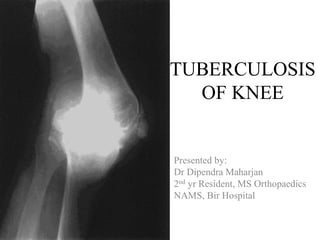
TUBERCULOSIS
OF KNEE
Presented by:
Dr Dipendra Maharjan
2nd yr Resident, MS Orthopaedics
NAMS, Bir Hospital
Introduction
• Skeletal Tuberculosis
– Ancient disease
– 2% of all Tuberculosis cases
– The most common form of skeletal TB is Pott’s
disease
– The next most common form of musculoskeletal
TB is tuberculous arthritis
• The knee joint
– the largest joint
– the largest intra-articular space
– third common site for osteoarticular tuberculosis
– accounts for nearly 10% of all skeletal tuberculous
lesions
Pathology
• Initial focus
– hematogenous dissemination in the synovium
– in the subchondral bone
– juxta-articular osseous focus.
• The synovial lesion may for many months
remain purely as tubercular synovitis.
• The synovial membrane gets congested,
edematous and studded with tubercles.
• The naked eye examination
– pinkish-blue or pinkish-gray appearance.
• The synovial lining becomes hypertrophied
and thickened with granulation tissue.
• The joint fluid in the initial stages is increased,
serous, opalescent, turbid ellowish and may
contain fibrinous flakes.
• In advanced stage of the disease
– tuberculous process becomes osteoarticular,
– the tuberculouse granulation tissue like the pannus
erodes the articular margins, destroys the bones
– involves the cruicate ligaments, periarticular
tissues, capsule and ligaments.
• In cases which start as osseous lesions, there
may be tuberculous abscess in
– subchondral bone
– epiphyseal bone
– metaphyseal region
• Abscess in the epiphyses and metaphyses may
sometimes be seen traversing the epiphyseal
cartilage plate
Clinical Features
• The onset and course is insidious
• The knee shows
– Swelling
• warm
• patellar tap is present due to synovial effusion
• the thickened synovium
– filling up all parapatellar fossa appreciated earliest
in medial parapatellar fossa.
• Tenderness is present to pressure is most
marked at the synovial reflection and along the
joint line.
• When the arthritis has set
– movements are grossly restricted,
– painful
– accompanied by muscle
• regional lymphadenopathy.
• Quadricep muscle shows gross wasting
• In the neglected case,
– triple deformity
• Once the flexion deformity established
– tensor fasciae lata exantuates the deformity.
• In long case
– Posterior capsule of the knee joint gets contracted
• synovial stage
– Generalized osteoporosis and
– increased soft tissue swelling caused by
• synovial effusion,
• thickened synovium and capsule.
• As the arthritis sets
– loss of definition of articular surfaces,
– marginal erosions,
– diminution of the joint space and
– destruction of the bones forming the joint.
Roentgonograms
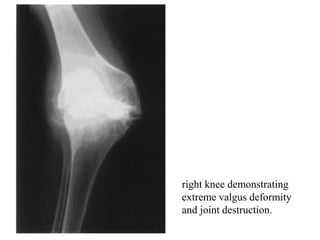
• In advance stage,
– gross destruction and deformation of bone ends,
– osteolytic cavities,
– tubercular sequestra and
– triple deformity may be seen
right knee demonstrating
extreme valgus deformity
and joint destruction.
Differential Diagnosis
• Monoarticular affections
– rheumatic arthritis (in children)
– chronic traumatic synovitis due to chronic internal derangement of knee
(e.g.
• meniscal tears, loose bodies,
• osteochondritis dissecans,
• chondromalaciapatellae,
• discoid semilunar cartilage etc)
• Rheumatoid arthritis (in adults),
• subacute pyogenic arthritis/synovitis,
• hemarthrosis,
• dysenteric arthritis,
• villonodular synovitis,
• synovial chondromatosus,
• synovioma,
• foreign body granuloma.
Prognosis
• lee et al 1995, Hoffman et al 2002
– With the modern methods of management the
functional results are directly related to the extent
of disease at the onset of antitubercular drugs
• In the stage of synovitis,
– non operative or operative
– complete healing
– excellent range of movements.
In advance arthritis with subluxation
severe restriction of motion is
inevitable,
arthrodesis (in adults) in functioning
position (5 to 10 degree of flexion) is
one of the option of treatment.
Treatment
• Non operative treatment with antitubercular drugs
is employed in
– tubercular synovitis
– children.
• Traction is applied to
– prevent (for correct) flexion and subluxation deformity
and to
– keep the joint surfaces distracted.
• In addition to the systemic drugs, the joint may
be aspirated
• With the quiescence of acute local signs, gently active
and assisted knee bending should be.
•
• Usually after 12 weeks of treatment the patient may be
permitted ambulation with suitable orthosis and
crutches.
• After 6 to 12 months of treatment, in cases with
favorable response, the crutches or orthosis may be
discarded.
• Unprotected weight bearing is usually permitted 9 to 12
months after the start of treatment.
• In children with arthritis the deformity and
subluxation is corrected/minimized by
– employing double traction or
– rarely by corrective plasters.
• Arthrodesis of the grossly destroyed knee in
children should be deferred till the completion
of growth potentioal fo the distal femur and
proximal tibia.
Operative Treatment
• In the synovial stage
– arthrotomy and synovectomy should be carried out.
• In early arthritis,
– synovectomy,
– removal of loose/rice bodies, debris, pannus, loose articular
cartilage and
– careful curettage of osseous juxtaarticular foci
• Postoperatively triple drug therapy,
– traction,
– intermittent active and assisted exercises,
– suitable brace ambulation should be continued
• In adults with advanced arthritis or in cases which
resulted in painful fibrous ankylosis during the process
of healing, the knee joint may be treated by arthrodesis.
• This option provides
– painless stable knee,
– prevents recrudescence,
– corrects deformity and the
– patients can do long hours of standing and walking.
However it imposes a lot of restrictions in sitting, using
public transport and many other social activities.
Arthroplasty
• Besser (1980), wray and roy (1987) performed
arthroplasty inadvertently in the preoperatively
unsuspected cases of tuberculosis of the knee.
• Kim(1988) reported good results after total knee
arthroplasty in selected cases of old healed
tuberculosis of knee.
• Gale and harding (1991) reported a short term
result of total knee arthroplasty in the presence of
active disease.
• Indication for arthroplasty for a healed disease may be
more justified for the knee than for any other joint
• At present replacement arthroplasty of knee is being
offered to selected patients. Most of the authors suggest
this operation at least 5 to 10 years after the last
evidence of activity of infection (Eskola et al 1988, kim
1988, gale and harding 1991)
• Mandatory coverage by modern antitubercular drugs
for about 5 months after replacement surgery is
advised.
Thank You!
References
• Tuberculosis of skeletal system by M.S. Tuli

Tuberculosis of knee

  • 1.
    TUBERCULOSIS OF KNEE Presented by: DrDipendra Maharjan 2nd yr Resident, MS Orthopaedics NAMS, Bir Hospital
  • 2.
    Introduction • Skeletal Tuberculosis –Ancient disease – 2% of all Tuberculosis cases – The most common form of skeletal TB is Pott’s disease – The next most common form of musculoskeletal TB is tuberculous arthritis
  • 3.
    • The kneejoint – the largest joint – the largest intra-articular space – third common site for osteoarticular tuberculosis – accounts for nearly 10% of all skeletal tuberculous lesions
  • 4.
    Pathology • Initial focus –hematogenous dissemination in the synovium – in the subchondral bone – juxta-articular osseous focus. • The synovial lesion may for many months remain purely as tubercular synovitis. • The synovial membrane gets congested, edematous and studded with tubercles.
  • 5.
    • The nakedeye examination – pinkish-blue or pinkish-gray appearance. • The synovial lining becomes hypertrophied and thickened with granulation tissue. • The joint fluid in the initial stages is increased, serous, opalescent, turbid ellowish and may contain fibrinous flakes.
  • 6.
    • In advancedstage of the disease – tuberculous process becomes osteoarticular, – the tuberculouse granulation tissue like the pannus erodes the articular margins, destroys the bones – involves the cruicate ligaments, periarticular tissues, capsule and ligaments.
  • 7.
    • In caseswhich start as osseous lesions, there may be tuberculous abscess in – subchondral bone – epiphyseal bone – metaphyseal region • Abscess in the epiphyses and metaphyses may sometimes be seen traversing the epiphyseal cartilage plate
  • 8.
    Clinical Features • Theonset and course is insidious • The knee shows – Swelling • warm • patellar tap is present due to synovial effusion • the thickened synovium – filling up all parapatellar fossa appreciated earliest in medial parapatellar fossa.
  • 9.
    • Tenderness ispresent to pressure is most marked at the synovial reflection and along the joint line. • When the arthritis has set – movements are grossly restricted, – painful – accompanied by muscle • regional lymphadenopathy.
  • 10.
    • Quadricep muscleshows gross wasting • In the neglected case, – triple deformity • Once the flexion deformity established – tensor fasciae lata exantuates the deformity. • In long case – Posterior capsule of the knee joint gets contracted
  • 11.
    • synovial stage –Generalized osteoporosis and – increased soft tissue swelling caused by • synovial effusion, • thickened synovium and capsule. • As the arthritis sets – loss of definition of articular surfaces, – marginal erosions, – diminution of the joint space and – destruction of the bones forming the joint. Roentgonograms
  • 12.
    • In advancestage, – gross destruction and deformation of bone ends, – osteolytic cavities, – tubercular sequestra and – triple deformity may be seen
  • 13.
    right knee demonstrating extremevalgus deformity and joint destruction.
  • 14.
    Differential Diagnosis • Monoarticularaffections – rheumatic arthritis (in children) – chronic traumatic synovitis due to chronic internal derangement of knee (e.g. • meniscal tears, loose bodies, • osteochondritis dissecans, • chondromalaciapatellae, • discoid semilunar cartilage etc) • Rheumatoid arthritis (in adults), • subacute pyogenic arthritis/synovitis, • hemarthrosis, • dysenteric arthritis, • villonodular synovitis, • synovial chondromatosus, • synovioma, • foreign body granuloma.
  • 15.
    Prognosis • lee etal 1995, Hoffman et al 2002 – With the modern methods of management the functional results are directly related to the extent of disease at the onset of antitubercular drugs • In the stage of synovitis, – non operative or operative – complete healing – excellent range of movements.
  • 16.
    In advance arthritiswith subluxation severe restriction of motion is inevitable, arthrodesis (in adults) in functioning position (5 to 10 degree of flexion) is one of the option of treatment.
  • 17.
    Treatment • Non operativetreatment with antitubercular drugs is employed in – tubercular synovitis – children. • Traction is applied to – prevent (for correct) flexion and subluxation deformity and to – keep the joint surfaces distracted. • In addition to the systemic drugs, the joint may be aspirated
  • 18.
    • With thequiescence of acute local signs, gently active and assisted knee bending should be. • • Usually after 12 weeks of treatment the patient may be permitted ambulation with suitable orthosis and crutches. • After 6 to 12 months of treatment, in cases with favorable response, the crutches or orthosis may be discarded. • Unprotected weight bearing is usually permitted 9 to 12 months after the start of treatment.
  • 19.
    • In childrenwith arthritis the deformity and subluxation is corrected/minimized by – employing double traction or – rarely by corrective plasters. • Arthrodesis of the grossly destroyed knee in children should be deferred till the completion of growth potentioal fo the distal femur and proximal tibia.
  • 20.
    Operative Treatment • Inthe synovial stage – arthrotomy and synovectomy should be carried out. • In early arthritis, – synovectomy, – removal of loose/rice bodies, debris, pannus, loose articular cartilage and – careful curettage of osseous juxtaarticular foci • Postoperatively triple drug therapy, – traction, – intermittent active and assisted exercises, – suitable brace ambulation should be continued
  • 21.
    • In adultswith advanced arthritis or in cases which resulted in painful fibrous ankylosis during the process of healing, the knee joint may be treated by arthrodesis. • This option provides – painless stable knee, – prevents recrudescence, – corrects deformity and the – patients can do long hours of standing and walking. However it imposes a lot of restrictions in sitting, using public transport and many other social activities.
  • 22.
    Arthroplasty • Besser (1980),wray and roy (1987) performed arthroplasty inadvertently in the preoperatively unsuspected cases of tuberculosis of the knee. • Kim(1988) reported good results after total knee arthroplasty in selected cases of old healed tuberculosis of knee. • Gale and harding (1991) reported a short term result of total knee arthroplasty in the presence of active disease.
  • 23.
    • Indication forarthroplasty for a healed disease may be more justified for the knee than for any other joint • At present replacement arthroplasty of knee is being offered to selected patients. Most of the authors suggest this operation at least 5 to 10 years after the last evidence of activity of infection (Eskola et al 1988, kim 1988, gale and harding 1991) • Mandatory coverage by modern antitubercular drugs for about 5 months after replacement surgery is advised.
  • 24.
  • 25.
    References • Tuberculosis ofskeletal system by M.S. Tuli

Editor's Notes

  • #8 The pannus may erode the margins of the articular cartilage, grow between the articular cartilage and the subchondral bone thus detaching the cartilage from the bone and may grow over the articular cartilage as a sheet of granulation tissue.
  • #9 the metaphyseal region usually in children leading to various degree of destruction of bone. Abscess in the epiphyses and metaphyses may sometimes be seen traversing the epiphyseal cartilage plate giving an appearance of la lesion sitting astride the physis.
  • #10 The onset and course is insidious without usual systemic and local feature of tuberculous disease. The knee shows swelling, filling up all parapatellar fossar appreciated earliest in medial parapatellar fossa, suprapatellar pouch and even popliteal fossa. The swelling is warm, patellar tap is present if the swelling is predominantly due to the synovial effusion, the thickened synovium gives a boggy (doughy or semielastic) feel and can be rolled between the fingers and the underlying femur. It is best palpated on the medial side of the knee because vastus medialis remains muscular up to its insertion to patella and gets wasted early.
  • #11 Tenderness is present to pressure is most marked at the synovial reflection and aling the joint line. In the synovial disease, for a long time, there may only terminal restriction of movements. When the arthritis has set in the movements are grossly restricted, painful and accompanied by muscle spasm (particularly of hamstring) Quadricep muscle shows gross wasting regional lymphadenopathy.
  • #23 In the synovial stage if the disease is not responding favorably or the diagnosis is uncertain even after semi-invasive procedure arthrotomy and synovectomy should be carried out. In early arthritis, in addition to synovectomy removal of losse/rice bodies, debris, pannus, loose articular cartilage and carefyl curettage of osseous juxtaarticular foci should be carried out. Postoperatively triple drug therapy, traction, intermitten active and assisted exercises, suitable brace abmbulation should be continued
  • #24 In adults with advanced arthritis or in cases which resulted in painful fibrous ankylosis during the process of healing, the knee joint may be treated by arthrodesis. This option provides a painless stable knee, prevents recrudexcence, corrects deformity and the patients can do long hours of standing and walking. However it imposes a lot of restrictions in sitting, using public transport and many other social activities.