 Presented to :
Dr Munazza Ambreen
 Presented by:
Shams ud din
INDIVIDUALIZED INSRTUCATION;
BASIS FOR DEALING WITH
INDIVIDUAL DIFFERENCES
 Individualized instruction is a method
of instruction in which content, instructional
technology (such as materials) and pace
of learning are based upon the abilities and
interests of each individual learner.
 One to one instruction to meet the particular
student’s needs
CONT……….
Individualized instruction involves
promoting student choice, curriculum
integration, differentiated learning,
and self-assessment that engage
students deeply in learning.
(Brown, 2002).
CONT………
Individual method provides for an
individual child, facilities of
instructions, keeping in view his
need, intelligence, and motivation
,rate of learning, capacity and aim
of life.
It would bring confidence, self
respect and self-reliance in
children.
CHARACTERISTICS
 It is a method of individualized instruction
 Instructional material is logically sequenced
 It has adequate provision for feed-back
 Interaction between the learner and the learning
material is very important
 Provides self-pacing to the learner
 Provides continuous evaluation
INDIVIDUAL DIFFERENCE
INTRODUCTION
The psychology of individual
differences is concerned with the
systematic study of intelligence and
abilities associated with personality of
learner, learning styles and needs
and interests of learner
It is these differences that are entitled
as ‘individual differences” in the
languages of sociology and
psychology.
CONTI…
 Learning is most effective when differences
in learner’s language, cultural, and social
behaviour are taken into account.
 A teacher should be sensitive to individual
differences.
 A teacher’s challenge is to acknowledge
and celebrate the differences among
children and work to maximize the growth in
each child Authentic
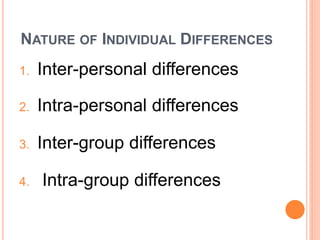
NATURE OF INDIVIDUAL DIFFERENCES
1. Inter-personal differences
2. Intra-personal differences
3. Inter-group differences
4. Intra-group differences
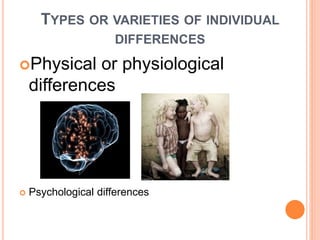
TYPES OR VARIETIES OF INDIVIDUAL
DIFFERENCES
Physical or physiological
differences
 Psychological differences
COOPERATIVE LEARNING
. Cooperative learning is an
instructional strategy in which
students are placed in
heterogeneous groups. In my
opinion, cooperative learning is one
of the best researched educational
innovations of the last two decades.
When implemented properly, it can
have dramatic effects on student
achievement.
LEARNING-STYLES
 “Even the slowest and more reluctant reader can learn to
read well when taught according to their individual
learning styles”
(Mariacarbo,2003)
 According to this learners differ in their styles of
learning, those styles are assessed and that knowledge of
styles help both learner and teacher.
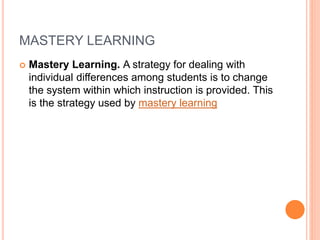
MASTERY LEARNING
 Mastery Learning. A strategy for dealing with
individual differences among students is to change
the system within which instruction is provided. This
is the strategy used by mastery learning
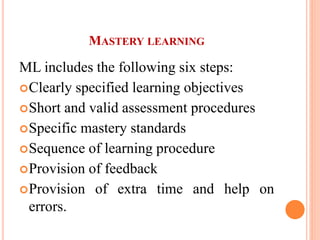
MASTERY LEARNING
ML includes the following six steps:
Clearly specified learning objectives
Short and valid assessment procedures
Specific mastery standards
Sequence of learning procedure
Provision of feedback
Provision of extra time and help on
errors.
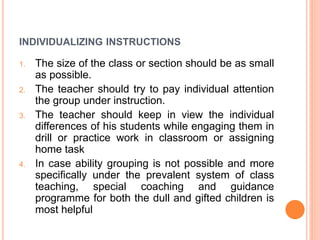
INDIVIDUALIZING INSTRUCTIONS
1. The size of the class or section should be as small
as possible.
2. The teacher should try to pay individual attention
the group under instruction.
3. The teacher should keep in view the individual
differences of his students while engaging them in
drill or practice work in classroom or assigning
home task
4. In case ability grouping is not possible and more
specifically under the prevalent system of class
teaching, special coaching and guidance
programme for both the dull and gifted children is
most helpful
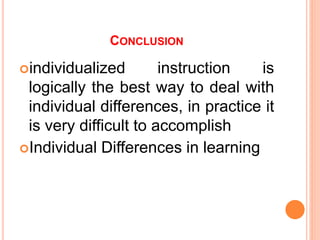
CONCLUSION
individualized instruction is
logically the best way to deal with
individual differences, in practice it
is very difficult to accomplish
Individual Differences in learning
REFERENCES
1. Abbass M, Nadeem M, Naseem Z.Module II:
LEARNER’S PSYCHOLOGY . Professional
Competency Enhancement Program for Teachers
(PCEPT). NATIONAL ACADEMY OF HIGHER
EDUCATION (NAHE). Learning Innovation Division
Higher Education Commission (HEC).Islamabad
2. Education Psychology. Canadian association. Copyright
© 2008 John Wiley & Sons Canada, Ltd.
3. Ormrod J.E. Educational psychology : Developing
learners. Fourth edition; Upper Saddle River. Merrill
Prentice Hall: 2003
4. Retrieved from
http://www.mu.ac.in/myweb_test/SYBA%20Study%20M
aterial/edu-II%20psycho.pdf on 19th November 2013.
Shams ppt 3940

Shams ppt 3940

  • 2.
     Presented to: Dr Munazza Ambreen  Presented by: Shams ud din
  • 3.
    INDIVIDUALIZED INSRTUCATION; BASIS FORDEALING WITH INDIVIDUAL DIFFERENCES
  • 4.
     Individualized instructionis a method of instruction in which content, instructional technology (such as materials) and pace of learning are based upon the abilities and interests of each individual learner.  One to one instruction to meet the particular student’s needs
  • 5.
    CONT………. Individualized instruction involves promotingstudent choice, curriculum integration, differentiated learning, and self-assessment that engage students deeply in learning. (Brown, 2002).
  • 6.
    CONT……… Individual method providesfor an individual child, facilities of instructions, keeping in view his need, intelligence, and motivation ,rate of learning, capacity and aim of life. It would bring confidence, self respect and self-reliance in children.
  • 7.
    CHARACTERISTICS  It isa method of individualized instruction  Instructional material is logically sequenced  It has adequate provision for feed-back  Interaction between the learner and the learning material is very important  Provides self-pacing to the learner  Provides continuous evaluation
  • 8.
    INDIVIDUAL DIFFERENCE INTRODUCTION The psychologyof individual differences is concerned with the systematic study of intelligence and abilities associated with personality of learner, learning styles and needs and interests of learner It is these differences that are entitled as ‘individual differences” in the languages of sociology and psychology.
  • 9.
    CONTI…  Learning ismost effective when differences in learner’s language, cultural, and social behaviour are taken into account.  A teacher should be sensitive to individual differences.  A teacher’s challenge is to acknowledge and celebrate the differences among children and work to maximize the growth in each child Authentic
  • 10.
    NATURE OF INDIVIDUALDIFFERENCES 1. Inter-personal differences 2. Intra-personal differences 3. Inter-group differences 4. Intra-group differences
  • 11.
    TYPES OR VARIETIESOF INDIVIDUAL DIFFERENCES Physical or physiological differences  Psychological differences
  • 12.
    COOPERATIVE LEARNING . Cooperativelearning is an instructional strategy in which students are placed in heterogeneous groups. In my opinion, cooperative learning is one of the best researched educational innovations of the last two decades. When implemented properly, it can have dramatic effects on student achievement.
  • 13.
    LEARNING-STYLES  “Even theslowest and more reluctant reader can learn to read well when taught according to their individual learning styles” (Mariacarbo,2003)  According to this learners differ in their styles of learning, those styles are assessed and that knowledge of styles help both learner and teacher.
  • 14.
    MASTERY LEARNING  MasteryLearning. A strategy for dealing with individual differences among students is to change the system within which instruction is provided. This is the strategy used by mastery learning
  • 15.
    MASTERY LEARNING ML includesthe following six steps: Clearly specified learning objectives Short and valid assessment procedures Specific mastery standards Sequence of learning procedure Provision of feedback Provision of extra time and help on errors.
  • 16.
    INDIVIDUALIZING INSTRUCTIONS 1. Thesize of the class or section should be as small as possible. 2. The teacher should try to pay individual attention the group under instruction. 3. The teacher should keep in view the individual differences of his students while engaging them in drill or practice work in classroom or assigning home task 4. In case ability grouping is not possible and more specifically under the prevalent system of class teaching, special coaching and guidance programme for both the dull and gifted children is most helpful
  • 17.
    CONCLUSION individualized instruction is logicallythe best way to deal with individual differences, in practice it is very difficult to accomplish Individual Differences in learning
  • 18.
    REFERENCES 1. Abbass M,Nadeem M, Naseem Z.Module II: LEARNER’S PSYCHOLOGY . Professional Competency Enhancement Program for Teachers (PCEPT). NATIONAL ACADEMY OF HIGHER EDUCATION (NAHE). Learning Innovation Division Higher Education Commission (HEC).Islamabad 2. Education Psychology. Canadian association. Copyright © 2008 John Wiley & Sons Canada, Ltd. 3. Ormrod J.E. Educational psychology : Developing learners. Fourth edition; Upper Saddle River. Merrill Prentice Hall: 2003 4. Retrieved from http://www.mu.ac.in/myweb_test/SYBA%20Study%20M aterial/edu-II%20psycho.pdf on 19th November 2013.