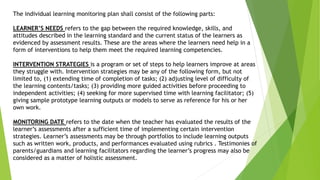
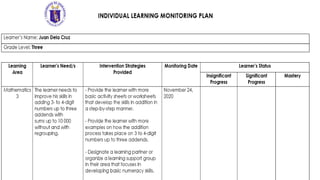
The individual learning monitoring plan shall consist of the following parts:
LEARNER’S NEEDS refers to the gap between the required knowledge, skills, and
attitudes described in the learning standard and the current status of the learners as
evidenced by assessment results. These are the areas where the learners need help in a
form of interventions to help them meet the required learning competencies.
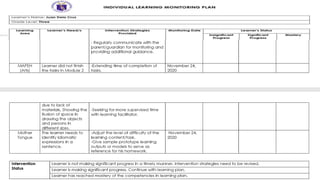
INTERVENTION STRATEGIES is a program or set of steps to help learners improve at areas
they struggle with. Intervention strategies may be any of the following form, but not
limited to, (1) extending time of completion of tasks; (2) adjusting level of difficulty of
the learning contents/tasks; (3) providing more guided activities before proceeding to
independent activities; (4) seeking for more supervised time with learning facilitator; (5)
giving sample prototype learning outputs or models to serve as reference for his or her
own work.
MONITORING DATE refers to the date when the teacher has evaluated the results of the
learner’s assessments after a sufficient time of implementing certain intervention
strategies. Learner’s assessments may be through portfolios to include learning outputs
such as written work, products, and performances evaluated using rubrics . Testimonies of
parents/guardians and learning facilitators regarding the learner’s progress may also be
considered as a matter of holistic assessment.
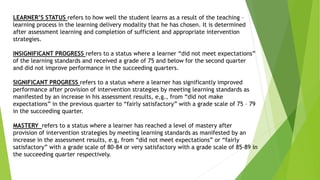
LEARNER’S STATUS refers to how well the student learns as a result of the teaching –
learning process in the learning delivery modality that he has chosen. It is determined
after assessment learning and completion of sufficient and appropriate intervention
strategies.
INSIGNIFICANT PROGRESS refers to a status where a learner “did not meet expectations”
of the learning standards and received a grade of 75 and below for the second quarter
and did not improve performance in the succeeding quarters.
SIGNIFICANT PROGRESS refers to a status where a learner has significantly improved
performance after provision of intervention strategies by meeting learning standards as
manifested by an increase in his assessment results, e,g., from “did not make
expectations” in the previous quarter to “fairly satisfactory” with a grade scale of 75 – 79
in the succeeding quarter.
MASTERY refers to a status where a learner has reached a level of mastery after
provision of intervention strategies by meeting learning standards as manifested by an
increase in the assessment results, e.g, from “did not meet expectations” or “fairly
satisfactory” with a grade scale of 80-84 or very satisfactory with a grade scale of 85-89 in
the succeeding quarter respectively.
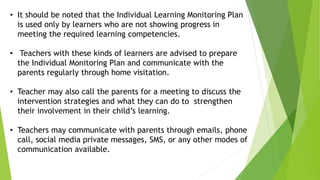
• It should be noted that the Individual Learning Monitoring Plan
is used only by learners who are not showing progress in
meeting the required learning competencies.
• Teachers with these kinds of learners are advised to prepare
the Individual Monitoring Plan and communicate with the
parents regularly through home visitation.
• Teacher may also call the parents for a meeting to discuss the
intervention strategies and what they can do to strengthen
their involvement in their child’s learning.
• Teachers may communicate with parents through emails, phone
call, social media private messages, SMS, or any other modes of
communication available.
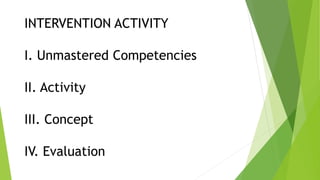
INTERVENTION ACTIVITY
I. Unmastered Competencies
II. Activity
III. Concept
IV. Evaluation

how to accomplish individual learning plan.pptx

  • 2.
    The individual learningmonitoring plan shall consist of the following parts: LEARNER’S NEEDS refers to the gap between the required knowledge, skills, and attitudes described in the learning standard and the current status of the learners as evidenced by assessment results. These are the areas where the learners need help in a form of interventions to help them meet the required learning competencies. INTERVENTION STRATEGIES is a program or set of steps to help learners improve at areas they struggle with. Intervention strategies may be any of the following form, but not limited to, (1) extending time of completion of tasks; (2) adjusting level of difficulty of the learning contents/tasks; (3) providing more guided activities before proceeding to independent activities; (4) seeking for more supervised time with learning facilitator; (5) giving sample prototype learning outputs or models to serve as reference for his or her own work. MONITORING DATE refers to the date when the teacher has evaluated the results of the learner’s assessments after a sufficient time of implementing certain intervention strategies. Learner’s assessments may be through portfolios to include learning outputs such as written work, products, and performances evaluated using rubrics . Testimonies of parents/guardians and learning facilitators regarding the learner’s progress may also be considered as a matter of holistic assessment.
  • 3.
    LEARNER’S STATUS refersto how well the student learns as a result of the teaching – learning process in the learning delivery modality that he has chosen. It is determined after assessment learning and completion of sufficient and appropriate intervention strategies. INSIGNIFICANT PROGRESS refers to a status where a learner “did not meet expectations” of the learning standards and received a grade of 75 and below for the second quarter and did not improve performance in the succeeding quarters. SIGNIFICANT PROGRESS refers to a status where a learner has significantly improved performance after provision of intervention strategies by meeting learning standards as manifested by an increase in his assessment results, e,g., from “did not make expectations” in the previous quarter to “fairly satisfactory” with a grade scale of 75 – 79 in the succeeding quarter. MASTERY refers to a status where a learner has reached a level of mastery after provision of intervention strategies by meeting learning standards as manifested by an increase in the assessment results, e.g, from “did not meet expectations” or “fairly satisfactory” with a grade scale of 80-84 or very satisfactory with a grade scale of 85-89 in the succeeding quarter respectively.
  • 4.
    • It shouldbe noted that the Individual Learning Monitoring Plan is used only by learners who are not showing progress in meeting the required learning competencies. • Teachers with these kinds of learners are advised to prepare the Individual Monitoring Plan and communicate with the parents regularly through home visitation. • Teacher may also call the parents for a meeting to discuss the intervention strategies and what they can do to strengthen their involvement in their child’s learning. • Teachers may communicate with parents through emails, phone call, social media private messages, SMS, or any other modes of communication available.
  • 9.
    INTERVENTION ACTIVITY I. UnmasteredCompetencies II. Activity III. Concept IV. Evaluation