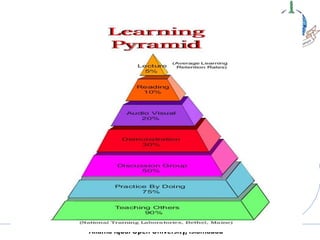
Allama Iqbal Open University, Islamabad
Elements of Effective
Teaching
Shams ud din pandrani
Mphil (Education)Scholar
shamskalati@yahoo.com
Allama Iqbal Open University, Islamabad
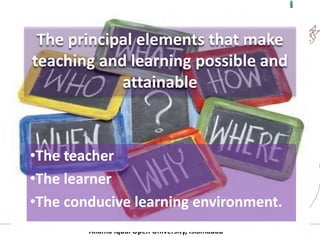
The principal elements that make
teaching and learning possible and
attainable
•The teacher
•The learner
•The conducive learning environment.
Allama Iqbal Open University, Islamabad
LEARNER-key participants in the learning process.
TEACHER-prime mover of the education wheel.
CONDUCIVE ENVIRONMENT-provides especial
features and ingredients that could make headway
and guiding processes and methodologies needed
for a smooth linkage of the elements.
Allama Iqbal Open University, Islamabad
“ Teachers, like leaves, everywhere abound.
Effective teachers, like fruits, are rarely found.”
An effective teacher is one who has honed
his skills in the art of teaching. He demonstrate
proficiency in the use of language, adopts
varied teaching strategies, recognizes change,
applies innovations, revises techniques for
optimum results, and allows himself to be
guided by acknowledged principles and
theories.
Allama Iqbal Open University, Islamabad
The Powerful Teacher
“I’ve come to a frightening
Conclusion that I am the decisive
element in the classroom. Its my
personal approach that creates the
climate. It’s my daily mood that makes
the weather. As a teacher, I possess a
tremendous power to make child’s life
miserable or joyous. I can be a tool of
torture or an instrument of inspiration.
I can humiliate or humor, hurt or heal.
In all situations it is my response that
decides whether a crisis will be escalated
or de-escalated and a child humanized
or de-humanized. Haim Ginott
Allama Iqbal Open University, Islamabad
The Teacher
“Teachers open the door. You enter by yourself.”
“The most important factor in a student’s learning
is the teacher.” William Sanders
Luzminda G. Machete
Allama Iqbal Open University, Islamabad
PERSONAL QUALITIES OF A TEACHER
• EMOTIONAL STABILITY
• DYNAMIC PERSONALITY
• INTELLIGENCE
• CREATIVITY, IMAGINATION AND RESOURCEFULNESS
• COURTESY, KINDNESS, SYMPATHY AND TACT
• PATIENCE, SINCERITY
• FIRMNESS, DISCIPLINE
• PROMPTNESS
• ABILITY TO ORGANISE
• POSITIVE AND ENCOURAGING ATTITUDE
• DEMOCRATIC LEADERSHIP
Allama Iqbal Open University, Islamabad
PROFESSIONAL QUALITIES OF A TEACHER
• SUBJECT KNOWLEDGE
• STUDENT ORIENTATION
• WIDER INTEREST/KNOWLEDGE
• SENSE OF HUMOUR
• MEMORY
• WILL POWER
• KEENNESS
• LOGICAL SEQUENCE
• SYSTEMATIC PRESENTATION
• CLEAR EXPRESSION
• RAPPORT
Allama Iqbal Open University, Islamabad
AVOIDABLE CHARACTERISTICS OF A
TEACHER
• IRRITABLE AND SHORT-TEMPERED
• OVER-CRITICAL
• SARCASTIC
• INDULGES IN SNUBBING
• DULL AND LIFELESS TEACHING
• SUSPICIOUS NATURE
• POOR DISCIPLINE
Allama Iqbal Open University, Islamabad
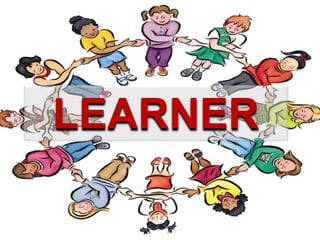
LEARNER
Allama Iqbal Open University, Islamabad
“NATURE OF LEARNER”
(KELLY, 1965)
LEARNER – is a union of sentient body and
rational soul.
His body experiences sensations and feels
pleasure & pain.
Allama Iqbal Open University, Islamabad
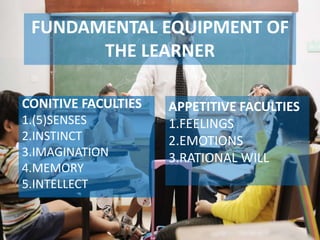
FUNDAMENTAL EQUIPMENT OF
THE LEARNER
CONITIVE FACULTIES
1.(5)SENSES
2.INSTINCT
3.IMAGINATION
4.MEMORY
5.INTELLECT
APPETITIVE FACULTIES
1.FEELINGS
2.EMOTIONS
3.RATIONAL WILL
Allama Iqbal Open University, Islamabad
FIVE DISTINGUISHING ELEMENTS
OF A LEARNER
1.ABILITY- the students native ability dictates
the prospects of success in any purposeful
activity.
Allama Iqbal Open University, Islamabad
2. APTITUDE- refers to the students innate talent or gift.
3.INTEREST- learners vary in activities that are
undertaken due to a strong appeal or attraction.
4.FAMILY & HOME BACKGROUND- students who came
from different socioeconomic background manifest a
wide range of behavior due to differences in upbringing
practices.
5.ATTITUDES-students had a unique way of thinking and
reacting.
Allama Iqbal Open University, Islamabad
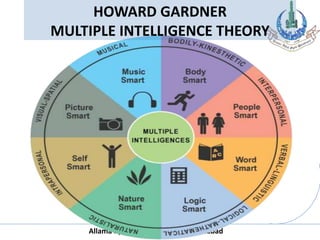
HOWARD GARDNER
MULTIPLE INTELLIGENCE THEORY
Allama Iqbal Open University, Islamabad
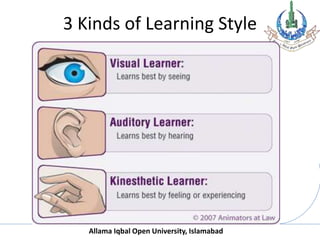
3 Kinds of Learning Style
Allama Iqbal Open University, Islamabad
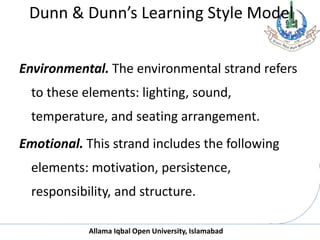
Dunn & Dunn’s Learning Style Model
Environmental. The environmental strand refers
to these elements: lighting, sound,
temperature, and seating arrangement.
Emotional. This strand includes the following
elements: motivation, persistence,
responsibility, and structure.
Allama Iqbal Open University, Islamabad
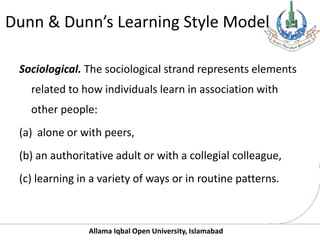
Dunn & Dunn’s Learning Style Model
Sociological. The sociological strand represents elements
related to how individuals learn in association with
other people:
(a) alone or with peers,
(b) an authoritative adult or with a collegial colleague,
(c) learning in a variety of ways or in routine patterns.

Allama Iqbal Open University, Islamabad
Physiological. The elements in this strand are:
perceptual (auditory, visual, tactile, and
kinesthetic), time-of-day energy levels, intake
(eating or not while studying) and mobility
(sitting still or moving around).
Psychological. The elements in this strand
correspond to the following types of
psychological processing: hemispheric,
impulsive or reflective, and global versus
analytic.
Allama Iqbal Open University, Islamabad
The Learning Environment
“To heredity, the child owes his possibilities.
However, to environment, he owes the
realization of these possibilities.”
Allama Iqbal Open University, Islamabad
Introduction
The learning environment is the place where teaching
and learning can take place in the most effective
and productive manner. It consists of the classroom
and all the instructional features and the non-
threatening classroom climate needed in planning and
implementing all teaching and learning activities.
Allama Iqbal Open University, Islamabad
Arrangement of Furniture
The furniture, like the table for demonstration located in front of the room
and the chairs facing it are neatly arranged with sufficient spaces in-
between for ease in moving around. Display shelves for safekeeping
of projects, collections and outstanding work are located at the sides.
Attached to the wall is the bulletin board for hanging posters,
announcements and illustrations about the unit being undertaken.
During discussions, the board in front is used for clarifying step-by-
step procedures and making clearer diagrams, illustrations and
figures.
Allama Iqbal Open University, Islamabad
cont.
Teaching devices like globes, maps and charts are kept in nearby
cabinets, together with simple tools and materials. A temporary
table is placed at the right side where supplies, materials and
handled instruments are arranged, ready for the day’s lesson.
Allama Iqbal Open University, Islamabad
Physical Condition of the Classroom
As soon as the students enter they are attracted by a clean
and orderly set-up. Natural light and flowing fresh air add
to their comfort and ease. Free from noise coming from
the surroundings, students’ concentration and interest are
easily sustained. The doors and windows could be
opened and closed with less difficulty and noise. The light
fixtures are located where needed.
Allama Iqbal Open University, Islamabad
Interactions
A diverse situation may exist in the classroom at any given time.
Students differ in abilities and interests while teachers likely
employ different strategies. Teachers must be sensitive to
positive or negative interactions and must immediately
undertake an instant revision or adjustment in the methodology
when necessary. The primary goal is to be able to motivate
them to work harmoniously, thereafter, inculcate the values of
cooperation and congeniality.
Allama Iqbal Open University, Islamabad
A Facilitative Learning Environment
Pine and Horn (1990) described the learning environment that facilitates

learning. It is an environment:
 Which encourages people to be active;
 Which promotes and facilitates the individual’s discovery of the
personal meaning of idea;
 Which emphasizes the uniquely personal and subjective nature of
learning in which difference is good and desirable;
Allama Iqbal Open University, Islamabad
 Which consistently recognizes people’s right to make mistakes;
 Which tolerates ambiguity;
 In which evaluation is a cooperative process with emphasis on self-
evaluation;
 Which encourages openness of self rather than concealment of self;
 In which people are encouraged to trust in themselves as well as in
external resources;
 In which people feel they are respected;
 In which people feel they are accepted;
 Which permits confrontation.
Allama Iqbal Open University, Islamabad
Research Findings on
Effective Teachers
Teachers with a major or minor in
content area are associated with
higher student achievement
especially in the area of science &
mathematics.
Luzminda G. Machete
Allama Iqbal Open University, Islamabad
Caring teachers who know their students
create relationships that enhance the
learning process.
Luzminda G. Machete
Allama Iqbal Open University, Islamabad
Effective teachers practice
gender, racial & ethnic fairness.
Effective teachers exude positive
attitudes about life and teaching.
Luzminda G. Machete
Allama Iqbal Open University, Islamabad
Effective teachers consistently
behave in a friendly &
personal manner while
maintaining appropriate
teacher-student role structure.
Luzminda G. Machete
Allama Iqbal Open University, Islamabad

ELEMENTS OF EFFECTIVE TEACHING.pptx

  • 1.
    Allama Iqbal OpenUniversity, Islamabad Allama Iqbal Open University, Islamabad
  • 2.
    Allama Iqbal OpenUniversity, Islamabad Allama Iqbal Open University, Islamabad Elements of Effective Teaching Shams ud din pandrani Mphil (Education)Scholar shamskalati@yahoo.com
  • 3.
    Allama Iqbal OpenUniversity, Islamabad Allama Iqbal Open University, Islamabad
  • 4.
    Allama Iqbal OpenUniversity, Islamabad The principal elements that make teaching and learning possible and attainable •The teacher •The learner •The conducive learning environment.
  • 5.
    Allama Iqbal OpenUniversity, Islamabad LEARNER-key participants in the learning process. TEACHER-prime mover of the education wheel. CONDUCIVE ENVIRONMENT-provides especial features and ingredients that could make headway and guiding processes and methodologies needed for a smooth linkage of the elements.
  • 6.
    Allama Iqbal OpenUniversity, Islamabad
  • 7.
    Allama Iqbal OpenUniversity, Islamabad “ Teachers, like leaves, everywhere abound. Effective teachers, like fruits, are rarely found.” An effective teacher is one who has honed his skills in the art of teaching. He demonstrate proficiency in the use of language, adopts varied teaching strategies, recognizes change, applies innovations, revises techniques for optimum results, and allows himself to be guided by acknowledged principles and theories.
  • 8.
    Allama Iqbal OpenUniversity, Islamabad The Powerful Teacher “I’ve come to a frightening Conclusion that I am the decisive element in the classroom. Its my personal approach that creates the climate. It’s my daily mood that makes the weather. As a teacher, I possess a tremendous power to make child’s life miserable or joyous. I can be a tool of torture or an instrument of inspiration. I can humiliate or humor, hurt or heal. In all situations it is my response that decides whether a crisis will be escalated or de-escalated and a child humanized or de-humanized. Haim Ginott
  • 9.
    Allama Iqbal OpenUniversity, Islamabad The Teacher “Teachers open the door. You enter by yourself.” “The most important factor in a student’s learning is the teacher.” William Sanders Luzminda G. Machete
  • 10.
    Allama Iqbal OpenUniversity, Islamabad PERSONAL QUALITIES OF A TEACHER • EMOTIONAL STABILITY • DYNAMIC PERSONALITY • INTELLIGENCE • CREATIVITY, IMAGINATION AND RESOURCEFULNESS • COURTESY, KINDNESS, SYMPATHY AND TACT • PATIENCE, SINCERITY • FIRMNESS, DISCIPLINE • PROMPTNESS • ABILITY TO ORGANISE • POSITIVE AND ENCOURAGING ATTITUDE • DEMOCRATIC LEADERSHIP
  • 11.
    Allama Iqbal OpenUniversity, Islamabad PROFESSIONAL QUALITIES OF A TEACHER • SUBJECT KNOWLEDGE • STUDENT ORIENTATION • WIDER INTEREST/KNOWLEDGE • SENSE OF HUMOUR • MEMORY • WILL POWER • KEENNESS • LOGICAL SEQUENCE • SYSTEMATIC PRESENTATION • CLEAR EXPRESSION • RAPPORT
  • 12.
    Allama Iqbal OpenUniversity, Islamabad AVOIDABLE CHARACTERISTICS OF A TEACHER • IRRITABLE AND SHORT-TEMPERED • OVER-CRITICAL • SARCASTIC • INDULGES IN SNUBBING • DULL AND LIFELESS TEACHING • SUSPICIOUS NATURE • POOR DISCIPLINE
  • 13.
    Allama Iqbal OpenUniversity, Islamabad LEARNER
  • 14.
    Allama Iqbal OpenUniversity, Islamabad “NATURE OF LEARNER” (KELLY, 1965) LEARNER – is a union of sentient body and rational soul. His body experiences sensations and feels pleasure & pain.
  • 15.
    Allama Iqbal OpenUniversity, Islamabad FUNDAMENTAL EQUIPMENT OF THE LEARNER CONITIVE FACULTIES 1.(5)SENSES 2.INSTINCT 3.IMAGINATION 4.MEMORY 5.INTELLECT APPETITIVE FACULTIES 1.FEELINGS 2.EMOTIONS 3.RATIONAL WILL
  • 16.
    Allama Iqbal OpenUniversity, Islamabad FIVE DISTINGUISHING ELEMENTS OF A LEARNER 1.ABILITY- the students native ability dictates the prospects of success in any purposeful activity.
  • 17.
    Allama Iqbal OpenUniversity, Islamabad 2. APTITUDE- refers to the students innate talent or gift. 3.INTEREST- learners vary in activities that are undertaken due to a strong appeal or attraction. 4.FAMILY & HOME BACKGROUND- students who came from different socioeconomic background manifest a wide range of behavior due to differences in upbringing practices. 5.ATTITUDES-students had a unique way of thinking and reacting.
  • 18.
    Allama Iqbal OpenUniversity, Islamabad HOWARD GARDNER MULTIPLE INTELLIGENCE THEORY
  • 19.
    Allama Iqbal OpenUniversity, Islamabad
  • 20.
    Allama Iqbal OpenUniversity, Islamabad 3 Kinds of Learning Style
  • 21.
    Allama Iqbal OpenUniversity, Islamabad Dunn & Dunn’s Learning Style Model Environmental. The environmental strand refers to these elements: lighting, sound, temperature, and seating arrangement. Emotional. This strand includes the following elements: motivation, persistence, responsibility, and structure.
  • 22.
    Allama Iqbal OpenUniversity, Islamabad Dunn & Dunn’s Learning Style Model Sociological. The sociological strand represents elements related to how individuals learn in association with other people: (a) alone or with peers, (b) an authoritative adult or with a collegial colleague, (c) learning in a variety of ways or in routine patterns.
  • 23.
    Allama Iqbal OpenUniversity, Islamabad Physiological. The elements in this strand are: perceptual (auditory, visual, tactile, and kinesthetic), time-of-day energy levels, intake (eating or not while studying) and mobility (sitting still or moving around). Psychological. The elements in this strand correspond to the following types of psychological processing: hemispheric, impulsive or reflective, and global versus analytic.
  • 24.
    Allama Iqbal OpenUniversity, Islamabad The Learning Environment “To heredity, the child owes his possibilities. However, to environment, he owes the realization of these possibilities.”
  • 25.
    Allama Iqbal OpenUniversity, Islamabad Introduction The learning environment is the place where teaching and learning can take place in the most effective and productive manner. It consists of the classroom and all the instructional features and the non- threatening classroom climate needed in planning and implementing all teaching and learning activities.
  • 26.
    Allama Iqbal OpenUniversity, Islamabad Arrangement of Furniture The furniture, like the table for demonstration located in front of the room and the chairs facing it are neatly arranged with sufficient spaces in- between for ease in moving around. Display shelves for safekeeping of projects, collections and outstanding work are located at the sides. Attached to the wall is the bulletin board for hanging posters, announcements and illustrations about the unit being undertaken. During discussions, the board in front is used for clarifying step-by- step procedures and making clearer diagrams, illustrations and figures.
  • 27.
    Allama Iqbal OpenUniversity, Islamabad cont. Teaching devices like globes, maps and charts are kept in nearby cabinets, together with simple tools and materials. A temporary table is placed at the right side where supplies, materials and handled instruments are arranged, ready for the day’s lesson.
  • 28.
    Allama Iqbal OpenUniversity, Islamabad Physical Condition of the Classroom As soon as the students enter they are attracted by a clean and orderly set-up. Natural light and flowing fresh air add to their comfort and ease. Free from noise coming from the surroundings, students’ concentration and interest are easily sustained. The doors and windows could be opened and closed with less difficulty and noise. The light fixtures are located where needed.
  • 29.
    Allama Iqbal OpenUniversity, Islamabad Interactions A diverse situation may exist in the classroom at any given time. Students differ in abilities and interests while teachers likely employ different strategies. Teachers must be sensitive to positive or negative interactions and must immediately undertake an instant revision or adjustment in the methodology when necessary. The primary goal is to be able to motivate them to work harmoniously, thereafter, inculcate the values of cooperation and congeniality.
  • 30.
    Allama Iqbal OpenUniversity, Islamabad A Facilitative Learning Environment Pine and Horn (1990) described the learning environment that facilitates learning. It is an environment:  Which encourages people to be active;  Which promotes and facilitates the individual’s discovery of the personal meaning of idea;  Which emphasizes the uniquely personal and subjective nature of learning in which difference is good and desirable;
  • 31.
    Allama Iqbal OpenUniversity, Islamabad  Which consistently recognizes people’s right to make mistakes;  Which tolerates ambiguity;  In which evaluation is a cooperative process with emphasis on self- evaluation;  Which encourages openness of self rather than concealment of self;  In which people are encouraged to trust in themselves as well as in external resources;  In which people feel they are respected;  In which people feel they are accepted;  Which permits confrontation.
  • 32.
    Allama Iqbal OpenUniversity, Islamabad Research Findings on Effective Teachers Teachers with a major or minor in content area are associated with higher student achievement especially in the area of science & mathematics. Luzminda G. Machete
  • 33.
    Allama Iqbal OpenUniversity, Islamabad Caring teachers who know their students create relationships that enhance the learning process. Luzminda G. Machete
  • 34.
    Allama Iqbal OpenUniversity, Islamabad Effective teachers practice gender, racial & ethnic fairness. Effective teachers exude positive attitudes about life and teaching. Luzminda G. Machete
  • 35.
    Allama Iqbal OpenUniversity, Islamabad Effective teachers consistently behave in a friendly & personal manner while maintaining appropriate teacher-student role structure. Luzminda G. Machete
  • 36.
    Allama Iqbal OpenUniversity, Islamabad
  • 37.
    Allama Iqbal OpenUniversity, Islamabad Allama Iqbal Open University, Islamabad
  • 38.
    Allama Iqbal OpenUniversity, Islamabad Allama Iqbal Open University, Islamabad

Editor's Notes

  • #22 The Dunn and Dunn Learning Style Model The Dunns' Learning-Style Model is complex and encompasses 5 strands of 21 elements that affect each individual's learning. Some of these elements are biological and others are developmental. Style changes over time. A summary of these elements is provided below (Dunn, 2000). -For example, some people need to study in a cool and quiet room, and others cannot focus unless they have music playing and it is warm (sound and temperature elements). -For example, some people must complete a project before they start a new one, and others work best on multiple tasks at the same time (persistence element). -For example, a number of people need to work alone when tackling a new and difficult subject, while others learn best when working with colleagues (learning alone or with peers element). -For example, many people refer to themselves as night owls or early birds because they function best at night or in the morning (time-of-day element). -The hemispheric element refers to left and right brain processing modes; the impulsive versus reflective style describes how some people leap before thinking and others scrutinize the situation before moving an inch. Global and analytic elements are unique in comparison to other elements because these two elements are made up of distinct clusters of elements found in the other four strands. The elements that determine global and analytic processing styles are: sound, light, seating arrangement, persistence, sociological preference, and intake. Global and analytic processing styles will be discussed in detail in the next section.
  • #23 The Dunn and Dunn Learning Style Model The Dunns' Learning-Style Model is complex and encompasses 5 strands of 21 elements that affect each individual's learning. Some of these elements are biological and others are developmental. Style changes over time. A summary of these elements is provided below (Dunn, 2000). -For example, some people need to study in a cool and quiet room, and others cannot focus unless they have music playing and it is warm (sound and temperature elements). -For example, some people must complete a project before they start a new one, and others work best on multiple tasks at the same time (persistence element). -For example, a number of people need to work alone when tackling a new and difficult subject, while others learn best when working with colleagues (learning alone or with peers element). -For example, many people refer to themselves as night owls or early birds because they function best at night or in the morning (time-of-day element). -The hemispheric element refers to left and right brain processing modes; the impulsive versus reflective style describes how some people leap before thinking and others scrutinize the situation before moving an inch. Global and analytic elements are unique in comparison to other elements because these two elements are made up of distinct clusters of elements found in the other four strands. The elements that determine global and analytic processing styles are: sound, light, seating arrangement, persistence, sociological preference, and intake. Global and analytic processing styles will be discussed in detail in the next section.