ALLAMA IQBAL OPEN UNIVERSITY,
ISLAMABAD
ONLINE WORKSHOP – JUL./AUG 2020
INDIVIDUAL DIFFERENCES
in
Human Development and Learning
C.C 8610 - B.Ed.
Presented by:
Ch. Muhammad Ashraf
m.ashraf0919@gmail.com
https://www.slideshare.net/RizwanDuhdra
Telegram: https://t.me/duhdra
HUMAN DEVELOPMENT AND LEARNING
2
By:Ch.M.Ashraf
https://www.slideshare.net/RizwanDuhdra
INDIVIDUAL DIFFERENCES
Objectives
After learning this unit, the learners can be able to
• Describe the meaning and nature of individual differences
• Bifurcate the areas of individual differences
• Identify the causes of individual differences
• Provide remedial measures for individual differences through
general and special educational provisions.
• take care of slow learners and finally be able to measure individual
differences through various tests and techniques.
3
By:Ch.M.Ashraf
https://www.slideshare.net/RizwanDuhdra
INDIVIDUAL DIFFERENCES
Overview
Everybody is a unique being. With respect to inclination,
interest, expertise, physique, intelligence, attitude, feelings etc. Only
the basic need of human beings are the same i.e. eating, drinking,
sleeping etc. The school should meet the needs of the students
keeping in view the unique characteristics of each learner.
4
By:Ch.M.Ashraf
https://www.slideshare.net/RizwanDuhdra
INDIVIDUAL DIFFERENCES
The Core Content of Today's Lecture
a. Meaning and nature of individual differences
b. Cases of individual differences
c. Educational provisions
d. Measurement of individual differences
5
By:Ch.M.Ashraf
https://www.slideshare.net/RizwanDuhdra
INDIVIDUAL DIFFERENCES
Meaning and Nature of Individual Differences
Individual differences means the differences found in the
individuals with respect to their abilities/capabilities and
competencies
Individual differences means differences and variations
regarding physical, mental, emotional, social including specific
inclinations that an individual passes apart from others.
6
By:Ch.M.Ashraf
https://www.slideshare.net/RizwanDuhdra
INDIVIDUAL DIFFERENCES
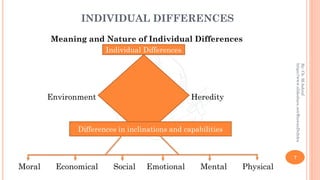
Meaning and Nature of Individual Differences
Environment Heredity
Moral Economical Social Emotional Mental Physical
7
By:Ch.M.Ashraf
https://www.slideshare.net/RizwanDuhdra
Individual Differences
Differences in inclinations and capabilities
INDIVIDUAL DIFFERENCES
Meaning and Nature of Individual Differences
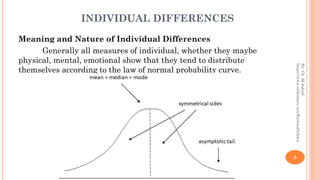
Generally all measures of individual, whether they maybe
physical, mental, emotional show that they tend to distribute
themselves according to the law of normal probability curve.
8
By:Ch.M.Ashraf
https://www.slideshare.net/RizwanDuhdra
INDIVIDUAL DIFFERENCES
Meaning and Nature of Individual Differences
This normal curve is bell shaped and bilaterally symmetrical
on each side of its central tendency, the mean. Same is the case with
percentage distribution of I.Q.
Individuals not only differ among themselves with respect to a
specific trait but differences may also be noticed within the same
individual when he is studied in respect of various traits - different
performance at different time i.e. interpersonal and intrapersonal
differences.
9
By:Ch.M.Ashraf
https://www.slideshare.net/RizwanDuhdra
INDIVIDUAL DIFFERENCES
Causes and Factors of Individual Differences
1. Heredity
2. Growth and Development
3. Environment
4. Chronological Age
10
By:Ch.M.Ashraf
https://www.slideshare.net/RizwanDuhdra
INDIVIDUAL DIFFERENCES
Causes and Factors of Individual Differences
5. Intellectual Abilities
a. Fluid Intelligence (peaks at about 25 years of age)
Here it is not necessary to undergo teaching/ learning
process
a. Crystalized Intelligence (It is concerned with teaching-learning
process)
It continuous to rise as long as a person continues to learn.
6. Primary Mental Abilities
11
By:Ch.M.Ashraf
https://www.slideshare.net/RizwanDuhdra
INDIVIDUAL DIFFERENCES
Causes and Factors of Individual Differences
Thurston’s Seven Primary Mental Abilities
12
By:Ch.M.Ashraf
https://www.slideshare.net/RizwanDuhdra
INDIVIDUAL DIFFERENCES
Causes and Factors of Individual Differences
7. Difference in Readiness for Learning
8. Difference in Motor Ability
9. Social Class Differences
13
By:Ch.M.Ashraf
https://www.slideshare.net/RizwanDuhdra
INDIVIDUAL DIFFERENCES
Galton’s Study
Galton was the first to study the possible relationship between
intelligence and heredity. To him there is a great deal of individual
variation in intelligence. These differences in mental ability were
largely inherited. He also believed that prominent men in certain
families showed greatness in the field of law, science, art and the
military.
14
By:Ch.M.Ashraf
https://www.slideshare.net/RizwanDuhdra
INDIVIDUAL DIFFERENCES
Goddard’s Study
Goddard’s study showed that the feeble-minded mother gave
rise to a high proportion of feeble-minded descendants, while the
mother with normal intelligence had no feeble children. I.Q can also
vary in case of identical twins-children with their true parents and
with that of foster parents
15
By:Ch.M.Ashraf
https://www.slideshare.net/RizwanDuhdra
INDIVIDUAL DIFFERENCES
Kimling and Jarvik’s Study: (1963)
These two scholar studied the I.Q. correlations for different blood
relations.
16
By:Ch.M.Ashraf
https://www.slideshare.net/RizwanDuhdra
INDIVIDUAL DIFFERENCES
Conclusion of Interpretations of Findings
We can say that both heredity and environment are potent
factors/ causes of individual differences in intelligence, affective and
cognitive characteristics. Intelligence is not only the result of
heredity and environmental influences and experiences. Arthur
Jensen (1969) says that intelligence is 80% inherited and genetic
elements are effective than environmental influences.
17
By:Ch.M.Ashraf
https://www.slideshare.net/RizwanDuhdra
INDIVIDUAL DIFFERENCES
Conclusion of Interpretations of Findings
We cannot forego environmental conditions that influence
intellectual development. Nutrition, health, stimulation, emotional
and intellectual climate and ECE are important determinants of
intelligence.
Therefore, a person’s intelligence is dependent upon heredity
and environment.
18
By:Ch.M.Ashraf
https://www.slideshare.net/RizwanDuhdra
INDIVIDUAL DIFFERENCES
Educational Provisions
1-Learner’s Ability and Needs Should be Assessed
(cognitive and psychomotor abilities, learning styles, quietness,
conducive learning environment, motivation, sociological aspects,
physical needs.)
2-Identification of Special Talents
3-Educational Provisions Must be Continuous
19
By:Ch.M.Ashraf
https://www.slideshare.net/RizwanDuhdra
INDIVIDUAL DIFFERENCES
Educational Provisions
4-Adequate facilities and materials
5-Competent school staff is needed
6-Individualization is necessary
(follow Parkhust's Dalton plan - House assignment and lab)
7-Need of adult education
(The parents must receive training regarding psychological needs
and nature of children)
20
By:Ch.M.Ashraf
https://www.slideshare.net/RizwanDuhdra
INDIVIDUAL DIFFERENCES
Educational Provisions
8-Special provisions for gifted / talented children
Gifted / talented children have high potential ability in any one of
the following areas
a. General intellectual ability
b. Specified academic aptitude
c. Creative, productive thinking
d. Leadership qualities
e. Visual and performing arts
f. Psychomotor skills
21
By:Ch.M.Ashraf
https://www.slideshare.net/RizwanDuhdra
INDIVIDUAL DIFFERENCES
Educating The Gifted Children
Special techniques for educating the gifted students
a-Enrichment
(extra reading, writing material, library, lab activities)
b-Acceleration
(Completion of programs, courses, activities, experiences in
less time)
c-Ability Grouping
(Gifted children must be identified and grouped together in a
special class so that the curriculum and methodology /teaching
techniques may be designed to meet their requirements) 22
By:Ch.M.Ashraf
https://www.slideshare.net/RizwanDuhdra
INDIVIDUAL DIFFERENCES
Provision for The Slow Learners
The students having I.Q below 90 are considered slow learners
and those who have I.Q below 80% are usually classified as retarded
children.
 Identifying the slow learners
 Periodic medical examination
 learning handicaps in exceptional children
 Placement with a teacher
 Avoid competition
 Remedial teaching
 Not to be branded as a failure/non-learner
23
By:Ch.M.Ashraf
https://www.slideshare.net/RizwanDuhdra
INDIVIDUAL DIFFERENCES
A Disadvantaged Child
(Economically, socially, culturally, intellectually, linguistically
disadvantaged child)
24
By:Ch.M.Ashraf
https://www.slideshare.net/RizwanDuhdra
INDIVIDUAL DIFFERENCES
Program for The Disadvantaged Children
a. Preventive program for health, nutrition and care
b. Preparatory and preschool education programs
c. Educational reforms for adapting curriculum, school, teaching
methods and textbooks
d. Parent education and functional literacy programme
e. Social and welfare programs for adolescence/ youth / families and
communities.
25
By:Ch.M.Ashraf
https://www.slideshare.net/RizwanDuhdra
HUMAN DEVELOPMENT AND LEARNING
THEORIES REGARDING INTELLECTUAL DEVELOPMENT
26
By:Ch.M.Ashraf
https://www.slideshare.net/RizwanDuhdra

INDIVIDUAL DIFFERENCES

  • 1.
    ALLAMA IQBAL OPENUNIVERSITY, ISLAMABAD ONLINE WORKSHOP – JUL./AUG 2020 INDIVIDUAL DIFFERENCES in Human Development and Learning C.C 8610 - B.Ed. Presented by: Ch. Muhammad Ashraf m.ashraf0919@gmail.com https://www.slideshare.net/RizwanDuhdra Telegram: https://t.me/duhdra
  • 2.
    HUMAN DEVELOPMENT ANDLEARNING 2 By:Ch.M.Ashraf https://www.slideshare.net/RizwanDuhdra INDIVIDUAL DIFFERENCES
  • 3.
    INDIVIDUAL DIFFERENCES Objectives After learningthis unit, the learners can be able to • Describe the meaning and nature of individual differences • Bifurcate the areas of individual differences • Identify the causes of individual differences • Provide remedial measures for individual differences through general and special educational provisions. • take care of slow learners and finally be able to measure individual differences through various tests and techniques. 3 By:Ch.M.Ashraf https://www.slideshare.net/RizwanDuhdra
  • 4.
    INDIVIDUAL DIFFERENCES Overview Everybody isa unique being. With respect to inclination, interest, expertise, physique, intelligence, attitude, feelings etc. Only the basic need of human beings are the same i.e. eating, drinking, sleeping etc. The school should meet the needs of the students keeping in view the unique characteristics of each learner. 4 By:Ch.M.Ashraf https://www.slideshare.net/RizwanDuhdra
  • 5.
    INDIVIDUAL DIFFERENCES The CoreContent of Today's Lecture a. Meaning and nature of individual differences b. Cases of individual differences c. Educational provisions d. Measurement of individual differences 5 By:Ch.M.Ashraf https://www.slideshare.net/RizwanDuhdra
  • 6.
    INDIVIDUAL DIFFERENCES Meaning andNature of Individual Differences Individual differences means the differences found in the individuals with respect to their abilities/capabilities and competencies Individual differences means differences and variations regarding physical, mental, emotional, social including specific inclinations that an individual passes apart from others. 6 By:Ch.M.Ashraf https://www.slideshare.net/RizwanDuhdra
  • 7.
    INDIVIDUAL DIFFERENCES Meaning andNature of Individual Differences Environment Heredity Moral Economical Social Emotional Mental Physical 7 By:Ch.M.Ashraf https://www.slideshare.net/RizwanDuhdra Individual Differences Differences in inclinations and capabilities
  • 8.
    INDIVIDUAL DIFFERENCES Meaning andNature of Individual Differences Generally all measures of individual, whether they maybe physical, mental, emotional show that they tend to distribute themselves according to the law of normal probability curve. 8 By:Ch.M.Ashraf https://www.slideshare.net/RizwanDuhdra
  • 9.
    INDIVIDUAL DIFFERENCES Meaning andNature of Individual Differences This normal curve is bell shaped and bilaterally symmetrical on each side of its central tendency, the mean. Same is the case with percentage distribution of I.Q. Individuals not only differ among themselves with respect to a specific trait but differences may also be noticed within the same individual when he is studied in respect of various traits - different performance at different time i.e. interpersonal and intrapersonal differences. 9 By:Ch.M.Ashraf https://www.slideshare.net/RizwanDuhdra
  • 10.
    INDIVIDUAL DIFFERENCES Causes andFactors of Individual Differences 1. Heredity 2. Growth and Development 3. Environment 4. Chronological Age 10 By:Ch.M.Ashraf https://www.slideshare.net/RizwanDuhdra
  • 11.
    INDIVIDUAL DIFFERENCES Causes andFactors of Individual Differences 5. Intellectual Abilities a. Fluid Intelligence (peaks at about 25 years of age) Here it is not necessary to undergo teaching/ learning process a. Crystalized Intelligence (It is concerned with teaching-learning process) It continuous to rise as long as a person continues to learn. 6. Primary Mental Abilities 11 By:Ch.M.Ashraf https://www.slideshare.net/RizwanDuhdra
  • 12.
    INDIVIDUAL DIFFERENCES Causes andFactors of Individual Differences Thurston’s Seven Primary Mental Abilities 12 By:Ch.M.Ashraf https://www.slideshare.net/RizwanDuhdra
  • 13.
    INDIVIDUAL DIFFERENCES Causes andFactors of Individual Differences 7. Difference in Readiness for Learning 8. Difference in Motor Ability 9. Social Class Differences 13 By:Ch.M.Ashraf https://www.slideshare.net/RizwanDuhdra
  • 14.
    INDIVIDUAL DIFFERENCES Galton’s Study Galtonwas the first to study the possible relationship between intelligence and heredity. To him there is a great deal of individual variation in intelligence. These differences in mental ability were largely inherited. He also believed that prominent men in certain families showed greatness in the field of law, science, art and the military. 14 By:Ch.M.Ashraf https://www.slideshare.net/RizwanDuhdra
  • 15.
    INDIVIDUAL DIFFERENCES Goddard’s Study Goddard’sstudy showed that the feeble-minded mother gave rise to a high proportion of feeble-minded descendants, while the mother with normal intelligence had no feeble children. I.Q can also vary in case of identical twins-children with their true parents and with that of foster parents 15 By:Ch.M.Ashraf https://www.slideshare.net/RizwanDuhdra
  • 16.
    INDIVIDUAL DIFFERENCES Kimling andJarvik’s Study: (1963) These two scholar studied the I.Q. correlations for different blood relations. 16 By:Ch.M.Ashraf https://www.slideshare.net/RizwanDuhdra
  • 17.
    INDIVIDUAL DIFFERENCES Conclusion ofInterpretations of Findings We can say that both heredity and environment are potent factors/ causes of individual differences in intelligence, affective and cognitive characteristics. Intelligence is not only the result of heredity and environmental influences and experiences. Arthur Jensen (1969) says that intelligence is 80% inherited and genetic elements are effective than environmental influences. 17 By:Ch.M.Ashraf https://www.slideshare.net/RizwanDuhdra
  • 18.
    INDIVIDUAL DIFFERENCES Conclusion ofInterpretations of Findings We cannot forego environmental conditions that influence intellectual development. Nutrition, health, stimulation, emotional and intellectual climate and ECE are important determinants of intelligence. Therefore, a person’s intelligence is dependent upon heredity and environment. 18 By:Ch.M.Ashraf https://www.slideshare.net/RizwanDuhdra
  • 19.
    INDIVIDUAL DIFFERENCES Educational Provisions 1-Learner’sAbility and Needs Should be Assessed (cognitive and psychomotor abilities, learning styles, quietness, conducive learning environment, motivation, sociological aspects, physical needs.) 2-Identification of Special Talents 3-Educational Provisions Must be Continuous 19 By:Ch.M.Ashraf https://www.slideshare.net/RizwanDuhdra
  • 20.
    INDIVIDUAL DIFFERENCES Educational Provisions 4-Adequatefacilities and materials 5-Competent school staff is needed 6-Individualization is necessary (follow Parkhust's Dalton plan - House assignment and lab) 7-Need of adult education (The parents must receive training regarding psychological needs and nature of children) 20 By:Ch.M.Ashraf https://www.slideshare.net/RizwanDuhdra
  • 21.
    INDIVIDUAL DIFFERENCES Educational Provisions 8-Specialprovisions for gifted / talented children Gifted / talented children have high potential ability in any one of the following areas a. General intellectual ability b. Specified academic aptitude c. Creative, productive thinking d. Leadership qualities e. Visual and performing arts f. Psychomotor skills 21 By:Ch.M.Ashraf https://www.slideshare.net/RizwanDuhdra
  • 22.
    INDIVIDUAL DIFFERENCES Educating TheGifted Children Special techniques for educating the gifted students a-Enrichment (extra reading, writing material, library, lab activities) b-Acceleration (Completion of programs, courses, activities, experiences in less time) c-Ability Grouping (Gifted children must be identified and grouped together in a special class so that the curriculum and methodology /teaching techniques may be designed to meet their requirements) 22 By:Ch.M.Ashraf https://www.slideshare.net/RizwanDuhdra
  • 23.
    INDIVIDUAL DIFFERENCES Provision forThe Slow Learners The students having I.Q below 90 are considered slow learners and those who have I.Q below 80% are usually classified as retarded children.  Identifying the slow learners  Periodic medical examination  learning handicaps in exceptional children  Placement with a teacher  Avoid competition  Remedial teaching  Not to be branded as a failure/non-learner 23 By:Ch.M.Ashraf https://www.slideshare.net/RizwanDuhdra
  • 24.
    INDIVIDUAL DIFFERENCES A DisadvantagedChild (Economically, socially, culturally, intellectually, linguistically disadvantaged child) 24 By:Ch.M.Ashraf https://www.slideshare.net/RizwanDuhdra
  • 25.
    INDIVIDUAL DIFFERENCES Program forThe Disadvantaged Children a. Preventive program for health, nutrition and care b. Preparatory and preschool education programs c. Educational reforms for adapting curriculum, school, teaching methods and textbooks d. Parent education and functional literacy programme e. Social and welfare programs for adolescence/ youth / families and communities. 25 By:Ch.M.Ashraf https://www.slideshare.net/RizwanDuhdra
  • 26.
    HUMAN DEVELOPMENT ANDLEARNING THEORIES REGARDING INTELLECTUAL DEVELOPMENT 26 By:Ch.M.Ashraf https://www.slideshare.net/RizwanDuhdra