INDIVIDUAL LEARNING
Hendro Ariyanto 110810251003
Alfeonita Dyah M 110810251008
Eka Ardha Nareswari 110810251013
Nirwan Sukma Jati 110810251016
Muhammad Khoiruddin 110810251019
Mirza Ananta Wirawan 110810251028
MGT - X
LEARNING
Any relatively permanent change in behavior, occurs as
a result of the experience. learning has occurred when an
individual behave, react, and respond as a result of experience
with one of different ways of how to behave before.
INDIVIDUAL
The smallest unit of society-forming. In the social
sciences, individual means also the smallest part of
community groups that cannot be divided into smaller parts.
Basically, each individual has different characteristics.
Individuals who join each other to form groups or
communities. The individual will have the same
characteristics with the group where he joined.
INDIVIDUAL LEARNING
• All individuals learn- whether they do it consciously or
unconsciously. It is a fundamental requirement of existence.
• Individual learning is defined as the capacity to build
knowledge through individual reflection about external
stimuli and sources, and through the personal re-
elaboration of individual knowledge and experience in light
of interaction with others and The environment.
Prof David Merrill, asserts:
“... the social context of a learning environment may
provide support for its members, nevertheless the change in
cognitive structure and the acquisition of knowledge and skill
is and individual event.
Here, we refer individual learning in the context of
organization. In other words it implies that How an individual
learns in an organization and how is it important in an
organization”.
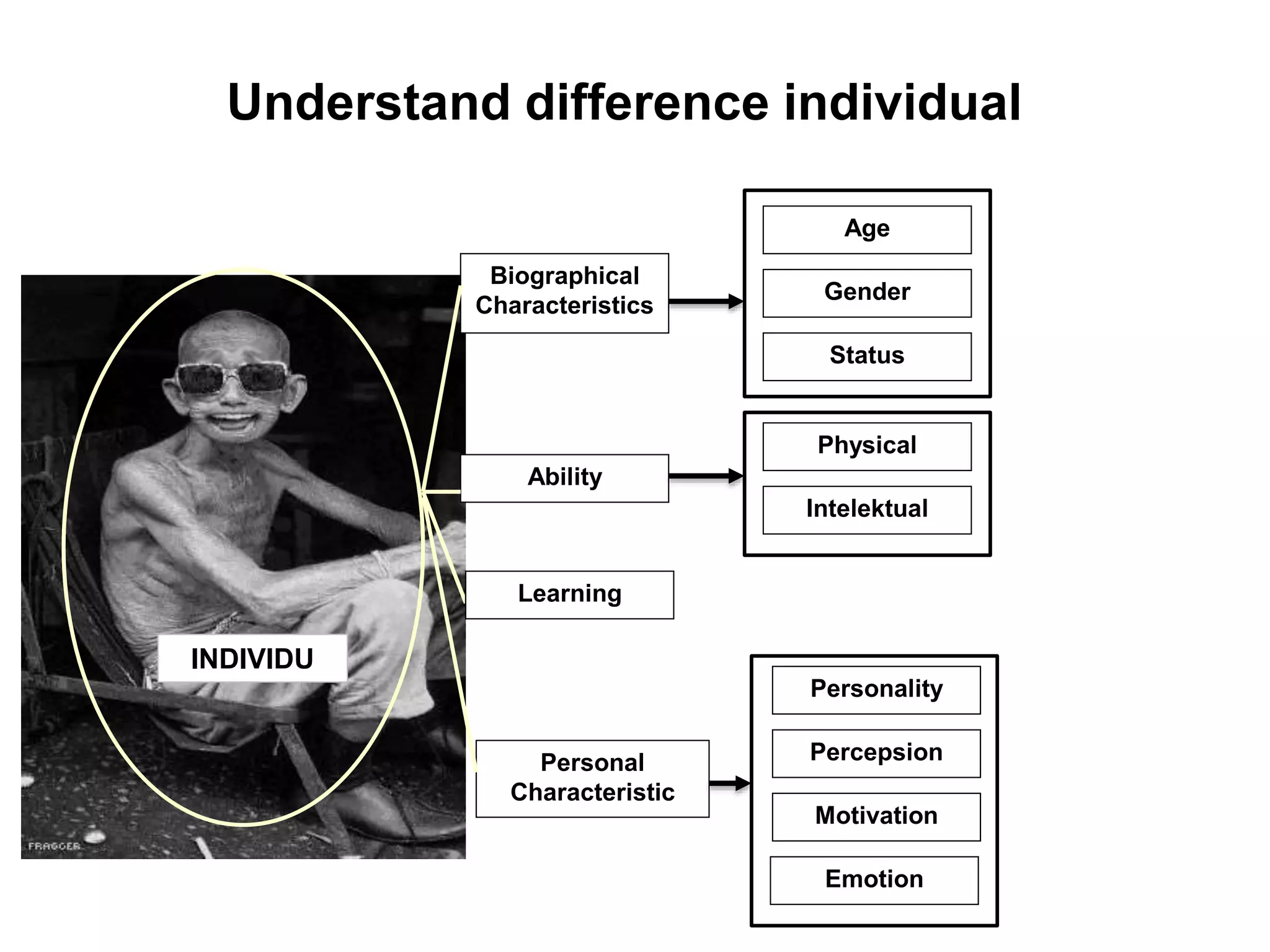
Understand difference individual
INDIVIDU
Biographical
Characteristics
Ability
Personal
Characteristic
Physical
Intelektual
Percepsion
Personality
Emotion
Age
Gender
Status
Learning
Motivation
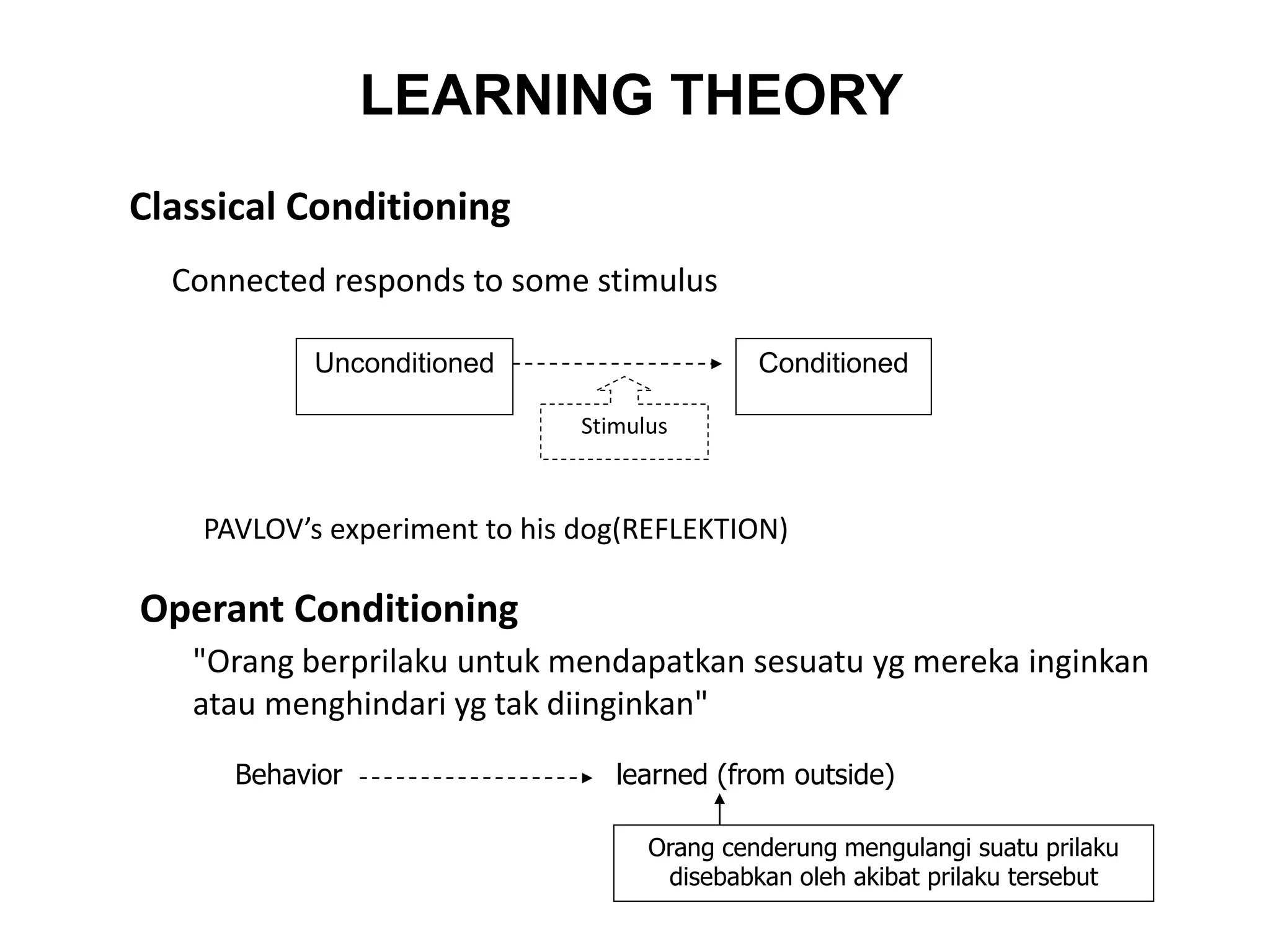
LEARNING THEORY
Connected responds to some stimulus
Classical Conditioning
Unconditioned Conditioned
Stimulus
PAVLOV’s experiment to his dog(REFLEKTION)
Operant Conditioning
"Orang berprilaku untuk mendapatkan sesuatu yg mereka inginkan
atau menghindari yg tak diinginkan"
Orang cenderung mengulangi suatu prilaku
disebabkan oleh akibat prilaku tersebut
Behavior learned (from outside)
Biographical Characteristics
Personal characteristics — such as age, gender,
and marital status — that are objective and easily obtained
from personnel records.
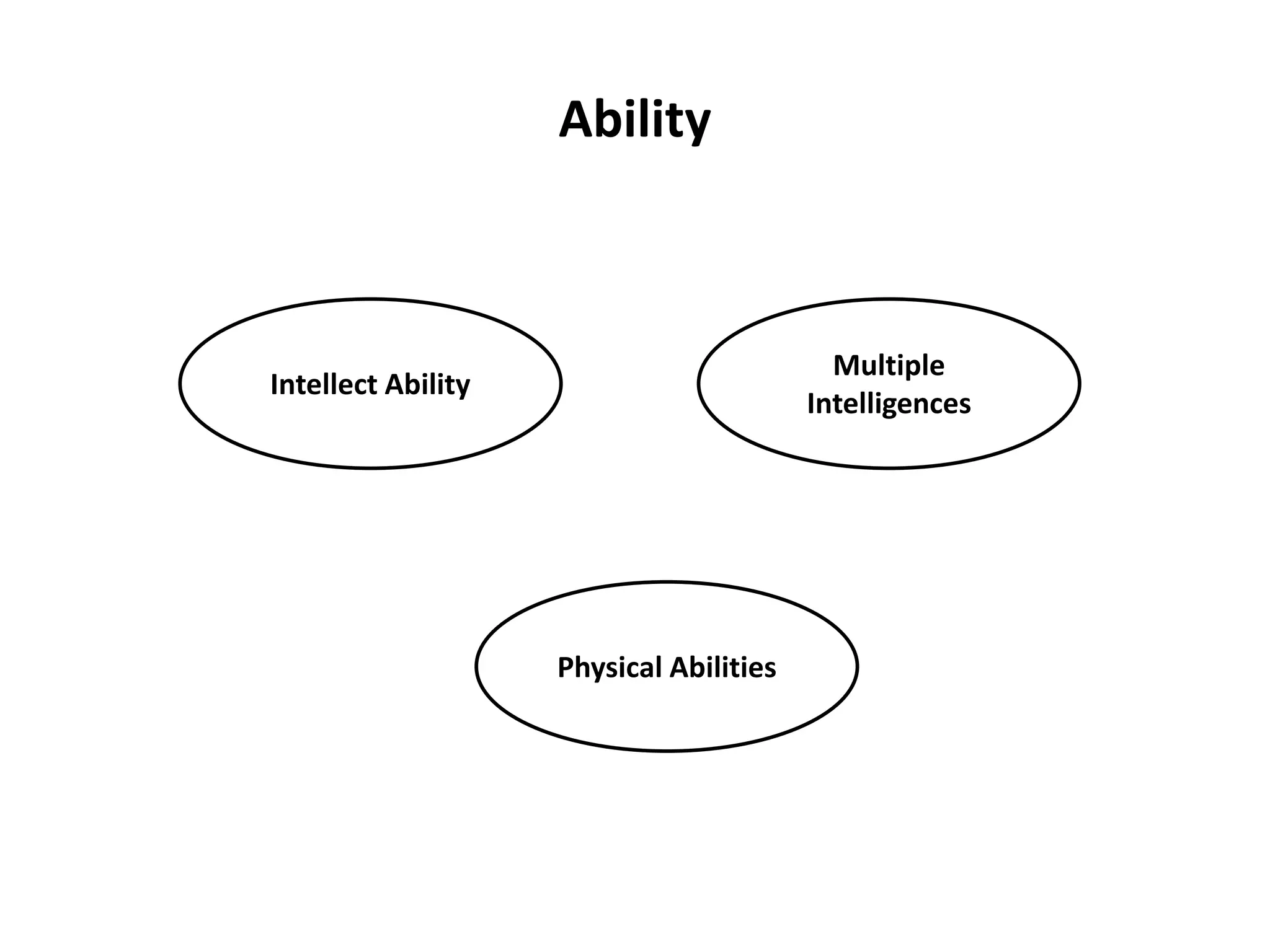
Ability
Intellect Ability
Physical Abilities
Multiple
Intelligences
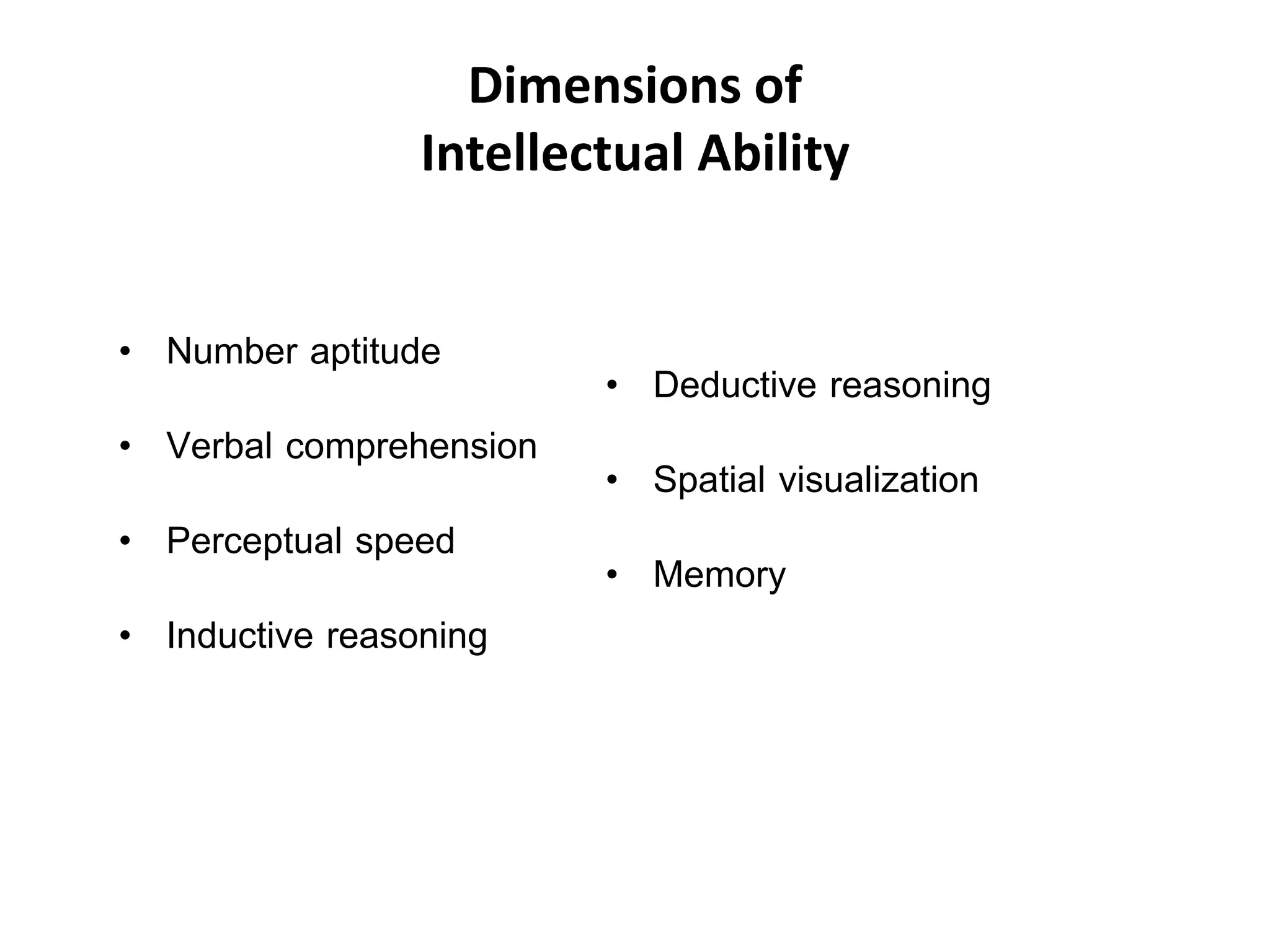
Dimensions of
Intellectual Ability
• Number aptitude
• Verbal comprehension
• Perceptual speed
• Inductive reasoning
• Deductive reasoning
• Spatial visualization
• Memory
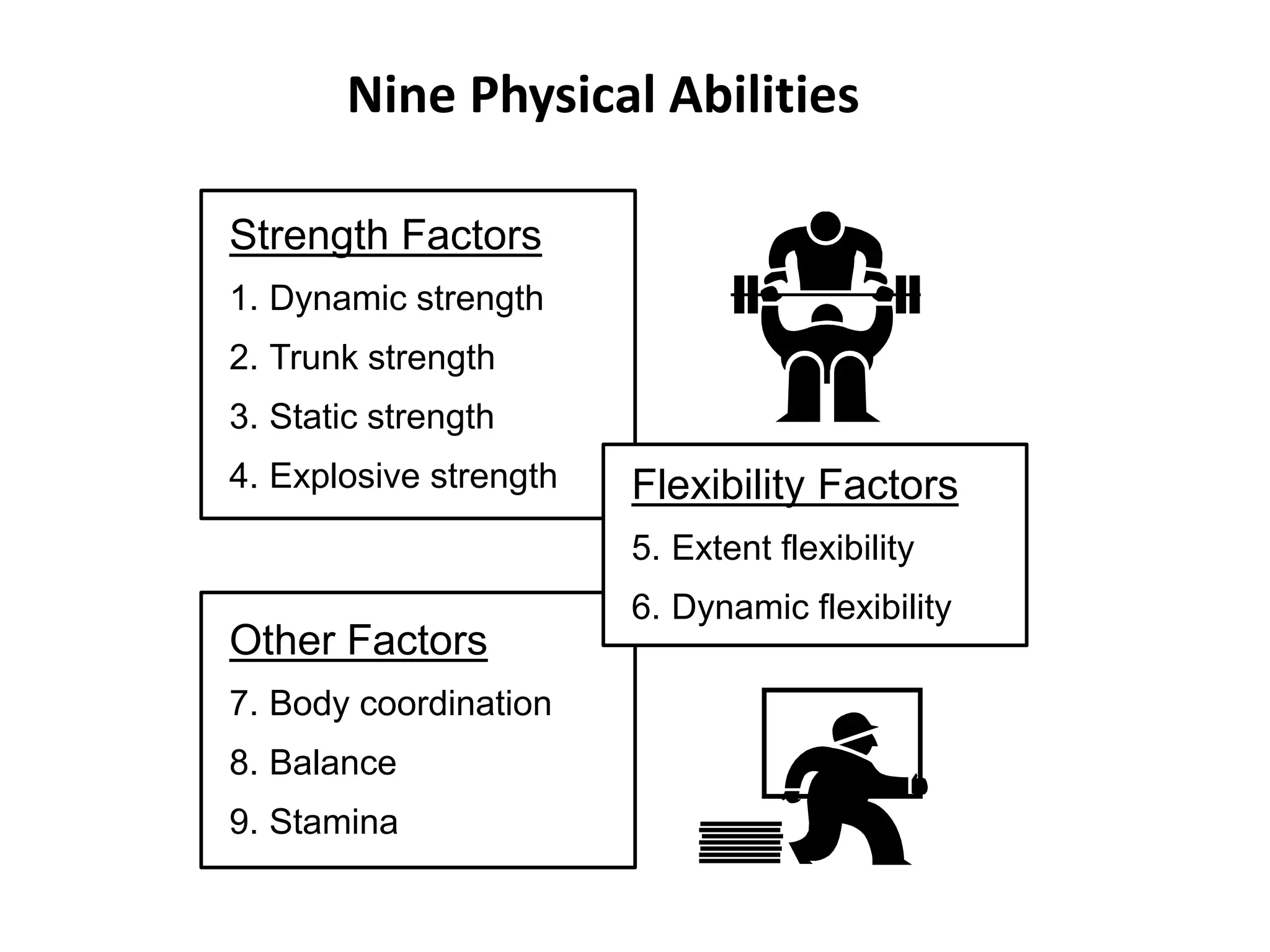
Nine Physical Abilities
Other Factors
7. Body coordination
8. Balance
9. Stamina
Strength Factors
1. Dynamic strength
2. Trunk strength
3. Static strength
4. Explosive strength Flexibility Factors
5. Extent flexibility
6. Dynamic flexibility
Shaping Behavior
Key Concepts
• Reinforcement is required to change behavior.
• Some rewards are more effective than others.
• The timing of reinforcement affects learning speed and
permanence.
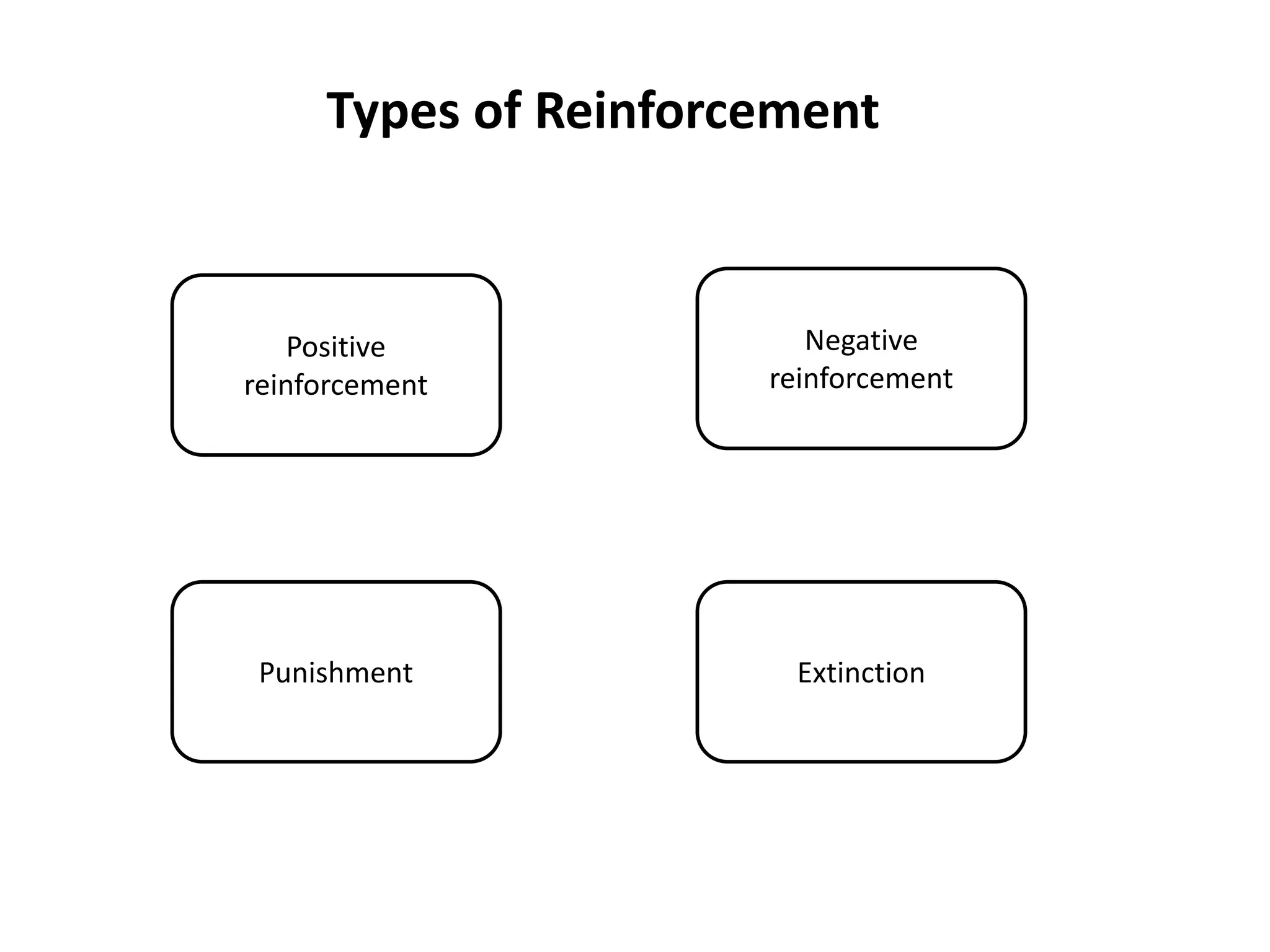
Types of Reinforcement
Positive
reinforcement
ExtinctionPunishment
Negative
reinforcement
Schedules of Reinforcement
Fixed-ratio
Behavior Modification
2–15
Five Step Problem-Solving Model
1. Identify critical behaviors
2. Develop baseline data
3. Identify behavioral consequences
4. Develop and apply intervention
5. Evaluate performance improvement
OB MOD Organizational Applications
• Well Pay versus Sick Pay
• Employee Discipline
• Developing Training Programs
• Self-management
References
• www.wikipedia.org/individual
• www.wikipedia.org/learning
• www.wikipedia.org/individuallearning
• Robbins, Stephen P., 2005, Organizational Behavior 11th
New Jersey, Prentice Hall.

Individual learning