Individual Differences is the uneven
rate of growth and development
among individuals.
“Individual difference
Contents
1. Introduction
2. Definition of individual difference
3. Nature of individual difference
4. Types of individual difference
5. Factors affecting individual difference
6. Individual difference and intelligence
7. Individual difference and attitude
8. Individual difference and thinking
9. Educational implications of individual difference
10. Role of schools in meeting the individual differences
Individual difference
Introduction
• We, in spite of belonging to a common
species known as human beings, have our
own individuality which contributes towards
the variation and differences found in us.
• It is these differences that are entitled as
„individual differences” in the languages of
sociology and psychology.
Introduction…
that• The differences among individuals,
distinguish or separate them from one
another and make one as an unique individual
in oneself, may be termed as individual
differences.
• The psychology of individual differences is
concerned with the systematic study of
intelligence and abilities associated with
personality of learner, learning styles and
needs and interests of learner.
Introduction…
• Learning is most effective when differences in
learner‟s language, cultural, and social behaviour
are taken into account.
• A teacher should be sensitive to individual
differences.
• A teacher‟s challenge is to acknowledge and
celebrate the differences among children and
work to maximize the growth in each child.
Definition of individual difference
• Individual differences stand for the
variations or deviations among individuals in
regard to a single characteristic or a
number of characteristics
-Carter B. Good
• Individual differences
differences which in
stand for “those
their totality,
distinguish one individual from another.
Nature of Individual Differences
1. Inter-personal differences
2. Intra-personal differences
3. Inter-group differences
4. Intra-group differences
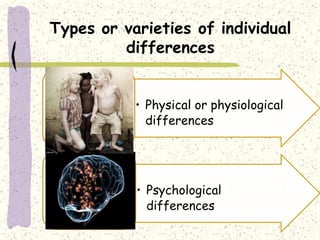
Types or varieties of individual
differences
• Physical or physiological
differences
• Psychological
differences
Types or varieties of individual
differences
• Physical differences: individual differ in
height, weight, colour of skin, colour of eyes
and hair, size of hands and heads, arms,
feet, mouth and nose, length of waistline,
structure and functioning of internal
organs, facial expression, mannerisms of
speech and walk, and other such native or
acquired physical characteristics.
Mental differences
• People differ in intellectual abilities and
capacities like reasoning and thinking, power
of imagination, creative expression,
concentration etc.
• On the basis of these differences they are
usually classified as idiot, imbecile, moron,
border line, normal, very superior and genius
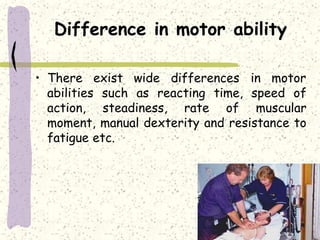
Difference in motor ability
• There exist wide differences in motor
abilities such as reacting time, speed of
action, steadiness, rate of muscular
moment, manual dexterity and resistance to
fatigue etc.
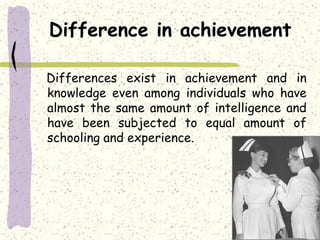
Difference in achievement
Differences exist in achievement and in
knowledge even among individuals who have
almost the same amount of intelligence and
have been subjected to equal amount of
schooling and experience.
Emotional differences
• In some individuals, positive emotions like
love, affection and amusement and the like
are prominent whereas, in some negative
emotions are more powerful.
• Individuals also differ in the manner they
express their emotions. Some are
emotionally stable and mature, while others
are emotionally unstable and immature.
Differences in interests and
aptitudes
• Variations occur among the individuals in relation to
the specific tastes and interests.
• In a similar way, people are found to have different
aptitudes. Some have mechanical aptitude, while
the others have scholastic, musical or artistic
aptitudes.
Differences in self-concept
• Self concept reflects the images, considerations or
judgement about one‟s abilities and limitations
usually held by an individual not only projecting
himself before others but also for estimating his
self in his own eyes.
• Students must be made to form proper and real
concept about their self so that they may be helped
in their progress and development by maximizing
their potentials after getting rid of evils and
negative things detrimental to progress.
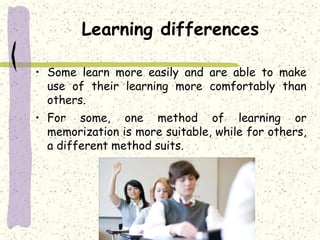
Learning differences
• Some learn more easily and are able to make
use of their learning more comfortably than
others.
• For some, one method of learning or
memorization is more suitable, while for others,
a different method suits.
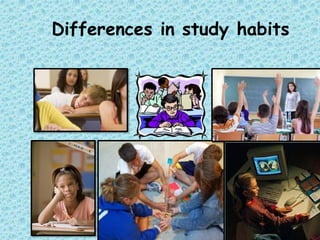
Differences in study habits
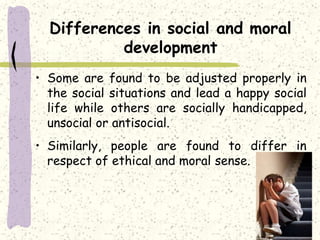
Differences in social and moral
development
• Some are found to be adjusted properly in
the social situations and lead a happy social
life while others are socially handicapped,
unsocial or antisocial.
• Similarly, people are found to differ in
respect of ethical and moral sense.
Factors Effecting Individual
Differences
1. Heredity (What occurs naturally as a function
of the genes)
2. Environment (What is learned and
communicated in different cultures or other
social groups) includes Family, Socio-economic
status, Culture, Previous knowledge,
experience and gender differences.
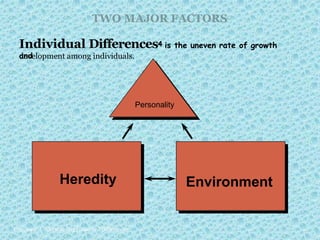
TWO MAJOR FACTORS
Chapter 2: Understanding Individual Differences
EnvironmentHeredity
Personality
Individual Differences4 is the uneven rate of growth
anddevelopment among individuals.
A. Heredity
1. Intelligence ( mental ab6ility)- Some are more intelligent
than the others. And those who are more intelligent progress and grow
faster than those who are less intelligent.
People differ in intellectual abilities and capacities like reasoning and
thinking, power of imagination, creative expression, concentration etc. • On
the basis of these differences they are usually classified as idiot, imbecile,
moron, border line, normal, very superior and genius
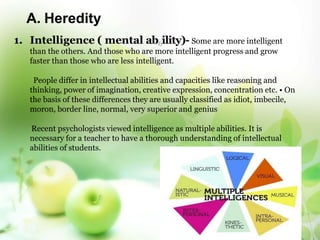
Recent psychologists viewed intelligence as multiple abilities. It is
necessary for a teacher to have a thorough understanding of intellectual
abilities of students.
A. Heredity
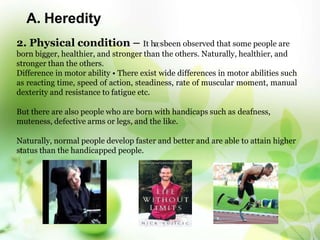
2. Physical condition – It ha7sbeen observed that some people are
born bigger, healthier, and stronger than the others. Naturally, healthier, and
stronger than the others.
Difference in motor ability • There exist wide differences in motor abilities such
as reacting time, speed of action, steadiness, rate of muscular moment, manual
dexterity and resistance to fatigue etc.
But there are also people who are born with handicaps such as deafness,
muteness, defective arms or legs, and the like.
Naturally, normal people develop faster and better and are able to attain higher
status than the handicapped people.
A. Heredity
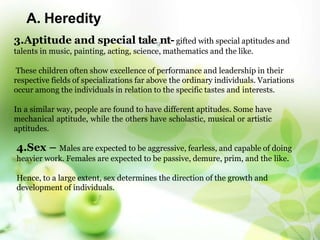
3.Aptitude and special tale9nt- gifted with special aptitudes and
talents in music, painting, acting, science, mathematics and the like.
These children often show excellence of performance and leadership in their
respective fields of specializations far above the ordinary individuals. Variations
occur among the individuals in relation to the specific tastes and interests.
In a similar way, people are found to have different aptitudes. Some have
mechanical aptitude, while the others have scholastic, musical or artistic
aptitudes.
4.Sex – Males are expected to be aggressive, fearless, and capable of doing
heavier work. Females are expected to be passive, demure, prim, and the like.
Hence, to a large extent, sex determines the direction of the growth and
development of individuals.
A. Heredity
10
5. Age – age is a big factor in making one different from another. Generally ,
older learners have more physical strength and higher level of comprehension
than younger ones.
Maturation and readiness are important in learning. Mature learners have greater
capacity to receive instruction.
B. Environment
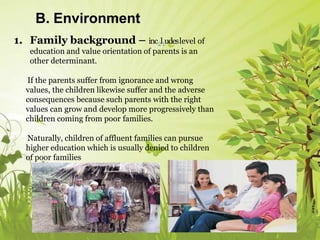
1. Family background – inc2l1udeslevel of
education and value orientation of parents is an
other determinant.
If the parents suffer from ignorance and wrong
values, the children likewise suffer and the adverse
consequences because such parents with the right
values can grow and develop more progressively than
children coming from poor families.
Naturally, children of affluent families can pursue
higher education which is usually denied to children
of poor families
B. Environment
2. Community background22– It can be observed that children of
individuals coming from these different types of communities differ markedly in
their values, manners, actions, and thinking.
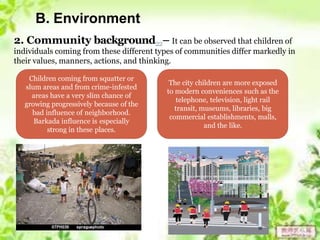
Children coming from squatter or
slum areas and from crime-infested
areas have a very slim chance of
growing progressively because of the
bad influence of neighborhood.
Barkada influence is especially
strong in these places.
The city children are more exposed
to modern conveniences such as the
telephone, television, light rail
transit, museums, libraries, big
commercial establishments, malls,
and the like.
B. Environment
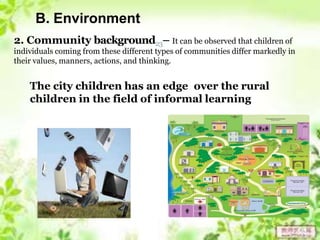
2. Community background23– It can be observed that children of
individuals coming from these different types of communities differ markedly in
their values, manners, actions, and thinking.
The city children has an edge over the rural
children in the field of informal learning
B. Environment
3. School – It is very importan24t factors in learning
and development. Good school can
develop pupils better than the poor ones.
There are three components make the
difference between the good and poor
schools.
1.Teachers
2.Facilities
3.Location
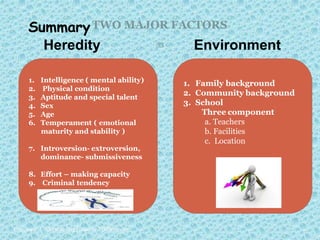
1. Family background
2. Community background
3. School
Three component
a. Teachers
b. Facilities
c. Location
1. Intelligence ( mental ability)
2. Physical condition
3. Aptitude and special talent
4. Sex
5. Age
6. Temperament ( emotional
maturity and stability )
7. Introversion- extroversion,
dominance- submissiveness
8. Effort – making capacity
9. Criminal tendency
SummaryTWO MAJOR FACTORS
Chapter 2: Understanding Individual Differences
33Heredity Environment
Intelligence…
• In a symposium on intelligence in 1986, 24
psychologists presented 24 different theories of
intelligence (Sternberg, 1986).
• In 1912, William Stern created the concept of IQ
• Intelligence is normally distributed in the
population
• There are crystallized and fluid intelligence
• A teacher should be aware of the concept of IQ
• Aware of the students having multiple intelligence
• Aware of the students having low IQ
Multiple Intelligence Theories
• Recent psychologists viewed intelligence as
multiple abilities.
• It is necessary for a teacher to have a
thorough understanding of intellectual
abilities of students.
Sternberg’s Theory of
Intelligence (2000)
• According to him, intelligence comes into three
forms that are analytical, creative, and
practical.
1. Analytical ability: The ability to analyze,
evaluate, judge, compare, and contrast.
2. Creative ability: The ability to create, design,
invent, and originate.
3. Practical ability: the ability to use, apply,
manipulate, and implement.
Gardener’s Eight Types of Intelligence
(Frames of Mind)
1. Verbal skills--------authors, journalists, speaker
2.Mathematical skills------scientists, engineers, accountants
3.Spatial ability---------three dimensional thinking, architects,
sailors
4.Bodily-kinaesthetic skills----manipulate objects, surgeons,
dancers, athletes
5.Musical skills------sensitivity to pitch, melody, composers,
sensitive listeners
psychologists,6.Intrapersonal-------understand oneself,
theologians
7. Interpersonal-------interact with others
and human made8.Naturalistic skills-----understand nature
systems, farmers, ecologists, landscapers
Learning and Social
Intelligence
• Learning is influenced by social intelligence which is
the ability to establish interpersonal relationships
with others. Socially intelligent person can easily
interact and communicate with others. He can
reduce his/her stress level by sharing it with
his/her support group.
• Learning can be enhanced when students have the
opportunities to interact and collaborate with
others on instructional tasks.
Learning and Social Intelligence…
situations for and• Learning
respect diversity
that allow
encourage
competence,
flexible
and moralthinking, social
development.
• Learning and self-esteem are heightened
when learners are in respected and caring
relationship with others who see their
potential, appreciate their unique talent,
and respect them as individuals.
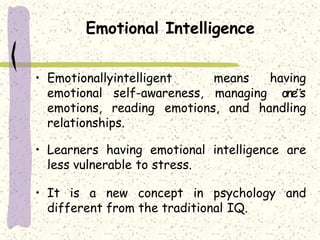
Emotional Intelligence
means having• Emotionallyintelligent
emotional self-awareness, managing one‟s
emotions, reading emotions, and handling
relationships.
• Learners having emotional intelligence are
less vulnerable to stress.
• It is a new concept in psychology and
different from the traditional IQ.
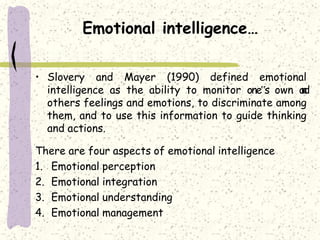
Emotional intelligence…
• Slovery and Mayer (1990) defined emotional
intelligence as the ability to monitor one‟s own and
others feelings and emotions, to discriminate among
them, and to use this information to guide thinking
and actions.
There are four aspects of emotional intelligence
1. Emotional perception
2. Emotional integration
3. Emotional understanding
4. Emotional management
Teachers and students having emotional
intelligence can improve their relationship:
1. By understanding the causes of their feelings
2. Being good at managing one‟sown anger
3. Being good at listening to what other people
are saying
4. Being motivated to share and cooperate
5. Deal with stressful situations with tactful
manner
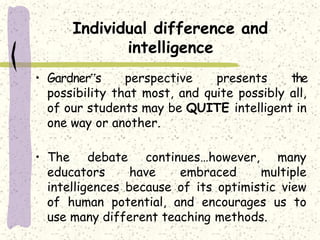
Individual difference and
intelligence
• Gardner‟s perspective presents the
possibility that most, and quite possibly all,
of our students may be QUITE intelligent in
one way or another.
• The debate continues…however, many
educators have embraced multiple
intelligences because of its optimistic view
of human potential, and encourages us to
use many different teaching methods.
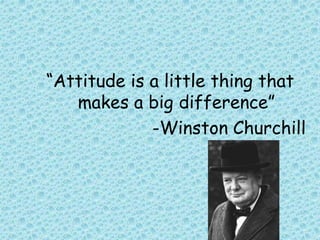
“Attitude is a little thing that
makes a big difference”
-Winston Churchill
Attitude
“An attitude is a particular feeling about
something. It therefore, involves a
tendency to behave in a certain way in
situations which involves that something,
whether person, idea or object. It is
partially rational and partially emotional and
is acquired, not inherent in and individual.”
Components of attitude
a. Cognitive - our thoughts, beliefs, and ideas about
something. When a human being is the object of an
attitude, the cognitive component is frequently a
stereotype.
b. Affective - feelings or emotions that something
evokes. e.g. fear, sympathy, hate.
c. Conative, or behavioral - tendency or disposition to
act in certain ways toward something. Emphasis is
on the tendency to act, not the actual acting; what
we intend and what we do may be quite different.
Attitudes can be acquired through social
learning
• Classical conditioning: This is learning based on
association when one stimulus regularly precedes
another. The one that occurs first may soon
become a signal for the one that occurs second.
• Instrumental conditioning: here a child plays an
active role in the learning process, which ranges
from receiving selective rewards or punishments to
learning to hold the right views.
• Modeling: this is learning that take place when a
child witness examples and models her behaviour
accordingly.
Individual difference and attitude
Some of the main influences on attitude
formation are:
1. Teacher
2. Friends/peer group
3. Parents
4. Teaching method
5. The language itself
Difference in attitude
• Attitude is one of the important attributes of our
behaviour.
• Individuals are found to possess varying attitude
towards different people, groups, objects and
ideas.
• Their attitude may be positive, negative or of
somewhat indifferent nature. Similarly they differ
in respect of beliefs, opinions and ideas.
• Some are conservative and rigid while the others
are progressive, liberal and dynamic.
Thinking
The great philosopher Descartes
had said, “I think, so I exist”,
implying that thought is the very
essence of human existence.
Concept of Thinking
• Thinking is a complex process which involves
manipulation of information as we form concepts. It
also engages in problem solving, reasoning and
making decisions.
• Thinking is a higher cognitive function and the
analysis of thinking processes is part of cognitive
psychology.
• Thinking is a pattern of behaviour in which we make
use of internal representations (symbols, signs etc.)
of things and events for the solution of some
specific, purposeful problem.
Definitions of thinking
• Ross: Thinking is a mental activity in its
cognitive aspect.
• Kolesnik: Thinking is the reorganization of
concepts.
• Woodworth:Thinking is mental exploration
for finding out the solution of a problem.
Types of Thinking
a) Convergent Thinking
b) Divergent Thinking
c) Critical Thinking
d) Reflective Thinking
e) Lateral Thinking
Types of thinking…
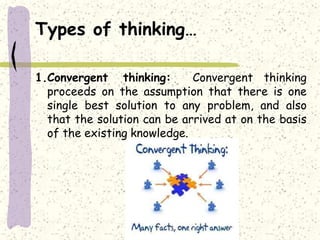
1.Convergent thinking: Convergent thinking
proceeds on the assumption that there is one
single best solution to any problem, and also
that the solution can be arrived at on the basis
of the existing knowledge.
Types of thinking…
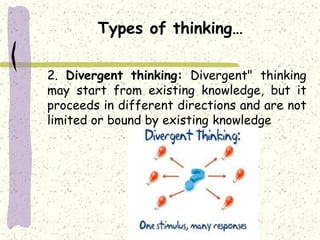
2. Divergent thinking: Divergent" thinking
may start from existing knowledge, but it
proceeds in different directions and are not
limited or bound by existing knowledge
Types of thinking…
3. Critical thinking
• Critical thinking assesses the worth and validity of
something existent. It involves precise, persistent,
objective analysis. When teachers try to get
several learners to think convergent, they try to
help them develop common understanding.
4. Reflective thinking
• Reflective thinking is normally a slow process. It
takes considerable time to work on inferring and
combining by reflecting upon what we have learnt.
This is a higher form of thinking.
Types of thinking…
5. Lateral thinking
• Lateral thinking is about reasoning that is
not immediately obvious and about ideas
that may not be obtainable by using only
traditional step-by-step logic.
• Lateral thinking involves discarding the
obvious, leaving behind traditional modes
of thought, and throwing away
preconceptions.
Educational implications of individual
differences
1. In any group there are individuals who deviate
from the norms of the group. Along with the
average, the presence of very superior and
extremely dull is equally possible in a class.
2. Every teacher should try to have the desired
knowledge of the abilities, capacities, interests,
attitudes, aptitudes and other personality traits
of his pupils and in the light of this knowledge
should render individual guidance to children for
the maximum utilization of their potentialities.
Educational implications of
individual differences…
• It is wrong to expect uniformity in gaining
proficiency or success in a particular field from a
group of students. On account of their subnormal
intelligence, previous background, lack of proper
interest, aptitude and attitude etc. some students
lag behind in one or the other area of achievement.
• All students cannot be benefited by a particular
method of instruction and a uniform and rigid
curriculum.
Role of schools in meeting the
individual differences
• “Since we supposedly are teaching
individuals, not groups of individuals, it is
the function of the school within its
budgetary personnel and curricular
limitations to provide adequate schooling
for every learner no matter how much he
differs from every other learner.”
-crow and crow
Role of school…
1. Proper knowledge of the individual’s
potentialities
• The first step in making provision for the
individual differences is to know about the
abilities, capacities, interests, aptitudes and
other personality traits of individual pupils.
• For this purpose, help from intelligence
test, cumulative record card, interest
inventories, attitude scales, aptitude tests
and measures for assessing personality
traits should be taken.
Role of school…
2.Ability grouping
• In the light of the results derived from
various tests for knowing individual
differences in terms of individual
potentialities in various dimensions, the
students in a class or area of activity can be
divided into homogenous groups.
• Such division can prove beneficial in
adjusting instruction to varying individual
differences.
Role of school…
3. Adjusting the curriculum
• The curriculum should be as flexible and
differentiated as possible.
• It should have the provision for a number of
diversified courses and co-curricular
experiences.
• It should provide adjustment suiting the
local requirements and potentialities of the
students in different groups.
Role of school…
4. Adjusting the method of teaching
• Every teacher should be somewhat free to
formulate his own plan and strategy and
adopt instructional procedure which he
finds most suited to the particular types of
pupils under him.
• He should try to follow a different
procedure or method of instruction suiting
the requirements of varying ability groups
of his pupils.
Role of school…
5.Adopting special programmes or methods
for individualizing instruction
• Schools may also adopt special programmes
or method of teaching like Dalton plan, the
Winnetka plan, the project method or use
programmed learning material for enabling
the students to learn their own individual
pace.
Other measures of individualizing
instructions
1. The size of the class or section should be as small as
possible.
2. The teacher should try to pay individual attention
the group under instruction.
3. The teacher should keep in view the individual
differences of his students while engaging them in
drill or practice work in classroom or assigning home
task
4. In case ability grouping is not possible and more
specifically under the prevalent system of class
teaching, special coaching and guidance programme
for both the dull and gifted children is most helpful.

Final individual differences

  • 1.
    Individual Differences isthe uneven rate of growth and development among individuals. “Individual difference
  • 2.
    Contents 1. Introduction 2. Definitionof individual difference 3. Nature of individual difference 4. Types of individual difference 5. Factors affecting individual difference 6. Individual difference and intelligence 7. Individual difference and attitude 8. Individual difference and thinking 9. Educational implications of individual difference 10. Role of schools in meeting the individual differences
  • 3.
    Individual difference Introduction • We,in spite of belonging to a common species known as human beings, have our own individuality which contributes towards the variation and differences found in us. • It is these differences that are entitled as „individual differences” in the languages of sociology and psychology.
  • 4.
    Introduction… that• The differencesamong individuals, distinguish or separate them from one another and make one as an unique individual in oneself, may be termed as individual differences. • The psychology of individual differences is concerned with the systematic study of intelligence and abilities associated with personality of learner, learning styles and needs and interests of learner.
  • 5.
    Introduction… • Learning ismost effective when differences in learner‟s language, cultural, and social behaviour are taken into account. • A teacher should be sensitive to individual differences. • A teacher‟s challenge is to acknowledge and celebrate the differences among children and work to maximize the growth in each child.
  • 6.
    Definition of individualdifference • Individual differences stand for the variations or deviations among individuals in regard to a single characteristic or a number of characteristics -Carter B. Good • Individual differences differences which in stand for “those their totality, distinguish one individual from another.
  • 7.
    Nature of IndividualDifferences 1. Inter-personal differences 2. Intra-personal differences 3. Inter-group differences 4. Intra-group differences
  • 8.
    Types or varietiesof individual differences • Physical or physiological differences • Psychological differences
  • 9.
    Types or varietiesof individual differences • Physical differences: individual differ in height, weight, colour of skin, colour of eyes and hair, size of hands and heads, arms, feet, mouth and nose, length of waistline, structure and functioning of internal organs, facial expression, mannerisms of speech and walk, and other such native or acquired physical characteristics.
  • 10.
    Mental differences • Peoplediffer in intellectual abilities and capacities like reasoning and thinking, power of imagination, creative expression, concentration etc. • On the basis of these differences they are usually classified as idiot, imbecile, moron, border line, normal, very superior and genius
  • 11.
    Difference in motorability • There exist wide differences in motor abilities such as reacting time, speed of action, steadiness, rate of muscular moment, manual dexterity and resistance to fatigue etc.
  • 12.
    Difference in achievement Differencesexist in achievement and in knowledge even among individuals who have almost the same amount of intelligence and have been subjected to equal amount of schooling and experience.
  • 13.
    Emotional differences • Insome individuals, positive emotions like love, affection and amusement and the like are prominent whereas, in some negative emotions are more powerful. • Individuals also differ in the manner they express their emotions. Some are emotionally stable and mature, while others are emotionally unstable and immature.
  • 14.
    Differences in interestsand aptitudes • Variations occur among the individuals in relation to the specific tastes and interests. • In a similar way, people are found to have different aptitudes. Some have mechanical aptitude, while the others have scholastic, musical or artistic aptitudes.
  • 15.
    Differences in self-concept •Self concept reflects the images, considerations or judgement about one‟s abilities and limitations usually held by an individual not only projecting himself before others but also for estimating his self in his own eyes. • Students must be made to form proper and real concept about their self so that they may be helped in their progress and development by maximizing their potentials after getting rid of evils and negative things detrimental to progress.
  • 16.
    Learning differences • Somelearn more easily and are able to make use of their learning more comfortably than others. • For some, one method of learning or memorization is more suitable, while for others, a different method suits.
  • 17.
  • 18.
    Differences in socialand moral development • Some are found to be adjusted properly in the social situations and lead a happy social life while others are socially handicapped, unsocial or antisocial. • Similarly, people are found to differ in respect of ethical and moral sense.
  • 19.
    Factors Effecting Individual Differences 1.Heredity (What occurs naturally as a function of the genes) 2. Environment (What is learned and communicated in different cultures or other social groups) includes Family, Socio-economic status, Culture, Previous knowledge, experience and gender differences.
  • 20.
    TWO MAJOR FACTORS Chapter2: Understanding Individual Differences EnvironmentHeredity Personality Individual Differences4 is the uneven rate of growth anddevelopment among individuals.
  • 21.
    A. Heredity 1. Intelligence( mental ab6ility)- Some are more intelligent than the others. And those who are more intelligent progress and grow faster than those who are less intelligent. People differ in intellectual abilities and capacities like reasoning and thinking, power of imagination, creative expression, concentration etc. • On the basis of these differences they are usually classified as idiot, imbecile, moron, border line, normal, very superior and genius Recent psychologists viewed intelligence as multiple abilities. It is necessary for a teacher to have a thorough understanding of intellectual abilities of students.
  • 22.
    A. Heredity 2. Physicalcondition – It ha7sbeen observed that some people are born bigger, healthier, and stronger than the others. Naturally, healthier, and stronger than the others. Difference in motor ability • There exist wide differences in motor abilities such as reacting time, speed of action, steadiness, rate of muscular moment, manual dexterity and resistance to fatigue etc. But there are also people who are born with handicaps such as deafness, muteness, defective arms or legs, and the like. Naturally, normal people develop faster and better and are able to attain higher status than the handicapped people.
  • 23.
    A. Heredity 3.Aptitude andspecial tale9nt- gifted with special aptitudes and talents in music, painting, acting, science, mathematics and the like. These children often show excellence of performance and leadership in their respective fields of specializations far above the ordinary individuals. Variations occur among the individuals in relation to the specific tastes and interests. In a similar way, people are found to have different aptitudes. Some have mechanical aptitude, while the others have scholastic, musical or artistic aptitudes. 4.Sex – Males are expected to be aggressive, fearless, and capable of doing heavier work. Females are expected to be passive, demure, prim, and the like. Hence, to a large extent, sex determines the direction of the growth and development of individuals.
  • 24.
    A. Heredity 10 5. Age– age is a big factor in making one different from another. Generally , older learners have more physical strength and higher level of comprehension than younger ones. Maturation and readiness are important in learning. Mature learners have greater capacity to receive instruction.
  • 25.
    B. Environment 1. Familybackground – inc2l1udeslevel of education and value orientation of parents is an other determinant. If the parents suffer from ignorance and wrong values, the children likewise suffer and the adverse consequences because such parents with the right values can grow and develop more progressively than children coming from poor families. Naturally, children of affluent families can pursue higher education which is usually denied to children of poor families
  • 26.
    B. Environment 2. Communitybackground22– It can be observed that children of individuals coming from these different types of communities differ markedly in their values, manners, actions, and thinking. Children coming from squatter or slum areas and from crime-infested areas have a very slim chance of growing progressively because of the bad influence of neighborhood. Barkada influence is especially strong in these places. The city children are more exposed to modern conveniences such as the telephone, television, light rail transit, museums, libraries, big commercial establishments, malls, and the like.
  • 27.
    B. Environment 2. Communitybackground23– It can be observed that children of individuals coming from these different types of communities differ markedly in their values, manners, actions, and thinking. The city children has an edge over the rural children in the field of informal learning
  • 28.
    B. Environment 3. School– It is very importan24t factors in learning and development. Good school can develop pupils better than the poor ones. There are three components make the difference between the good and poor schools. 1.Teachers 2.Facilities 3.Location
  • 29.
    1. Family background 2.Community background 3. School Three component a. Teachers b. Facilities c. Location 1. Intelligence ( mental ability) 2. Physical condition 3. Aptitude and special talent 4. Sex 5. Age 6. Temperament ( emotional maturity and stability ) 7. Introversion- extroversion, dominance- submissiveness 8. Effort – making capacity 9. Criminal tendency SummaryTWO MAJOR FACTORS Chapter 2: Understanding Individual Differences 33Heredity Environment
  • 30.
    Intelligence… • In asymposium on intelligence in 1986, 24 psychologists presented 24 different theories of intelligence (Sternberg, 1986). • In 1912, William Stern created the concept of IQ • Intelligence is normally distributed in the population • There are crystallized and fluid intelligence • A teacher should be aware of the concept of IQ • Aware of the students having multiple intelligence • Aware of the students having low IQ
  • 31.
    Multiple Intelligence Theories •Recent psychologists viewed intelligence as multiple abilities. • It is necessary for a teacher to have a thorough understanding of intellectual abilities of students.
  • 32.
    Sternberg’s Theory of Intelligence(2000) • According to him, intelligence comes into three forms that are analytical, creative, and practical. 1. Analytical ability: The ability to analyze, evaluate, judge, compare, and contrast. 2. Creative ability: The ability to create, design, invent, and originate. 3. Practical ability: the ability to use, apply, manipulate, and implement.
  • 33.
    Gardener’s Eight Typesof Intelligence (Frames of Mind) 1. Verbal skills--------authors, journalists, speaker 2.Mathematical skills------scientists, engineers, accountants 3.Spatial ability---------three dimensional thinking, architects, sailors 4.Bodily-kinaesthetic skills----manipulate objects, surgeons, dancers, athletes 5.Musical skills------sensitivity to pitch, melody, composers, sensitive listeners psychologists,6.Intrapersonal-------understand oneself, theologians 7. Interpersonal-------interact with others and human made8.Naturalistic skills-----understand nature systems, farmers, ecologists, landscapers
  • 34.
    Learning and Social Intelligence •Learning is influenced by social intelligence which is the ability to establish interpersonal relationships with others. Socially intelligent person can easily interact and communicate with others. He can reduce his/her stress level by sharing it with his/her support group. • Learning can be enhanced when students have the opportunities to interact and collaborate with others on instructional tasks.
  • 35.
    Learning and SocialIntelligence… situations for and• Learning respect diversity that allow encourage competence, flexible and moralthinking, social development. • Learning and self-esteem are heightened when learners are in respected and caring relationship with others who see their potential, appreciate their unique talent, and respect them as individuals.
  • 36.
    Emotional Intelligence means having•Emotionallyintelligent emotional self-awareness, managing one‟s emotions, reading emotions, and handling relationships. • Learners having emotional intelligence are less vulnerable to stress. • It is a new concept in psychology and different from the traditional IQ.
  • 37.
    Emotional intelligence… • Sloveryand Mayer (1990) defined emotional intelligence as the ability to monitor one‟s own and others feelings and emotions, to discriminate among them, and to use this information to guide thinking and actions. There are four aspects of emotional intelligence 1. Emotional perception 2. Emotional integration 3. Emotional understanding 4. Emotional management
  • 38.
    Teachers and studentshaving emotional intelligence can improve their relationship: 1. By understanding the causes of their feelings 2. Being good at managing one‟sown anger 3. Being good at listening to what other people are saying 4. Being motivated to share and cooperate 5. Deal with stressful situations with tactful manner
  • 39.
    Individual difference and intelligence •Gardner‟s perspective presents the possibility that most, and quite possibly all, of our students may be QUITE intelligent in one way or another. • The debate continues…however, many educators have embraced multiple intelligences because of its optimistic view of human potential, and encourages us to use many different teaching methods.
  • 40.
    “Attitude is alittle thing that makes a big difference” -Winston Churchill
  • 41.
    Attitude “An attitude isa particular feeling about something. It therefore, involves a tendency to behave in a certain way in situations which involves that something, whether person, idea or object. It is partially rational and partially emotional and is acquired, not inherent in and individual.”
  • 42.
    Components of attitude a.Cognitive - our thoughts, beliefs, and ideas about something. When a human being is the object of an attitude, the cognitive component is frequently a stereotype. b. Affective - feelings or emotions that something evokes. e.g. fear, sympathy, hate. c. Conative, or behavioral - tendency or disposition to act in certain ways toward something. Emphasis is on the tendency to act, not the actual acting; what we intend and what we do may be quite different.
  • 43.
    Attitudes can beacquired through social learning • Classical conditioning: This is learning based on association when one stimulus regularly precedes another. The one that occurs first may soon become a signal for the one that occurs second. • Instrumental conditioning: here a child plays an active role in the learning process, which ranges from receiving selective rewards or punishments to learning to hold the right views. • Modeling: this is learning that take place when a child witness examples and models her behaviour accordingly.
  • 44.
    Individual difference andattitude Some of the main influences on attitude formation are: 1. Teacher 2. Friends/peer group 3. Parents 4. Teaching method 5. The language itself
  • 45.
    Difference in attitude •Attitude is one of the important attributes of our behaviour. • Individuals are found to possess varying attitude towards different people, groups, objects and ideas. • Their attitude may be positive, negative or of somewhat indifferent nature. Similarly they differ in respect of beliefs, opinions and ideas. • Some are conservative and rigid while the others are progressive, liberal and dynamic.
  • 46.
    Thinking The great philosopherDescartes had said, “I think, so I exist”, implying that thought is the very essence of human existence.
  • 47.
    Concept of Thinking •Thinking is a complex process which involves manipulation of information as we form concepts. It also engages in problem solving, reasoning and making decisions. • Thinking is a higher cognitive function and the analysis of thinking processes is part of cognitive psychology. • Thinking is a pattern of behaviour in which we make use of internal representations (symbols, signs etc.) of things and events for the solution of some specific, purposeful problem.
  • 48.
    Definitions of thinking •Ross: Thinking is a mental activity in its cognitive aspect. • Kolesnik: Thinking is the reorganization of concepts. • Woodworth:Thinking is mental exploration for finding out the solution of a problem.
  • 49.
    Types of Thinking a)Convergent Thinking b) Divergent Thinking c) Critical Thinking d) Reflective Thinking e) Lateral Thinking
  • 50.
    Types of thinking… 1.Convergentthinking: Convergent thinking proceeds on the assumption that there is one single best solution to any problem, and also that the solution can be arrived at on the basis of the existing knowledge.
  • 51.
    Types of thinking… 2.Divergent thinking: Divergent" thinking may start from existing knowledge, but it proceeds in different directions and are not limited or bound by existing knowledge
  • 52.
    Types of thinking… 3.Critical thinking • Critical thinking assesses the worth and validity of something existent. It involves precise, persistent, objective analysis. When teachers try to get several learners to think convergent, they try to help them develop common understanding. 4. Reflective thinking • Reflective thinking is normally a slow process. It takes considerable time to work on inferring and combining by reflecting upon what we have learnt. This is a higher form of thinking.
  • 53.
    Types of thinking… 5.Lateral thinking • Lateral thinking is about reasoning that is not immediately obvious and about ideas that may not be obtainable by using only traditional step-by-step logic. • Lateral thinking involves discarding the obvious, leaving behind traditional modes of thought, and throwing away preconceptions.
  • 54.
    Educational implications ofindividual differences 1. In any group there are individuals who deviate from the norms of the group. Along with the average, the presence of very superior and extremely dull is equally possible in a class. 2. Every teacher should try to have the desired knowledge of the abilities, capacities, interests, attitudes, aptitudes and other personality traits of his pupils and in the light of this knowledge should render individual guidance to children for the maximum utilization of their potentialities.
  • 55.
    Educational implications of individualdifferences… • It is wrong to expect uniformity in gaining proficiency or success in a particular field from a group of students. On account of their subnormal intelligence, previous background, lack of proper interest, aptitude and attitude etc. some students lag behind in one or the other area of achievement. • All students cannot be benefited by a particular method of instruction and a uniform and rigid curriculum.
  • 56.
    Role of schoolsin meeting the individual differences • “Since we supposedly are teaching individuals, not groups of individuals, it is the function of the school within its budgetary personnel and curricular limitations to provide adequate schooling for every learner no matter how much he differs from every other learner.” -crow and crow
  • 57.
    Role of school… 1.Proper knowledge of the individual’s potentialities • The first step in making provision for the individual differences is to know about the abilities, capacities, interests, aptitudes and other personality traits of individual pupils. • For this purpose, help from intelligence test, cumulative record card, interest inventories, attitude scales, aptitude tests and measures for assessing personality traits should be taken.
  • 58.
    Role of school… 2.Abilitygrouping • In the light of the results derived from various tests for knowing individual differences in terms of individual potentialities in various dimensions, the students in a class or area of activity can be divided into homogenous groups. • Such division can prove beneficial in adjusting instruction to varying individual differences.
  • 59.
    Role of school… 3.Adjusting the curriculum • The curriculum should be as flexible and differentiated as possible. • It should have the provision for a number of diversified courses and co-curricular experiences. • It should provide adjustment suiting the local requirements and potentialities of the students in different groups.
  • 60.
    Role of school… 4.Adjusting the method of teaching • Every teacher should be somewhat free to formulate his own plan and strategy and adopt instructional procedure which he finds most suited to the particular types of pupils under him. • He should try to follow a different procedure or method of instruction suiting the requirements of varying ability groups of his pupils.
  • 61.
    Role of school… 5.Adoptingspecial programmes or methods for individualizing instruction • Schools may also adopt special programmes or method of teaching like Dalton plan, the Winnetka plan, the project method or use programmed learning material for enabling the students to learn their own individual pace.
  • 62.
    Other measures ofindividualizing instructions 1. The size of the class or section should be as small as possible. 2. The teacher should try to pay individual attention the group under instruction. 3. The teacher should keep in view the individual differences of his students while engaging them in drill or practice work in classroom or assigning home task 4. In case ability grouping is not possible and more specifically under the prevalent system of class teaching, special coaching and guidance programme for both the dull and gifted children is most helpful.