WHAT WE’VE COVERED SO FAR…
• Social Psychological Explanations of Aggression
• SLT & Deindividuation
• Institutional Aggression
• Dispositional vs. Situational Approaches
• Biological Explanations of Aggression
• Genes & Neural Explanations of Aggression
Institutional
Aggression
Deindividuation
Theory
Neural
Explanations
Genetic
Explanation
Social
Learning
Theory
1 2 3
4 5
BIOLOGICAL
EXPLANATIONS OF
AGGRESSION
INCREASED TESTOSTERONE
DECREASED CORTISOL
HORMONES…
• “Chemicals that regulate and control bodily
functions”
HORMONES…
• Endocrine system produces hundreds of hormones which
interact with the nervous system to regulate…
• Short Term process: (responses to threats)
• Long Term process: (sex differentiation; maturation; reproduction)
'MONTHLY MISERIES SAVE THE KILLER MISTRESS’
• 1980’s Court Case of R.V. English
• A woman (with no previous convictions) had a fight with her
lover, a married man. Later, English drove her carat him
ramming him into a lamp post. He did not survive and English
was charged with murder
• Lawyer appealed the case
• He used the excuse that “The woman was experiencing PMT
(pre-menstrual tension) and caused hazy judgement and
impaired self-control.”
• English’s charges were reduced to manslaughter.
TESTOSTERONE…
• ‘Androgen’
• 10x higher in males
• Released from testes in males
• Released from Adrenal Glands in females
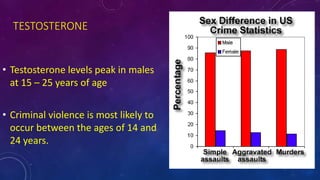
TESTOSTERONE
• Testosterone levels peak in males
at 15 – 25 years of age
• Criminal violence is most likely to
occur between the ages of 14 and
24 years.

MORE TESTOSTERONE = MORE AGGRESSIVE?
• Dabbs et al (1995)
• Measured testosterone levels
in prisoners
• Correlated results with
violence of crime
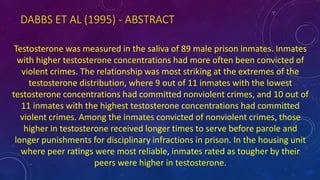
DABBS ET AL (1995) - ABSTRACT
Testosterone was measured in the saliva of 89 male prison inmates. Inmates

with higher testosterone concentrations had more often been convicted of
violent crimes. The relationship was most striking at the extremes of the
testosterone distribution, where 9 out of 11 inmates with the lowest
testosterone concentrations had committed nonviolent crimes, and 10 out of
11 inmates with the highest testosterone concentrations had committed
violent crimes. Among the inmates convicted of nonviolent crimes, those
higher in testosterone received longer times to serve before parole and
longer punishments for disciplinary infractions in prison. In the housing unit
where peer ratings were most reliable, inmates rated as tougher by their
peers were higher in testosterone.
MORE TESTOSTERONE = MORE AGGRESSION?
• Testosterone levels have to be checked before professional
sporting events…
MORE TESTOSTERONE = MORE AGGRESSION?
• Higher testosterone levels are consistently found in
athletes from more ‘aggressive’ sports (wrestling; rugby
etc.)
• In comparison to non-aggressive sports (i.e. swimming)
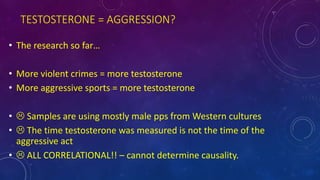
TESTOSTERONE = AGGRESSION?
• The research so far…
• More violent crimes = more testosterone
• More aggressive sports = more testosterone
•  Samples are using mostly male pps from Western cultures
•  The time testosterone was measured is not the time of the
aggressive act
•  ALL CORRELATIONAL!! – cannot determine causality.
ANIMAL STUDIES…
• Nobody wants an
aggressive pet
• How to reduce
aggression in animals…
THERE ARE 4 BREEDS OF DOG WHICH ARE BANNED IN
THE UK…
• Japanese Tosa
• Dogo Argentino
• Fila Braziliero
• Pit Bull Terrier
• Q. What are the conditions of owning a pit bull type apart from having the dog
registered
• A. The dog has to be neutered, micro-chipped, and insured.
• It must be kept in secure conditions to prevent it from escaping.
• If the address where the dog is kept changes for more than 30 days you must notify the
Index.
• You must notify the Index if the dog dies or is exported.
• Also, no person shall:-
• Breed, or breed from, the dog
• Make or offer to make a gift of the dog or advertise or expose the dog as a gift
• Allow the dog to be in a public place without being muzzled and kept on a lead
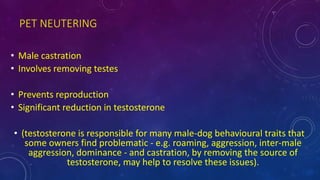
PET NEUTERING
• Male castration
• Involves removing testes
• Prevents reproduction
• Significant reduction in testosterone
• (testosterone is responsible for many male-dog behavioural traits that
some owners find problematic - e.g. roaming, aggression, inter-male
aggression, dominance - and castration, by removing the source of
testosterone, may help to resolve these issues).
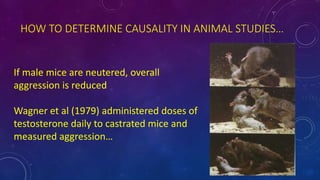
HOW TO DETERMINE CAUSALITY IN ANIMAL STUDIES…
If male mice are neutered, overall
aggression is reduced
Wagner et al (1979) administered doses of
testosterone daily to castrated mice and
measured aggression…
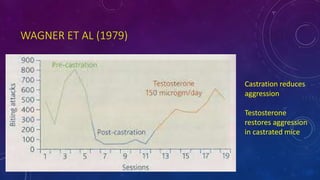
WAGNER ET AL (1979)
Castration reduces
aggression
Testosterone
restores aggression
in castrated mice
WAGNER ET AL (1979)
•  Gives evidence of possible causal factors of
testosterone
•  Cannot assume homogeneity in results for humans
•  Only used male mice… same result for female?
•  Extraneous variables?
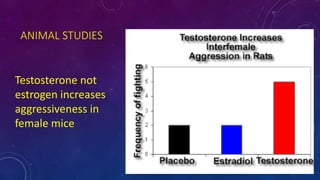
ANIMAL STUDIES
Testosterone not
estrogen increases
aggressiveness in
female mice
CAN THESE FINDINGS BE REPLICATED IN HUMANS?
• How could we find a causality link between increased
testosterone and increased aggression in humans?
• What would your DV involve?
TESTOSTERONE & AGGRESSION IN HUMANS…
• Harrison et al (2000)
• Administered testosterone to 56 men aged 20-50
years.
• Compared aggressive responses to a control group
given a placebo
• “Double Blind Study”
HARRISON ET AL (2000)
• All pps aggression was measured by their responses to a
computer game
• The game involved money being rewarded to the pp and to a
fictitious player.
• The pp believed the other ‘player’ was controlling the amount
of money rewarded to them.
• They were then allowed to control the amount of money
reward to ‘Player 2’.
HARRISON ET AL (2000)
• DV = Amount of money deducted from the other player
• Testosterone treatment significantly increased aggressive
responses compared to placebo controls.
• Yet this effect was not uniform across all individuals.
HARRISON ET AL (2000)
•  Individual differences?
•  Small sample of men, can results be generalised?
•  Is the DV valid?
THE RESEARCH SO FAR…
• More testosterone = more violent crimes
• More testosterone = more aggressive sports
• More testosterone = more aggressive mice
• More testosterone = more antisocial humans
• How strong is the relationship between testosterone and
aggressive behaviour?
META-ANALYSIS
• A meta analysis of 45 studies measuring testosterone
and levels of aggressive behaviour
• Data collated and average correlation formulated…
META-ANALYSIS
• Testosterone levels and
aggression…
• Correlation was 0.14
OTHER FACTORS…
• Cortisol…
• Popma (2006)
• Found a positive correlation between higher levels
of testosterone and aggression…
• But only in pps with lower levels of cortisol
WEAK POSITIVE CORRELATION???
• Despite many studies showing a positive correlation between
testosterone & aggression, some studies have found no such
relationship…
• Many studies showing positive correlation have involved small
samples (usually prison populations)…
•  they lack population validity
DOES TESTOSTERONE INCREASE AGGRESSION?
• Perhaps we’re measuring the wrong thing…
AGGRESSION OR DOMINANCE?...
• Androgens (male hormones like testosterone);
• A) Facilitate Aggression, or,
• B) Encourage Social Dominance
AGGRESSION OR DOMINANCE?
• Mazur & Booth argued that “Testosterone
encourages behaviour intended to dominate”
• To enhance one’s status over other people
• Sometimes dominant behaviour is aggressive, but
often dominance is expressed non-aggressively…
• Testosterone = Aggression
• Testosterone = Dominance
• Testosterone = Competitiveness
• Testosterone = Impulsiveness
INCREASED TESTOSTERONE = INCREASED DOMINANCE?
• Testosterone rises in the face of a challenge (anticipating
competition)
• After competition, testosterone rises in winners and declines
in losers.
• Testosterone leads to dominance behaviour… not
necessarily aggression
TESTOSTERONE
• Higher in athletes from aggressive sports
• Higher in more aggressive prison populations
• Can increase aggression in castrated mice
• Can increase anti-social competition in men
HOWEVER…
• Data generated from small samples
• General population shows 0.14 correlation (other factors)
• Alternative explanation may be that testosterone increases
social dominance…not aggression
AO3
Gender
Reductionist
Ethical Guidelines?
Nature vs. Nurture
Animal Studies
Determinsm vs. Free Will
Ethnocentricism

Hormonal Explanation of Aggression

  • 1.
    WHAT WE’VE COVEREDSO FAR… • Social Psychological Explanations of Aggression • SLT & Deindividuation • Institutional Aggression • Dispositional vs. Situational Approaches • Biological Explanations of Aggression • Genes & Neural Explanations of Aggression
  • 2.
  • 3.
  • 5.
    HORMONES… • “Chemicals thatregulate and control bodily functions”
  • 6.
    HORMONES… • Endocrine systemproduces hundreds of hormones which interact with the nervous system to regulate… • Short Term process: (responses to threats) • Long Term process: (sex differentiation; maturation; reproduction)
  • 7.
    'MONTHLY MISERIES SAVETHE KILLER MISTRESS’ • 1980’s Court Case of R.V. English • A woman (with no previous convictions) had a fight with her lover, a married man. Later, English drove her carat him ramming him into a lamp post. He did not survive and English was charged with murder • Lawyer appealed the case • He used the excuse that “The woman was experiencing PMT (pre-menstrual tension) and caused hazy judgement and impaired self-control.” • English’s charges were reduced to manslaughter.
  • 8.
    TESTOSTERONE… • ‘Androgen’ • 10xhigher in males • Released from testes in males • Released from Adrenal Glands in females
  • 9.
    TESTOSTERONE • Testosterone levelspeak in males at 15 – 25 years of age • Criminal violence is most likely to occur between the ages of 14 and 24 years.
  • 10.
    MORE TESTOSTERONE =MORE AGGRESSIVE? • Dabbs et al (1995) • Measured testosterone levels in prisoners • Correlated results with violence of crime
  • 11.
    DABBS ET AL(1995) - ABSTRACT Testosterone was measured in the saliva of 89 male prison inmates. Inmates with higher testosterone concentrations had more often been convicted of violent crimes. The relationship was most striking at the extremes of the testosterone distribution, where 9 out of 11 inmates with the lowest testosterone concentrations had committed nonviolent crimes, and 10 out of 11 inmates with the highest testosterone concentrations had committed violent crimes. Among the inmates convicted of nonviolent crimes, those higher in testosterone received longer times to serve before parole and longer punishments for disciplinary infractions in prison. In the housing unit where peer ratings were most reliable, inmates rated as tougher by their peers were higher in testosterone.
  • 12.
    MORE TESTOSTERONE =MORE AGGRESSION? • Testosterone levels have to be checked before professional sporting events…
  • 13.
    MORE TESTOSTERONE =MORE AGGRESSION? • Higher testosterone levels are consistently found in athletes from more ‘aggressive’ sports (wrestling; rugby etc.) • In comparison to non-aggressive sports (i.e. swimming)
  • 14.
    TESTOSTERONE = AGGRESSION? •The research so far… • More violent crimes = more testosterone • More aggressive sports = more testosterone •  Samples are using mostly male pps from Western cultures •  The time testosterone was measured is not the time of the aggressive act •  ALL CORRELATIONAL!! – cannot determine causality.
  • 15.
    ANIMAL STUDIES… • Nobodywants an aggressive pet • How to reduce aggression in animals…
  • 16.
    THERE ARE 4BREEDS OF DOG WHICH ARE BANNED IN THE UK… • Japanese Tosa • Dogo Argentino • Fila Braziliero • Pit Bull Terrier
  • 17.
    • Q. Whatare the conditions of owning a pit bull type apart from having the dog registered • A. The dog has to be neutered, micro-chipped, and insured. • It must be kept in secure conditions to prevent it from escaping. • If the address where the dog is kept changes for more than 30 days you must notify the Index. • You must notify the Index if the dog dies or is exported. • Also, no person shall:- • Breed, or breed from, the dog • Make or offer to make a gift of the dog or advertise or expose the dog as a gift • Allow the dog to be in a public place without being muzzled and kept on a lead
  • 18.
    PET NEUTERING • Malecastration • Involves removing testes • Prevents reproduction • Significant reduction in testosterone • (testosterone is responsible for many male-dog behavioural traits that some owners find problematic - e.g. roaming, aggression, inter-male aggression, dominance - and castration, by removing the source of testosterone, may help to resolve these issues).
  • 19.
    HOW TO DETERMINECAUSALITY IN ANIMAL STUDIES… If male mice are neutered, overall aggression is reduced Wagner et al (1979) administered doses of testosterone daily to castrated mice and measured aggression…
  • 20.
    WAGNER ET AL(1979) Castration reduces aggression Testosterone restores aggression in castrated mice
  • 21.
    WAGNER ET AL(1979) •  Gives evidence of possible causal factors of testosterone •  Cannot assume homogeneity in results for humans •  Only used male mice… same result for female? •  Extraneous variables?
  • 22.
    ANIMAL STUDIES Testosterone not estrogenincreases aggressiveness in female mice
  • 23.
    CAN THESE FINDINGSBE REPLICATED IN HUMANS? • How could we find a causality link between increased testosterone and increased aggression in humans? • What would your DV involve?
  • 24.
    TESTOSTERONE & AGGRESSIONIN HUMANS… • Harrison et al (2000) • Administered testosterone to 56 men aged 20-50 years. • Compared aggressive responses to a control group given a placebo • “Double Blind Study”
  • 25.
    HARRISON ET AL(2000) • All pps aggression was measured by their responses to a computer game • The game involved money being rewarded to the pp and to a fictitious player. • The pp believed the other ‘player’ was controlling the amount of money rewarded to them. • They were then allowed to control the amount of money reward to ‘Player 2’.
  • 26.
    HARRISON ET AL(2000) • DV = Amount of money deducted from the other player • Testosterone treatment significantly increased aggressive responses compared to placebo controls. • Yet this effect was not uniform across all individuals.
  • 27.
    HARRISON ET AL(2000) •  Individual differences? •  Small sample of men, can results be generalised? •  Is the DV valid?
  • 28.
    THE RESEARCH SOFAR… • More testosterone = more violent crimes • More testosterone = more aggressive sports • More testosterone = more aggressive mice • More testosterone = more antisocial humans • How strong is the relationship between testosterone and aggressive behaviour?
  • 29.
    META-ANALYSIS • A metaanalysis of 45 studies measuring testosterone and levels of aggressive behaviour • Data collated and average correlation formulated…
  • 30.
    META-ANALYSIS • Testosterone levelsand aggression… • Correlation was 0.14
  • 31.
    OTHER FACTORS… • Cortisol… •Popma (2006) • Found a positive correlation between higher levels of testosterone and aggression… • But only in pps with lower levels of cortisol
  • 32.
    WEAK POSITIVE CORRELATION??? •Despite many studies showing a positive correlation between testosterone & aggression, some studies have found no such relationship… • Many studies showing positive correlation have involved small samples (usually prison populations)… •  they lack population validity
  • 33.
    DOES TESTOSTERONE INCREASEAGGRESSION? • Perhaps we’re measuring the wrong thing…
  • 34.
    AGGRESSION OR DOMINANCE?... •Androgens (male hormones like testosterone); • A) Facilitate Aggression, or, • B) Encourage Social Dominance
  • 35.
    AGGRESSION OR DOMINANCE? •Mazur & Booth argued that “Testosterone encourages behaviour intended to dominate” • To enhance one’s status over other people • Sometimes dominant behaviour is aggressive, but often dominance is expressed non-aggressively…
  • 37.
    • Testosterone =Aggression • Testosterone = Dominance • Testosterone = Competitiveness • Testosterone = Impulsiveness
  • 38.
    INCREASED TESTOSTERONE =INCREASED DOMINANCE? • Testosterone rises in the face of a challenge (anticipating competition) • After competition, testosterone rises in winners and declines in losers. • Testosterone leads to dominance behaviour… not necessarily aggression
  • 39.
    TESTOSTERONE • Higher inathletes from aggressive sports • Higher in more aggressive prison populations • Can increase aggression in castrated mice • Can increase anti-social competition in men HOWEVER… • Data generated from small samples • General population shows 0.14 correlation (other factors) • Alternative explanation may be that testosterone increases social dominance…not aggression
  • 40.
    AO3 Gender Reductionist Ethical Guidelines? Nature vs.Nurture Animal Studies Determinsm vs. Free Will Ethnocentricism

Editor's Notes

  • #5 Can anyone explain what these are? (class discussion – hands up activity) Then go through and explain each. Then get them to link these to aggression, very basically e.g. Might be a gene that causes aggression, does anyone know any hormones that might explain it?
  • #11 Look at EP chart…
  • #20 A2 pg 132