5.2: NATURAL
SELECTION
What is required?
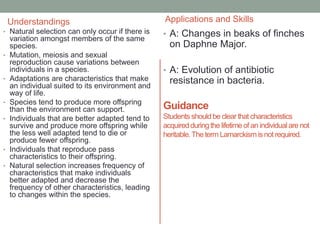
Guidance
Students shouldbe clearthat characteristics
acquiredduringthe lifetimeof an individualare not
heritable.Theterm Lamarckism isnot required.
Understandings
• Natural selection can only occur if there is
variation amongst members of the same
species.
• Mutation, meiosis and sexual
reproduction cause variations between
individuals in a species.
• Adaptations are characteristics that make
an individual suited to its environment and
way of life.
• Species tend to produce more offspring
than the environment can support.
• Individuals that are better adapted tend to
survive and produce more offspring while
the less well adapted tend to die or
produce fewer offspring.
• Individuals that reproduce pass
characteristics to their offspring.
• Natural selection increases frequency of
characteristics that make individuals
better adapted and decrease the
frequency of other characteristics, leading
to changes within the species.
Applications and Skills
• A: Changes in beaks of finches
on Daphne Major.
• A: Evolution of antibiotic
resistance in bacteria.
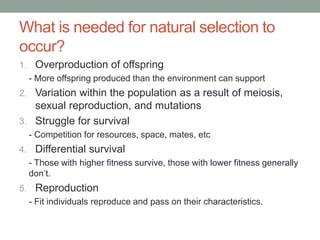
What is needed for natural selection to
occur?
1. Overproduction of offspring
- More offspring produced than the environment can support
2. Variation within the population as a result of meiosis,
sexual reproduction, and mutations
3. Struggle for survival
- Competition for resources, space, mates, etc
4. Differential survival
- Those with higher fitness survive, those with lower fitness generally
don’t.
5. Reproduction
- Fit individuals reproduce and pass on their characteristics.
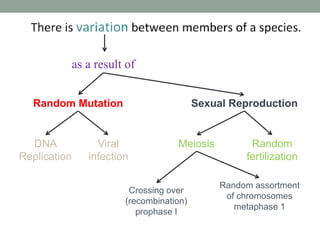
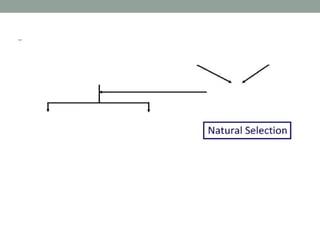
as a result of
Random Mutation Sexual Reproduction
DNA
Replication
Viral
infection
Meiosis Random
fertilization
Random assortment
of chromosomes
metaphase 1
Crossing over
(recombination)
prophase I
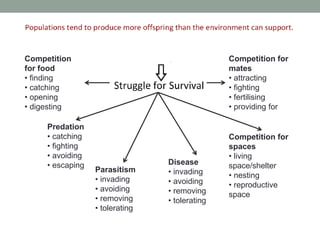
Competition
for food
• finding
• catching
• opening
• digesting
Predation
• catching
• fighting
• avoiding
• escaping
Parasitism
• invading
• avoiding
• removing
• tolerating
Disease
• invading
• avoiding
• removing
• tolerating
Competition for
mates
• attracting
• fighting
• fertilising
• providing for
Competition for
spaces
• living
space/shelter
• nesting
• reproductive
space
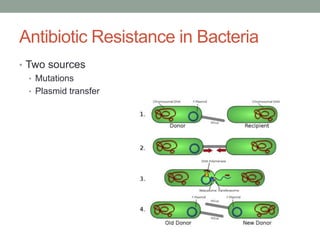
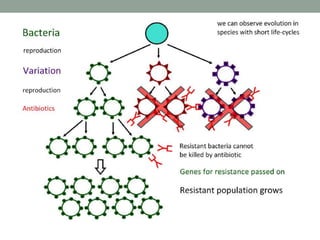
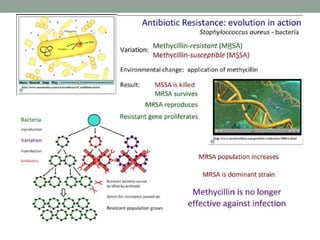
Antibiotic Resistance in Bacteria
• Two sources
• Mutations
• Plasmid transfer
Homework!
• Plasmid
• Pilli/pillus
• Plasmid transfer
• Exercises 5-8 on pg 239
• Describe the study done
by Rosemary and Peter
Grant on the differences
in beak sizes of ground
finches (Geospiza fortis)
from Daphne Major.
Explain their findings.
How does this support the
theory of evolution?
For 5.3
• Notes including tables organizing the required organisms
from the Applications for this section (pg 240)
• See the worked example on 254
• Exercises 9-12

5.2 natural selection

  • 1.
  • 2.
    Guidance Students shouldbe clearthatcharacteristics acquiredduringthe lifetimeof an individualare not heritable.Theterm Lamarckism isnot required. Understandings • Natural selection can only occur if there is variation amongst members of the same species. • Mutation, meiosis and sexual reproduction cause variations between individuals in a species. • Adaptations are characteristics that make an individual suited to its environment and way of life. • Species tend to produce more offspring than the environment can support. • Individuals that are better adapted tend to survive and produce more offspring while the less well adapted tend to die or produce fewer offspring. • Individuals that reproduce pass characteristics to their offspring. • Natural selection increases frequency of characteristics that make individuals better adapted and decrease the frequency of other characteristics, leading to changes within the species. Applications and Skills • A: Changes in beaks of finches on Daphne Major. • A: Evolution of antibiotic resistance in bacteria.
  • 3.
    What is neededfor natural selection to occur? 1. Overproduction of offspring - More offspring produced than the environment can support 2. Variation within the population as a result of meiosis, sexual reproduction, and mutations 3. Struggle for survival - Competition for resources, space, mates, etc 4. Differential survival - Those with higher fitness survive, those with lower fitness generally don’t. 5. Reproduction - Fit individuals reproduce and pass on their characteristics.
  • 4.
    as a resultof Random Mutation Sexual Reproduction DNA Replication Viral infection Meiosis Random fertilization Random assortment of chromosomes metaphase 1 Crossing over (recombination) prophase I
  • 5.
    Competition for food • finding •catching • opening • digesting Predation • catching • fighting • avoiding • escaping Parasitism • invading • avoiding • removing • tolerating Disease • invading • avoiding • removing • tolerating Competition for mates • attracting • fighting • fertilising • providing for Competition for spaces • living space/shelter • nesting • reproductive space
  • 7.
    Antibiotic Resistance inBacteria • Two sources • Mutations • Plasmid transfer
  • 10.
    Homework! • Plasmid • Pilli/pillus •Plasmid transfer • Exercises 5-8 on pg 239 • Describe the study done by Rosemary and Peter Grant on the differences in beak sizes of ground finches (Geospiza fortis) from Daphne Major. Explain their findings. How does this support the theory of evolution?
  • 11.
    For 5.3 • Notesincluding tables organizing the required organisms from the Applications for this section (pg 240) • See the worked example on 254 • Exercises 9-12