Social Influences
To Start: Recap from last lesson…
5 minutes
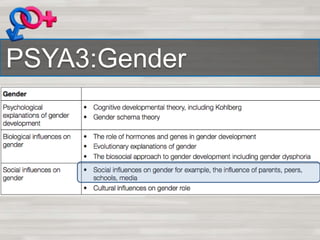
PSYA3:Gender
1: AO1 Parents
Social Influences
Children observe parent’s behaviour
Parent’s model Gender-Appropriate behaviour
Reinforcement / Punishment of gender-(non)stereotyped
behaviour
Some parents may offer ‘direct tuition’ of gender-stereotyped
behaviour, i.e. encouraging a girl to do housework or a boy to play
sport
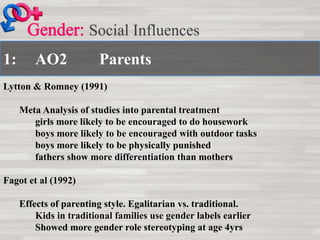
1: AO2 Parents
Social Influences
Lytton & Romney (1991)
Meta Analysis of studies into parental treatment
girls more likely to be encouraged to do housework
boys more likely to be encouraged with outdoor tasks
boys more likely to be physically punished
fathers show more differentiation than mothers
Fagot et al (1992)
Effects of parenting style. Egalitarian vs. traditional.
Kids in traditional families use gender labels earlier
Showed more gender role stereotyping at age 4yrs
1: AO3 Parents
Social Influences
Gender
Reductionist
Ethics
Nature Nurture
Animal
Determinism
Ethnocentric
Meta analysis research from mainly North
America, doesn’t consider parenting in
other cultures
Doesn’t consider single-parent families or
homosexual parents where a same-gender role
model may not be present
Only considers upbringing (not impact of genes)
2: AO1 Peers
Social Influences
Other same-aged children show Punishment of non- gender-
appropriate behaviour
Observing other children receive punishment can also cause
children to learn vicariously about gender-appropriate behaviour
2: AO2 Peers
Social Influences
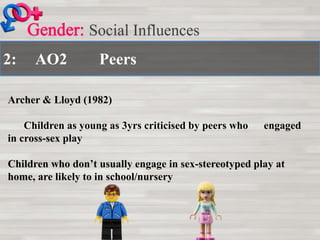
Archer & Lloyd (1982)
Children as young as 3yrs criticised by peers who engaged
in cross-sex play
Children who don’t usually engage in sex-stereotyped play at
home, are likely to in school/nursery
2: AO3 Peers
Social Influences
Gender
Reductionist
Ethics
Nature Nurture
Animal
Determinism
Ethnocentric
Temporal Validity
Doesn’t consider changes in gender
stereotyped behaviour in schools and
playgroups which are now much more
flexible. Research may be archaic and lack
temporal validity
3: AO1 Media
Social Influences
Bandura demonstrated the power of role models in film on
behaviour
Children observe sex-stereotyped behaviours in media role models
Magazines aimed at young people are also often aimed at
particular genders and reinforce gender-stereotype behaviour
males – sport/computer games
females – fashion/celebrities
3: AO2 Media
Social Influences
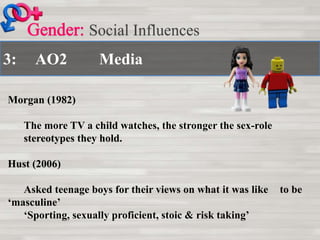
Morgan (1982)
The more TV a child watches, the stronger the sex-role
stereotypes they hold.
Hust (2006)
Asked teenage boys for their views on what it was like to be
‘masculine’
‘Sporting, sexually proficient, stoic & risk taking’
: AO3 Media
Social Influences
Gender
Reductionist
Ethics
Nature Nurture
Animal
Determinism
Ethnocentric
Temporal Validity
Difficult to measure influence of media
Ignores biological factors of Gender
Most research conducted in Westernized culture
Media is becoming more gender-neutral
PSYA3 Gender:
Cultural Influences
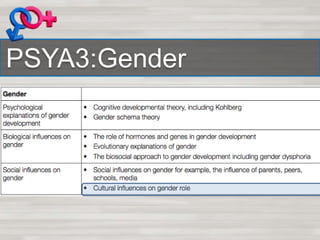
PSYA3:Gender
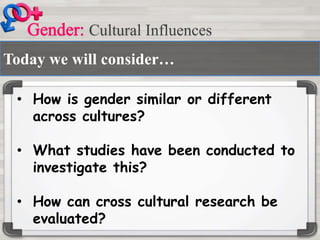
Today we will consider…
• How is gender similar or different
across cultures?
• What studies have been conducted to
investigate this?
• How can cross cultural research be
evaluated?
Cultural Influences
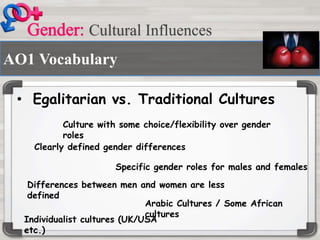
AO1 Vocabulary
• Egalitarian vs. Traditional Cultures
Cultural Influences
Culture with some choice/flexibility over gender
roles
Differences between men and women are less
defined
Clearly defined gender differences
Specific gender roles for males and females
Arabic Cultures / Some African
cultures
Individualist cultures (UK/USA
etc.)
AO1 Vocabulary
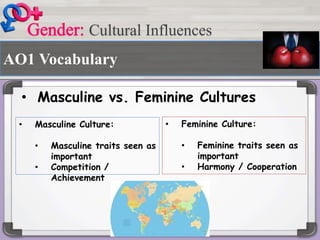
• Masculine vs. Feminine Cultures
Cultural Influences
• Masculine Culture:
• Masculine traits seen as
important
• Competition /
Achievement
• Feminine Culture:
• Feminine traits seen as
important
• Harmony / Cooperation
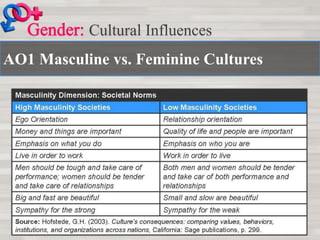
AO1 Masculine vs. Feminine Cultures
Cultural Influences
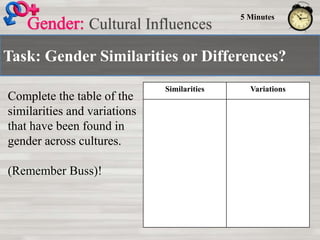
Task: Gender Similarities or Differences?
Cultural Influences
5 Minutes
Complete the table of the
similarities and variations
that have been found in
gender across cultures.
(Remember Buss)!
Similarities Variations
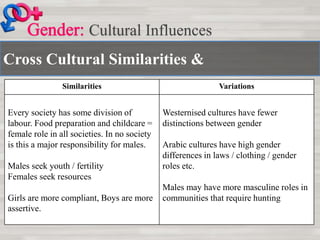
Cross Cultural Similarities &
Cultural Influences
Similarities Variations
Every society has some division of
labour. Food preparation and childcare =
female role in all societies. In no society
is this a major responsibility for males.
Males seek youth / fertility
Females seek resources
Girls are more compliant, Boys are more
assertive.
Westernised cultures have fewer
distinctions between gender
Arabic cultures have high gender
differences in laws / clothing / gender
roles etc.
Males may have more masculine roles in
communities that require hunting
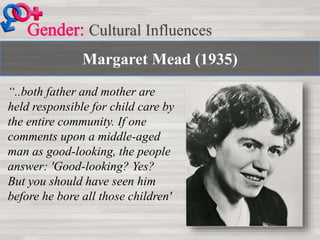
Margaret Mead (1935)
Cultural Influences
“..both father and mother are
held responsible for child care by
the entire community. If one
comments upon a middle-aged
man as good-looking, the people
answer: 'Good-looking? Yes?
But you should have seen him
before he bore all those children'
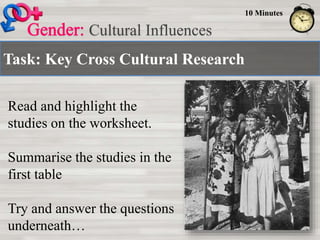
Task: Key Cross Cultural Research
Cultural Influences
10 Minutes
Read and highlight the
studies on the worksheet.
Summarise the studies in the
first table
Try and answer the questions
underneath…
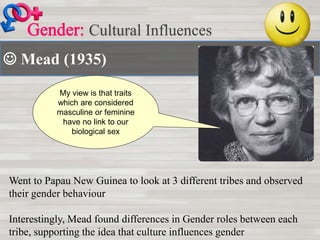
 Mead (1935)
Cultural Influences
My view is that traits
which are considered
masculine or feminine
have no link to our
biological sex
Went to Papau New Guinea to look at 3 different tribes and observed
their gender behaviour
Interestingly, Mead found differences in Gender roles between each
tribe, supporting the idea that culture influences gender
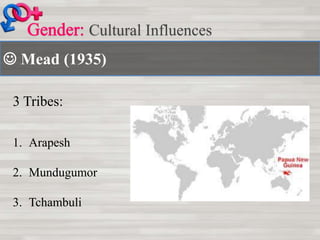
 Mead (1935)
Cultural Influences
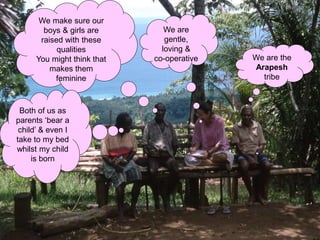
3 Tribes:
1. Arapesh
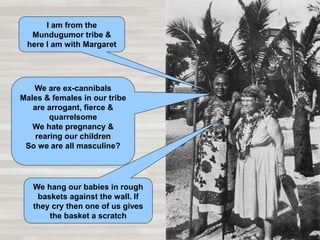
2. Mundugumor
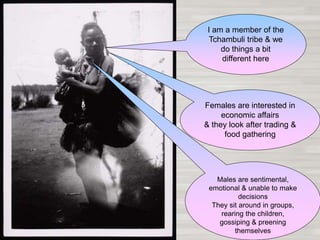
3. Tchambuli
We are the
Arapesh
tribe
We are
gentle,
loving &
co-operative
We make sure our
boys & girls are
raised with these
qualities
You might think that
makes them
feminine
Both of us as
parents ‘bear a
child’ & even I
take to my bed
whilst my child
is born
I am from the
Mundugumor tribe &
here I am with Margaret
We are ex-cannibals
Males & females in our tribe
are arrogant, fierce &
quarrelsome
We hate pregnancy &
rearing our children
So we are all masculine?
We hang our babies in rough
baskets against the wall. If
they cry then one of us gives
the basket a scratch
I am a member of the
Tchambuli tribe & we
do things a bit
different here
Females are interested in
economic affairs
& they look after trading &
food gathering
Males are sentimental,
emotional & unable to make
decisions
They sit around in groups,
rearing the children,
gossiping & preening
themselves
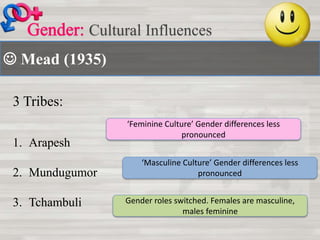
 Mead (1935)
Cultural Influences
3 Tribes:
1. Arapesh
2. Mundugumor
3. Tchambuli
‘Feminine Culture’ Gender differences less
pronounced
‘Masculine Culture’ Gender differences less
pronounced
Gender roles switched. Females are masculine,
males feminine
 Whiting et al (1975)
Cultural Influences
Studied Child-rearing practices in 6 different cultures:
USA; Mexico; India; Japan; Kenya & the Philippines
Researchers integrated themselves within the
communities and carried out observations of children’s
daily lives.
 Whiting et al (1975)
Cultural Influences
Results:
Extent of gender role differences correlated with how much
work children were expected to do
USA: 2% of child’s time spent working
- gender roles negligible
Kenya: 41% of child’s time spent working
- distinct differences in gender roles
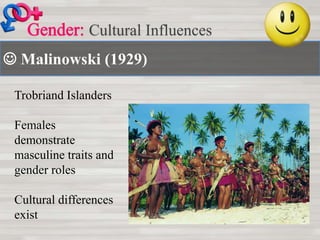
 Malinowski (1929)
Cultural Influences
Trobriand Islanders
Females
demonstrate
masculine traits and
gender roles
Cultural differences
exist
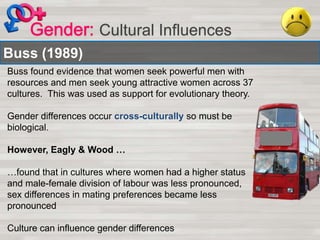
Cultural Influences
Buss (1989)
Buss found evidence that women seek powerful men with
resources and men seek young attractive women across 37
cultures. This was used as support for evolutionary theory.
Gender differences occur cross-culturally so must be
biological.
However, Eagly & Wood …
…found that in cultures where women had a higher status
and male-female division of labour was less pronounced,
sex differences in mating preferences became less
pronounced
Culture can influence gender differences
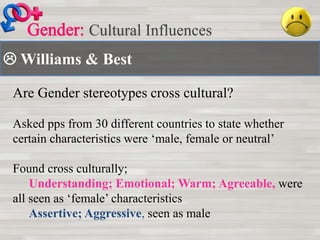
 Williams & Best
Cultural Influences
Are Gender stereotypes cross cultural?
Asked pps from 30 different countries to state whether
certain characteristics were ‘male, female or neutral’
Found cross culturally;
Understanding; Emotional; Warm; Agreeable, were
all seen as ‘female’ characteristics
Assertive; Aggressive, seen as male
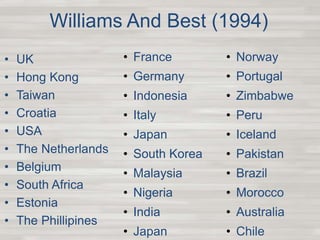
Williams And Best (1994)
• UK
• Hong Kong
• Taiwan
• Croatia
• USA
• The Netherlands
• Belgium
• South Africa
• Estonia
• The Phillipines
• France
• Germany
• Indonesia
• Italy
• Japan
• South Korea
• Malaysia
• Nigeria
• India
• Japan
• Norway
• Portugal
• Zimbabwe
• Peru
• Iceland
• Pakistan
• Brazil
• Morocco
• Australia
• Chile
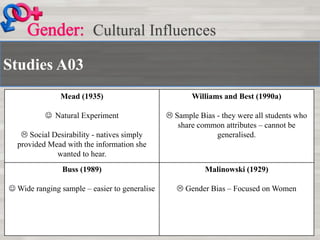
Studies A03
Cultural Influences
Mead (1935)
 Natural Experiment
 Social Desirability - natives simply
provided Mead with the information she
wanted to hear.
Williams and Best (1990a)
 Sample Bias - they were all students who
share common attributes – cannot be
generalised.
Buss (1989)
 Wide ranging sample – easier to generalise
Malinowski (1929)
 Gender Bias – Focused on Women
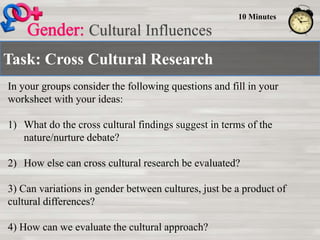
Task: Cross Cultural Research
Cultural Influences
10 Minutes
In your groups consider the following questions and fill in your
worksheet with your ideas:
1) What do the cross cultural findings suggest in terms of the
nature/nurture debate?
2) How else can cross cultural research be evaluated?
3) Can variations in gender between cultures, just be a product of
cultural differences?
4) How can we evaluate the cultural approach?
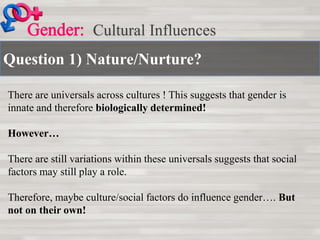
Question 1) Nature/Nurture?
Cultural Influences
There are universals across cultures ! This suggests that gender is
innate and therefore biologically determined!
However…
There are still variations within these universals suggests that social
factors may still play a role.
Therefore, maybe culture/social factors do influence gender…. But
not on their own!
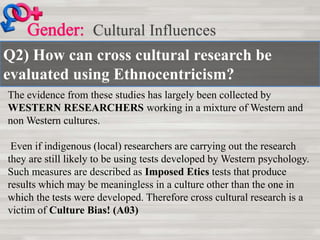
Q2) How can cross cultural research be
evaluated using Ethnocentricism?
Cultural Influences
The evidence from these studies has largely been collected by
WESTERN RESEARCHERS working in a mixture of Western and
non Western cultures.
Even if indigenous (local) researchers are carrying out the research
they are still likely to be using tests developed by Western psychology.
Such measures are described as Imposed Etics tests that produce
results which may be meaningless in a culture other than the one in
which the tests were developed. Therefore cross cultural research is a
victim of Culture Bias! (A03)
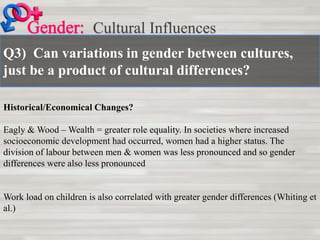
Q3) Can variations in gender between cultures,
just be a product of cultural differences?
Cultural Influences
Historical/Economical Changes?
Eagly & Wood – Wealth = greater role equality. In societies where increased
socioeconomic development had occurred, women had a higher status. The
division of labour between men & women was less pronounced and so gender
differences were also less pronounced
Work load on children is also correlated with greater gender differences (Whiting et
al.)
Q4) How can we evaluate the Cultural Approach?
Cultural Influences
Determinism?
Mead later changed her view to one of cultural relativism.
When she re analysed her data she realised that although both sexes of the
Arapesh were non aggressive and both sexes of the Mundugamor were
aggressive, in all societies the men were more aggressive than women. This
suggests that some behaviours are innate and universal but the degree to which
these behaviours are expressed is relative to the particular culture.
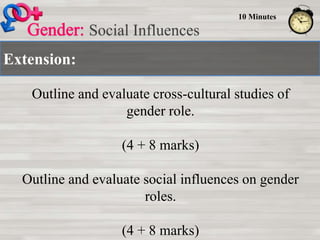
Extension:
Social Influences
10 Minutes
Outline and evaluate cross-cultural studies of
gender role.
(4 + 8 marks)
Outline and evaluate social influences on gender
roles.
(4 + 8 marks)
Revision Notes
Social Influences
10 Minutes
Revision Notes for all 3 topics in PSYA3 should
be completed and organised by NEXT MONDAY
AGGRESSION
RELATIONSHIPS
GENDER

Gender and culture

  • 1.
    Social Influences To Start:Recap from last lesson… 5 minutes
  • 2.
  • 3.
    1: AO1 Parents SocialInfluences Children observe parent’s behaviour Parent’s model Gender-Appropriate behaviour Reinforcement / Punishment of gender-(non)stereotyped behaviour Some parents may offer ‘direct tuition’ of gender-stereotyped behaviour, i.e. encouraging a girl to do housework or a boy to play sport
  • 4.
    1: AO2 Parents SocialInfluences Lytton & Romney (1991) Meta Analysis of studies into parental treatment girls more likely to be encouraged to do housework boys more likely to be encouraged with outdoor tasks boys more likely to be physically punished fathers show more differentiation than mothers Fagot et al (1992) Effects of parenting style. Egalitarian vs. traditional. Kids in traditional families use gender labels earlier Showed more gender role stereotyping at age 4yrs
  • 5.
    1: AO3 Parents SocialInfluences Gender Reductionist Ethics Nature Nurture Animal Determinism Ethnocentric Meta analysis research from mainly North America, doesn’t consider parenting in other cultures Doesn’t consider single-parent families or homosexual parents where a same-gender role model may not be present Only considers upbringing (not impact of genes)
  • 6.
    2: AO1 Peers SocialInfluences Other same-aged children show Punishment of non- gender- appropriate behaviour Observing other children receive punishment can also cause children to learn vicariously about gender-appropriate behaviour
  • 7.
    2: AO2 Peers SocialInfluences Archer & Lloyd (1982) Children as young as 3yrs criticised by peers who engaged in cross-sex play Children who don’t usually engage in sex-stereotyped play at home, are likely to in school/nursery
  • 8.
    2: AO3 Peers SocialInfluences Gender Reductionist Ethics Nature Nurture Animal Determinism Ethnocentric Temporal Validity Doesn’t consider changes in gender stereotyped behaviour in schools and playgroups which are now much more flexible. Research may be archaic and lack temporal validity
  • 9.
    3: AO1 Media SocialInfluences Bandura demonstrated the power of role models in film on behaviour Children observe sex-stereotyped behaviours in media role models Magazines aimed at young people are also often aimed at particular genders and reinforce gender-stereotype behaviour males – sport/computer games females – fashion/celebrities
  • 10.
    3: AO2 Media SocialInfluences Morgan (1982) The more TV a child watches, the stronger the sex-role stereotypes they hold. Hust (2006) Asked teenage boys for their views on what it was like to be ‘masculine’ ‘Sporting, sexually proficient, stoic & risk taking’
  • 11.
    : AO3 Media SocialInfluences Gender Reductionist Ethics Nature Nurture Animal Determinism Ethnocentric Temporal Validity Difficult to measure influence of media Ignores biological factors of Gender Most research conducted in Westernized culture Media is becoming more gender-neutral
  • 12.
  • 13.
  • 14.
    Today we willconsider… • How is gender similar or different across cultures? • What studies have been conducted to investigate this? • How can cross cultural research be evaluated? Cultural Influences
  • 15.
    AO1 Vocabulary • Egalitarianvs. Traditional Cultures Cultural Influences Culture with some choice/flexibility over gender roles Differences between men and women are less defined Clearly defined gender differences Specific gender roles for males and females Arabic Cultures / Some African cultures Individualist cultures (UK/USA etc.)
  • 16.
    AO1 Vocabulary • Masculinevs. Feminine Cultures Cultural Influences • Masculine Culture: • Masculine traits seen as important • Competition / Achievement • Feminine Culture: • Feminine traits seen as important • Harmony / Cooperation
  • 17.
    AO1 Masculine vs.Feminine Cultures Cultural Influences
  • 18.
    Task: Gender Similaritiesor Differences? Cultural Influences 5 Minutes Complete the table of the similarities and variations that have been found in gender across cultures. (Remember Buss)! Similarities Variations
  • 19.
    Cross Cultural Similarities& Cultural Influences Similarities Variations Every society has some division of labour. Food preparation and childcare = female role in all societies. In no society is this a major responsibility for males. Males seek youth / fertility Females seek resources Girls are more compliant, Boys are more assertive. Westernised cultures have fewer distinctions between gender Arabic cultures have high gender differences in laws / clothing / gender roles etc. Males may have more masculine roles in communities that require hunting
  • 20.
    Margaret Mead (1935) CulturalInfluences “..both father and mother are held responsible for child care by the entire community. If one comments upon a middle-aged man as good-looking, the people answer: 'Good-looking? Yes? But you should have seen him before he bore all those children'
  • 21.
    Task: Key CrossCultural Research Cultural Influences 10 Minutes Read and highlight the studies on the worksheet. Summarise the studies in the first table Try and answer the questions underneath…
  • 22.
     Mead (1935) CulturalInfluences My view is that traits which are considered masculine or feminine have no link to our biological sex Went to Papau New Guinea to look at 3 different tribes and observed their gender behaviour Interestingly, Mead found differences in Gender roles between each tribe, supporting the idea that culture influences gender
  • 23.
     Mead (1935) CulturalInfluences 3 Tribes: 1. Arapesh 2. Mundugumor 3. Tchambuli
  • 24.
    We are the Arapesh tribe Weare gentle, loving & co-operative We make sure our boys & girls are raised with these qualities You might think that makes them feminine Both of us as parents ‘bear a child’ & even I take to my bed whilst my child is born
  • 25.
    I am fromthe Mundugumor tribe & here I am with Margaret We are ex-cannibals Males & females in our tribe are arrogant, fierce & quarrelsome We hate pregnancy & rearing our children So we are all masculine? We hang our babies in rough baskets against the wall. If they cry then one of us gives the basket a scratch
  • 26.
    I am amember of the Tchambuli tribe & we do things a bit different here Females are interested in economic affairs & they look after trading & food gathering Males are sentimental, emotional & unable to make decisions They sit around in groups, rearing the children, gossiping & preening themselves
  • 27.
     Mead (1935) CulturalInfluences 3 Tribes: 1. Arapesh 2. Mundugumor 3. Tchambuli ‘Feminine Culture’ Gender differences less pronounced ‘Masculine Culture’ Gender differences less pronounced Gender roles switched. Females are masculine, males feminine
  • 28.
     Whiting etal (1975) Cultural Influences Studied Child-rearing practices in 6 different cultures: USA; Mexico; India; Japan; Kenya & the Philippines Researchers integrated themselves within the communities and carried out observations of children’s daily lives.
  • 29.
     Whiting etal (1975) Cultural Influences Results: Extent of gender role differences correlated with how much work children were expected to do USA: 2% of child’s time spent working - gender roles negligible Kenya: 41% of child’s time spent working - distinct differences in gender roles
  • 30.
     Malinowski (1929) CulturalInfluences Trobriand Islanders Females demonstrate masculine traits and gender roles Cultural differences exist
  • 31.
    Cultural Influences Buss (1989) Bussfound evidence that women seek powerful men with resources and men seek young attractive women across 37 cultures. This was used as support for evolutionary theory. Gender differences occur cross-culturally so must be biological. However, Eagly & Wood … …found that in cultures where women had a higher status and male-female division of labour was less pronounced, sex differences in mating preferences became less pronounced Culture can influence gender differences
  • 32.
     Williams &Best Cultural Influences Are Gender stereotypes cross cultural? Asked pps from 30 different countries to state whether certain characteristics were ‘male, female or neutral’ Found cross culturally; Understanding; Emotional; Warm; Agreeable, were all seen as ‘female’ characteristics Assertive; Aggressive, seen as male
  • 33.
    Williams And Best(1994) • UK • Hong Kong • Taiwan • Croatia • USA • The Netherlands • Belgium • South Africa • Estonia • The Phillipines • France • Germany • Indonesia • Italy • Japan • South Korea • Malaysia • Nigeria • India • Japan • Norway • Portugal • Zimbabwe • Peru • Iceland • Pakistan • Brazil • Morocco • Australia • Chile
  • 34.
    Studies A03 Cultural Influences Mead(1935)  Natural Experiment  Social Desirability - natives simply provided Mead with the information she wanted to hear. Williams and Best (1990a)  Sample Bias - they were all students who share common attributes – cannot be generalised. Buss (1989)  Wide ranging sample – easier to generalise Malinowski (1929)  Gender Bias – Focused on Women
  • 35.
    Task: Cross CulturalResearch Cultural Influences 10 Minutes In your groups consider the following questions and fill in your worksheet with your ideas: 1) What do the cross cultural findings suggest in terms of the nature/nurture debate? 2) How else can cross cultural research be evaluated? 3) Can variations in gender between cultures, just be a product of cultural differences? 4) How can we evaluate the cultural approach?
  • 36.
    Question 1) Nature/Nurture? CulturalInfluences There are universals across cultures ! This suggests that gender is innate and therefore biologically determined! However… There are still variations within these universals suggests that social factors may still play a role. Therefore, maybe culture/social factors do influence gender…. But not on their own!
  • 37.
    Q2) How cancross cultural research be evaluated using Ethnocentricism? Cultural Influences The evidence from these studies has largely been collected by WESTERN RESEARCHERS working in a mixture of Western and non Western cultures. Even if indigenous (local) researchers are carrying out the research they are still likely to be using tests developed by Western psychology. Such measures are described as Imposed Etics tests that produce results which may be meaningless in a culture other than the one in which the tests were developed. Therefore cross cultural research is a victim of Culture Bias! (A03)
  • 38.
    Q3) Can variationsin gender between cultures, just be a product of cultural differences? Cultural Influences Historical/Economical Changes? Eagly & Wood – Wealth = greater role equality. In societies where increased socioeconomic development had occurred, women had a higher status. The division of labour between men & women was less pronounced and so gender differences were also less pronounced Work load on children is also correlated with greater gender differences (Whiting et al.)
  • 39.
    Q4) How canwe evaluate the Cultural Approach? Cultural Influences Determinism? Mead later changed her view to one of cultural relativism. When she re analysed her data she realised that although both sexes of the Arapesh were non aggressive and both sexes of the Mundugamor were aggressive, in all societies the men were more aggressive than women. This suggests that some behaviours are innate and universal but the degree to which these behaviours are expressed is relative to the particular culture.
  • 40.
    Extension: Social Influences 10 Minutes Outlineand evaluate cross-cultural studies of gender role. (4 + 8 marks) Outline and evaluate social influences on gender roles. (4 + 8 marks)
  • 41.
    Revision Notes Social Influences 10Minutes Revision Notes for all 3 topics in PSYA3 should be completed and organised by NEXT MONDAY AGGRESSION RELATIONSHIPS GENDER

Editor's Notes

  • #3 pick 1 of the first 4 bullet points to complete an exam question plan
  • #14 pick 1 of the first 4 bullet points to complete an exam question plan
  • #17 UK USA JAPAN vs. PAKISTAN & INDIA