Sexual Strategies
Sexual Strategies Sexual strategies  Intraselection (competition within a gender for mates) Interselection (mate choice)
Sexual Strategies Historically intrasexual selection was studied (e.g., male male competition) Now more attention to interselection (e.g., female choice of mates)
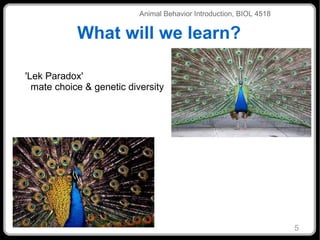
Sexual Strategies Both may occur For example the peacock feathers Intrasexual selection male/male  size of feathers Intersexual selection female/male – females prefer males with most dense occelli
What will we learn? 'Lek Paradox' mate choice & genetic diversity Animal Behavior Introduction, BIOL 4518
Sexual Strategies More recently competition between the sexes
Sexual Stragies e.g., strategies that tradeoff fitness of male and female What are Sexual strategies?  Finding a mate, securing reproductive success, reproductive success of males vs females (intersexual conflict) This is distinct from “Mating Systems” Monogamy Polyandry polygamy
Sexual strategies: You will need to be able to answer the following questions: How have the strategies resulted in positive fitness/evolutionarily beneficial (provide a description)?
Sexual strategies: You will need to be able to answer the following questions (cont): What are the costs/benefits that have selected for certain animal characteristics, such as sexual dimorphism, and multiple male morphs?
Sexual strategies You will need to be able to answer the following questions (cont.): What are the selective pressures on males and females (e.g., sexual conflict between genders within a species)?
Sexual strategies You will need to be able to answer the following questions (cont.): Why have multiple sexual strategies remained in population?
Sexual Strategies Use theoretical models to examine strategies
Topics Intrasexual strategies Competition for mates Conditional Strategies Intersexual competition Female choice Intersexual conflict Honest signalling
Concept behind competition for mates Factors Energy investment in reproduction Availability of mates Concept is that females have greater investment in reproduction therefore tend to be choosier Greater gamete size, and typically greater gestation, parental care than males Males therefore compete for females;
Conditional strategies A conditional strategy is a strategy only adopted under certain conditions Example Reverse gender role of aggression with:  high male parental care,  low male availability  Different strategies by Multiple morphs  Sneaker strategy Gender switching
Intraselection  Mate selection systems Male dominance hierarchy system established for mating Males compete with each other until they win the right to be around a female unmolested by males until she is ready to mate. A losing male may mate with a female if more than one female is in estrous at a time E.g., mountain sheep;  Exception – sneaker role, where very low ranking male mates with a female while more dominant males are fighting for highest rank.
Ritualized aggression in mating systems Aggression in mating systems is often ritualized.  e.g., weaponry for killing is often not used Venomous snakes wrestle without biting, fish lock jaws but do not bite; antelopes  push and fence with the probable winner.  Communication system e.g., roaring in red deer and outcome of competition
Intraselection Mate selection systems, Lek:  Single area seemingly randomly selected area “matrix” within the territory that all males go to and compete for and defend a spot nearest the center (even when they doen’t stand a chance of mating).
Mate selection systems,  Lek:  Leks may last for weeks. Area is same year to year. Area offers no food or place to rest.  Number of copulations is highly skewed to one male with the territory in the center who may do 50-75% of the copulations (e.g., kobs and grouse), and neighbors may account for the remainder while the majority of males do not mate at all.  Female “honor” the lek system.
Mate selection systems, Lek:  E.g., Hawaiian drosophila,  2 species of grouse, 2 species of tropical birds, African antelope (e.g., the Uganda kobs), prairie chicken, kakapo (flightless parrot in New Zealand) Some species leks are brothers or half brothers Female lek (females aggregate and compete for males) yellow spotted millipede
Male Competition: Interference Previous examples have been male/male competition before females arrive Also, competition during attempt to copulation Larger bodied males interrupt copulation between smaller bodied males and females Solicitation help by females in elephant seals Earwigs, elephant seals
Male Competition: Cuckoldry Bluegill sunfish 3 male morphs Parental male Sneaker male Satellite male Parental – maintain territory, mate with female Sneaker -  no territory, sneak to fertilize eggs when parental mates with femal Satellite – looks like a female; fools male (who tries to mate with satellite) and fertilizes egg
Male Competition: Sperm competition Sperm competition Parental male Sneaker male Sneaker male –  more sperm per ejaculate Short lived sperm Increases chance of fertilization Parental male –  less dense longer lived high quality sperm When same density, equal fertilization by parental and sneaker sperm
Mate guarding Males guard females from other males Monogamous systems
Male mating strategies:  Sexual Dimorphism Hypothesize  Sexual dimorphism is largest when harem size is large and hence when male/male competition is most intense 38 species of pinnipeds (harbor seals, elephant seals etc.) Independent contrasts phylogenetic analysis Found support for this hypothesis
Alternative male strategies Sneaker role Different strategies by Multiple morphs  Sneaker strategy Gender switching
Alternative male strategies Horseshoe crab  Males which grasps onto female have higher chance of fertilizing eggs
Female Choice Theories behind female choice of mates: What are females using to select mates? Does the selection criteria increase females fitness or fitness of offspring? Theories: Good genes Gift Runaway selection hypothesis
Female choice Good genes Pronghorn harem size as indicator of genes, and correlation with growth rate of offspring
Female Choice Good genes MHC complex MHC number of alleles
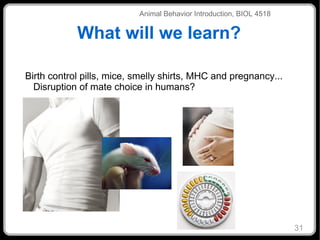
What will we learn? Birth control pills, mice, smelly shirts, MHC and pregnancy... Disruption of mate choice in humans? Animal Behavior Introduction, BIOL 4518
Female Choice Good genes Number of MHC alleles Female sticklebacks Number of MHC peptides – smell (proximate mechanism) Optimal number  - offspring with intermediate MHC diversity Experiment  Female and male fish of known allele number (2-8) Supplement water with MHC peptides increasing the apparent number of MHC alleles Examine female choice
Female Choice Males have large symbols Bower bird – size of the bower and amount of decoration Size of antlers Density of occelli in peacock’s tail (Size of peacock tail is part of male dominance hierarchy)
Female choice Gifts e.g., insects, provide a gift to female
Female choice  Males present with gifts Example  Male spider presents a wrapped up fly Body of male praying mantis  (removal of head removes reproduction FAP inhibitors)
Female Choice:  Mate Choice Copying Grouse in leks Evidence that young females tend to copy mate choice of older females Supported with experiment
Female choice Removal of spermatophore Sperm storage Choice of stored sperm to use
Female Choice Do females always choose the best mates? Choice of non-dominant male Primates; females may mate with persistent non-dominant males Direct fitness benefits? Indirect? Avoid non-dominant male Elephant seals, female will increase calls if non-dominant male attempts to mate Mate choice copying
Female Choice When is female mate choice not beneficial? Example of Drosophila largest males result in a reduced lifespan of the female Direct fitness benefits? Indirect? This leads us to intersexual (male/female) conflict
Intersexual conflict Conflict between fitness of males and females Examples: “Dishonest” signaling of health “Dishonest” gifts Arms race of detection of genetic quality and dishonest signaling
Signaling Healthy male Female preferences based on displays of male health Males display gene quality Runaway selection theory Endow offspring with genes to prefer traits mothers prefer
Intersexual conflict: “Dishonest” signaling Dishonest gift to females Only exoskeleton of body is presented How can this strategy persist in the population?
Summary

Lec 12 Sexual Strategies

  • 1.
  • 2.
    Sexual Strategies Sexualstrategies Intraselection (competition within a gender for mates) Interselection (mate choice)
  • 3.
    Sexual Strategies Historicallyintrasexual selection was studied (e.g., male male competition) Now more attention to interselection (e.g., female choice of mates)
  • 4.
    Sexual Strategies Bothmay occur For example the peacock feathers Intrasexual selection male/male size of feathers Intersexual selection female/male – females prefer males with most dense occelli
  • 5.
    What will welearn? 'Lek Paradox' mate choice & genetic diversity Animal Behavior Introduction, BIOL 4518
  • 6.
    Sexual Strategies Morerecently competition between the sexes
  • 7.
    Sexual Stragies e.g.,strategies that tradeoff fitness of male and female What are Sexual strategies? Finding a mate, securing reproductive success, reproductive success of males vs females (intersexual conflict) This is distinct from “Mating Systems” Monogamy Polyandry polygamy
  • 8.
    Sexual strategies: Youwill need to be able to answer the following questions: How have the strategies resulted in positive fitness/evolutionarily beneficial (provide a description)?
  • 9.
    Sexual strategies: Youwill need to be able to answer the following questions (cont): What are the costs/benefits that have selected for certain animal characteristics, such as sexual dimorphism, and multiple male morphs?
  • 10.
    Sexual strategies Youwill need to be able to answer the following questions (cont.): What are the selective pressures on males and females (e.g., sexual conflict between genders within a species)?
  • 11.
    Sexual strategies Youwill need to be able to answer the following questions (cont.): Why have multiple sexual strategies remained in population?
  • 12.
    Sexual Strategies Usetheoretical models to examine strategies
  • 13.
    Topics Intrasexual strategiesCompetition for mates Conditional Strategies Intersexual competition Female choice Intersexual conflict Honest signalling
  • 14.
    Concept behind competitionfor mates Factors Energy investment in reproduction Availability of mates Concept is that females have greater investment in reproduction therefore tend to be choosier Greater gamete size, and typically greater gestation, parental care than males Males therefore compete for females;
  • 15.
    Conditional strategies Aconditional strategy is a strategy only adopted under certain conditions Example Reverse gender role of aggression with: high male parental care, low male availability Different strategies by Multiple morphs Sneaker strategy Gender switching
  • 16.
    Intraselection Mateselection systems Male dominance hierarchy system established for mating Males compete with each other until they win the right to be around a female unmolested by males until she is ready to mate. A losing male may mate with a female if more than one female is in estrous at a time E.g., mountain sheep; Exception – sneaker role, where very low ranking male mates with a female while more dominant males are fighting for highest rank.
  • 17.
    Ritualized aggression inmating systems Aggression in mating systems is often ritualized. e.g., weaponry for killing is often not used Venomous snakes wrestle without biting, fish lock jaws but do not bite; antelopes push and fence with the probable winner. Communication system e.g., roaring in red deer and outcome of competition
  • 18.
    Intraselection Mate selectionsystems, Lek: Single area seemingly randomly selected area “matrix” within the territory that all males go to and compete for and defend a spot nearest the center (even when they doen’t stand a chance of mating).
  • 19.
    Mate selection systems, Lek: Leks may last for weeks. Area is same year to year. Area offers no food or place to rest. Number of copulations is highly skewed to one male with the territory in the center who may do 50-75% of the copulations (e.g., kobs and grouse), and neighbors may account for the remainder while the majority of males do not mate at all. Female “honor” the lek system.
  • 20.
    Mate selection systems,Lek: E.g., Hawaiian drosophila, 2 species of grouse, 2 species of tropical birds, African antelope (e.g., the Uganda kobs), prairie chicken, kakapo (flightless parrot in New Zealand) Some species leks are brothers or half brothers Female lek (females aggregate and compete for males) yellow spotted millipede
  • 21.
    Male Competition: InterferencePrevious examples have been male/male competition before females arrive Also, competition during attempt to copulation Larger bodied males interrupt copulation between smaller bodied males and females Solicitation help by females in elephant seals Earwigs, elephant seals
  • 22.
    Male Competition: CuckoldryBluegill sunfish 3 male morphs Parental male Sneaker male Satellite male Parental – maintain territory, mate with female Sneaker - no territory, sneak to fertilize eggs when parental mates with femal Satellite – looks like a female; fools male (who tries to mate with satellite) and fertilizes egg
  • 23.
    Male Competition: Spermcompetition Sperm competition Parental male Sneaker male Sneaker male – more sperm per ejaculate Short lived sperm Increases chance of fertilization Parental male – less dense longer lived high quality sperm When same density, equal fertilization by parental and sneaker sperm
  • 24.
    Mate guarding Malesguard females from other males Monogamous systems
  • 25.
    Male mating strategies: Sexual Dimorphism Hypothesize Sexual dimorphism is largest when harem size is large and hence when male/male competition is most intense 38 species of pinnipeds (harbor seals, elephant seals etc.) Independent contrasts phylogenetic analysis Found support for this hypothesis
  • 26.
    Alternative male strategiesSneaker role Different strategies by Multiple morphs Sneaker strategy Gender switching
  • 27.
    Alternative male strategiesHorseshoe crab Males which grasps onto female have higher chance of fertilizing eggs
  • 28.
    Female Choice Theoriesbehind female choice of mates: What are females using to select mates? Does the selection criteria increase females fitness or fitness of offspring? Theories: Good genes Gift Runaway selection hypothesis
  • 29.
    Female choice Goodgenes Pronghorn harem size as indicator of genes, and correlation with growth rate of offspring
  • 30.
    Female Choice Goodgenes MHC complex MHC number of alleles
  • 31.
    What will welearn? Birth control pills, mice, smelly shirts, MHC and pregnancy... Disruption of mate choice in humans? Animal Behavior Introduction, BIOL 4518
  • 32.
    Female Choice Goodgenes Number of MHC alleles Female sticklebacks Number of MHC peptides – smell (proximate mechanism) Optimal number - offspring with intermediate MHC diversity Experiment Female and male fish of known allele number (2-8) Supplement water with MHC peptides increasing the apparent number of MHC alleles Examine female choice
  • 33.
    Female Choice Maleshave large symbols Bower bird – size of the bower and amount of decoration Size of antlers Density of occelli in peacock’s tail (Size of peacock tail is part of male dominance hierarchy)
  • 34.
    Female choice Giftse.g., insects, provide a gift to female
  • 35.
    Female choice Males present with gifts Example Male spider presents a wrapped up fly Body of male praying mantis (removal of head removes reproduction FAP inhibitors)
  • 36.
    Female Choice: Mate Choice Copying Grouse in leks Evidence that young females tend to copy mate choice of older females Supported with experiment
  • 37.
    Female choice Removalof spermatophore Sperm storage Choice of stored sperm to use
  • 38.
    Female Choice Dofemales always choose the best mates? Choice of non-dominant male Primates; females may mate with persistent non-dominant males Direct fitness benefits? Indirect? Avoid non-dominant male Elephant seals, female will increase calls if non-dominant male attempts to mate Mate choice copying
  • 39.
    Female Choice Whenis female mate choice not beneficial? Example of Drosophila largest males result in a reduced lifespan of the female Direct fitness benefits? Indirect? This leads us to intersexual (male/female) conflict
  • 40.
    Intersexual conflict Conflictbetween fitness of males and females Examples: “Dishonest” signaling of health “Dishonest” gifts Arms race of detection of genetic quality and dishonest signaling
  • 41.
    Signaling Healthy maleFemale preferences based on displays of male health Males display gene quality Runaway selection theory Endow offspring with genes to prefer traits mothers prefer
  • 42.
    Intersexual conflict: “Dishonest”signaling Dishonest gift to females Only exoskeleton of body is presented How can this strategy persist in the population?
  • 43.