Caregiver-infant interactions
◦ Who tested the correlation between physical contact and
attachment?
◦ What is reciprocity? (TT)
◦ One factor of infant-caregiver attachment is “I____________
S____________”
◦ What did Meltzoff and Moore find?
Homework…
What we’ve looked at so far…
◦ Physical Contact
◦ Reciprocity
◦ Interactional Synchrony
◦ Evaluate these theories/research using PEE’s for each point made…
◦  Intentional Behaviour
◦  Ethics and infants
◦  Failure to replicate
◦  Individual differences
 Intentional Behaviour
◦ P – People have argued that the infants do not imitate facial expressions as an
intentional effort to encourage social attachments
◦ E – However, research has found that infants will not imitate the same facial
expressions used in Meltzoff and Moore’s study when they are simulated by
inanimate objects
◦ E – This suggests that interactional synchrony and imitation is used by infants
as a social response to aid attachment building and therefore is intentional .
 Failure to Replicate
◦ P - Despite findings demonstrating new born imitation, Meltzoff and Moore’s study
has been criticised as being unreliable due to replications not finding the same results
◦ E - Koepke (1983) carried out the same experiment as Meltzoff and Moore and failed
to identify any evidence of new born imitation
◦ E - The lack of replicability questions the original findings’ reliability which may have
been vulnerable to experimental bias.
 Individual Differences
◦ P – There may be individual differences in the level of reciprocity and
interactional synchrony seen in infants and care givers
◦ E – Isabelle (1989) found that more strongly attached infants are likely
to demonstrate greater levels of interactional synchrony
◦ E – Therefore these behaviours will differ dependent on strength of
attachment
 Ethics & Infants
◦ P - Experimenting infant-caregiver interactions can be difficult to pass through Ethical
Guidelines.
◦ E - Observation techniques used may breach Informed Consent guidelines, especially
if they are naturalistic, covert observation methods
◦ E - Researchers can also not guarantee protection from harm as the discovery of an
insecure attachment with one’s infant may be psychologically distressing for the care
giver in question.
Observational Research
◦ Observing participant(s) behaviour…
◦ Naturalistic vs. Controlled Observations
◦ Naturalistic = nothing has been manipulated by experimenter
◦ Controlled = researcher regulates aspects of environment
◦ Overt vs. Covert Observations
Observational Research
◦  High Ecological Validity (natural observations)
◦  Practical Method for things you can’t test (i.e. aggression in football
hooligans)
◦  No demand characteristics (covert observations)
Observational Research
◦ Researchers use either event-sampling or time-sampling to collect
data
◦ Event sampling = ‘how often did the infant stick out it’s tongue’
◦ Time Sampling = ‘Record behaviour at every 20 seconds’
Tronick’s Still Face Experiment
◦ Tronick wanted to observe caregiver-infant interactions
◦ He wanted to see what would happen if interactional synchrony and
reciprocity were lost
◦ Mothers were instructed to interact normally with the infant and then
stop responding and show a ‘still face’
◦ The baby’s response was observed and recorded
In pairs…
◦Produce an observational schedule using event
sampling
◦You will be observing the response of an infant to the
still face experiment
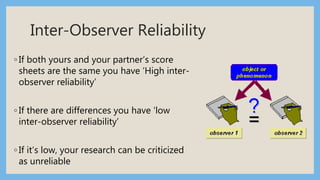
Inter-Observer Reliability
◦ If both yours and your partner’s score
sheets are the same you have ‘High inter-
observer reliability’
◦ If there are differences you have ‘low
inter-observer reliability’
◦ If it’s low, your research can be criticized
as unreliable
How to Overcome
Low Inter-Observer Reliability
◦ Train your Observers
◦ Use more observers
◦ Use objective observation schedules
◦ How reliable was meltzoff and moore’s
inter-observer data? (pg. 70)
Disadvantages of Observations
◦ Possibly low inter-observer reliability?
◦ Cause and Effect cannot be inferred
◦ Ethics?
◦ Observer Bias
DEVELOPMENT OF
ATTACHMENTS
Shaffer and Emerson’s Stage theory of Attachment Development
How/when do we make these
attachments?
◦ ‘Stage theory’ of attachment
◦ Schaffer & Emerson (1964) devised 4 stages of attachment
development
◦ They conducted a study to create their stage theory
Schaffer & Emerson (1964)
◦ Conducted a Longitudinal Study
◦ Followed 60 infants from a mainly working-class area of Glasgow
◦ Observed parent-infant interactions and ‘Stranger Anxiety’ every
month until they were 18m
◦ Asked parents to report ‘Separation Anxiety’ each month
Schaffer & Emerson (1964)
◦ Parent Reports on Separation Anxiety in 7 everyday scenarios;
◦ Left alone in a room
◦ Left with other people
◦ Left in their pram outside the house
◦ Left in their pram outside the shops
◦ Left in their cot at night
◦ Put down after being held
◦ Passed by while sitting on their cot/chair
Schaffer & Emerson (1964)
◦ Results:
◦ Half the children showed their 1st specific attachment between 6-8m
◦ By 10m 50% had more than one attachment
◦ 65% had the mother as primary attachment
◦ 39% of the infants had a primary attachment with someone other than the person
who usually fed, bathed and changed them
S&E’s 4 stages of attachment
1. ‘Indiscriminate Attachments’
* Approx. 2 months
* Babies respond equally to all caregivers
* Begin to show greater preference for ‘Social
Stimuli’
S&E’s 4 stages of attachment
2. ‘Preference’
* Approx. 4 months
* Prefer human company
* Can distinguish between unfamiliar & familiar people
S&E’s 4 stages of attachment
3. ‘Discriminate’
* Approx. 7 months
* Specific attachment with PCG
* Experience ‘Separation Anxiety’
* Experience ‘Stranger Anxiety’
S&E’s 4 stages of attachment
4. ‘Multiple Attachments’
* Approx. 10 months
* Baby becomes increasingly independent
* Forms several attachments
S&E’s 4 stages of Attachment
◦ Indiscriminate
◦ Preference
◦ Discriminate
◦ Multiple
Evaluation of Schaffer & Emerson’s
Stage Theory of Attachment
◦  Unreliable/Invalid Data?
◦ Data based on reports from mothers, likely to have been
skewed
◦ Vulnerable to ‘Social Desirability’
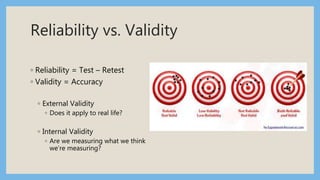
Reliability vs. Validity
◦ Reliability = Test – Retest
◦ Validity = Accuracy
◦ External Validity
◦ Does it apply to real life?
◦ Internal Validity
◦ Are we measuring what we think
we’re measuring?
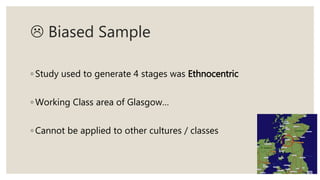
 Biased Sample
◦ Study used to generate 4 stages was Ethnocentric
◦ Working Class area of Glasgow…
◦ Cannot be applied to other cultures / classes
 Temporal Validity?
◦Study was conducted in the 1960s
◦If the study was repeated today would we still get the
same results?
◦Why might there be differences?
 Cultural Variation?
◦ UK is an Individualistic country
◦ Collectivist cultures often have shared responsibility of child-
rearing and do not experience just 1 primary care-giver
◦ Thus the stage model may only apply to individualist cultures
 Too rigid?
◦ A stage theory suggests all children should reach each stage
at specific time brackets
◦ It doesn’t allow for individual differences
◦ Highlights abnormalities in child development
Task
◦ Create a poster/powerpoint on Schaffer and Emerson (1964)
◦ Keep it brief!
◦ Outline main points in A01 + A03 as bullet points…

Attachment development

  • 1.
    Caregiver-infant interactions ◦ Whotested the correlation between physical contact and attachment? ◦ What is reciprocity? (TT) ◦ One factor of infant-caregiver attachment is “I____________ S____________” ◦ What did Meltzoff and Moore find?
  • 2.
    Homework… What we’ve lookedat so far… ◦ Physical Contact ◦ Reciprocity ◦ Interactional Synchrony ◦ Evaluate these theories/research using PEE’s for each point made… ◦  Intentional Behaviour ◦  Ethics and infants ◦  Failure to replicate ◦  Individual differences
  • 3.
     Intentional Behaviour ◦P – People have argued that the infants do not imitate facial expressions as an intentional effort to encourage social attachments ◦ E – However, research has found that infants will not imitate the same facial expressions used in Meltzoff and Moore’s study when they are simulated by inanimate objects ◦ E – This suggests that interactional synchrony and imitation is used by infants as a social response to aid attachment building and therefore is intentional .
  • 4.
     Failure toReplicate ◦ P - Despite findings demonstrating new born imitation, Meltzoff and Moore’s study has been criticised as being unreliable due to replications not finding the same results ◦ E - Koepke (1983) carried out the same experiment as Meltzoff and Moore and failed to identify any evidence of new born imitation ◦ E - The lack of replicability questions the original findings’ reliability which may have been vulnerable to experimental bias.
  • 5.
     Individual Differences ◦P – There may be individual differences in the level of reciprocity and interactional synchrony seen in infants and care givers ◦ E – Isabelle (1989) found that more strongly attached infants are likely to demonstrate greater levels of interactional synchrony ◦ E – Therefore these behaviours will differ dependent on strength of attachment
  • 6.
     Ethics &Infants ◦ P - Experimenting infant-caregiver interactions can be difficult to pass through Ethical Guidelines. ◦ E - Observation techniques used may breach Informed Consent guidelines, especially if they are naturalistic, covert observation methods ◦ E - Researchers can also not guarantee protection from harm as the discovery of an insecure attachment with one’s infant may be psychologically distressing for the care giver in question.
  • 7.
    Observational Research ◦ Observingparticipant(s) behaviour… ◦ Naturalistic vs. Controlled Observations ◦ Naturalistic = nothing has been manipulated by experimenter ◦ Controlled = researcher regulates aspects of environment ◦ Overt vs. Covert Observations
  • 8.
    Observational Research ◦ High Ecological Validity (natural observations) ◦  Practical Method for things you can’t test (i.e. aggression in football hooligans) ◦  No demand characteristics (covert observations)
  • 9.
    Observational Research ◦ Researchersuse either event-sampling or time-sampling to collect data ◦ Event sampling = ‘how often did the infant stick out it’s tongue’ ◦ Time Sampling = ‘Record behaviour at every 20 seconds’
  • 10.
    Tronick’s Still FaceExperiment ◦ Tronick wanted to observe caregiver-infant interactions ◦ He wanted to see what would happen if interactional synchrony and reciprocity were lost ◦ Mothers were instructed to interact normally with the infant and then stop responding and show a ‘still face’ ◦ The baby’s response was observed and recorded
  • 12.
    In pairs… ◦Produce anobservational schedule using event sampling ◦You will be observing the response of an infant to the still face experiment
  • 15.
    Inter-Observer Reliability ◦ Ifboth yours and your partner’s score sheets are the same you have ‘High inter- observer reliability’ ◦ If there are differences you have ‘low inter-observer reliability’ ◦ If it’s low, your research can be criticized as unreliable
  • 16.
    How to Overcome LowInter-Observer Reliability ◦ Train your Observers ◦ Use more observers ◦ Use objective observation schedules ◦ How reliable was meltzoff and moore’s inter-observer data? (pg. 70)
  • 17.
    Disadvantages of Observations ◦Possibly low inter-observer reliability? ◦ Cause and Effect cannot be inferred ◦ Ethics? ◦ Observer Bias
  • 18.
    DEVELOPMENT OF ATTACHMENTS Shaffer andEmerson’s Stage theory of Attachment Development
  • 19.
    How/when do wemake these attachments? ◦ ‘Stage theory’ of attachment ◦ Schaffer & Emerson (1964) devised 4 stages of attachment development ◦ They conducted a study to create their stage theory
  • 20.
    Schaffer & Emerson(1964) ◦ Conducted a Longitudinal Study ◦ Followed 60 infants from a mainly working-class area of Glasgow ◦ Observed parent-infant interactions and ‘Stranger Anxiety’ every month until they were 18m ◦ Asked parents to report ‘Separation Anxiety’ each month
  • 21.
    Schaffer & Emerson(1964) ◦ Parent Reports on Separation Anxiety in 7 everyday scenarios; ◦ Left alone in a room ◦ Left with other people ◦ Left in their pram outside the house ◦ Left in their pram outside the shops ◦ Left in their cot at night ◦ Put down after being held ◦ Passed by while sitting on their cot/chair
  • 22.
    Schaffer & Emerson(1964) ◦ Results: ◦ Half the children showed their 1st specific attachment between 6-8m ◦ By 10m 50% had more than one attachment ◦ 65% had the mother as primary attachment ◦ 39% of the infants had a primary attachment with someone other than the person who usually fed, bathed and changed them
  • 23.
    S&E’s 4 stagesof attachment 1. ‘Indiscriminate Attachments’ * Approx. 2 months * Babies respond equally to all caregivers * Begin to show greater preference for ‘Social Stimuli’
  • 24.
    S&E’s 4 stagesof attachment 2. ‘Preference’ * Approx. 4 months * Prefer human company * Can distinguish between unfamiliar & familiar people
  • 25.
    S&E’s 4 stagesof attachment 3. ‘Discriminate’ * Approx. 7 months * Specific attachment with PCG * Experience ‘Separation Anxiety’ * Experience ‘Stranger Anxiety’
  • 26.
    S&E’s 4 stagesof attachment 4. ‘Multiple Attachments’ * Approx. 10 months * Baby becomes increasingly independent * Forms several attachments
  • 27.
    S&E’s 4 stagesof Attachment ◦ Indiscriminate ◦ Preference ◦ Discriminate ◦ Multiple
  • 28.
    Evaluation of Schaffer& Emerson’s Stage Theory of Attachment ◦  Unreliable/Invalid Data? ◦ Data based on reports from mothers, likely to have been skewed ◦ Vulnerable to ‘Social Desirability’
  • 29.
    Reliability vs. Validity ◦Reliability = Test – Retest ◦ Validity = Accuracy ◦ External Validity ◦ Does it apply to real life? ◦ Internal Validity ◦ Are we measuring what we think we’re measuring?
  • 30.
     Biased Sample ◦Study used to generate 4 stages was Ethnocentric ◦ Working Class area of Glasgow… ◦ Cannot be applied to other cultures / classes
  • 31.
     Temporal Validity? ◦Studywas conducted in the 1960s ◦If the study was repeated today would we still get the same results? ◦Why might there be differences?
  • 32.
     Cultural Variation? ◦UK is an Individualistic country ◦ Collectivist cultures often have shared responsibility of child- rearing and do not experience just 1 primary care-giver ◦ Thus the stage model may only apply to individualist cultures
  • 33.
     Too rigid? ◦A stage theory suggests all children should reach each stage at specific time brackets ◦ It doesn’t allow for individual differences ◦ Highlights abnormalities in child development
  • 34.
    Task ◦ Create aposter/powerpoint on Schaffer and Emerson (1964) ◦ Keep it brief! ◦ Outline main points in A01 + A03 as bullet points…

Editor's Notes

  • #3 Groups piece together perfect PEE’s for each point
  • #17 ‘appears distressed’
  • #20 Read through study on page 72 -
  • #21 Guess interactions you’d be looking for… create event-sampling observation record ‘Social Referencing’
  • #23 Evaluate schaffer and emerson
  • #26 Shows joy at reunion
  • #27 Shows joy at reunion