ETHOLOGY

                  Prof. S. D. Rathod
   B N Bandodkar College of Science
          Thane, Maharashtra, India
Ethology: Definition


 Study of animal behavior in their natural
  environment.
 Ethology is biological study of animal
  behavior.
Development of Animal
Behavior
 Animals exhibit different behavior at their
  different ages more or less in orderly
  sequence.
 When and how the animals start exhibiting
  different kinds of behavior in their life time?
 Therefore study of onset (development) of
  behavior is of utmost concern.
 Firstly we consider ontogency i.e. study of
  development of learning and memory in
  embryonic condition.
Ontogency: Ontogeny of
Behavior
 Ontogency is studied at embryonic
    stage of animals.
   Study is divided in to three stages viz.
   1) Neonatal roots of behavior;
   2) Maturation and behavioral changes
    and
   3) Phenomenon of equifinality
Neonatal roots of behavior

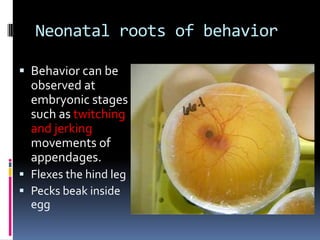
 Behavior can be
  observed at
  embryonic stages
  such as twitching
  and jerking
  movements of
  appendages.
 Flexes the hind leg
 Pecks beak inside
  egg
Types of embryos
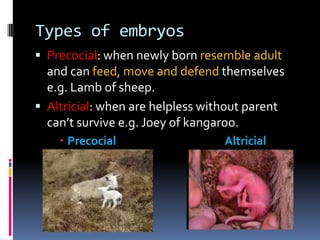
 Precocial: when newly born resemble adult
  and can feed, move and defend themselves
  e.g. Lamb of sheep.
 Altricial: when are helpless without parent
  can’t survive e.g. Joey of kangaroo.
     Precocial                   Altricial
Concepts of Behavioral
development
 1. Preformation
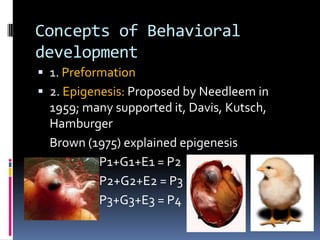
 2. Epigenesis: Proposed by Needleem in
  1959; many supported it, Davis, Kutsch,
  Hamburger
  Brown (1975) explained epigenesis
          P1+G1+E1 = P2
          P2+G2+E2 = P3
          P3+G3+E3 = P4
 3. Reflexogenous concept: Neuromuscular
  pathways are predetermined but movements
  are not exhibited until pathways develop.
 4. Systemogenous behavior: Movements or
  behavior develop before birth and pattern of
  behavior depends up on the environmental
  factors available at that time. The behavior
  also vary from species to species.
 Probabilistic viewpoint: a/c this the early
  behavioral development is not
  predetermined rather it is probabilistic
  dependent on the stimulating factors.
Maturation and behavioral
changes
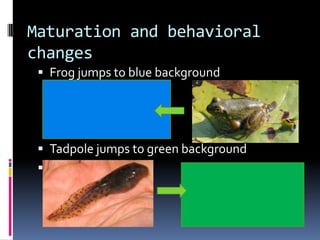
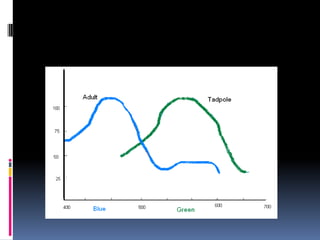
  Frog jumps to blue background


  Tadpole jumps to green background
 
 As animal grows, it Practices for survival:
  involves increasing completion, organization
  or reinforcement of neural pathways
 Practice also improves behavior
Phenomenon of equifinality

 It is a phenomenon by which a structure or
  behavior pattern may develop by different
  pathways. There are vast number of process
  to finalize the personality of a fully mature
  grown up adult.
Conclusions:
 Simple "nature/nurture" or "instinctive/learned"
  dichotomies have now been abandoned
 Nowadays ethologists and psychologists are less
  divided by the nature - nurture debate. Both
  groups are interested in how genetic and
  environmental factors interact to control the
  development and expression of behaviour.
 All behaviour depends on both genes and
  environment
Impact of environment on
behaviour
Effect of Environment
 Enriched environment enhance the problem
  solving ability in rats whereas the deprived
  environment has been found to affect the
  performance of them at later stage.
 Enriched environment during development led to
  heavier and thicker brain cortex tissue, larger
  neurons and more dendrites of rat and also the
  increase in acetylcholine esterase activity as
  compared to rats living in deprived environment.
 Environmental impact on behavior occur during
  sensitive period or critical period only.
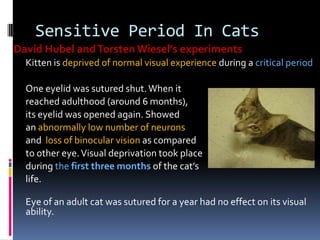
Sensitive Period In Cats
David Hubel and Torsten Wiesel’s experiments
  Kitten is deprived of normal visual experience during a critical period

  One eyelid was sutured shut. When it
  reached adulthood (around 6 months),
  its eyelid was opened again. Showed
  an abnormally low number of neurons
  and loss of binocular vision as compared
  to other eye. Visual deprivation took place
  during the first three months of the cat’s
  life.

  Eye of an adult cat was sutured for a year had no effect on its visual
  ability.
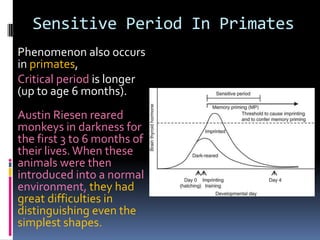
Sensitive Period In Primates
Phenomenon also occurs
in primates,
Critical period is longer
(up to age 6 months).
Austin Riesen reared
monkeys in darkness for
the first 3 to 6 months of
their lives. When these
animals were then
introduced into a normal
environment, they had
great difficulties in
distinguishing even the
simplest shapes.
Sensitive Period During
Development
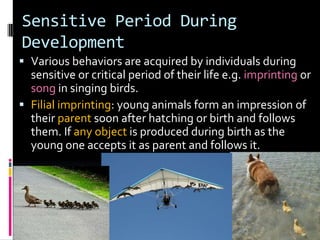
 Various behaviors are acquired by individuals during
  sensitive or critical period of their life e.g. imprinting or
  song in singing birds.
 Filial imprinting: young animals form an impression of
  their parent soon after hatching or birth and follows
  them. If any object is produced during birth as the
  young one accepts it as parent and follows it.
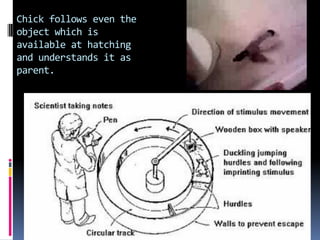
Chick follows even the
object which is
available at hatching
and understands it as
parent.
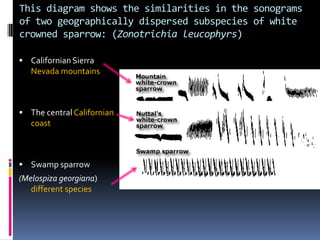
This diagram shows the similarities in the sonograms
of two geographically dispersed subspecies of white
crowned sparrow: (Zonotrichia leucophyrs)

 Californian Sierra
   Nevada mountains


 The central Californian
   coast


 Swamp sparrow
(Melospiza georgiana)
   different species
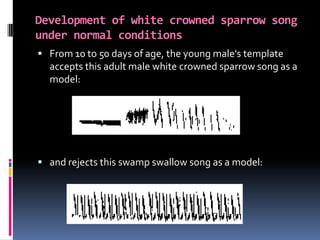
Development of white crowned sparrow song
under normal conditions
 From 10 to 50 days of age, the young male's template
  accepts this adult male white crowned sparrow song as a
  model:


 and rejects this swamp swallow song as a model:
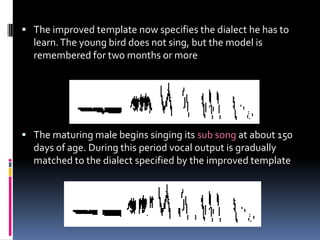
 The improved template now specifies the dialect he has to
  learn. The young bird does not sing, but the model is
  remembered for two months or more


 The maturing male begins singing its sub song at about 150
  days of age. During this period vocal output is gradually
  matched to the dialect specified by the improved template
Primary song –white crowned
sparrow

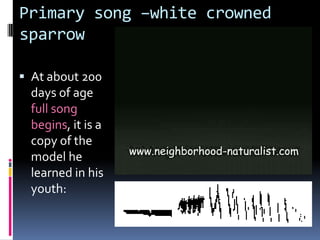
 At about 200
  days of age
  full song
  begins, it is a
  copy of the
  model he
  learned in his
  youth:
Juvenile Behaviour
Juvenile Behaviour

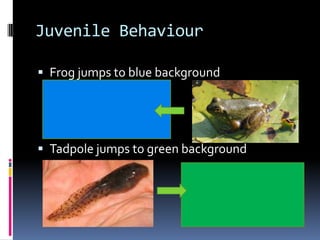
 Frog jumps to blue background


 Tadpole jumps to green background
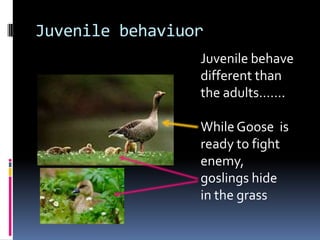
Juvenile behaviuor
                 Juvenile behave
                 different than
                 the adults…….

                 While Goose is
                 ready to fight
                 enemy,
                 goslings hide
                 in the grass
Innate Behaviour
Innate Behaviour
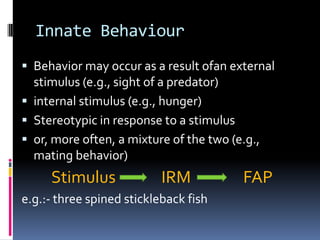
 Behavior may occur as a result ofan external
  stimulus (e.g., sight of a predator)
 internal stimulus (e.g., hunger)
 Stereotypic in response to a stimulus
 or, more often, a mixture of the two (e.g.,
  mating behavior)
     Stimulus              IRM           FAP
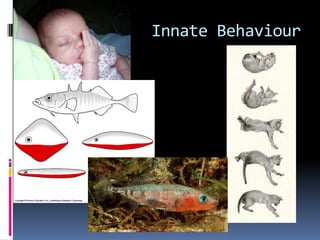
e.g.:- three spined stickleback fish
Innate Behaviour
THANK YOU

Ethology: Development of Animal Behavior

  • 1.
    ETHOLOGY Prof. S. D. Rathod B N Bandodkar College of Science Thane, Maharashtra, India
  • 2.
    Ethology: Definition  Studyof animal behavior in their natural environment.  Ethology is biological study of animal behavior.
  • 3.
    Development of Animal Behavior Animals exhibit different behavior at their different ages more or less in orderly sequence.  When and how the animals start exhibiting different kinds of behavior in their life time?  Therefore study of onset (development) of behavior is of utmost concern.  Firstly we consider ontogency i.e. study of development of learning and memory in embryonic condition.
  • 4.
    Ontogency: Ontogeny of Behavior Ontogency is studied at embryonic stage of animals.  Study is divided in to three stages viz.  1) Neonatal roots of behavior;  2) Maturation and behavioral changes and  3) Phenomenon of equifinality
  • 5.
    Neonatal roots ofbehavior  Behavior can be observed at embryonic stages such as twitching and jerking movements of appendages.  Flexes the hind leg  Pecks beak inside egg
  • 6.
    Types of embryos Precocial: when newly born resemble adult and can feed, move and defend themselves e.g. Lamb of sheep.  Altricial: when are helpless without parent can’t survive e.g. Joey of kangaroo.  Precocial Altricial
  • 7.
    Concepts of Behavioral development 1. Preformation  2. Epigenesis: Proposed by Needleem in 1959; many supported it, Davis, Kutsch, Hamburger Brown (1975) explained epigenesis P1+G1+E1 = P2 P2+G2+E2 = P3 P3+G3+E3 = P4
  • 8.
     3. Reflexogenousconcept: Neuromuscular pathways are predetermined but movements are not exhibited until pathways develop.  4. Systemogenous behavior: Movements or behavior develop before birth and pattern of behavior depends up on the environmental factors available at that time. The behavior also vary from species to species.  Probabilistic viewpoint: a/c this the early behavioral development is not predetermined rather it is probabilistic dependent on the stimulating factors.
  • 9.
    Maturation and behavioral changes  Frog jumps to blue background  Tadpole jumps to green background 
  • 11.
     As animalgrows, it Practices for survival: involves increasing completion, organization or reinforcement of neural pathways  Practice also improves behavior
  • 12.
    Phenomenon of equifinality It is a phenomenon by which a structure or behavior pattern may develop by different pathways. There are vast number of process to finalize the personality of a fully mature grown up adult.
  • 13.
    Conclusions:  Simple "nature/nurture"or "instinctive/learned" dichotomies have now been abandoned  Nowadays ethologists and psychologists are less divided by the nature - nurture debate. Both groups are interested in how genetic and environmental factors interact to control the development and expression of behaviour.  All behaviour depends on both genes and environment
  • 14.
  • 15.
    Effect of Environment Enriched environment enhance the problem solving ability in rats whereas the deprived environment has been found to affect the performance of them at later stage.  Enriched environment during development led to heavier and thicker brain cortex tissue, larger neurons and more dendrites of rat and also the increase in acetylcholine esterase activity as compared to rats living in deprived environment.  Environmental impact on behavior occur during sensitive period or critical period only.
  • 16.
    Sensitive Period InCats David Hubel and Torsten Wiesel’s experiments Kitten is deprived of normal visual experience during a critical period One eyelid was sutured shut. When it reached adulthood (around 6 months), its eyelid was opened again. Showed an abnormally low number of neurons and loss of binocular vision as compared to other eye. Visual deprivation took place during the first three months of the cat’s life. Eye of an adult cat was sutured for a year had no effect on its visual ability.
  • 17.
    Sensitive Period InPrimates Phenomenon also occurs in primates, Critical period is longer (up to age 6 months). Austin Riesen reared monkeys in darkness for the first 3 to 6 months of their lives. When these animals were then introduced into a normal environment, they had great difficulties in distinguishing even the simplest shapes.
  • 18.
    Sensitive Period During Development Various behaviors are acquired by individuals during sensitive or critical period of their life e.g. imprinting or song in singing birds.  Filial imprinting: young animals form an impression of their parent soon after hatching or birth and follows them. If any object is produced during birth as the young one accepts it as parent and follows it.
  • 19.
    Chick follows eventhe object which is available at hatching and understands it as parent.
  • 20.
    This diagram showsthe similarities in the sonograms of two geographically dispersed subspecies of white crowned sparrow: (Zonotrichia leucophyrs)  Californian Sierra Nevada mountains  The central Californian coast  Swamp sparrow (Melospiza georgiana) different species
  • 21.
    Development of whitecrowned sparrow song under normal conditions  From 10 to 50 days of age, the young male's template accepts this adult male white crowned sparrow song as a model:  and rejects this swamp swallow song as a model:
  • 22.
     The improvedtemplate now specifies the dialect he has to learn. The young bird does not sing, but the model is remembered for two months or more  The maturing male begins singing its sub song at about 150 days of age. During this period vocal output is gradually matched to the dialect specified by the improved template
  • 23.
    Primary song –whitecrowned sparrow  At about 200 days of age full song begins, it is a copy of the model he learned in his youth:
  • 24.
  • 25.
    Juvenile Behaviour  Frogjumps to blue background  Tadpole jumps to green background
  • 26.
    Juvenile behaviuor Juvenile behave different than the adults……. While Goose is ready to fight enemy, goslings hide in the grass
  • 27.
  • 28.
    Innate Behaviour  Behaviormay occur as a result ofan external stimulus (e.g., sight of a predator)  internal stimulus (e.g., hunger)  Stereotypic in response to a stimulus  or, more often, a mixture of the two (e.g., mating behavior) Stimulus IRM FAP e.g.:- three spined stickleback fish
  • 29.
  • 30.