SEXUAL
SELECTION
SEXUAL SELECTION
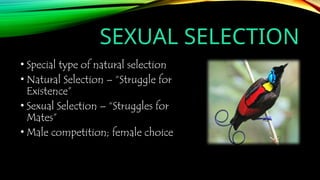
• Special type of natural selection
• Natural Selection – “Struggle for
Existence”
• Sexual Selection – “Struggles for
Mates”
• Male competition; female choice
THEORY OF SEXUAL
SELECTION
• Proposed by Charles Darwin in
1871
• “…the advantage, which
certain individuals have over
others of the same sex and
species, in exclusive relation to
reproduction.”
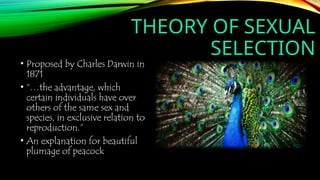
• An explanation for beautiful
plumage of peacock
• Considered it significant for
the gradual perfection of the
sexual process
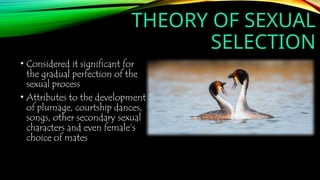
• Attributes to the development
of plumage, courtship dances,
songs, other secondary sexual
characters and even female’s
choice of mates
THEORY OF SEXUAL
SELECTION
INTRASEXUAL &
INTERSEXUAL SELECTION
The differences in individuals’ breeding success rate depends on two
factors:
• Competition within one sex (mostly males) for access to
members of opposite sex – Intrasexual selection
• Choice by individuals of one sex (mostly females) for members of
opposite sex – Intersexual selection
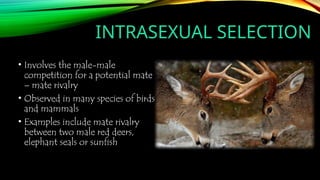
INTRASEXUAL SELECTION
• Involves the male-male
competition for a potential mate
– mate rivalry
• Observed in many species of birds
and mammals
• Examples include mate rivalry
between two male red deers,
elephant seals or sunfish
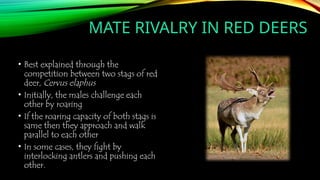
• Best explained through the
competition between two stags of red
deer, Cervus elaphus
• Initially, the males challenge each
other by roaring
• If the roaring capacity of both stags is
same then they approach and walk
parallel to each other
• In some cases, they fight by
interlocking antlers and pushing each
other.
MATE RIVALRY IN RED DEERS
MATE RIVALRY IN ELEPHANT
SEALS
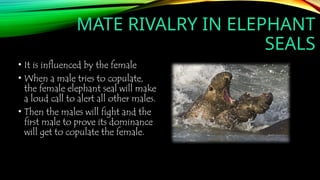
• It is influenced by the female
• When a male tries to copulate,
the female elephant seal will make
a loud call to alert all other males.
• Then the males will fight and the
first male to prove its dominance
will get to copulate the female.
MATE RIVALRY IN
SUNFISH
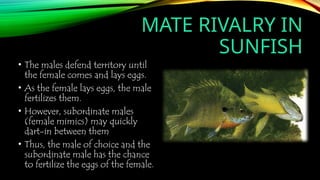
• The males defend territory until
the female comes and lays eggs.
• As the female lays eggs, the male
fertilizes them.
• However, subordinate males
(female mimics) may quickly
dart-in between them
• Thus, the male of choice and the
subordinate male has the chance
to fertilize the eggs of the female.
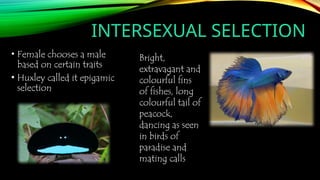
INTERSEXUAL SELECTION
• Female chooses a male
based on certain traits
• Huxley called it epigamic
selection
Bright,
extravagant and
colourful fins
of fishes, long
colourful tail of
peacock,
dancing as seen
in birds of
paradise and
mating calls
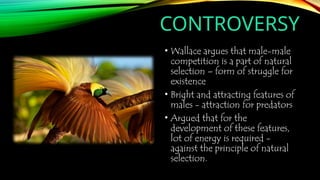
CONTROVERSY
• Wallace argues that male-male
competition is a part of natural
selection – form of struggle for
existence
• Bright and attracting features of
males - attraction for predators
• Argued that for the
development of these features,
lot of energy is required -
against the principle of natural
selection.
SEXUAL SELECTION IN
HUMANS
• Darwin (1871) thought sexual selection was more important than natural
selection in the evolution of the differences between the human races
• Geoffrey Miller – humor, music, visual art, verbal creativity & even
vocabulary – not survival benefits but courtship adaptation favored by
sexual selection
Example: Miller (2000) proposed that greater vocabulary demonstrate
intelligence (fitness) to potential mate
Experiment: Males use greater lower-frequency vocabulary when in
romantic mindset (Rosenberg & Tunney, 2008)
SEXUAL SELECTION IN
HUMANS
• Secondary sexual characters like facial hair, vocal characteristics appear
to have been shaped by sexual selection
• Men’s secondary sexual traits like robust face, beard and deep voice are
more effective in intimidating men than attracting women
• Men’s dominance and social status – preferences of women
• Women’s physical appearance – competition for male choice (Puts,
2016)
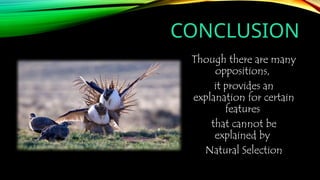
CONCLUSION
Though there are many
oppositions,
it provides an
explanation for certain
features
that cannot be
explained by
Natural Selection
REFERENCES – BOOKS
#McFarland D., Animal Behaviour – Psychobiology, Ethology and
Evolution, Longman Group UK Ltd, 1985.
#Gundevia H.S., Singh H.G., A Textbook of Animal Behaviour, 2nd
Edition, S. Chand & Company Ltd., New Delhi, 2006.
#Chattopadhyay S., LIFE – Evolution, Adaptation & Ethology, 2nd
Edition, BOOKS & ALLIED (P) LTD., Kolkata, 2009.
#Verma P.S., Agarwal V.K., Cell Biology, Genetics, Molecular Biology,
Evolution and Ecology, Multicolor Edition, S. Chand & Company
Ltd., New Delhi, 2009.
REFERENCES – WEBSITES
#http://vetsci.co.uk/2010/05/17/intrasexual-selection/
#https://
amp.theguardian.com/science/2017/may/19/a-peacocks-tail-how-
darwin-arrived-at-his-theory-of-sexual-selection
#https://www.dictionary.com/browse/sexual-selection
#https://evolution.berkeley.edu/evolibrary/article/evo_28
#http://en.Wikipedia.org/wiki/Sexual_selection_in_humans
REFERENCES – ARTICLES
#Kirkpatrick, M. (1987). Sexual selection by female choice in polygynous
animals. Annual Review of Ecology and Systematics, 18(1), 43-70.
#Kirkpatrick, M. (1982). SEXUAL SELECTION AND THE EVOLUTION
OF FEMALE CHOICE. Evolution, 36(1), 1-12.
#Pellegrini, A. D., & Long, J. D. (2003). A sexual selection theory
longitudinal analysis of sexual segregation and integration in early
adolescence. Journal of experimental child psychology, 85(3), 257-278.
#Puts , D. (2016). Human Sexual Selection. Current Opinion in
Psychology, 7, 28-32.

Thank
You

Animal Behaviour – SEXUAL SELECTION IN ANIMALS

  • 1.
  • 2.
    SEXUAL SELECTION • Specialtype of natural selection • Natural Selection – “Struggle for Existence” • Sexual Selection – “Struggles for Mates” • Male competition; female choice
  • 3.
    THEORY OF SEXUAL SELECTION •Proposed by Charles Darwin in 1871 • “…the advantage, which certain individuals have over others of the same sex and species, in exclusive relation to reproduction.” • An explanation for beautiful plumage of peacock
  • 4.
    • Considered itsignificant for the gradual perfection of the sexual process • Attributes to the development of plumage, courtship dances, songs, other secondary sexual characters and even female’s choice of mates THEORY OF SEXUAL SELECTION
  • 5.
    INTRASEXUAL & INTERSEXUAL SELECTION Thedifferences in individuals’ breeding success rate depends on two factors: • Competition within one sex (mostly males) for access to members of opposite sex – Intrasexual selection • Choice by individuals of one sex (mostly females) for members of opposite sex – Intersexual selection
  • 6.
    INTRASEXUAL SELECTION • Involvesthe male-male competition for a potential mate – mate rivalry • Observed in many species of birds and mammals • Examples include mate rivalry between two male red deers, elephant seals or sunfish
  • 7.
    • Best explainedthrough the competition between two stags of red deer, Cervus elaphus • Initially, the males challenge each other by roaring • If the roaring capacity of both stags is same then they approach and walk parallel to each other • In some cases, they fight by interlocking antlers and pushing each other. MATE RIVALRY IN RED DEERS
  • 8.
    MATE RIVALRY INELEPHANT SEALS • It is influenced by the female • When a male tries to copulate, the female elephant seal will make a loud call to alert all other males. • Then the males will fight and the first male to prove its dominance will get to copulate the female.
  • 9.
    MATE RIVALRY IN SUNFISH •The males defend territory until the female comes and lays eggs. • As the female lays eggs, the male fertilizes them. • However, subordinate males (female mimics) may quickly dart-in between them • Thus, the male of choice and the subordinate male has the chance to fertilize the eggs of the female.
  • 10.
    INTERSEXUAL SELECTION • Femalechooses a male based on certain traits • Huxley called it epigamic selection Bright, extravagant and colourful fins of fishes, long colourful tail of peacock, dancing as seen in birds of paradise and mating calls
  • 11.
    CONTROVERSY • Wallace arguesthat male-male competition is a part of natural selection – form of struggle for existence • Bright and attracting features of males - attraction for predators • Argued that for the development of these features, lot of energy is required - against the principle of natural selection.
  • 12.
    SEXUAL SELECTION IN HUMANS •Darwin (1871) thought sexual selection was more important than natural selection in the evolution of the differences between the human races • Geoffrey Miller – humor, music, visual art, verbal creativity & even vocabulary – not survival benefits but courtship adaptation favored by sexual selection Example: Miller (2000) proposed that greater vocabulary demonstrate intelligence (fitness) to potential mate Experiment: Males use greater lower-frequency vocabulary when in romantic mindset (Rosenberg & Tunney, 2008)
  • 13.
    SEXUAL SELECTION IN HUMANS •Secondary sexual characters like facial hair, vocal characteristics appear to have been shaped by sexual selection • Men’s secondary sexual traits like robust face, beard and deep voice are more effective in intimidating men than attracting women • Men’s dominance and social status – preferences of women • Women’s physical appearance – competition for male choice (Puts, 2016)
  • 14.
    CONCLUSION Though there aremany oppositions, it provides an explanation for certain features that cannot be explained by Natural Selection
  • 15.
    REFERENCES – BOOKS #McFarlandD., Animal Behaviour – Psychobiology, Ethology and Evolution, Longman Group UK Ltd, 1985. #Gundevia H.S., Singh H.G., A Textbook of Animal Behaviour, 2nd Edition, S. Chand & Company Ltd., New Delhi, 2006. #Chattopadhyay S., LIFE – Evolution, Adaptation & Ethology, 2nd Edition, BOOKS & ALLIED (P) LTD., Kolkata, 2009. #Verma P.S., Agarwal V.K., Cell Biology, Genetics, Molecular Biology, Evolution and Ecology, Multicolor Edition, S. Chand & Company Ltd., New Delhi, 2009.
  • 16.
  • 17.
    REFERENCES – ARTICLES #Kirkpatrick,M. (1987). Sexual selection by female choice in polygynous animals. Annual Review of Ecology and Systematics, 18(1), 43-70. #Kirkpatrick, M. (1982). SEXUAL SELECTION AND THE EVOLUTION OF FEMALE CHOICE. Evolution, 36(1), 1-12. #Pellegrini, A. D., & Long, J. D. (2003). A sexual selection theory longitudinal analysis of sexual segregation and integration in early adolescence. Journal of experimental child psychology, 85(3), 257-278. #Puts , D. (2016). Human Sexual Selection. Current Opinion in Psychology, 7, 28-32.
  • 18.