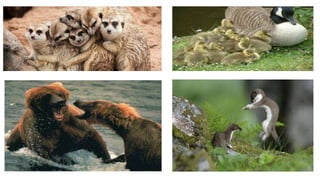
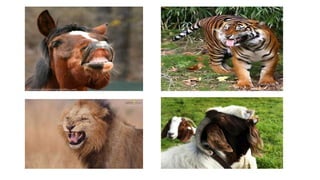
What is behavior ?????
1. Behavior is everything a person does.
2. Behavior includes all those processes by which an animal senses the
external world and the internal state of its body and responds to
situation it perceives.
3. The way an organism responds to environmental stimuli.
4. “Stimulus response relationship”.
1
Ethology
• Study of animal behaviour
• Two Greek words;
i. Ethos means habit
ii. Logos means study
• 17th century the word was used for stage actors.
• Geoffroy Saint Hillaire (1859) use this term to describe the
relationship of animal with environment, family and society.
• Since the beginning of 20th century the term is restricted only to the
study of behaviour of animals.
Branches of Ethology
1. Ethoecology: relationship between behaviour of species and its
environment.
2. Ethogenetics: Genetical basis of behaviour.
3. Neuroethology: Sensory processes and CNS that initiate and
control a particular behaviour.
4. Ethoendocrinology: Relations between hormones and behaviour.
5. Bahavorial Embryology: Prenatal development of behaviour
pattern.
6. Human Ethology: Study of human behaviour.
4
Ethology VS Psychology
• The scientific study of the human mind and its functions,
especially those affecting behaviour in a given context is
called Psychology.
• Scientific study of animal behavior in their natural or usual
environment is called Ethology.
History
• Scientific study of animal behavior in their natural or usual
environment
• Study of habits and customs of animals
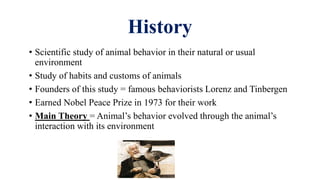
• Founders of this study = famous behaviorists Lorenz and Tinbergen
• Earned Nobel Peace Prize in 1973 for their work
• Main Theory = Animal’s behavior evolved through the animal’s
interaction with its environment
History
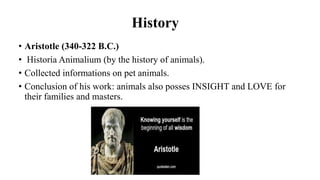
• Aristotle (340-322 B.C.)
• Historia Animalium (by the history of animals).
• Collected informations on pet animals.
• Conclusion of his work: animals also posses INSIGHT and LOVE for
their families and masters.
THOMAS MORE
• UTOPIA (1518)
• Mentioned various behavioral patterns of animals in this book.
GILBERT WHITE (1720-1793) AND CHARLES LEROY (1723-1789).
(The scientific study of animal behaviour has its origin in their work)
Foundation Of Modern Ethology
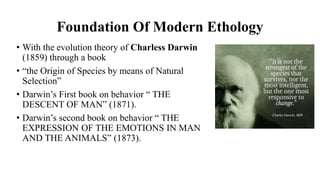
• With the evolution theory of Charless Darwin
(1859) through a book
• “the Origin of Species by means of Natural
Selection”
• Darwin’s First book on behavior “ THE
DESCENT OF MAN” (1871).
• Darwin’s second book on behavior “ THE
EXPRESSION OF THE EMOTIONS IN MAN
AND THE ANIMALS” (1873).
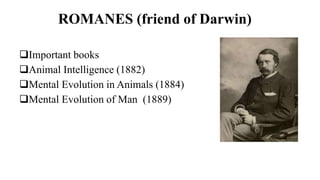
ROMANES (friend of Darwin)
Important books
Animal Intelligence (1882)
Mental Evolution in Animals (1884)
Mental Evolution of Man (1889)
Nobels Prize Winners In 1973
Three Scientists
 Karl Von Frisch (1886-1983) from Germany
Nikolaus Tinbergen (1907-1988) from Holland
 Konrad Lorenz (1903-1988) from Vienna
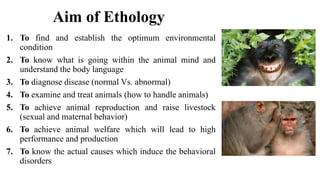
Aim of Ethology
1. To find and establish the optimum environmental
condition
2. To know what is going within the animal mind and
understand the body language
3. To diagnose disease (normal Vs. abnormal)
4. To examine and treat animals (how to handle animals)
5. To achieve animal reproduction and raise livestock
(sexual and maternal behavior)
6. To achieve animal welfare which will lead to high
performance and production
7. To know the actual causes which induce the behavioral
disorders
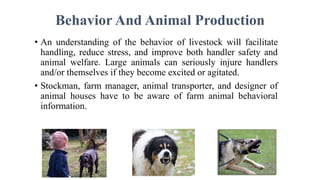
Behavior And Animal Production
• An understanding of the behavior of livestock will facilitate
handling, reduce stress, and improve both handler safety and
animal welfare. Large animals can seriously injure handlers
and/or themselves if they become excited or agitated.
• Stockman, farm manager, animal transporter, and designer of
animal houses have to be aware of farm animal behavioral
information.
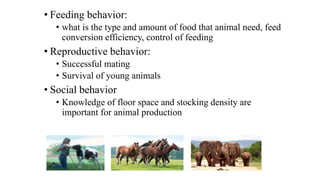
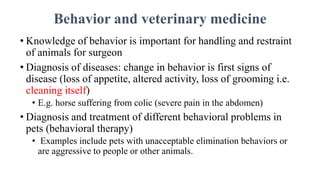
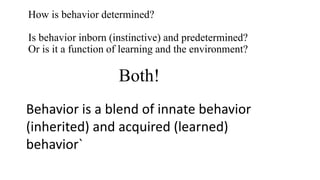
• Feeding behavior:
• what is the type and amount of food that animal need, feed
conversion efficiency, control of feeding
• Reproductive behavior:
• Successful mating
• Survival of young animals
• Social behavior
• Knowledge of floor space and stocking density are
important for animal production
Behavior and veterinary medicine
• Knowledge of behavior is important for handling and restraint
of animals for surgeon
• Diagnosis of diseases: change in behavior is first signs of
disease (loss of appetite, altered activity, loss of grooming i.e.
cleaning itself)
• E.g. horse suffering from colic (severe pain in the abdomen)
• Diagnosis and treatment of different behavioral problems in
pets (behavioral therapy)
• Examples include pets with unacceptable elimination behaviors or
are aggressive to people or other animals.
How is behavior determined?
Is behavior inborn (instinctive) and predetermined?
Or is it a function of learning and the environment?
Both!
Behavior is a blend of innate behavior
(inherited) and acquired (learned)
behavior`
Classification Of Animal Behavior
1. Inherited behavior (innate, unlearned, instinctive,
native)
• Important for survival and conservation of species
2. Acquired behavior (learned)
• Adopt useful method for survival within their environment
Inherited behavior
• Includes two types:
1. Behavior of maintenance
• Constant behavioral patterns needed to maintain animal
life (self-maintenance) such as ingestion, elimination,
rest and sleep
2. Reproductive behavior
• Behavioral patterns occurring during reproduction
needed to maintain animal species
• Sexual behavior
• Maternal behavior
Maintenance behaviors
• Ingestive behavior:
• Related to anatomy and physiology of each species
• Related to nature of food (herbivorous, carnivores,
omnivorous)
• Including feeding (ingestion of solid feed), drinking (ingestion
of water and milk)
• Understanding of ingestive behavior (how to search for, to
locate and to ingest food) is critical to animal production.
• Horse = cropping by incisors
• Cattle = eating by tongue
• Sheep and goat = incisors and lips
• Dog = gulping the food
Eliminative behavior
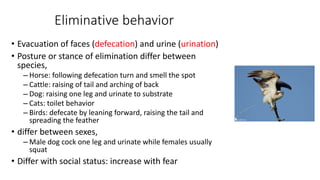
• Evacuation of faces (defecation) and urine (urination)
• Posture or stance of elimination differ between
species,
– Horse: following defecation turn and smell the spot
– Cattle: raising of tail and arching of back
– Dog: raising one leg and urinate to substrate
– Cats: toilet behavior
– Birds: defecate by leaning forward, raising the tail and
spreading the feather
• differ between sexes,
– Male dog cock one leg and urinate while females usually
squat
• Differ with social status: increase with fear
Grooming Behavior (Body Care)
• Including:
• Care of the body (natural grooming)
• Thermoregulation (regulate body temperature)
• Self-Grooming (Auto-grooming)= animal take care of
its own body through licking and rubbing (parts that
can reach)
• Body licking, nose licking, rolling, scratching
• Function
• Keep body clean (One good indicator of general health)
• Free from ecto-parasites
• Free from foreign objects (faces, urine, mud)
• Reduce risk of diseases
• Mutual grooming (social or allo-grooming)
• One animal take care of another animal (herdmates)
• Function (biological and social):
• Remove ecto-parasites from parts that animal can not reach
• Take care of wounds
• Reward for the groomer (obtain salt and vitamin D)
• Promote and cement relationship between individuals
• Reduce aggression and tension
• Maintain social structure
Reproductive behaviors
• The activities or actions during reproduction includes:
• Sexual behavior:
• Male sexual behavior
• Pre-copulatory (courtship/libido)
• Copulatory (erection, mounting, ejaculation, dismounting)
• Post-copulatory (quiet period, flehmen response)
• Female sexual behavior
• Estrous cycle (length, type, signs)
• Ovulation (type, time)
• Best time of mating
• Maternal behavior (care-giving behavior, Epimeletic, attentive)
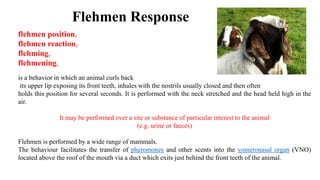
Flehmen Response
is a behavior in which an animal curls back
its upper lip exposing its front teeth, inhales with the nostrils usually closed and then often
holds this position for several seconds. It is performed with the neck stretched and the head held high in the
air.
It may be performed over a site or substance of particular interest to the animal
(e.g. urine or faeces)
Flehmen is performed by a wide range of mammals.
The behaviour facilitates the transfer of pheromones and other scents into the vomeronasal organ (VNO)
located above the roof of the mouth via a duct which exits just behind the front teeth of the animal.
flehmen position,
flehmen reaction,
flehming,
flehmening,
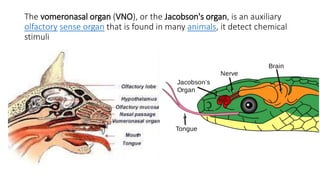
The vomeronasal organ (VNO), or the Jacobson's organ, is an auxiliary
olfactory sense organ that is found in many animals, it detect chemical
stimuli
Maternal behavior (Epimeletic)
• Feeding and keeping of the offspring from danger by
dam (female) which is important for survival of animal
• Pre-parturient (the action of giving birth to young; childbirth)
• signs approaching parturition
• Nest-building (rabbits)
• Isolation and shelter-seeking (sheep)
• Parturient (stages of birth / Action of giving birth)
• Post parturient
• Licking behavior (maternal licking and imprinting)
• Sucking behavior
• Brooding in chickens
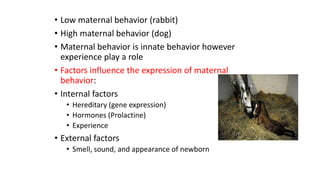
• Low maternal behavior (rabbit)
• High maternal behavior (dog)
• Maternal behavior is innate behavior however
experience play a role
• Factors influence the expression of maternal
behavior:
• Internal factors
• Hereditary (gene expression)
• Hormones (Prolactine)
• Experience
• External factors
• Smell, sound, and appearance of newborn
Two classes of maternal behavior
• Polytocous species (dog, cat, rabbits, mice, rat)
(Produce many youngs / eggs at a time)
• Atrocious (Fearful) young
• Young entirely depend on mother
• Monotocus species (horse, cattle, camel, sheep)
(Produce single young / egg at a time)
• Precocious (intelligent) young
• Low maternal behavior
Types Of Embryos
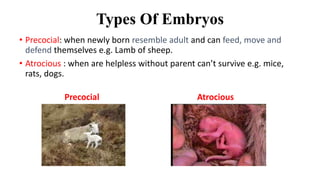
• Precocial: when newly born resemble adult and can feed, move and
defend themselves e.g. Lamb of sheep.
• Atrocious : when are helpless without parent can’t survive e.g. mice,
rats, dogs.
Precocial Atrocious
In biology, paternal care is parental investment provided by a male animal
to his own offspring. Paternal care may provided in concert with the mother
(biparental care) or, more rarely, by the male alone (so called exclusive
paternal care).
• Parental behavior: in which both parents (male and female) take care
offspring equally
• E.g. many species of birds (pigeon) and fish (take care of egg and squabs)
• Male parental behavior: in which male take care offspring
• Not common in animals (primates)
• Common in birds (dark eye junco)
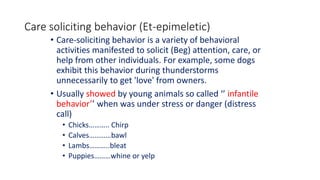
Care soliciting behavior (Et-epimeletic)
• Care-soliciting behavior is a variety of behavioral
activities manifested to solicit (Beg) attention, care, or
help from other individuals. For example, some dogs
exhibit this behavior during thunderstorms
unnecessarily to get 'love' from owners.
• Usually showed by young animals so called ‘’ infantile
behavior’’ when was under stress or danger (distress
call)
• Chicks……….. Chirp
• Calves…………bawl
• Lambs………..bleat
• Puppies………whine or yelp
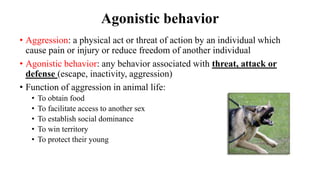
Agonistic behavior
• Aggression: a physical act or threat of action by an individual which
cause pain or injury or reduce freedom of another individual
• Agonistic behavior: any behavior associated with threat, attack or
defense (escape, inactivity, aggression)
• Function of aggression in animal life:
• To obtain food
• To facilitate access to another sex
• To establish social dominance
• To win territory
• To protect their young
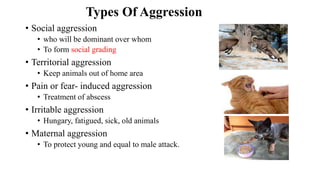
Types Of Aggression
• Social aggression
• who will be dominant over whom
• To form social grading
• Territorial aggression
• Keep animals out of home area
• Pain or fear- induced aggression
• Treatment of abscess
• Irritable aggression
• Hungary, fatigued, sick, old animals
• Maternal aggression
• To protect young and equal to male attack.
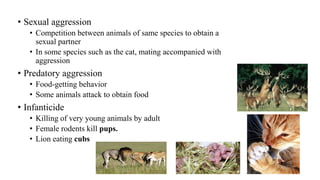
• Sexual aggression
• Competition between animals of same species to obtain a
sexual partner
• In some species such as the cat, mating accompanied with
aggression
• Predatory aggression
• Food-getting behavior
• Some animals attack to obtain food
• Infanticide
• Killing of very young animals by adult
• Female rodents kill pups.
• Lion eating cubs
Shelter-seeking behavior
• Looking for optimum environmental condition to avoid predators
• Some animals find shelter from bodies of other animals
• Other animals find shelter within farm, barn or from objects like trees
• Thermoregulation
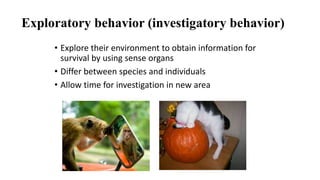
Exploratory behavior (investigatory behavior)
• Explore their environment to obtain information for
survival by using sense organs
• Differ between species and individuals
• Allow time for investigation in new area
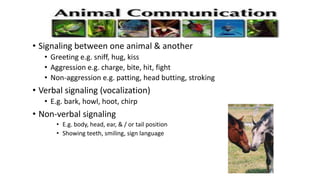
• Signaling between one animal & another
• Greeting e.g. sniff, hug, kiss
• Aggression e.g. charge, bite, hit, fight
• Non-aggression e.g. patting, head butting, stroking
• Verbal signaling (vocalization)
• E.g. bark, howl, hoot, chirp
• Non-verbal signaling
• E.g. body, head, ear, & / or tail position
• Showing teeth, smiling, sign language
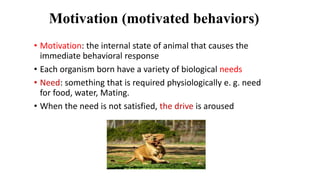
Motivation (motivated behaviors)
• Motivation: the internal state of animal that causes the
immediate behavioral response
• Each organism born have a variety of biological needs
• Need: something that is required physiologically e. g. need
for food, water, Mating.
• When the need is not satisfied, the drive is aroused
• The drive / ambition: is psychological consequence of need
• Once the animal in high drive state (motivated), the animal
start to move
• So we can observe 3 stages in animal’s behavior:
1. The searching phase (Appetitive behavior)
2. Consumatory behavior (achievement of the goal)
3. Phase of quiescence (Stillness).
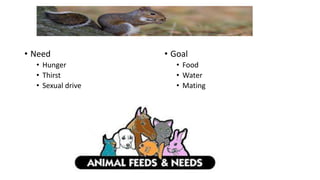
• Need
• Hunger
• Thirst
• Sexual drive
• Goal
• Food
• Water
• Mating
Acquired behaviors
• Domestic animals have ability to learn
• They adopt new useful methods for survival within their
environment
• Animals acquire many behavioral patterns through learning
• Learning
• Development of behavior through experience
• Determine final shape of innate behaviors
• 7 types of learning
Types of learning
• Habituation
• Is waning (Fading) of a new response to a repeated
stimulus
• Simplest form of learning
• Occur rapidly if stimuli are given close together
• Importance of habituation
• Filtering large amounts of information received from
surrounding environment
• Waning of the responses of farm animals to handling
procedures and housing conditions
• Animal learns to ignore frequent, harmless stimulus
• E.g Birds on highway, habituation to Cars
The Kapil Sherma Show
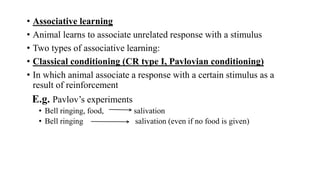
• Associative learning
• Animal learns to associate unrelated response with a stimulus
• Two types of associative learning:
• Classical conditioning (CR type I, Pavlovian conditioning)
• In which animal associate a response with a certain stimulus as a
result of reinforcement
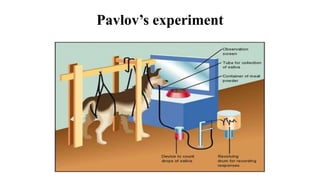
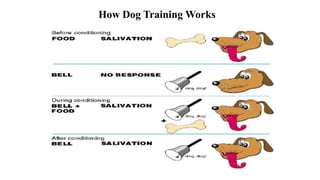
E.g. Pavlov’s experiments
• Bell ringing, food, salivation
• Bell ringing salivation (even if no food is given)
Pavlov’s experiment
How Dog Training Works
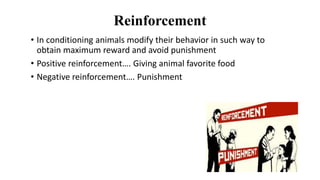
Reinforcement
• In conditioning animals modify their behavior in such way to
obtain maximum reward and avoid punishment
• Positive reinforcement…. Giving animal favorite food
• Negative reinforcement…. Punishment
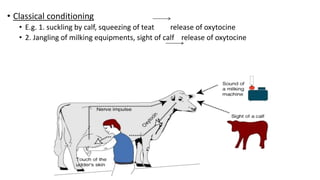
• Classical conditioning
• E.g. 1. suckling by calf, squeezing of teat release of oxytocine
• 2. Jangling of milking equipments, sight of calf release of oxytocine
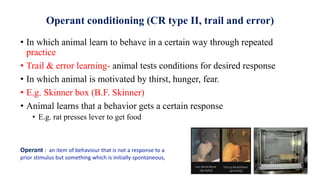
Operant conditioning (CR type II, trail and error)
• In which animal learn to behave in a certain way through repeated
practice
• Trail & error learning- animal tests conditions for desired response
• In which animal is motivated by thirst, hunger, fear.
• E.g. Skinner box (B.F. Skinner)
• Animal learns that a behavior gets a certain response
• E.g. rat presses lever to get food
Operant : an item of behaviour that is not a response to a
prior stimulus but something which is initially spontaneous,
Imprinting
• Definition:
• A process that occurs when an animal learns to make a particular response to only
type of animal or object
• Both innate and learned
• Occurs during a definite critical time period (within first 36 hr)
• Irreversible (once learned, can’t be changed)
• Conard Lorenz with duckling
Operant conditioning
• Because the animal uses behavior as instrument in getting a reward, it is usually
called instrumental conditioning
• Operant used because the animal response in some way operates on the environment
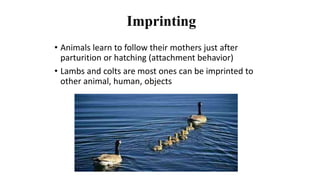
Imprinting
• Animals learn to follow their mothers just after
parturition or hatching (attachment behavior)
• Lambs and colts are most ones can be imprinted to
other animal, human, objects
Insight learning (Reasoning)
• Highest form of learning
• The immediate understanding, and response to new situation
without trail and error
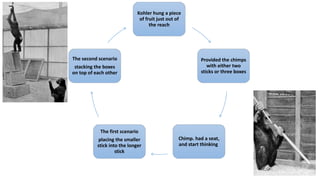
• Was identified by Wolfgang kohler while studying the behavior of
chimpanzee
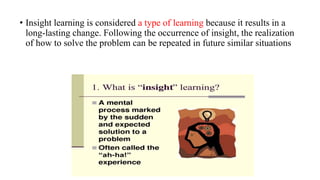
• Insight learning is the abrupt realization of a problem's solution
• insight learning is often at the root of creative, out of the box,
thinking (Inventions and innovations)
Kohler hung a piece
of fruit just out of
the reach
Provided the chimps
with either two
sticks or three boxes
Chimp. had a seat,
and start thinking
The first scenario
placing the smaller
stick into the longer
stick
The second scenario
stacking the boxes
on top of each other
• Insight learning is considered a type of learning because it results in a
long-lasting change. Following the occurrence of insight, the realization
of how to solve the problem can be repeated in future similar situations
Imitation (observational learning)
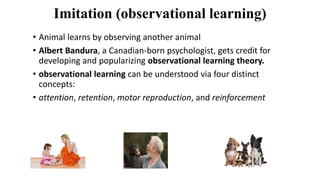
• Animal learns by observing another animal
• Albert Bandura, a Canadian-born psychologist, gets credit for
developing and popularizing observational learning theory.
• observational learning can be understood via four distinct
concepts:
• attention, retention, motor reproduction, and reinforcement
Taste aversion (bait shyness)
• Taste aversion is a learned response to eating spoiled or toxic
food. When taste aversion takes place, you avoid eating the
foods that made you ill. Taste aversion can be so powerful that
sometimes you also avoid the foods that you associate with an
illness, even if the food did not cause the illness
• Psychologists John Garcia and Robert Koelling studied taste
aversion in 1966 while researching the effects of radiation on
laboratory rats
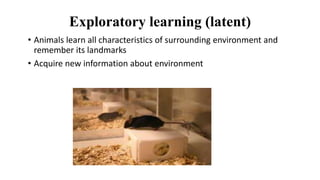
Exploratory learning (latent)
• Animals learn all characteristics of surrounding environment and
remember its landmarks
• Acquire new information about environment
Learning
• Learning occurs in a variety of ways:
• sometimes it is the result of direct observation of another
• other times, it is the result of experience through personal
interactions with the environment.
• response to an environmental stimulus
• as a result of trial and error
• Kohler's theory of insight learning became an early argument for
the involvement of cognition, or thinking, in the process of
learning.