ANATOMY &
PHYSIOLOGY OF
REPRODUCTIVE SYSTEM
Trainee teacher
Sadia Ahmad
OBJECTIVES:
• At the end of this lecture learner will be able to:
• Define mitosis and meiosis ?
• Define Reproductive system and Enlist male and female
reproductive organs ?
• Elaborate male and female reproductive organs .
• Explain significance of menstrual cycle.
REPRODUCTION:
Mitosis is the type of cell division that occurs
in non-reproductive cells.
Produces exact copies of the parent cell
Meiosis is cell division that occurs in
reproductive cells; gametes.
Produces egg and sperm cells with half the
genetic material of the parent cells.
23 chromosomes are contained in gametes;
this is so that when egg and sperm meet, they
produce offspring with 46 chromosomes
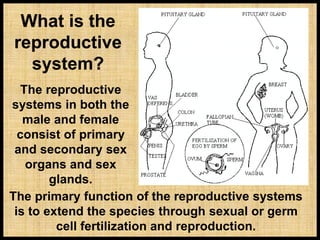
What is the
reproductive
system?
The reproductive
systems in both the
male and female
consist of primary
and secondary sex
organs and sex
glands.
The primary function of the reproductive systems
is to extend the species through sexual or germ
cell fertilization and reproduction.
Female reproductive system:
the uterus…
The uterus is a hollow,
muscular, pear-shaped
organ about the size of a
woman’s clenched fist. The
top is tipped forward in a
normal ‘anteflexion’
position. It can be divided
into the body and the
bottom cervix. The
rounded top portion,
above the fallopian tubes,
is called the fundus.
Female reproductive system:
the uterus…
The uterus wall
has 3 layers: the
outside layer
called the
perimetrium, the
muscular inside
layer called the
myometrium, and
the mucous
membrane lining
the uterus called
the endometrium.
Outer layer
(Perimetrium)
Thick layer of muscle
(Myometrium)
Mucous lining
(Endometrium)
The cervical opening is about
the diameter of a pencil.
Female reproductive system:
the uterus…
The uterus has 3
functions:
1. It provides a place for
the protection and
nourishment of the fetus
during pregnancy
2. It separates the bladder
and the bowels.
3. The fertilized ovum gets
implanted into the uterus
4. It contracts during labor to
expel the fetus
Female reproductive system:
the fallopian tubes…
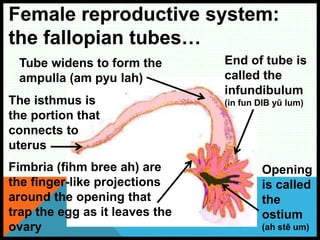
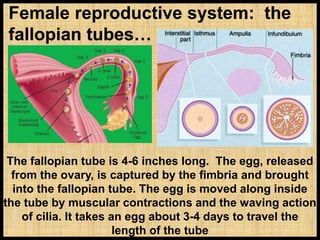
The isthmus is
the portion that
connects to
uterus
Tube widens to form the
ampulla (am pyu lah)
Fimbria (fihm bree ah) are
the finger-like projections
around the opening that
trap the egg as it leaves the
ovary
End of tube is
called the
infundibulum
(in fun DIB yū lum)
Opening
is called
the
ostium
(ah stē um)
Female reproductive system: the
fallopian tubes…
The fallopian tube is 4-6 inches long. The egg, released
from the ovary, is captured by the fimbria and brought
into the fallopian tube. The egg is moved along inside
the tube by muscular contractions and the waving action
of cilia. It takes an egg about 3-4 days to travel the
length of the tube
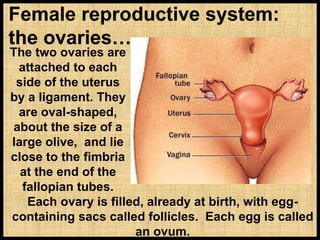
The two ovaries are
attached to each
side of the uterus
by a ligament. They
are oval-shaped,
about the size of a
large olive, and lie
close to the fimbria
at the end of the
fallopian tubes.
Female reproductive system:
the ovaries…
Each ovary is filled, already at birth, with egg-
containing sacs called follicles. Each egg is called
an ovum.
Once every 21 days,
one follicle in one
ovary matures. This
mature follicle is a
graafian (GRAW fee un)
follicle. The follicle
ruptures in response
to hormones from the
pituitary gland,
releasing the
ovum/egg… a process
called ovulation.
After the follicle ruptures, it
becomes a mass of yellow
cells called the corpus
luteum. This is a temporary,
progesterone-producing
structure.
Female reproductive system: the
ovaries and ova…
The vagina extends
from the cervix to the
outside of the body. It
is a 3 ½ inch long
muscular tube that
expands in length and
width during sexual
arousal.
Female reproductive system: the
vagina…
The vagina is the female organ for copulation
(sexual intercourse), receiving the seminal fluid
from the male penis. It is also a passageway for
menstruation or the birth of a fetus.
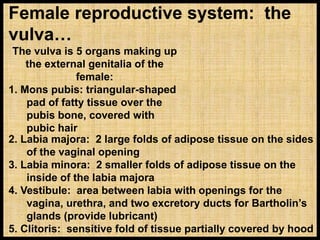
The vulva is 5 organs making up
the external genitalia of the
female:
1. Mons pubis: triangular-shaped
pad of fatty tissue over the
pubis bone, covered with
pubic hair
Female reproductive system: the
vulva…
2. Labia majora: 2 large folds of adipose tissue on the sides
of the vaginal opening
3. Labia minora: 2 smaller folds of adipose tissue on the
inside of the labia majora
4. Vestibule: area between labia with openings for the
vagina, urethra, and two excretory ducts for Bartholin’s
glands (provide lubricant)
5. Clitoris: sensitive fold of tissue partially covered by hood
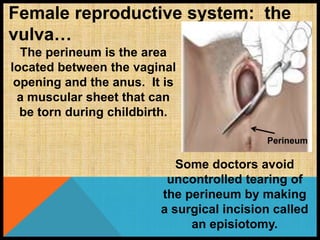
The perineum is the area
located between the vaginal
opening and the anus. It is
a muscular sheet that can
be torn during childbirth.
Female reproductive system: the
vulva…
Some doctors avoid
uncontrolled tearing of
the perineum by making
a surgical incision called
an episiotomy.
Perineum
The breasts are the
mammary glands,
varying in size according
to age, heredity, and the
amount of fatty tissue
present. Each breast has
15-20 glandular lobes
separated by connective
tissue. After childbirth,
the pituitary gland
stimulates these lobules
with the hormone
prolactin… and they
produce milk.
Female reproductive system: the
breasts…
The onset of the
menstrual cycle, or
menarche, begins at
puberty and ceases
at menopause. The
cycle has 3 phases:
The follicular phase is characterized by menstruation,
when the thickened lining of the endometrium is shed
because no egg was fertilized or implanted. Just prior to
this phase is a premenstrual period characterized by
hormonal and physical changes.
Female reproductive system: the
menstrual cycle…
The ovulatory phase
comes next. Estrogen is
the hormone produced by
the ovaries, which
stimulates the maturation
of a follicle and thickens
the endometrium.
The luteal phase follows ovulation, and is characterized
by the development of the corpus luteum, the secretion
of progesterone, the preparation of the endometrium for
implantation of a fertilized egg, and the formation of a
thick mucous to block the cervix once the egg passes
out of the fallopian tube.
Female reproductive system: the
menstrual cycle…
ORGANS OF THE MALE REPRODUCTIVE SYSTEM
 Penis
 Urethra
 Vas Deferens
 Scrotum
 Testes
 Bladder*
 *Not a part of the reproductive system
The scrotum is a
pouch of skin
suspended from
the perineal area
and divided into
two sacs… each
containing one
testicle and
epididymis.
Male reproductive system: scrotum
The scrotal tissue contracts in the absence of
sufficient heat, pulling the testes up closer to the
body where the temperature maintains the viability
of sperm.
A lubricant, smegma,is produced under the prepuce
on the penis. This foreskin may be circumcised/
removed for hygiene or religious reasons. It covers
the glans/head that is filled with nerve endings.
The urethra runs the
length of the penis from
the bladder to the meatus
(me Ā tus). The flaccid
penis fills with blood
during arousal, causing
an erection and allowing
for the function of
copulation/intercourse.
Male reproductive system: penis
The oval-shaped
testes are located in
the scrotum, and are
each divided into 250
lobules. Coiled
within the lobule are
seminiferous tubes
where the sperm are
formed.
The mature sperm are stored in the epididymis, a
tube 13-20 feet in length, coiled and lying on the
side of each testicle.
Male reproductive system: testes
and epididymis…
The acrosome
(AK roh zome) covering
the head of the
sperm contains
enzymes that help
it penetrate the
ova. The head
carries the genetic
material. The
midpiece supplies
energy. The tail or
flagellum (flah JELL
um) provides
motility.
Sperm carry either an
X/female OR Y/male
chromosome. Since all ova
carry the X/female
chromosome, the male sperm
does influence the baby’s sex.
Male reproductive system: sperm…
The vas deferens are
muscular tubes
transporting sperm from
the epididymis to the
seminal vesicles. The
seminal vesicles produce a
slightly alkaline fluid that
mixes with the sperm and
becomes part of the semen
ejaculated during the male
orgasm. It protects the
sperm from the acidity of
the urethra.
Male reproductive system:
vas deferens and seminal vesicles…
The prostate gland also secretes an alkaline fluid
that mixes with the sperm as part of the semen.
Enlargement of the prostate, benign prostatic
hyperplasia, obstructs the flow of urine through the
urethra. The Cowper’s or
bulbourethral glands
(bull boh yur REE thral)
produce another
mucous- alkaline
secretion in the
urethra, excreted from
the glands just before
ejaculation.
Male reproductive system: Prostate
and Cowper’s glands
REFERENCES
McKinney, E. S. (2013). Maternal-
child nursing. St. Louis,
Missouri: Elsevier/Saunders

178-Anatomy-Reproductive-System.ppt

  • 1.
    ANATOMY & PHYSIOLOGY OF REPRODUCTIVESYSTEM Trainee teacher Sadia Ahmad
  • 3.
    OBJECTIVES: • At theend of this lecture learner will be able to: • Define mitosis and meiosis ? • Define Reproductive system and Enlist male and female reproductive organs ? • Elaborate male and female reproductive organs . • Explain significance of menstrual cycle.
  • 4.
    REPRODUCTION: Mitosis is thetype of cell division that occurs in non-reproductive cells. Produces exact copies of the parent cell Meiosis is cell division that occurs in reproductive cells; gametes. Produces egg and sperm cells with half the genetic material of the parent cells. 23 chromosomes are contained in gametes; this is so that when egg and sperm meet, they produce offspring with 46 chromosomes
  • 5.
    What is the reproductive system? Thereproductive systems in both the male and female consist of primary and secondary sex organs and sex glands. The primary function of the reproductive systems is to extend the species through sexual or germ cell fertilization and reproduction.
  • 6.
    Female reproductive system: theuterus… The uterus is a hollow, muscular, pear-shaped organ about the size of a woman’s clenched fist. The top is tipped forward in a normal ‘anteflexion’ position. It can be divided into the body and the bottom cervix. The rounded top portion, above the fallopian tubes, is called the fundus.
  • 8.
    Female reproductive system: theuterus… The uterus wall has 3 layers: the outside layer called the perimetrium, the muscular inside layer called the myometrium, and the mucous membrane lining the uterus called the endometrium. Outer layer (Perimetrium) Thick layer of muscle (Myometrium) Mucous lining (Endometrium) The cervical opening is about the diameter of a pencil.
  • 9.
    Female reproductive system: theuterus… The uterus has 3 functions: 1. It provides a place for the protection and nourishment of the fetus during pregnancy 2. It separates the bladder and the bowels. 3. The fertilized ovum gets implanted into the uterus 4. It contracts during labor to expel the fetus
  • 10.
    Female reproductive system: thefallopian tubes… The isthmus is the portion that connects to uterus Tube widens to form the ampulla (am pyu lah) Fimbria (fihm bree ah) are the finger-like projections around the opening that trap the egg as it leaves the ovary End of tube is called the infundibulum (in fun DIB yū lum) Opening is called the ostium (ah stē um)
  • 11.
    Female reproductive system:the fallopian tubes… The fallopian tube is 4-6 inches long. The egg, released from the ovary, is captured by the fimbria and brought into the fallopian tube. The egg is moved along inside the tube by muscular contractions and the waving action of cilia. It takes an egg about 3-4 days to travel the length of the tube
  • 12.
    The two ovariesare attached to each side of the uterus by a ligament. They are oval-shaped, about the size of a large olive, and lie close to the fimbria at the end of the fallopian tubes. Female reproductive system: the ovaries… Each ovary is filled, already at birth, with egg- containing sacs called follicles. Each egg is called an ovum.
  • 13.
    Once every 21days, one follicle in one ovary matures. This mature follicle is a graafian (GRAW fee un) follicle. The follicle ruptures in response to hormones from the pituitary gland, releasing the ovum/egg… a process called ovulation. After the follicle ruptures, it becomes a mass of yellow cells called the corpus luteum. This is a temporary, progesterone-producing structure. Female reproductive system: the ovaries and ova…
  • 14.
    The vagina extends fromthe cervix to the outside of the body. It is a 3 ½ inch long muscular tube that expands in length and width during sexual arousal. Female reproductive system: the vagina… The vagina is the female organ for copulation (sexual intercourse), receiving the seminal fluid from the male penis. It is also a passageway for menstruation or the birth of a fetus.
  • 15.
    The vulva is5 organs making up the external genitalia of the female: 1. Mons pubis: triangular-shaped pad of fatty tissue over the pubis bone, covered with pubic hair Female reproductive system: the vulva… 2. Labia majora: 2 large folds of adipose tissue on the sides of the vaginal opening 3. Labia minora: 2 smaller folds of adipose tissue on the inside of the labia majora 4. Vestibule: area between labia with openings for the vagina, urethra, and two excretory ducts for Bartholin’s glands (provide lubricant) 5. Clitoris: sensitive fold of tissue partially covered by hood
  • 16.
    The perineum isthe area located between the vaginal opening and the anus. It is a muscular sheet that can be torn during childbirth. Female reproductive system: the vulva… Some doctors avoid uncontrolled tearing of the perineum by making a surgical incision called an episiotomy. Perineum
  • 17.
    The breasts arethe mammary glands, varying in size according to age, heredity, and the amount of fatty tissue present. Each breast has 15-20 glandular lobes separated by connective tissue. After childbirth, the pituitary gland stimulates these lobules with the hormone prolactin… and they produce milk. Female reproductive system: the breasts…
  • 18.
    The onset ofthe menstrual cycle, or menarche, begins at puberty and ceases at menopause. The cycle has 3 phases: The follicular phase is characterized by menstruation, when the thickened lining of the endometrium is shed because no egg was fertilized or implanted. Just prior to this phase is a premenstrual period characterized by hormonal and physical changes. Female reproductive system: the menstrual cycle…
  • 19.
    The ovulatory phase comesnext. Estrogen is the hormone produced by the ovaries, which stimulates the maturation of a follicle and thickens the endometrium. The luteal phase follows ovulation, and is characterized by the development of the corpus luteum, the secretion of progesterone, the preparation of the endometrium for implantation of a fertilized egg, and the formation of a thick mucous to block the cervix once the egg passes out of the fallopian tube. Female reproductive system: the menstrual cycle…
  • 20.
    ORGANS OF THEMALE REPRODUCTIVE SYSTEM  Penis  Urethra  Vas Deferens  Scrotum  Testes  Bladder*  *Not a part of the reproductive system
  • 21.
    The scrotum isa pouch of skin suspended from the perineal area and divided into two sacs… each containing one testicle and epididymis. Male reproductive system: scrotum The scrotal tissue contracts in the absence of sufficient heat, pulling the testes up closer to the body where the temperature maintains the viability of sperm.
  • 22.
    A lubricant, smegma,isproduced under the prepuce on the penis. This foreskin may be circumcised/ removed for hygiene or religious reasons. It covers the glans/head that is filled with nerve endings. The urethra runs the length of the penis from the bladder to the meatus (me Ā tus). The flaccid penis fills with blood during arousal, causing an erection and allowing for the function of copulation/intercourse. Male reproductive system: penis
  • 23.
    The oval-shaped testes arelocated in the scrotum, and are each divided into 250 lobules. Coiled within the lobule are seminiferous tubes where the sperm are formed. The mature sperm are stored in the epididymis, a tube 13-20 feet in length, coiled and lying on the side of each testicle. Male reproductive system: testes and epididymis…
  • 24.
    The acrosome (AK rohzome) covering the head of the sperm contains enzymes that help it penetrate the ova. The head carries the genetic material. The midpiece supplies energy. The tail or flagellum (flah JELL um) provides motility. Sperm carry either an X/female OR Y/male chromosome. Since all ova carry the X/female chromosome, the male sperm does influence the baby’s sex. Male reproductive system: sperm…
  • 25.
    The vas deferensare muscular tubes transporting sperm from the epididymis to the seminal vesicles. The seminal vesicles produce a slightly alkaline fluid that mixes with the sperm and becomes part of the semen ejaculated during the male orgasm. It protects the sperm from the acidity of the urethra. Male reproductive system: vas deferens and seminal vesicles…
  • 26.
    The prostate glandalso secretes an alkaline fluid that mixes with the sperm as part of the semen. Enlargement of the prostate, benign prostatic hyperplasia, obstructs the flow of urine through the urethra. The Cowper’s or bulbourethral glands (bull boh yur REE thral) produce another mucous- alkaline secretion in the urethra, excreted from the glands just before ejaculation. Male reproductive system: Prostate and Cowper’s glands
  • 27.
    REFERENCES McKinney, E. S.(2013). Maternal- child nursing. St. Louis, Missouri: Elsevier/Saunders

Editor's Notes

  • #20 Follicular, ovulatory, luteal phase