Reproductive SystemReproductive System
Male Reproductive SystemMale Reproductive System Female Reproductive SystemFemale Reproductive System
The Menstrual CycleThe Menstrual Cycle
HUMAN REPRODUCTIVE
SYSTEM
The reproductive system enables human
beings to reproduce another human being.
The reproductive system starts the life of every
human being.
The reproductive system of boys is different
from that of girls.
The male reproductive system is designed for
production and transport of sperm cells.
The female reproductive system is designed for
child bearing.
The male and female reproductive systems are
designed to create new life.
REPRODUCTION
is a process that makes possible the
continuance of life in earth.
Males and females have structures specialized
for their role in reproduction.
The process that produces babies, young
animals, or new plants.
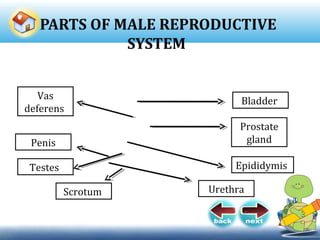
PARTS OF MALE REPRODUCTIVE
SYSTEM
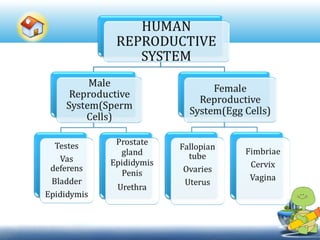
Epididymis
Vas
deferens
Prostate
gland
Urethra
Testes
Scrotum
Penis
Bladder
MALE REPRODUCTIVE SYTEM
 Is made up of several organs which include
the testes, ducts, accessory glands, and
penis.
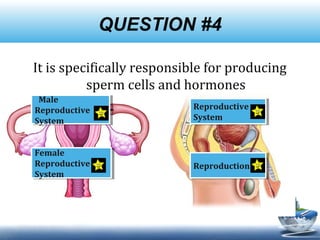
 It is specifically responsible for producing
sperm cells and hormones.
An average man can have about 5 000 000
sperm cells in a single drop.
Parts and Functions
Testes – sex glands located in the scrotum.
They produce sperms and the hormone
testosterone.
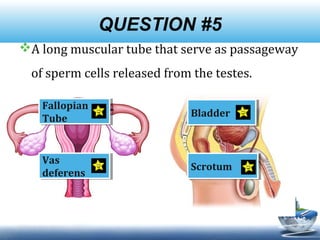
Vas deferens– A long muscular tube that serve
as passageway of sperm cells released from the
testes.

Scrotum– is a pair of pouch-like sacs. It serves

as skin covering of the testes.
Bladder– a sac in the anterior part of the
pelvis for temporary retention of urine.
Epididymis– is a narrow coiled tube that
stores immature sperm cells.
Prostate Gland– is a wall-nut sized gland
located between the bladder and the penis
 Urethra– an opening for sperm and urine
passage.
 Penis– is the external male organ with a tip
called glans.
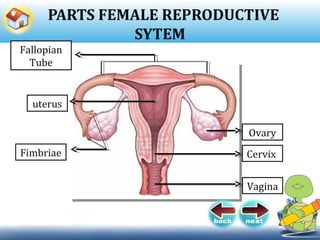
PARTS FEMALE REPRODUCTIVE
SYTEM
Fallopian
Tube
uterus
Ovary
Fimbriae
Vagina
Cervix
FEMALE REPRODUCTIVE SYTEM
Designed for conception, pregnancy and
childbirth.
It is made up of several organs which include
the ovaries, fallopian tubes, uterus and vagina.
It is responsible for producing eggs and
supporting a developing baby inside a mother’s
womb.
Parts and Functions
FALLOPIAN TUBES– also called oviduct.
Lies close to the ovary waiting for the egg to
enter.
OVARIES (ovary)- produces egg cells and
the sex hormones estrogen and progesterone.
Uterus– also called the womb. Shaped like an
upside– down pear. Has smooth, soft, inner
lining of the uterus called uterine lining or
endometrium.
Fimbriae– the fringe of tissue around the
fallopian tube.

Cervix– narrow opening between the uterus
and vagina. Enlarges to let the passage of a
fetus during birth.
Vagina– also called the birth canal. Hollow
muscular tube that leads to the opening called
vulva.
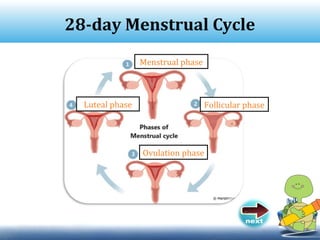
The Menstrual Cycle
Menstrual flow happen only among girls.
Menstruation is part of a menstrual cycle.
Menstruation is the monthly discharge of blood
from the uterus through the vagina.
When a girl reaches puberty, one egg
ripens or matures every 28 days.
If no sperm cell arrives from 15 to 28, no
fertilization and implantation occurs.
The egg cell will then breakdown along with
the uterine lining as blood.
This marks the beginning of another menstrual
cycle.
28-day Menstrual Cycle
Menstrual phase
Follicular phase
Ovulation phase
Luteal phase
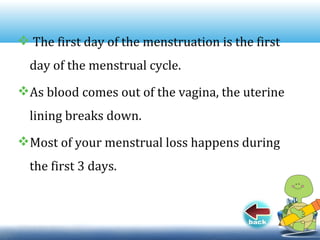
 The first day of the menstruation is the first
day of the menstrual cycle.
As blood comes out of the vagina, the uterine
lining breaks down.
Most of your menstrual loss happens during
the first 3 days.
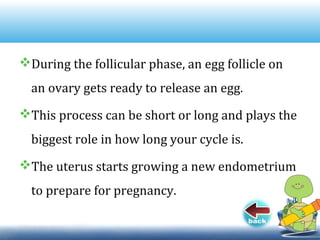
During the follicular phase, an egg follicle on
an ovary gets ready to release an egg.
This process can be short or long and plays the
biggest role in how long your cycle is.
The uterus starts growing a new endometrium
to prepare for pregnancy.
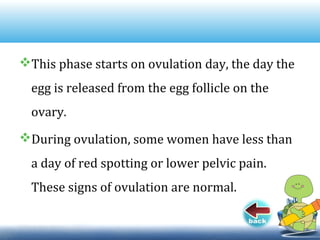
This phase starts on ovulation day, the day the
egg is released from the egg follicle on the
ovary.
During ovulation, some women have less than
a day of red spotting or lower pelvic pain.
These signs of ovulation are normal.
It is the phase of a female's menstrual cycle
when an egg(ovule) is released from the
ovaries.
At day 14, ovulation takes place. Ovulation
occurs when an egg is released by the ovary.
The egg cells travels along the oviduct and
waits for a sperm cell.
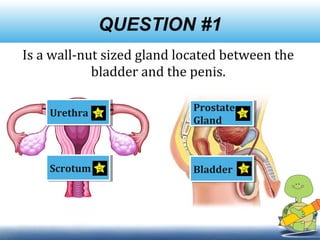
Is a wall-nut sized gland located between the
bladder and the penis.
QUESTION #1
UrethraUrethra
BladderBladderScrotumScrotum
Prostate
Gland
Prostate
Gland
CORRECT
Oh!!! iTs wROng .
TRy again
!
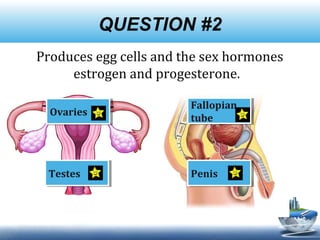
QUESTION #2
Produces egg cells and the sex hormones
estrogen and progesterone.
OvariesOvaries
PenisPenis
Fallopian
tube
Fallopian
tube
TestesTestes
CORRECT
Oh!!! iTs wROng .
TRy again
!
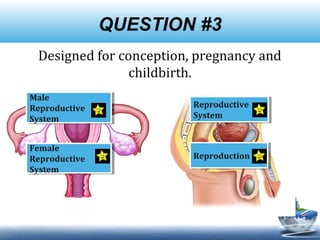
QUESTION #3
Designed for conception, pregnancy and
childbirth.
Male
Reproductive
System
Male
Reproductive
System
Female
Reproductive
System
Female
Reproductive
System
ReproductionReproduction
Reproductive
System
Reproductive
System
CORRECT
Oh!!! iTs wROng .
TRy again
!
QUESTION #4
It is specifically responsible for producing
sperm cells and hormones
Male
Reproductive
System
Male
Reproductive
System
Female
Reproductive
System
Female
Reproductive
System
ReproductionReproduction
Reproductive
System
Reproductive
System
CORRECT
Oh!!! iTs wROng .
TRy again!
QUESTION #5
A long muscular tube that serve as passageway
of sperm cells released from the testes.
Fallopian
Tube
Fallopian
Tube
ScrotumScrotum
Vas
deferens
Vas
deferens
BladderBladder
CORRECT
Oh!!! iTs wROng .
TRy again!
REFERENCES:
 Abracia, N.M., DeleCruz , M.G. & Sarte, E.T. (2014). Science
in our World. Quezon City Philippines: Vibal Group, Inc.
 Apolinario, A.A. & Fallaria, R.R. (1996). Science and Health
Today. Quezon City Philippines: Rex Book store, Inc.
 Coronel, C.C., Rimando, M.C. & Saclamitao (1999).Science
and Health. Quezon City Philippines: SD Publications, Inc.
 Tan,C.T.(2002). Science for Daily Use. Marikina City
Philippines: Jica Enterprises
 Reproduction. (n.d). Retrieved from
http://www.merriam-
webster.com/dictionary/reproduction
发展经济学 40

Reproductive System

  • 1.
    Reproductive SystemReproductive System MaleReproductive SystemMale Reproductive System Female Reproductive SystemFemale Reproductive System The Menstrual CycleThe Menstrual Cycle
  • 3.
    HUMAN REPRODUCTIVE SYSTEM The reproductivesystem enables human beings to reproduce another human being. The reproductive system starts the life of every human being. The reproductive system of boys is different from that of girls.
  • 4.
    The male reproductivesystem is designed for production and transport of sperm cells. The female reproductive system is designed for child bearing. The male and female reproductive systems are designed to create new life.
  • 5.
    REPRODUCTION is a processthat makes possible the continuance of life in earth. Males and females have structures specialized for their role in reproduction. The process that produces babies, young animals, or new plants.
  • 6.
    PARTS OF MALEREPRODUCTIVE SYSTEM Epididymis Vas deferens Prostate gland Urethra Testes Scrotum Penis Bladder
  • 7.
    MALE REPRODUCTIVE SYTEM Is made up of several organs which include the testes, ducts, accessory glands, and penis.  It is specifically responsible for producing sperm cells and hormones. An average man can have about 5 000 000 sperm cells in a single drop.
  • 8.
    Parts and Functions Testes– sex glands located in the scrotum. They produce sperms and the hormone testosterone. Vas deferens– A long muscular tube that serve as passageway of sperm cells released from the testes.
  • 9.
    Scrotum– is apair of pouch-like sacs. It serves as skin covering of the testes. Bladder– a sac in the anterior part of the pelvis for temporary retention of urine. Epididymis– is a narrow coiled tube that stores immature sperm cells.
  • 10.
    Prostate Gland– isa wall-nut sized gland located between the bladder and the penis  Urethra– an opening for sperm and urine passage.  Penis– is the external male organ with a tip called glans.
  • 11.
  • 12.
    FEMALE REPRODUCTIVE SYTEM Designedfor conception, pregnancy and childbirth. It is made up of several organs which include the ovaries, fallopian tubes, uterus and vagina. It is responsible for producing eggs and supporting a developing baby inside a mother’s womb.
  • 13.
    Parts and Functions FALLOPIANTUBES– also called oviduct. Lies close to the ovary waiting for the egg to enter. OVARIES (ovary)- produces egg cells and the sex hormones estrogen and progesterone.
  • 14.
    Uterus– also calledthe womb. Shaped like an upside– down pear. Has smooth, soft, inner lining of the uterus called uterine lining or endometrium. Fimbriae– the fringe of tissue around the fallopian tube. 
  • 15.
    Cervix– narrow openingbetween the uterus and vagina. Enlarges to let the passage of a fetus during birth. Vagina– also called the birth canal. Hollow muscular tube that leads to the opening called vulva.
  • 16.
    The Menstrual Cycle Menstrualflow happen only among girls. Menstruation is part of a menstrual cycle. Menstruation is the monthly discharge of blood from the uterus through the vagina. When a girl reaches puberty, one egg ripens or matures every 28 days.
  • 17.
    If no spermcell arrives from 15 to 28, no fertilization and implantation occurs. The egg cell will then breakdown along with the uterine lining as blood. This marks the beginning of another menstrual cycle.
  • 18.
    28-day Menstrual Cycle Menstrualphase Follicular phase Ovulation phase Luteal phase
  • 19.
     The firstday of the menstruation is the first day of the menstrual cycle. As blood comes out of the vagina, the uterine lining breaks down. Most of your menstrual loss happens during the first 3 days.
  • 20.
    During the follicularphase, an egg follicle on an ovary gets ready to release an egg. This process can be short or long and plays the biggest role in how long your cycle is. The uterus starts growing a new endometrium to prepare for pregnancy.
  • 21.
    This phase startson ovulation day, the day the egg is released from the egg follicle on the ovary. During ovulation, some women have less than a day of red spotting or lower pelvic pain. These signs of ovulation are normal.
  • 22.
    It is thephase of a female's menstrual cycle when an egg(ovule) is released from the ovaries. At day 14, ovulation takes place. Ovulation occurs when an egg is released by the ovary. The egg cells travels along the oviduct and waits for a sperm cell.
  • 24.
    Is a wall-nutsized gland located between the bladder and the penis. QUESTION #1 UrethraUrethra BladderBladderScrotumScrotum Prostate Gland Prostate Gland
  • 25.
  • 26.
    Oh!!! iTs wROng. TRy again !
  • 27.
    QUESTION #2 Produces eggcells and the sex hormones estrogen and progesterone. OvariesOvaries PenisPenis Fallopian tube Fallopian tube TestesTestes
  • 28.
  • 29.
    Oh!!! iTs wROng. TRy again !
  • 30.
    QUESTION #3 Designed forconception, pregnancy and childbirth. Male Reproductive System Male Reproductive System Female Reproductive System Female Reproductive System ReproductionReproduction Reproductive System Reproductive System
  • 31.
  • 32.
    Oh!!! iTs wROng. TRy again !
  • 33.
    QUESTION #4 It isspecifically responsible for producing sperm cells and hormones Male Reproductive System Male Reproductive System Female Reproductive System Female Reproductive System ReproductionReproduction Reproductive System Reproductive System
  • 34.
  • 35.
    Oh!!! iTs wROng. TRy again!
  • 36.
    QUESTION #5 A longmuscular tube that serve as passageway of sperm cells released from the testes. Fallopian Tube Fallopian Tube ScrotumScrotum Vas deferens Vas deferens BladderBladder
  • 37.
  • 38.
    Oh!!! iTs wROng. TRy again!
  • 39.
    REFERENCES:  Abracia, N.M.,DeleCruz , M.G. & Sarte, E.T. (2014). Science in our World. Quezon City Philippines: Vibal Group, Inc.  Apolinario, A.A. & Fallaria, R.R. (1996). Science and Health Today. Quezon City Philippines: Rex Book store, Inc.  Coronel, C.C., Rimando, M.C. & Saclamitao (1999).Science and Health. Quezon City Philippines: SD Publications, Inc.  Tan,C.T.(2002). Science for Daily Use. Marikina City Philippines: Jica Enterprises  Reproduction. (n.d). Retrieved from http://www.merriam- webster.com/dictionary/reproduction
  • 40.