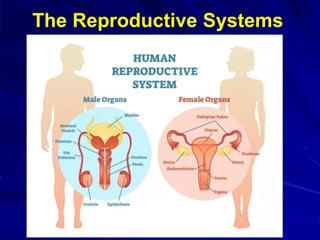
The Reproductive Systems
A. Male reproductive system
1. Scrotum
2. Testes
a. Spermatogenesis
b. Spermatozoa
c.Hormones of the brain-
testicular axis
3. Ducts
a. Ducts of the testis
b. Epididymis
c. Ductus (vas) deferens
d. Ejaculatory ducts
e. Urethra
4. Accessory sex glands
5. Semen
6. Penis
B. Female reproductive system
1. Ovaries
a. Oogenesis
2. Uterine (fallopian) tubes
3. Uterus
4. Vagina
5. Vulva
6. Perineum
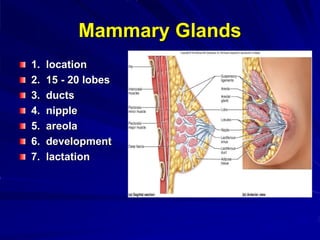
7. Mammary glands
C. Female reproductive cycle
1. Hormonal regulation
2. Phases of the female
reproductive cycle
a. Menstrual phase
(menstruation)
b. Preovulatory
phase
c. Ovulation
d. Postovulatory
phase
What is the reproduction
• Primary reproductive organs are called gonads – testes
in the male and ovaries in the female.
• Gonads:
(1) produce reproductive cells called gametes –
spermatozoa in males and ova in females, the process is
called gametogenesis.
(2) secrete steroid hormones called sex hormones –
testosterone in males, estradiol, and progesterone in
females.
• GnRH stimulates the release of pituitary gonadotropins –
FSH and LH, which act upon the gonads to stimulate the
development of sperm and ova.
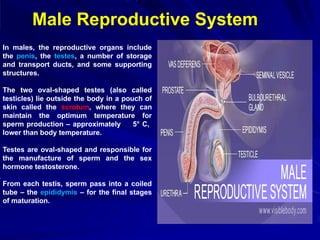
Male Reproductive System
In males, the reproductive organs include
the penis, the testes, a number of storage
and transport ducts, and some supporting
structures.
The two oval-shaped testes (also called
testicles) lie outside the body in a pouch of
skin called the scrotum, where they can
maintain the optimum temperature for
sperm production – approximately 5° C,
lower than body temperature.
Testes are oval-shaped and responsible for
the manufacture of sperm and the sex
hormone testosterone.
From each testis, sperm pass into a coiled
tube – the epididymis – for the final stages
of maturation.
The Testes
 Produce sperms
 Produce sex hormones
 Found in a sac called the scrotum
 Suspended outside of the body cavity for temperature
reduction
 Testes wall made of fibrous connective tissue
(Divides the testes into lobules (Chambers)
 Inside the chambers are long tubules (70 cm)
called the Seminiferous tubules, this is the actual site
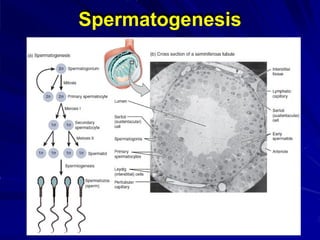
for spermatogenesis (manufacturing sperms).
 Interstitial cells secrete androgens “testosterone”
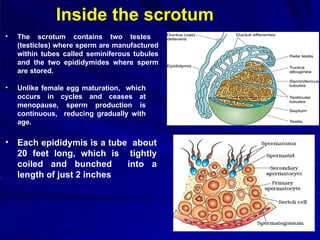
Inside the scrotum
• The scrotum contains two testes
(testicles) where sperm are manufactured
within tubes called seminiferous tubules
and the two epididymides where sperm
are stored.
• Unlike female egg maturation, which
occurs in cycles and ceases at
menopause, sperm production is
continuous, reducing gradually with
age.
• Each epididymis is a tube about
20 feet long, which is tightly
coiled and bunched into a
length of just 2 inches
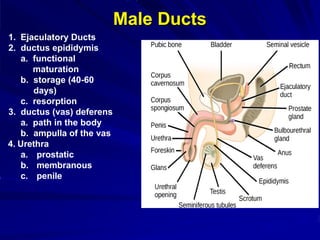
Male Ducts
1. Ejaculatory Ducts
2. ductus epididymis
a. functional
maturation
b. storage (40-60
days)
c. resorption
3. ductus (vas) deferens
a. path in the body
b. ampulla of the vas
4. Urethra
a. prostatic
b. membranous
c. penile
Accessory sex glands
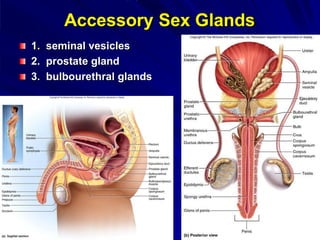
• The glands associated with the male reproductive tract are :
1- paired seminal vesicles
2- the single prostate gland
3- two bulbourethral glands (Cowper).
• These glands form the non-cellular portion of semen (spermatozoa
suspended in the secretions of the accessory glands), which not only
nourishes the spermatozoa but also provides a fluid vehicle for their
delivery into the female reproductive tract.
• The penis has a dual function: It delivers semen to the female
reproductive tract during copulation and serves as the conduit of
urine from the urinary bladder to outside the body.
Accessory Sex Glands
1. seminal vesicles
2. prostate gland
3. bulbourethral glands
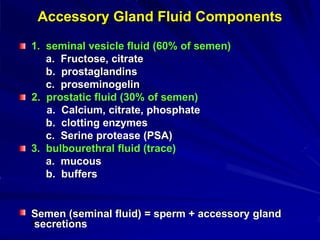
Accessory Gland Fluid Components
1. seminal vesicle fluid (60% of semen)
a. Fructose, citrate
b. prostaglandins
c. proseminogelin
2. prostatic fluid (30% of semen)
a. Calcium, citrate, phosphate
b. clotting enzymes
c. Serine protease (PSA)
3. bulbourethral fluid (trace)
a. mucous
b. buffers
Semen (seminal fluid) = sperm + accessory gland
secretions
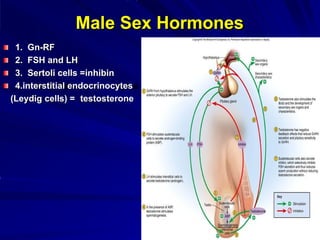
Male Sex Hormones
1. Gn-RF
2. FSH and LH
3. Sertoli cells =inhibin
4.interstitial endocrinocytes
(Leydig cells) = testosterone
Spermatogenesis
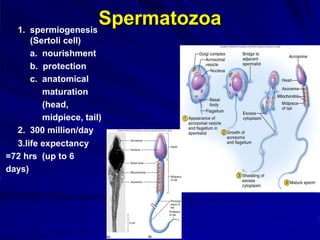
Spermatozoa
1. spermiogenesis
(Sertoli cell)
a. nourishment
b. protection
c. anatomical
maturation
(head,
midpiece, tail)
2. 300 million/day
3.life expectancy
=72 hrs (up to 6
days)
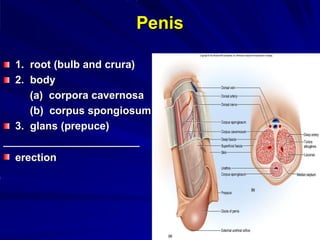
Penis
1. root (bulb and crura)
2. body
(a) corpora cavernosa
(b) corpus spongiosum
3. glans (prepuce)
erection
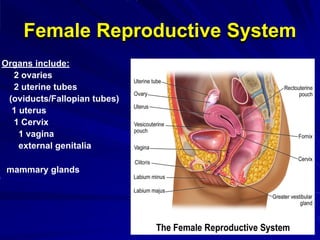
Female Reproductive System
Organs include:
2 ovaries
2 uterine tubes
(oviducts/Fallopian tubes)
1 uterus
1 Cervix
1 vagina
external genitalia
mammary glands
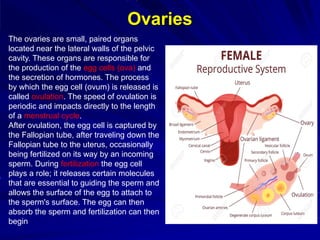
Ovaries
The ovaries are small, paired organs
located near the lateral walls of the pelvic
cavity. These organs are responsible for
the production of the egg cells (ova) and
the secretion of hormones. The process
by which the egg cell (ovum) is released is
called ovulation. The speed of ovulation is
periodic and impacts directly to the length
of a menstrual cycle.
After ovulation, the egg cell is captured by
the Fallopian tube, after traveling down the
Fallopian tube to the uterus, occasionally
being fertilized on its way by an incoming
sperm. During fertilization the egg cell
plays a role; it releases certain molecules
that are essential to guiding the sperm and
allows the surface of the egg to attach to
the sperm's surface. The egg can then
absorb the sperm and fertilization can then
begin
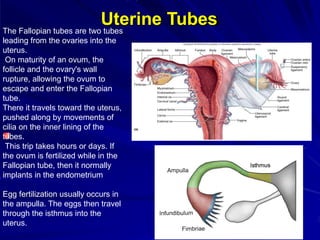
Uterine Tubes
The Fallopian tubes are two tubes
leading from the ovaries into the
uterus.
On maturity of an ovum, the
follicle and the ovary's wall
rupture, allowing the ovum to
escape and enter the Fallopian
tube.
There it travels toward the uterus,
pushed along by movements of
cilia on the inner lining of the
tubes.
This trip takes hours or days. If
the ovum is fertilized while in the
Fallopian tube, then it normally
implants in the endometrium
Egg fertilization usually occurs in
the ampulla. The eggs then travel
through the isthmus into the
uterus.
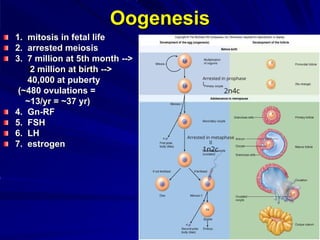
Oogenesis
1. mitosis in fetal life
2. arrested meiosis
3. 7 million at 5th month -->
2 million at birth -->
40,000 at puberty
(~480 ovulations =
~13/yr = ~37 yr)
4. Gn-RF
5. FSH
6. LH
7. estrogen
Arrested in metaphase
II
1n2c
Arrested in prophase
I
2n4c
Oogenesis
• Oogenesis. Primitive germ cells, called oogonia undergo mitosis and develop into
primary oocytes (with 46 chromosomes) and remain at a state of meiotic arrest (they
begin the first meiotic development but do not complete it). All the germ cells in a
female are at this developmental stage at birth.
• At puberty, primary oocytes destined for ovulation complete meiosis, each daughter
cell receiving 23 chromosomes. One of the two daughter cells retains all the
cytoplasm and is called the secondary oocyte while the other, called the first polar
body, is nonfunctional. The second meiotic division occurs in the uterine tube after
ovulation, ONLY IF the secondary oocyte is fertilized. Again, one daughter cell retains
all the cytoplasm and is called the ovum while the other cell, called the second polar
body, is nonfunctional and is later absorbed by the body.
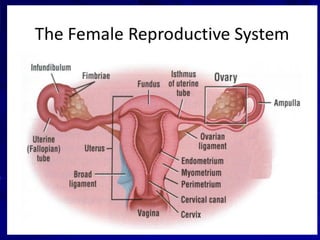
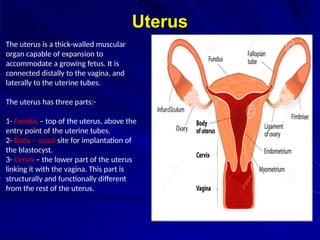
Uterus
The uterus is a thick-walled muscular
organ capable of expansion to
accommodate a growing fetus. It is
connected distally to the vagina, and
laterally to the uterine tubes.
The uterus has three parts:-
1- Fundus – top of the uterus, above the
entry point of the uterine tubes.
2- Body – usual site for implantation of
the blastocyst.
3- Cervix – the lower part of the uterus
linking it with the vagina. This part is
structurally and functionally different
from the rest of the uterus.
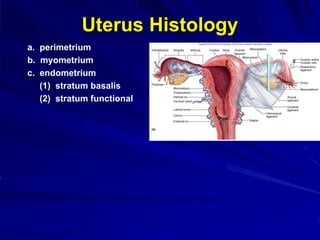
Uterus Histology
a. perimetrium
b. myometrium
c. endometrium
(1) stratum basalis
(2) stratum functional
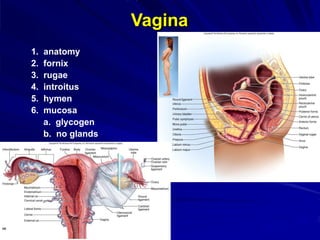
Vagina
1. anatomy
2. fornix
3. rugae
4. introitus
5. hymen
6. mucosa
a. glycogen
b. no glands
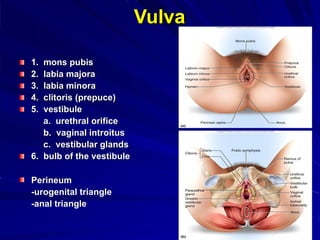
Vulva
1. mons pubis
2. labia majora
3. labia minora
4. clitoris (prepuce)
5. vestibule
a. urethral orifice
b. vaginal introitus
c. vestibular glands
6. bulb of the vestibule
Perineum
-urogenital triangle
-anal triangle
Mammary Glands
1. location
2. 15 - 20 lobes
3. ducts
4. nipple
5. areola
6. development
7. lactation
Female Reproductive Cycle
1. ovarian cycle
2. uterine (menstrual) cycle
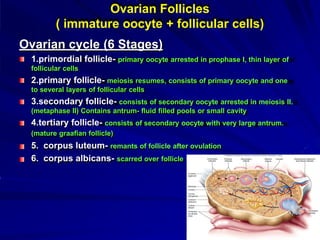
Ovarian Follicles
( immature oocyte + follicular cells)
Ovarian cycle (6 Stages)
1.primordial follicle- primary oocyte arrested in prophase I, thin layer of
follicular cells
2.primary follicle- meiosis resumes, consists of primary oocyte and one
to several layers of follicular cells
3.secondary follicle- consists of secondary oocyte arrested in meiosis II.
(metaphase II) Contains antrum- fluid filled pools or small cavity
4.tertiary follicle- consists of secondary oocyte with very large antrum.
(mature graafian follicle)
5. corpus luteum- remants of follicle after ovulation
6. corpus albicans- scarred over follicle
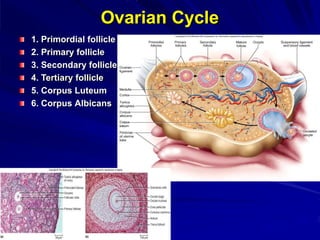
Ovarian Cycle
1. Primordial follicle
2. Primary follicle
3. Secondary follicle
4. Tertiary follicle
5. Corpus Luteum
6. Corpus Albicans
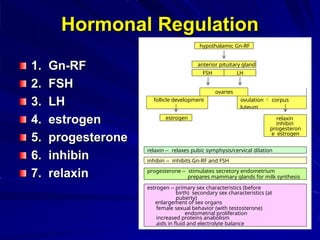
Hormonal Regulation
1. Gn-RF
2. FSH
3. LH
4. estrogen
5. progesterone
6. inhibin
7. relaxin
hypothalamic Gn-RF
anterior pituitary gland
FSH LH
ovaries
follicle development ovulation  corpus
luteum
relaxin
inhibin
progesteron
e estrogen
estrogen
relaxin -- relaxes pubic symphysis/cervical dilation
inhibin -- inhibits Gn-RF and FSH
progesterone -- stimulates secretory endometrium
prepares mammary glands for milk synthesis
estrogen -- primary sex characteristics (before
birth) secondary sex characteristics (at
puberty)
enlargement of sex organs
female sexual behavior (with testosterone)
endometrial proliferation
increased proteins anabolism
aids in fluid and electrolyte balance
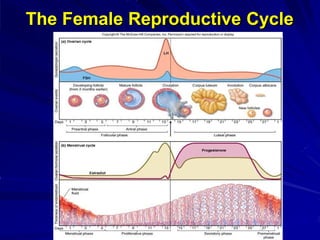
The Female Reproductive Cycle

reproductive system lecture44444444.pptx

  • 1.
  • 2.
    The Reproductive Systems A.Male reproductive system 1. Scrotum 2. Testes a. Spermatogenesis b. Spermatozoa c.Hormones of the brain- testicular axis 3. Ducts a. Ducts of the testis b. Epididymis c. Ductus (vas) deferens d. Ejaculatory ducts e. Urethra 4. Accessory sex glands 5. Semen 6. Penis B. Female reproductive system 1. Ovaries a. Oogenesis 2. Uterine (fallopian) tubes 3. Uterus 4. Vagina 5. Vulva 6. Perineum 7. Mammary glands C. Female reproductive cycle 1. Hormonal regulation 2. Phases of the female reproductive cycle a. Menstrual phase (menstruation) b. Preovulatory phase c. Ovulation d. Postovulatory phase
  • 3.
    What is thereproduction • Primary reproductive organs are called gonads – testes in the male and ovaries in the female. • Gonads: (1) produce reproductive cells called gametes – spermatozoa in males and ova in females, the process is called gametogenesis. (2) secrete steroid hormones called sex hormones – testosterone in males, estradiol, and progesterone in females. • GnRH stimulates the release of pituitary gonadotropins – FSH and LH, which act upon the gonads to stimulate the development of sperm and ova.
  • 4.
    Male Reproductive System Inmales, the reproductive organs include the penis, the testes, a number of storage and transport ducts, and some supporting structures. The two oval-shaped testes (also called testicles) lie outside the body in a pouch of skin called the scrotum, where they can maintain the optimum temperature for sperm production – approximately 5° C, lower than body temperature. Testes are oval-shaped and responsible for the manufacture of sperm and the sex hormone testosterone. From each testis, sperm pass into a coiled tube – the epididymis – for the final stages of maturation.
  • 5.
    The Testes  Producesperms  Produce sex hormones  Found in a sac called the scrotum  Suspended outside of the body cavity for temperature reduction  Testes wall made of fibrous connective tissue (Divides the testes into lobules (Chambers)  Inside the chambers are long tubules (70 cm) called the Seminiferous tubules, this is the actual site for spermatogenesis (manufacturing sperms).  Interstitial cells secrete androgens “testosterone”
  • 6.
    Inside the scrotum •The scrotum contains two testes (testicles) where sperm are manufactured within tubes called seminiferous tubules and the two epididymides where sperm are stored. • Unlike female egg maturation, which occurs in cycles and ceases at menopause, sperm production is continuous, reducing gradually with age. • Each epididymis is a tube about 20 feet long, which is tightly coiled and bunched into a length of just 2 inches
  • 7.
    Male Ducts 1. EjaculatoryDucts 2. ductus epididymis a. functional maturation b. storage (40-60 days) c. resorption 3. ductus (vas) deferens a. path in the body b. ampulla of the vas 4. Urethra a. prostatic b. membranous c. penile
  • 8.
    Accessory sex glands •The glands associated with the male reproductive tract are : 1- paired seminal vesicles 2- the single prostate gland 3- two bulbourethral glands (Cowper). • These glands form the non-cellular portion of semen (spermatozoa suspended in the secretions of the accessory glands), which not only nourishes the spermatozoa but also provides a fluid vehicle for their delivery into the female reproductive tract. • The penis has a dual function: It delivers semen to the female reproductive tract during copulation and serves as the conduit of urine from the urinary bladder to outside the body.
  • 9.
    Accessory Sex Glands 1.seminal vesicles 2. prostate gland 3. bulbourethral glands
  • 10.
    Accessory Gland FluidComponents 1. seminal vesicle fluid (60% of semen) a. Fructose, citrate b. prostaglandins c. proseminogelin 2. prostatic fluid (30% of semen) a. Calcium, citrate, phosphate b. clotting enzymes c. Serine protease (PSA) 3. bulbourethral fluid (trace) a. mucous b. buffers Semen (seminal fluid) = sperm + accessory gland secretions
  • 11.
    Male Sex Hormones 1.Gn-RF 2. FSH and LH 3. Sertoli cells =inhibin 4.interstitial endocrinocytes (Leydig cells) = testosterone
  • 12.
  • 13.
    Spermatozoa 1. spermiogenesis (Sertoli cell) a.nourishment b. protection c. anatomical maturation (head, midpiece, tail) 2. 300 million/day 3.life expectancy =72 hrs (up to 6 days)
  • 14.
    Penis 1. root (bulband crura) 2. body (a) corpora cavernosa (b) corpus spongiosum 3. glans (prepuce) erection
  • 15.
    Female Reproductive System Organsinclude: 2 ovaries 2 uterine tubes (oviducts/Fallopian tubes) 1 uterus 1 Cervix 1 vagina external genitalia mammary glands
  • 17.
    Ovaries The ovaries aresmall, paired organs located near the lateral walls of the pelvic cavity. These organs are responsible for the production of the egg cells (ova) and the secretion of hormones. The process by which the egg cell (ovum) is released is called ovulation. The speed of ovulation is periodic and impacts directly to the length of a menstrual cycle. After ovulation, the egg cell is captured by the Fallopian tube, after traveling down the Fallopian tube to the uterus, occasionally being fertilized on its way by an incoming sperm. During fertilization the egg cell plays a role; it releases certain molecules that are essential to guiding the sperm and allows the surface of the egg to attach to the sperm's surface. The egg can then absorb the sperm and fertilization can then begin
  • 18.
    Uterine Tubes The Fallopiantubes are two tubes leading from the ovaries into the uterus. On maturity of an ovum, the follicle and the ovary's wall rupture, allowing the ovum to escape and enter the Fallopian tube. There it travels toward the uterus, pushed along by movements of cilia on the inner lining of the tubes. This trip takes hours or days. If the ovum is fertilized while in the Fallopian tube, then it normally implants in the endometrium Egg fertilization usually occurs in the ampulla. The eggs then travel through the isthmus into the uterus.
  • 19.
    Oogenesis 1. mitosis infetal life 2. arrested meiosis 3. 7 million at 5th month --> 2 million at birth --> 40,000 at puberty (~480 ovulations = ~13/yr = ~37 yr) 4. Gn-RF 5. FSH 6. LH 7. estrogen Arrested in metaphase II 1n2c Arrested in prophase I 2n4c
  • 20.
    Oogenesis • Oogenesis. Primitivegerm cells, called oogonia undergo mitosis and develop into primary oocytes (with 46 chromosomes) and remain at a state of meiotic arrest (they begin the first meiotic development but do not complete it). All the germ cells in a female are at this developmental stage at birth. • At puberty, primary oocytes destined for ovulation complete meiosis, each daughter cell receiving 23 chromosomes. One of the two daughter cells retains all the cytoplasm and is called the secondary oocyte while the other, called the first polar body, is nonfunctional. The second meiotic division occurs in the uterine tube after ovulation, ONLY IF the secondary oocyte is fertilized. Again, one daughter cell retains all the cytoplasm and is called the ovum while the other cell, called the second polar body, is nonfunctional and is later absorbed by the body.
  • 21.
    Uterus The uterus isa thick-walled muscular organ capable of expansion to accommodate a growing fetus. It is connected distally to the vagina, and laterally to the uterine tubes. The uterus has three parts:- 1- Fundus – top of the uterus, above the entry point of the uterine tubes. 2- Body – usual site for implantation of the blastocyst. 3- Cervix – the lower part of the uterus linking it with the vagina. This part is structurally and functionally different from the rest of the uterus.
  • 22.
    Uterus Histology a. perimetrium b.myometrium c. endometrium (1) stratum basalis (2) stratum functional
  • 23.
    Vagina 1. anatomy 2. fornix 3.rugae 4. introitus 5. hymen 6. mucosa a. glycogen b. no glands
  • 24.
    Vulva 1. mons pubis 2.labia majora 3. labia minora 4. clitoris (prepuce) 5. vestibule a. urethral orifice b. vaginal introitus c. vestibular glands 6. bulb of the vestibule Perineum -urogenital triangle -anal triangle
  • 25.
    Mammary Glands 1. location 2.15 - 20 lobes 3. ducts 4. nipple 5. areola 6. development 7. lactation
  • 26.
    Female Reproductive Cycle 1.ovarian cycle 2. uterine (menstrual) cycle
  • 27.
    Ovarian Follicles ( immatureoocyte + follicular cells) Ovarian cycle (6 Stages) 1.primordial follicle- primary oocyte arrested in prophase I, thin layer of follicular cells 2.primary follicle- meiosis resumes, consists of primary oocyte and one to several layers of follicular cells 3.secondary follicle- consists of secondary oocyte arrested in meiosis II. (metaphase II) Contains antrum- fluid filled pools or small cavity 4.tertiary follicle- consists of secondary oocyte with very large antrum. (mature graafian follicle) 5. corpus luteum- remants of follicle after ovulation 6. corpus albicans- scarred over follicle
  • 28.
    Ovarian Cycle 1. Primordialfollicle 2. Primary follicle 3. Secondary follicle 4. Tertiary follicle 5. Corpus Luteum 6. Corpus Albicans
  • 29.
    Hormonal Regulation 1. Gn-RF 2.FSH 3. LH 4. estrogen 5. progesterone 6. inhibin 7. relaxin hypothalamic Gn-RF anterior pituitary gland FSH LH ovaries follicle development ovulation  corpus luteum relaxin inhibin progesteron e estrogen estrogen relaxin -- relaxes pubic symphysis/cervical dilation inhibin -- inhibits Gn-RF and FSH progesterone -- stimulates secretory endometrium prepares mammary glands for milk synthesis estrogen -- primary sex characteristics (before birth) secondary sex characteristics (at puberty) enlargement of sex organs female sexual behavior (with testosterone) endometrial proliferation increased proteins anabolism aids in fluid and electrolyte balance
  • 30.