2006-2007 Endocrine System Hormones Reproduction
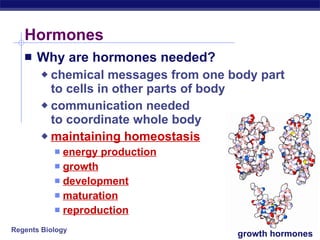
Hormones Why are hormones needed? chemical messages from one body part to cells in other parts of body communication needed  to coordinate whole body maintaining homeostasis energy production growth development maturation reproduction growth hormones
Endocrine System Endocrine system releases hormones glands which secrete  chemical signals into blood chemicals cause changes  in other parts of body slow, long-lasting response growth hormones sex hormones response hormones metabolism hormones and more….
Regulation by chemical messengers Hormones  released by endocrine glands axon endocrine gland Receptor sites target cell receptor molecules hormone carried by blood neurotransmitter
Glands Pituitary   many hormones: master gland Thyroid thyroxine Pancreas Insulin glucagon Ovary Estrogen Progesterone Testes Testosterone
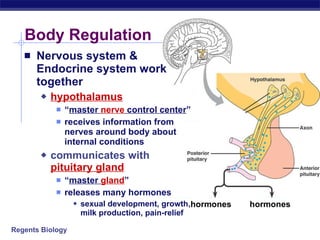
Body Regulation Nervous system &  Endocrine system work together hypothalamus   “ master  nerve  control center ” receives information from nerves around body about internal conditions  communicates with  pituitary gland   “ master  gland ” releases many hormones sexual development, growth, milk production, pain-relief hormones hormones
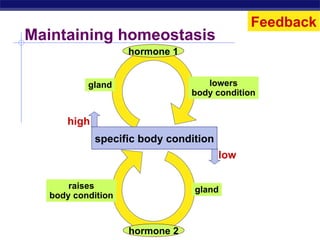
Maintaining homeostasis hormone 1 lowers body condition hormone 2 gland specific body condition raises body condition gland Feedback high low
Negative Feedback Response to changed body condition every time body is  high  or  low  from  normal level  a signal tells the body to make changes that will bring body back to normal level once body is back  to  normal level ,  signal is  turned off hormone 1 lowers body condition gland specific body condition high
Controlling Body Temperature nerve signals sweat nerve signals brain body temperature shiver brain dilates surface blood vessels constricts surface blood vessels Nervous System Control Feedback high low
Regulation of Blood Sugar blood sugar level (90mg/100ml) insulin body  cells take up sugar  from blood glucagon Feedback Endocrine System Control pancreas pancreas high low
Negative Feedback Negative feedback every time body is  high  or  low  from  normal level  a signal tells the body to make changes that will bring body back body temperature control of blood sugar
Sex & Growth Hormones Large scale body changes how do they work turn genes on start new processes in the body by turning genes on that were lying “dormant”
Pituitary gland hormones Sex & reproductive hormones FSH follicle stimulating hormone stimulates egg & sperm production LH luteinizing hormone stimulates ovaries & testes prepares uterus for fertilized egg hormones hormones
Reproductive hormones Testosterone from testes sperm production & secondary sexual characteristics Estrogen from ovaries egg production, preparing uterus for fertilized egg & secondary sexual characteristics
Sperm production over 100 million produced per day! ~2.5 million released per drop! Male reproductive system
spermatocytes seminiferous tubule sperm
Male reproductive system Testes & epididymis sperm production & maturation Glands seminal vesicles, prostate, bulbourethal produce seminal fluid nutrient-rich
Male reproductive system Testicles (Testes) produces sperm & hormones Scrotum sac that holds testicles outside of body Vas deferens tubes for sperm to travel from testes to penis Prostate Produces nutrient rich fluid to feed & protect sperm
Female reproductive system
Female reproductive system Ovaries produces eggs & hormones Uterus nurtures fetus; lining builds up each month Oviduct (Fallopian tubes) tubes for eggs to travel from ovaries to uterus Cervix opening to uterus, dilates 10 cm for birthing baby Vagina birth canal for birthing baby
Female reproductive system
Egg maturation in ovary releases progesterone maintains uterus lining produces estrogen
Menstrual cycle LH FSH estrogen progesterone lining of uterus egg development ovulation = egg release corpus luteum 0 7 14 21 28 days Controlled by interaction of 4 hormones FSH & LH estrogen progesterone
Female reproductive cycle pregnancy maintains uterus lining Feedback estrogen egg matures & is released (ovulation) builds up  uterus lining FSH & LH progesterone progesterone fertilized egg (zygote) HCG corpus luteum breaks down progesterone drops menstruation maintains uterus lining GnRH pituitary gland hypothalamus corpus luteum ovary no yes corpus luteum
Female hormones FSH & LH released from pituitary stimulates egg development & hormone release peak release = release of egg (ovulation) Estrogen  released from ovary cells around developing egg stimulates growth of lining of uterus decreasing levels causes menstruation Progesterone  released from “corpus luteum” in ovaries cells that used to take care of developing egg stimulates blood supply to lining of uterus decreasing levels causes menstruation
Fertilization
Any Questions?? 2006-2007
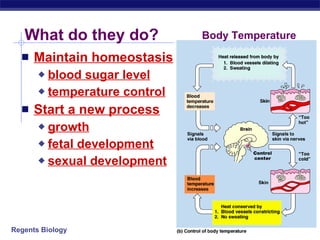
What do they do? Maintain homeostasis blood sugar level temperature control Start a new process growth fetal development sexual development Body Temperature

Hormones & Reproduction

  • 1.
    2006-2007 Endocrine SystemHormones Reproduction
  • 2.
    Hormones Why arehormones needed? chemical messages from one body part to cells in other parts of body communication needed to coordinate whole body maintaining homeostasis energy production growth development maturation reproduction growth hormones
  • 3.
    Endocrine System Endocrinesystem releases hormones glands which secrete chemical signals into blood chemicals cause changes in other parts of body slow, long-lasting response growth hormones sex hormones response hormones metabolism hormones and more….
  • 4.
    Regulation by chemicalmessengers Hormones released by endocrine glands axon endocrine gland Receptor sites target cell receptor molecules hormone carried by blood neurotransmitter
  • 5.
    Glands Pituitary many hormones: master gland Thyroid thyroxine Pancreas Insulin glucagon Ovary Estrogen Progesterone Testes Testosterone
  • 6.
    Body Regulation Nervoussystem & Endocrine system work together hypothalamus “ master nerve control center ” receives information from nerves around body about internal conditions communicates with pituitary gland “ master gland ” releases many hormones sexual development, growth, milk production, pain-relief hormones hormones
  • 7.
    Maintaining homeostasis hormone1 lowers body condition hormone 2 gland specific body condition raises body condition gland Feedback high low
  • 8.
    Negative Feedback Responseto changed body condition every time body is high or low from normal level a signal tells the body to make changes that will bring body back to normal level once body is back to normal level , signal is turned off hormone 1 lowers body condition gland specific body condition high
  • 9.
    Controlling Body Temperaturenerve signals sweat nerve signals brain body temperature shiver brain dilates surface blood vessels constricts surface blood vessels Nervous System Control Feedback high low
  • 10.
    Regulation of BloodSugar blood sugar level (90mg/100ml) insulin body cells take up sugar from blood glucagon Feedback Endocrine System Control pancreas pancreas high low
  • 11.
    Negative Feedback Negativefeedback every time body is high or low from normal level a signal tells the body to make changes that will bring body back body temperature control of blood sugar
  • 12.
    Sex & GrowthHormones Large scale body changes how do they work turn genes on start new processes in the body by turning genes on that were lying “dormant”
  • 13.
    Pituitary gland hormonesSex & reproductive hormones FSH follicle stimulating hormone stimulates egg & sperm production LH luteinizing hormone stimulates ovaries & testes prepares uterus for fertilized egg hormones hormones
  • 14.
    Reproductive hormones Testosteronefrom testes sperm production & secondary sexual characteristics Estrogen from ovaries egg production, preparing uterus for fertilized egg & secondary sexual characteristics
  • 15.
    Sperm production over100 million produced per day! ~2.5 million released per drop! Male reproductive system
  • 16.
  • 17.
    Male reproductive systemTestes & epididymis sperm production & maturation Glands seminal vesicles, prostate, bulbourethal produce seminal fluid nutrient-rich
  • 18.
    Male reproductive systemTesticles (Testes) produces sperm & hormones Scrotum sac that holds testicles outside of body Vas deferens tubes for sperm to travel from testes to penis Prostate Produces nutrient rich fluid to feed & protect sperm
  • 19.
  • 20.
    Female reproductive systemOvaries produces eggs & hormones Uterus nurtures fetus; lining builds up each month Oviduct (Fallopian tubes) tubes for eggs to travel from ovaries to uterus Cervix opening to uterus, dilates 10 cm for birthing baby Vagina birth canal for birthing baby
  • 21.
  • 22.
    Egg maturation inovary releases progesterone maintains uterus lining produces estrogen
  • 23.
    Menstrual cycle LHFSH estrogen progesterone lining of uterus egg development ovulation = egg release corpus luteum 0 7 14 21 28 days Controlled by interaction of 4 hormones FSH & LH estrogen progesterone
  • 24.
    Female reproductive cyclepregnancy maintains uterus lining Feedback estrogen egg matures & is released (ovulation) builds up uterus lining FSH & LH progesterone progesterone fertilized egg (zygote) HCG corpus luteum breaks down progesterone drops menstruation maintains uterus lining GnRH pituitary gland hypothalamus corpus luteum ovary no yes corpus luteum
  • 25.
    Female hormones FSH& LH released from pituitary stimulates egg development & hormone release peak release = release of egg (ovulation) Estrogen released from ovary cells around developing egg stimulates growth of lining of uterus decreasing levels causes menstruation Progesterone released from “corpus luteum” in ovaries cells that used to take care of developing egg stimulates blood supply to lining of uterus decreasing levels causes menstruation
  • 26.
  • 27.
  • 28.
    What do theydo? Maintain homeostasis blood sugar level temperature control Start a new process growth fetal development sexual development Body Temperature

Editor's Notes

  • #4 Hormones coordinate slower but longer–acting responses to stimuli such as stress, dehydration, and low blood glucose levels. Hormones also regulate long–term developmental processes by informing different parts of the body how fast to grow or when to develop the characteristics that distinguish male from female or juvenile from adult. Hormone–secreting organs, called endocrine glands, are referred to as ductless glands because they secrete their chemical messengers directly into extracellular fluid. From there, the chemicals diffuse into the circulation.