Frederick A. Kamke1, Josef Weissensteiner 1,2
                and Hongling Lui 1,3
      1 Oregon  State University, Corvallis, Oregon USA
         2 Universität für Bodenkultur , Vienna, Austria
   3 Northwest A&F University, Yangling, Shanxi, P.R. China


Forest Products Society 65th International Convention
         June 19-21, 2001, Portland, Oregon
Abstract
Wood modification technology has created opportunities to expand
the application of structural wood composites. Previously, wood
composites had mechanical properties that were limited by the
properties of the virgin wood. Typically, properties of the composite,
such as OSB, plywood, and LVL, are less than the properties of the
virgin wood due to process-induced damage or limitations of adhesive
bonding. However, composites have the advantage of reduced
variability, and consequently, engineering design values for the
composite are often greater than comparable solid wood products.
Wood modification technology can increase strength and stiffness of
wood three to four times above virgin timber. While wood modification
increases processing cost, strategic composite design minimizes final
product cost by minimizing the amount of modified wood required. In
addition, modification techniques may upgrade low quality veneer that
previously was not suited for structural composites. This presentation
summarizes applications of wood modification technology in the
design of a laminated composite.
Manufacture high value composite materials from
  rapid-grown, under-utilized and sustainable forest
  resources.


11-year hybrid poplar
                                   Courtesy of APA The Engineered Wood Association
Densification of wood by mechanical compression
into thin lamina using rapid processing technology
and lamination to produce engineered composites.


     • Damage of wood during densification
     • Dimensional stability
     • Adhesive bonding
     • Manufacturing cost
Densification of wood by mechanical compression
into thin lamina using rapid processing technology
and lamination to produce engineered composites.


     • Wood densification
     • Thermo-mechanical compression
     • Thermo-hydro-mechanical (THM) compression
     • Viscoelastic thermal compression (VTC)
     • And others
Manufacture structural composite materials from
      rapid-grown and sustainable forest resources.                   I-Beams


                                        Bridge Structures
                                                Transportation Vehicles
                  Structural Panels

Laminated
        Engineered Wood        Concrete Forms
Veneer Lumber
       Flooring


                                                         Wind Turbine Blades
• Perpendicular to grain
• Wood above glass transition temperature
• Minimal to no cell wall fracture
• Can be performed in a few minutes
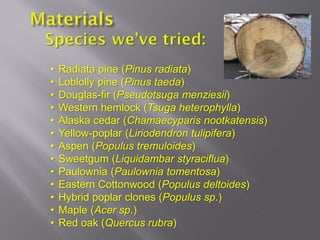
•   Radiata pine (Pinus radiata)
•   Loblolly pine (Pinus taeda)
•   Douglas-fir (Pseudotsuga menziesii)
•   Western hemlock (Tsuga heterophylla)
•   Alaska cedar (Chamaecyparis nootkatensis)
•   Yellow-poplar (Liriodendron tulipifera)
•   Aspen (Populus tremuloides)
•   Sweetgum (Liquidambar styraciflua)
•   Paulownia (Paulownia tomentosa)
•   Eastern Cottonwood (Populus deltoides)
•   Hybrid poplar clones (Populus sp.)
•   Maple (Acer sp.)
•   Red oak (Quercus rubra)
Green Building Materials Laboratory
Sealed Chamber
   Max. Steam Pressure: 150 psi
   Max. Compression: 3000 psi
   Platen Size: 10 in. x 24 in.
                     Stainless-Steel
                     Bellows, 28 in Ø


Interior: Electrically-Heated Platens with Water Cooling
Electrically-Heated &
 Lid     Sample      Water Cooled Platens


Steam                                Vent
 Inlet


Thermal Insulation      Stainless-Steel Bellows

         SIDE VIEW of CHAMBER
Typical Process Schedule

                     TEMPERATURE   170oC
   WOOD THICKNESS
     <10 mm
                         COMPRESSION
                         FORCE 800 psi
                         TIME
      125 psi
    STEAM
    PRESSURE


 CONDITIONING TIME    COMPRESSION TIME   COOLING TIME
Example: Hybrid Poplar - Effect of Compression Time


                        UNTREATED
Number of plies = 16
     Non-VTC MOE = 11 GPa
     VTC MOE = 25 GPa
     LVL MOE = 15 GPa
                                 2 VTC Plies
38.1 mm


                    14 Non-VTC Plies


                                 2 VTC Plies
      30% increase of MOE with 25% VTC by weight
100   95                    Hybrid Poplar &
                                                              Phenol-Formaldehyde
               Effective Adhesive
               Penetration (mm)

                                    80

                                    60
                                                        41
                                    40
                                                             30
                                                                      23
                                    20

                                      0
                                          0             63   98      132
                                                Densification (%)

Kutnar et al (2008) Wood and Fiber Sci. 40(3):362-373
Example: Hybrid poplar

                         ASTM D905


                         Shear in
                         Compression
                         Loading
3-Point Bending
                       UNTREATED


         UNTREATED   • Brittle failures common
                     • No delaminations
F


Specific Gravity: Untreated = 0.37, VTC = 1.2                   D
                                                                              h

                          Hybrid Poplar

                                                       HB = F / (p  D  h)
                                                       D = 10 mm
                                                       F = 500 N (112 lbf)


                           Rautkari, Kamke & Hughes, 2011, Wood Sci. & Tech.
F


Specific Gravity: Untreated = 0.37, VTC = 1.2                   D
                                                                              h

                          Hybrid Poplar

                                                       HB = F / (p  D  h)
                                                       D = 10 mm
                                                       F = 500 N (112 lbf)


                          Rautkari, Kamke & Hughes, 2011, Wood Sci. & Tech.
Design by Corvallis Tool Company


          Annealing Zone


Cooling Zone


                                                  Conditioning Zone

                                     Compression Zone
•   Densification possible without cell wall fracture.
•   Thin lamina may be processed in short time.
•   Energy cost approximately same as conventional
    veneer processing by substitution of drying step.
•   Densified wood bonds well and consumes much less
    adhesive.
•   Dimensional stability controlled by heat treatment or
    chemical treatments, if needed.
•   Brittle failure could be a problem in critical structural
    applications.
•   Manufacturing cost higher than conventional veneer
    processing, but significant value added in process.
USDA Wood Utilization Research Center Special Grant
JELD-WEN Foundation
Oregon BEST
Session 29 ic2011 kamke

Session 29 ic2011 kamke

  • 1.
    Frederick A. Kamke1,Josef Weissensteiner 1,2 and Hongling Lui 1,3 1 Oregon State University, Corvallis, Oregon USA 2 Universität für Bodenkultur , Vienna, Austria 3 Northwest A&F University, Yangling, Shanxi, P.R. China Forest Products Society 65th International Convention June 19-21, 2001, Portland, Oregon
  • 2.
    Abstract Wood modification technologyhas created opportunities to expand the application of structural wood composites. Previously, wood composites had mechanical properties that were limited by the properties of the virgin wood. Typically, properties of the composite, such as OSB, plywood, and LVL, are less than the properties of the virgin wood due to process-induced damage or limitations of adhesive bonding. However, composites have the advantage of reduced variability, and consequently, engineering design values for the composite are often greater than comparable solid wood products. Wood modification technology can increase strength and stiffness of wood three to four times above virgin timber. While wood modification increases processing cost, strategic composite design minimizes final product cost by minimizing the amount of modified wood required. In addition, modification techniques may upgrade low quality veneer that previously was not suited for structural composites. This presentation summarizes applications of wood modification technology in the design of a laminated composite.
  • 3.
    Manufacture high valuecomposite materials from rapid-grown, under-utilized and sustainable forest resources. 11-year hybrid poplar Courtesy of APA The Engineered Wood Association
  • 4.
    Densification of woodby mechanical compression into thin lamina using rapid processing technology and lamination to produce engineered composites. • Damage of wood during densification • Dimensional stability • Adhesive bonding • Manufacturing cost
  • 5.
    Densification of woodby mechanical compression into thin lamina using rapid processing technology and lamination to produce engineered composites. • Wood densification • Thermo-mechanical compression • Thermo-hydro-mechanical (THM) compression • Viscoelastic thermal compression (VTC) • And others
  • 6.
    Manufacture structural compositematerials from rapid-grown and sustainable forest resources. I-Beams Bridge Structures Transportation Vehicles Structural Panels Laminated Engineered Wood Concrete Forms Veneer Lumber Flooring Wind Turbine Blades
  • 7.
    • Perpendicular tograin • Wood above glass transition temperature • Minimal to no cell wall fracture • Can be performed in a few minutes
  • 8.
    Radiata pine (Pinus radiata) • Loblolly pine (Pinus taeda) • Douglas-fir (Pseudotsuga menziesii) • Western hemlock (Tsuga heterophylla) • Alaska cedar (Chamaecyparis nootkatensis) • Yellow-poplar (Liriodendron tulipifera) • Aspen (Populus tremuloides) • Sweetgum (Liquidambar styraciflua) • Paulownia (Paulownia tomentosa) • Eastern Cottonwood (Populus deltoides) • Hybrid poplar clones (Populus sp.) • Maple (Acer sp.) • Red oak (Quercus rubra)
  • 9.
  • 10.
    Sealed Chamber Max. Steam Pressure: 150 psi Max. Compression: 3000 psi Platen Size: 10 in. x 24 in. Stainless-Steel Bellows, 28 in Ø Interior: Electrically-Heated Platens with Water Cooling
  • 11.
    Electrically-Heated & Lid Sample Water Cooled Platens Steam Vent Inlet Thermal Insulation Stainless-Steel Bellows SIDE VIEW of CHAMBER
  • 12.
    Typical Process Schedule TEMPERATURE 170oC WOOD THICKNESS <10 mm COMPRESSION FORCE 800 psi TIME 125 psi STEAM PRESSURE CONDITIONING TIME COMPRESSION TIME COOLING TIME
  • 13.
    Example: Hybrid Poplar- Effect of Compression Time UNTREATED
  • 14.
    Number of plies= 16 Non-VTC MOE = 11 GPa VTC MOE = 25 GPa LVL MOE = 15 GPa 2 VTC Plies 38.1 mm 14 Non-VTC Plies 2 VTC Plies 30% increase of MOE with 25% VTC by weight
  • 15.
    100 95 Hybrid Poplar & Phenol-Formaldehyde Effective Adhesive Penetration (mm) 80 60 41 40 30 23 20 0 0 63 98 132 Densification (%) Kutnar et al (2008) Wood and Fiber Sci. 40(3):362-373
  • 16.
    Example: Hybrid poplar ASTM D905 Shear in Compression Loading
  • 17.
    3-Point Bending UNTREATED UNTREATED • Brittle failures common • No delaminations
  • 18.
    F Specific Gravity: Untreated= 0.37, VTC = 1.2 D h Hybrid Poplar HB = F / (p  D  h) D = 10 mm F = 500 N (112 lbf) Rautkari, Kamke & Hughes, 2011, Wood Sci. & Tech.
  • 19.
    F Specific Gravity: Untreated= 0.37, VTC = 1.2 D h Hybrid Poplar HB = F / (p  D  h) D = 10 mm F = 500 N (112 lbf) Rautkari, Kamke & Hughes, 2011, Wood Sci. & Tech.
  • 20.
    Design by CorvallisTool Company Annealing Zone Cooling Zone Conditioning Zone Compression Zone
  • 21.
    Densification possible without cell wall fracture. • Thin lamina may be processed in short time. • Energy cost approximately same as conventional veneer processing by substitution of drying step. • Densified wood bonds well and consumes much less adhesive. • Dimensional stability controlled by heat treatment or chemical treatments, if needed. • Brittle failure could be a problem in critical structural applications. • Manufacturing cost higher than conventional veneer processing, but significant value added in process.
  • 22.
    USDA Wood UtilizationResearch Center Special Grant JELD-WEN Foundation Oregon BEST