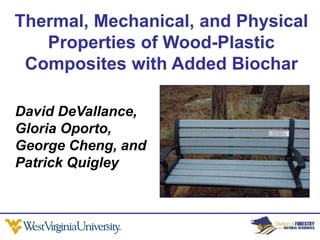

Thermal, Mechanical, and Physical
   Properties of Wood-Plastic
 Composites with Added Biochar

David DeVallance,
Gloria Oporto,
George Cheng, and
Patrick Quigley
GOALS & OBJECTIVES
 The long-term goal of this research:
 • Integrate bio-energy related by-products,
   particularly biochar, with plastics and wood by-
   products to create sustainable composite products

 The objective in this project:
 • To combine biochar with wood flour and polymeric
   materials (i.e., plastics) to fabricate a novel
   composite material
BACKGROUND
• Wood and most polymers (i.e., plastics) are not
  compatible
• Polymers – hydrophobic (i.e., non-polar)
• Wood – hydrophilic (i.e., polar)
• Traditional WPC’s use coupling agents
• Most WPCs undergo some UV degradation and
  lighten over time (Falk et al. 2001)
• Carbon black – additive to reduce UV degradation

• There is a need to identify alternative,
  environmentally friendly materials that can replace
  the currently used additives in WPCs
• Biochar - Viable replacement for WPC
            additives?
BACKGROUND
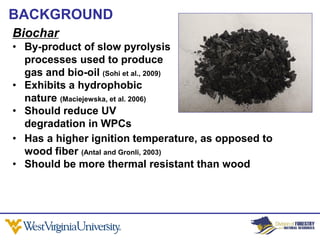
Biochar
• By-product of slow pyrolysis
  processes used to produce
  gas and bio-oil (Sohi et al., 2009)
• Exhibits a hydrophobic
  nature (Maciejewska, et al. 2006)
• Should reduce UV
  degradation in WPCs
• Has a higher ignition temperature, as opposed to
  wood fiber (Antal and Gronli, 2003)
• Should be more thermal resistant than wood
EXPERIMENTAL
   Wood (yellow-poplar), Biochar (mixed hardwoods), and
    Polypropylene (with lubricant) were combined to form
    composites
EXPERIMENTAL
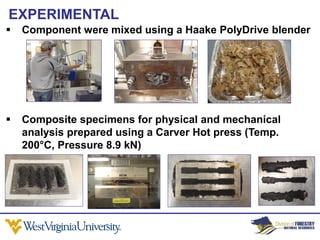
   Component were mixed using a Haake PolyDrive blender


   Composite specimens for physical and mechanical
    analysis prepared using a Carver Hot press (Temp.
    200°C, Pressure 8.9 kN)
EXPERIMENTAL
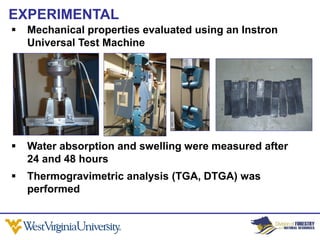
   Mechanical properties evaluated using an Instron
    Universal Test Machine


   Water absorption and swelling were measured after
    24 and 48 hours
   Thermogravimetric analysis (TGA, DTGA) was
    performed
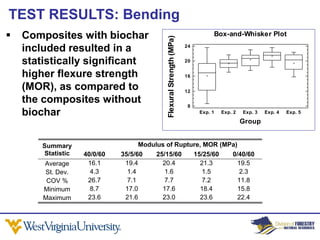
TEST RESULTS: Bending
   Composites with biochar                                                     Box-and-Whisker Plot


                                            Flexural Strength (MPa)
    included resulted in a                                            24


    statistically significant                                         20


    higher flexure strength                                           16

    (MOR), as compared to                                             12

    the composites without                                             8
    biochar                                                                Exp. 1   Exp. 2   Exp. 3   Exp. 4   Exp. 5

                                                                                             Group


        Summary                     Modulus of Rupture, MOR (MPa)
        Statistic   40/0/60   35/5/60    25/15/60   15/25/60   0/40/60
        Average      16.1      19.4        20.4       21.3       19.5
        St. Dev.      4.3       1.4         1.6        1.5        2.3
         COV %       26.7       7.1         7.7        7.2       11.8
        Minimum       8.7      17.0        17.6       18.4       15.8
        Maximum      23.6      21.6        23.0       23.6       22.4
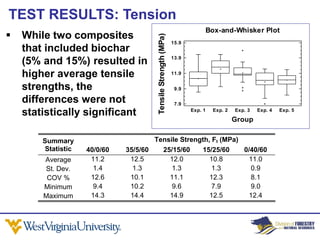
TEST RESULTS: Tension
                                                                            Box-and-Whisker Plot
   While two composites


                                       Tensile Strength (MPa)
                                                                15.9
    that included biochar
                                                                13.9
    (5% and 15%) resulted in
    higher average tensile                                      11.9


    strengths, the                                               9.9

    differences were not                                         7.9

    statistically significant                                          Exp. 1   Exp. 2   Exp. 3   Exp. 4   Exp. 5

                                                                                         Group


        Summary                       Tensile Strength, Ft (MPa)
        Statistic   40/0/60   35/5/60   25/15/60    15/25/60     0/40/60
        Average      11.2      12.5       12.0         10.8       11.0
        St. Dev.      1.4       1.3        1.3          1.3        0.9
         COV %       12.6      10.1       11.1         12.3        8.1
        Minimum       9.4      10.2        9.6          7.9        9.0
        Maximum      14.3      14.4       14.9         12.5       12.4
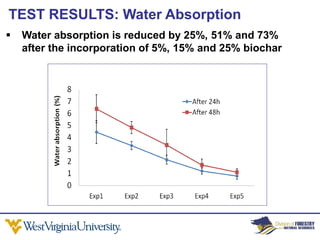
TEST RESULTS: Water Absorption
   Water absorption is reduced by 25%, 51% and 73%
    after the incorporation of 5%, 15% and 25% biochar
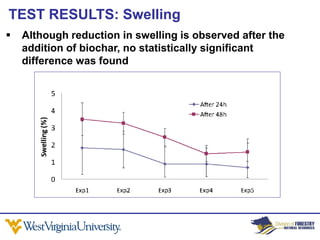
TEST RESULTS: Swelling
   Although reduction in swelling is observed after the
    addition of biochar, no statistically significant
    difference was found
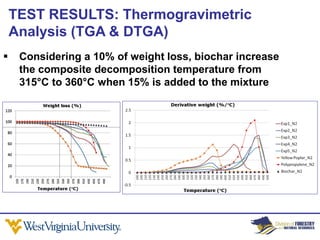
TEST RESULTS: Thermogravimetric
    Analysis (TGA & DTGA)
    Considering a 10% of weight loss, biochar increase
     the composite decomposition temperature from
     315°C to 360°C when 15% is added to the mixture
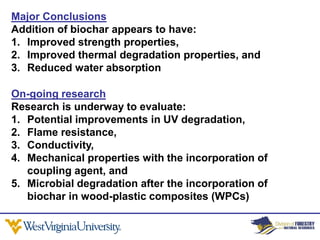
Major Conclusions
Addition of biochar appears to have:
1. Improved strength properties,
2. Improved thermal degradation properties, and
3. Reduced water absorption

On-going research
Research is underway to evaluate:
1. Potential improvements in UV degradation,
2. Flame resistance,
3. Conductivity,
4. Mechanical properties with the incorporation of
   coupling agent, and
5. Microbial degradation after the incorporation of
   biochar in wood-plastic composites (WPCs)
Questions?
Further Information: david.devallance@mail.wvu.edu


Acknowledgments:
Dr. Rakesh Gupta, Chair of the Chemical Engineer
Department at West Virginia University, for giving us
access to some laboratory equipment
References:
 Antal, M.J. and Gronli, M. 2003. The art, science, and technology of charcoal
 production. Ind. Eng. Chem. Res. 2003(42):1619-1640.
 Falk, R.H., T. Lundin, and C. Felton, 2001. Accelerated weathering of natural
 fiber-thermoplastic composites: Effects of ultraviolet exposure on bending
 strength and stiffness. In: Proc. Sixth International Conference on Woodfiber-
 Plastic Composites. Forest Prod. Soc., Madison, WI. pp. 87-93.
 Maciejewska, A., H. Veringa, J. Sanders, and S.D. Peteves. 2006. Co-firing of
 biomass with coal: Constraints and role of biomass pre-treatment. DG JRC
 Institute for Energy. Retrieved October 21, 2010, from
 <http://www.techtp.com/Cofiring/Cofiring%20biomass%20with%20Coal.pdf>
 Sohi, S., E. Lopex-capel, E. Krull, and R. Bol. 2009. Biochar, climate change
 and soil: A review to guide future research. CSIRO Land and Water Science
 Report. Retrieved April 28, 2010, from, <http://www.csiro.au/files/files/poei.pdf>.

Session 26 ic2011 de vallance 2

  • 1.
    Thermal, Mechanical, andPhysical Properties of Wood-Plastic Composites with Added Biochar David DeVallance, Gloria Oporto, George Cheng, and Patrick Quigley
  • 2.
    GOALS & OBJECTIVES The long-term goal of this research: • Integrate bio-energy related by-products, particularly biochar, with plastics and wood by- products to create sustainable composite products The objective in this project: • To combine biochar with wood flour and polymeric materials (i.e., plastics) to fabricate a novel composite material
  • 3.
    BACKGROUND • Wood andmost polymers (i.e., plastics) are not compatible • Polymers – hydrophobic (i.e., non-polar) • Wood – hydrophilic (i.e., polar) • Traditional WPC’s use coupling agents • Most WPCs undergo some UV degradation and lighten over time (Falk et al. 2001) • Carbon black – additive to reduce UV degradation • There is a need to identify alternative, environmentally friendly materials that can replace the currently used additives in WPCs • Biochar - Viable replacement for WPC additives?
  • 4.
    BACKGROUND Biochar • By-product ofslow pyrolysis processes used to produce gas and bio-oil (Sohi et al., 2009) • Exhibits a hydrophobic nature (Maciejewska, et al. 2006) • Should reduce UV degradation in WPCs • Has a higher ignition temperature, as opposed to wood fiber (Antal and Gronli, 2003) • Should be more thermal resistant than wood
  • 5.
    EXPERIMENTAL  Wood (yellow-poplar), Biochar (mixed hardwoods), and Polypropylene (with lubricant) were combined to form composites
  • 6.
    EXPERIMENTAL  Component were mixed using a Haake PolyDrive blender  Composite specimens for physical and mechanical analysis prepared using a Carver Hot press (Temp. 200°C, Pressure 8.9 kN)
  • 7.
    EXPERIMENTAL  Mechanical properties evaluated using an Instron Universal Test Machine  Water absorption and swelling were measured after 24 and 48 hours  Thermogravimetric analysis (TGA, DTGA) was performed
  • 8.
    TEST RESULTS: Bending  Composites with biochar Box-and-Whisker Plot Flexural Strength (MPa) included resulted in a 24 statistically significant 20 higher flexure strength 16 (MOR), as compared to 12 the composites without 8 biochar Exp. 1 Exp. 2 Exp. 3 Exp. 4 Exp. 5 Group Summary Modulus of Rupture, MOR (MPa) Statistic 40/0/60 35/5/60 25/15/60 15/25/60 0/40/60 Average 16.1 19.4 20.4 21.3 19.5 St. Dev. 4.3 1.4 1.6 1.5 2.3 COV % 26.7 7.1 7.7 7.2 11.8 Minimum 8.7 17.0 17.6 18.4 15.8 Maximum 23.6 21.6 23.0 23.6 22.4
  • 9.
    TEST RESULTS: Tension Box-and-Whisker Plot  While two composites Tensile Strength (MPa) 15.9 that included biochar 13.9 (5% and 15%) resulted in higher average tensile 11.9 strengths, the 9.9 differences were not 7.9 statistically significant Exp. 1 Exp. 2 Exp. 3 Exp. 4 Exp. 5 Group Summary Tensile Strength, Ft (MPa) Statistic 40/0/60 35/5/60 25/15/60 15/25/60 0/40/60 Average 11.2 12.5 12.0 10.8 11.0 St. Dev. 1.4 1.3 1.3 1.3 0.9 COV % 12.6 10.1 11.1 12.3 8.1 Minimum 9.4 10.2 9.6 7.9 9.0 Maximum 14.3 14.4 14.9 12.5 12.4
  • 10.
    TEST RESULTS: WaterAbsorption  Water absorption is reduced by 25%, 51% and 73% after the incorporation of 5%, 15% and 25% biochar
  • 11.
    TEST RESULTS: Swelling  Although reduction in swelling is observed after the addition of biochar, no statistically significant difference was found
  • 12.
    TEST RESULTS: Thermogravimetric Analysis (TGA & DTGA)  Considering a 10% of weight loss, biochar increase the composite decomposition temperature from 315°C to 360°C when 15% is added to the mixture
  • 13.
    Major Conclusions Addition ofbiochar appears to have: 1. Improved strength properties, 2. Improved thermal degradation properties, and 3. Reduced water absorption On-going research Research is underway to evaluate: 1. Potential improvements in UV degradation, 2. Flame resistance, 3. Conductivity, 4. Mechanical properties with the incorporation of coupling agent, and 5. Microbial degradation after the incorporation of biochar in wood-plastic composites (WPCs)
  • 14.
    Questions? Further Information: david.devallance@mail.wvu.edu Acknowledgments: Dr.Rakesh Gupta, Chair of the Chemical Engineer Department at West Virginia University, for giving us access to some laboratory equipment
  • 15.
    References: Antal, M.J.and Gronli, M. 2003. The art, science, and technology of charcoal production. Ind. Eng. Chem. Res. 2003(42):1619-1640. Falk, R.H., T. Lundin, and C. Felton, 2001. Accelerated weathering of natural fiber-thermoplastic composites: Effects of ultraviolet exposure on bending strength and stiffness. In: Proc. Sixth International Conference on Woodfiber- Plastic Composites. Forest Prod. Soc., Madison, WI. pp. 87-93. Maciejewska, A., H. Veringa, J. Sanders, and S.D. Peteves. 2006. Co-firing of biomass with coal: Constraints and role of biomass pre-treatment. DG JRC Institute for Energy. Retrieved October 21, 2010, from <http://www.techtp.com/Cofiring/Cofiring%20biomass%20with%20Coal.pdf> Sohi, S., E. Lopex-capel, E. Krull, and R. Bol. 2009. Biochar, climate change and soil: A review to guide future research. CSIRO Land and Water Science Report. Retrieved April 28, 2010, from, <http://www.csiro.au/files/files/poei.pdf>.