1.Based on Pulping
Process
                                                                               3. Based on Bleaching
       Fully Mechanical 2. Based on Raw Material
       (GW, PGW, RMP)
                                                                                         Totally Chlorine
       Mechanical &            Wood (HW, SW)
                                                                                         Free (TCF)
       Thermal (TMP)           Agricultural Residue
                                                                                         Elemental Chlorine
       Semi-mechanical,        (Straws)
                                                                                         Free (ECF)
       semi-chemical           Annual Plants & Grasses
                                                                                         Chlorine Bleaching
       (CTMP)                  (Hemp, Jute, Kenaf,
                                                                                         (Chlorine gas &
       Semi chemical           Bamboo)
                                                                                         Hypochlorite)
       (NSSC, Cold Soda)       Rags
                                                                                         Oxygen/Ozone
       Fully Chemical          Recycled or secondary Fiber
                                                                                         Bleached.
       (Sulfite, sulfate)      Deinked
                                                                                         Unbleached
       Soft Cook Fully
       Chemical (Rayon,
       viscose)
4. Based on Yield
                                                        5. Based on Fiber Length
         Very High Yield (>95%) - GW, PGW
         High Yield (85-95%) - RMP, TMP
                                                                 Long Fiber Pulp (>10mm) - Cotton,
         Medium High Yield (65-85%) -
                                                                 Hemp, Flax, Jute
         CTMP, NSSC, CMP
                                                                 Medium Fiber Pulp (2 - 10mm) -
         Medium Yield (45-65%) - (Sulfite,
                                                                 Northern S/W, H/W
         Sulfate)
                                                                 Short Fiber Pulp (< 2mm) - Tropical
         Medium Low Yield (35-45%) Straw,
                                                                 H/W, straws, grasses
         Grass, Bagasse chemical pulp
         Low Yield (<35%) - Rayon, viscose


The three most important Parameters which defines the pulp are. 1.) Fiber Length, 2.)
Brightness, 3.) Pulping process used. e.g


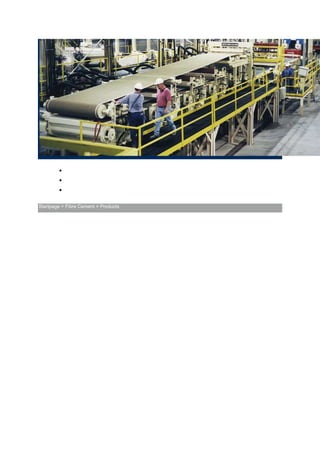
WEHRHAHN plants (equipment)

Individually designed to meet your requirements.

Wehrhahn supplies plants with capacities from
2 - 20 t/h. The fibre cement production process has continuously been further developed to reduce

material and energy consumption figures. Process related cut-off materials and rejects
are immediately recycled in the process. Surplus water runs through a treatment plant and
returns into the production process.
For the production of the large variety of sheets, two technologies have proven to be suitable:


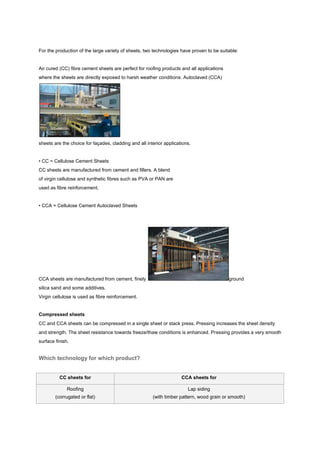
Air cured (CC) fibre cement sheets are perfect for roofing products and all applications
where the sheets are directly exposed to harsh weather conditions. Autoclaved (CCA)


sheets are the choice for façades, cladding and all interior applications.


• CC = Cellulose Cement Sheets
CC sheets are manufactured from cement and fillers. A blend
of virgin cellulose and synthetic fibres such as PVA or PAN are
used as fibre reinforcement.


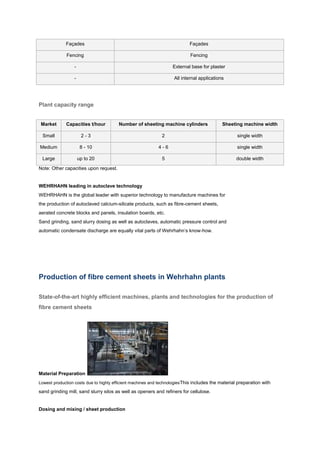
• CCA = Cellulose Cement Autoclaved Sheets


CCA sheets are manufactured from cement, finely                                            ground
silica sand and some additives.
Virgin cellulose is used as fibre reinforcement.


Compressed sheets
CC and CCA sheets can be compressed in a single sheet or stack press. Pressing increases the sheet density
and strength. The sheet resistance towards freeze/thaw conditions is enhanced. Pressing provides a very smooth
surface finish.


Which technology for which product?


          CC sheets for                                              CCA sheets for

              Roofing                                                   Lap siding
        (corrugated or flat)                           (with timber pattern, wood grain or smooth)
Façades                                                        Façades

              Fencing                                                       Fencing

                  -                                                External base for plaster

                  -                                                 All internal applications


Plant capacity range


 Market      Capacities t/hour          Number of sheeting machine cylinders                Sheeting machine width

 Small                 2-3                                    2                                     single width

Medium                 8 - 10                               4-6                                     single width

 Large                up to 20                                5                                    double width

Note: Other capacities upon request.


WEHRHAHN leading in autoclave technology
WEHRHAHN is the global leader with superior technology to manufacture machines for
the production of autoclaved calcium-silicate products, such as fibre-cement sheets,
aerated concrete blocks and panels, insulation boards, etc.
Sand grinding, sand slurry dosing as well as autoclaves, automatic pressure control and
automatic condensate discharge are equally vital parts of Wehrhahn‘s know-how.


Production of fibre cement sheets in Wehrhahn plants

State-of-the-art highly efficient machines, plants and technologies for the production of
fibre cement sheets


Material Preparation
Lowest production costs due to highly efficient machines and technologies This includes the material preparation with

sand grinding mill, sand slurry silos as well as openers and refiners for cellulose.


Dosing and mixing / sheet production
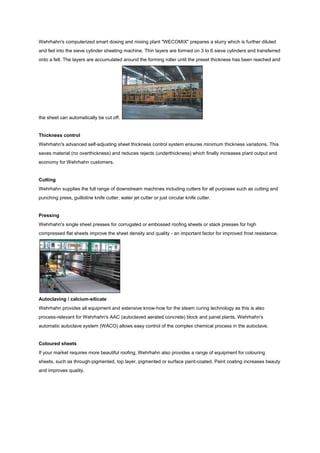
Wehrhahn's computerized smart dosing and mixing plant "WECOMIX" prepares a slurry which is further diluted
and fed into the sieve cylinder sheeting machine. Thin layers are formed on 3 to 6 sieve cylinders and transferred
onto a felt. The layers are accumulated around the forming roller until the preset thickness has been reached and


the sheet can automatically be cut off.


Thickness control
Wehrhahn's advanced self-adjusting sheet thickness control system ensures minimum thickness variations. This
saves material (no overthickness) and reduces rejects (underthickness) which finally increases plant output and
economy for Wehrhahn customers.


Cutting
Wehrhahn supplies the full range of downstream machines including cutters for all purposes such as cutting and
punching press, guillotine knife cutter, water jet cutter or just circular knife cutter.


Pressing
Wehrhahn's single sheet presses for corrugated or embossed roofing sheets or stack presses for high
compressed flat sheets improve the sheet density and quality - an important factor for improved frost resistance.


Autoclaving / calcium-silicate
Wehrhahn provides all equipment and extensive know-how for the steam curing technology as this is also
process-relevant for Wehrhahn's AAC (autoclaved aerated concrete) block and panel plants. Wehrhahn's
automatic autoclave system (WACO) allows easy control of the complex chemical process in the autoclave.


Coloured sheets
If your market requires more beautiful roofing, Wehrhahn also provides a range of equipment for colouring
sheets, such as through-pigmented, top layer, pigmented or surface paint-coated. Paint coating increases beauty
and improves quality.
> Production

             > Plants (equipment)

             > Products


Startpage > Fibre Cement > Products
Fibre cement sheets for façade, roof and internal application

A unique and versatile building material


Few building materials offer a combination of architectural scope and strong technical specification as convincing
as fibre cement cladding and roofing.
Fibre cement combines strength with ease of handling and stylish versatile colour options.


Fibre cement gains its impressive strength in a special manufacturing process where thin layers of fibre cement
are laminated and compressed under high pressure followed by air curing or autoclave curing.
A major advantage of fibre cement is its ability to resist all kinds of weather conditions. Frost and thaw, heat, hale
or rain do not pose a threat to fibre cement. Inside buildings fibre cement is applied as backer board in wet areas
or for dry walls in heavy duty applications where fire resistance and strength are the dominant requirements.
Architects love fibre cement, elegantly finished with a wide range of colours to select from. Sheets are easy to
install and can be cut to any required dimensions or edge details.


Fibre cement sheets are used for residential, industrial and agricultural applications. Its appearance and
advantageous characteristics make it the ideal material for the following applications:


External cladding / caçades / fencing
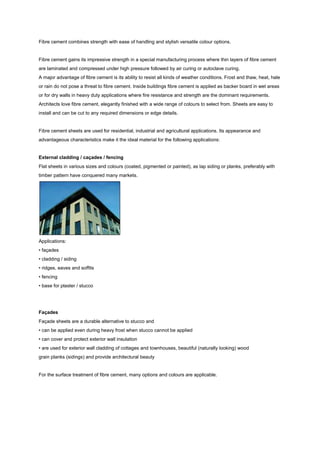
Flat sheets in various sizes and colours (coated, pigmented or painted), as lap siding or planks, preferably with
timber pattern have conquered many markets.


Applications:
• façades
• cladding / siding
• ridges, eaves and soffits
• fencing
• base for plaster / stucco


Façades
Façade sheets are a durable alternative to stucco and
• can be applied even during heavy frost when stucco cannot be applied
• can cover and protect exterior wall insulation
• are used for exterior wall cladding of cottages and townhouses, beautiful (naturally looking) wood
grain planks (sidings) and provide architectural beauty


For the surface treatment of fibre cement, many options and colours are applicable.
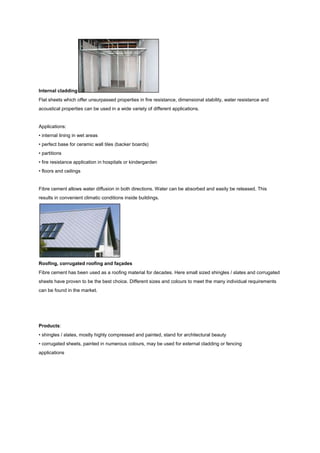
Internal cladding
Flat sheets which offer unsurpassed properties in fire resistance, dimensional stability, water resistance and
acoustical properties can be used in a wide variety of different applications.


Applications:
• internal lining in wet areas
• perfect base for ceramic wall tiles (backer boards)
• partitions
• fire resistance application in hospitals or kindergarden
• floors and ceilings


Fibre cement allows water diffusion in both directions. Water can be absorbed and easily be released. This
results in convenient climatic conditions inside buildings.


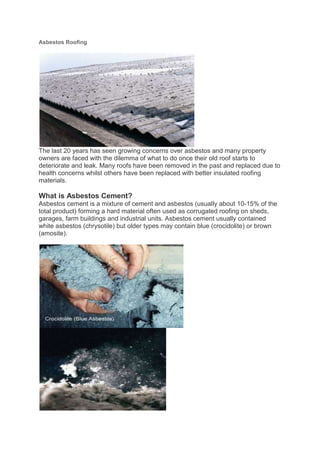
Roofing, corrugated roofing and façades
Fibre cement has been used as a roofing material for decades. Here small sized shingles / slates and corrugated
sheets have proven to be the best choice. Different sizes and colours to meet the many individual requirements
can be found in the market.


Products:
• shingles / slates, mostly highly compressed and painted, stand for architectural beauty
• corrugated sheets, painted in numerous colours, may be used for external cladding or fencing
applications
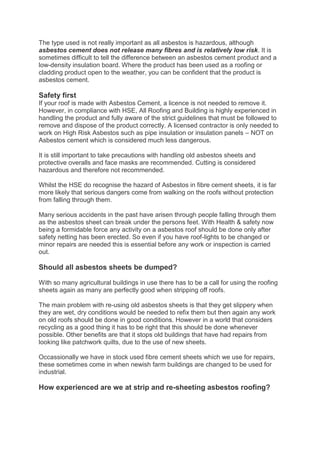
Asbestos Roofing


The last 20 years has seen growing concerns over asbestos and many property
owners are faced with the dilemma of what to do once their old roof starts to
deteriorate and leak. Many roofs have been removed in the past and replaced due to
health concerns whilst others have been replaced with better insulated roofing
materials.

What is Asbestos Cement?
Asbestos cement is a mixture of cement and asbestos (usually about 10-15% of the
total product) forming a hard material often used as corrugated roofing on sheds,
garages, farm buildings and industrial units. Asbestos cement usually contained
white asbestos (chrysotile) but older types may contain blue (crocidolite) or brown
(amosite).
The type used is not really important as all asbestos is hazardous, although
asbestos cement does not release many fibres and is relatively low risk. It is
sometimes difficult to tell the difference between an asbestos cement product and a
low-density insulation board. Where the product has been used as a roofing or
cladding product open to the weather, you can be confident that the product is
asbestos cement.

Safety first
If your roof is made with Asbestos Cement, a licence is not needed to remove it.
However, in compliance with HSE, All Roofing and Building is highly experienced in
handling the product and fully aware of the strict guidelines that must be followed to
remove and dispose of the product correctly. A licensed contractor is only needed to
work on High Risk Asbestos such as pipe insulation or insulation panels – NOT on
Asbestos cement which is considered much less dangerous.

It is still important to take precautions with handling old asbestos sheets and
protective overalls and face masks are recommended. Cutting is considered
hazardous and therefore not recommended.

Whilst the HSE do recognise the hazard of Asbestos in fibre cement sheets, it is far
more likely that serious dangers come from walking on the roofs without protection
from falling through them.

Many serious accidents in the past have arisen through people falling through them
as the asbestos sheet can break under the persons feet. With Health & safety now
being a formidable force any activity on a asbestos roof should be done only after
safety netting has been erected. So even if you have roof-lights to be changed or
minor repairs are needed this is essential before any work or inspection is carried
out.

Should all asbestos sheets be dumped?

With so many agricultural buildings in use there has to be a call for using the roofing
sheets again as many are perfectly good when stripping off roofs.

The main problem with re-using old asbestos sheets is that they get slippery when
they are wet, dry conditions would be needed to refix them but then again any work
on old roofs should be done in good conditions. However in a world that considers
recycling as a good thing it has to be right that this should be done whenever
possible. Other benefits are that it stops old buildings that have had repairs from
looking like patchwork quilts, due to the use of new sheets.

Occassionally we have in stock used fibre cement sheets which we use for repairs,
these sometimes come in when newish farm buildings are changed to be used for
industrial.

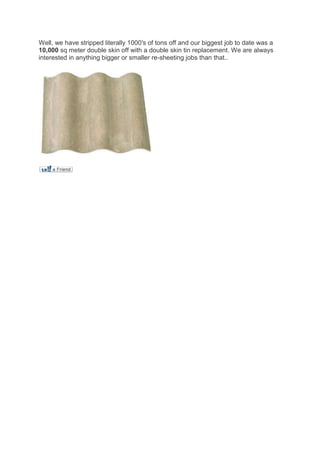
How experienced are we at strip and re-sheeting asbestos roofing?
Well, we have stripped literally 1000′s of tons off and our biggest job to date was a
10,000 sq meter double skin off with a double skin tin replacement. We are always
interested in anything bigger or smaller re-sheeting jobs than that..

Pulp

  • 1.
    1.Based on Pulping Process 3. Based on Bleaching Fully Mechanical 2. Based on Raw Material (GW, PGW, RMP) Totally Chlorine Mechanical & Wood (HW, SW) Free (TCF) Thermal (TMP) Agricultural Residue Elemental Chlorine Semi-mechanical, (Straws) Free (ECF) semi-chemical Annual Plants & Grasses Chlorine Bleaching (CTMP) (Hemp, Jute, Kenaf, (Chlorine gas & Semi chemical Bamboo) Hypochlorite) (NSSC, Cold Soda) Rags Oxygen/Ozone Fully Chemical Recycled or secondary Fiber Bleached. (Sulfite, sulfate) Deinked Unbleached Soft Cook Fully Chemical (Rayon, viscose) 4. Based on Yield 5. Based on Fiber Length Very High Yield (>95%) - GW, PGW High Yield (85-95%) - RMP, TMP Long Fiber Pulp (>10mm) - Cotton, Medium High Yield (65-85%) - Hemp, Flax, Jute CTMP, NSSC, CMP Medium Fiber Pulp (2 - 10mm) - Medium Yield (45-65%) - (Sulfite, Northern S/W, H/W Sulfate) Short Fiber Pulp (< 2mm) - Tropical Medium Low Yield (35-45%) Straw, H/W, straws, grasses Grass, Bagasse chemical pulp Low Yield (<35%) - Rayon, viscose The three most important Parameters which defines the pulp are. 1.) Fiber Length, 2.) Brightness, 3.) Pulping process used. e.g WEHRHAHN plants (equipment) Individually designed to meet your requirements. Wehrhahn supplies plants with capacities from 2 - 20 t/h. The fibre cement production process has continuously been further developed to reduce material and energy consumption figures. Process related cut-off materials and rejects are immediately recycled in the process. Surplus water runs through a treatment plant and returns into the production process.
  • 2.
    For the productionof the large variety of sheets, two technologies have proven to be suitable: Air cured (CC) fibre cement sheets are perfect for roofing products and all applications where the sheets are directly exposed to harsh weather conditions. Autoclaved (CCA) sheets are the choice for façades, cladding and all interior applications. • CC = Cellulose Cement Sheets CC sheets are manufactured from cement and fillers. A blend of virgin cellulose and synthetic fibres such as PVA or PAN are used as fibre reinforcement. • CCA = Cellulose Cement Autoclaved Sheets CCA sheets are manufactured from cement, finely ground silica sand and some additives. Virgin cellulose is used as fibre reinforcement. Compressed sheets CC and CCA sheets can be compressed in a single sheet or stack press. Pressing increases the sheet density and strength. The sheet resistance towards freeze/thaw conditions is enhanced. Pressing provides a very smooth surface finish. Which technology for which product? CC sheets for CCA sheets for Roofing Lap siding (corrugated or flat) (with timber pattern, wood grain or smooth)
  • 3.
    Façades Façades Fencing Fencing - External base for plaster - All internal applications Plant capacity range Market Capacities t/hour Number of sheeting machine cylinders Sheeting machine width Small 2-3 2 single width Medium 8 - 10 4-6 single width Large up to 20 5 double width Note: Other capacities upon request. WEHRHAHN leading in autoclave technology WEHRHAHN is the global leader with superior technology to manufacture machines for the production of autoclaved calcium-silicate products, such as fibre-cement sheets, aerated concrete blocks and panels, insulation boards, etc. Sand grinding, sand slurry dosing as well as autoclaves, automatic pressure control and automatic condensate discharge are equally vital parts of Wehrhahn‘s know-how. Production of fibre cement sheets in Wehrhahn plants State-of-the-art highly efficient machines, plants and technologies for the production of fibre cement sheets Material Preparation Lowest production costs due to highly efficient machines and technologies This includes the material preparation with sand grinding mill, sand slurry silos as well as openers and refiners for cellulose. Dosing and mixing / sheet production
  • 4.
    Wehrhahn's computerized smartdosing and mixing plant "WECOMIX" prepares a slurry which is further diluted and fed into the sieve cylinder sheeting machine. Thin layers are formed on 3 to 6 sieve cylinders and transferred onto a felt. The layers are accumulated around the forming roller until the preset thickness has been reached and the sheet can automatically be cut off. Thickness control Wehrhahn's advanced self-adjusting sheet thickness control system ensures minimum thickness variations. This saves material (no overthickness) and reduces rejects (underthickness) which finally increases plant output and economy for Wehrhahn customers. Cutting Wehrhahn supplies the full range of downstream machines including cutters for all purposes such as cutting and punching press, guillotine knife cutter, water jet cutter or just circular knife cutter. Pressing Wehrhahn's single sheet presses for corrugated or embossed roofing sheets or stack presses for high compressed flat sheets improve the sheet density and quality - an important factor for improved frost resistance. Autoclaving / calcium-silicate Wehrhahn provides all equipment and extensive know-how for the steam curing technology as this is also process-relevant for Wehrhahn's AAC (autoclaved aerated concrete) block and panel plants. Wehrhahn's automatic autoclave system (WACO) allows easy control of the complex chemical process in the autoclave. Coloured sheets If your market requires more beautiful roofing, Wehrhahn also provides a range of equipment for colouring sheets, such as through-pigmented, top layer, pigmented or surface paint-coated. Paint coating increases beauty and improves quality.
  • 5.
    > Production > Plants (equipment) > Products Startpage > Fibre Cement > Products
  • 6.
    Fibre cement sheetsfor façade, roof and internal application A unique and versatile building material Few building materials offer a combination of architectural scope and strong technical specification as convincing as fibre cement cladding and roofing.
  • 7.
    Fibre cement combinesstrength with ease of handling and stylish versatile colour options. Fibre cement gains its impressive strength in a special manufacturing process where thin layers of fibre cement are laminated and compressed under high pressure followed by air curing or autoclave curing. A major advantage of fibre cement is its ability to resist all kinds of weather conditions. Frost and thaw, heat, hale or rain do not pose a threat to fibre cement. Inside buildings fibre cement is applied as backer board in wet areas or for dry walls in heavy duty applications where fire resistance and strength are the dominant requirements. Architects love fibre cement, elegantly finished with a wide range of colours to select from. Sheets are easy to install and can be cut to any required dimensions or edge details. Fibre cement sheets are used for residential, industrial and agricultural applications. Its appearance and advantageous characteristics make it the ideal material for the following applications: External cladding / caçades / fencing Flat sheets in various sizes and colours (coated, pigmented or painted), as lap siding or planks, preferably with timber pattern have conquered many markets. Applications: • façades • cladding / siding • ridges, eaves and soffits • fencing • base for plaster / stucco Façades Façade sheets are a durable alternative to stucco and • can be applied even during heavy frost when stucco cannot be applied • can cover and protect exterior wall insulation • are used for exterior wall cladding of cottages and townhouses, beautiful (naturally looking) wood grain planks (sidings) and provide architectural beauty For the surface treatment of fibre cement, many options and colours are applicable.
  • 8.
    Internal cladding Flat sheetswhich offer unsurpassed properties in fire resistance, dimensional stability, water resistance and acoustical properties can be used in a wide variety of different applications. Applications: • internal lining in wet areas • perfect base for ceramic wall tiles (backer boards) • partitions • fire resistance application in hospitals or kindergarden • floors and ceilings Fibre cement allows water diffusion in both directions. Water can be absorbed and easily be released. This results in convenient climatic conditions inside buildings. Roofing, corrugated roofing and façades Fibre cement has been used as a roofing material for decades. Here small sized shingles / slates and corrugated sheets have proven to be the best choice. Different sizes and colours to meet the many individual requirements can be found in the market. Products: • shingles / slates, mostly highly compressed and painted, stand for architectural beauty • corrugated sheets, painted in numerous colours, may be used for external cladding or fencing applications
  • 9.
    Asbestos Roofing The last20 years has seen growing concerns over asbestos and many property owners are faced with the dilemma of what to do once their old roof starts to deteriorate and leak. Many roofs have been removed in the past and replaced due to health concerns whilst others have been replaced with better insulated roofing materials. What is Asbestos Cement? Asbestos cement is a mixture of cement and asbestos (usually about 10-15% of the total product) forming a hard material often used as corrugated roofing on sheds, garages, farm buildings and industrial units. Asbestos cement usually contained white asbestos (chrysotile) but older types may contain blue (crocidolite) or brown (amosite).
  • 10.
    The type usedis not really important as all asbestos is hazardous, although asbestos cement does not release many fibres and is relatively low risk. It is sometimes difficult to tell the difference between an asbestos cement product and a low-density insulation board. Where the product has been used as a roofing or cladding product open to the weather, you can be confident that the product is asbestos cement. Safety first If your roof is made with Asbestos Cement, a licence is not needed to remove it. However, in compliance with HSE, All Roofing and Building is highly experienced in handling the product and fully aware of the strict guidelines that must be followed to remove and dispose of the product correctly. A licensed contractor is only needed to work on High Risk Asbestos such as pipe insulation or insulation panels – NOT on Asbestos cement which is considered much less dangerous. It is still important to take precautions with handling old asbestos sheets and protective overalls and face masks are recommended. Cutting is considered hazardous and therefore not recommended. Whilst the HSE do recognise the hazard of Asbestos in fibre cement sheets, it is far more likely that serious dangers come from walking on the roofs without protection from falling through them. Many serious accidents in the past have arisen through people falling through them as the asbestos sheet can break under the persons feet. With Health & safety now being a formidable force any activity on a asbestos roof should be done only after safety netting has been erected. So even if you have roof-lights to be changed or minor repairs are needed this is essential before any work or inspection is carried out. Should all asbestos sheets be dumped? With so many agricultural buildings in use there has to be a call for using the roofing sheets again as many are perfectly good when stripping off roofs. The main problem with re-using old asbestos sheets is that they get slippery when they are wet, dry conditions would be needed to refix them but then again any work on old roofs should be done in good conditions. However in a world that considers recycling as a good thing it has to be right that this should be done whenever possible. Other benefits are that it stops old buildings that have had repairs from looking like patchwork quilts, due to the use of new sheets. Occassionally we have in stock used fibre cement sheets which we use for repairs, these sometimes come in when newish farm buildings are changed to be used for industrial. How experienced are we at strip and re-sheeting asbestos roofing?
  • 11.
    Well, we havestripped literally 1000′s of tons off and our biggest job to date was a 10,000 sq meter double skin off with a double skin tin replacement. We are always interested in anything bigger or smaller re-sheeting jobs than that..