Search Engine Optimisation
“SEO Basics” Training
23 April 2013
Shanelle Newton Clapham
Parachute Digital
Search engine optimisation
(SEO) is the process of
improving your website and
content so that it is visible to
search engines.

Website SEO aims to make the
information & services that your
organisation provide deemed
most relevant (by the search
engine) to match the keywords
that their users are searching
for.
What is SEO?
     SEO means Search Engine Optimisation,
which is optimising your website to make it easier for
             search engines to find you.
•Good SEO = High rankings in Google search listings (pg. 1)
•SEO is about many small tactics, implemented in increments
over time to help your website rank better in search engine
results. These tactics include:
   • Website content (engagement objects [images, maps, video,
     infographics, ebooks] + words)
   • Internal and external linking strategies (expertness)
   • Information architecture and siloing (URLs and site navigation)
   • Meta data + keywords (html)
   • Site map (html and XML) and much more.
Optimising for Google

  90% of all internet sessions start with a Search query

                                            93% of all searches in Australia
                                            are on Google (Nov 2012)


Google Global Market share Nov 2012
#10 on Google gets more traffic than #1 on Yahoo
Optimising for Google
There are [reportedly] over 200 variables in Google’s algorithm
which determine rankings, some of them are:
   • Content
       • language and uniqueness
       • frequency of updating
       • Duplicate content
       • Keywords used and anchor text + alt text
   • Domain age
   • Where you servers are located
   • URL structure
   • Internal cross linking
   • Outbound and Inbound linking
       • Authority of domains being linked to
   • XML and html site maps
   • Robots.txt
   • Page load time
Content is King!
What is ‘Content’?


In the digital world, everything
you can add to a webpage is
‘content’
•Written words
•Images
•Video
•Graphs and infographics
•Links.
Treat your Content like a Queen!


Content brings
•Search engines
•People/ Partners/ Prospects
•Credibility
•A good user experience
•Variety
•Inbound links
•Sharing
•Stickiness (repeat visitation).
How people search

There is no right way to search
Different strokes for different folks
Spelling & grammar
Micromachining, micro-machining, micro machining
Suggestive or Predictive search

Some people use abbreviations when they type, others only type in 3 letters.
The Consideration Cycle
                   From generic to specific


   How many
    How many
searches does aa
 searches does
 shopper make
  shopper make
before deciding
 before deciding
     to buy?
      to buy?
Browsing behaviour
The location of Google’s Sponsored links changes so people don’t ignore it
Browsing behaviour
Search Preview              Universal Search
Can we make assumptions about a
  user’s assumed knowledge?
SEO Fundamentals

The stuff you need to know and get right
SEO Fundamentals
What you can control
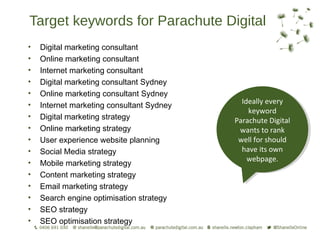
Target keywords for Parachute Digital
•   Digital marketing consultant
•   Online marketing consultant
•   Internet marketing consultant
•   Digital marketing consultant Sydney
•   Online marketing consultant Sydney
                                             Ideally every
                                              Ideally every
•   Internet marketing consultant Sydney
                                               keyword
                                                keyword
•   Digital marketing strategy             Parachute Digital
                                            Parachute Digital
•   Online marketing strategy                wants to rank
                                             wants to rank
•   User experience website planning        well for should
                                             well for should
•   Social Media strategy                    have its own
                                              have its own
                                               webpage.
                                                webpage.
•   Mobile marketing strategy
•   Content marketing strategy
•   Email marketing strategy
•   Search engine optimisation strategy
•   SEO strategy
•   SEO optimisation strategy
Meta Data or Meta tags

• Page title – the title that shows in Google’s Search listing
• Description – the description that shows in Google’s
  Search listing
• Keywords

• Meta tags must be specific to each page
• They must describe the page content and use the SEO
  keywords
• They must match the page URL
• Any words that are hyperlinked through the page content,
  should match the keywords (this is called anchor text).
Parachute Digital Meta data
                  example
http://parachutedigitalmarketing.com.au/blog/usability-2/planning-your-website-for-
                        the-best-possible-user-experience/
Ideal: Meta Data example

•   Page title: Deforestation, illegal timber imports, logging - Say No to Bad
    Wood

•   Description: The wood you have in your home could be linked to
    deforestation or logging in some of the world's most precious ecosystems.
    Help us to ban illegal timber imports of bad wood into Australia.

•   Keywords: ban illegal logging imports into Australia, ban illegal timber
    imports into Australia, ban illegal forest products, Say no to bad wood,
    ecosystem Papua New Guinea, deforestation Papua New Guinea, illegally
    logged forest products, logging Papua New Guinea, illegal logging New
    Guinea, illegal timber imports, illegal logging practices, illegal forest
    products, illegal timber Australia, illegal logging Borneo, illegal logging
    Indonesia, illegal logging Malaysia, , good wood Australia, tropical forest
    timber, ecosystem Sumatra, deforestation Sumatra, ecosystem Borneo,
    deforestation Borneo, illegal logging, logging Sumatra, logging Borneo,
    logging Australia, bad wood, ecosystem, deforestation, logging, forests,
    timber, wood, Australia.
Meta data template

• Page title
   • 8-10 words: Literally what the page is about
      • the most important words first (brand is the last thing)
• Description
   • 12-24 words: this is what the user will read in the
     Google search listings
      • so it needs to be an accurate description of what is on
        the page
• Keywords
   • 24-48 keywords: this is what we think people will
     be typing into a Google Search
      • starting with the longest keywords (5+ words) down to
        single word keywords
Heading tags <H1> to <H6>
Linking – Internal, External, Inbound

Linking is important because Google’s “spiders” crawl the
internet, moving from one link to another. So these links should
have relevant keywords in them

•Internal linking
•creating hyperlinks to move users around your own site
•External linking
•hyperlinks that direct users to websites outside of your domain
•Inbound links
•Google gives points to sites who have lots of links pointing to them
•Ideally, you want inbound links from authority or “expert”
websites (page rank 4 and above).
Anchor text

• The words you choose to hyperlink are called “anchor
  text”.
   • Google puts more emphasis on words that are linked or
     bolded
• These anchor text words should match your keywords
  wherever possible
• Therefore, your anchor text gives Google a quick
  snapshot of your page content and the pages you’re
  linking to.

  Don’t hyperlink words like “Find out More” or “Click here for more
   Don’t hyperlink words like “Find out More” or “Click here for more
  information”.
   information”.
  We want to hyperlink our keywords such as “digital marketing strategy” or
   We want to hyperlink our keywords such as “digital marketing strategy” or
  “online marketing consultant sydney”
   “online marketing consultant sydney”
Alt text or Alt tags
Alt text is a literal description of your images that search engines can read.
This should be different to the caption (but many websites use the same info).
On Page SEO Template
What you can do now

Quick Wins for your website’s SEO
Quick Wins for SEO

• Improve the page content by using identified keywords
  within the text on the page
• Remove duplicate pages/ content across the network
• Add page specific meta tags to every webpage
• Increase internal and external linking, with anchor text
  rich in keywords
• Add more images
• Add alt tags to all images
• Create transcripts for videos.
What else can I do to influence SEO?

 • Write articles or Blogs
     • On your website
     • On other websites that will link back to you
 • Participate in Social media, add social/ user generated
   commentary to your website
 • Create location markers – such as Google Places or GPS maps
 • Build up your website quality score with Paid search
 • Optimise your website for Mobile search.
Long term SEO Success

1. Continued publication of new content
2. Ongoing maintenance of SEO optimisation
3. Quality control and refinement of silos and linking strategy
    1. Inbound linking             This is really tough!
    2. External linking
    3. Internal linking
4. Maintenance of site maps to ensure all pages are indexed
    1. Html
    2. XML
5. Regular SEO reporting to measure success and then continue
   to optimise for best results.
Thank You

Search Engine Optimisation (SEO) Basics Training - April 2013

  • 1.
    Search Engine Optimisation “SEOBasics” Training 23 April 2013 Shanelle Newton Clapham Parachute Digital
  • 2.
    Search engine optimisation (SEO)is the process of improving your website and content so that it is visible to search engines. Website SEO aims to make the information & services that your organisation provide deemed most relevant (by the search engine) to match the keywords that their users are searching for.
  • 3.
    What is SEO? SEO means Search Engine Optimisation, which is optimising your website to make it easier for search engines to find you. •Good SEO = High rankings in Google search listings (pg. 1) •SEO is about many small tactics, implemented in increments over time to help your website rank better in search engine results. These tactics include: • Website content (engagement objects [images, maps, video, infographics, ebooks] + words) • Internal and external linking strategies (expertness) • Information architecture and siloing (URLs and site navigation) • Meta data + keywords (html) • Site map (html and XML) and much more.
  • 4.
    Optimising for Google 90% of all internet sessions start with a Search query 93% of all searches in Australia are on Google (Nov 2012) Google Global Market share Nov 2012 #10 on Google gets more traffic than #1 on Yahoo
  • 5.
    Optimising for Google Thereare [reportedly] over 200 variables in Google’s algorithm which determine rankings, some of them are: • Content • language and uniqueness • frequency of updating • Duplicate content • Keywords used and anchor text + alt text • Domain age • Where you servers are located • URL structure • Internal cross linking • Outbound and Inbound linking • Authority of domains being linked to • XML and html site maps • Robots.txt • Page load time
  • 6.
  • 7.
    What is ‘Content’? Inthe digital world, everything you can add to a webpage is ‘content’ •Written words •Images •Video •Graphs and infographics •Links.
  • 8.
    Treat your Contentlike a Queen! Content brings •Search engines •People/ Partners/ Prospects •Credibility •A good user experience •Variety •Inbound links •Sharing •Stickiness (repeat visitation).
  • 9.
    How people search Thereis no right way to search
  • 10.
    Different strokes fordifferent folks
  • 11.
    Spelling & grammar Micromachining,micro-machining, micro machining
  • 12.
    Suggestive or Predictivesearch Some people use abbreviations when they type, others only type in 3 letters.
  • 13.
    The Consideration Cycle From generic to specific How many How many searches does aa searches does shopper make shopper make before deciding before deciding to buy? to buy?
  • 14.
    Browsing behaviour The locationof Google’s Sponsored links changes so people don’t ignore it
  • 15.
  • 16.
    Can we makeassumptions about a user’s assumed knowledge?
  • 17.
    SEO Fundamentals The stuffyou need to know and get right
  • 18.
  • 19.
    Target keywords forParachute Digital • Digital marketing consultant • Online marketing consultant • Internet marketing consultant • Digital marketing consultant Sydney • Online marketing consultant Sydney Ideally every Ideally every • Internet marketing consultant Sydney keyword keyword • Digital marketing strategy Parachute Digital Parachute Digital • Online marketing strategy wants to rank wants to rank • User experience website planning well for should well for should • Social Media strategy have its own have its own webpage. webpage. • Mobile marketing strategy • Content marketing strategy • Email marketing strategy • Search engine optimisation strategy • SEO strategy • SEO optimisation strategy
  • 20.
    Meta Data orMeta tags • Page title – the title that shows in Google’s Search listing • Description – the description that shows in Google’s Search listing • Keywords • Meta tags must be specific to each page • They must describe the page content and use the SEO keywords • They must match the page URL • Any words that are hyperlinked through the page content, should match the keywords (this is called anchor text).
  • 21.
    Parachute Digital Metadata example http://parachutedigitalmarketing.com.au/blog/usability-2/planning-your-website-for- the-best-possible-user-experience/
  • 22.
    Ideal: Meta Dataexample • Page title: Deforestation, illegal timber imports, logging - Say No to Bad Wood • Description: The wood you have in your home could be linked to deforestation or logging in some of the world's most precious ecosystems. Help us to ban illegal timber imports of bad wood into Australia. • Keywords: ban illegal logging imports into Australia, ban illegal timber imports into Australia, ban illegal forest products, Say no to bad wood, ecosystem Papua New Guinea, deforestation Papua New Guinea, illegally logged forest products, logging Papua New Guinea, illegal logging New Guinea, illegal timber imports, illegal logging practices, illegal forest products, illegal timber Australia, illegal logging Borneo, illegal logging Indonesia, illegal logging Malaysia, , good wood Australia, tropical forest timber, ecosystem Sumatra, deforestation Sumatra, ecosystem Borneo, deforestation Borneo, illegal logging, logging Sumatra, logging Borneo, logging Australia, bad wood, ecosystem, deforestation, logging, forests, timber, wood, Australia.
  • 23.
    Meta data template •Page title • 8-10 words: Literally what the page is about • the most important words first (brand is the last thing) • Description • 12-24 words: this is what the user will read in the Google search listings • so it needs to be an accurate description of what is on the page • Keywords • 24-48 keywords: this is what we think people will be typing into a Google Search • starting with the longest keywords (5+ words) down to single word keywords
  • 24.
  • 25.
    Linking – Internal,External, Inbound Linking is important because Google’s “spiders” crawl the internet, moving from one link to another. So these links should have relevant keywords in them •Internal linking •creating hyperlinks to move users around your own site •External linking •hyperlinks that direct users to websites outside of your domain •Inbound links •Google gives points to sites who have lots of links pointing to them •Ideally, you want inbound links from authority or “expert” websites (page rank 4 and above).
  • 26.
    Anchor text • Thewords you choose to hyperlink are called “anchor text”. • Google puts more emphasis on words that are linked or bolded • These anchor text words should match your keywords wherever possible • Therefore, your anchor text gives Google a quick snapshot of your page content and the pages you’re linking to. Don’t hyperlink words like “Find out More” or “Click here for more Don’t hyperlink words like “Find out More” or “Click here for more information”. information”. We want to hyperlink our keywords such as “digital marketing strategy” or We want to hyperlink our keywords such as “digital marketing strategy” or “online marketing consultant sydney” “online marketing consultant sydney”
  • 27.
    Alt text orAlt tags Alt text is a literal description of your images that search engines can read. This should be different to the caption (but many websites use the same info).
  • 28.
    On Page SEOTemplate
  • 29.
    What you cando now Quick Wins for your website’s SEO
  • 30.
    Quick Wins forSEO • Improve the page content by using identified keywords within the text on the page • Remove duplicate pages/ content across the network • Add page specific meta tags to every webpage • Increase internal and external linking, with anchor text rich in keywords • Add more images • Add alt tags to all images • Create transcripts for videos.
  • 31.
    What else canI do to influence SEO? • Write articles or Blogs • On your website • On other websites that will link back to you • Participate in Social media, add social/ user generated commentary to your website • Create location markers – such as Google Places or GPS maps • Build up your website quality score with Paid search • Optimise your website for Mobile search.
  • 32.
    Long term SEOSuccess 1. Continued publication of new content 2. Ongoing maintenance of SEO optimisation 3. Quality control and refinement of silos and linking strategy 1. Inbound linking This is really tough! 2. External linking 3. Internal linking 4. Maintenance of site maps to ensure all pages are indexed 1. Html 2. XML 5. Regular SEO reporting to measure success and then continue to optimise for best results.
  • 33.

Editor's Notes

  • #5 Sources: http://www.thewebshowroom.com.au/blog/search-engine-market-share/ http://www.searchenginejournal.com/search-engine-market-share-November/56626/ http://www.sbnonline.com/2011/02/time-to-optimize/
  • #6 http://www.searchenginejournal.com/200-parameters-in-google-algorithm/15457/