
Digital Insight Current Trends and Best Practices in Search Marketing
Search Marketing
What is SEO? As defined by Darren Rowse,  co-founder of one of the world’s largest blog networks:  1. The right answer - SEO is something that helps a website to increase it’s ranking in a search engine. 2. My ‘historical’ answer (ie what I would have answered a few years ago) SEO is about manipulating Search Engines in order to get them to send you as much traffic as possible. 3. The ‘in practice’ answer (ie how it impacts me these days) - SEO for me these days is a combination of: •  About knowing some of the general principles that help a site or page to rank well in search engines •  Building the best quality site that I can with content that meets the needs of readers (and as a result attracts links from other sites)
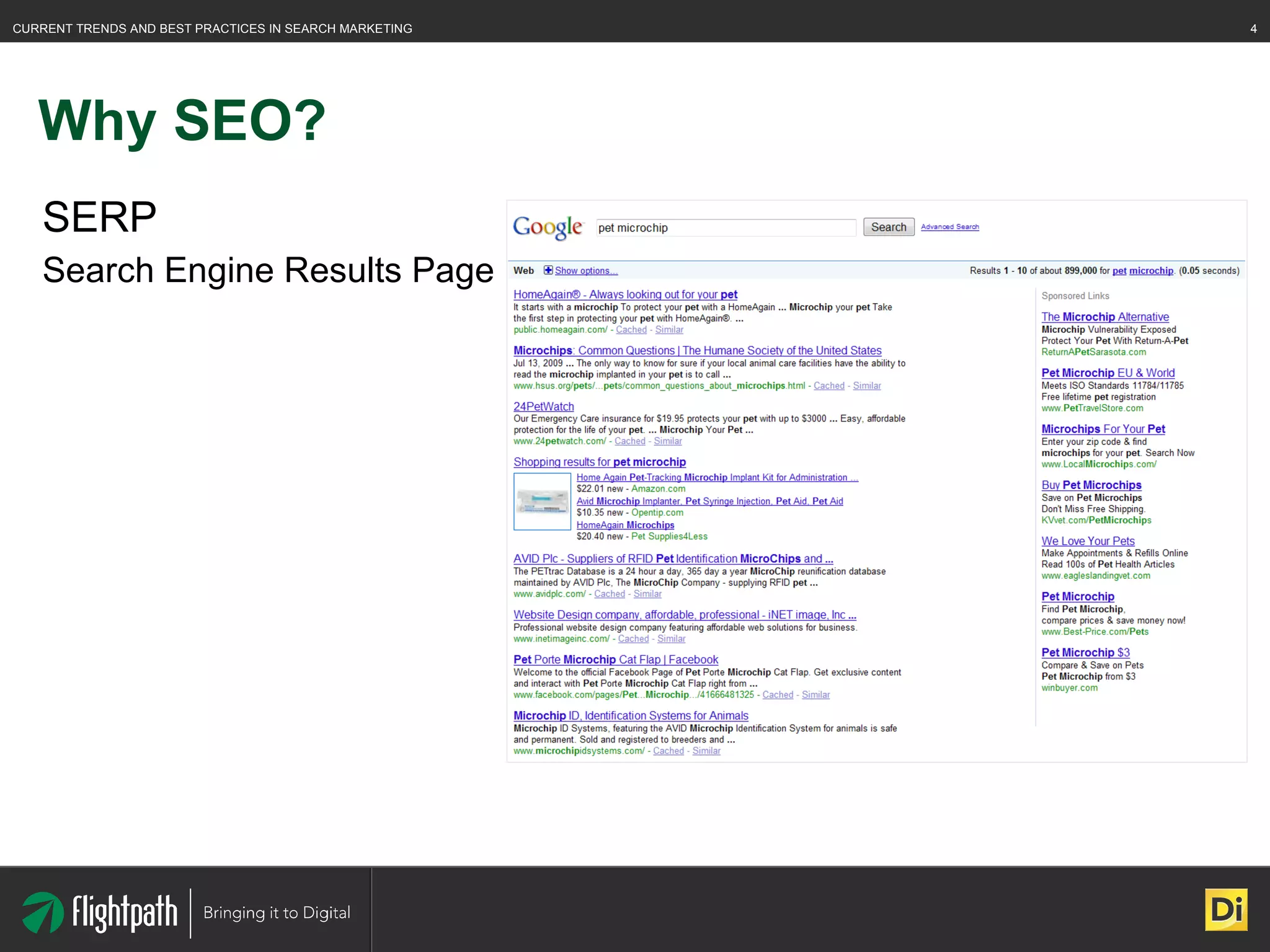
Why SEO? SERP Search Engine Results Page
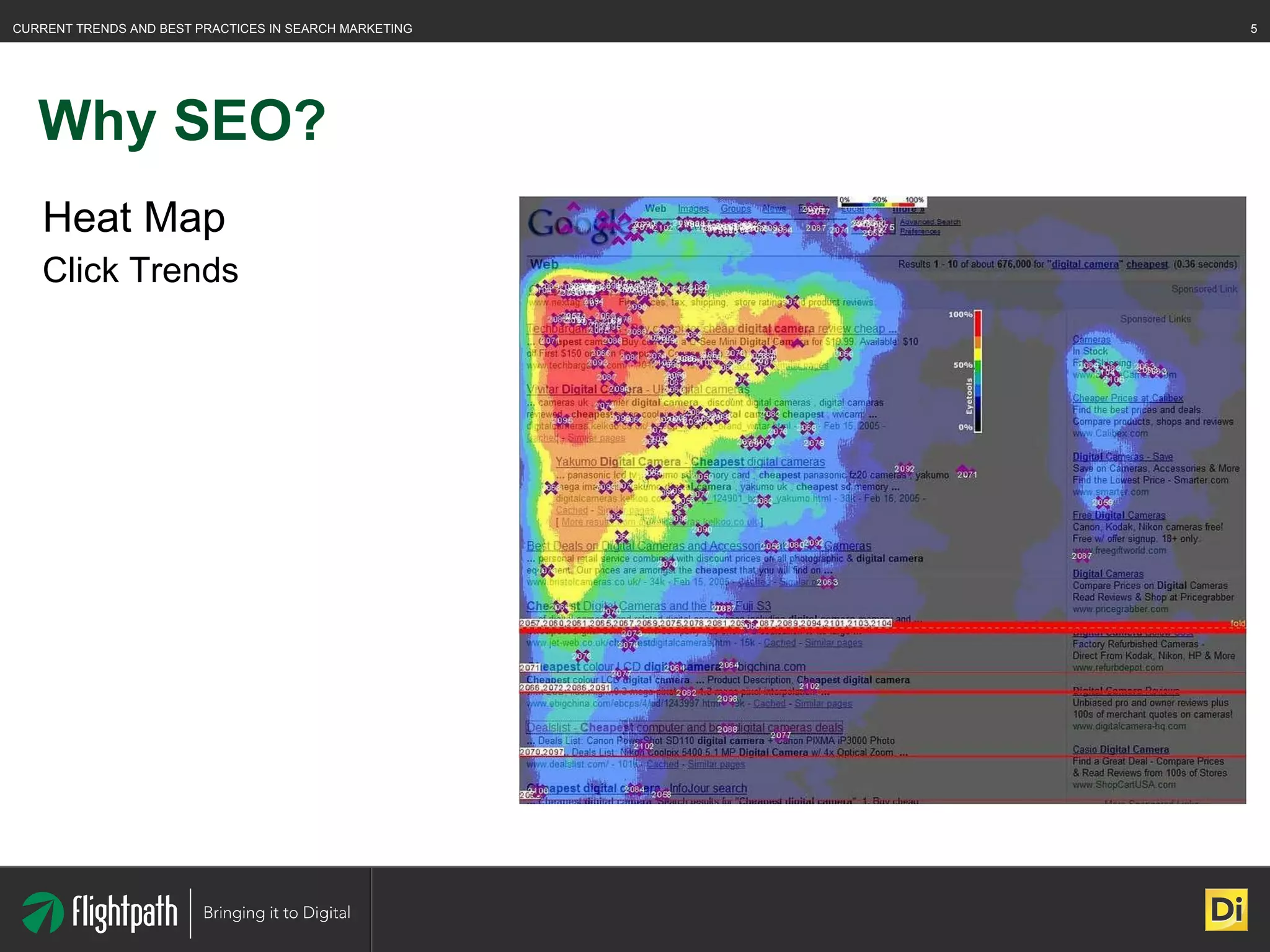
Why SEO? Heat Map Click Trends
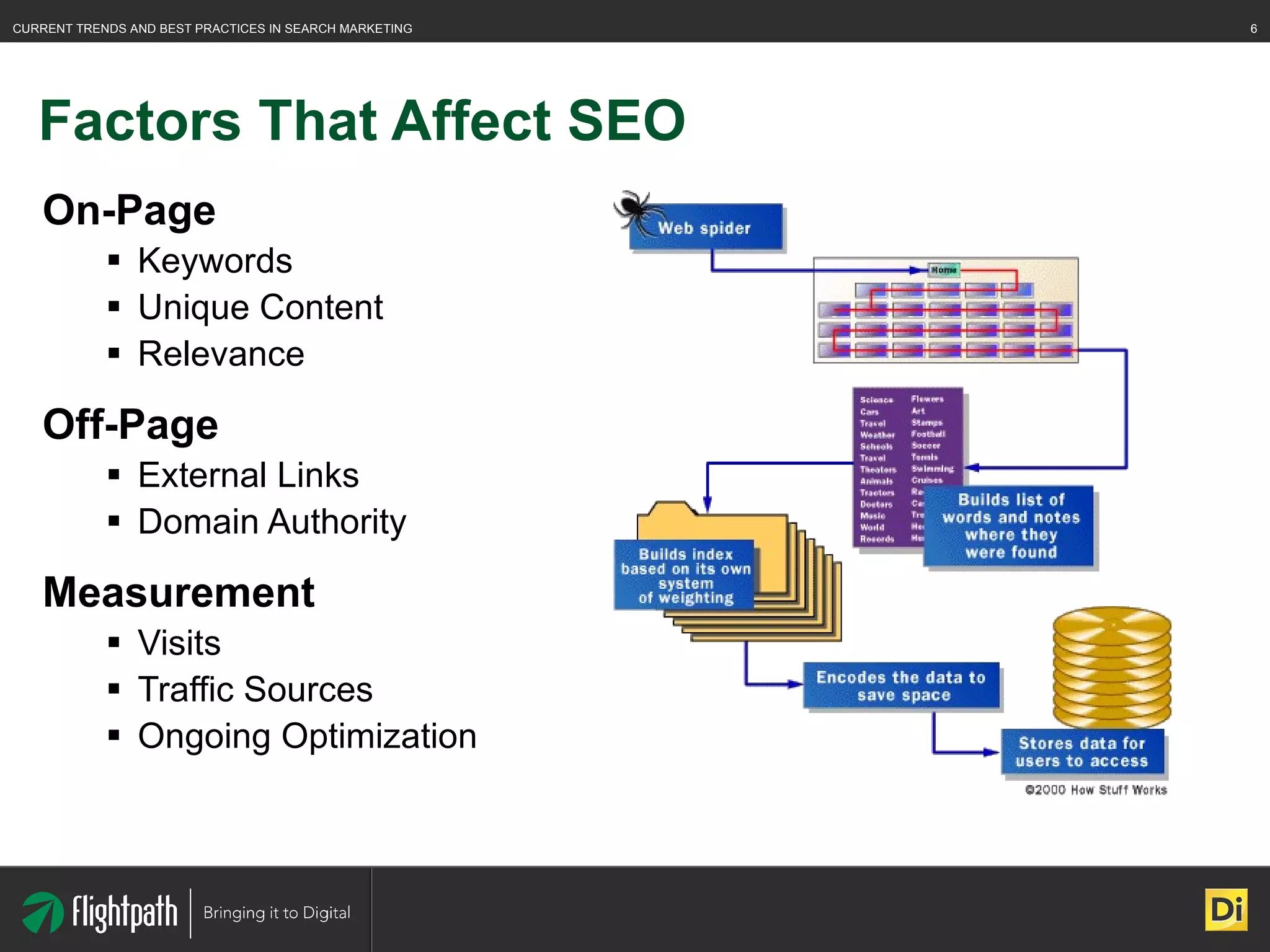
Factors That Affect SEO On-Page Keywords Unique Content Relevance Off-Page External Links Domain Authority Measurement Visits Traffic Sources Ongoing Optimization
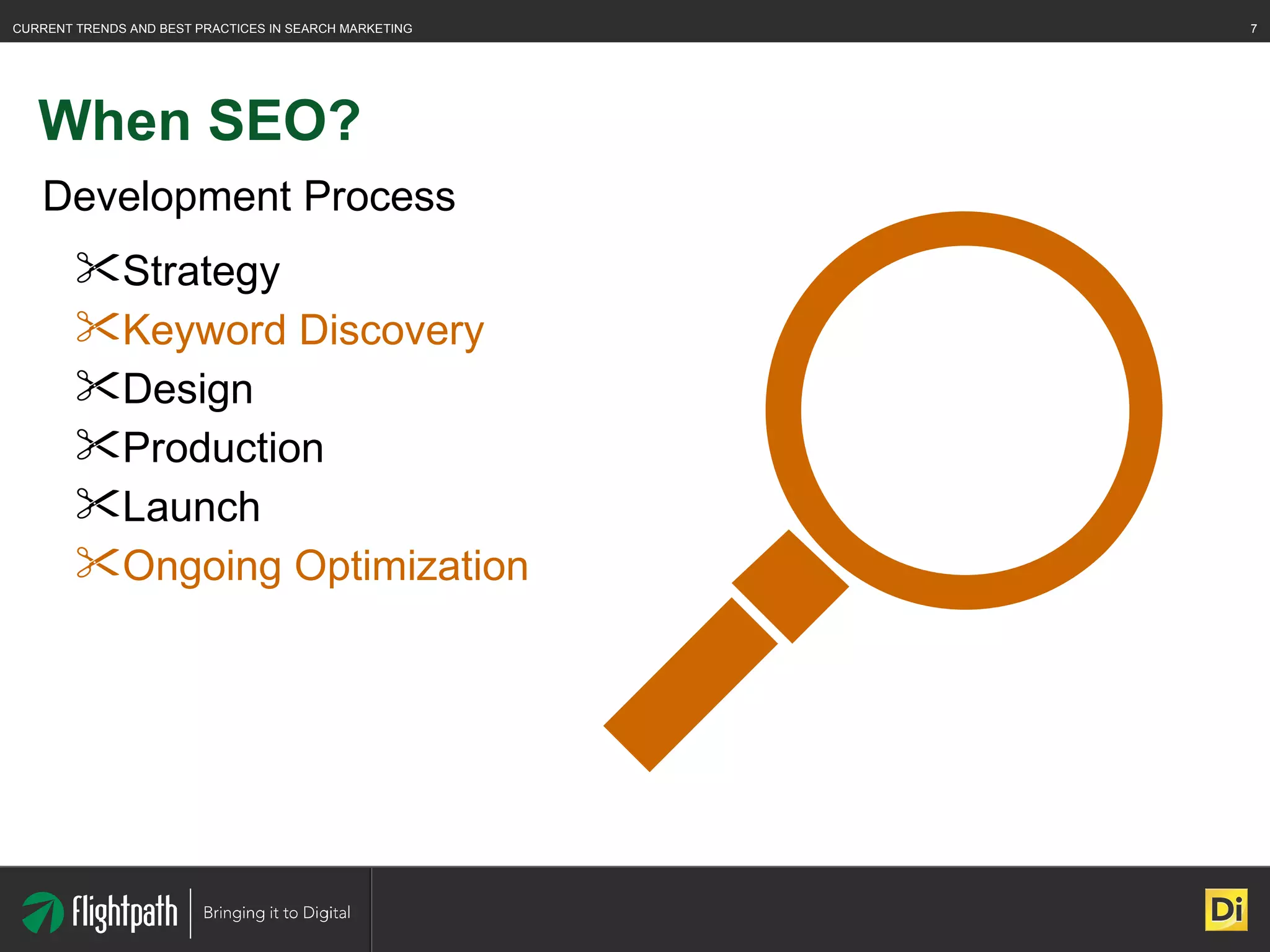
When SEO? Development Process Strategy Keyword Discovery Design  Production Launch  Ongoing Optimization
On-Page SEO Factors
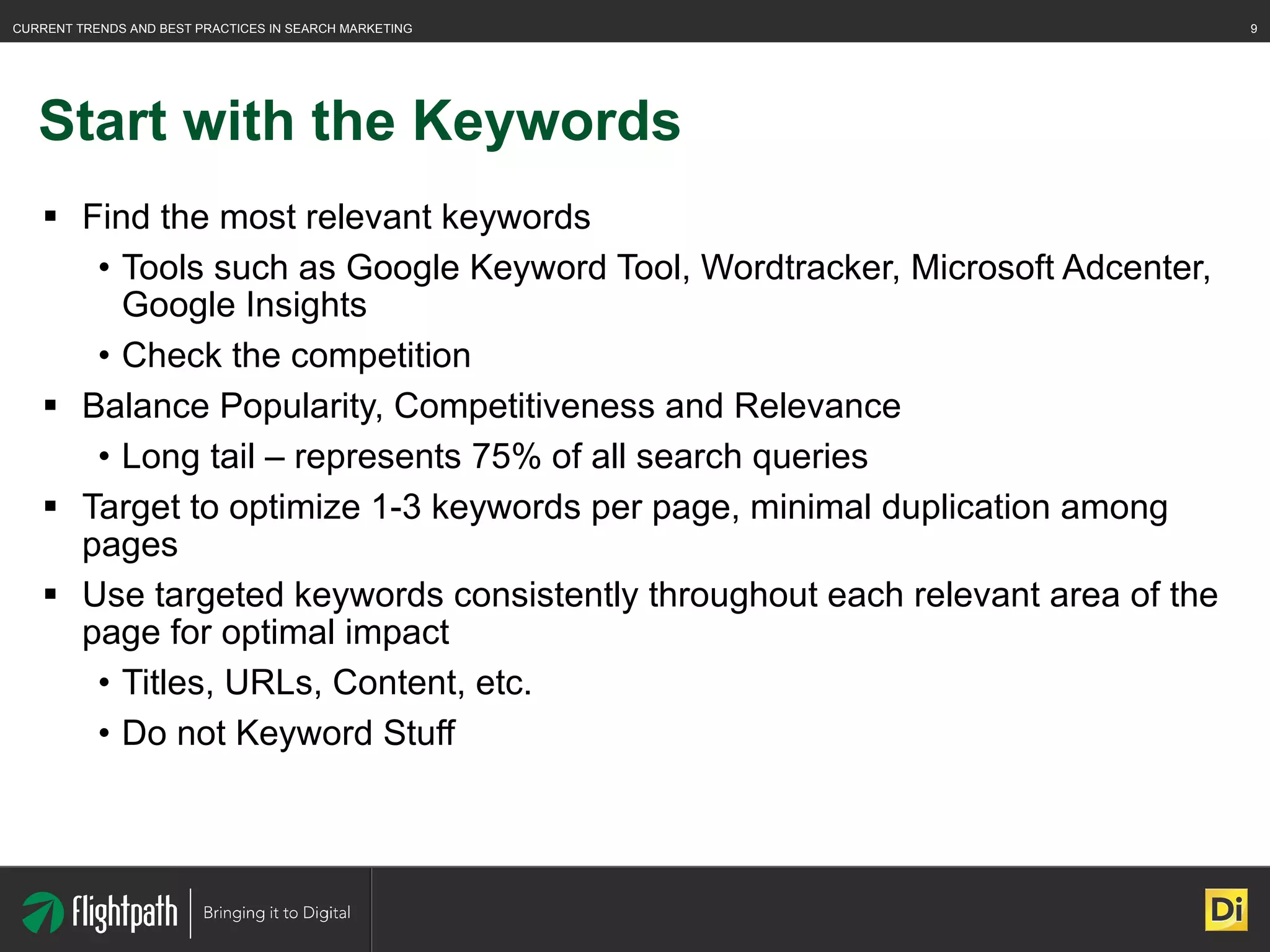
Start with the Keywords Find the most relevant keywords Tools such as Google Keyword Tool, Wordtracker, Microsoft Adcenter, Google Insights Check the competition Balance Popularity, Competitiveness and Relevance Long tail – represents 75% of all search queries Target to optimize 1-3 keywords per page, minimal duplication among pages Use targeted keywords consistently throughout each relevant area of the page for optimal impact Titles, URLs, Content, etc. Do not Keyword Stuff
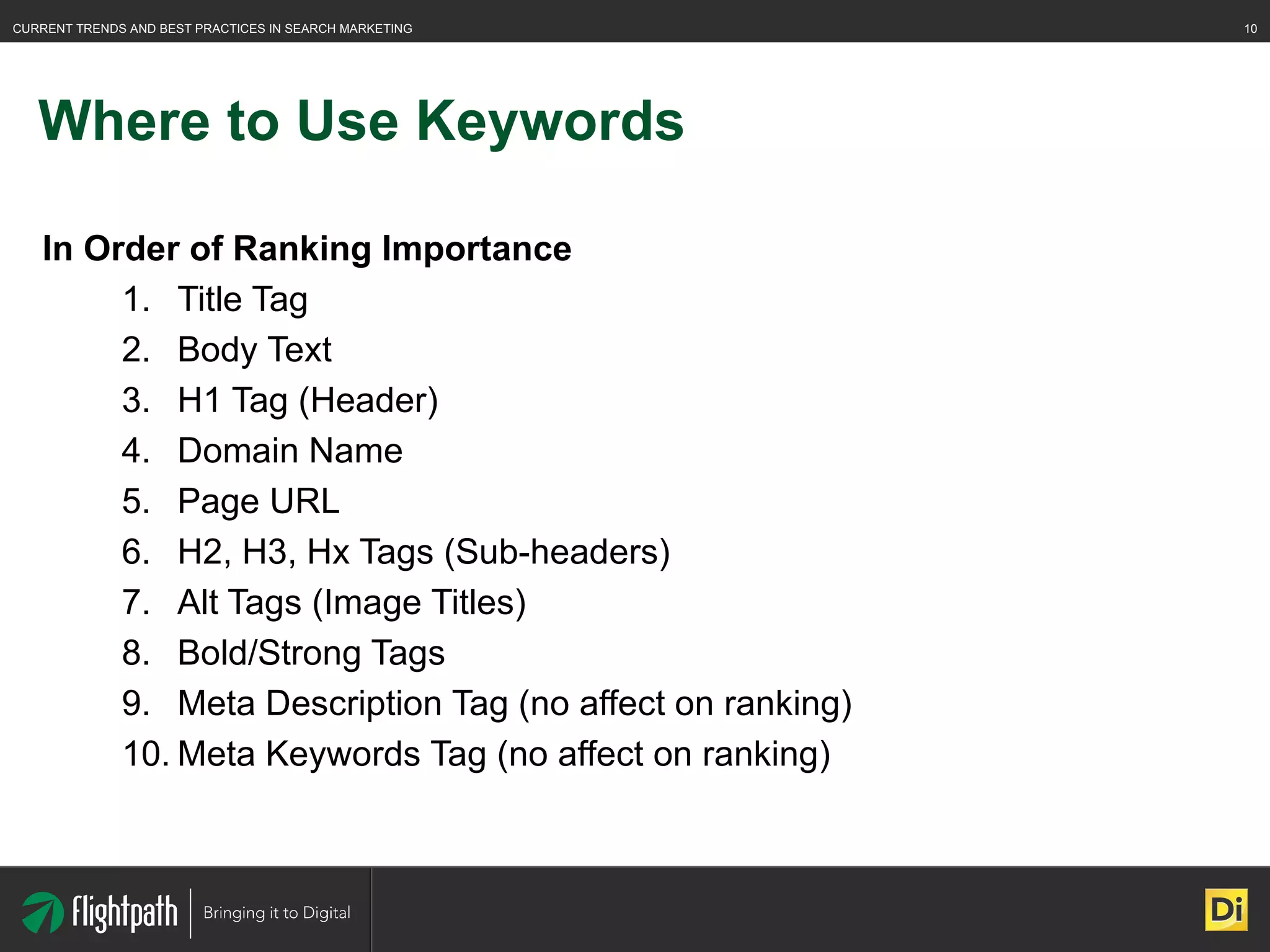
Where to Use Keywords In Order of Ranking Importance Title Tag Body Text H1 Tag (Header) Domain Name Page URL H2, H3, Hx Tags (Sub-headers) Alt Tags (Image Titles) Bold/Strong Tags Meta Description Tag (no affect on ranking) Meta Keywords Tag (no affect on ranking)
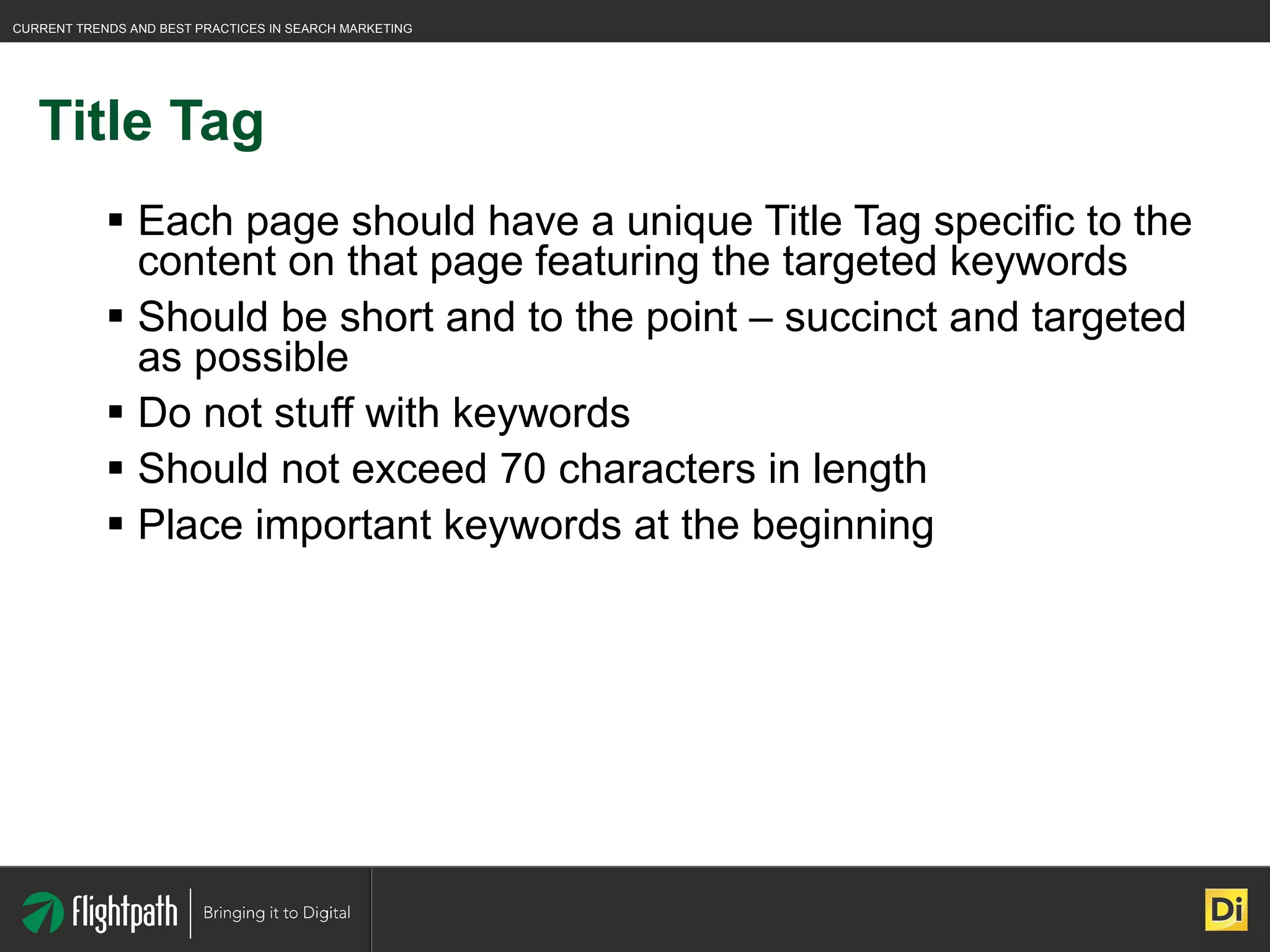
Title Tag Each page should have a unique Title Tag specific to the content on that page featuring the targeted keywords Should be short and to the point – succinct and targeted as possible Do not stuff with keywords Should not exceed 70 characters in length Place important keywords at the beginning
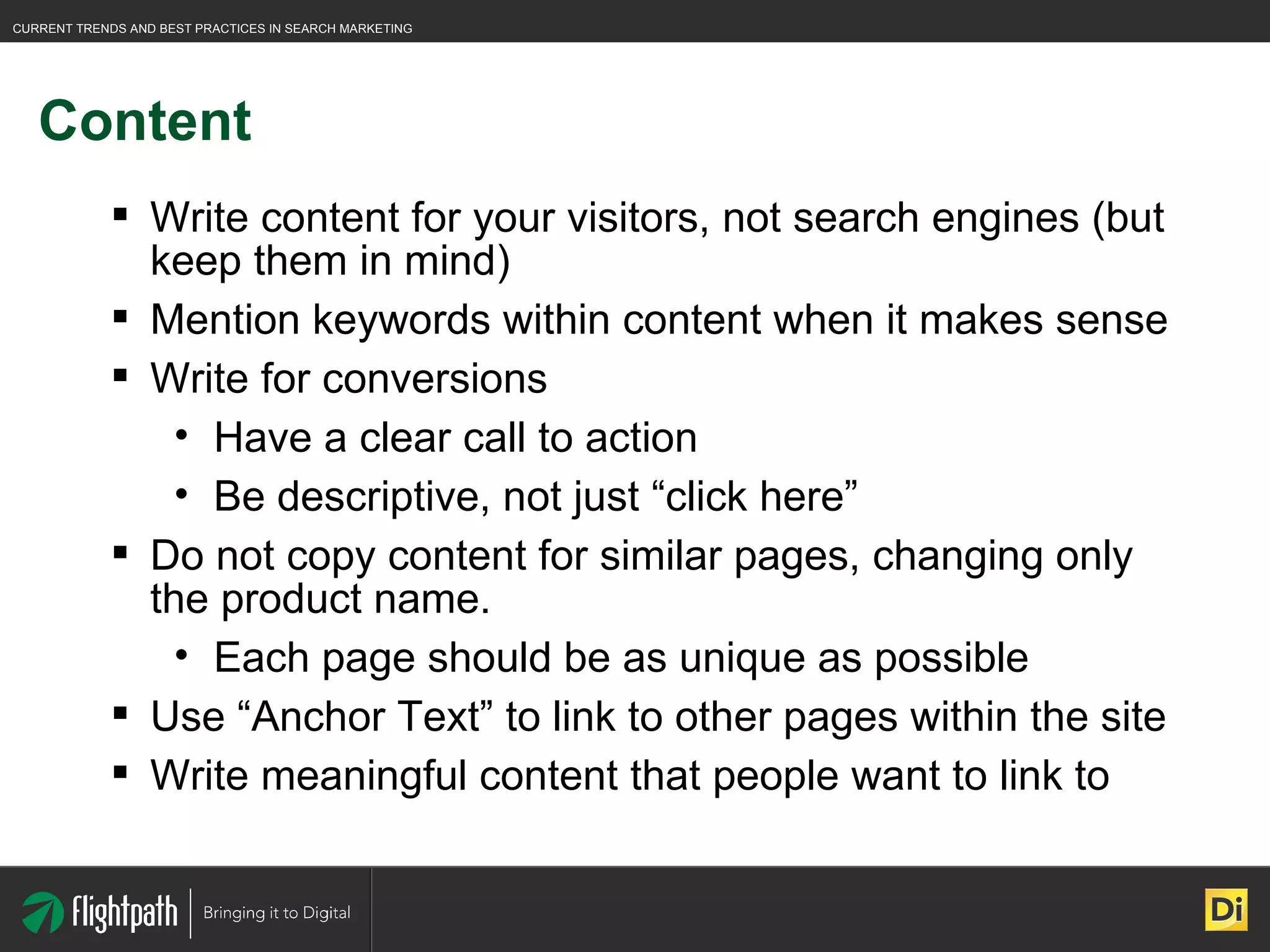
Content Write content for your visitors, not search engines (but keep them in mind) Mention keywords within content when it makes sense Write for conversions Have a clear call to action Be descriptive, not just “click here” Do not copy content for similar pages, changing only the product name. Each page should be as unique as possible Use “Anchor Text” to link to other pages within the site Write meaningful content that people want to link to
Other Keyword Opportunities H1 Tags Headers normally very similar to the Title H2, H3, Hx not as important Domains and URLs Utilize keywords Dashes instead of underscores Alt Text Used with images and graphics (ex. logo) Include keywords Most useful for sites with many images
Meta Data Meta Description Unique for each page, relevant to page content Not relevant in rankings, but engines will use it as a descriptor in listings, so important for click-throughs Sentence format A properly written description can get more traffic Meta Keywords Listing of keywords, separated by a comma Use most relevant keywords first Not a factor in ranking
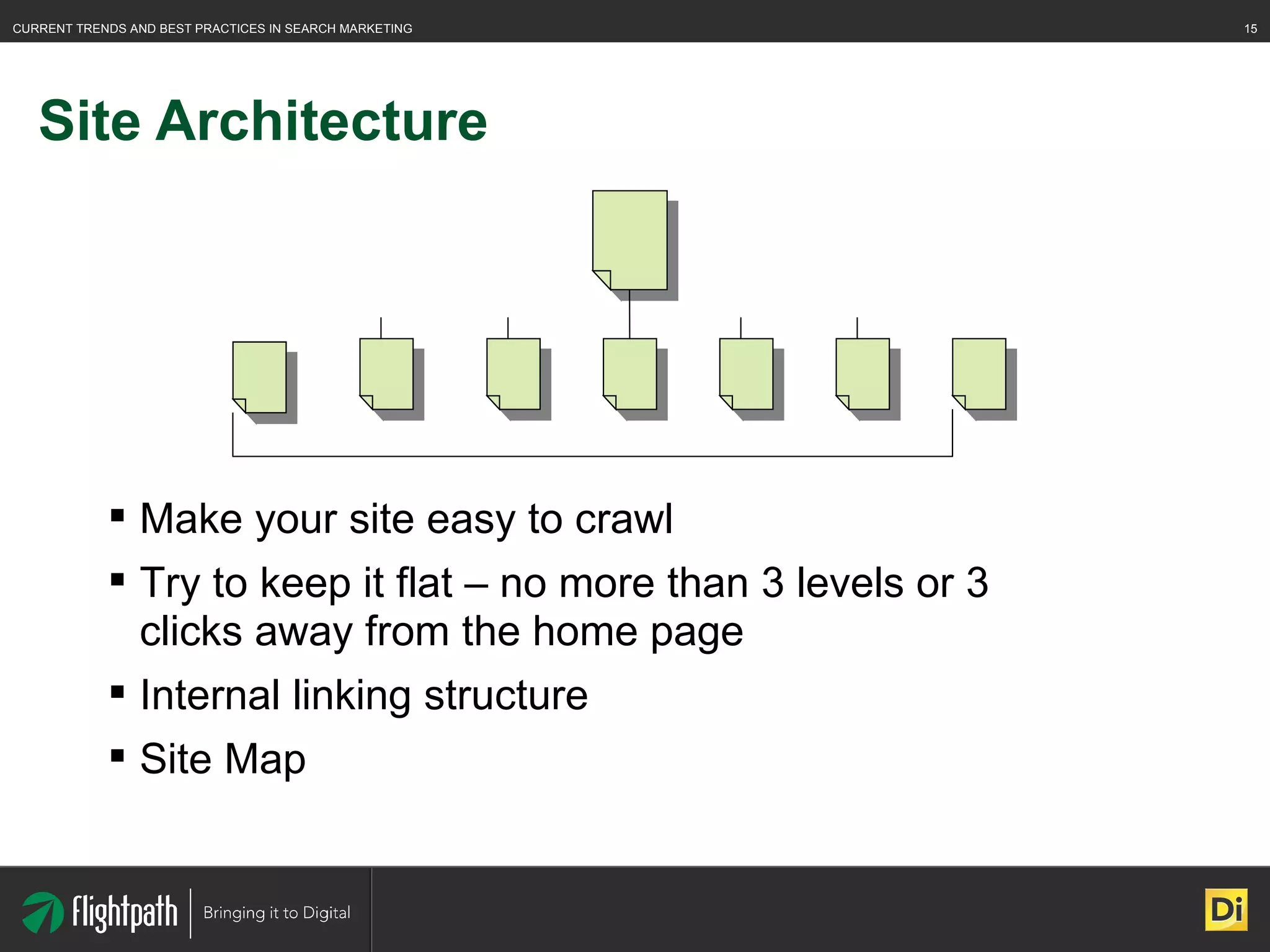
Site Architecture Make your site easy to crawl Try to keep it flat – no more than 3 levels or 3 clicks away from the home page Internal linking structure Site Map
Off-Page SEO Factors
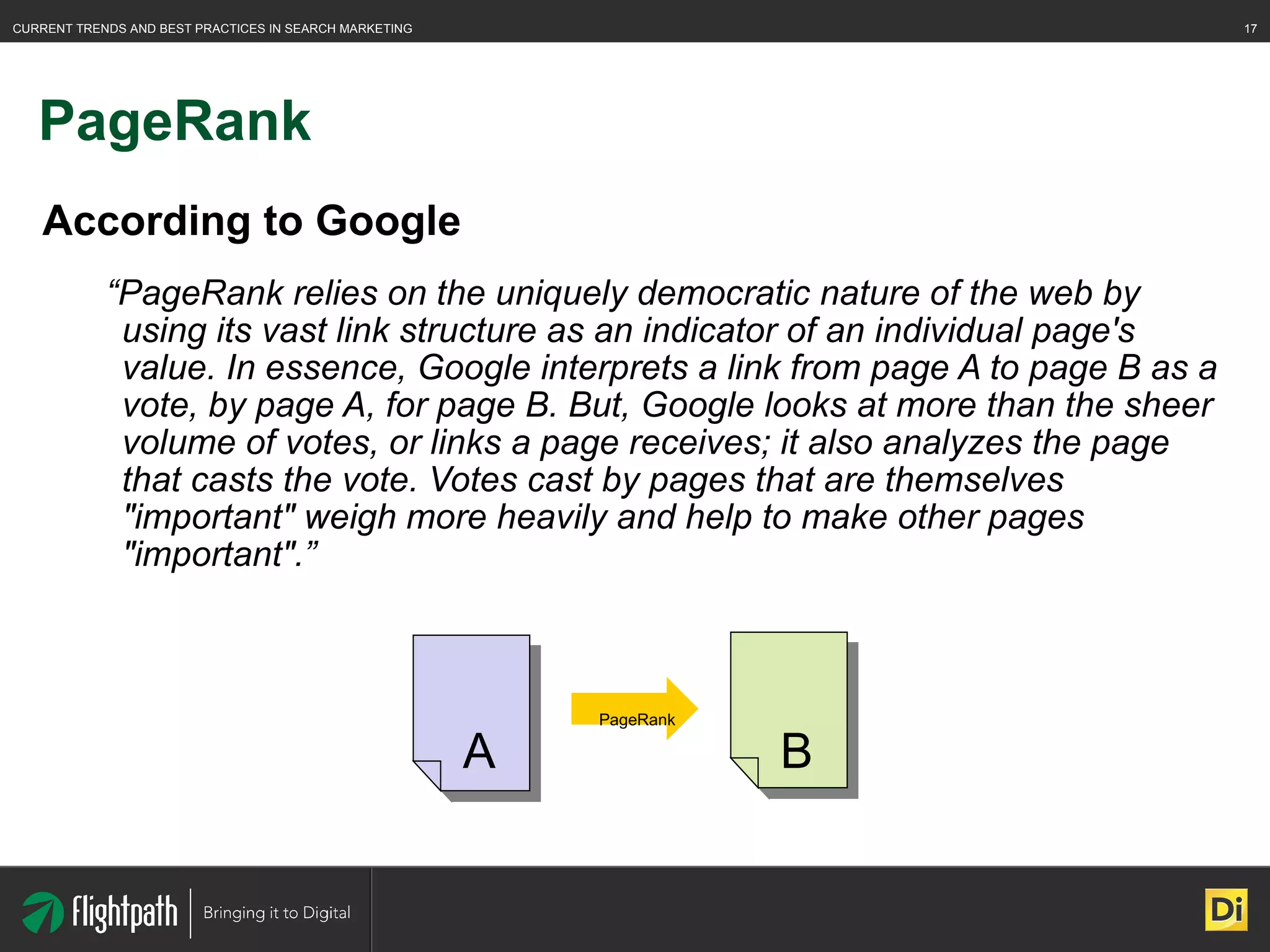
PageRank According to Google “ PageRank relies on the uniquely democratic nature of the web by using its vast link structure as an indicator of an individual page's value. In essence, Google interprets a link from page A to page B as a vote, by page A, for page B. But, Google looks at more than the sheer volume of votes, or links a page receives; it also analyzes the page that casts the vote. Votes cast by pages that are themselves "important" weigh more heavily and help to make other pages "important".” A B PageRank
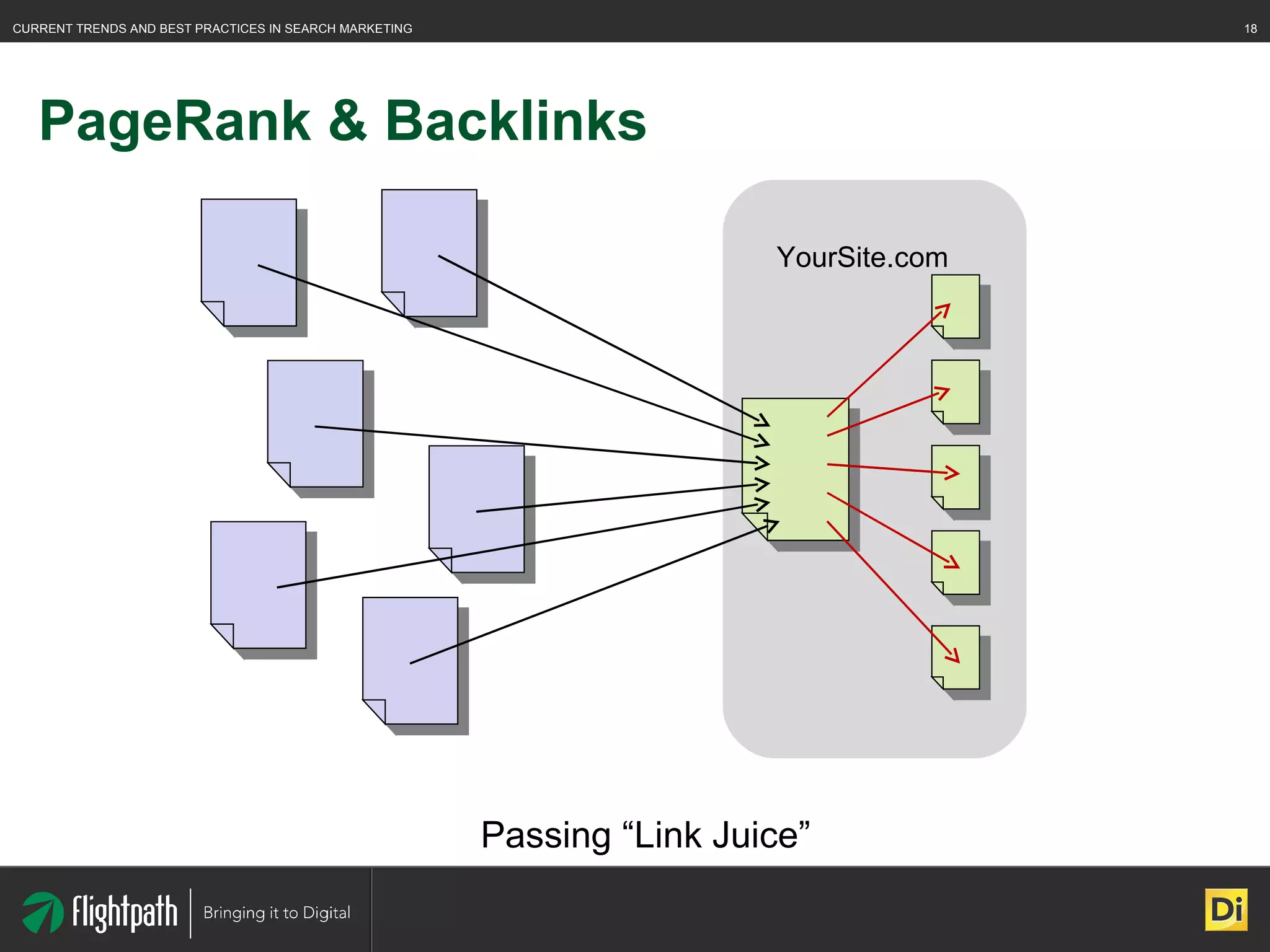
PageRank & Backlinks YourSite.com Passing “Link Juice”
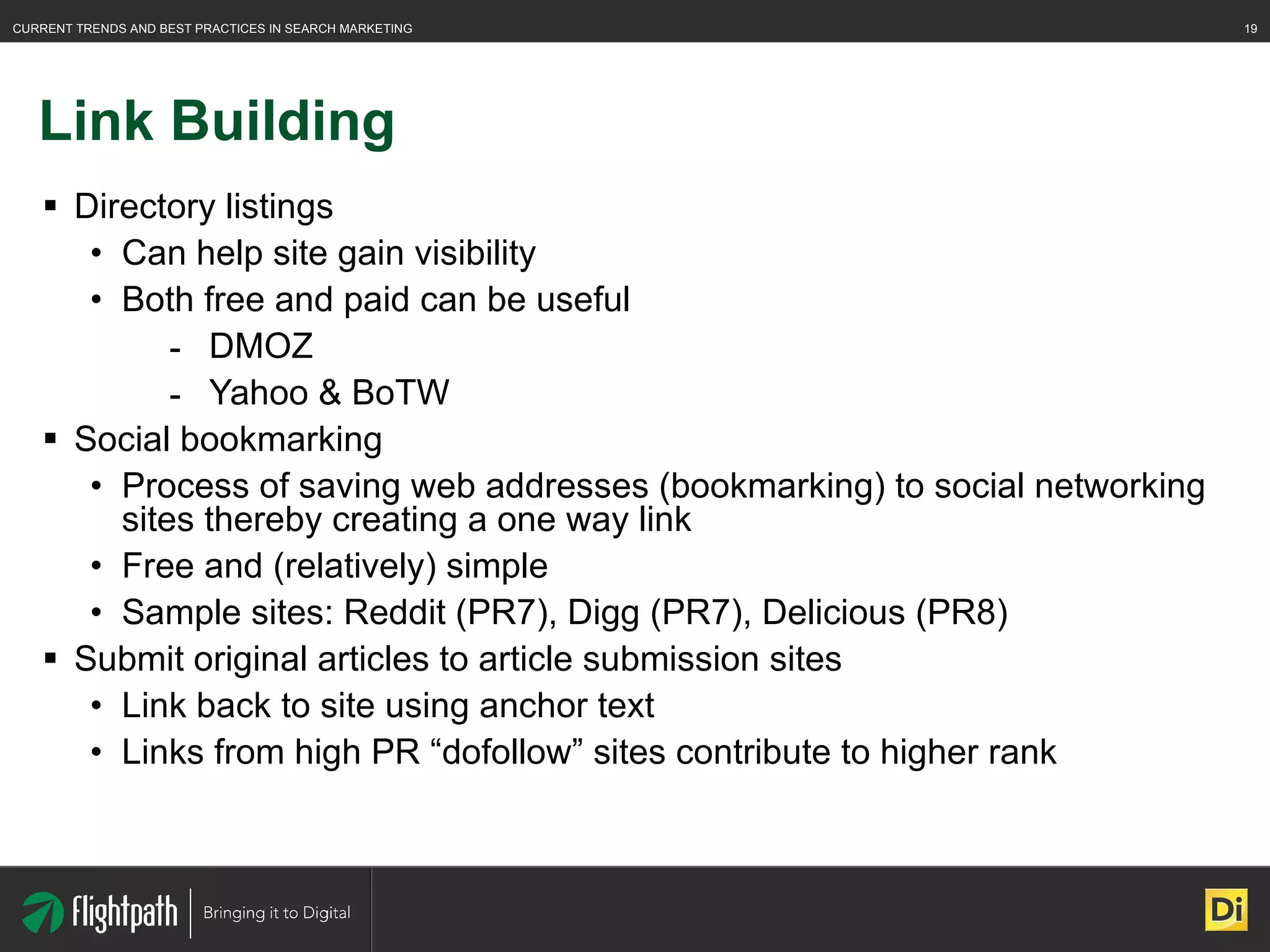
Link Building Directory listings Can help site gain visibility Both free and paid can be useful DMOZ Yahoo & BoTW Social bookmarking Process of saving web addresses (bookmarking) to social networking sites thereby creating a one way link Free and (relatively) simple Sample sites: Reddit (PR7), Digg (PR7), Delicious (PR8) Submit original articles to article submission sites Link back to site using anchor text Links from high PR “dofollow” sites contribute to higher rank
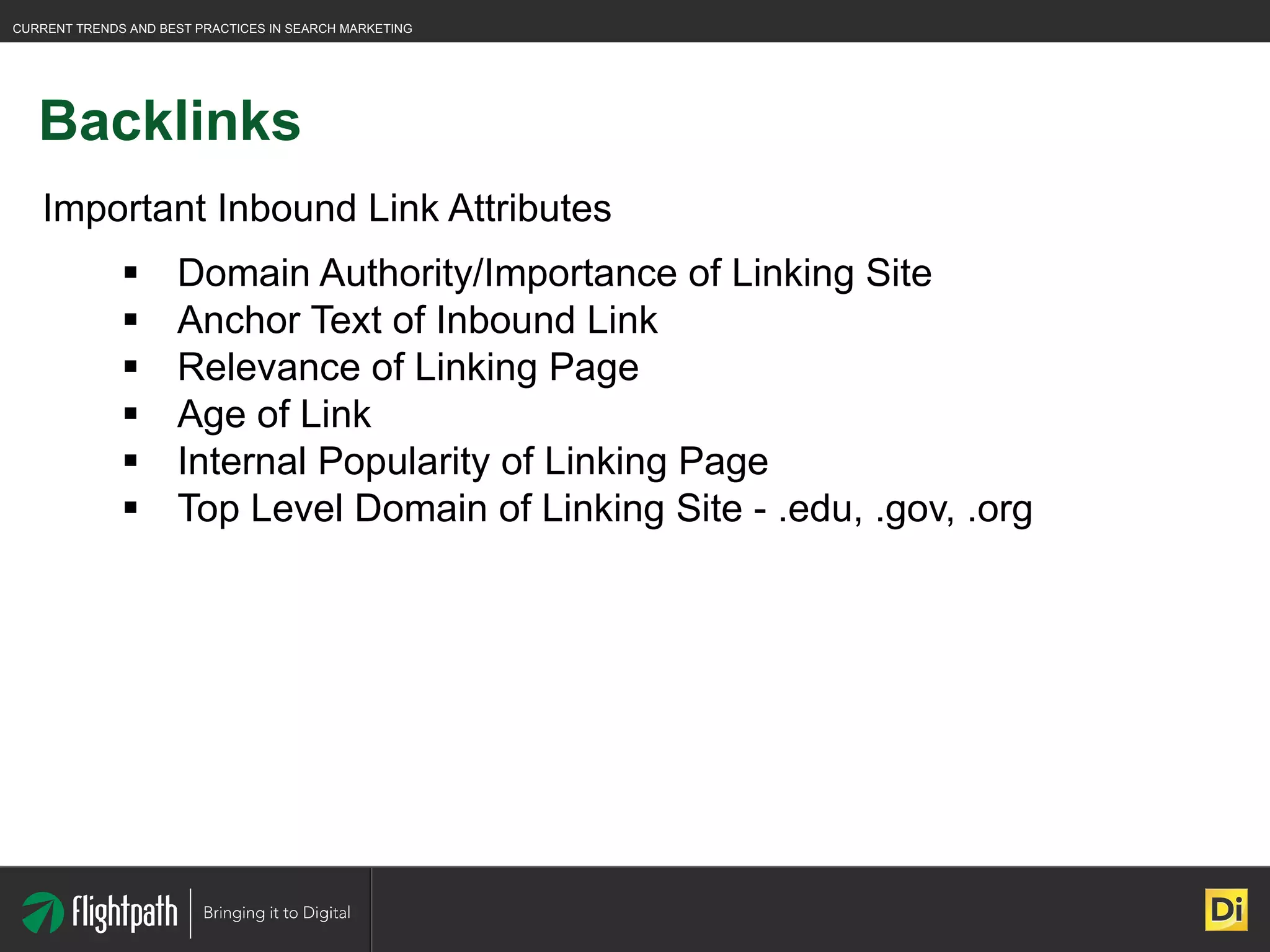
Backlinks Important Inbound Link Attributes Domain Authority/Importance of Linking Site Anchor Text of Inbound Link Relevance of Linking Page Age of Link Internal Popularity of Linking Page Top Level Domain of Linking Site - .edu, .gov, .org
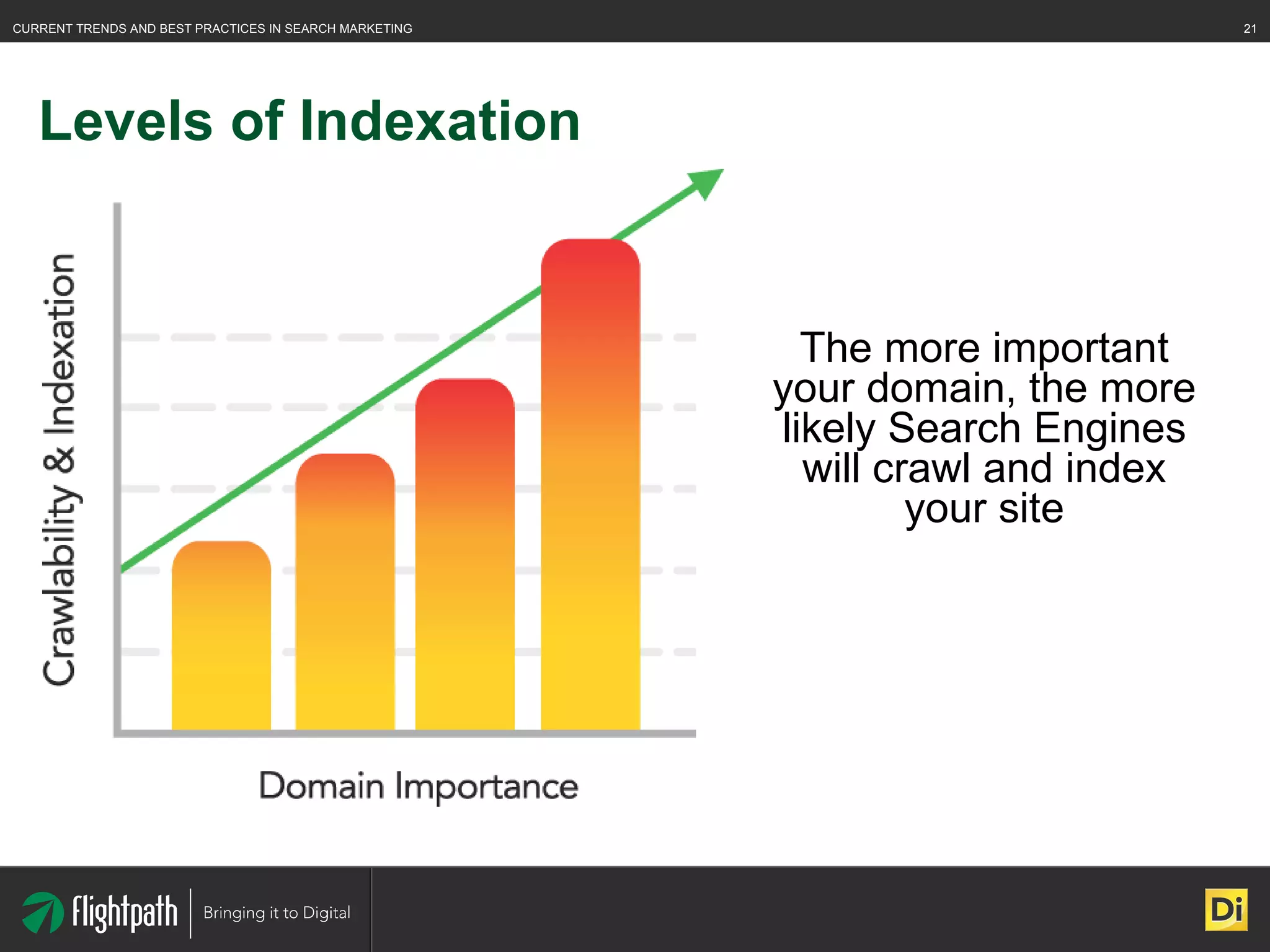
Levels of Indexation The more important your domain, the more likely Search Engines will crawl and index your site
Thank You

Current Trends and Best Practices in Search Marketing

  • 1.
    Digital Insight CurrentTrends and Best Practices in Search Marketing
  • 2.
  • 3.
    What is SEO?As defined by Darren Rowse, co-founder of one of the world’s largest blog networks: 1. The right answer - SEO is something that helps a website to increase it’s ranking in a search engine. 2. My ‘historical’ answer (ie what I would have answered a few years ago) SEO is about manipulating Search Engines in order to get them to send you as much traffic as possible. 3. The ‘in practice’ answer (ie how it impacts me these days) - SEO for me these days is a combination of: • About knowing some of the general principles that help a site or page to rank well in search engines • Building the best quality site that I can with content that meets the needs of readers (and as a result attracts links from other sites)
  • 4.
    Why SEO? SERPSearch Engine Results Page
  • 5.
    Why SEO? HeatMap Click Trends
  • 6.
    Factors That AffectSEO On-Page Keywords Unique Content Relevance Off-Page External Links Domain Authority Measurement Visits Traffic Sources Ongoing Optimization
  • 7.
    When SEO? DevelopmentProcess Strategy Keyword Discovery Design Production Launch Ongoing Optimization
  • 8.
  • 9.
    Start with theKeywords Find the most relevant keywords Tools such as Google Keyword Tool, Wordtracker, Microsoft Adcenter, Google Insights Check the competition Balance Popularity, Competitiveness and Relevance Long tail – represents 75% of all search queries Target to optimize 1-3 keywords per page, minimal duplication among pages Use targeted keywords consistently throughout each relevant area of the page for optimal impact Titles, URLs, Content, etc. Do not Keyword Stuff
  • 10.
    Where to UseKeywords In Order of Ranking Importance Title Tag Body Text H1 Tag (Header) Domain Name Page URL H2, H3, Hx Tags (Sub-headers) Alt Tags (Image Titles) Bold/Strong Tags Meta Description Tag (no affect on ranking) Meta Keywords Tag (no affect on ranking)
  • 11.
    Title Tag Eachpage should have a unique Title Tag specific to the content on that page featuring the targeted keywords Should be short and to the point – succinct and targeted as possible Do not stuff with keywords Should not exceed 70 characters in length Place important keywords at the beginning
  • 12.
    Content Write contentfor your visitors, not search engines (but keep them in mind) Mention keywords within content when it makes sense Write for conversions Have a clear call to action Be descriptive, not just “click here” Do not copy content for similar pages, changing only the product name. Each page should be as unique as possible Use “Anchor Text” to link to other pages within the site Write meaningful content that people want to link to
  • 13.
    Other Keyword OpportunitiesH1 Tags Headers normally very similar to the Title H2, H3, Hx not as important Domains and URLs Utilize keywords Dashes instead of underscores Alt Text Used with images and graphics (ex. logo) Include keywords Most useful for sites with many images
  • 14.
    Meta Data MetaDescription Unique for each page, relevant to page content Not relevant in rankings, but engines will use it as a descriptor in listings, so important for click-throughs Sentence format A properly written description can get more traffic Meta Keywords Listing of keywords, separated by a comma Use most relevant keywords first Not a factor in ranking
  • 15.
    Site Architecture Makeyour site easy to crawl Try to keep it flat – no more than 3 levels or 3 clicks away from the home page Internal linking structure Site Map
  • 16.
  • 17.
    PageRank According toGoogle “ PageRank relies on the uniquely democratic nature of the web by using its vast link structure as an indicator of an individual page's value. In essence, Google interprets a link from page A to page B as a vote, by page A, for page B. But, Google looks at more than the sheer volume of votes, or links a page receives; it also analyzes the page that casts the vote. Votes cast by pages that are themselves "important" weigh more heavily and help to make other pages "important".” A B PageRank
  • 18.
    PageRank & BacklinksYourSite.com Passing “Link Juice”
  • 19.
    Link Building Directorylistings Can help site gain visibility Both free and paid can be useful DMOZ Yahoo & BoTW Social bookmarking Process of saving web addresses (bookmarking) to social networking sites thereby creating a one way link Free and (relatively) simple Sample sites: Reddit (PR7), Digg (PR7), Delicious (PR8) Submit original articles to article submission sites Link back to site using anchor text Links from high PR “dofollow” sites contribute to higher rank
  • 20.
    Backlinks Important InboundLink Attributes Domain Authority/Importance of Linking Site Anchor Text of Inbound Link Relevance of Linking Page Age of Link Internal Popularity of Linking Page Top Level Domain of Linking Site - .edu, .gov, .org
  • 21.
    Levels of IndexationThe more important your domain, the more likely Search Engines will crawl and index your site
  • 22.