Understanding who our target
audience is and where they
spend their time, you can build
an organic presence by focusing
on content that speaks to their
needs and wants.
What Is SEO?
Search engine optimization (SEO)
is the process of affecting the visibility of a
website or a web page in a search engine's
unpaid results—often referred to as
"natural," "organic," or "earned" results.
SEO Approach
BLACK HAT WHITE HAT
Black Hat SEO
• Exploits weaknesses in search engine
algorithms to obtain high rankings for a
website.
• Keyword Stuffing, Cloaking, Hidden Text and
links and Link Spam.
• Quick, unpredictable and short-lasting growth
in rankings.
White Hat SEO
• Utilize techniques and methods to improve
search rankings in accordance with the Search
Engine’s Guidelines.
• High quality content, website HTML
optimization, relevant inbound links, social
authority .
• Steady, gradual, last growth in rankings.
Meta Tags
Meta Tags explain to search engines and
(sometimes) searchers themselves what
your page is about. Meta Tags are inserted
into every page of your website code.
How SEO Has Changed
Focus on singular
keyword
Focus on long tail
keywords, keyword
intent and
searcher’s needs
OLD SEO NEW SEO
How SEO Has Changed
• When search engines were first created, early
search marketers were able to easily find ways
to make the search engine think that their
client's site was the one that should rank well.
• In some cases it was as simple as putting in
some code on the website called a meta
keywords tag. The meta keywords tag would tell
search engines what the page was about.
How SEO Has Changed
• Google updated their search algorithm to
decrease search engine rankings of websites
that violate Google’s Webmaster Guidelines by
using now declared Black Hat SEO techniques
involved in increasing artificially the ranking of a
webpage through manipulation.
• High-quality sites rank higher in search results
and demote sites that may be of lower quality.
The days of keyword stuffing, or
writing meaningless content that
would only impress search engines,
are thankfully a distant memory.
Violations are generally tactics
meant to deceive or manipulate a
search engine’s understanding of a
site’s true relevancy and authority.
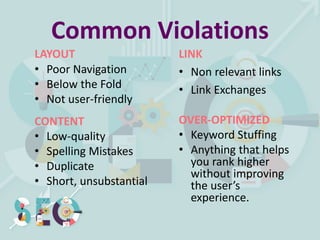
Common Violations
LINK
• Non relevant links
• Link Exchanges
CONTENT
• Low-quality
• Spelling Mistakes
• Duplicate
• Short, unsubstantial
LAYOUT
• Poor Navigation
• Below the Fold
• Not user-friendly
OVER-OPTIMIZED
• Keyword Stuffing
• Anything that helps
you rank higher
without improving
the user’s
experience.
Handles 64.4% of all Searches
Google works for the individual performing a
search. Their job is to deliver the most relevant
websites (best answer) to a searcher’s query.
comScore Explicit Core Search Share Report April 15, 2015
Combination of Factors
• No single SEO factor will guarantee search
engine rankings.
• Having a great Meta Tags won’t help if a page
has low quality content.
• Having many links won’t help if they are all low
in quality.
• Having several positive factors can increase the
odds of success while the presence of negative
factors can worsen those odds.
On Page SEO
• On-The-Page search ranking factors are those
that are almost entirely within your control.
• What type of content do you publish? Are you
providing important clues that help search
engines (and users) determine relevancy?
• Does your site architecture help or hinder
search engines?
OFF Page SEO
• Activities outside the boundaries of the
webpage.
• Gives Search Engines a very good indication on
how the world (other websites and users)
perceive your website.
• Link Building
• Social Media
• Social bookmarking
Long Tail Keywords
• Very targeted search phrase containing
3 or more words.
• Comprise over 70% of all search traffic.
• Generate better quality traffic because
they are more specific.
• Less competitive.
Example
Keyword: Insurance
Long Tail Keywords:
Group Health Insurance for Small Business
Long Tail Keywords
• Each page of your website should focus
on one set of long tail keywords.
• Try to use long tail keywords in your
page headers.
Keyword Planner Tool
Research keyword performance, historical
statistics and create keyword lists.
www.adwords.google.com/KeywordPlanner
Schema Markup
Code placed in website pages to help
Search Engines return more
informative results.
TYPES
Creative work
Event
Organization
Person
Place
Product
AND
Social Authority
• Individuals or Organizations are
recognized as experts in a given field or
topic.
• Participate in online conversations and
contribute valuable information.
AND
Social Shares
• Is your content being shared on social
networks?
• Post to Online Communities
AND
Local Search Directories
Local Search Directories find out about
your business in two ways:
They visit links that point to your website
and track sites where those links appear.
Track Citations of your business and which
sites these citations appear.
Local Search Directories
Businesses with the most links from
QUALITY WEBSITES IN YOUR AREA,
and the most citations from high-
quality websites will rank the highest.
What Are Citations?
Citations are “mentions” of your business
name on webpages other than your own.
Business Name
Address & Phone
Link to Website
Information in your
Citations MUST be
consistent!
What Are Citations?
Citations are “mentions” of your business
name on webpages other than your own.
Business Name
Address & Phone
Link to Website
Information in your
Citations MUST be
consistent!
My Business Page
Displays your listing in Search, Maps & Google+
Customers can review and rate and use
the +1 Button to endorse your business.
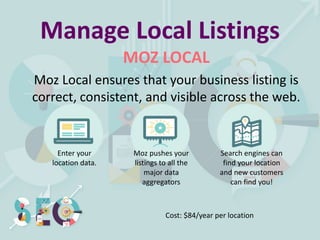
Manage Local Listings
MOZ LOCAL
Moz Local ensures that your business listing is
correct, consistent, and visible across the web.
Enter your
location data.
Moz pushes your
listings to all the
major data
aggregators
Search engines can
find your location
and new customers
can find you!
Cost: $84/year per location
The line between writing good
SEO copy for search engines and
engaging copy for humans has
all but disappeared.
 A free service offered by Google that generates
detailed statistics about the visitors to your
web site.
 Shows you how people found your site, how
they explored it, and how you can enhance
their visitor experience.
• Moz.com/local
• Moz.com/blog
• SearchEngineLand.com
• Rand Fishkin - Moz
• Matt Cutts - Google
• Hubspot.com
SEO Resources
Presentation available:
www.slideshare.net/hbram/social-media-power-point-3-12
SEO Presentation

SEO Presentation

  • 4.
    Understanding who ourtarget audience is and where they spend their time, you can build an organic presence by focusing on content that speaks to their needs and wants.
  • 5.
    What Is SEO? Searchengine optimization (SEO) is the process of affecting the visibility of a website or a web page in a search engine's unpaid results—often referred to as "natural," "organic," or "earned" results.
  • 6.
  • 7.
    Black Hat SEO •Exploits weaknesses in search engine algorithms to obtain high rankings for a website. • Keyword Stuffing, Cloaking, Hidden Text and links and Link Spam. • Quick, unpredictable and short-lasting growth in rankings.
  • 8.
    White Hat SEO •Utilize techniques and methods to improve search rankings in accordance with the Search Engine’s Guidelines. • High quality content, website HTML optimization, relevant inbound links, social authority . • Steady, gradual, last growth in rankings.
  • 9.
    Meta Tags Meta Tagsexplain to search engines and (sometimes) searchers themselves what your page is about. Meta Tags are inserted into every page of your website code.
  • 10.
    How SEO HasChanged Focus on singular keyword Focus on long tail keywords, keyword intent and searcher’s needs OLD SEO NEW SEO
  • 11.
    How SEO HasChanged • When search engines were first created, early search marketers were able to easily find ways to make the search engine think that their client's site was the one that should rank well. • In some cases it was as simple as putting in some code on the website called a meta keywords tag. The meta keywords tag would tell search engines what the page was about.
  • 12.
    How SEO HasChanged • Google updated their search algorithm to decrease search engine rankings of websites that violate Google’s Webmaster Guidelines by using now declared Black Hat SEO techniques involved in increasing artificially the ranking of a webpage through manipulation. • High-quality sites rank higher in search results and demote sites that may be of lower quality.
  • 13.
    The days ofkeyword stuffing, or writing meaningless content that would only impress search engines, are thankfully a distant memory.
  • 14.
    Violations are generallytactics meant to deceive or manipulate a search engine’s understanding of a site’s true relevancy and authority.
  • 15.
    Common Violations LINK • Nonrelevant links • Link Exchanges CONTENT • Low-quality • Spelling Mistakes • Duplicate • Short, unsubstantial LAYOUT • Poor Navigation • Below the Fold • Not user-friendly OVER-OPTIMIZED • Keyword Stuffing • Anything that helps you rank higher without improving the user’s experience.
  • 16.
    Handles 64.4% ofall Searches Google works for the individual performing a search. Their job is to deliver the most relevant websites (best answer) to a searcher’s query. comScore Explicit Core Search Share Report April 15, 2015
  • 17.
    Combination of Factors •No single SEO factor will guarantee search engine rankings. • Having a great Meta Tags won’t help if a page has low quality content. • Having many links won’t help if they are all low in quality. • Having several positive factors can increase the odds of success while the presence of negative factors can worsen those odds.
  • 18.
    On Page SEO •On-The-Page search ranking factors are those that are almost entirely within your control. • What type of content do you publish? Are you providing important clues that help search engines (and users) determine relevancy? • Does your site architecture help or hinder search engines?
  • 19.
    OFF Page SEO •Activities outside the boundaries of the webpage. • Gives Search Engines a very good indication on how the world (other websites and users) perceive your website. • Link Building • Social Media • Social bookmarking
  • 20.
    Long Tail Keywords •Very targeted search phrase containing 3 or more words. • Comprise over 70% of all search traffic. • Generate better quality traffic because they are more specific. • Less competitive.
  • 21.
    Example Keyword: Insurance Long TailKeywords: Group Health Insurance for Small Business
  • 22.
    Long Tail Keywords •Each page of your website should focus on one set of long tail keywords. • Try to use long tail keywords in your page headers.
  • 23.
    Keyword Planner Tool Researchkeyword performance, historical statistics and create keyword lists. www.adwords.google.com/KeywordPlanner
  • 24.
    Schema Markup Code placedin website pages to help Search Engines return more informative results. TYPES Creative work Event Organization Person Place Product
  • 25.
  • 26.
    Social Authority • Individualsor Organizations are recognized as experts in a given field or topic. • Participate in online conversations and contribute valuable information. AND
  • 27.
    Social Shares • Isyour content being shared on social networks? • Post to Online Communities AND
  • 30.
    Local Search Directories LocalSearch Directories find out about your business in two ways: They visit links that point to your website and track sites where those links appear. Track Citations of your business and which sites these citations appear.
  • 31.
    Local Search Directories Businesseswith the most links from QUALITY WEBSITES IN YOUR AREA, and the most citations from high- quality websites will rank the highest.
  • 32.
    What Are Citations? Citationsare “mentions” of your business name on webpages other than your own. Business Name Address & Phone Link to Website Information in your Citations MUST be consistent!
  • 33.
    What Are Citations? Citationsare “mentions” of your business name on webpages other than your own. Business Name Address & Phone Link to Website Information in your Citations MUST be consistent!
  • 34.
    My Business Page Displaysyour listing in Search, Maps & Google+ Customers can review and rate and use the +1 Button to endorse your business.
  • 35.
    Manage Local Listings MOZLOCAL Moz Local ensures that your business listing is correct, consistent, and visible across the web. Enter your location data. Moz pushes your listings to all the major data aggregators Search engines can find your location and new customers can find you! Cost: $84/year per location
  • 36.
    The line betweenwriting good SEO copy for search engines and engaging copy for humans has all but disappeared.
  • 37.
     A freeservice offered by Google that generates detailed statistics about the visitors to your web site.  Shows you how people found your site, how they explored it, and how you can enhance their visitor experience.
  • 38.
    • Moz.com/local • Moz.com/blog •SearchEngineLand.com • Rand Fishkin - Moz • Matt Cutts - Google • Hubspot.com SEO Resources
  • 39.

Editor's Notes

  • #4 Tweet out resources to #GetToKnowYourSEO
  • #5 Understanding who our target audience is and where they spend their time, you can build an organic presence by focusing on specific platforms.
  • #9 Definition: Utilize techniques and methods to improve search rankings in accordance with the Search Engine’s Guidelines. Techniques: High quality content, website HTML optimization, relevant inbound links, social ?? Expectations: Steady, gradual, last growth in rankings.
  • #10 Meta Tags Meta Tags explain to search engines and (sometimes) searchers themselves what your page is about. Meta Tags are inserted into every page of your website code.
  • #11 How SEO Has Changed. Old SEO focuses on singular keyword. New SEO focuses on long tail keywords, keyword intent and searcher’s needs
  • #12 How SEO has Changed When search engines were first created, early search marketers were able to easily find ways to make the search engine think that their client's site was the one that should rank well.
  • #13 How SEO has Changed Google updated their search algorithm to decrease search engine rankings of websites that violate Google’s Webmaster Guidelines by using now declared Black Hat SEO techniques involved in increasing artificially the ranking of a webpage through manipulation. High-quality sites rank higher in search results and demote sites that may be of lower quality.
  • #14 The days of keyword stuffing, or writing meaningless content that would only impress search engines, are thankfully a distant memory.
  • #15 Violations are generally tactics meant to deceive or manipulate a search engine’s understanding of a site’s true relevancy and authority.
  • #16 Common penalties Layout, Link, Content Over-Optimized
  • #17 Why Focus on Google Handles 64.4% of all searches Google works for the individual performing the search. Their job is to deliver the best answer to a searcher’s query
  • #18 No single SEO factor will guarantee search engine rankings It’s a combination of factors.
  • #19 How SEO has Changed Google updated their search algorithm to decrease search engine rankings of websites that violate Google’s Webmaster Guidelines by using now declared Black Hat SEO techniques involved in increasing artificially the ranking of a webpage through manipulation. High-quality sites rank higher in search results and demote sites that may be of lower quality.
  • #20 Off Page SEO Activities outside the boundaries of the webpage. Gives Search Engines a very good indication on how the world (other websites and users) perceive your website. Link Building Social Media Social bookmarking
  • #21 Long tail keywords contain 3 or more words and comprise over 70% of all search traffic. They generate better quality traffic because they are more specific and less competitive.
  • #22 Long tail keywords contain 3 or more words and comprise over 70% of all search traffic. They generate better quality traffic because they are more specific and less competitive.
  • #23 Long tail keywords Each page of your website should focus on one set of long tail keywords. Try to use long tail keywords in your page headers.
  • #24 Google Keyword Planning Tool Research keyword performance, historical statistics and create keyword lists.
  • #25 Schema Markup Code placed in website pages to help Search Engines return more informative results.
  • #26 Social Media and SEO
  • #27 Long tail keywords Each page of your website should focus on one set of long tail keywords. Try to use long tail keywords in your page headers.
  • #28 Social Shares Is your content being shared on social networks? Post to Online Communities.
  • #29 Social Shares Is your content being shared on social networks? Post to Online Communities.
  • #31 Local Search Directories Local Search Directories find out about your business in two ways: They visit links that point to your website and track sites where those links appear. Track Citations of your business and which sites these citations appear.
  • #32 Local Search Directories find out about your business in two ways: They visit links that point to your website and track sites where those links appear. Track Citations of your business and which sites these citations appear.
  • #33 Citations are “mentions” of your business name on webpages other than your own. Business Name Address & Phone Link to Website Information in your citatins MUST be consistent
  • #34 Citations are “mentions” of your business name on webpages other than your own. Business Name Address & Phone Link to Website Information in your citatins MUST be consistent
  • #35 Google My Business Page Displays your listing in Search, Maps and Google+ Customers can review and rate your business and use the +1 Button to endorse your business.
  • #36 Moz Local ensures that your business listing is correct, consistent, and visible across the web.
  • #37 The line between writing good SEO copy for search engines and engaging copy for humans has all but disappeared.
  • #38 Measure! A free service offered by Google that generates detailed statistics about the visitors to your web site.
  • #39 SEO Resources