Sentence Types:
Structural classification
Compiled by: Belachew Weldegebriel
Jimma University
CSSH
Department of English Language and Literature
Part 1
Types of Sentences: Structural
Sentences are classified in to four according to their
structure i.e. the type and number of clauses it consists.
1. Simple Sentence
2. Compound Sentence
3. Complex Sentence
4. Compound-Complex Sentence
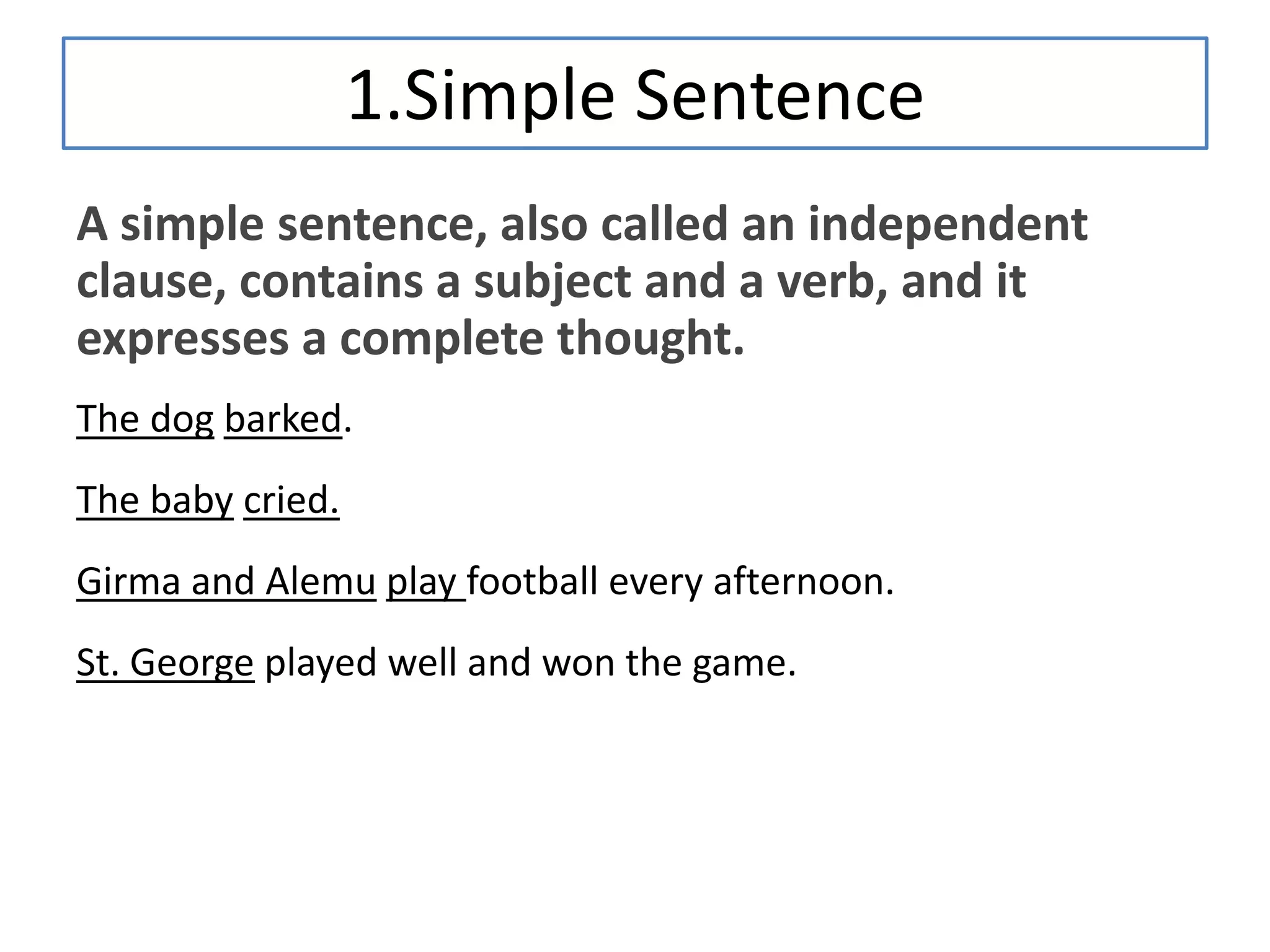
1.Simple Sentence
A simple sentence, also called an independent
clause, contains a subject and a verb, and it
expresses a complete thought.
The dog barked.
The baby cried.
Girma and Alemu play football every afternoon.
St. George played well and won the game.
Simple Sentence
• A simple sentence contains a subject and verb.
• It expresses a single complete thought.
• A simple sentence is a single independent clause.
• A simple sentence might have a compound subject
and/or compound verb.
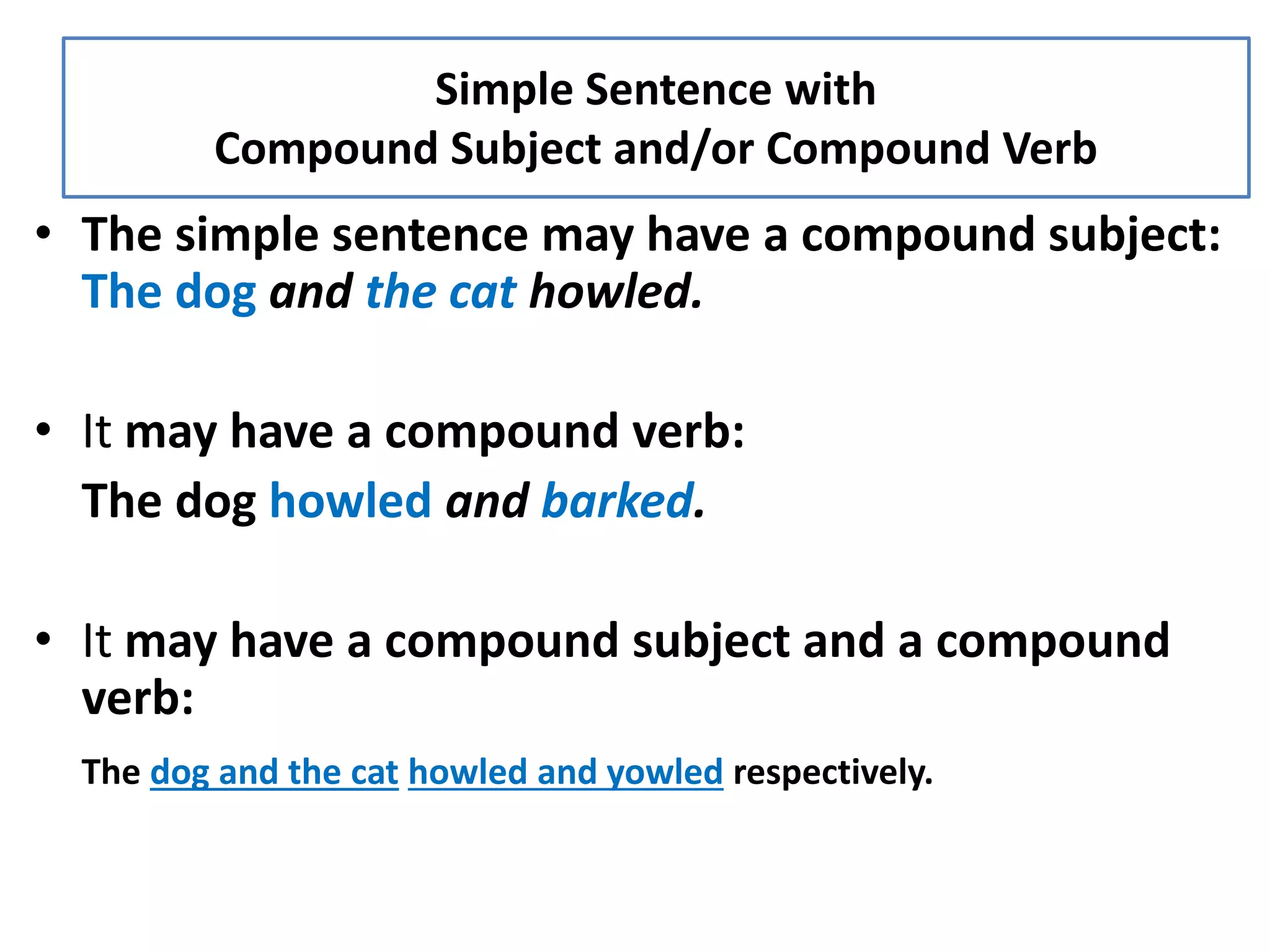
Simple Sentence with
Compound Subject and/or Compound Verb
• The simple sentence may have a compound subject:
The dog and the cat howled.
• It may have a compound verb:
The dog howled and barked.
• It may have a compound subject and a compound
verb:
The dog and the cat howled and yowled respectively.
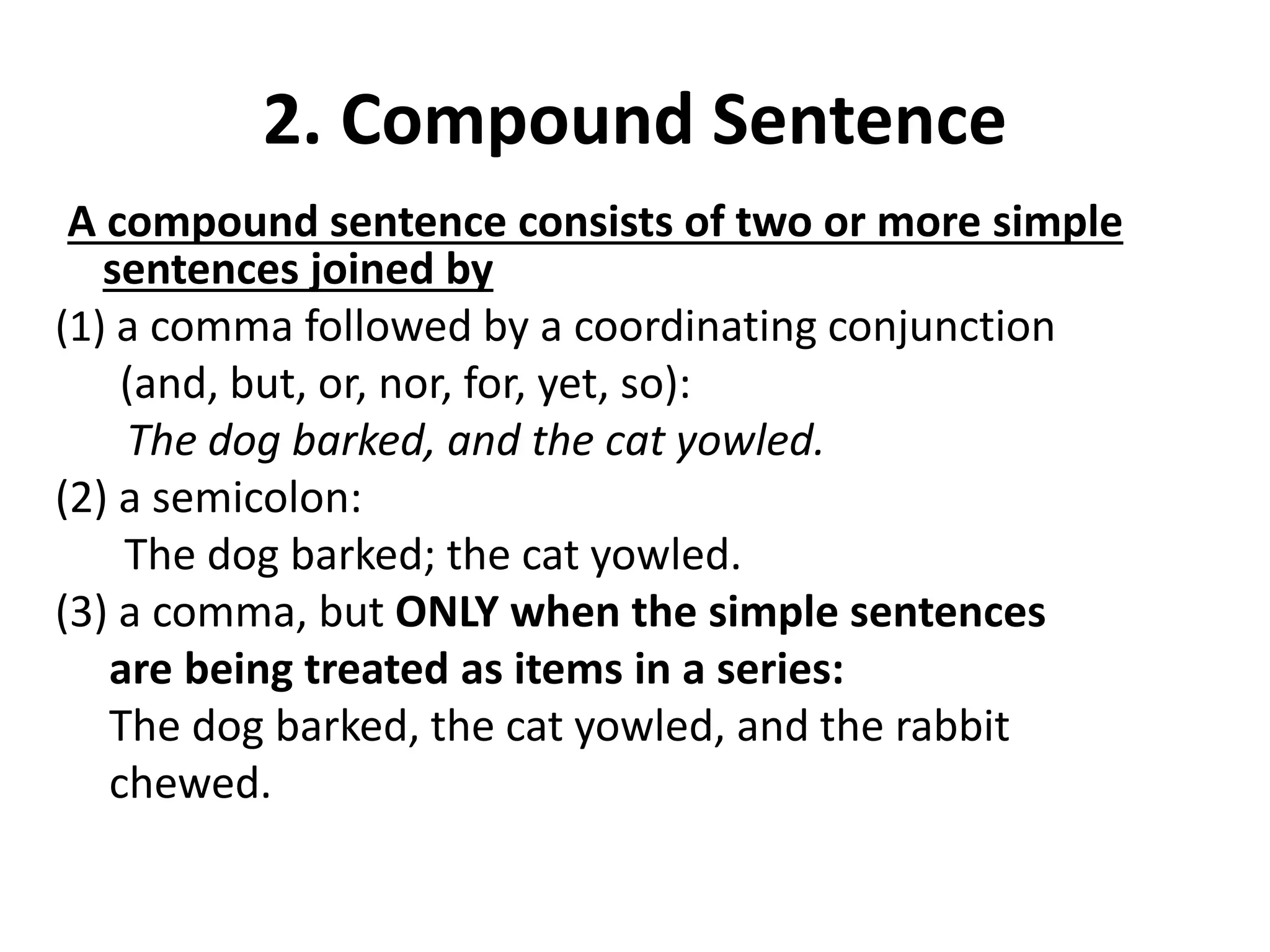
2. Compound Sentence
A compound sentence consists of two or more simple
sentences joined by
(1) a comma followed by a coordinating conjunction
(and, but, or, nor, for, yet, so):
The dog barked, and the cat yowled.
(2) a semicolon:
The dog barked; the cat yowled.
(3) a comma, but ONLY when the simple sentences
are being treated as items in a series:
The dog barked, the cat yowled, and the rabbit
chewed.
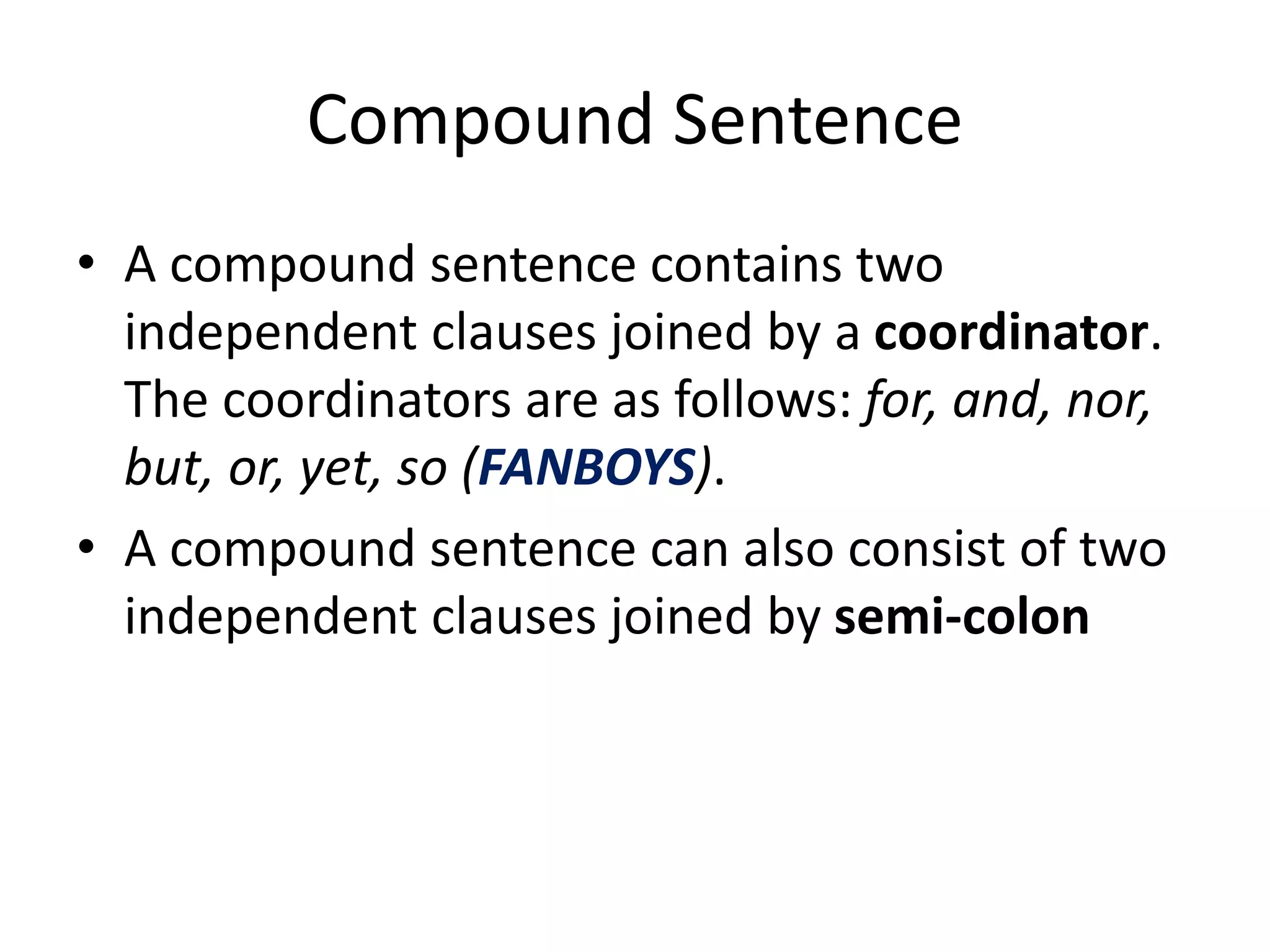
Compound Sentence
• A compound sentence contains two
independent clauses joined by a coordinator.
The coordinators are as follows: for, and, nor,
but, or, yet, so (FANBOYS).
• A compound sentence can also consist of two
independent clauses joined by semi-colon
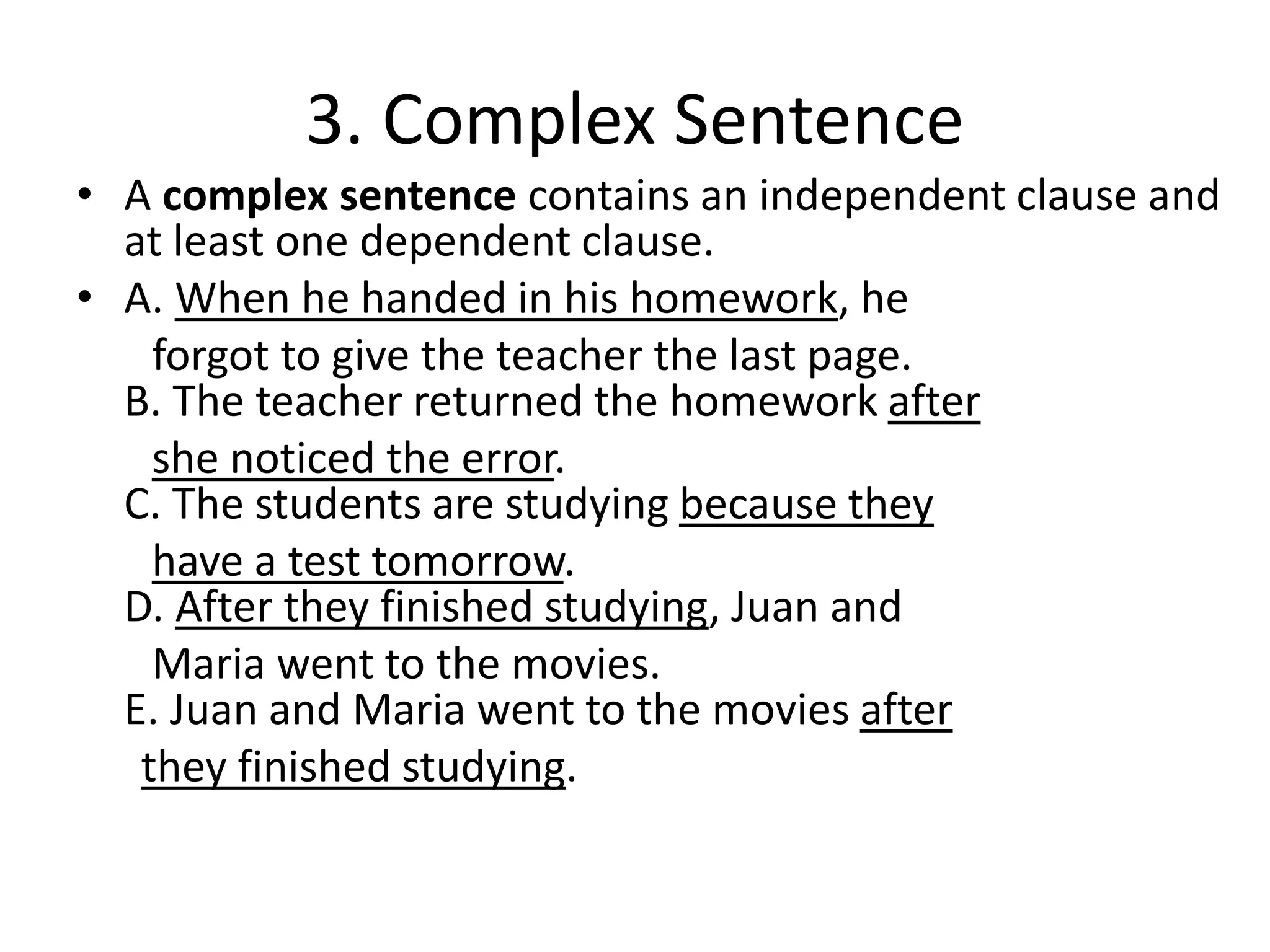
3. Complex Sentence
• A complex sentence contains an independent clause and
at least one dependent clause.
• A. When he handed in his homework, he
forgot to give the teacher the last page.
B. The teacher returned the homework after
she noticed the error.
C. The students are studying because they
have a test tomorrow.
D. After they finished studying, Juan and
Maria went to the movies.
E. Juan and Maria went to the movies after
they finished studying.
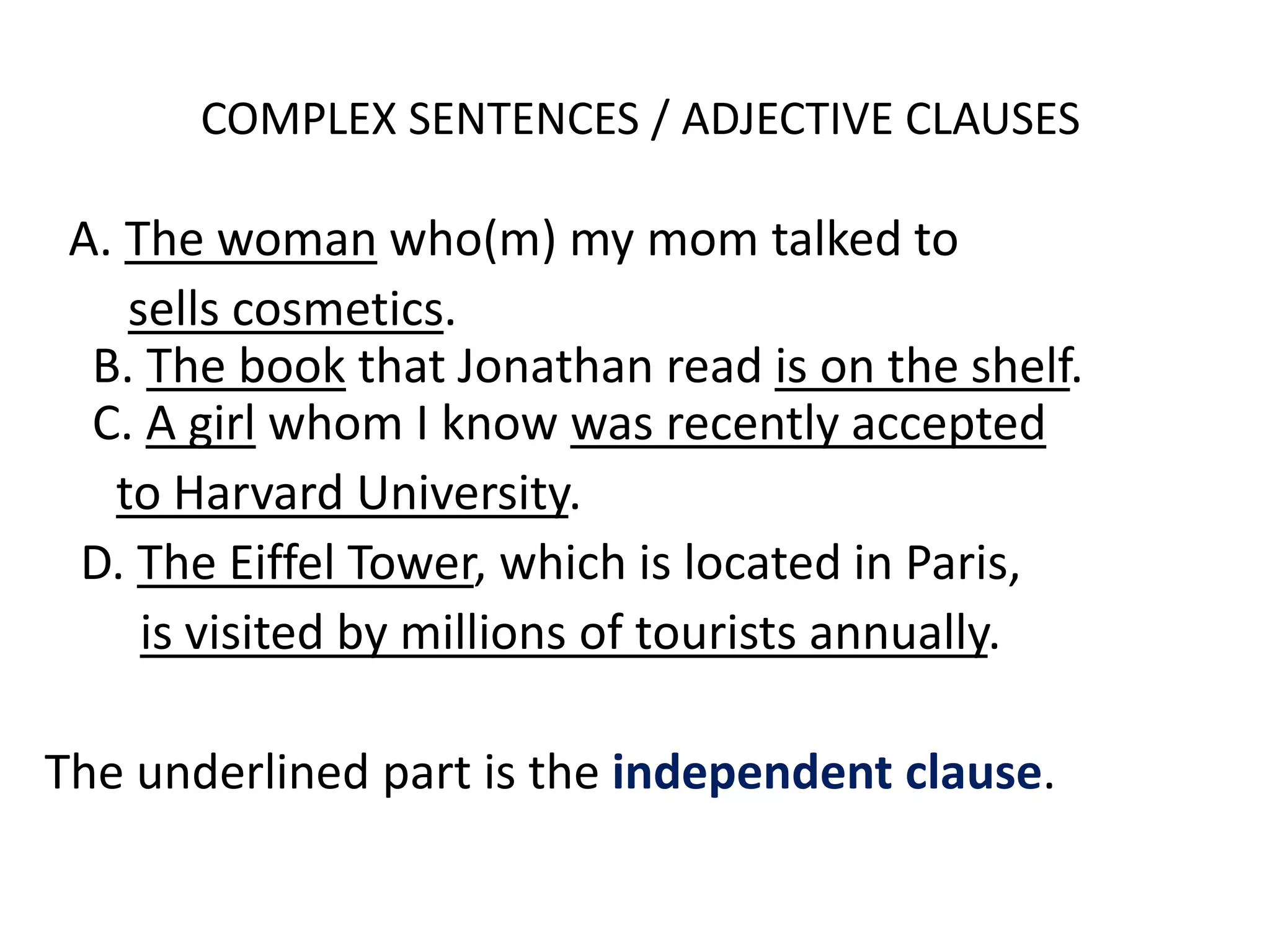
COMPLEX SENTENCES / ADJECTIVE CLAUSES
A. The woman who(m) my mom talked to
sells cosmetics.
B. The book that Jonathan read is on the shelf.
C. A girl whom I know was recently accepted
to Harvard University.
D. The Eiffel Tower, which is located in Paris,
is visited by millions of tourists annually.
The underlined part is the independent clause.
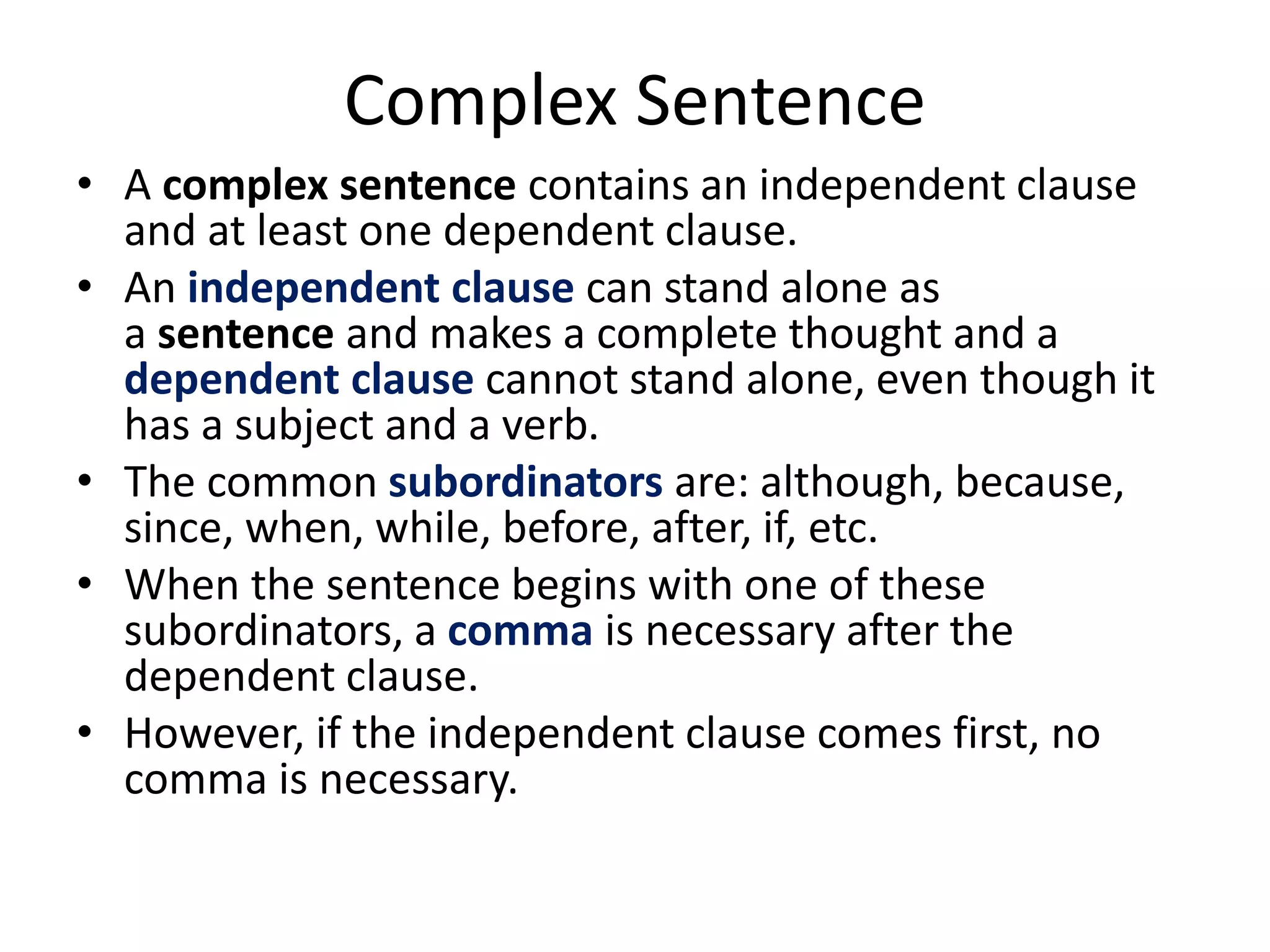
Complex Sentence
• A complex sentence contains an independent clause
and at least one dependent clause.
• An independent clause can stand alone as
a sentence and makes a complete thought and a
dependent clause cannot stand alone, even though it
has a subject and a verb.
• The common subordinators are: although, because,
since, when, while, before, after, if, etc.
• When the sentence begins with one of these
subordinators, a comma is necessary after the
dependent clause.
• However, if the independent clause comes first, no
comma is necessary.

Sentences Types: Simple, Compound, Complex, Compound-Complex

  • 1.
    Sentence Types: Structural classification Compiledby: Belachew Weldegebriel Jimma University CSSH Department of English Language and Literature Part 1
  • 2.
    Types of Sentences:Structural Sentences are classified in to four according to their structure i.e. the type and number of clauses it consists. 1. Simple Sentence 2. Compound Sentence 3. Complex Sentence 4. Compound-Complex Sentence
  • 3.
    1.Simple Sentence A simplesentence, also called an independent clause, contains a subject and a verb, and it expresses a complete thought. The dog barked. The baby cried. Girma and Alemu play football every afternoon. St. George played well and won the game.
  • 4.
    Simple Sentence • Asimple sentence contains a subject and verb. • It expresses a single complete thought. • A simple sentence is a single independent clause. • A simple sentence might have a compound subject and/or compound verb.
  • 5.
    Simple Sentence with CompoundSubject and/or Compound Verb • The simple sentence may have a compound subject: The dog and the cat howled. • It may have a compound verb: The dog howled and barked. • It may have a compound subject and a compound verb: The dog and the cat howled and yowled respectively.
  • 6.
    2. Compound Sentence Acompound sentence consists of two or more simple sentences joined by (1) a comma followed by a coordinating conjunction (and, but, or, nor, for, yet, so): The dog barked, and the cat yowled. (2) a semicolon: The dog barked; the cat yowled. (3) a comma, but ONLY when the simple sentences are being treated as items in a series: The dog barked, the cat yowled, and the rabbit chewed.
  • 7.
    Compound Sentence • Acompound sentence contains two independent clauses joined by a coordinator. The coordinators are as follows: for, and, nor, but, or, yet, so (FANBOYS). • A compound sentence can also consist of two independent clauses joined by semi-colon
  • 8.
    3. Complex Sentence •A complex sentence contains an independent clause and at least one dependent clause. • A. When he handed in his homework, he forgot to give the teacher the last page. B. The teacher returned the homework after she noticed the error. C. The students are studying because they have a test tomorrow. D. After they finished studying, Juan and Maria went to the movies. E. Juan and Maria went to the movies after they finished studying.
  • 9.
    COMPLEX SENTENCES /ADJECTIVE CLAUSES A. The woman who(m) my mom talked to sells cosmetics. B. The book that Jonathan read is on the shelf. C. A girl whom I know was recently accepted to Harvard University. D. The Eiffel Tower, which is located in Paris, is visited by millions of tourists annually. The underlined part is the independent clause.
  • 10.
    Complex Sentence • Acomplex sentence contains an independent clause and at least one dependent clause. • An independent clause can stand alone as a sentence and makes a complete thought and a dependent clause cannot stand alone, even though it has a subject and a verb. • The common subordinators are: although, because, since, when, while, before, after, if, etc. • When the sentence begins with one of these subordinators, a comma is necessary after the dependent clause. • However, if the independent clause comes first, no comma is necessary.