Four Sentence Types!
Types of Sentences
1. Simple
2. Compound
3. Complex
4. Compound-complex
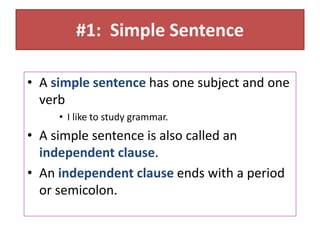
#1: Simple Sentence
• A simple sentence has one subject and one
verb
• I like to study grammar.
• A simple sentence is also called an
independent clause.
• An independent clause ends with a period
or semicolon.
Simple Sentences
• Examples:
–Carol’s sweater is red.
–You and Alex need to be quiet.
–Ms. Bennett did a cartwheel
and a backflip.
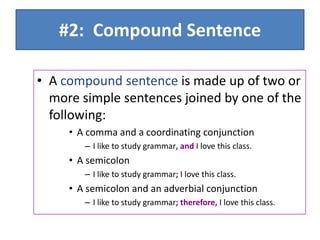
#2: Compound Sentence
• A compound sentence is made up of two or
more simple sentences joined by one of the
following:
• A comma and a coordinating conjunction
– I like to study grammar, and I love this class.
• A semicolon
– I like to study grammar; I love this class.
• A semicolon and an adverbial conjunction
– I like to study grammar; therefore, I love this class.
Coordinating Conjunctions
• Coordinating Conjunctions are used to join together
two independent clauses.
• Examples:
• For
• And
• Nor
• But
• Or
• Yet
• So
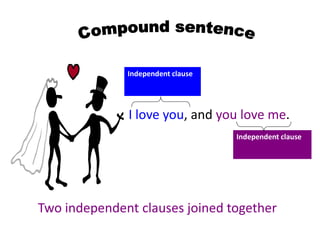
Two independent clauses joined together
I love you, and you love me.
Independent clause
Independent clause
Semicolons
• “If the relation between the ideas expressed
in the main clauses is very close and
obvious without a conjunction, you can
separate the clauses with a semicolon”
(Little, Brown Handbook, 9th Edition, p. 361).
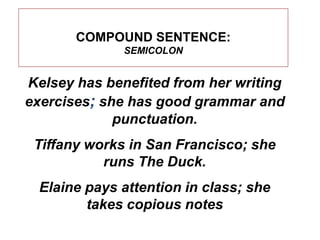
COMPOUND SENTENCE:
SEMICOLON
Kelsey has benefited from her writing
exercises; she has good grammar and
punctuation.
Tiffany works in San Francisco; she
runs The Duck.
Elaine pays attention in class; she
takes copious notes
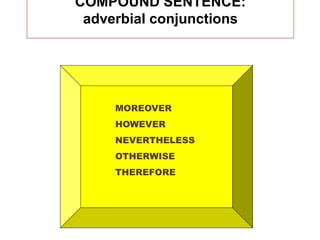
COMPOUND SENTENCE:
adverbial conjunctions
MOREOVER
HOWEVER
NEVERTHELESS
OTHERWISE
THEREFORE
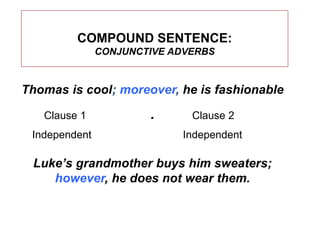
COMPOUND SENTENCE:
CONJUNCTIVE ADVERBS
Thomas is cool; moreover, he is fashionable
.
Luke’s grandmother buys him sweaters;
however, he does not wear them.
Clause 1 Clause 2
Independent Independent
#3: Complex Sentence
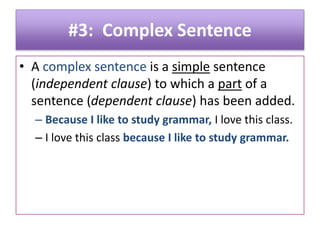
• A complex sentence is a simple sentence
(independent clause) to which a part of a
sentence (dependent clause) has been added.
– Because I like to study grammar, I love this class.
– I love this class because I like to study grammar.
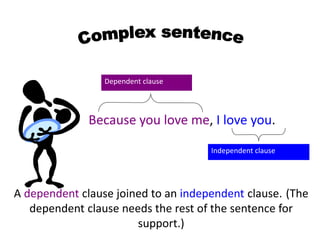
A dependent clause joined to an independent clause. (The

dependent clause needs the rest of the sentence for
support.)
Because you love me, I love you.
Dependent clause
Independent clause
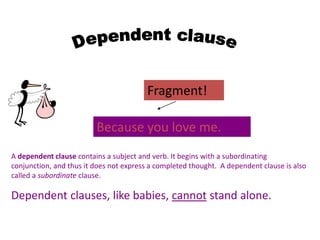
A dependent clause contains a subject and verb. It begins with a subordinating
conjunction, and thus it does not express a completed thought. A dependent clause is also
called a subordinate clause.
Dependent clauses, like babies, cannot stand alone.
Because you love me.
Fragment!
A Tip on Punctuation
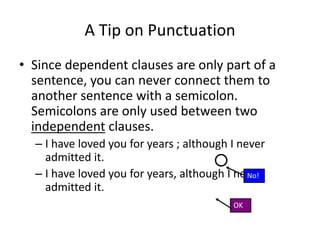
• Since dependent clauses are only part of a
sentence, you can never connect them to
another sentence with a semicolon.
Semicolons are only used between two
independent clauses.
– I have loved you for years ; although I never
admitted it.
– I have loved you for years, although I never
admitted it.
OK
No!
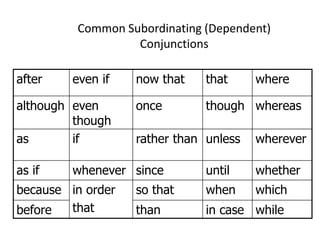
Common Subordinating (Dependent)
Conjunctions
after even if now that that where
although even
though
once though whereas
as if rather than unless wherever
as if whenever since until whether
because in order
that
so that when which
before than in case while
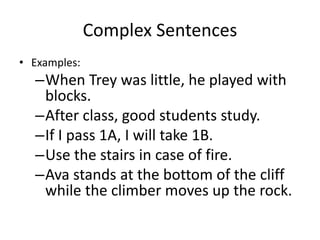
Complex Sentences
• Examples:
–When Trey was little, he played with
blocks.
–After class, good students study.
–If I pass 1A, I will take 1B.
–Use the stairs in case of fire.
–Ava stands at the bottom of the cliff
while the climber moves up the rock.
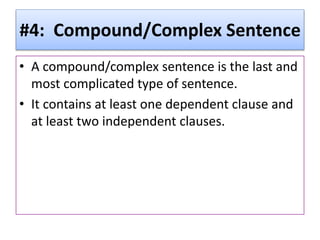
#4: Compound/Complex Sentence
• A compound/complex sentence is the last and
most complicated type of sentence.
• It contains at least one dependent clause and
at least two independent clauses.
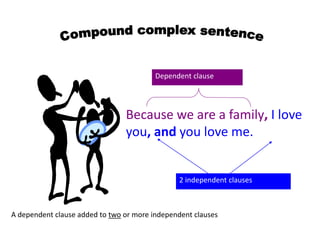
A dependent clause added to two or more independent clauses
Because we are a family, I love
you, and you love me.
2 independent clauses
Dependent clause
Compound Complex Sentences
Example:
–Laura forgot her friend’s birthday, so she
sent her a card when she finally
remembered.
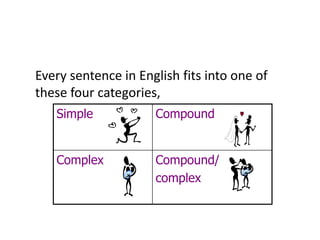
Simple Compound
Complex Compound/
complex
Every sentence in English fits into one of
these four categories,
Think You’ve Got It?
• 1 independent clause = simple sentence
– Don’t’ forget: These can have compound subjects and predicates!
• 2 independent clauses = compound sentence
• 1 or more dependent clause + 1 independent clause
= complex sentence
• 2 or more independent clauses + 1 or more dep. clause
= compound complex sentence
Let’s Review…
Simple, Compound, or Complex?
• The teacher walked into the classroom,
greeted the students, and took attendance.
Simple, Compound, or Complex?
• The teacher walked into the classroom,
greeted the students, and took attendance.
• SIMPLE:
– Subject: “the teacher”
– Compound Predicate “walked into the classroom,
greeted the students, and took attendance.”
Simple, Compound, or Complex?
• Juan played football while Juanita went
shopping.
Simple, Compound, or Complex?
• Juan played football while Juanita went
shopping.
• COMPLEX
– Independent Clause: Juan played football
– Subordinate Clause: while (subordinating
conjunction) Juanita went shopping.
Simple, Compound, or Complex?
• Juan played football, yet Juanita went
shopping.
Simple, Compound, or Complex?
• Juan played football, yet Juanita went
shopping.
• COMPOUND
– Juan played football, yet (coordinating
conjunction)
– Juanita went shopping.
Simple, Compound, or Complex?
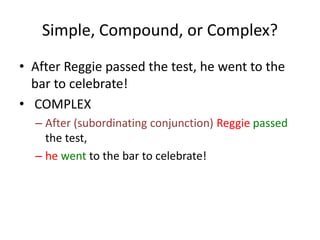
• After Reggie passed the test, he went to the
bar to celebrate!
Simple, Compound, or Complex?
• After Reggie passed the test, he went to the
bar to celebrate!
• COMPLEX
– After (subordinating conjunction) Reggie passed
the test,
– he went to the bar to celebrate!
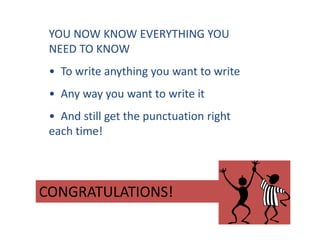
CONGRATULATIONS!
YOU NOW KNOW EVERYTHING YOU
NEED TO KNOW
• To write anything you want to write
• Any way you want to write it
• And still get the punctuation right
each time!
Writing Sentences
Write two of each kind of sentence and post them
for homework. Make the sentences relevant to
your essay #1 outline.
1. Simple
2. Compound
3. Complex
4. Compound-complex

Four sentence types

  • 1.
  • 2.
    Types of Sentences 1.Simple 2. Compound 3. Complex 4. Compound-complex
  • 3.
    #1: Simple Sentence •A simple sentence has one subject and one verb • I like to study grammar. • A simple sentence is also called an independent clause. • An independent clause ends with a period or semicolon.
  • 4.
    Simple Sentences • Examples: –Carol’ssweater is red. –You and Alex need to be quiet. –Ms. Bennett did a cartwheel and a backflip.
  • 5.
    #2: Compound Sentence •A compound sentence is made up of two or more simple sentences joined by one of the following: • A comma and a coordinating conjunction – I like to study grammar, and I love this class. • A semicolon – I like to study grammar; I love this class. • A semicolon and an adverbial conjunction – I like to study grammar; therefore, I love this class.
  • 6.
    Coordinating Conjunctions • CoordinatingConjunctions are used to join together two independent clauses. • Examples: • For • And • Nor • But • Or • Yet • So
  • 7.
    Two independent clausesjoined together I love you, and you love me. Independent clause Independent clause
  • 8.
    Semicolons • “If therelation between the ideas expressed in the main clauses is very close and obvious without a conjunction, you can separate the clauses with a semicolon” (Little, Brown Handbook, 9th Edition, p. 361).
  • 9.
    COMPOUND SENTENCE: SEMICOLON Kelsey hasbenefited from her writing exercises; she has good grammar and punctuation. Tiffany works in San Francisco; she runs The Duck. Elaine pays attention in class; she takes copious notes
  • 10.
  • 11.
    COMPOUND SENTENCE: CONJUNCTIVE ADVERBS Thomasis cool; moreover, he is fashionable . Luke’s grandmother buys him sweaters; however, he does not wear them. Clause 1 Clause 2 Independent Independent
  • 12.
    #3: Complex Sentence •A complex sentence is a simple sentence (independent clause) to which a part of a sentence (dependent clause) has been added. – Because I like to study grammar, I love this class. – I love this class because I like to study grammar.
  • 13.
    A dependent clausejoined to an independent clause. (The dependent clause needs the rest of the sentence for support.) Because you love me, I love you. Dependent clause Independent clause
  • 14.
    A dependent clausecontains a subject and verb. It begins with a subordinating conjunction, and thus it does not express a completed thought. A dependent clause is also called a subordinate clause. Dependent clauses, like babies, cannot stand alone. Because you love me. Fragment!
  • 15.
    A Tip onPunctuation • Since dependent clauses are only part of a sentence, you can never connect them to another sentence with a semicolon. Semicolons are only used between two independent clauses. – I have loved you for years ; although I never admitted it. – I have loved you for years, although I never admitted it. OK No!
  • 16.
    Common Subordinating (Dependent) Conjunctions aftereven if now that that where although even though once though whereas as if rather than unless wherever as if whenever since until whether because in order that so that when which before than in case while
  • 17.
    Complex Sentences • Examples: –WhenTrey was little, he played with blocks. –After class, good students study. –If I pass 1A, I will take 1B. –Use the stairs in case of fire. –Ava stands at the bottom of the cliff while the climber moves up the rock.
  • 18.
    #4: Compound/Complex Sentence •A compound/complex sentence is the last and most complicated type of sentence. • It contains at least one dependent clause and at least two independent clauses.
  • 19.
    A dependent clauseadded to two or more independent clauses Because we are a family, I love you, and you love me. 2 independent clauses Dependent clause
  • 20.
    Compound Complex Sentences Example: –Lauraforgot her friend’s birthday, so she sent her a card when she finally remembered.
  • 21.
    Simple Compound Complex Compound/ complex Everysentence in English fits into one of these four categories,
  • 22.
    Think You’ve GotIt? • 1 independent clause = simple sentence – Don’t’ forget: These can have compound subjects and predicates! • 2 independent clauses = compound sentence • 1 or more dependent clause + 1 independent clause = complex sentence • 2 or more independent clauses + 1 or more dep. clause = compound complex sentence
  • 23.
  • 24.
    Simple, Compound, orComplex? • The teacher walked into the classroom, greeted the students, and took attendance.
  • 25.
    Simple, Compound, orComplex? • The teacher walked into the classroom, greeted the students, and took attendance. • SIMPLE: – Subject: “the teacher” – Compound Predicate “walked into the classroom, greeted the students, and took attendance.”
  • 26.
    Simple, Compound, orComplex? • Juan played football while Juanita went shopping.
  • 27.
    Simple, Compound, orComplex? • Juan played football while Juanita went shopping. • COMPLEX – Independent Clause: Juan played football – Subordinate Clause: while (subordinating conjunction) Juanita went shopping.
  • 28.
    Simple, Compound, orComplex? • Juan played football, yet Juanita went shopping.
  • 29.
    Simple, Compound, orComplex? • Juan played football, yet Juanita went shopping. • COMPOUND – Juan played football, yet (coordinating conjunction) – Juanita went shopping.
  • 30.
    Simple, Compound, orComplex? • After Reggie passed the test, he went to the bar to celebrate!
  • 31.
    Simple, Compound, orComplex? • After Reggie passed the test, he went to the bar to celebrate! • COMPLEX – After (subordinating conjunction) Reggie passed the test, – he went to the bar to celebrate!
  • 32.
    CONGRATULATIONS! YOU NOW KNOWEVERYTHING YOU NEED TO KNOW • To write anything you want to write • Any way you want to write it • And still get the punctuation right each time!
  • 33.
    Writing Sentences Write twoof each kind of sentence and post them for homework. Make the sentences relevant to your essay #1 outline. 1. Simple 2. Compound 3. Complex 4. Compound-complex