SENTENCE
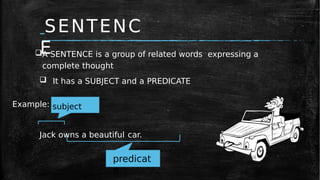
SENTENC
E
predicat
e
A SENTENCE is a group of related words expressing a
complete thought
 It has a SUBJECT and a PREDICATE
Example: subject
Jack owns a beautiful car.
KINDS OF SENTENCES
ACCORDING TO USE
KINDS OF SENTENCES
ACCORDING TO USE
1. Declarative Sentence (a statement)
2. Impérative Sentence (a command)
4. Exclamatory Sentence (an exclamation)
3. Interrogative Sentence (a question)
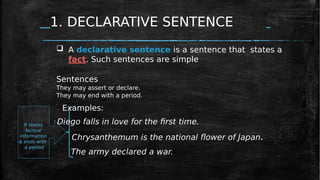
1. DECLARATIVE SENTENCE
Chrysanthemum is the national flower of Japan.
The army declared a war.
It states
factual
information
& ends with
a period
 A declarative sentence is a sentence that states a
fact. Such sentences are simple
Sentences
They may assert or declare.
They may end with a period.
Examples:
Diego falls in love for the first time.
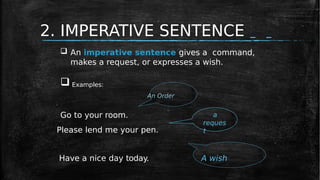
2. IMPERATIVE SENTENCE
a
reques
t
Please lend me your pen.
Have a nice day today. A wish
 An imperative sentence gives a command,
makes a request, or expresses a wish.
 Examples:
An Order
Go to your room.
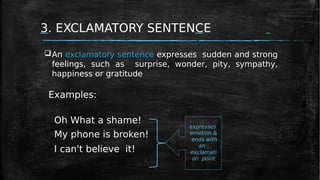
3. EXCLAMATORY SENTENCE
Examples:
Oh What a shame!
My phone is broken!
I can't believe it!
An exclamatory sentence expresses sudden and strong
feelings, such as surprise, wonder, pity, sympathy,
happiness or gratitude
expresses
emotion &
ends with
an
exclamati
on point
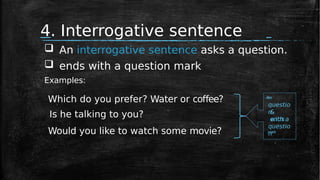
4. Interrogative sentence
Is he talking to you?
Which do you prefer? Water or coffee? A
s
k
s
questio
n
&
ends
with a
questio
n
Would you like to watch some movie? mark
 An interrogative sentence asks a question.
 ends with a question mark
Examples:
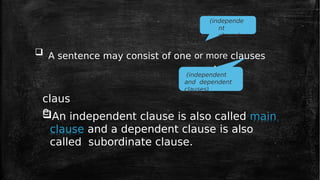
claus
e
An independent clause is also called main
clause and a dependent clause is also
called subordinate clause.
(independe
nt
clause)
(independent
and dependent
clauses)
 A sentence may consist of one or more clauses
.
Kinds of
Sentences
According to
Structure
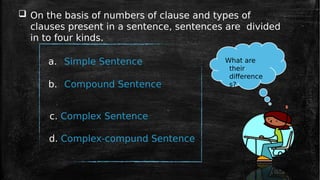
 On the basis of numbers of clause and types of
clauses present in a sentence, sentences are divided
in to four kinds.
a. Simple Sentence
b. Compound Sentence
c. Complex Sentence
d. Complex-compund Sentence
What are
their
difference
s?
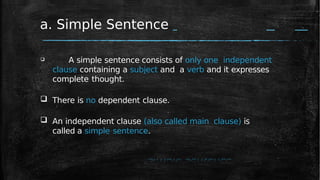
a. Simple Sentence
 A simple sentence consists of only one independent
clause containing a subject and a verb and it expresses
complete thought.
 There is no dependent clause.
 An independent clause (also called main clause) is
called a simple sentence.
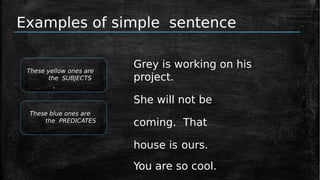
Examples of simple sentence
Grey is working on his
project.
She will not be
coming. That
house is ours.
You are so cool.
These yellow ones are
the SUBJECTS
.
These blue ones are
the PREDICATES
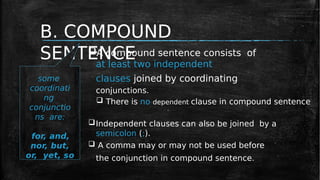
B. COMPOUND
SENTENCE
A compound sentence consists of
at least two independent
clauses joined by coordinating
conjunctions.
 There is no dependent clause in compound sentence
Independent clauses can also be joined by a
semicolon (;).
 A comma may or may not be used before
the conjunction in compound sentence.
some
coordinati
ng
conjunctio
ns are:
for, and,
nor, but,
or, yet, so
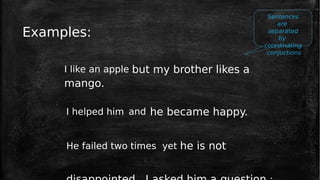
Examples:
I like an apple but my brother likes a
mango.
I helped him and he became happy.
He failed two times yet he is not
Sentences
are
separated
by
coordinating
conjuctions
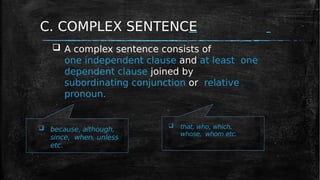
C. COMPLEX SENTENCE
 A complex sentence consists of
one independent clause and at least one
dependent clause joined by
subordinating conjunction or relative
pronoun.
 that, who, which,
whose, whom etc.
 because, although,
since, when, unless
etc.
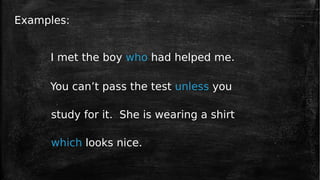
Examples:
I met the boy who had helped me.
You can’t pass the test unless you
study for it. She is wearing a shirt
which looks nice.
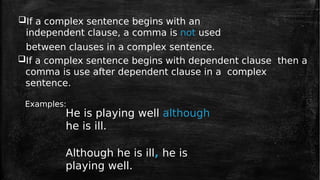
If a complex sentence begins with an
independent clause, a comma is not used
between clauses in a complex sentence.
If a complex sentence begins with dependent clause then a
comma is use after dependent clause in a complex
sentence.
Examples:
He is playing well although
he is ill.
Although he is ill, he is
playing well.
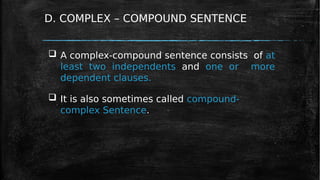
D. COMPLEX – COMPOUND SENTENCE
 A complex-compound sentence consists of at
least two independents and one or more
dependent clauses.
 It is also sometimes called compound-
complex Sentence.
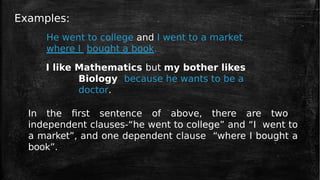
Examples:
He went to college and I went to a market
where I bought a book.
I like Mathematics but my bother likes
Biology because he wants to be a
doctor.
In the first sentence of above, there are two
independent clauses-“he went to college” and “I went to
a market”, and one dependent clause “where I bought a
book”.
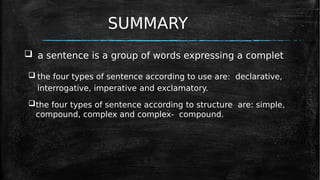
SUMMARY
 a sentence is a group of words expressing a complet
 the four types of sentence according to use are: declarative,
interrogative, imperative and exclamatory.
the four types of sentence according to structure are: simple,
compound, complex and complex- compound.
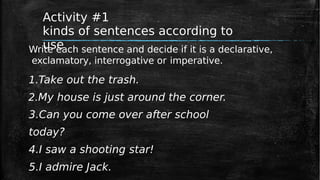
Activity #1
kinds of sentences according to
use
Write each sentence and decide if it is a declarative,
exclamatory, interrogative or imperative.
1.Take out the trash.
2.My house is just around the corner.
3.Can you come over after school
today?
4.I saw a shooting star!
5.I admire Jack.
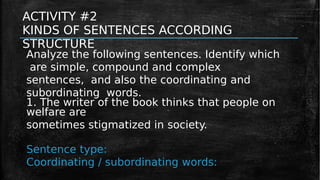
ACTIVITY #2
KINDS OF SENTENCES ACCORDING
STRUCTURE
Analyze the following sentences. Identify which
are simple, compound and complex
sentences, and also the coordinating and
subordinating words.
1. The writer of the book thinks that people on
welfare are
sometimes stigmatized in society.
Sentence type:
Coordinating / subordinating words:
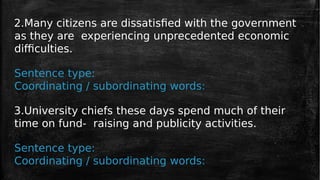
2.Many citizens are dissatisfied with the government
as they are experiencing unprecedented economic
difficulties.
Sentence type:
Coordinating / subordinating words:
3.University chiefs these days spend much of their
time on fund- raising and publicity activities.
Sentence type:
Coordinating / subordinating words:
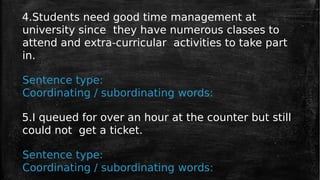
4.Students need good time management at
university since they have numerous classes to
attend and extra-curricular activities to take part
in.
Sentence type:
Coordinating / subordinating words:
5.I queued for over an hour at the counter but still
could not get a ticket.
Sentence type:
Coordinating / subordinating words:
The end of
presentatio
n

sentence-150426071610-conversion-gate02.pdf

  • 1.
  • 2.
    SENTENC E predicat e A SENTENCE isa group of related words expressing a complete thought  It has a SUBJECT and a PREDICATE Example: subject Jack owns a beautiful car.
  • 3.
  • 4.
    KINDS OF SENTENCES ACCORDINGTO USE 1. Declarative Sentence (a statement) 2. Impérative Sentence (a command) 4. Exclamatory Sentence (an exclamation) 3. Interrogative Sentence (a question)
  • 5.
    1. DECLARATIVE SENTENCE Chrysanthemumis the national flower of Japan. The army declared a war. It states factual information & ends with a period  A declarative sentence is a sentence that states a fact. Such sentences are simple Sentences They may assert or declare. They may end with a period. Examples: Diego falls in love for the first time.
  • 6.
    2. IMPERATIVE SENTENCE a reques t Pleaselend me your pen. Have a nice day today. A wish  An imperative sentence gives a command, makes a request, or expresses a wish.  Examples: An Order Go to your room.
  • 7.
    3. EXCLAMATORY SENTENCE Examples: OhWhat a shame! My phone is broken! I can't believe it! An exclamatory sentence expresses sudden and strong feelings, such as surprise, wonder, pity, sympathy, happiness or gratitude expresses emotion & ends with an exclamati on point
  • 8.
    4. Interrogative sentence Ishe talking to you? Which do you prefer? Water or coffee? A s k s questio n & ends with a questio n Would you like to watch some movie? mark  An interrogative sentence asks a question.  ends with a question mark Examples:
  • 9.
    claus e An independent clauseis also called main clause and a dependent clause is also called subordinate clause. (independe nt clause) (independent and dependent clauses)  A sentence may consist of one or more clauses .
  • 10.
  • 11.
     On thebasis of numbers of clause and types of clauses present in a sentence, sentences are divided in to four kinds. a. Simple Sentence b. Compound Sentence c. Complex Sentence d. Complex-compund Sentence What are their difference s?
  • 12.
    a. Simple Sentence A simple sentence consists of only one independent clause containing a subject and a verb and it expresses complete thought.  There is no dependent clause.  An independent clause (also called main clause) is called a simple sentence.
  • 13.
    Examples of simplesentence Grey is working on his project. She will not be coming. That house is ours. You are so cool. These yellow ones are the SUBJECTS . These blue ones are the PREDICATES
  • 14.
    B. COMPOUND SENTENCE A compoundsentence consists of at least two independent clauses joined by coordinating conjunctions.  There is no dependent clause in compound sentence Independent clauses can also be joined by a semicolon (;).  A comma may or may not be used before the conjunction in compound sentence. some coordinati ng conjunctio ns are: for, and, nor, but, or, yet, so
  • 15.
    Examples: I like anapple but my brother likes a mango. I helped him and he became happy. He failed two times yet he is not Sentences are separated by coordinating conjuctions
  • 16.
    C. COMPLEX SENTENCE A complex sentence consists of one independent clause and at least one dependent clause joined by subordinating conjunction or relative pronoun.  that, who, which, whose, whom etc.  because, although, since, when, unless etc.
  • 17.
    Examples: I met theboy who had helped me. You can’t pass the test unless you study for it. She is wearing a shirt which looks nice.
  • 18.
    If a complexsentence begins with an independent clause, a comma is not used between clauses in a complex sentence. If a complex sentence begins with dependent clause then a comma is use after dependent clause in a complex sentence. Examples: He is playing well although he is ill. Although he is ill, he is playing well.
  • 19.
    D. COMPLEX –COMPOUND SENTENCE  A complex-compound sentence consists of at least two independents and one or more dependent clauses.  It is also sometimes called compound- complex Sentence.
  • 20.
    Examples: He went tocollege and I went to a market where I bought a book. I like Mathematics but my bother likes Biology because he wants to be a doctor. In the first sentence of above, there are two independent clauses-“he went to college” and “I went to a market”, and one dependent clause “where I bought a book”.
  • 21.
    SUMMARY  a sentenceis a group of words expressing a complet  the four types of sentence according to use are: declarative, interrogative, imperative and exclamatory. the four types of sentence according to structure are: simple, compound, complex and complex- compound.
  • 22.
    Activity #1 kinds ofsentences according to use Write each sentence and decide if it is a declarative, exclamatory, interrogative or imperative. 1.Take out the trash. 2.My house is just around the corner. 3.Can you come over after school today? 4.I saw a shooting star! 5.I admire Jack.
  • 23.
    ACTIVITY #2 KINDS OFSENTENCES ACCORDING STRUCTURE Analyze the following sentences. Identify which are simple, compound and complex sentences, and also the coordinating and subordinating words. 1. The writer of the book thinks that people on welfare are sometimes stigmatized in society. Sentence type: Coordinating / subordinating words:
  • 24.
    2.Many citizens aredissatisfied with the government as they are experiencing unprecedented economic difficulties. Sentence type: Coordinating / subordinating words: 3.University chiefs these days spend much of their time on fund- raising and publicity activities. Sentence type: Coordinating / subordinating words:
  • 25.
    4.Students need goodtime management at university since they have numerous classes to attend and extra-curricular activities to take part in. Sentence type: Coordinating / subordinating words: 5.I queued for over an hour at the counter but still could not get a ticket. Sentence type: Coordinating / subordinating words:
  • 26.