THE FOUR TYPES OF
SENTENCE STRUCTURE
Let's play!
There are two types of clauses: independent clauses and
dependent clauses.
Independent Clause
An independent clause
(also called a main clause)
can stand alone as a
complete sentence
because its meaning is
complete. It must contain
at least one subject and
one verb.
Dependent Clause
A dependent clause
(also called a subordinate
clause) is a group of words
that contains a subject and
verb but does not express a
complete thought.
Therefore, a dependent
clause cannot be a
complete sentence on its
own.
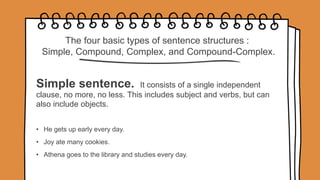
The four basic types of sentence structures :
Simple, Compound, Complex, and Compound-Complex.
Simple sentence. It consists of a single independent
clause, no more, no less. This includes subject and verbs, but can
also include objects.
• He gets up early every day.
• Joy ate many cookies.
• Athena goes to the library and studies every day.
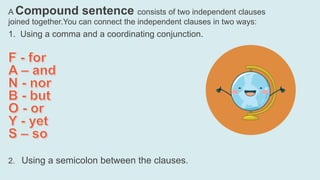
A Compound sentence consists of two independent clauses
joined together.You can connect the independent clauses in two ways:
1. Using a comma and a coordinating conjunction.
2. Using a semicolon between the clauses.
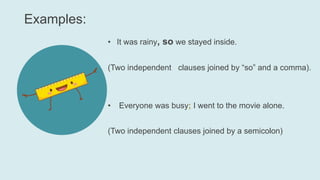
Examples:
• It was rainy, so we stayed inside.
(Two independent clauses joined by “so” and a comma).
• Everyone was busy; I went to the movie alone.
(Two independent clauses joined by a semicolon)
A Complex sentence contains one main
independent clause and one or more dependent clauses.
To join the clauses together ,complex sentences use
subordinating conjunctions.
Examples:
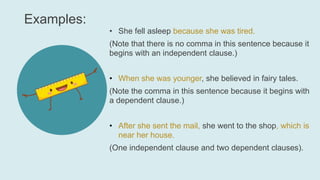
• She fell asleep because she was tired.
(Note that there is no comma in this sentence because it
begins with an independent clause.)
• When she was younger, she believed in fairy tales.
(Note the comma in this sentence because it begins with
a dependent clause.)
• After she sent the mail, she went to the shop, which is
near her house.
(One independent clause and two dependent clauses).
A Compound-complex sentence
consists of two or more independent clauses
connected by a coordinating conjunction and one or
more dependent clause. This type shares the
characteristics of both compound and complex
sentences.
Examples:
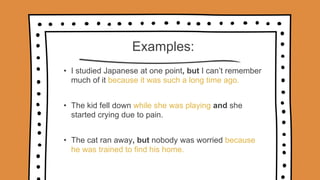
• I studied Japanese at one point, but I can’t remember
much of it because it was such a long time ago.
• The kid fell down while she was playing and she
started crying due to pain.
• The cat ran away, but nobody was worried because
he was trained to find his home.
Take up this practice quiz and
see if you can determine the
different types of sentences. All
the best!
1. Identify the sentence structure: Violence on television has
been debated by politicians for years, yet they still don't have a
good plan about how to deal with it.
A. Simple sentence
B. Compound Sentence
C. Complex Sentence
D. Compound-Complex Sentence
2. Identify the sentence structure: Since we had only
gone a mile from camp, we decided to return before
dark.
A. Simple sentence
B. Compound Sentence
C. Complex Sentence
D. Compound-Complex Sentence
3. Identify the sentence structure:This summer
our vacation should be both exciting and restful.
A. Simple sentence
B. Compound Sentence
C. Complex Sentence
D. Compound-Complex Sentence
5. I am a sentence with one
independent clause and one
or more dependent clauses.
A. Complex
B. Compound
C. Compound-complex
D. Simple
4. I have only one
independent clause and no
dependent clauses.
A. Complex
B. Compound
C. Compound-complex
D. Simple
6. I am a sentence with two
independent clauses and a
coordinating conjunction or a
semicolon that separates the
clauses.
A. Complex
B. Compound
C. Compound-complex
D. Simple
7. I contain a subject and verb
and cannot stand alone by
myself. Subordinating
conjunction usually comes
before me in a sentence.
A. Dependent clause
B. Independent clause
8. Older television sets had
tubes; the newest models,
which take less space, are
digital televisions.
A. Simple sentence
B. Compound Sentence
C. Complex Sentence
D. Compound-Complex
Sentence
9. I want to be a ballerina
when I grow up, and my mom
is proud of me.
A. Simple sentence
B. Compound Sentence
C. Complex Sentence
D. Compound-Complex
Sentence
10. This is the end of my quiz,
which had to happen
sometime; I hope you liked it!
A. Simple sentence
B. Compound Sentence
C. Complex Sentence
D. Compound-Complex
Sentence
Paying attention to sentence structure is a great
way to study the pattern of your writing extra
carefully.

sentencestructure.pptx

  • 1.
    THE FOUR TYPESOF SENTENCE STRUCTURE
  • 2.
  • 3.
    There are twotypes of clauses: independent clauses and dependent clauses. Independent Clause An independent clause (also called a main clause) can stand alone as a complete sentence because its meaning is complete. It must contain at least one subject and one verb. Dependent Clause A dependent clause (also called a subordinate clause) is a group of words that contains a subject and verb but does not express a complete thought. Therefore, a dependent clause cannot be a complete sentence on its own.
  • 4.
    The four basictypes of sentence structures : Simple, Compound, Complex, and Compound-Complex. Simple sentence. It consists of a single independent clause, no more, no less. This includes subject and verbs, but can also include objects. • He gets up early every day. • Joy ate many cookies. • Athena goes to the library and studies every day.
  • 5.
    A Compound sentenceconsists of two independent clauses joined together.You can connect the independent clauses in two ways: 1. Using a comma and a coordinating conjunction. 2. Using a semicolon between the clauses.
  • 6.
    Examples: • It wasrainy, so we stayed inside. (Two independent clauses joined by “so” and a comma). • Everyone was busy; I went to the movie alone. (Two independent clauses joined by a semicolon)
  • 7.
    A Complex sentencecontains one main independent clause and one or more dependent clauses. To join the clauses together ,complex sentences use subordinating conjunctions.
  • 8.
    Examples: • She fellasleep because she was tired. (Note that there is no comma in this sentence because it begins with an independent clause.) • When she was younger, she believed in fairy tales. (Note the comma in this sentence because it begins with a dependent clause.) • After she sent the mail, she went to the shop, which is near her house. (One independent clause and two dependent clauses).
  • 9.
    A Compound-complex sentence consistsof two or more independent clauses connected by a coordinating conjunction and one or more dependent clause. This type shares the characteristics of both compound and complex sentences.
  • 10.
    Examples: • I studiedJapanese at one point, but I can’t remember much of it because it was such a long time ago. • The kid fell down while she was playing and she started crying due to pain. • The cat ran away, but nobody was worried because he was trained to find his home.
  • 11.
    Take up thispractice quiz and see if you can determine the different types of sentences. All the best!
  • 12.
    1. Identify thesentence structure: Violence on television has been debated by politicians for years, yet they still don't have a good plan about how to deal with it. A. Simple sentence B. Compound Sentence C. Complex Sentence D. Compound-Complex Sentence 2. Identify the sentence structure: Since we had only gone a mile from camp, we decided to return before dark. A. Simple sentence B. Compound Sentence C. Complex Sentence D. Compound-Complex Sentence 3. Identify the sentence structure:This summer our vacation should be both exciting and restful. A. Simple sentence B. Compound Sentence C. Complex Sentence D. Compound-Complex Sentence 5. I am a sentence with one independent clause and one or more dependent clauses. A. Complex B. Compound C. Compound-complex D. Simple 4. I have only one independent clause and no dependent clauses. A. Complex B. Compound C. Compound-complex D. Simple 6. I am a sentence with two independent clauses and a coordinating conjunction or a semicolon that separates the clauses. A. Complex B. Compound C. Compound-complex D. Simple 7. I contain a subject and verb and cannot stand alone by myself. Subordinating conjunction usually comes before me in a sentence. A. Dependent clause B. Independent clause 8. Older television sets had tubes; the newest models, which take less space, are digital televisions. A. Simple sentence B. Compound Sentence C. Complex Sentence D. Compound-Complex Sentence 9. I want to be a ballerina when I grow up, and my mom is proud of me. A. Simple sentence B. Compound Sentence C. Complex Sentence D. Compound-Complex Sentence 10. This is the end of my quiz, which had to happen sometime; I hope you liked it! A. Simple sentence B. Compound Sentence C. Complex Sentence D. Compound-Complex Sentence
  • 13.
    Paying attention tosentence structure is a great way to study the pattern of your writing extra carefully.

Editor's Notes

  • #4 A clause is the part of a sentence that contains a subject and verb. remember that the number of independent clauses and dependent clauses can also determine the sentence type as a simple, compound, complex, or a compound-complex sentence.”
  • #5 “Let us take a deeper look at each type of sentence structure and how to form it.” “There various ways a simple sentence can be constructed. Simple sentences can consist only of one word, and can be longer. Just make sure that in constructing simple sentences longer, always see to it that it only has one independent clause.”
  • #8 Take note: The dependent clause can come at the beginning of the sentence or at the end. If the dependent clause comes first, use a comma before the independent clause. If the independent clause comes first, we do not need a comma at all.
  • #9 “Note that just by adding a subordinating conjunction, you can turn an independent clause into a subordinating clause.”
  • #10 also;;The dependent clause can be anywhere in the sentence
  • #13 1. Compound 2. Complex 3. Simple 4. Simple 5. Complex 6. Compound 7. Dependent 8. Compound-complex 9. compound-complex 10. compound-complex