The Sublime
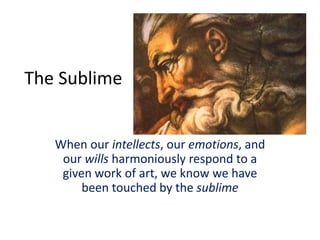
When our intellects, our emotions, and
our wills harmoniously respond to a
given work of art, we know we have
been touched by the sublime
Longinus
• Its author is unknown, but is conventionally
referred to as Longinus or Pseudo-Longinus.
• It is regarded as a classic work on aesthetics
and the effects of good writing. The treatise
highlights examples of good and bad writing
from the previous millennium, focusing
particularly on what may lead to the sublime.
• Before Longinus, the critics believed that the
function of poetry was to instruct or to delight
or both and if it is prose, its function was to
persuade also. But Longinus was not satisfied
with this formula.
• So a great work of art does not only please or
instruct, but it also moves, transports, elevates.
It pleases all and it pleases all the time.
• He believed “
.” According to him the work of art
become excellent, only when it has power to
sublimate, By sublimity Longinus means
‘ ’ or ‘
.
• On the Sublime is both a treatise on aesthetics
and a work of literary criticism. It is written in an
epistolary form and the final part, possibly
dealing with public speaking, has been lost
• On the Sublime is a compendium of literary
exemplars, with about 50 authors spanning 1,000
years mentioned or quoted.[5]
• Along with the expected examples from Homer
and other figures of Greek culture, Longinus
refers to a passage from Genesis, which is quite
unusual for the 1st century:
The sublime
• Longinus critically applauds and condemns certain literary
works as examples of good or bad styles of writing.[5]
• Longinus ultimately promotes an "elevation of style"[5] and
an essence of "simplicity".[8]
• To quote this famous author, "the first and most important
source of sublimity [is] the power of forming great
conceptions."[8]
• The concept of the sublime is generally accepted to refer
to a style of writing that elevates itself "above the
ordinary".
• Finally, Longinus sets out five sources of sublimity: "great
thoughts, strong emotions, certain figures of thought and
speech, noble diction, and dignified word arrangement".[6]
• The effects of the Sublime are: loss of rationality,
an alienation leading to identification with the
creative process of the artist and a deep emotion
mixed in pleasure and exaltation.
• An example of sublime (which the author quotes in
the work) is a poem by Sappho, the so-called Ode
to Jealousy, defined as a "Sublime ode".
• A writer's goal is not so much to express empty
feelings, but to arouse emotion in his audience.
• he thought that literature could model a soul,
and that a soul could pour itself out into a work
of art.
• The sources of the Sublime are of two kinds:
inborn sources ("aspiration to vigorous concepts"
and "strong and enthusiastic passion") and
acquirable sources (rhetorical devices, choice of
the right lexicon, and "dignified and high
composition").[8]
• Then, the Sublime is a mechanism of
recognition (arising from the impact of the
work of art) of the greatness of a spirit, of the
depth of an idea, of the power of speech.
• Thus Longinus is the golden balance between Plato
and Aristotle, Homer and Shelley, classicism and
Romanticism down to Eliot’s modernism.
• As a critic he displays a rare breath and
universality of outlook.
• Moreover, his mind is free from any prejudice. His
judgments are essentially apt. They have been
supported by posterity.
• Atkins says, “
.”
• His mind is free from prejudice. A great deal of his
work is original and illuminating and is of permanent or
universal significance.
• He attaches importance to emotion, imagination and
beauty of words. He thus becomes a pioneer in the
field of aesthetic appreciation. He finds the permanent
and universal qualities in the works of Homer.
• According to him, the function of literature is not
didactic, but aesthetic. That is why Scott-James calls
him the first romantic critic, but Atkins calls him an
exponent/exemplery if real classic spirit.
• According to Longinus, the purpose of the greatest
writers has been to introduce, to delight and to
persuade.
• But their greatness lies in sublimity. Sublimity is the
echo of a great soul, of a lofty mind; it is not merely an
excellence in language.
• It is the note that rings from a great mind. It lies in
intensity—"on a certain distinction and consummation
of excellence in expression." A work of genius must aim
at ecstasy. In other words, it is the combination of (the
true, the good and the beautiful) that makes a work
sublime.
Questions
1. Longinus identified five main sources of
the sublime. What are they?
2. Can you describe Longinus in few
terms?
3. What is the function of literature
according to Horace?
4. What makes Longinus a classicist as
well as a romantic?
Q with A
• Longinus identified five main sources of the
sublime. What are they?
• grandeur of thought, capacity for strong emotion, appropriate use of figures of speech,
nobility of diction and dignified and elaborated composition.
• Can you describe Longinus in few terms?
• Longinus is a classical critic with romantic sentiment; a pioneer in literary
appreciation; the first critic to emphasize the importance of style so
elaborately
• What is the function of literature according to
Horace?
• the function of literature is not moral but aesthetic.
Q with A
• What makes Longinus a classicist as well as a
romantic?
• A romantic because of his aestheticism, emphasis on strong emotion,
subjectivity, beauty; a classicist because of his emphasis on grandeur.

Longinus The sublime

  • 1.
    The Sublime When ourintellects, our emotions, and our wills harmoniously respond to a given work of art, we know we have been touched by the sublime
  • 2.
    Longinus • Its authoris unknown, but is conventionally referred to as Longinus or Pseudo-Longinus. • It is regarded as a classic work on aesthetics and the effects of good writing. The treatise highlights examples of good and bad writing from the previous millennium, focusing particularly on what may lead to the sublime.
  • 3.
    • Before Longinus,the critics believed that the function of poetry was to instruct or to delight or both and if it is prose, its function was to persuade also. But Longinus was not satisfied with this formula.
  • 4.
    • So agreat work of art does not only please or instruct, but it also moves, transports, elevates. It pleases all and it pleases all the time. • He believed “ .” According to him the work of art become excellent, only when it has power to sublimate, By sublimity Longinus means ‘ ’ or ‘ .
  • 5.
    • On theSublime is both a treatise on aesthetics and a work of literary criticism. It is written in an epistolary form and the final part, possibly dealing with public speaking, has been lost • On the Sublime is a compendium of literary exemplars, with about 50 authors spanning 1,000 years mentioned or quoted.[5] • Along with the expected examples from Homer and other figures of Greek culture, Longinus refers to a passage from Genesis, which is quite unusual for the 1st century:
  • 6.
    The sublime • Longinuscritically applauds and condemns certain literary works as examples of good or bad styles of writing.[5] • Longinus ultimately promotes an "elevation of style"[5] and an essence of "simplicity".[8] • To quote this famous author, "the first and most important source of sublimity [is] the power of forming great conceptions."[8] • The concept of the sublime is generally accepted to refer to a style of writing that elevates itself "above the ordinary". • Finally, Longinus sets out five sources of sublimity: "great thoughts, strong emotions, certain figures of thought and speech, noble diction, and dignified word arrangement".[6]
  • 7.
    • The effectsof the Sublime are: loss of rationality, an alienation leading to identification with the creative process of the artist and a deep emotion mixed in pleasure and exaltation. • An example of sublime (which the author quotes in the work) is a poem by Sappho, the so-called Ode to Jealousy, defined as a "Sublime ode". • A writer's goal is not so much to express empty feelings, but to arouse emotion in his audience.
  • 8.
    • he thoughtthat literature could model a soul, and that a soul could pour itself out into a work of art. • The sources of the Sublime are of two kinds: inborn sources ("aspiration to vigorous concepts" and "strong and enthusiastic passion") and acquirable sources (rhetorical devices, choice of the right lexicon, and "dignified and high composition").[8]
  • 9.
    • Then, theSublime is a mechanism of recognition (arising from the impact of the work of art) of the greatness of a spirit, of the depth of an idea, of the power of speech.
  • 10.
    • Thus Longinusis the golden balance between Plato and Aristotle, Homer and Shelley, classicism and Romanticism down to Eliot’s modernism. • As a critic he displays a rare breath and universality of outlook. • Moreover, his mind is free from any prejudice. His judgments are essentially apt. They have been supported by posterity. • Atkins says, “ .”
  • 11.
    • His mindis free from prejudice. A great deal of his work is original and illuminating and is of permanent or universal significance. • He attaches importance to emotion, imagination and beauty of words. He thus becomes a pioneer in the field of aesthetic appreciation. He finds the permanent and universal qualities in the works of Homer. • According to him, the function of literature is not didactic, but aesthetic. That is why Scott-James calls him the first romantic critic, but Atkins calls him an exponent/exemplery if real classic spirit.
  • 12.
    • According toLonginus, the purpose of the greatest writers has been to introduce, to delight and to persuade. • But their greatness lies in sublimity. Sublimity is the echo of a great soul, of a lofty mind; it is not merely an excellence in language. • It is the note that rings from a great mind. It lies in intensity—"on a certain distinction and consummation of excellence in expression." A work of genius must aim at ecstasy. In other words, it is the combination of (the true, the good and the beautiful) that makes a work sublime.
  • 13.
    Questions 1. Longinus identifiedfive main sources of the sublime. What are they? 2. Can you describe Longinus in few terms? 3. What is the function of literature according to Horace? 4. What makes Longinus a classicist as well as a romantic?
  • 14.
    Q with A •Longinus identified five main sources of the sublime. What are they? • grandeur of thought, capacity for strong emotion, appropriate use of figures of speech, nobility of diction and dignified and elaborated composition. • Can you describe Longinus in few terms? • Longinus is a classical critic with romantic sentiment; a pioneer in literary appreciation; the first critic to emphasize the importance of style so elaborately • What is the function of literature according to Horace? • the function of literature is not moral but aesthetic.
  • 15.
    Q with A •What makes Longinus a classicist as well as a romantic? • A romantic because of his aestheticism, emphasis on strong emotion, subjectivity, beauty; a classicist because of his emphasis on grandeur.