SENTENCE
CONSTRUCTION
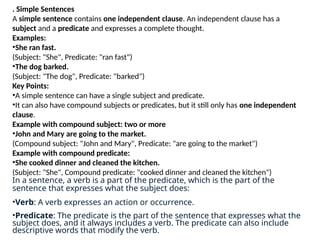
. Simple Sentences
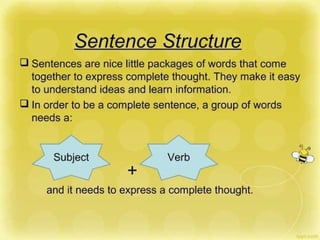
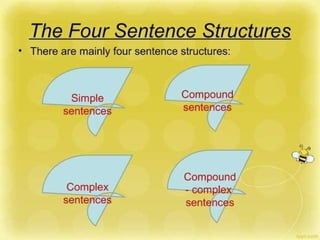
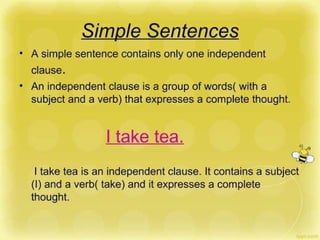
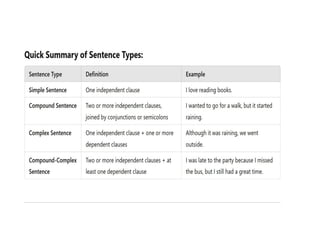
A simple sentence contains one independent clause. An independent clause has a
subject and a predicate and expresses a complete thought.
Examples:
•She ran fast.
(Subject: "She", Predicate: "ran fast")
•The dog barked.
(Subject: "The dog", Predicate: "barked")
Key Points:
•A simple sentence can have a single subject and predicate.
•It can also have compound subjects or predicates, but it still only has one independent
clause.
Example with compound subject: two or more
•John and Mary are going to the market.
(Compound subject: "John and Mary", Predicate: "are going to the market")
Example with compound predicate:
•She cooked dinner and cleaned the kitchen.
(Subject: "She", Compound predicate: "cooked dinner and cleaned the kitchen")
In a sentence, a verb is a part of the predicate, which is the part of the
sentence that expresses what the subject does:
•Verb: A verb expresses an action or occurrence.
•Predicate: The predicate is the part of the sentence that expresses what the
subject does, and it always includes a verb. The predicate can also include
descriptive words that modify the verb.
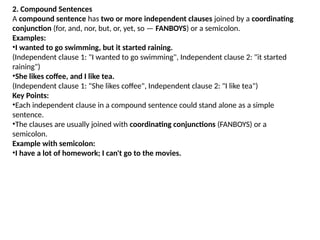
2. Compound Sentences
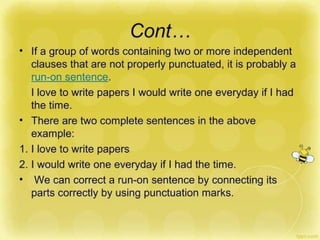
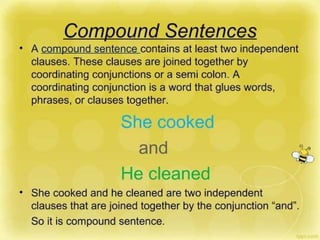
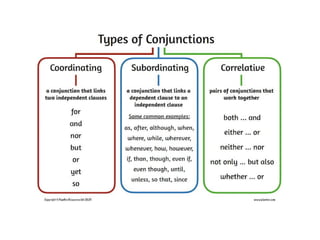
A compound sentence has two or more independent clauses joined by a coordinating
conjunction (for, and, nor, but, or, yet, so — FANBOYS) or a semicolon.
Examples:
•I wanted to go swimming, but it started raining.
(Independent clause 1: "I wanted to go swimming", Independent clause 2: "it started
raining")
•She likes coffee, and I like tea.
(Independent clause 1: "She likes coffee", Independent clause 2: "I like tea")
Key Points:
•Each independent clause in a compound sentence could stand alone as a simple
sentence.
•The clauses are usually joined with coordinating conjunctions (FANBOYS) or a
semicolon.
Example with semicolon:
•I have a lot of homework; I can't go to the movies.
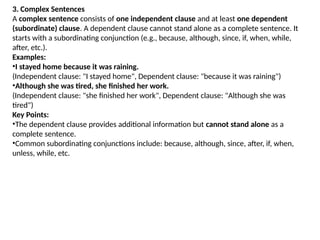
3. Complex Sentences
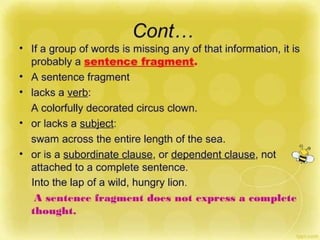
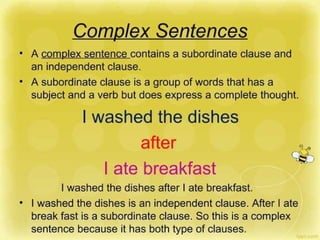
A complex sentence consists of one independent clause and at least one dependent
(subordinate) clause. A dependent clause cannot stand alone as a complete sentence. It
starts with a subordinating conjunction (e.g., because, although, since, if, when, while,
after, etc.).
Examples:
•I stayed home because it was raining.
(Independent clause: "I stayed home", Dependent clause: "because it was raining")
•Although she was tired, she finished her work.
(Independent clause: "she finished her work", Dependent clause: "Although she was
tired")
Key Points:
•The dependent clause provides additional information but cannot stand alone as a
complete sentence.
•Common subordinating conjunctions include: because, although, since, after, if, when,
unless, while, etc.
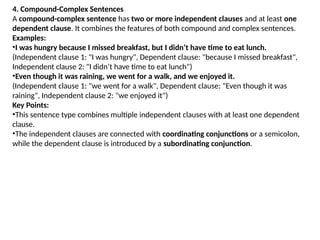
4. Compound-Complex Sentences
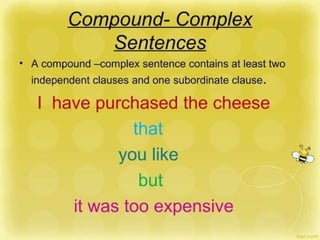
A compound-complex sentence has two or more independent clauses and at least one
dependent clause. It combines the features of both compound and complex sentences.
Examples:
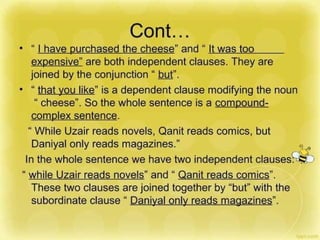
•I was hungry because I missed breakfast, but I didn’t have time to eat lunch.
(Independent clause 1: "I was hungry", Dependent clause: "because I missed breakfast",
Independent clause 2: "I didn’t have time to eat lunch")
•Even though it was raining, we went for a walk, and we enjoyed it.
(Independent clause 1: "we went for a walk", Dependent clause: "Even though it was
raining", Independent clause 2: "we enjoyed it")
Key Points:
•This sentence type combines multiple independent clauses with at least one dependent
clause.
•The independent clauses are connected with coordinating conjunctions or a semicolon,
while the dependent clause is introduced by a subordinating conjunction.
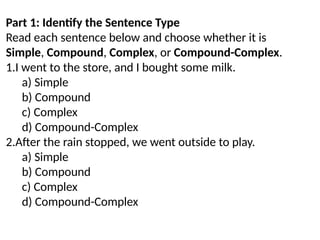
Part 1: Identify the Sentence Type
Read each sentence below and choose whether it is
Simple, Compound, Complex, or Compound-Complex.
1.I went to the store, and I bought some milk.
a) Simple
b) Compound
c) Complex
d) Compound-Complex
2.After the rain stopped, we went outside to play.
a) Simple
b) Compound
c) Complex
d) Compound-Complex
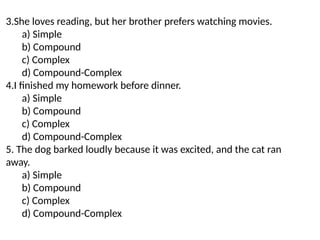
3.She loves reading, but her brother prefers watching movies.
a) Simple
b) Compound
c) Complex
d) Compound-Complex
4.I finished my homework before dinner.
a) Simple
b) Compound
c) Complex
d) Compound-Complex
5. The dog barked loudly because it was excited, and the cat ran
away.
a) Simple
b) Compound
c) Complex
d) Compound-Complex
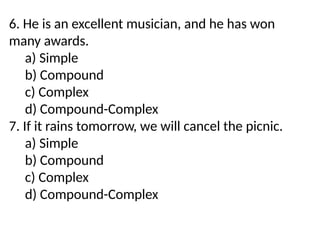
6. He is an excellent musician, and he has won
many awards.
a) Simple
b) Compound
c) Complex
d) Compound-Complex
7. If it rains tomorrow, we will cancel the picnic.
a) Simple
b) Compound
c) Complex
d) Compound-Complex
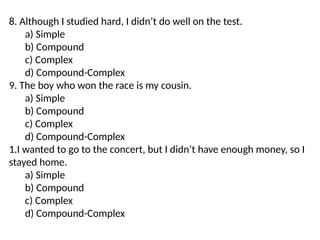
8. Although I studied hard, I didn’t do well on the test.
a) Simple
b) Compound
c) Complex
d) Compound-Complex
9. The boy who won the race is my cousin.
a) Simple
b) Compound
c) Complex
d) Compound-Complex
1.I wanted to go to the concert, but I didn’t have enough money, so I
stayed home.
a) Simple
b) Compound
c) Complex
d) Compound-Complex
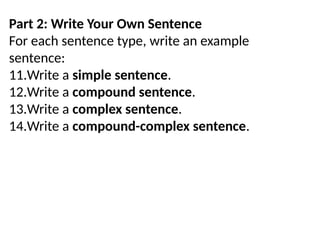
Part 2: Write Your Own Sentence
For each sentence type, write an example
sentence:
11.Write a simple sentence.
12.Write a compound sentence.
13.Write a complex sentence.
14.Write a compound-complex sentence.
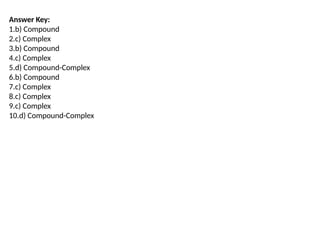
Answer Key:
1.b) Compound
2.c) Complex
3.b) Compound
4.c) Complex
5.d) Compound-Complex
6.b) Compound
7.c) Complex
8.c) Complex
9.c) Complex
10.d) Compound-Complex
Contact Center Servicing-UNIT 2- SENTENCE CONSTRUCTION.pptx

Contact Center Servicing-UNIT 2- SENTENCE CONSTRUCTION.pptx

  • 1.
  • 12.
    . Simple Sentences Asimple sentence contains one independent clause. An independent clause has a subject and a predicate and expresses a complete thought. Examples: •She ran fast. (Subject: "She", Predicate: "ran fast") •The dog barked. (Subject: "The dog", Predicate: "barked") Key Points: •A simple sentence can have a single subject and predicate. •It can also have compound subjects or predicates, but it still only has one independent clause. Example with compound subject: two or more •John and Mary are going to the market. (Compound subject: "John and Mary", Predicate: "are going to the market") Example with compound predicate: •She cooked dinner and cleaned the kitchen. (Subject: "She", Compound predicate: "cooked dinner and cleaned the kitchen") In a sentence, a verb is a part of the predicate, which is the part of the sentence that expresses what the subject does: •Verb: A verb expresses an action or occurrence. •Predicate: The predicate is the part of the sentence that expresses what the subject does, and it always includes a verb. The predicate can also include descriptive words that modify the verb.
  • 13.
    2. Compound Sentences Acompound sentence has two or more independent clauses joined by a coordinating conjunction (for, and, nor, but, or, yet, so — FANBOYS) or a semicolon. Examples: •I wanted to go swimming, but it started raining. (Independent clause 1: "I wanted to go swimming", Independent clause 2: "it started raining") •She likes coffee, and I like tea. (Independent clause 1: "She likes coffee", Independent clause 2: "I like tea") Key Points: •Each independent clause in a compound sentence could stand alone as a simple sentence. •The clauses are usually joined with coordinating conjunctions (FANBOYS) or a semicolon. Example with semicolon: •I have a lot of homework; I can't go to the movies.
  • 14.
    3. Complex Sentences Acomplex sentence consists of one independent clause and at least one dependent (subordinate) clause. A dependent clause cannot stand alone as a complete sentence. It starts with a subordinating conjunction (e.g., because, although, since, if, when, while, after, etc.). Examples: •I stayed home because it was raining. (Independent clause: "I stayed home", Dependent clause: "because it was raining") •Although she was tired, she finished her work. (Independent clause: "she finished her work", Dependent clause: "Although she was tired") Key Points: •The dependent clause provides additional information but cannot stand alone as a complete sentence. •Common subordinating conjunctions include: because, although, since, after, if, when, unless, while, etc.
  • 15.
    4. Compound-Complex Sentences Acompound-complex sentence has two or more independent clauses and at least one dependent clause. It combines the features of both compound and complex sentences. Examples: •I was hungry because I missed breakfast, but I didn’t have time to eat lunch. (Independent clause 1: "I was hungry", Dependent clause: "because I missed breakfast", Independent clause 2: "I didn’t have time to eat lunch") •Even though it was raining, we went for a walk, and we enjoyed it. (Independent clause 1: "we went for a walk", Dependent clause: "Even though it was raining", Independent clause 2: "we enjoyed it") Key Points: •This sentence type combines multiple independent clauses with at least one dependent clause. •The independent clauses are connected with coordinating conjunctions or a semicolon, while the dependent clause is introduced by a subordinating conjunction.
  • 18.
    Part 1: Identifythe Sentence Type Read each sentence below and choose whether it is Simple, Compound, Complex, or Compound-Complex. 1.I went to the store, and I bought some milk. a) Simple b) Compound c) Complex d) Compound-Complex 2.After the rain stopped, we went outside to play. a) Simple b) Compound c) Complex d) Compound-Complex
  • 19.
    3.She loves reading,but her brother prefers watching movies. a) Simple b) Compound c) Complex d) Compound-Complex 4.I finished my homework before dinner. a) Simple b) Compound c) Complex d) Compound-Complex 5. The dog barked loudly because it was excited, and the cat ran away. a) Simple b) Compound c) Complex d) Compound-Complex
  • 20.
    6. He isan excellent musician, and he has won many awards. a) Simple b) Compound c) Complex d) Compound-Complex 7. If it rains tomorrow, we will cancel the picnic. a) Simple b) Compound c) Complex d) Compound-Complex
  • 21.
    8. Although Istudied hard, I didn’t do well on the test. a) Simple b) Compound c) Complex d) Compound-Complex 9. The boy who won the race is my cousin. a) Simple b) Compound c) Complex d) Compound-Complex 1.I wanted to go to the concert, but I didn’t have enough money, so I stayed home. a) Simple b) Compound c) Complex d) Compound-Complex
  • 22.
    Part 2: WriteYour Own Sentence For each sentence type, write an example sentence: 11.Write a simple sentence. 12.Write a compound sentence. 13.Write a complex sentence. 14.Write a compound-complex sentence.
  • 23.
    Answer Key: 1.b) Compound 2.c)Complex 3.b) Compound 4.c) Complex 5.d) Compound-Complex 6.b) Compound 7.c) Complex 8.c) Complex 9.c) Complex 10.d) Compound-Complex