Types and Usage
An adverb is a word that describes or
gives more information about a verb,
an adjective, another adverb, or even
the entire sentence.
The word "adverb" comes for the
Latin ad- (in addition) and verbum
(word).
Where? Home. ("I went home.")
When? Yesterday. ("We met yesterday.")
How? Slowly. ("The turtle moves slowly.")
How often? Sometimes. ("Sometimes it stops
responding.")
How long? Temporarily. ("She is staying with us
temporarily.")
How likely? Surely. ("Our team will surely win!")
To what degree? Very. ("She was very pleased.")
An adverb can describe a verb:
She runs quickly.
An adverb can describe an adjective:
She is so beautiful.
An adverb can describe another adverb:
She smokes very rarely.
An adverb can describe an entire sentence:
Obviously, you don't have to come.
In many cases (but not always!) adverbs have the
following form:
Adjective + "-ly"
Examples:
Quick + ly = quickly
Strange + ly = strangely
Dead + ly = deadly
Sudden + ly = suddenly
Clever + ly = cleverly
Brave + ly = bravely
Real + ly = really
When an adjective ends with "y" replace the "y"
with an "i":
Heavy + ly = heavi + ly = heavily
Happy + ly = happi + ly = happily
When the adjective ends with an "e" drop the "e":
True + ly = tru + ly = truly
However, there are many adverbs that do not end
in "-ly": Very, home, too, well, never, sometimes, and
so forth.
Adverbs of degree
Very, highly, totally, perfectly, partially, almost.
Adverbs of manner
Well, badly, nicely, slowly, loudly, quietly, happily,
sadly, secretly, weakly.
Adverbs of place
Home, here, there, outside, inside, away, around,
anywhere, abroad, up, down, out.
Adverbs of time
Now, soon, later, yesterday, tomorrow, early, before,
lately, recently.
Adverbs of frequency
Always, never, sometimes, often, rarely, usually,
occasionally.
Adverbs of duration
Forever, constantly, temporarily, briefly.
Adverbs of probability
Certainly, maybe, probably, possibly, surely.
"Comparative" means "comparing something to
something else.“
Comparative adverbs show us which action or state is
better, worse, stronger, weaker, and so forth.
Examples:
more, less, better, worse, faster, slower, farther, closer.
Example sentences:
Maggie works out more seriously than Donna.
She eats less than her friends.
You are better than this.
We couldn't go slower even if we wanted to.
"Superlative" means "of the highest degree.“
Superlative adverbs show us which action or state is
the best, the strongest, and so forth.
Examples:
Best, most, least, worst, strongest, fastest, slowest.
Example sentences:
He knows best.
It was the most boring experience.
He shouted the loudest so he won.
He ran the slowest so he lost.
Hardly means almost none, and hard means
heavily
Rama works hardly ✘
Rama works hard ✔
Rama hardly works ✔
Third sentence is correct as hardly indicates here,
Rama is a lazy person.
Late means after the expected time. Lately
means recently.
He came lately ✘
He came late. ✔
Have you seen her lately? ✔
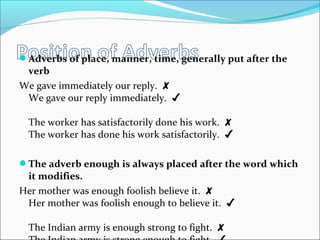
Adverbs of place, manner, time, generally put after the
verb
We gave immediately our reply. ✘
We gave our reply immediately. ✔
The worker has satisfactorily done his work. ✘
The worker has done his work satisfactorily. ✔
The adverb enough is always placed after the word which
it modifies.
Her mother was enough foolish believe it. ✘
Her mother was foolish enough to believe it. ✔
The Indian army is enough strong to fight. ✘
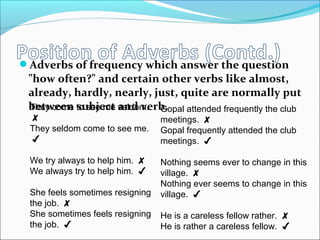
Adverbs of frequency which answer the question
"how often?" and certain other verbs like almost,
already, hardly, nearly, just, quite are normally put
between subject and verb.They come to see me seldom.
✘
They seldom come to see me.
✔
We try always to help him. ✘
We always try to help him. ✔
She feels sometimes resigning
the job. ✘
She sometimes feels resigning
the job. ✔
Gopal attended frequently the club
meetings. ✘
Gopal frequently attended the club
meetings. ✔
Nothing seems ever to change in this
village. ✘
Nothing ever seems to change in this
village. ✔
He is a careless fellow rather. ✘
He is rather a careless fellow. ✔
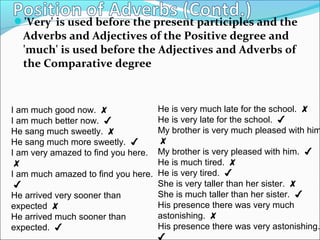
'Very' is used before the present participles and the
Adverbs and Adjectives of the Positive degree and
'much' is used before the Adjectives and Adverbs of
the Comparative degree
I am much good now. ✘
I am much better now. ✔
He sang much sweetly. ✘
He sang much more sweetly. ✔
I am very amazed to find you here.
✘
I am much amazed to find you here.
✔
He arrived very sooner than
expected ✘
He arrived much sooner than
expected. ✔
He is very much late for the school. ✘
He is very late for the school. ✔
My brother is very much pleased with him
✘
My brother is very pleased with him. ✔
He is much tired. ✘
He is very tired. ✔
She is very taller than her sister. ✘
She is much taller than her sister. ✔
His presence there was very much
astonishing. ✘
His presence there was very astonishing.
✔
Too, Very: "Too" indicates excess. It should not be
used in the above sense. It is better to use 'very'.
Geeta is too glad to meet
you. ✘
Geeta is very glad to meet
you. ✔
Sunil is too humble. ✘
Sunil is very humble. ✔
This manga is too delicious.
✘
This mango is very
delicious. ✔
You are very weak to walk. ✘
You are too weak to walk. ✔
Today's news is very good to be
true. ✘
Today's news is too good to be true.
✔
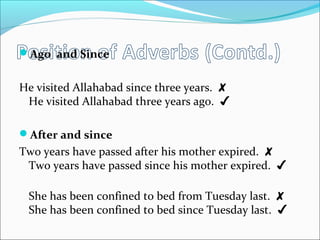
Ago and Since
He visited Allahabad since three years. ✘
He visited Allahabad three years ago. ✔
After and since
Two years have passed after his mother expired. ✘
Two years have passed since his mother expired. ✔
She has been confined to bed from Tuesday last. ✘
She has been confined to bed since Tuesday last. ✔
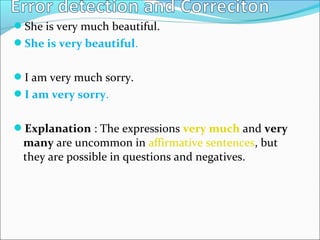
She is very much beautiful.
She is very beautiful.
I am very much sorry.
I am very sorry.
Explanation : The expressions very much and very
many are uncommon in affirmative sentences, but
they are possible in questions and negatives.
He was very foolish enough to trust her.
He was too foolish to trust her.
He was foolish enough to trust her.
He was so foolish that he trusted her.
Explanation : Enough cannot be modified by very.
I managed to do it anyhow.
I managed to do it somehow.
Explanation : Anyhow means in disorder. Somehow
means by some means. Anyhow can also mean for
certain. E.g., He may not win but anyhow I shall.
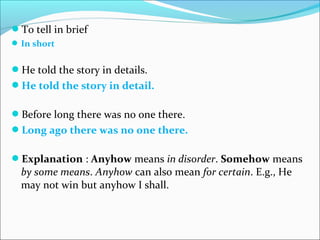
To tell in brief
In short
He told the story in details.
He told the story in detail.
Before long there was no one there.
Long ago there was no one there.
Explanation : Anyhow means in disorder. Somehow means
by some means. Anyhow can also mean for certain. E.g., He
may not win but anyhow I shall.
This story is too interesting.
This story is very interesting.
She is too beautiful.
She is very beautiful.
Explanation : Too means more than it ought to be. It
has a negative meaning. E.g., He is too fat.
He sings good.
He sings well.
Explanation : To modify the verb sings, we have to
use an adverb. Good is an adjective. The adverb for
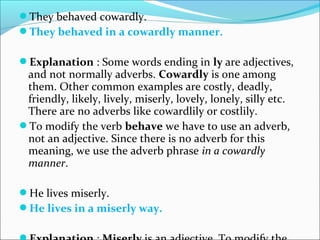
They behaved cowardly.
They behaved in a cowardly manner.
Explanation : Some words ending in ly are adjectives,
and not normally adverbs. Cowardly is one among
them. Other common examples are costly, deadly,
friendly, likely, lively, miserly, lovely, lonely, silly etc.
There are no adverbs like cowardlily or costlily.
To modify the verb behave we have to use an adverb,
not an adjective. Since there is no adverb for this
meaning, we use the adverb phrase in a cowardly
manner.
He lives miserly.
He lives in a miserly way.
My sister is tall than me.
My sister is taller than me.
Explanation : We use comparative adjectives and adverbs
before than.
Really speaking she isn’t very brilliant.
To speak the truth she isn’t very brilliant.
Explanation : Other phrases that can be used instead of
to speak the truth are: as a matter of fact, in truth and in
fact.
In fact she isn’t very brilliant.
As a matter of fact she isn’t very brilliant.
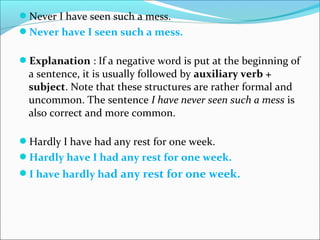
Never I have seen such a mess.
Never have I seen such a mess.
Explanation : If a negative word is put at the beginning of
a sentence, it is usually followed by auxiliary verb +
subject. Note that these structures are rather formal and
uncommon. The sentence I have never seen such a mess is
also correct and more common.
Hardly I have had any rest for one week.
Hardly have I had any rest for one week.
I have hardly had any rest for one week.
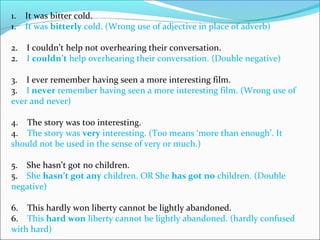
1.    It was bitter cold.
1.    It was bitterly cold. (Wrong use of adjective in place of adverb)
2.    I couldn’t help not overhearing their conversation.
2.    I couldn’t help overhearing their conversation. (Double negative)
3.    I ever remember having seen a more interesting film.
3.    I never remember having seen a more interesting film. (Wrong use of 
ever and never)
4.    The story was too interesting.
4.    The story was very interesting. (Too means ‘more than enough’. It 
should not be used in the sense of very or much.)
5.    She hasn’t got no children.
5.    She hasn’t got any children. OR She has got no children. (Double 
negative)
6.    This hardly won liberty cannot be lightly abandoned.
6.    This hard won liberty cannot be lightly abandoned. (hardly confused 
with hard)
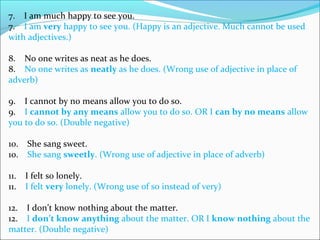
7.    I am much happy to see you.
7.    I am very happy to see you. (Happy is an adjective. Much cannot be used 
with adjectives.)
8.    No one writes as neat as he does.
8.    No one writes as neatly as he does. (Wrong use of adjective in place of 
adverb)
9.    I cannot by no means allow you to do so.
9.    I cannot by any means allow you to do so. OR I can by no means allow 
you to do so. (Double negative)
10.    She sang sweet.
10.    She sang sweetly. (Wrong use of adjective in place of adverb)
11.    I felt so lonely.
11.    I felt very lonely. (Wrong use of so instead of very)
12.    I don’t know nothing about the matter.
12.    I don’t know anything about the matter. OR I know nothing about the 
matter. (Double negative)
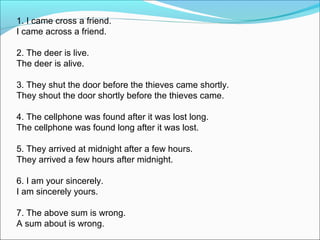
1. I came cross a friend.
I came across a friend.
2. The deer is live.
The deer is alive.
3. They shut the door before the thieves came shortly.
They shout the door shortly before the thieves came.
4. The cellphone was found after it was lost long.
The cellphone was found long after it was lost.
5. They arrived at midnight after a few hours.
They arrived a few hours after midnight.
6. I am your sincerely.
I am sincerely yours.
7. The above sum is wrong.
A sum about is wrong.
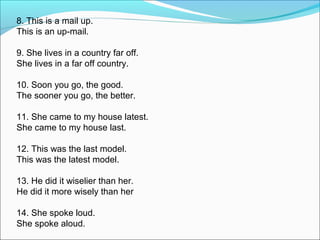
8. This is a mail up.
This is an up-mail.
9. She lives in a country far off.
She lives in a far off country.
10. Soon you go, the good.
The sooner you go, the better.
11. She came to my house latest.
She came to my house last.
12. This was the last model.
This was the latest model.
13. He did it wiselier than her.
He did it more wisely than her
14. She spoke loud.
She spoke aloud.
15. I was little tried.
I was a little tired.
16. She comes to me sometime.
She comes to me sometimes / Sometimes, she come to me.
17. She stays with me sometimes.
She stays with me for sometimes.
18. All saves one left.
All save one left.
19. Crops have been spoiled owing to rains.
Crops have been spoiled due to heavy rains.
20. The flea flew exactly the boy’s overhead.
lea flew exactly over the boy’s head.
21. He was sitting inside the door almost.
He was sitting almost outside the door.
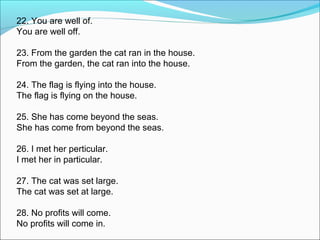
22. You are well of.
You are well off.
23. From the garden the cat ran in the house.
From the garden, the cat ran into the house.
24. The flag is flying into the house.
The flag is flying on the house.
25. She has come beyond the seas.
She has come from beyond the seas.
26. I met her perticular.
I met her in particular.
27. The cat was set large.
The cat was set at large.
28. No profits will come.
No profits will come in.
 adverbs

adverbs

  • 1.
  • 2.
    An adverb isa word that describes or gives more information about a verb, an adjective, another adverb, or even the entire sentence. The word "adverb" comes for the Latin ad- (in addition) and verbum (word).
  • 3.
    Where? Home. ("Iwent home.") When? Yesterday. ("We met yesterday.") How? Slowly. ("The turtle moves slowly.") How often? Sometimes. ("Sometimes it stops responding.") How long? Temporarily. ("She is staying with us temporarily.") How likely? Surely. ("Our team will surely win!") To what degree? Very. ("She was very pleased.")
  • 4.
    An adverb candescribe a verb: She runs quickly. An adverb can describe an adjective: She is so beautiful. An adverb can describe another adverb: She smokes very rarely. An adverb can describe an entire sentence: Obviously, you don't have to come.
  • 5.
    In many cases(but not always!) adverbs have the following form: Adjective + "-ly" Examples: Quick + ly = quickly Strange + ly = strangely Dead + ly = deadly Sudden + ly = suddenly Clever + ly = cleverly Brave + ly = bravely Real + ly = really
  • 6.
    When an adjectiveends with "y" replace the "y" with an "i": Heavy + ly = heavi + ly = heavily Happy + ly = happi + ly = happily When the adjective ends with an "e" drop the "e": True + ly = tru + ly = truly However, there are many adverbs that do not end in "-ly": Very, home, too, well, never, sometimes, and so forth.
  • 7.
    Adverbs of degree Very,highly, totally, perfectly, partially, almost. Adverbs of manner Well, badly, nicely, slowly, loudly, quietly, happily, sadly, secretly, weakly. Adverbs of place Home, here, there, outside, inside, away, around, anywhere, abroad, up, down, out. Adverbs of time Now, soon, later, yesterday, tomorrow, early, before, lately, recently.
  • 8.
    Adverbs of frequency Always,never, sometimes, often, rarely, usually, occasionally. Adverbs of duration Forever, constantly, temporarily, briefly. Adverbs of probability Certainly, maybe, probably, possibly, surely.
  • 9.
    "Comparative" means "comparingsomething to something else.“ Comparative adverbs show us which action or state is better, worse, stronger, weaker, and so forth. Examples: more, less, better, worse, faster, slower, farther, closer. Example sentences: Maggie works out more seriously than Donna. She eats less than her friends. You are better than this. We couldn't go slower even if we wanted to.
  • 10.
    "Superlative" means "ofthe highest degree.“ Superlative adverbs show us which action or state is the best, the strongest, and so forth. Examples: Best, most, least, worst, strongest, fastest, slowest. Example sentences: He knows best. It was the most boring experience. He shouted the loudest so he won. He ran the slowest so he lost.
  • 11.
    Hardly means almostnone, and hard means heavily Rama works hardly ✘ Rama works hard ✔ Rama hardly works ✔ Third sentence is correct as hardly indicates here, Rama is a lazy person.
  • 12.
    Late means afterthe expected time. Lately means recently. He came lately ✘ He came late. ✔ Have you seen her lately? ✔
  • 13.
    Adverbs of place,manner, time, generally put after the verb We gave immediately our reply. ✘ We gave our reply immediately. ✔ The worker has satisfactorily done his work. ✘ The worker has done his work satisfactorily. ✔ The adverb enough is always placed after the word which it modifies. Her mother was enough foolish believe it. ✘ Her mother was foolish enough to believe it. ✔ The Indian army is enough strong to fight. ✘
  • 14.
    Adverbs of frequencywhich answer the question "how often?" and certain other verbs like almost, already, hardly, nearly, just, quite are normally put between subject and verb.They come to see me seldom. ✘ They seldom come to see me. ✔ We try always to help him. ✘ We always try to help him. ✔ She feels sometimes resigning the job. ✘ She sometimes feels resigning the job. ✔ Gopal attended frequently the club meetings. ✘ Gopal frequently attended the club meetings. ✔ Nothing seems ever to change in this village. ✘ Nothing ever seems to change in this village. ✔ He is a careless fellow rather. ✘ He is rather a careless fellow. ✔
  • 15.
    'Very' is usedbefore the present participles and the Adverbs and Adjectives of the Positive degree and 'much' is used before the Adjectives and Adverbs of the Comparative degree I am much good now. ✘ I am much better now. ✔ He sang much sweetly. ✘ He sang much more sweetly. ✔ I am very amazed to find you here. ✘ I am much amazed to find you here. ✔ He arrived very sooner than expected ✘ He arrived much sooner than expected. ✔ He is very much late for the school. ✘ He is very late for the school. ✔ My brother is very much pleased with him ✘ My brother is very pleased with him. ✔ He is much tired. ✘ He is very tired. ✔ She is very taller than her sister. ✘ She is much taller than her sister. ✔ His presence there was very much astonishing. ✘ His presence there was very astonishing. ✔
  • 16.
    Too, Very: "Too"indicates excess. It should not be used in the above sense. It is better to use 'very'. Geeta is too glad to meet you. ✘ Geeta is very glad to meet you. ✔ Sunil is too humble. ✘ Sunil is very humble. ✔ This manga is too delicious. ✘ This mango is very delicious. ✔ You are very weak to walk. ✘ You are too weak to walk. ✔ Today's news is very good to be true. ✘ Today's news is too good to be true. ✔
  • 17.
    Ago and Since Hevisited Allahabad since three years. ✘ He visited Allahabad three years ago. ✔ After and since Two years have passed after his mother expired. ✘ Two years have passed since his mother expired. ✔ She has been confined to bed from Tuesday last. ✘ She has been confined to bed since Tuesday last. ✔
  • 18.
    She is verymuch beautiful. She is very beautiful. I am very much sorry. I am very sorry. Explanation : The expressions very much and very many are uncommon in affirmative sentences, but they are possible in questions and negatives.
  • 19.
    He was veryfoolish enough to trust her. He was too foolish to trust her. He was foolish enough to trust her. He was so foolish that he trusted her. Explanation : Enough cannot be modified by very. I managed to do it anyhow. I managed to do it somehow. Explanation : Anyhow means in disorder. Somehow means by some means. Anyhow can also mean for certain. E.g., He may not win but anyhow I shall.
  • 20.
    To tell inbrief In short He told the story in details. He told the story in detail. Before long there was no one there. Long ago there was no one there. Explanation : Anyhow means in disorder. Somehow means by some means. Anyhow can also mean for certain. E.g., He may not win but anyhow I shall.
  • 21.
    This story istoo interesting. This story is very interesting. She is too beautiful. She is very beautiful. Explanation : Too means more than it ought to be. It has a negative meaning. E.g., He is too fat. He sings good. He sings well. Explanation : To modify the verb sings, we have to use an adverb. Good is an adjective. The adverb for
  • 22.
    They behaved cowardly. Theybehaved in a cowardly manner. Explanation : Some words ending in ly are adjectives, and not normally adverbs. Cowardly is one among them. Other common examples are costly, deadly, friendly, likely, lively, miserly, lovely, lonely, silly etc. There are no adverbs like cowardlily or costlily. To modify the verb behave we have to use an adverb, not an adjective. Since there is no adverb for this meaning, we use the adverb phrase in a cowardly manner. He lives miserly. He lives in a miserly way.
  • 23.
    My sister istall than me. My sister is taller than me. Explanation : We use comparative adjectives and adverbs before than. Really speaking she isn’t very brilliant. To speak the truth she isn’t very brilliant. Explanation : Other phrases that can be used instead of to speak the truth are: as a matter of fact, in truth and in fact. In fact she isn’t very brilliant. As a matter of fact she isn’t very brilliant.
  • 24.
    Never I haveseen such a mess. Never have I seen such a mess. Explanation : If a negative word is put at the beginning of a sentence, it is usually followed by auxiliary verb + subject. Note that these structures are rather formal and uncommon. The sentence I have never seen such a mess is also correct and more common. Hardly I have had any rest for one week. Hardly have I had any rest for one week. I have hardly had any rest for one week.
  • 25.
    1.    It was bitter cold. 1.    It was bitterly cold. (Wrong use of adjective in place of adverb) 2.    I couldn’t help not overhearing their conversation. 2.    I couldn’t help overhearing their conversation. (Double negative) 3.    I ever remember having seen a more interesting film. 3.    I never remember having seen a more interesting film. (Wrong use of  ever and never) 4.    The story was too interesting. 4.    The story was very interesting. (Too means ‘more than enough’. It  should not be used in the sense of very or much.) 5.    She hasn’t got no children. 5.    She hasn’tgot any children. OR She has got no children. (Double  negative) 6.    This hardly won liberty cannot be lightly abandoned. 6.    This hard won liberty cannot be lightly abandoned. (hardly confused  with hard)
  • 26.
    7.    I am much happy to see you. 7.    I am very happy to see you. (Happy is an adjective. Much cannot be used  with adjectives.) 8.    No one writes as neat as he does. 8.    No one writes as neatly as he does. (Wrong use of adjective in place of  adverb) 9.    I cannot by no means allow you to do so. 9.    I cannotby any means allow you to do so. OR I can by no means allow  you to do so. (Double negative) 10.    She sang sweet. 10.    She sang sweetly. (Wrong use of adjective in place of adverb) 11.    I felt so lonely. 11.    I felt very lonely. (Wrong use of so instead of very) 12.    I don’t know nothing about the matter. 12.    I don’t know anything about the matter. OR I know nothing about the  matter. (Double negative)
  • 27.
    1. I camecross a friend. I came across a friend. 2. The deer is live. The deer is alive. 3. They shut the door before the thieves came shortly. They shout the door shortly before the thieves came. 4. The cellphone was found after it was lost long. The cellphone was found long after it was lost. 5. They arrived at midnight after a few hours. They arrived a few hours after midnight. 6. I am your sincerely. I am sincerely yours. 7. The above sum is wrong. A sum about is wrong.
  • 28.
    8. This isa mail up. This is an up-mail. 9. She lives in a country far off. She lives in a far off country. 10. Soon you go, the good. The sooner you go, the better. 11. She came to my house latest. She came to my house last. 12. This was the last model. This was the latest model. 13. He did it wiselier than her. He did it more wisely than her 14. She spoke loud. She spoke aloud.
  • 29.
    15. I waslittle tried. I was a little tired. 16. She comes to me sometime. She comes to me sometimes / Sometimes, she come to me. 17. She stays with me sometimes. She stays with me for sometimes. 18. All saves one left. All save one left. 19. Crops have been spoiled owing to rains. Crops have been spoiled due to heavy rains. 20. The flea flew exactly the boy’s overhead. lea flew exactly over the boy’s head. 21. He was sitting inside the door almost. He was sitting almost outside the door.
  • 30.
    22. You arewell of. You are well off. 23. From the garden the cat ran in the house. From the garden, the cat ran into the house. 24. The flag is flying into the house. The flag is flying on the house. 25. She has come beyond the seas. She has come from beyond the seas. 26. I met her perticular. I met her in particular. 27. The cat was set large. The cat was set at large. 28. No profits will come. No profits will come in.