Video!
 http://www.youtube.com/watch?v=CHCuELKsHJ
 k
Simple Sentences

 A simple sentence has the most basic
 elements needed to create a complete
 thought.
    Subject
    Predicate
Simple Sentences
 A simple sentence can also be referred to as an
 independent clause. It is "independent"
 because, while it might be part of a compound
 or complex sentence, it can also stand by itself.
Examples

Joe waited for the train.
    Subject: Joe
    Predicate: waited for the
    train.
Examples

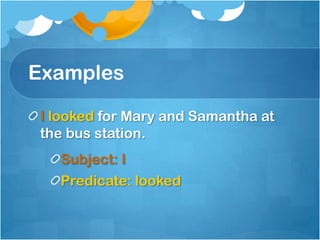
I looked for Mary and Samantha at
the bus station.
  Subject: I
  Predicate: looked
Compound Sentences
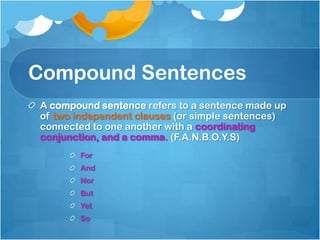
A compound sentence refers to a sentence made up
of two independent clauses (or simple sentences)
connected to one another with a coordinating
conjunction, and a comma. (F.A.N.B.O.Y.S)
       For
       And
       Nor
       But
       Yet
       So
Compound Sentences

    Coordinating conjunctions go
    with compound sentences!!!!!

• FANBOYS are examples of coordinating conjunctions.
Examples

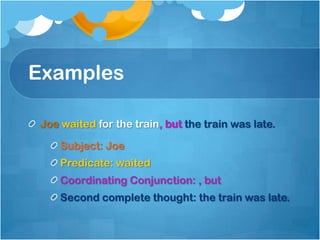
Joe waited for the train, but the train was late.

    Subject: Joe
    Predicate: waited
    Coordinating Conjunction: , but
    Second complete thought: the train was late.
Examples
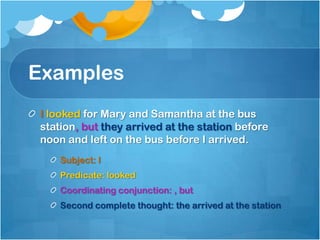
I looked for Mary and Samantha at the bus
station, but they arrived at the station before
noon and left on the bus before I arrived.
    Subject: I
    Predicate: looked
    Coordinating conjunction: , but
    Second complete thought: the arrived at the station
Complex Sentences

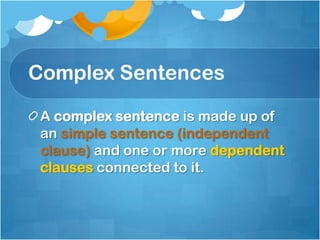
 A complex sentence is made up of
 an simple sentence (independent
 clause) and one or more dependent
 clauses connected to it.
Complex Sentences
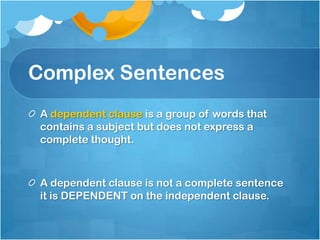
 A dependent clause is a group of words that
 contains a subject but does not express a
 complete thought.


 A dependent clause is not a complete sentence
 it is DEPENDENT on the independent clause.
Examples of Dependent
Clauses
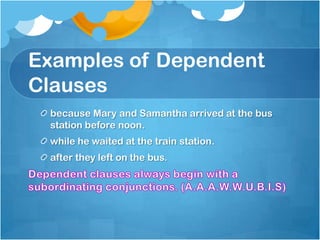
 because Mary and Samantha arrived at the bus
 station before noon.
 while he waited at the train station.
 after they left on the bus.
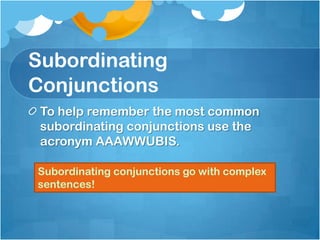
Subordinating
Conjunctions
 To help remember the most common
 subordinating conjunctions use the
 acronym AAAWWUBIS.

Subordinating conjunctions go with complex
sentences!
After

Although

As

When

While

Until

Because

If

Since
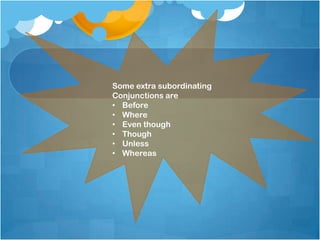
Some extra subordinating
Conjunctions are
• Before
• Where
• Even though
• Though
• Unless
• Whereas
Examples
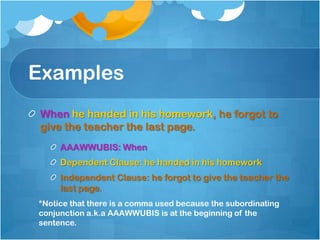
When he handed in his homework, he forgot to
give the teacher the last page.
     AAAWWUBIS: When
     Dependent Clause: he handed in his homework
     Independent Clause: he forgot to give the teacher the
     last page.
*Notice that there is a comma used because the subordinating
conjunction a.k.a AAAWWUBIS is at the beginning of the
sentence.
Examples
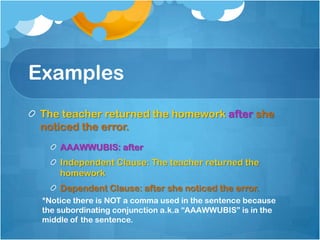
The teacher returned the homework after she
noticed the error.
     AAAWWUBIS: after
     Independent Clause: The teacher returned the
     homework
     Dependent Clause: after she noticed the error.
 *Notice there is NOT a comma used in the sentence because
 the subordinating conjunction a.k.a “AAAWWUBIS” is in the
 middle of the sentence.
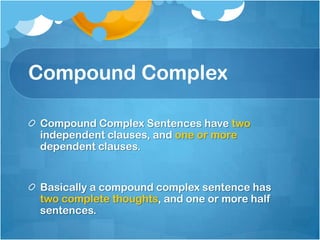
Compound Complex

Compound Complex Sentences have two
independent clauses, and one or more
dependent clauses.


Basically a compound complex sentence has
two complete thoughts, and one or more half
sentences.
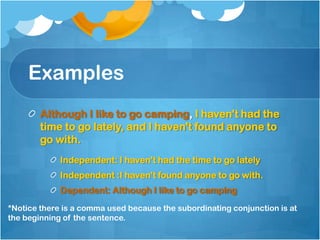
Examples
        Although I like to go camping, I haven't had the
        time to go lately, and I haven't found anyone to
        go with.
             Independent: I haven't had the time to go lately
             Independent :I haven't found anyone to go with.
             Dependent: Although I like to go camping
*Notice there is a comma used because the subordinating conjunction is at
the beginning of the sentence.
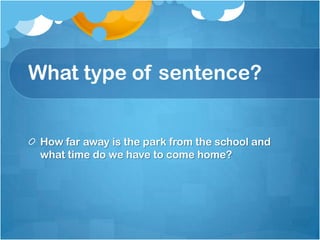
What type of sentence?


 How far away is the park from the school and
 what time do we have to come home?
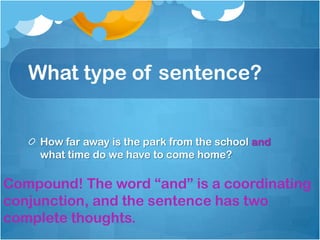
What type of sentence?


     How far away is the park from the school and
     what time do we have to come home?

Compound! The word “and” is a coordinating
conjunction, and the sentence has two
complete thoughts.
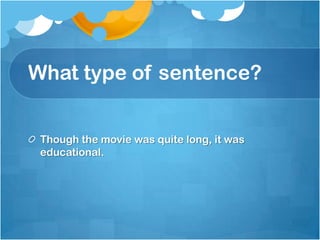
What type of sentence?


 Though the movie was quite long, it was
 educational.
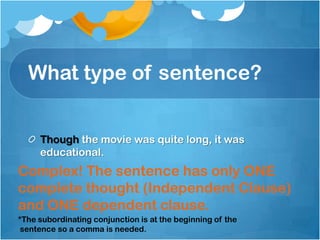
What type of sentence?


     Though the movie was quite long, it was
     educational.
Complex! The sentence has only ONE
complete thought (Independent Clause)
and ONE dependent clause.
*The subordinating conjunction is at the beginning of the
 sentence so a comma is needed.
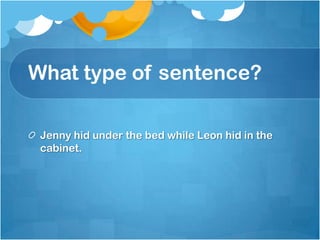
What type of sentence?

 Jenny hid under the bed while Leon hid in the
 cabinet.
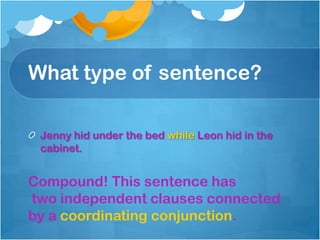
What type of sentence?

 Jenny hid under the bed while Leon hid in the
 cabinet.


Compound! This sentence has
two independent clauses connected
by a coordinating conjunction.
What type of sentence?


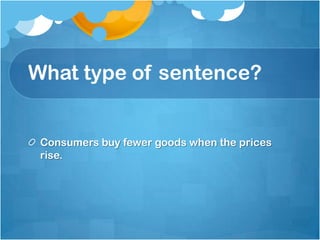
 Consumers buy fewer goods when the prices
 rise.
What type of sentence?


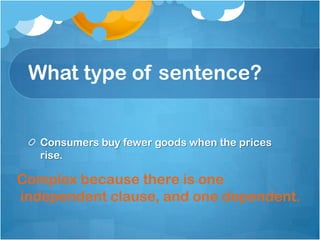
   Consumers buy fewer goods when the prices
   rise.

Complex because there is one
independent clause, and one dependent.
What type of sentence?


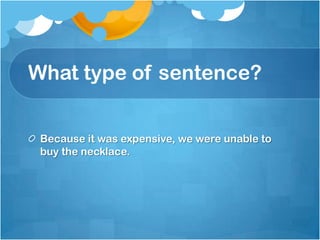
 Because it was expensive, we were unable to
 buy the necklace.
What type of sentence?


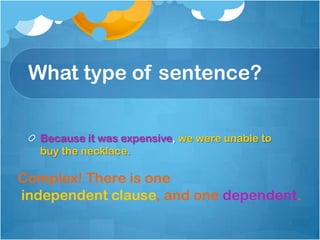
   Because it was expensive, we were unable to
   buy the necklace.

Complex! There is one
independent clause, and one dependent.
Game!
http://www.quia.com/rr/126726.html

Types of sentences group project

  • 2.
  • 3.
    Simple Sentences Asimple sentence has the most basic elements needed to create a complete thought. Subject Predicate
  • 4.
    Simple Sentences Asimple sentence can also be referred to as an independent clause. It is "independent" because, while it might be part of a compound or complex sentence, it can also stand by itself.
  • 5.
    Examples Joe waited forthe train. Subject: Joe Predicate: waited for the train.
  • 6.
    Examples I looked forMary and Samantha at the bus station. Subject: I Predicate: looked
  • 7.
    Compound Sentences A compoundsentence refers to a sentence made up of two independent clauses (or simple sentences) connected to one another with a coordinating conjunction, and a comma. (F.A.N.B.O.Y.S) For And Nor But Yet So
  • 8.
    Compound Sentences Coordinating conjunctions go with compound sentences!!!!! • FANBOYS are examples of coordinating conjunctions.
  • 9.
    Examples Joe waited forthe train, but the train was late. Subject: Joe Predicate: waited Coordinating Conjunction: , but Second complete thought: the train was late.
  • 10.
    Examples I looked forMary and Samantha at the bus station, but they arrived at the station before noon and left on the bus before I arrived. Subject: I Predicate: looked Coordinating conjunction: , but Second complete thought: the arrived at the station
  • 11.
    Complex Sentences Acomplex sentence is made up of an simple sentence (independent clause) and one or more dependent clauses connected to it.
  • 12.
    Complex Sentences Adependent clause is a group of words that contains a subject but does not express a complete thought. A dependent clause is not a complete sentence it is DEPENDENT on the independent clause.
  • 13.
    Examples of Dependent Clauses because Mary and Samantha arrived at the bus station before noon. while he waited at the train station. after they left on the bus.
  • 14.
    Subordinating Conjunctions To helpremember the most common subordinating conjunctions use the acronym AAAWWUBIS. Subordinating conjunctions go with complex sentences!
  • 15.
  • 16.
    Some extra subordinating Conjunctionsare • Before • Where • Even though • Though • Unless • Whereas
  • 17.
    Examples When he handedin his homework, he forgot to give the teacher the last page. AAAWWUBIS: When Dependent Clause: he handed in his homework Independent Clause: he forgot to give the teacher the last page. *Notice that there is a comma used because the subordinating conjunction a.k.a AAAWWUBIS is at the beginning of the sentence.
  • 18.
    Examples The teacher returnedthe homework after she noticed the error. AAAWWUBIS: after Independent Clause: The teacher returned the homework Dependent Clause: after she noticed the error. *Notice there is NOT a comma used in the sentence because the subordinating conjunction a.k.a “AAAWWUBIS” is in the middle of the sentence.
  • 19.
    Compound Complex Compound ComplexSentences have two independent clauses, and one or more dependent clauses. Basically a compound complex sentence has two complete thoughts, and one or more half sentences.
  • 20.
    Examples Although I like to go camping, I haven't had the time to go lately, and I haven't found anyone to go with. Independent: I haven't had the time to go lately Independent :I haven't found anyone to go with. Dependent: Although I like to go camping *Notice there is a comma used because the subordinating conjunction is at the beginning of the sentence.
  • 21.
    What type ofsentence? How far away is the park from the school and what time do we have to come home?
  • 22.
    What type ofsentence? How far away is the park from the school and what time do we have to come home? Compound! The word “and” is a coordinating conjunction, and the sentence has two complete thoughts.
  • 23.
    What type ofsentence? Though the movie was quite long, it was educational.
  • 24.
    What type ofsentence? Though the movie was quite long, it was educational. Complex! The sentence has only ONE complete thought (Independent Clause) and ONE dependent clause. *The subordinating conjunction is at the beginning of the sentence so a comma is needed.
  • 25.
    What type ofsentence? Jenny hid under the bed while Leon hid in the cabinet.
  • 26.
    What type ofsentence? Jenny hid under the bed while Leon hid in the cabinet. Compound! This sentence has two independent clauses connected by a coordinating conjunction.
  • 27.
    What type ofsentence? Consumers buy fewer goods when the prices rise.
  • 28.
    What type ofsentence? Consumers buy fewer goods when the prices rise. Complex because there is one independent clause, and one dependent.
  • 29.
    What type ofsentence? Because it was expensive, we were unable to buy the necklace.
  • 30.
    What type ofsentence? Because it was expensive, we were unable to buy the necklace. Complex! There is one independent clause, and one dependent.
  • 31.